Home / Blog / Materials & Construction
Colour Fastness in Saltwater
Colour fastness is a numbered result, not an opinion: on the ISO grey scale a 5 means no visible change and a 1 means severe change. In marine use the combination that does the damage is salt crystals plus ultraviolet light plus heat, and accelerated testing shows a mid-tone 420D polyester losing 1.5 to 2 grey scale points after 300 hours of cyclic salt spray and UV, while a solution-dyed black loses under half a point.
This guide explains what the ratings mean, why seawater is harsher than freshwater, which colour families survive a season on a boat, and how to read a test report before you commit to a colourway. It also covers the two different failure paths, pigment bleed versus surface print loss, and the care habits that slow both down.
- What colour fastness actually measures
- Why saltwater is harsher than freshwater
- The rating scales and what a point is worth
- Pigment in the film versus print on the surface
- Which colourways survive a marine season
- Chlorine, sunscreen and the other colour killers
- Test methods you should see on a report
- How film chemistry affects colour stability
- Reading a colour fastness report before you commit
- Specifying colour fastness for a branded range
- Care habits that slow fading
- Colour and fabric choices that work together
- Colour fastness checklist
What colour fastness actually measures
Colour fastness describes how well a material keeps its colour when it is exposed to something: light, water, rubbing, sweat, chlorine or seawater. Each exposure has its own test method and its own scale, so a single number without a method attached is meaningless. The two scales you will meet on bag fabric are the grey scale for colour change, rated 1 to 5, and the blue wool reference scale for light fastness, rated 1 to 8.
The grey scale works by comparison. A technician exposes a sample, then places it beside a standard grey pair of chips under controlled light and assigns the rating that matches the observed contrast. Half steps are allowed, so 4-5 is a real result and means the change is slight but detectable by a trained eye. Ratings of 4 and above are generally considered acceptable for outdoor product.
Blue wool works differently: eight dyed wool strips of known light sensitivity are exposed alongside the sample, and the sample is rated by which strip faded to the same degree. A rating of 6 means the sample performed like wool strip 6, which is useful for comparing fabrics but harder to translate into a number of seasons in the sun.
Why saltwater is harsher than freshwater
Freshwater mostly tests whether a dye is water soluble. Seawater adds three things at once: dissolved chloride at about 35 grams per litre, a mildly alkaline pH near 8.1, and, once the water evaporates, crystals that grow inside the weave and between the film and the face fabric. Those crystals are the real problem, because sodium chloride expands as it crystallises and mechanically lifts dye and finish off the fibre surface.
Salt also changes how the surface behaves optically. A dried salt film scatters light, which makes a faded panel look chalkier than the same panel faded in a lake, and it holds moisture against the fabric overnight. That extended damp time matters for hydrolysis in some coatings and for any dye that is only marginally fixed.
Then there is abrasion. On a boat, a salt-crusted bag is dragged across a deck, shoved into a hatch and rubbed against a wet life jacket. Each contact drives crystals into the surface. A fabric that scores well in a static soak can still lose colour quickly in real use, which is why combined cyclic testing is closer to the truth than any single test.
| Exposure | Typical test condition | Common failure mode | Rating seen on mid-tone polyester | Rating seen on solution-dyed black |
|---|---|---|---|---|
| Still seawater soak | 35 g/L NaCl, 24 h, 23 °C | Dye bleed into solution | 4-5 | 5 |
| Cyclic salt spray | 5% NaCl, 35 °C, 300 h | Chalking and lightening | 3 | 4-5 |
| Salt spray plus UV | 4 h spray, 4 h UV, 500 h | Severe fading at fold lines | 2-3 | 4 |
| Xenon arc light only | 0.55 W/m2 at 420 nm, 200 h | Uniform fading | 3-4 | 4-5 |
| Wet rubbing after salt | 10 cycles, 9 N load | Colour transfer to a cloth | 3-4 | 5 |
The rating scales and what a point is worth
A single grey scale point is a large difference, not a small one. The scale is roughly logarithmic in perceived contrast: the jump from 4 to 3 is obvious to an untrained eye at arm length, while 4-5 versus 4 is a difference most buyers would never notice side by side. That is why a spec that asks for 4 after 300 hours is far more demanding than one that asks for 3-4.
Commercial practice usually sets acceptance at 4 for colour change and 3-4 for colour transfer to a rubbing cloth. Transfer is judged separately because a fabric can keep its own colour reasonably well and still rub off onto a light-coloured shirt or a boat cushion, which generates complaints even when the bag itself looks fine.
| Grey scale rating | What it means | Visible to a buyer | Typical commercial acceptance |
|---|---|---|---|
| 5 | No change | Not detectable | Target for premium ranges |
| 4-5 | Slight change | Only side by side | Pass |
| 4 | Perceptible change | Noticeable when compared | Standard pass level |
| 3-4 | Moderate change | Obvious in good light | Pass for rubbing only |
| 3 | Appreciable change | Clear at a glance | Usually a fail |
| 1-2 | Severe change | Unsaleable | Fail |
When you compare two fabrics, compare at the same exposure duration. A 4 after 100 hours and a 4 after 500 hours are not the same product, and a report that omits the duration tells you very little. Colour measurement instruments help here: a spectrophotometer returns a delta E value, and a delta E of 1.0 is roughly the threshold of visible difference for a saturated colour.
Pigment in the film versus print on the surface
Waterproof bag fabric fails in two distinct ways, and telling them apart saves a lot of argument. The first path is the body colour: pigment dispersed in the TPU film or dye in the face fabric, which fades gradually and evenly. The second path is any printed layer sitting on top of the film, which can flake, crack or rub away entirely while the body colour underneath is unchanged.
Pigmented film is the more durable route for marine use because the colour runs through the thickness of the layer rather than sitting on it. A 0.5 mm film with pigment through its depth can lose surface gloss and still read as the same colour. A surface print on the same film can lose its sharp edges after 200 hours of salt spray and abrasion.
Prints are not automatically a bad choice. A print protected under a clear film, or a heat transfer that bonds into the surface rather than sitting on it, performs far better than an unprotected screen layer. The question to ask is where the colour sits relative to the wear surface, and the answer determines whether a printed panel survives a season on a deck.

Which colourways survive a marine season
Colour chemistry is not equally forgiving across the spectrum. Dark saturated shades hold longer because there is more pigment per unit area, so a given amount of surface loss removes a smaller share of the visual density. Bright mid-tones, particularly reds, oranges and some blues, use dye systems that are more light sensitive and show fading sooner.
| Colourway | Marine behaviour | Typical grey scale after 500 h | Notes |
|---|---|---|---|
| Black | Best of the range | 4-5 | Highest pigment load, hides chalking |
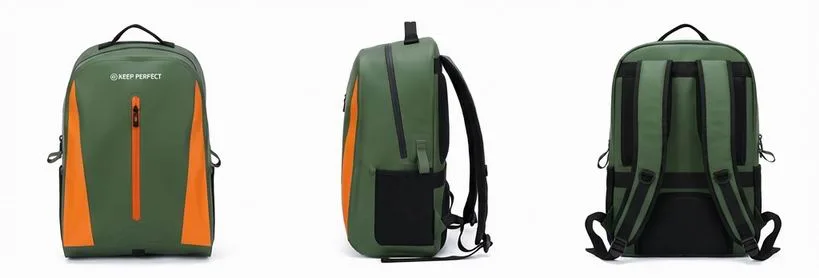
| Olive and khaki | Very good | 4 | Earth pigments are stable |
| Camo print | Good body, print wears first | 4 body, 3 print | Edges of the pattern fade first |
| Navy and deep blue | Good | 4 | Watch for red-shift as it fades |
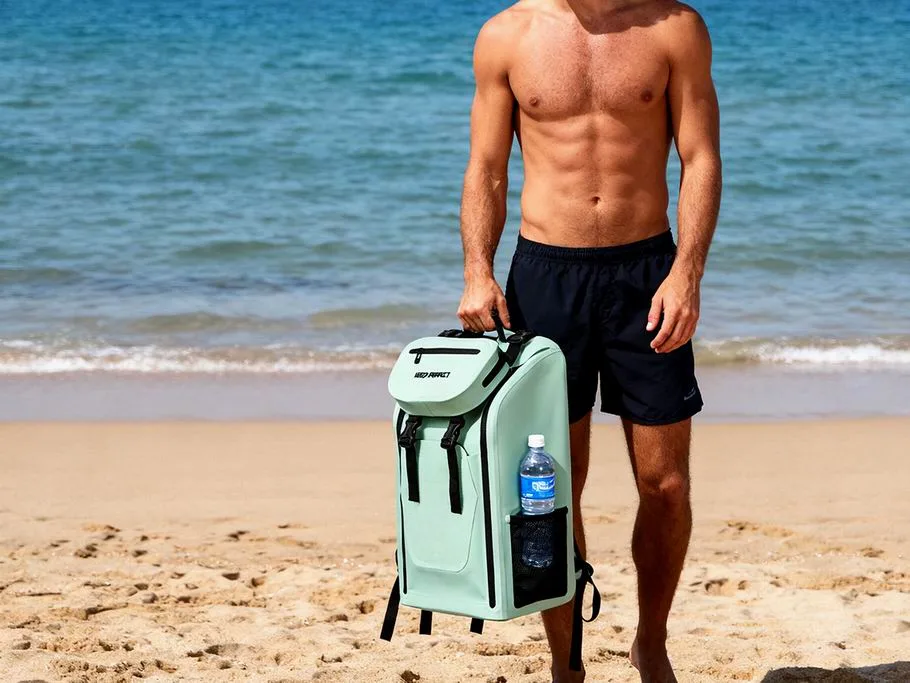
| Mint and pale green | Moderate | 3-4 | Light tones show chalking clearly |
| Pink and coral | Fair | 3 | Red component is the weak link |
| Orange and bright yellow | Poorest | 2-3 | Use only where high visibility is required |
That table describes appearance, not waterproofing. A faded bag still keeps water out, so choosing a brighter colour is a legitimate trade when visibility matters more than looks: a safety orange bag that has gone pale after two seasons is still doing its job on a rescue boat. The point is to enter the trade with open eyes and set an expectation with the buyer.
There is also a heat argument. A black bag on a tropical deck can reach 60 to 65 °C surface temperature in direct sun, against 45 °C for a pale mint bag of the same construction. That extra heat ages the film as well as the colour, so the darkest colourway is not automatically the longest-lived product even though it looks the best for longest.
Chlorine, sunscreen and the other colour killers
Pools are worse than the sea for colour. Free chlorine at 1 to 3 mg per litre is a strong oxidising agent and attacks dye systems directly, and pool water is usually warmer, which speeds every reaction. A bag that lives at a poolside or in an aquapark bag drop will typically fade faster than the same bag used in saltwater.
Sunscreen is the overlooked one. Many formulations contain avobenzone and oxybenzone, and some contain DEET in combination products; these solvents can lift print and plasticise a film surface on contact. Wipe the outside of a bag with fresh water after a day at the beach, and keep sunscreen bottles inside a pouch rather than loose against the fabric.
Other common offenders are insect repellent, fish blood and bait oils, and diesel or petrol fumes in a boat locker. Each of these either solvates the surface or stains it chemically. None of them is covered by a standard colour fastness test, which is why a realistic care note on the product is worth more than another test report.
Test methods you should see on a report
A credible colour fastness report names the standard, the exposure, the duration and the rating scale. Textile colour fastness methods are published by the ISO in the ISO 105 series, which covers light, water, seawater, rubbing and perspiration as separate parts. Corrosion and salt spray practice is documented by ASTM International.
| Test | What it exposes the fabric to | Typical duration | Result reported as | Practical reading |
|---|---|---|---|---|
| Colour fastness to light | Xenon arc, controlled irradiance | 100-500 h | Blue wool 1-8 | Sun fading in service |
| Colour fastness to water | Immersion in distilled water | 4 h at 23 °C | Grey scale 1-5 | Baseline dye fixation |
| Colour fastness to seawater | Immersion in 30 g/L NaCl | 4 h at 23 °C | Grey scale 1-5 | Bleed risk on first use |
| Salt spray cyclic | 5% NaCl fog at 35 °C | 96-500 h | Grey scale plus visual | Marine realism |
| Rubbing, wet and dry | Crockmeter, 10 cycles | Seconds | Grey scale 1-5 | Transfer to clothing |
One limitation is worth stating plainly: laboratory light sources are not sunlight. A xenon arc filtered to match daylight is close, but real service adds thermal cycling, salt crystal growth and abrasion that no single standard reproduces. Treat a good laboratory result as necessary rather than sufficient, and ask for cyclic testing when the product will live on the water.
How film chemistry affects colour stability
The polymer carrying the colour matters as much as the colour itself. TPU is generally friendlier to pigment stability than PVC, partly because PVC formulations rely on heat stabilisers and plasticisers that can migrate to the surface and carry dye with them. That migration is also what makes older PVC bags feel tacky and look blotchy.
UV absorber packages change the outcome substantially. A hindered amine light stabiliser plus a UV absorber added to the film can double the time to a visible fade, at a cost of a few percent on the material bill. On a bag with a five-year expected life, that is one of the cheapest durability upgrades available; the mechanisms are set out in more detail in our UV-stabilised fabric guide.
Film thickness interacts with this too. A 0.5 mm film has more pigment depth than a 0.3 mm film of the same formulation, so surface loss has to go further before the colour visibly changes. This is one of several reasons thicker film performs better outdoors, alongside puncture resistance and abrasion life.
Reading a colour fastness report before you commit
Work through a report in a fixed order. Check the identification first: is the sample the same fabric, colour and finish as the production bag, or an early lab dip? Then check the exposure and duration. Then check the rating scale, because a blue wool 6 and a grey scale 4 are not comparable numbers. Only then look at the result itself.
Ask for the delta E numbers alongside the grey scale. A grey scale rating compresses a lot of information into one step, while a spectrophotometer gives you the direction of the change as well as the size. A sample that has gone slightly darker reads differently from one that has gone pale and chalky, even if both land on the same grey scale step.
Finally, ask what the control was tested against. Rubbing results in particular depend on the companion fabric: cotton lawn, wet or dry, and the load applied. A 3-4 result against abrasive wet cotton is a different proposition from 3-4 against a dry smooth cloth, and the report should say which was used.
Specifying colour fastness for a branded range
For a retail or programme range, write the colour requirement into the specification rather than relying on a sample approval. A useful line reads: body colour to reach grey scale 4 minimum after 300 hours cyclic salt spray with UV, and rubbing to reach 3-4 wet. That is a testable requirement, and it gives a production partner something to verify before shipping.
Approved reference samples still matter. Keep a signed retained sample from the approval round, stored in a dark drawer, and compare production against it under the same light. Fading arguments are much easier to settle with a physical reference in hand than with a description in an email thread.
Our production programme has run waterproof bag projects since 2014 in an SGS-verified 4,950 m2 facility, with 7 production lines, 149 machines and 200,000 pieces of monthly output, and colour approval is a standard step in that flow. Minimum order is 500 pieces, sampling takes 6 to 10 working days and bulk runs 35 to 50 days FOB Xiamen.We hold retained colour standards for every programme so reorders match the original shade.
Care habits that slow fading
- Rinse with fresh water after every saltwater day; focus on the closure fold and the printed panels.
- Dry in shade with the mouth open; never dry a wet bag on a hot deck or a dashboard.
- Wipe sunscreen and insect repellent off the outside as soon as you notice it.
- Store out of direct sun, loosely rolled, away from diesel fumes and bait.
- Re-rinse pool bags within an hour; chlorine keeps working while the fabric is damp.
Rinsing is the single most effective habit, and it works for a mechanical reason rather than a cosmetic one: you are removing crystals before they grow. A bag rinsed within two hours of a saltwater trip looks noticeably better after a season than the same bag rinsed the following weekend, and the difference widens with every trip.
Store colour-critical bags away from windows. A bag on a shelf in direct sun receives meaningful ultraviolet dose every day of the year, and that dose accumulates even when the bag is not in use. Off-season storage guidance is in rinsing saltwater off dry bags, which also covers hardware corrosion that runs alongside colour loss.
Colour and fabric choices that work together
Colour decisions and fabric decisions are the same decision made twice. A solution-dyed face fabric under a pigmented TPU film gives the best marine result available at a sensible price, because both layers carry their colour in depth rather than on the surface. A piece-dyed face under a clear film is the more fragile combination.
There is a sustainability angle as well. Solution dyeing uses less water and energy than piece dyeing, and a colour that lasts longer means a bag that is replaced less often. See eco-friendly dry bag options and the material comparison in TPU versus PVC, which explains why PVC migration makes colour loss worse over time.
For a range with several colourways, expect different lives. The colour range guide covers how to balance a range so the fragile shades are not the ones carrying the highest volume. The practical rule: put your volume in the stable shades, keep the bright ones as accents, and specify a test level that every shade can actually reach.
Colour fastness checklist
- Ask for the method and the duration, not just the rating.
- Set acceptance at grey scale 4 for colour change and 3-4 for wet rubbing.
- Prefer pigment carried in the film over any colour printed on the surface.
- Choose solution-dyed face fabric where the budget allows.
- Add a UV absorber package to the film for bags that live outdoors.
- Keep a retained approval sample in the dark for comparison at reorder.
Worked example: a resort programme wanted a coral 10L bag for a fleet of 300. Laboratory testing put coral at grey scale 3 after 300 hours of cyclic salt spray, which would have looked tired halfway through a season. Switching the body to a stable navy with a coral printed side panel held the brand look and lifted the body rating to 4, with the print treated as a replaceable accent.
The same logic applies to hardware and trim. A faded bag with bright anodised hardware looks worse than a faded bag with matching hardware, so specify the finish alongside the fabric; see hardware corrosion resistance. Current fabric and colourway options are listed under products, and all marine fabrics are tested to the levels described above.
Frequently asked questions
Q1. What is colour fastness in saltwater?
Colour fastness in saltwater is a measured rating of how well a fabric keeps its colour after exposure to salt, light and rubbing. Most bag fabric is rated on the ISO grey scale from 5, no change, down to 1, severe change, after a defined test duration.
Q2. Does saltwater fade dry bags faster than freshwater?
Yes. Seawater adds chloride at about 35 grams per litre, alkaline pH near 8.1, and salt crystals that grow in the weave as the bag dries. Those crystals lift dye mechanically and hold moisture against the fabric overnight.
Q3. What grey scale rating should I ask for?
Ask for 4 minimum for colour change after a defined exposure, and 3-4 for wet rubbing. Ratings of 3 and below are usually treated as a fail for outdoor product, because the change is obvious at a glance.
Q4. Which dry bag colours last longest at sea?
Black, olive and navy hold best, typically reaching grey scale 4 or better after 500 hours of cyclic exposure. Pink, coral, orange and bright yellow fade fastest because the red component of the dye system is the most light sensitive.
Q5. Is a faded dry bag still waterproof?
Almost always. Fading affects pigment in the surface layers, not the integrity of the film or the welded seams. A pale bag keeps water out as well as a new one, so fading is a cosmetic issue unless the film has also gone chalky and stiff.
Q6. Does chlorine damage bag colour more than salt?
Yes, typically. Free chlorine at 1 to 3 mg per litre oxidises dye directly, and pool water is usually warmer. A bag used daily at a pool fades faster than the same bag used in the sea.
Q7. Can sunscreen damage a dry bag?
It can. Solvents in some sunscreen and repellent formulations lift print and soften the film surface. Wipe the outside of the bag with fresh water at the end of the day and store bottles in a pouch rather than loose against the fabric.
Q8. What is the difference between grey scale and blue wool ratings?
The grey scale, 1 to 5, rates how much the sample itself has changed. The blue wool scale, 1 to 8, rates light fastness by comparing the sample against eight reference strips of known sensitivity. They are not interchangeable numbers.
Q9. How long should a colour fastness test run?
For marine product, ask for 300 to 500 hours of cyclic salt spray combined with UV. A 100-hour light-only test is too short to predict a season on the water, and it misses salt crystal damage entirely.
Q10. Does thicker film hold colour better?
Yes. A 0.5 mm film carries more pigment depth than a 0.3 mm film of the same formulation, so surface loss has to go further before the colour visibly changes. Thicker film also resists abrasion better.
Q11. Why do printed panels fade before the body fabric?
Because print sits on the surface rather than in the depth of the material. Abrasion and ultraviolet reach it first, and edges of a pattern lose definition well before the body colour shifts.
Q12. Is TPU better than PVC for colour stability?
Generally yes. PVC relies on plasticisers and heat stabilisers that migrate to the surface and can carry dye with them, which produces blotching as well as fading. TPU has no plasticiser to migrate.
Q13. Can I stop a dry bag fading completely?
No. Any coloured material exposed to sun and salt changes eventually. Rinsing after use, drying in shade and storing out of direct sun typically double the time to a visible fade, which is the realistic goal.
Q14. What does a delta E value tell me?
Delta E is the measured size of a colour difference from an instrument rather than an eye. About 1.0 is the threshold of visible difference for a saturated colour, so a report with delta E alongside the grey scale tells you both the size and the direction of the change.
Q15. Do UV stabilisers help bag fabric?
Substantially. A UV absorber plus a hindered amine light stabiliser added to the film can roughly double the time to a visible fade, for a small increase in material cost. It is one of the cheapest durability upgrades available.
Q16. Should I avoid bright colours on a boat?
Not if visibility is the point. A safety orange bag that fades still does its job on a rescue boat. Choose bright shades deliberately, keep them as accents rather than the volume shades in a range, and set the expectation with the buyer.
People also ask
What is colour fastness to seawater?
It is a laboratory rating of how much a fabric changes after immersion in a salt solution, typically 30 grams per litre for four hours, judged on the ISO grey scale. It predicts bleed risk on first use rather than long-term fading.
How do you test colour fastness at home?
Compare a hidden area with an exposed one in daylight, and rub a damp white cloth over the surface ten times to check for transfer. Neither method gives a number, but both reveal change that is already past the acceptable point.
Do black dry bags fade in the sun?
They fade least of any colourway because of the high pigment load, typically reaching grey scale 4-5 after 500 hours. Black bags do run hotter though, around 60 °C surface temperature in tropical sun, which ages the film faster.
Why does my dry bag look chalky?
Chalking is salt residue plus degraded surface finish, not dye loss. Rinse with fresh water and wipe with a soft cloth; if the chalky look remains after rinsing, the film surface itself has degraded and will not recover.
Are printed dry bags less durable than plain ones?
Printed panels wear before the body fabric because the colour sits on the surface. A print protected under a clear film or bonded into the surface performs far better than an unprotected layer on top of the film.
Does rinsing a dry bag really protect the colour?
Yes, and it is the most effective single habit. Removing salt within two hours stops crystals growing in the weave, and the difference against a bag rinsed days later widens with every trip.
Need this in production volume?
QUANZHOU JUNYUAN BAGS has produced waterproof bags since 2014 in an SGS-verified 4,950 m2 facility in Fujian, China. Minimum order 500 pieces, sampling in 6–10 working days, bulk in 35–50 days, FOB Xiamen — write to service@junyuanbags.com with your spec and target market.