Home / Blog / Buying & Comparisons
Economy vs Premium Dry Bags
The gap between a 4.20 USD economy dry bag and a 34.00 USD premium one is four measurable things: film thickness at 0.28 mm versus 0.55 mm, laminate weight at 240 g/m² versus 520 g/m², a seam that is stitched and taped versus one that is radio-frequency welded, and hardware with no UV stabiliser versus acetal tested to 5,000 open-and-close cycles. Worked out per year of service, the economy bag costs 4.20 USD and lasts one season, while the premium bag costs 34.00 USD and lasts eight years, which puts both at roughly 4.20 USD a year.
That near-identical cost per year is the surprising part, and it is why the decision is not simply buy the expensive one. This guide breaks the two apart component by component, gives the failure mode that belongs to each price band, shows where premium spending is wasted and where economy spending is genuinely sensible, and ends with the listing checks that tell you which side of the line a particular bag sits on.
- The four things the price actually buys
- Film: 0.28 mm against 0.55 mm in the field
- Seams: welded versus stitched and taped
- Hardware: the component that fails first
- Closures: the one place economy catches up
- Chemical content and the odour test
- Colour fastness, UV and how a bag ages
- Cost per year: the number that reframes the choice
- Failure modes by price band
- When the economy bag is the right buy
- When premium is the right buy
- What each band looks like after two years
- Reading a listing: how to tell which band you are looking at
The four things the price actually buys
Strip the marketing away and a dry bag is a laminated shell, a closure, a seam and some hardware. Price moves with all four, but not evenly. Most of the difference in a cheap bag shows up in the film and the hardware, because those are the two items a buyer cannot see in a photograph, while the closure geometry and the weld width are where a mid-priced bag quietly catches up with an expensive one.
Film thickness is the clearest single indicator. An economy bag sits at 0.25 to 0.32 mm and is usually PVC or PEVA coated onto a 210D face; a premium bag runs 0.50 to 0.70 mm of TPU on 420D to 840D. The thicker film costs more per square metre, is heavier to ship, needs more energy to weld, and resists puncture roughly three times better. It is also the difference between a bag that survives a season of granite gravel and one that does not.
The second indicator is what the maker is willing to publish. A premium listing names the film, the denier, the weld width and the rating standard. An economy listing says waterproof and heavy duty. That asymmetry is not snobbery, it is simply that publishing a spec invites a test, and a bag built to be tested usually passes one.
| Component | Economy band | Mid band | Premium band | What it changes |
|---|---|---|---|---|
| Film | 0.25-0.32 mm PVC | 0.40 mm TPU | 0.55-0.70 mm TPU | Puncture and tear resistance |
| Laminate weight | 240 g/m² | 380 g/m² | 520 g/m² | Abrasion life and drape |
| Face fabric | 210D polyester | 420D nylon | 500-840D nylon | Scuff and locker damage |
| Seam | Stitched and taped | RF welded, 20 mm | RF welded, 28 mm | Where water enters first |
| Hardware | Generic acetal | Branded acetal | UV-stable POM, tested | Cold-weather cracking |
| Rating | Claimed | IPX6 tested | IPX7 plus cycle test | Whether the claim is checks |
Film: 0.28 mm against 0.55 mm in the field
Film thickness sounds like a small difference until you put a number on the failure. A 0.28 mm film punctures under a point load of roughly 25 N, which is what happens when a bag full of 4 kg of kit is dropped onto a sharp corner of a boat thwart. The same drop on a 0.55 mm film needs about 70 N. Neither bag tears in normal use; both tear when something sharp and heavy meets something hard at the right angle, and the thicker film simply moves that threshold further away.
Thickness also changes how the bag behaves at the fold. Thin film rolls easily and seals with two folds, which feels better in a shop, but it creases more sharply and a crease is where fatigue starts. Thicker film resists the first fold, which is why premium bags sometimes feel stiff to close, and then holds its shape for years. If you open and close a bag twice a day, the thicker film is the one that is still sealing in year five.
There is a real cost to thickness beyond money: weight. A 20L bag built at 0.55 mm weighs about 620 g empty against 380 g at 0.28 mm. On a kayak deck or a bike handlebar that 240 g is noticeable over a day, and for a bag that only ever sees light rain it is weight carried for no benefit. This is the first place where premium spending is genuinely wasted.
Seams: welded versus stitched and taped
The seam is where a dry bag fails, and the two constructions fail differently. A radio-frequency weld fuses two film layers into a continuous piece with no thread channel, so water has no path and the joint does not rely on an adhesive that can hydrolyse in a humid climate. A stitched seam with tape laid over it depends entirely on that tape; when the tape lifts at an end, water enters through the needle holes underneath and the bag is finished.
Weld width is the quality signal inside welded construction. A 20 mm weld is adequate for a bag that never carries load at the seam; a 28 mm weld spreads peel stress and survives being dragged over rock. Peel strength is measurable, and the honest numbers are worth knowing: 30 N per 50 mm on an economy weld, 70 N per 50 mm on a premium one. Standardised peel and hydrostatic methods are published by ISO and ASTM, and a maker who runs them will quote the method number.

| Seam type | Construction | Typical peel strength | Service life | Failure mode |
|---|---|---|---|---|
| Economy taped | Stitched, tape over thread | 18 N / 50 mm | 1 season | Tape lifts at the ends |
| Mid welded, narrow | RF weld at 20 mm | 40 N / 50 mm | 3-5 years | Peel under shock load |
| Premium welded, wide | RF weld at 28 mm | 70 N / 50 mm | 8-12 years | Fatigue at a sharp crease |
| Double welded | Two parallel welds | 95 N / 50 mm | 10+ years | Abrasion of the outer weld |
Hardware: the component that fails first
If you sort a year of warranty returns by cause, buckles win by a wide margin. An economy buckle is an unbranded acetal moulding with no UV stabiliser and no cold-weather specification; it is fine at 20 °C in a shop and it cracks at -5 °C on a December morning or after a summer on a boat deck. A premium buckle is a UV-stabilised POM part that has been cycled 5,000 times and is rated for a release force that stays consistent across a temperature range.
Webbing and D-rings follow the same pattern. Economy webbing is 20 mm wide with a loose weave that absorbs water and stays wet; premium webbing is 25 mm, tighter, and dries faster. Welded D-rings on a TPU shell take a lashing load without deforming, whereas a sewn loop on a coated bag is a hole plus a thread, and that is exactly the combination a seam failure needs. Our buckle and hardware notes go through the grades by part number.

Closures: the one place economy catches up
Closure geometry is the pleasant surprise in this comparison. A roll-top is a roll-top: three folds, a stiffened mouth, a buckle. A well-executed economy bag can have exactly the same closure as a premium one, because the cost is in the film piece and the moulding, both of which are cheap once the tooling exists. If a bag has a wide stiffened mouth, three clear fold lines and a buckle with a smooth release, it will seal as well as a bag costing five times more.
What economy closures lose is consistency rather than design. The fold allowance on a cheap bag is often narrower, so you get fewer usable litres and a stiffer roll, and the mouth stiffener can be a thin insert that creases instead of holding a line. Test it by closing the bag empty and pressing on the fold: it should hold a straight line with light pressure, not collapse.
Chemical content and the odour test
One difference is invisible on day one and obvious by month three: what is in the coating. Cheap PVC coatings can plasticise with short-chain chlorinated paraffins or phthalates, which migrate to the surface in warm storage and produce the smell that a new shower curtain has. Beyond the smell, some of those substances are restricted in the markets most readers buy in, and a bag that cannot clear a screening test is not a bargain at any price.
The practical check is simple and takes two minutes. Seal the bag empty, leave it in a warm room for 48 hours, then open it and smell the inside. A well-formulated TPU bag is close to odourless; a heavily plasticised PVC bag will have a distinct solvent note. Guidance on safer chemical choices in consumer products is published by the US EPA, and our phthalate-free options are specified from the film up rather than tested at the end.
Colour fastness, UV and how a bag ages
Premium bags cost more partly because of what is added to the film rather than how much film there is: UV absorbers, hindered amine light stabilisers and, in some grades, a topcoat that resists marking. Those additives are a small cost per square metre and they are the difference between a bag that is still supple after four summers and one that has gone chalky and stiff. In strong sun, an unstabilised PVC bag can lose 30% of its tensile strength within a single season.
Colour fastness is the visible half of the same story. A cheap dyed face fabric will fade unevenly and can rub off onto light clothing when wet, which is the complaint that arrives about four months into ownership. Ask for a colour-fastness rating to rubbing and to light; both are cheap tests and both are routinely run on premium programmes. If a maker cannot produce either, assume the worst and choose a dark colourway where fading shows less.
Cost per year: the number that reframes the choice
Sticker price is the wrong metric for a bag that is used hard. Divide by expected years of service and the three bands land surprisingly close together, because an economy bag that lasts one season has to be bought every year while a premium bag is bought once a decade. The spread narrows further once you count the value of not discovering a failed seal at the moment you needed it.
The table below assumes weekend use, roughly 30 uses a year, with normal care: rinsed after salt exposure, dried in shade, stored loose. Change those assumptions and the ranking changes. A premium bag left full of damp kit in a garage will not reach eight years, and an economy bag used twice a year for a beach day may well reach five.
| Band and size | Price | Expected uses | Service life | Cost per year | Per 100 uses |
|---|---|---|---|---|---|
| Economy 10 L PVC | 4.20 USD | 30 | 1 year | 4.20 USD | 14.00 USD |
| Mid 10 L TPU | 12.50 USD | 150 | 3 years | 4.17 USD | 8.33 USD |
| Premium 20 L TPU | 34.00 USD | 400 | 8 years | 4.25 USD | 8.50 USD |
| Heavy duty 40 L | 52.00 USD | 500 | 10 years | 5.20 USD | 10.40 USD |
| Marine grade 60 L | 68.00 USD | 700 | 12 years | 5.67 USD | 9.71 USD |
Read that table carefully, because the honest conclusion is not the one either side of the argument expects. The mid band is the best value per year in almost every scenario, and the premium band is not bought for value: it is bought when failure is expensive. If a wet sleeping bag means a cold night, or a wet camera means a lost commission, the premium bag is insurance, and insurance is priced for the tail risk rather than the average.

Failure modes by price band
Each band fails in its own way, and knowing the pattern tells you what to inspect before a trip. Economy bags fail at the seam tape ends and at the buckle. Mid bags fail at a crease after several years, usually near a corner where the film has been folded the same way hundreds of times. Premium bags rarely fail at all in normal use, and when they do it is usually abuse: a puncture from a sharp tool, or damage from being machine washed.
There is a fourth failure that crosses every band and is entirely the user's: a closure rolled over sand, grit or a fold in the fabric. It causes more wet sleeping bags than any seam defect in any price band, and the fix costs nothing. Rinse the fold line before you roll it and run a thumb along it to check for grit; that single habit matters more than the 30 USD difference between two bags.
When the economy bag is the right buy
Economy is genuinely correct in four situations. First, when the bag is a consumable: a festival, a one-week holiday, a school trip that ends with the bag being left behind. Second, when the exposure is light and predictable, such as a gym bag that meets rain between a car and a door. Third, when you need several sizes for organisation and would rather buy five cheap bags than one expensive one. Fourth, when the bag is a backup or a liner inside another bag.
It is also the right buy when you are still learning what you need. Buying a 4.20 USD 10L bag, using it for a season and discovering that you actually wanted a 20L with a harness is a much cheaper education than buying the wrong premium bag. Upgrade once you know your real pattern of use, and keep the economy bag as the liner.
When premium is the right buy
Premium is correct when the consequence of failure is expensive or when access to a replacement is impossible. A bag carrying a camera body and two lenses on a remote trip, a bag holding medication on a multi-day paddle, a bag that lives on a saltwater boat for years: in each of these the cost of a failure dwarfs the price difference. It is also correct when the bag is used more than 50 times a year, because that is where fatigue life becomes the binding constraint.
Premium is also the correct buy for cold. Below freezing, a stiff film is hard to roll and an unstabilised buckle is brittle; the gap between bands widens dramatically at -10 °C. If your season runs through winter, the film and the hardware grade are worth paying for, and the difference is obvious the first time you close a bag with numb hands.
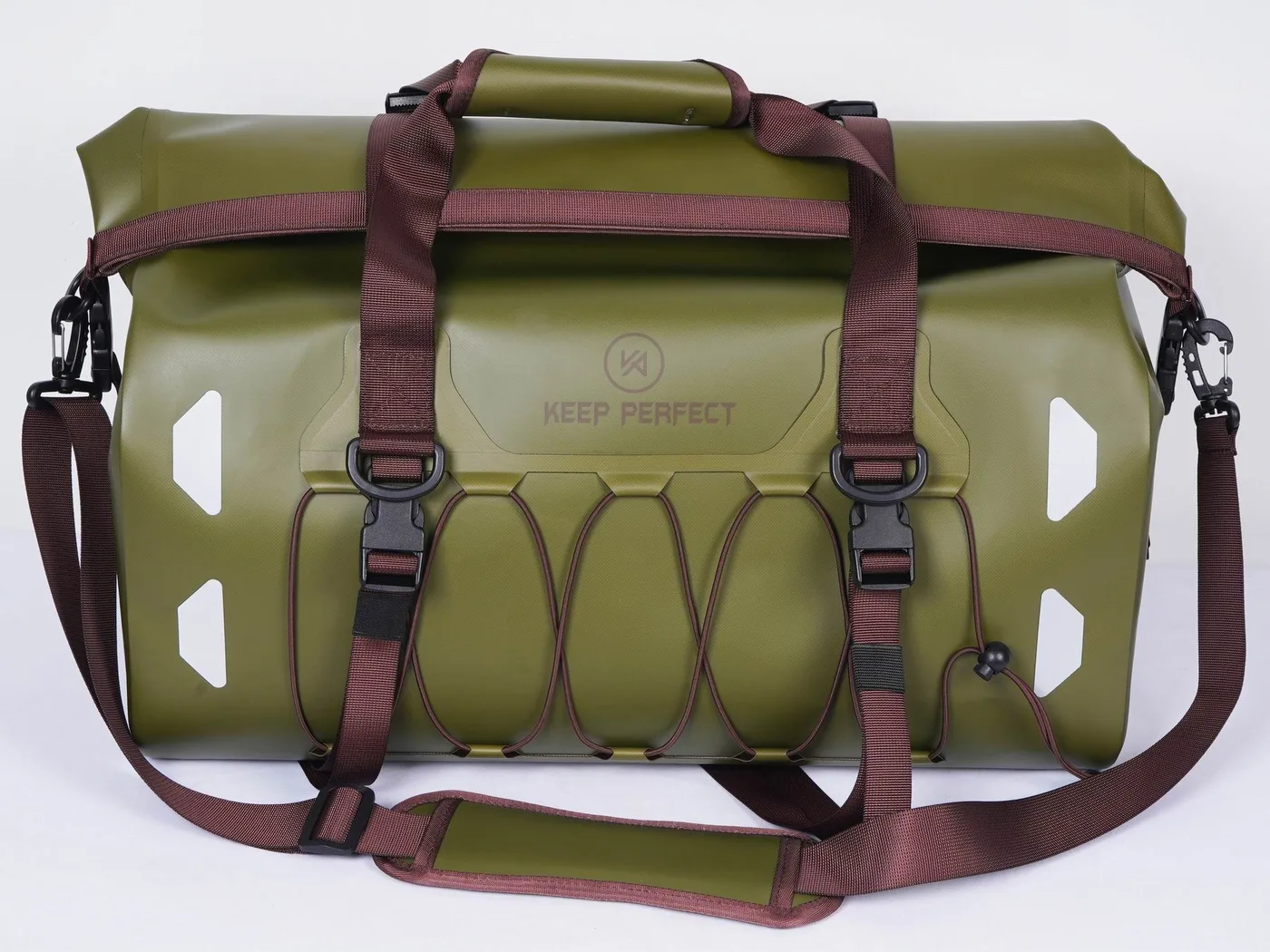
What each band looks like after two years
Ageing is where the price bands separate visibly, and it is the one comparison nobody can do in a shop. Put an economy bag and a premium bag on the same boat for two summers, rinse both the same way, and the difference is measurable rather than a matter of opinion. The economy shell has stiffened, the colour has shifted, and the buckle takes noticeably more force to release because the moulding has worn.
Two numbers capture most of it. Tensile retention after UV exposure falls to about 70% on an unstabilised PVC film in a single season and still sits above 90% on a UV-stabilised TPU film after two years. Buckle release force drifts by 15 to 25% on a generic moulding as the contact surfaces wear, while a tested part stays within 5%. Both are the kind of degradation you only notice when the bag is cold, wet and you are in a hurry.
| Measure after 2 years | Economy | Mid | Premium | How to check at home |
|---|---|---|---|---|
| Tensile retention | 70% | 85% | 92% | Stretch a corner and look for whitening |
| Fold flexibility | Stiff, creased | Supple | Supple | Roll empty and feel the resistance |
| Colour shift | Visible fade | Slight fade | Minimal | Compare an inside panel to the outside |
| Buckle force drift | +25% | +12% | +5% | Release ten times and feel for grit |
| Weld appearance | Tape lift at ends | Sound | Sound | Run a fingernail along the seam end |
| Odour after warm storage | Noticeable | Faint | None | Seal empty for 48 hours, then smell |
Reading a listing: how to tell which band you are looking at
- Look for film thickness in millimetres. If it is absent, assume 0.30 mm or less.
- Look for laminate weight in grams per square metre. Under 300 g/m² is economy.
- Look for the seam method. Welded beats taped; weld width in millimetres beats adjectives.
- Look for a named rating standard and grade, such as IPX7 under IEC 60529.
- Look at the hardware: webbing width, buckle branding, and whether D-rings are welded or sewn.
- Check the fold allowance in photographs; a narrow mouth costs usable litres.
- Search the listing for the word lining. A separate loose liner usually means a taped seam.
- Compare the published spec against the full product line before you buy.
Two of those eight checks will sort most listings in under a minute: film thickness and seam method. Everything else refines the answer. If a listing fails both, price it as an economy bag regardless of what it costs, because the components inside it are economy components.
Our own line has produced waterproof bags since 2014 in an SGS-verified 4,950 m2 facility in Fujian, with 137 staff across seven production lines and a monthly capacity of 200,000 pieces, so we build across all three bands and see the component costs directly. Sampling takes 6 to 10 working days and bulk runs 35 to 50 days at a 500-piece minimum, FOB Xiamen, with AQL 2.5 inspection; the production programme sets out how the bands differ on the bench.
Two comparisons close the decision. If you are weighing two sizes rather than two qualities, our light versus heavy duty guide maps fabric weight to activity. And if you have a specific number in mind, the price breakdown by component shows where each dollar goes, while the spec sheet guide covers the wording traps that make an economy bag read like a premium one.
Frequently asked questions
Q1. Is a premium dry bag worth the extra cost?
Yes when failure is expensive or use is frequent: over 50 uses a year, cold weather, saltwater boats, or anything carrying a camera or medication. For light, occasional use the mid band gives the best cost per year at about 4.17 USD.
Q2. What film thickness separates cheap from expensive?
Economy bags run 0.25 to 0.32 mm of PVC or PEVA, mid bags about 0.40 mm of TPU, and premium bags 0.55 to 0.70 mm. The thicker film resists puncture at roughly 70 N against 25 N and holds its fold for years.
Q3. Do cheap dry bags leak more?
Not initially. A well-made economy roll-top seals as well as a premium one; what differs is how long it keeps sealing. Cheap bags fail at the taped seam ends and at the buckle, usually within a season of hard use.
Q4. How long does an economy dry bag last?
About one season of weekend use, roughly 30 outings, before the seam tape lifts or the buckle cracks. With light use and shade storage an economy bag can last three to five years, but the film will have stiffened by then.
Q5. How long does a premium dry bag last?
Eight to twelve years of weekend use with normal care: rinsed after salt exposure, dried in shade, stored loose. The limiting factor is crease fatigue near the corners rather than the seam, which is the strongest part of the bag.
Q6. Are welded seams really better than taped?
Yes. A radio-frequency weld fuses the films into one continuous piece with no thread channel, at 40 to 70 N per 50 mm of peel strength. Taped seams rely on an adhesive that hydrolyses in humid conditions and lifts at the ends.
Q7. Why does my cheap dry bag smell?
Plasticiser migrating out of a PVC coating. Cheap formulations can use phthalates or short-chain chlorinated paraffins, which surface in warm storage. A well-formulated TPU bag is close to odourless after 48 hours sealed in a warm room.
Q8. Is TPU always better than PVC?
For a bag that is folded, squeezed or used in the cold, yes. PVC is acceptable for a bag that sits still in mild conditions, and it is cheaper per square metre. PVC softens above 35 °C and stiffens after sustained UV exposure.
Q9. What breaks first on a dry bag?
The buckle, accounting for the majority of first-year returns, followed by seam tape lift. Specify a UV-stabilised buckle and cycle it 200 times before a trip rather than trusting how it feels in a shop.
Q10. How much extra weight does a premium bag add?
About 240 g on a 20L: roughly 620 g empty at 0.55 mm against 380 g at 0.28 mm. That is worth carrying for abrasion resistance and fold life, and wasted weight if the bag only ever meets light rain.
Q11. When should I buy the cheapest bag?
When the bag is a consumable such as a festival or a one-week holiday, when exposure is light and predictable, when you need several sizes for organisation, or when the bag is a backup liner inside another bag.
Q12. Do premium bags need less care?
No. Crease damage, grit in the closure and UV exposure affect every band. A premium bag left full of damp kit in a garage will not reach eight years, and the habit that matters most is rinsing the fold line before rolling.
Q13. Can I tell the price band from a listing?
Yes, from film thickness and seam method. If the listing will not state millimetres or say welded rather than taped, price it as an economy bag regardless of what it costs, because the components inside are economy components.
Q14. Is a mid-priced bag the best value?
Usually. At 12.50 USD for a 10L TPU bag lasting three years, the cost per year is about 4.17 USD, marginally better than both economy and premium. Premium is bought for reliability in the tail cases, not for value.
Q15. Do expensive bags keep water out better in a capsize?
They hold a rating longer. A fresh economy bag can pass an IPX7 immersion test; the difference is that a premium bag still passes after years of creasing, UV and salt, which is what you are relying on in a real capsize.
Q16. Should I buy one premium bag or three cheap ones?
One premium bag for the load that must stay dry, and cheap bags for organisation inside it. Redundancy is cheap and worth more than a single expensive bag: a liner inside a waterproof pack turns a leak into an inconvenience.
People also ask
What is the difference between cheap and expensive dry bags?
Four measurable things: film at 0.28 mm against 0.55 mm, laminate at 240 against 520 g/m², stitched-and-taped seams against radio-frequency welded ones, and unbranded hardware against UV-stabilised parts tested to 5,000 cycles.
Are expensive dry bags worth it?
Yes if you use the bag more than 50 times a year, use it in the cold, or carry something expensive inside it. For occasional light use the mid band is better value at roughly 4.17 USD per year of service.
How long should a dry bag last?
An economy bag lasts about one season of weekend use, a mid-range TPU bag three to five years, and a premium welded bag eight to twelve years. Care shifts all three: shade drying and rinsing after salt use add years.
Do welded seams last longer than taped seams?
Yes. Welded seams measure 40 to 70 N per 50 mm of peel strength and have no thread channel for water, while taped seams depend on an adhesive that lifts at the ends, typically within one season of hard use.
Why do cheap dry bags smell of plastic?
Plasticiser migration from a PVC coating, often phthalates or short-chain chlorinated paraffins. It surfaces in warm storage. Seal the bag empty for 48 hours in a warm room and smell the inside before you buy another.
Can a cheap dry bag be as waterproof as an expensive one?
On day one, often yes, because closure geometry is cheap to copy. Over time, no: the economy bag loses its seal at the taped seam and the buckle, while a welded premium bag keeps its rating through years of creasing and UV.
Need this in production volume?
QUANZHOU JUNYUAN BAGS has produced waterproof bags since 2014 in an SGS-verified 4,950 m2 facility in Fujian, China. Minimum order 500 pieces, sampling in 6–10 working days, bulk in 35–50 days, FOB Xiamen — write to service@junyuanbags.com with your spec and target market.