Home / Blog / Buying & Comparisons
How to Read a Dry Bag Spec Sheet
A usable dry bag spec sheet answers 8 questions with numbers: how many litres remain after three folds, what the laminate weighs in grams per square metre, how thick the 0.3 to 0.7 mm film is, how the seam is built, which standard the waterproof claim was tested to, what the hard points hold, what tolerance applies to weight and dimensions, and which lead times are real. If any of those lines reads waterproof, heavy duty or high quality with no figure beside it, the sheet is marketing copy rather than a specification.
This guide walks each line in the order it appears on most sheets, gives the figures you should expect for roll-tops in the 5L to 40L range, and shows where the gaps usually are. You will see why a 20L bag rarely holds more than 17 litres when closed, why 420D is not automatically lighter than 500D, and why a claim without a method number is worth very little when comparing two similar-looking bags.
- Two numbers decide whether a sheet is real
- Capacity line: claimed, tested and usable
- Fabric line: reading denier, GSM and film thickness
- Coating versus lamination: the wording gives it away
- The seam line and the proof behind it
- Waterproof rating: the number and the method
- Test evidence: what a credible sheet attaches
- Hardware fields worth their space
- Weight, dimensions and the tolerance line
- Colour, UV and chemical lines
- Production, inspection and traceability fields
- Commercial lines and what they reveal
- A two-minute decoding routine
Two numbers decide whether a sheet is real
Look for usable capacity and packed weight first. Most sheets quote capacity only, and usually the maximum theoretical volume of the open bag. If those two lines are absent, everything else on the page is unverifiable, because there is no way to check the claimed performance against a physical unit that turns up later. Ask for them in writing before comparing anything else.
The reason both matter together is that they constrain each other. A roll-top that genuinely holds 17 litres with three folds, weighs 480 g and survives immersion has had design work done; one that claims 20 litres and weighs 300 g has either measured differently or used lighter film. Putting the two side by side across three shortlisted bags makes most of the decision for you before you read a single sentence of the copy.
Watch for the third hidden number: the units. Litres, cubic inches and litres measured by water displacement versus by internal geometry differ by 5 to 12 per cent for the same bag. Proceedings worth comparing state how the figure was obtained, and a sheet that does not say is not necessarily wrong, but it cannot be compared to one that does.
Capacity line: claimed, tested and usable
Capacity is where most end-user disappointment originates. A nominal 20L bag loses 2.5 to 4 litres to the three folds needed for a seal, so usable volume is closer to 16 to 17 litres, and more again if you pack the mouth with anything bulky. The honest sheet states both figures or states usable capacity alone, which is the more useful convention.
Check how the volume was derived. Filling a bag with water until it overflows gives a different answer than multiplying internal dimensions, and neither matches what a person can practically carry. Rather than argue about the method, ask for a loaded reference: how many 330 ml drink cans the bag holds, or whether a specified sleeping bag fits alongside a stated clothing set.
| Nominal size | Loss to three folds | Usable litres | Loaded reference | Typical empty weight |
|---|---|---|---|---|
| 5 L | 0.8 L | 4.2 L | Three packed lunches | 150 g |
| 10 L | 1.4 L | 8.6 L | Six 330 ml cans | 230 g |
| 20 L | 3.2 L | 16.8 L | Twelve 330 ml cans | 410 g |
| 30 L | 4.4 L | 25.6 L | One sleeping bag plus clothing | 560 g |
| 40 L | 5.6 L | 34.4 L | Two-day kit for one person | 720 g |
The practical test takes four minutes and settles any argument. Fill the bag with dry rice or water measured in a jug, roll it three times the way you would on a boat, and record what actually fitted. Compare that with the sheet; a difference beyond about 8 per cent means the two of you are using different definitions, and everything else on the document deserves a second look too.
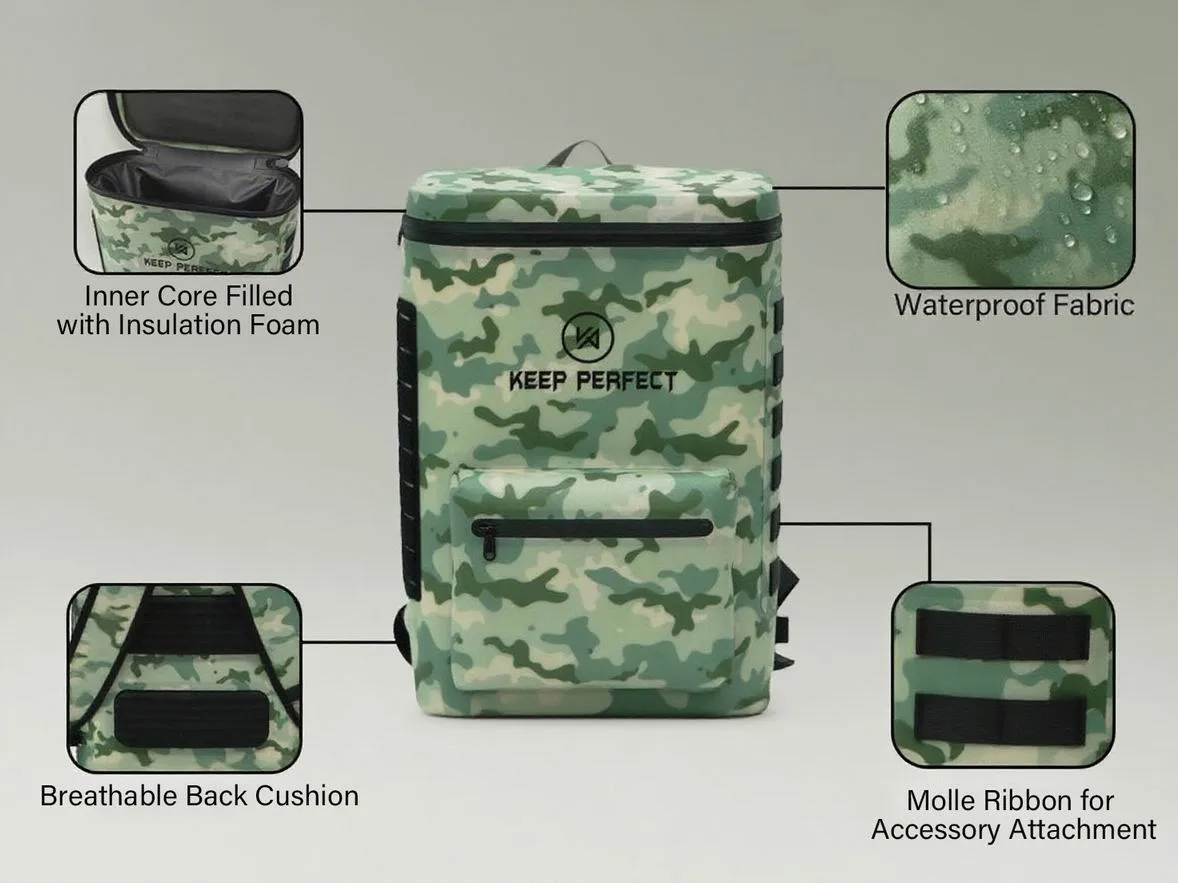
Fabric line: reading denier, GSM and film thickness
Fabric lines look precise and often are not. Four hundred and twenty denier tells you the yarn thickness of the face fabric; it does not tell you how strong the laminate is, what the coating weight is, or how the two are bonded. Two bags can both quote 500D and differ by 30 per cent in abrasion life, because one uses a heavier coating and a tighter weave.
Grams per square metre is the number that actually describes the laminate, and it is the one most often missing. Expect roughly 200 to 260 gsm for light roll-tops, 260 to 340 gsm for general purpose bags, and above 400 gsm for expedition duffels. A 0.3 mm TPU film laminated to a 420D woven face lands near 240 gsm; going to 0.5 mm film adds about 90 g to a 20L bag.
| Specification | Light duty | General purpose | Heavy duty | What it predicts |
|---|---|---|---|---|
| Face fabric | 210D / 420D | 420D / 500D | 840D / 1000D | Tear and scuff resistance |
| Film thickness | 0.25-0.35 mm | 0.40-0.50 mm | 0.55-0.70 mm | Puncture life in the field |
| Total laminate | 190-230 gsm | 260-340 gsm | 420-520 gsm | Overall weight and hand |
| Peel strength | 25 N / 25 mm | 40 N / 25 mm | 60 N / 25 mm | Delamination resistance |
| Abrasion cycles | 5,000 | 10,000-15,000 | 25,000+ | Years before the coating goes |
Peel strength and abrasion cycles are the two lines that separate a real sheet from a catalogue. Ask which method produced them: abrasion numbers are meaningless without the head type, load and endpoint, and standard abrasion methods such as those published by ASTM exist precisely so that two labs disagree as rarely as possible. A figure without a method number is a figure you cannot compare.
Coating versus lamination: the wording gives it away
TPU-coated and TPU-laminated sound like synonyms and behave differently. In a coating, the polymer is spread onto the woven base and the bond depends on adhesive chemistry and cure; in a lamination, a pre-formed film is bonded under heat and pressure. Laminates generally hold a higher, more consistent peel strength and are the usual choice for radio-frequency welded bags.
You can usually tell which you are getting from the numbers offered. Coated constructions tend to quote coating weight in grams per square metre, often 40 to 80 gsm for a single pass, and may list a solvent or water-based system. Laminated constructions quote film thickness in millimetres and mention the base fabric separately. If neither appears, ask directly what the construction is.
Why it matters at the bench rather than on paper: welded seams depend on the film melting into itself. A thinly coated fabric with little bulk will not form a consistent weld, so a bag can be sold as welded and still rely partly on adhesive tape at stress points. Ask whether every seam is welded or whether high-load junctions are reinforced, and compare that answer across our seam construction notes.
The seam line and the proof behind it
Seam type should be stated explicitly: radio-frequency welded, hot-air welded, taped and stitched, or ultrasonically welded. Each has a place, but only continuous welding gives you a seam with no needle holes, and even then the corners and the closure junction need to be described, because that is where failure starts after a season of use.
Ask for two numbers here. First, seam strength as a percentage of fabric strength: anything above 85 per cent is acceptable, below 70 per cent means the seam is the weak link and the rest of the fabric is over-specified. Second, peel or shear strength in newtons per 25 mm strip, measured both before and after ageing, because TPU-to-fabric bonds weaken under heat and humidity.
Ageing data is the line almost nobody quotes and the one that predicts service life. A bag tested only in a new condition tells you what left the facility; a bag tested after 168 hours at 70 °C and high humidity tells you something about year three. Where you see both groups given for fabric-based standards, typically under methods published by ISO, you are reading a sheet written by someone who has been asked about durability before.

Waterproof rating: the number and the method
Two classes of claim appear on dry bag sheets. Ingress protection codes such as IPX6, IPX7 and IPX8 describe behaviour in a defined test; hydrostatic head figures in millimetres describe how much water pressure the fabric resists before penetration. The two measure different things: one tests the whole assembly, the other tests only the material.
Ingress codes are defined in standards maintained by the IEC, and the grade is meaningless without the method and duration. IPX7 means immersion at one metre for 30 minutes; IPX8 means continuous immersion under conditions agreed between buyer and seller, which is why an IPX8 claim carries no information at all unless the depth and hours are printed beside it.
Hydrostatic head behaves similarly. A figure of 10,000 mm describes resistance under a rising column test, not performance after abrasion or after 200 folding cycles. It is a useful comparison between two fabrics and a poor prediction of field life. Read it alongside the abrasion figure or the seam data, never on its own.
Test evidence: what a credible sheet attaches
Every performance claim should trace to a document: standard number, test house, date and sample size. Those four identifiers make the difference between evidence and decoration. Standard number tells you the method; test house tells you whether it was independent; date tells you whether it applies to the present construction; and sample size tells you whether three pieces or thirty were checked.
Watch for date drift in particular. Fabrics change sources, film makers change formulation, and a report from 2021 may not describe the material shipping today. Ask for reports dated within 12 months, or within one production cycle of the order you are placing. Sheets of this kind are the basis of our own sample review checklist.
| Claim on the sheet | What to request | Acceptable response | Red flag |
|---|---|---|---|
| Waterproof IPX7 | Report number and date | IEC 60529, this year | No report, or 'self-tested' |
| 10,000 mm fabric | Method and lab | Named ISO method, third-party | Figure with no method |
| Welded seams | Seam strength vs fabric | Above 85 per cent | No seam data at all |
| Abrasion resistant | Cycles and method | 10,000+, named method | Adjective only |
| AQL 2.5 inspection | Sampling plan and level | Named plan, critical defects nil | No defect classes defined |
Finally, note who pays for the test. Independent laboratory reports cost money and the fee is visible in the unit price, so an unusually cheap bag with a very long list of certified claims deserves the question of whether the report covers the construction being sold. Reputable sellers will send the PDF; reluctant ones usually cannot.
Hardware fields worth their space
Hardware is specified far less often than fabric and fails more often in the field. Buckles should state material—POM, nylon or acetal—and a load figure; webbing should state width and breaking strength; D-rings should state whether they are welded-on (strong) or sewn-on (usually the first thing to tear). Anything described only as heavy duty is unspecified.
| Component | Typical rating | Failure load to expect | Note |
|---|---|---|---|
| 25 mm webbing | 600-1,000 kgf break | Tears before buckle slips | Check for UV-stabilised yarn |
| Side-release buckle | 40-60 kgf | Deforms then releases | POM survives cold better |
| Welded D-ring | 80-120 kgf | Deforms but stays attached | Prefer over stitched loops |
| Sewn webbing loop | 30-60 kgf | Stitch failure at the seam | Avoid on load-bearing points |
| Cam buckle | 50-80 kgf | Slips gradually in salt | Rinse after every coastal trip |
Temperature deserves a line of its own here. Buckle polymers become brittle below about minus 20 °C and lose strength above 60 °C, both reachable in real transport and use. Ask for the working range and compare it with where the bags will actually go: a ski patroller and a tropical dive operator should not receive the same hardware specification.
Weight, dimensions and the tolerance line
Weight figures invite scepticism because they are often copied from a pattern rather than measured. Expect a tolerance of plus or minus 5 per cent on total laminate weight and around 10 per cent on finished bag weight, since closure hardware, webbing length and trim add variation between pieces. A sheet quoting an exact gram figure with no tolerance is guessing.
Dimensions need the same treatment, and for a practical reason: they decide whether the bag fits a hatch, a rack or a locker. Ask for external dimensions when rolled closed and when flat, since those differ by several centimetres, and ask whether the figure includes hardware. A 20L roll-top might be 42 cm tall flat and 36 cm rolled.
Tolerance also applies to capacity between sizes. If a range lists 5L, 10L, 20L and 40L, check that each step roughly doubles rather than being adjusted to look tidy. Consistent steps indicate a genuine family of patterns; irregular ones often mean the numbers were chosen in a marketing meeting rather than measured in the workshop.
Colour, UV and chemical lines
Colour fields look cosmetic and are among the most informative. Colour fastness to rubbing, light and salt water should each carry a rating on the standard 1 to 5 scale, with 4 or above expected for outdoor use and 3 marginally acceptable for fashion colourways. Darker colours fade faster in sunlight than you might expect, and camo prints often use pigments with lower light fastness.
Chemical lines cover what people worry about after buying rather than before. Phthalate-free film, PFAS-free water repellent finish, and compliance with restricted substances frameworks should each appear with a stated limit rather than a general claim. If a sheet says compliant without naming the regulation or the test, treat it as an intention rather than a result.
Ask specifically about UV stabilisers in the film and whether they are present throughout or surface-applied. This line predicts whether a bag survives three summers in Mediterranean sun or stiffens after one. The difference in the finished product is small and the difference in service life is large, which is exactly the sort of thing worth reading a specification for.

Production, inspection and traceability fields
The lower half of a sheet covers how the goods will be made and checked. Look for a named sampling standard rather than a general promise: an inspection plan at AQL 2.5 with defined critical, major and minor defect classes is normal for this category, and critical defects—anything allowing water in—should be set to zero acceptance.
Traceability fields follow. Every production unit should carry a batch or lot code, and the sheet should state where it appears and how long records are kept. Without that, a warranty conversation in eighteen months becomes an argument about whether the bag was yours at all, which is resolvable only by goodwill rather than by evidence.
Ask what the destructive testing schedule looks like. A line running five thousand units should cut open a few each day to check weld integrity, and the sheet should say how many and when. This is cheap insurance against a systemic fault that no amount of visual inspection would catch, and it is the field that most reliably separates mature operations from opportunistic ones.
Commercial lines and what they reveal
Lead time, minimum order quantity and shipping terms are read as logistics, but they quietly describe capability. A minimum of 500 pieces per design is typical for this product class and reflects real set-up costs; a much lower figure may indicate that orders are being consolidated elsewhere, which affects how much control you have over material choice.
Timings read similarly. Sampling in 6 to 10 working days and bulk production in 35 to 50 days are realistic figures for a welded construction; shorter promises usually mean existing patterns rather than new ones, and longer ones can indicate a genuine queue rather than a problem. FOB Xiamen with T/T 30/70 is the common structure for this region.
Incoterms and inspection rights belong in the same block. Who inspects, at what stage, and who owns the goods during transit determines who carries the risk when something goes wrong, so read these lines as carefully as the fabric ones.
A two-minute decoding routine
Read the sheet in a fixed order and note gaps rather than impressions. First skim for missing units, then compare capacity and weight against real expectations, then move to film thickness and seam type, then to evidence for every claim, then hardware ratings, then tolerances, then production fields. Ten minutes with a highlighter finds more than an hour of reading.
Then convert the sheet into three questions you can put in writing: what standard and date supports each performance claim, what happens to capacity with three folds, and what the tolerance is on weight and dimension. Sellers comfortable with their specifications answer within a day, and the reply is often more informative than the document itself.
Keep a scorecard for shortlisted bags rather than reading each in isolation, and check any remaining claims against independent reading elsewhere on this site: our guides to listing red flags and IPX rating behaviour cover the same ground from the buyer's side. A sheet that survives all three documents is one worth quoting against.

Frequently asked questions
Q1. What should a good dry bag spec sheet contain?
Eight numeric answers: usable capacity after rolling, finished weight, film thickness in millimetres, seam type and strength as a share of fabric strength, the standard behind any waterproof claim, hardware load ratings, tolerances on weight and dimensions, and realistic lead times.
Q2. Why does my 20L dry bag hold less than 20 litres?
Because three folds consume 2.5 to 4 litres of volume. Usable capacity for a nominal 20L bag is closer to 16.8 litres, and less again if bulky items sit at the mouth where the roll begins.
Q3. What film thickness should a dry bag have?
0.25 to 0.35 mm for light duty packs, 0.40 to 0.50 mm for general use, and 0.55 to 0.70 mm for expedition or rental work. Thickness drives puncture life more than the denier of the face fabric does.
Q4. Is 420D weaker than 500D?
Not automatically. Denier describes yarn thickness, not laminate strength; a 420D with a heavier film and tighter weave can outlast a 500D built lighter. Compare grams per square metre, peel strength and abrasion cycles instead.
Q5. What does IPX7 actually mean?
Immersion at one metre for 30 minutes under IEC 60529. It covers a capsize and a brief submersion, but it says nothing about abrasion resistance or long-term durability, so read it alongside the seam and fabric figures.
Q6. Is IPX8 always better than IPX7?
No. IPX8 means continuous immersion under conditions agreed between buyer and seller, so the depth and duration must be printed beside it. An unqualified IPX8 claim carries less information than a properly stated IPX7.
Q7. How much should a weld weaken the fabric?
A good weld retains more than 85 per cent of fabric strength; below 70 per cent the seam becomes the weak point and the rest of the specification is wasted. Ask for the figure measured on a 25 mm strip, both new and after ageing.
Q8. What is the difference between coated and laminated fabric?
Coating spreads polymer onto the base fabric and depends on cure and adhesion, usually 40 to 80 gsm per pass. Lamination bonds a pre-formed film under heat and pressure, giving higher and more consistent peel strength and cleaner radio-frequency welding.
Q9. Which tests should third-party labs run?
Ingress protection to IEC 60529, hydrostatic resistance by a named ISO method, abrasion cycles with the method stated, colour fastness to light and rubbing, and restricted substance screening. Always request the report number and the date.
Q10. How recent should a test report be?
Within 12 months, or within one production cycle of your order. Fabrics and films change sources, and a report from three years ago may describe a material that is no longer in use.
Q11. What tolerance is normal on bag weight?
Around 5 per cent on laminate weight and roughly 10 per cent on a finished bag, because hardware and trim add variation. An exact gram figure given with no tolerance range should be treated with suspicion.
Q12. How strong should a dry bag buckle be?
Expect 40 to 60 kgf from a 25 mm side-release buckle, 80 to 120 kgf from a welded D-ring, and only 30 to 60 kgf from a sewn webbing loop. Check the working temperature range too, since polymers embrittle below minus 20 °C.
Q13. What does AQL 2.5 mean on a bag order?
It is the acceptable quality limit for a defined sampling plan, with critical, major and minor defects classified separately. For waterproof bags, critical defects—anything that lets water in—should always be set to zero acceptance.
Q14. Why do some sheets list no seam data?
Usually because nobody has asked for it. Once you request seam strength as a share of fabric strength, most serious sellers can produce the figure within a day, and their willingness to do so is itself informative.
Q15. Should colour fastness really matter for a dry bag?
Yes. Light fastness below 4 causes visible fading within one season of strong sun, and rubbing fastness below 4 transfers colour onto light clothing. Both are cheap to specify and expensive to discover afterwards.
Q16. What minimum order quantity is typical for dry bags?
About 500 pieces per design is standard, reflecting pattern and set-up costs for welded construction. Much lower minimums often mean capacity is being resold, which limits how much control you have over materials.
People also ask
How do you measure dry bag capacity?
Two methods dominate: filling to the overflow point with water, and multiplying internal dimensions. They differ by 5 to 12 per cent for the same bag, so ask which was used, then check it yourself with a measuring jug and three closure folds.
What is GSM on a fabric specification?
Grams per square metre, the weight of the finished laminate. Around 200 to 260 gsm suits light roll-tops, 260 to 340 gsm suits general use, and above 400 gsm is expedition territory.
Are hydrostatic head figures useful for dry bags?
They compare fabrics well and predict field performance poorly. A 10,000 mm figure tells you the material resisted a rising water column, not that it will still resist after 200 fold cycles or a season of abrasion.
How can you tell if a dry bag seam is really welded?
Look at the seam under light: a true weld is continuous, slightly glossy and shows no stitch holes. Then ask for seam strength as a share of fabric strength, which is above 85 per cent on a genuine construction.
What does peeling mean in a spec sheet?
Peel strength measures how well film and base fabric are bonded, reported in newtons per 25 mm strip. Around 25 N is light duty, 40 N general purpose and 60 N heavy duty, and it drops after heat ageing.
How do you compare two dry bag spec sheets?
Score them field by field rather than reading each one alone: usable capacity, weight, film thickness, seam strength share, evidence behind claims, hardware ratings, tolerances, then production and inspection fields.
Need this in production volume?
QUANZHOU JUNYUAN BAGS has produced waterproof bags since 2014 in an SGS-verified 4,950 m2 facility in Fujian, China. Minimum order 500 pieces, sampling in 6–10 working days, bulk in 35–50 days, FOB Xiamen — write to service@junyuanbags.com with your spec and target market.