Home / Blog / Buying & Comparisons
Red Flags in Dry Bag Listings
Three numbers expose most bad dry bag listings before you spend anything. First, multiply the stated dimensions: a bag listed as 60 x 30 x 25 cm cannot hold 45 litres, because the rectangular product is 45 litres and a real fabric bag loses 8 to 15% of that to seams, taper and the roll. Second, check the claimed fabric against its mass: a 0.5 mm TPU laminate on 500D polyester weighs 480 to 560 grams per square metre, so a 'military grade' 40L bag shipping at 320 g does not contain it. Third, compare price against material: coated film plus hardware plus labour puts a real 20L welded bag above roughly 6 to 8 USD at the door.
None of those checks need a laboratory, and all three are arithmetic you can do on a phone in ninety seconds. What follows covers ten signals in detail, each with the numbers behind it, then a weighted audit table you can run against any listing, including photos, delivery promises and compliance paperwork. The aim is not to teach suspicion but to give you a repeatable method: when two of the ten flags appear together, the odds that the bag survives a season are poor regardless of what the top of the page says.
- Why listings mislead without ever lying
- Flag 1: a waterproof claim with no standard behind it
- Flag 2: litre claims that fail their own dimensions
- Flag 3: fabric specifications that cannot coexist
- Flag 4: a price below the plausible material cost
- Flag 5: photographs that contradict the copy
- Flag 6: a rating with no laboratory behind it
- Flag 7: reviews that cluster unnaturally
- Flag 8: no compliance paperwork available
- Flag 9: no care instructions and no spare parts
- Flag 10: delivery promises and return terms that dodge
- The five-minute listing audit
- What a trustworthy listing puts where
Why listings mislead without ever lying
Most bad listings do not contain a false sentence. They contain true sentences arranged so the reader draws the wrong conclusion: a genuine TPU film on one panel described so that the buyer assumes the whole shell, a real IPX6 result described next to a photo of a kayak rolling, a litre figure measured to the very top of an unrolled mouth. Each element is defensible in isolation, and together they sell a product that does not exist.
The marketplace environment amplifies this. Listings compete on visual thumbnail and price, the copy is often assembled from several sources, and there is no technical reviewer in the chain. That is why the buyer has to become the reviewer. The good news is that the useful checks are mechanical: volume from dimensions, mass per area from denier and film thickness, price floor from material plus labour, and standard citation from the claim itself.
Flag 1: a waterproof claim with no standard behind it
Waterproof has no legal meaning. Any claim should name the test it passed and ideally the depth and duration. Ingress protection grades are defined in IEC 60529, published by the IEC, and every grade in that system specifies a method: IPX6 is a jet test at 100 litres per minute from 3 metres, IPX7 is 30 minutes at one metre. A listing that says waterproof, or even IPX8 without stating the agreed depth, has told you nothing that can be checked.
Watch for adjectives doing a standard's job. Phrases like heavy duty sealed, storm proof or marine grade appear precisely where a number should be, and they are strongest in listings aimed at buyers who will not submerge the bag. If you plan to kayak, paddleboard or boat, insist on the grade and read our breakdown of IPX ratings for dry bags before comparing prices, because IPX6 and IPX7 bags are not substitutes for each other.
Flag 2: litre claims that fail their own dimensions
This is the simplest check and the most reliable. Dry bag volume is usually quoted rolled, sometimes unrolled, and rarely with the method stated, which opens a 20 to 30% gap. Compute the rectangular volume from the listed height, width and depth, subtract 10 to 15% for taper and seam allowance, then subtract a further 2.5 to 4 litres on a large bag for the rolled closure itself. If the claim sits above that result, you have your answer.
A worked example: a bag at 55 x 28 x 24 cm gives 36.9 litres of rectangular envelope. After taper and seams that is roughly 31 litres, and after three rolls of closure about 27 litres of usable volume. A listing calling that same bag 40L is inflating by nearly 50%, which is typical of budget imports. The table below shows the same arithmetic across five sizes, and our guide to how capacity is measured explains why two honest brands can differ by 10% without anyone lying.
| Listed dimensions | Envelope | Realistic usable | Typical inflated claim | Gap |
|---|---|---|---|---|
| 40 x 20 x 18 cm | 14.4 L | 11 L | 20 L | +45% |
| 48 x 24 x 20 cm | 23.0 L | 19 L | 30 L | +37% |
| 55 x 28 x 24 cm | 36.9 L | 27 L | 40 L | +48% |
| 65 x 32 x 28 cm | 58.2 L | 46 L | 70 L | +52% |
| 75 x 38 x 32 cm | 91.2 L | 74 L | 110 L | +49% |

Flag 3: fabric specifications that cannot coexist
Fabric claims fail silently because few buyers know the mass relationships. A 500D polyester with a 0.5 mm TPU film weighs 480 to 560 gsm; the same base with a 0.3 mm film is nearer 340 to 400 gsm. Add hardware and you can predict the whole bag's mass within about 10%. So when a listing pairs heavy-duty 1000D with a delivered weight that implies 200 gsm fabric, one of the two numbers is decorative.
Denier is the other common inflation. Denier describes yarn thickness, not fabric strength, and it is meaningless without the weave and any coating. A 420D high-tenacity weave can out-tear a 600D commodity weave, which is why comparison belongs to the standardised test results rather than the headline number. For tensile and tear behaviour, referenced methods are published by ISO and its national equivalents; a serious listing cites one.
| Shell plus film | Expected gsm | Expected 20L shell mass | Typical mass with hardware | Implausible listing |
|---|---|---|---|---|
| 210D + 0.3 mm TPU | 240-290 gsm | 170 g | 240-290 g | under 180 g |
| 420D + 0.4 mm TPU | 360-440 gsm | 250 g | 330-400 g | under 250 g |
| 500D + 0.5 mm TPU | 480-560 gsm | 330 g | 430-520 g | under 350 g |
| 840D + PVC coat | 620-720 gsm | 430 g | 560-680 g | under 450 g |
Flag 4: a price below the plausible material cost
Every dry bag has a floor made of fabric area, hardware count, labour minutes and freight. A 20L welded TPU bag uses roughly 0.35 square metres of laminate, one buckle set, two D-rings and about 6 minutes of bench time including inspection. At any realistic input pricing that puts the unit well above the 4 to 5 USD seen in the shallowest listings, before shipping of roughly 1 to 2 USD per unit is counted.
The tell is usually not the price alone but a cluster: rock-bottom price, free express shipping, five colourways photographed identically, and a delivery estimate of six weeks. That combination usually means the listing is a placeholder against stock that does not exist yet, and the eventual item may differ from the images. Use the table as a sanity check rather than a rule; regional costs vary, but nobody publishes below material cost for long.
| Bag size | Fabric area | Hardware | Plausible unit floor | Suspicious below |
|---|---|---|---|---|
| 5L | 0.13 m2 | 1 buckle, 1 ring | 3.5 USD | 2.0 USD |
| 10L | 0.21 m2 | 1 buckle, 2 rings | 4.5 USD | 2.6 USD |
| 20L | 0.35 m2 | 1 buckle, 2 rings, strap | 6.5 USD | 3.8 USD |
| 40L | 0.55 m2 | 2 buckles, 4 rings | 10.5 USD | 6.0 USD |
| 70L | 0.85 m2 | 2 buckles, 6 rings | 16.0 USD | 9.5 USD |
Flag 5: photographs that contradict the copy
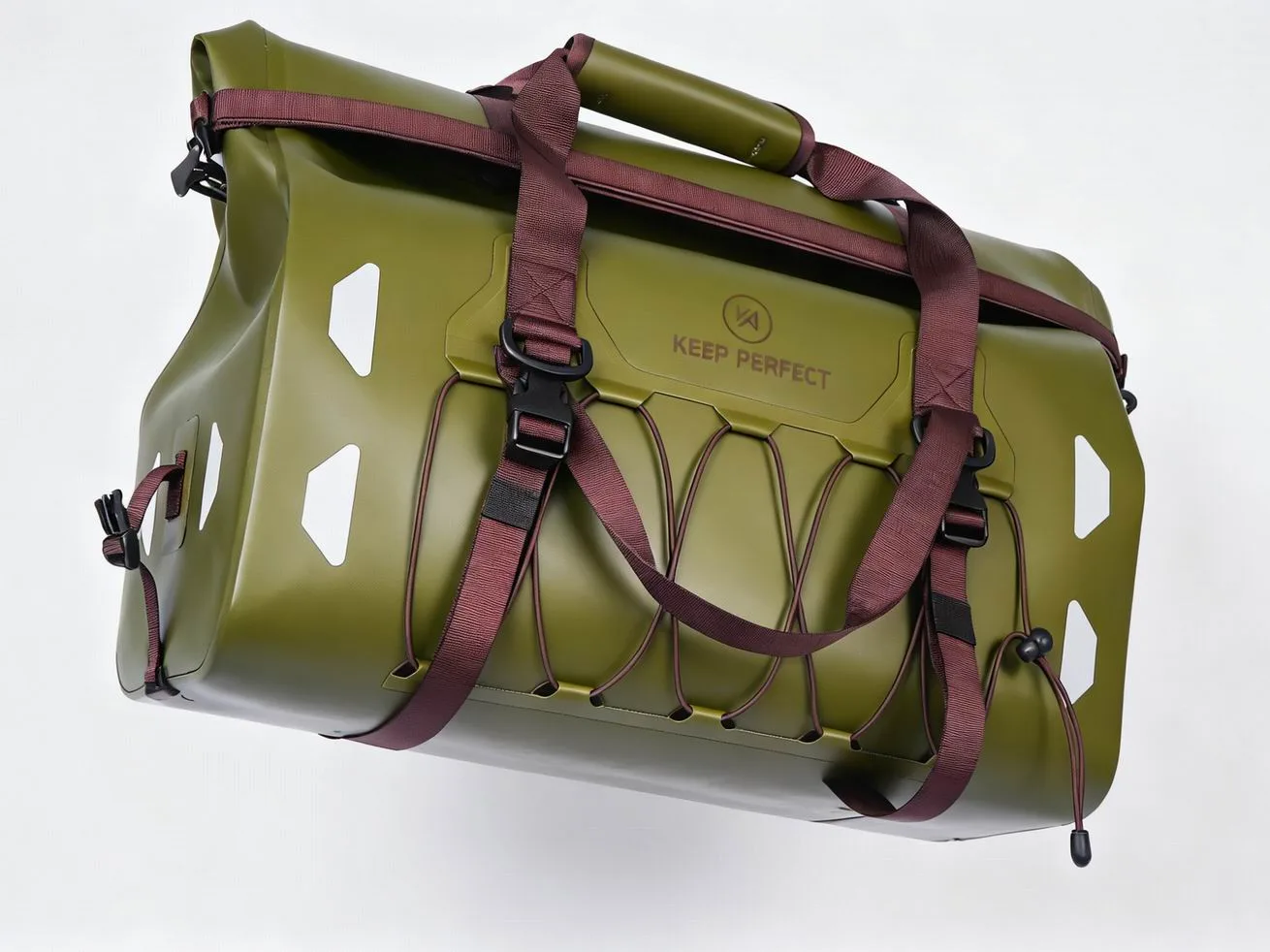
Read the images as evidence rather than decoration. A listing claiming fully welded seams but showing a row of stitch holes along the base contradicts itself; so does a roll-top closure photographed without the third fold, a claimed 0.5 mm film shown draping like tissue, and a 'welded D-ring' that is visibly sewn webbing with a bar tack.
Zoom the hardware too. Engineering photographs show a clean gate mark, consistent colour and no flash; poor ones show rough parting lines and cloudy plastic that will fail at low temperature. If four colourways share pixel-identical shadows, the images are renders, and if every lifestyle shot has the same model in different locations, the shots were bought from a library rather than taken of the product you will receive.
Flag 6: a rating with no laboratory behind it
A test result has provenance. It comes from a named laboratory, against a stated standard, on a dated report, usually with a sample photograph. When a listing shows a certificate image with no report number, no accreditation mark and no sample identification, it may well have been generated for the previous product line. Accredited laboratories are assessed against ISO/IEC 17025, so ask for the accreditation number and look it up.
Also check what was tested. A hydrostatic head result describes fabric resistance under a column of water, which is not the same as a finished bag holding water through a rolled closure. Similarly, an immersion result on one sample unit says little about batch consistency. The right question is which pieces were tested and how many: single-sample hero testing is how a weak specification reaches the front page.
Flag 7: reviews that cluster unnaturally
Reviews are useful for pattern rather than content. Useful distributions show a spread across stars, mentions of specific use cases, and a tail of complaints about sizing or odour. A skewed set at five stars with identical phrasing, hundreds posted within a two-week window, and no verified purchase marker is worth almost nothing, particularly on a listing that is also obviously new.
Read the three-star reviews instead. Buyers who are mildly dissatisfied write the useful detail: buckle slipped after four uses, capacity 20% smaller than advertised, seam split at the base corner after a season. Two-star complaints about the same component across twelve months of postings are the strongest durability signal you will get without owning the bag.
Flag 8: no compliance paperwork available
Ask one question before buying, particularly for children's products or bags carrying a chemical safety claim: can you send the compliance file? For the EU that means REACH documentation on restricted substances; for California shipments, the Prop 65 position; for anything claiming recycled content, a certificate tracing it. A serious seller answers within a day, because the documents already exist.
Silence is itself a finding. If nobody can produce a restricted-substance statement, assume none exists, which matters most for PVC bags where plasticiser content is a live regulatory issue and for printed panels where solvent residues concentrate. Our own notes on REACH compliance show what a usable file contains, so you know what you are asking for.
Flag 9: no care instructions and no spare parts
A product team that tested its own bag knows how to maintain it and which parts fail. Its listing therefore usually includes a care line, a listed strap or buckle size, and a contact route for spares. Listings that say nothing about either are telling you there is nobody behind the page, which is the same conclusion you reach when the contact address resolves to a mailbox facility.
This is the cheapest check with the longest tail. A buckle that can be replaced for 2 USD in year three turns a disposable bag into a ten-year one, and a care note telling you not to machine wash prevents what is probably the most common premature failure we see. If you want the maintenance side before purchase, our care routine for roll-top bags is a fair template.

Flag 10: delivery promises and return terms that dodge
Read the fine print on shipping and returns as part of the specification. Combined delivery windows of five to eight weeks on stock items, no named carrier, and return terms requiring the buyer to ship back at their own cost to an unnamed address add real risk to a low price. Add up the total: unit price plus postage plus the practical cost of returning a 900 g parcel.
Genuine limitations are fine when stated honestly. A made-to-order colourway legitimately takes longer, and a distant warehouse legitimately adds postage; both should be stated on the listing rather than discovered at checkout. What you are testing is whether the seller tells you inconvenient facts in advance, because that behaviour predicts how they will handle a failed seam in month four.
The five-minute listing audit
Run these seven checks in order and stop when the score is poor. Each one takes under a minute and none needs special equipment: a calculator for the volume check, a search for the standard, a question about paperwork, a zoom into the hardware, a scan of three-star reviews, a check of returns wording, and finally the price floor comparison from Flag 4.
| Check | Pass condition | Fail condition | Weight |
|---|---|---|---|
| Volume maths | Claim within 15% of computed | Claim 30%+ above | 20% |
| Named standard | IPX grade plus method cited | Adjectives only | 20% |
| Fabric plausibility | Mass fits denier plus film | Mass contradicts claim | 15% |
| Photo consistency | Welds match copy | Stitch holes visible | 15% |
| Test provenance | Lab name and report number | Unattributed certificate | 10% |
| Compliance file | Documents supplied in 24 h | No answer | 10% |
| Returns and delivery | Named carrier, clear window | Vague six-week window | 10% |
Scoring is deliberately unforgiving on the first two checks because they are the ones that determine whether the bag keeps water out at all. A listing that fails either should be dropped even at half price, since every later saving is conditional on the product being dry inside. The remaining five decide value and longevity, and two fails among them is a reasonable line to draw.
What a trustworthy listing puts where
- Capacity in litres with the measuring method stated, rolled or unrolled.
- An ingress grade citing IEC 60529, including duration and depth where relevant.
- Shell construction named: base fabric denier plus film type and thickness.
- Total product mass, not just shipping weight of the carton.
- Care instructions and the part number for a replacement buckle or strap.
- A responsible-party address plus a compliance contact for restricted substances.
- Photographs of the actual weld geometry, including the base corners.
- A delivery window and named carrier rather than an open-ended estimate.
Listings that carry all eight are usually priced accordingly, and that is the honest trade: a fully specified 20L welded bag costs more than a vague one because the material and the testing are real. If you want the full reading order before spending, our walkthrough on reading a dry bag spec sheet covers the same eight fields in narrative form, and the price band analysis shows where each tier sits.
For context on how these failures look once the bags are in the field, our production partner has inspected waterproof bag programmes since 2014 across an SGS-verified 4,950 m2 site using AQL 2.5 sampling, and the three most common rejection causes are seam geometry, weld contamination and hardware mismatch.That inspection reality is what makes the price-floor table above useful: below roughly 6.5 USD for a 20L welded unit, something has been removed from the process.
Frequently asked questions
Q1. What are the biggest red flags in a dry bag listing?
Two decide it: a capacity claim more than 30% above the volume computed from the listed dimensions, and a waterproof claim with no named standard such as IEC 60529. Either alone is a strong warning; both together mean you should not buy, regardless of how low the price is.
Q2. How can I check if a dry bag's litre claim is honest?
Multiply height, width and depth, subtract 10 to 15% for taper and seam allowance, then subtract 2.5 to 4 litres for the rolled closure on larger bags. If the advertised figure sits more than about 15% above your result, it is inflated.
Q3. Is IPX8 always better than IPX7?
Not necessarily. IPX7 is a defined 30-minute immersion at one metre, while IPX8 is whatever the seller agreed with the testing laboratory, so an unstated IPX8 depth tells you nothing. Always ask for the depth and duration behind the grade.
Q4. Why do some very cheap dry bags actually work?
Because they are simple. A basic taped-seam splash bag for a dry(ish) gym run can be built cheaply and still function. What cannot be built cheaply is a genuinely welded, halogen-free TPU bag that survives a 30-minute immersion and repeated folding.
Q5. Can I trust 'military grade' in a listing?
No. There is no military specification for recreational dry bags being cited in these listings, and the phrase exists to substitute for test data. Replace it with two questions: which standard was tested, and what was the result number?
Q6. What should the photos of a welded bag show?
Continuous welds with no stitch holes, clean base corners, consistent hardware colour and a reasonably rigid roll-top mouth. Contrast that with visible needle holes, cloudy buckle plastic, and identical shadows across every colourway, which indicate renders rather than product shots.
Q7. How can I tell if review count is inflated?
Look for clustering in time, repeated phrasing, a five-star share above roughly 85%, and no verified-purchase markers. Then read the three-star reviews, which contain the useful recurring complaints about specific components such as buckles or base corners.
Q8. What compliance file should a dry bag seller have?
For the EU market, REACH restricted-substance documentation; for California, a Prop 65 position; and for any recycled-content claim, a batch certificate. Ask for all three: a prepared seller responds within a working day.
Q9. Does a heavier dry bag mean it lasts longer?
Not always, but within a given construction it correlates with thicker film and tighter weave. Weight only helps combined with the right construction: 500 gsm of poorly welded laminate fails sooner than 380 gsm of well-welded laminate.
Q10. Is it worth buying from an unnamed brand online?
Sometimes, if the specification is complete and the paperwork exists on request. Judge the listing rather than the name: many competent products reach the market without strong branding, but none with complete specifications disappear when asked about restricted substances.
Q11. How do I spot a listing that never shipped that product?
Watch for a combination: an implausible price, a five-to-eight-week delivery window, several identical renders of different colourways, and no recent dated reviews. That pattern usually indicates a placeholder listing rather than held stock.
Q12. Should I avoid stitched seams entirely?
Not for every use. Stitched plus taped seams handle rain and splash well and cost less, which suits a commute bag. They fail under sustained immersion because pressure drives water through the needle holes, so they are the wrong choice for kayaking or boating.
Q13. What does AQL 2.5 mean in quality checking?
It is a sampling plan: inspectors pull a defined number of units from the batch and accept it if defects fall below 2.5% of the sample, although the exact accept and reject numbers depend on lot size. A seller citing it is describing a statistical standard rather than a guarantee.
Q14. Are image renders always a bad sign?
Not always; some brands use renders alongside real photography. The concern is renders alone, particularly when every colourway shares pixel-identical shadows and lighting, because nothing in the images has then been verified against physical stock.
Q15. How long does a proper immersion test take?
The standard IPX7 test is 30 minutes at one metre, which is why it is the common benchmark for finished dry bags. Add preconditioning such as flex cycling and you have a test cycle running several hours per sample, which explains why credible testing costs money.
Q16. Can a good bag still leak after purchase?
Yes, and most often from user rather than product causes: an over-filled closure that cannot fold cleanly, grit trapped in the roll, or a buckle left half-clipped. Run a quarterly air-inflation check; our leak testing method takes about four minutes.
People also ask
How do you know if a dry bag is genuinely waterproof?
Look for a named grade citing IEC 60529 with its method and duration, plus welded rather than stitched seams and a stated film thickness. Then verify the photos show continuous welds, and check whether the seller can supply a laboratory report number.
Why is my dry bag smaller than advertised?
Because many listings quote unrolled volume or the rectangular envelope rather than usable rolled capacity. Realistic usable volume runs 20 to 30% below the headline figure once taper, seams and three rolls of closure are accounted for.
What does 500D mean on a dry bag?
It describes yarn thickness in the base fabric, not overall strength. Without weave type, coating and standardised tear results, denier alone cannot be compared between listings, which is why it is one of the most inflated numbers in the category.
Are cheap dry bags worth buying?
For light splash duty, often yes. For immersion, no: below roughly 6.5 USD for a 20L welded unit, the material, the weld quality or the inspection step has been reduced, and the failure usually appears after the return window closes.
Can I return a leaking dry bag bought online?
Usually yes within the platform window, but check who pays return postage and to which address; a 900 g parcel returned internationally can cost 20 USD or more. That practical cost belongs in the price comparison you do before buying.
How do I compare two dry bag listings fairly?
Normalise three things first: usable litres rather than claimed litres, the named ingress grade, and the total delivered price including postage and realistic return cost. Comparing those three removes most of the tricks that make a weak listing look strong.
Need this in production volume?
QUANZHOU JUNYUAN BAGS has produced waterproof bags since 2014 in an SGS-verified 4,950 m2 facility in Fujian, China. Minimum order 500 pieces, sampling in 6–10 working days, bulk in 35–50 days, FOB Xiamen — write to service@junyuanbags.com with your spec and target market.