Home / Blog / Buying & Comparisons
Light vs Heavy-Duty Dry Bags
A light-duty 20 litre dry bag weighs 220 to 320 g and uses a 0.25 to 0.35 mm film on a 210D to 420D face; a heavy-duty 20 litre bag weighs 520 to 780 g and uses a 0.5 to 0.7 mm film on a 500D to 1000D face. That 300 to 460 g penalty buys roughly three to four times the abrasion life and about double the puncture resistance, which is decisive on a raft or an expedition and largely wasted on a day hike or a travel liner.
Choosing between the two is therefore a question of what will attack the bag. This guide compares the two builds across fabric mass, seam construction, grams per litre, abrasion and puncture numbers, cold and UV behaviour, hardware duty, service life and cost per season, then finishes with a decision matrix that maps each build to the activities where it actually pays for itself. Every number is a field planning figure rather than a laboratory best case.
- What duty rating actually measures on a dry bag
- Face fabric and film: where the grams come from
- Seam construction: the difference nobody photographs
- Grams per litre: the real cost of durability
- Abrasion and puncture in the field
- Cold, heat and UV behaviour
- Closure and hardware duty ratings
- Where light-duty wins
- Where heavy-duty is not optional
- Cost per season, not cost per bag
- Reading the spec sheet before you choose
- Decision matrix: matching build to activity
- A duty-class checklist before you buy
What duty rating actually measures on a dry bag
Duty is not a single property, and no standard defines a light or heavy grade for dry bags. In practice the label describes three independent variables: the mass of the face fabric, the thickness of the waterproof film, and the construction of the seam. A bag can be heavy in one dimension and light in another, which is why two bags of identical weight can behave completely differently after a season on gravel.
The most useful framing is resistance to the three things that actually end a bag: abrasion, puncture and seam fatigue. Abrasion is the slow loss of film thickness where the bag rubs a surface, puncture is a single event from a sharp object, and seam fatigue is the progressive failure of the weld or stitch line under repeated folding. Light-duty bags fail at the first two; heavy-duty bags usually fail at the third, long after the fabric has gone matte.
Waterproofness, importantly, is not the difference. A well-welded light-duty bag and a heavy-duty bag can both hold IPX7, because immersion performance comes from the continuity of the film and the seam rather than from its thickness. The rating tells you whether water gets in this week; the duty class tells you whether it still gets kept out in year five.
Face fabric and film: where the grams come from
Total fabric mass is the sum of two layers. The face fabric carries abrasion and tear strength, measured in denier and grams per square metre; the film carries the waterproofing and most of the puncture resistance, measured in millimetres. Moving from 210D to 500D roughly doubles face mass from 70 to 150 gsm, while moving the film from 0.3 mm to 0.5 mm adds about 230 to 260 gsm of its own, so the film is the bigger lever on weight.
That is why the film thickness decision matters more than the denier decision for most buyers. A 420D face with a 0.5 mm film outperforms a 500D face with a 0.3 mm film in puncture testing, weighs about the same, and folds better in cold weather because the thicker film dominates flex behaviour. Our film thickness comparison and the 420D versus 500D notes both go deeper on the trade-off.
| Build | Face fabric | Film thickness | Total fabric mass | Typical use |
|---|---|---|---|---|
| Ultralight liner | 70D-210D ripstop | 0.15-0.25 mm | 180-260 gsm | Pack liner, food bag |
| Light duty | 210D-420D nylon | 0.25-0.35 mm | 260-420 gsm | Day hike, travel, commute |
| Mid duty | 420D-500D nylon | 0.35-0.45 mm | 420-560 gsm | Kayak touring, bikepacking |
| Heavy duty | 500D-840D polyester | 0.5-0.6 mm | 560-760 gsm | Rafting, expedition |
| Extreme duty | 840D-1000D or PVC tarp | 0.6-0.9 mm | 760-1100 gsm | Rental fleets, rescue |
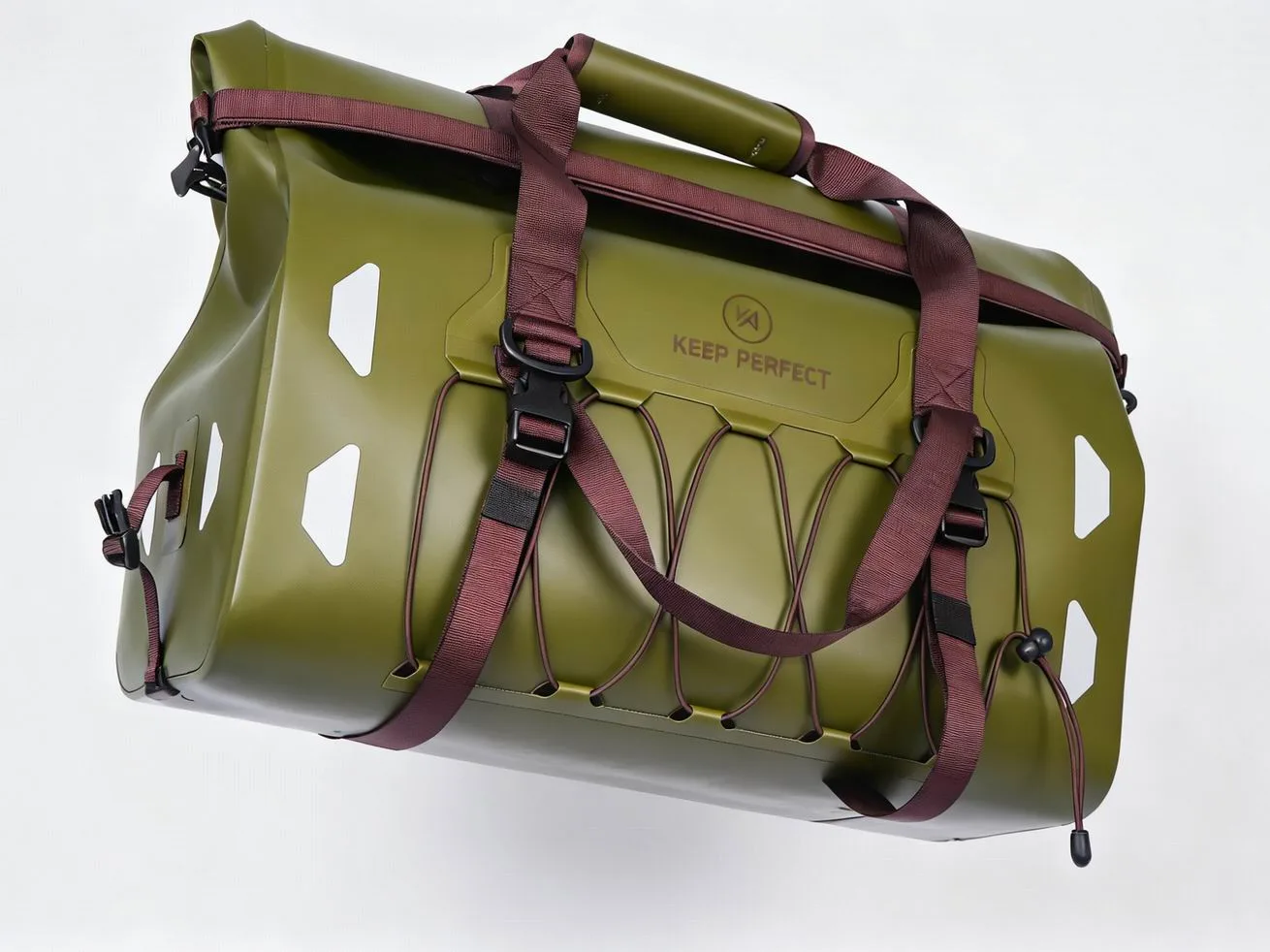
Seam construction: the difference nobody photographs
The seam is where duty class shows most clearly. A light-duty bag is usually high-frequency welded with a 6 to 10 mm weld width on a single pass, which is fast, cheap and perfectly waterproof when new. A heavy-duty bag runs a wider weld of 12 to 20 mm, often double-passed, and in some builds adds a welded reinforcement strip over the base seam where the bag sits on the ground.
Weld width matters because the joint fails at its edge. A narrow weld concentrates peel stress in a small area, so a bag dragged across a beach loses a little material every time and eventually opens at the corner. Doubling the weld width roughly triples the peel strength of the joint, which is why heavy-duty bags survive being strapped to a raft frame and light-duty bags do not.
Stitched and taped seams sit outside this comparison entirely. A needle hole is a hole, and the tape that covers it is an adhesive bond that degrades with heat and salt. For any application where the bag will be squeezed under load, choose welded construction; the full argument is set out in our welded versus stitched seam guide.

Grams per litre: the real cost of durability
Weight scales with surface area, not with volume, so the grams-per-litre penalty is worst on small bags. A light-duty 5 litre bag can be made at 90 to 130 g, a heavy-duty 5 litre at 210 to 290 g, and the difference of 120 to 160 g is proportionally enormous on a bag that small. By 40 litres the gap is 350 to 600 g, which on a 40 litre load is under 10% of total packed weight and much easier to justify.
This is the argument for splitting duty classes within one kit. Carry the small, frequently handled items in light bags where low weight matters and abrasion risk is low, and carry the big, dragged, strapped-down items in heavy bags where the weight penalty is diluted. A mixed kit of two heavy 40 litre bags and three light 10 litre bags weighs less and lasts longer than five mid-duty bags.
| Capacity | Light duty weight | Heavy duty weight | Difference | Grams per litre, heavy |
|---|---|---|---|---|
| 2 L | 45-65 g | 110-150 g | 65-85 g | 55-75 g/L |
| 5 L | 90-130 g | 210-290 g | 120-160 g | 42-58 g/L |
| 10 L | 140-200 g | 320-430 g | 180-230 g | 32-43 g/L |
| 20 L | 220-320 g | 520-780 g | 300-460 g | 26-39 g/L |
| 40 L | 380-520 g | 780-1120 g | 400-600 g | 20-28 g/L |
| 90 L | 700-950 g | 1500-2100 g | 800-1150 g | 17-23 g/L |

Abrasion and puncture in the field
Abrasion is the most common cause of retirement. A fabric rubbed against itself under load loses thickness at a measurable rate, and the standard test methods published by the ASTM give comparable cycle counts: a light-duty laminate typically shows visible wear at 5,000 to 12,000 cycles while a heavy-duty laminate runs past 30,000 to 50,000. On a raft frame or a roof rack, that difference is the whole service life.
Puncture is a single-event property and it scales with film thickness rather than denier. A 0.3 mm TPU film typically resists 25 to 45 N of puncture force at a standard probe, and a 0.5 mm film resists 60 to 95 N, so doubling thickness roughly doubles resistance. The practical translation is simple: if the bag will share a space with a pump, a paddle blade or a fishing gaff, buy the thicker film.
| Property | Light duty, 0.3 mm | Heavy duty, 0.5 mm | Heavy duty, 0.7 mm | What it means in use |
|---|---|---|---|---|
| Abrasion cycles to visible wear | 5,000-12,000 | 30,000-50,000 | 50,000-80,000 | Raft frames and roof racks |
| Puncture force at probe | 25-45 N | 60-95 N | 90-140 N | Sharing space with sharp kit |
| Tear strength, tongue method | 25-40 N | 55-90 N | 80-130 N | Resisting a rip from a small cut |
| Weld peel strength | 20-35 N/25 mm | 45-70 N/25 mm | 60-100 N/25 mm | Corner survival under load |
| Typical service life, weekly use | 2-4 years | 6-10 years | 8-15 years | Replacement cycle |
Cold, heat and UV behaviour
Temperature separates the two builds less than buyers expect. TPU stays flexible well below freezing, with a cold crack point typically under minus 30 °C for both 0.3 mm and 0.5 mm film, so a winter paddler does not need heavy duty for cold alone. What cold does change is handling: a thick, stiff film is harder to roll with numb hands, and a light bag is noticeably easier to close in a hurry at minus 5 °C.
UV is the opposite story. Sun degrades the polymer from the outside in, so a thicker film has a larger reservoir before the damage reaches through, and UV-stabilised heavy-duty fabric can last two to three times longer in tropical sun than an unstabilised light film. If the bag will live on a deck, a beach or a roof rack, buy heavy duty and buy a stabilised face fabric, not a fashionable colourway.
Closure and hardware duty ratings
Hardware is where cheap heavy-duty bags give back everything the fabric bought. A 0.6 mm body with a 15 mm acetal buckle rated to 180 N will fail long before the fabric does, because the closure and the lash points carry concentrated loads while the fabric carries distributed ones. Check the buckle rating, the D-ring attachment method and the strap width as carefully as the film thickness.
- Buckle: light duty 15 to 20 mm acetal at 180 to 300 N; heavy duty 25 to 40 mm at 400 to 800 N.
- D-ring: light duty sewn webbing loop; heavy duty welded patch with a reinforced plate.
- Strap: light duty 15 to 20 mm at 250 to 400 N; heavy duty 25 to 40 mm at 700 to 1200 N.
- Base: light duty single layer; heavy duty double layer or a welded abrasion panel.
- Handle: light duty webbing loop; heavy duty moulded or welded grab handle with a 40 kg rating.
A useful field test is to load the bag to its rated weight and lift it by a single lash point. A heavy-duty bag should deform and recover without any visible movement at the attachment; a light-duty bag will show the webbing pulling at the weld. Do this before a trip rather than on a river bank, because a D-ring that tears out at the put-in costs a whole day.
Where light-duty wins
Light-duty bags are the right answer whenever the bag is carried rather than dragged. Inside a backpack as a liner, in a suitcase as a wet-kit separator, on a day hike where the load is 2 kg and the ground is grass, or in a commuter bag that never touches concrete, a 0.3 mm film is more than enough and weighs half as much. Our economy versus premium comparison covers the price side of that decision.
They also win on handling. A light bag packs smaller when empty, rolls more easily with cold hands, dries faster because there is less mass to hold water in the weave, and is far less tiring to carry on a long walk. For a traveller who wants a 10 litre bag in a daypack for the one rainy afternoon of a trip, the heavy-duty version is pure penalty.

Where heavy-duty is not optional
Four situations justify the weight without argument. Anything strapped to a raft frame or a roof rack, where vibration and strap abrasion run for hours at a time. Anything used commercially, where a rental fleet replaces bags on an annual cycle and a failure costs a booking. Anything carried on an expedition where the bag cannot be replaced for weeks. And anything that shares a hatch or a hold with sharp equipment.
Commercial use is the clearest case, because the cost of a failure is not the bag. A rental operator running 200 bags across a season will see 8 to 15% of light-duty bags retired for abrasion or seam damage, against 1 to 3% of heavy-duty bags, and the replacement cost plus the operational disruption dwarfs the 300 g penalty. The same arithmetic applies to a club kit or a rescue team store.

Cost per season, not cost per bag
Sticker price favours light duty by a wide margin and hides the real answer. A light-duty 20 litre bag costs roughly 18 to 30 USD and lasts two to four years of weekly use; a heavy-duty 20 litre bag costs 45 to 75 USD and lasts six to ten. Per season of service the heavy bag is usually cheaper, and the gap widens in commercial use where labour and downtime are counted.
There is a second cost that rarely appears in the comparison: the cost of a wet load. A bag that fails mid-trip can ruin a sleeping bag, a camera or a set of documents worth many times the price difference. Buy to the value of the contents rather than the price of the bag, and reserve light duty for loads you could afford to lose.
| Use case | Light duty price | Heavy duty price | Service life | Cost per season |
|---|---|---|---|---|
| Occasional day hike, 10 L | 12-20 USD | 28-45 USD | 4 / 10 years | 4 / 4 USD |
| Weekly paddling, 20 L | 18-30 USD | 45-75 USD | 3 / 8 years | 8 / 9 USD |
| Bikepacking, 10 L | 14-24 USD | 32-52 USD | 3 / 7 years | 6 / 7 USD |
| Rental fleet, 40 L | 28-45 USD | 70-110 USD | 1 / 4 years | 36 / 22 USD |
| Expedition, 90 L | 55-85 USD | 130-190 USD | 4 / 12 years | 17 / 13 USD |
Reading the spec sheet before you choose
A listing that quotes litres, a colour and the word waterproof tells you nothing about duty class. The four lines that matter are total fabric mass in grams per square metre, film thickness in millimetres, seam type and weld width, and hardware rating. If a seller will not give you the film thickness, assume a light-duty build and price it accordingly.
Ratings sit alongside duty rather than instead of it. The IEC 60529 ingress grades tell you what the bag survived in a test tank, and the ISO textile test series covers abrasion and tear methods, but neither tells you how long it will last. Our spec sheet guide sets out how to read all four lines together.
Decision matrix: matching build to activity
The cleanest way to choose is to score the three failure modes against your activity. If abrasion risk is low, puncture risk is low and the bag is carried rather than dragged, light duty wins on every axis. Raise any one of those to high and the calculus moves quickly, because service life falls faster than the price rises.
| Activity | Abrasion risk | Puncture risk | Recommended build | Why |
|---|---|---|---|---|
| Travel liner and packing | Low | Low | Light, 0.25-0.3 mm | Weight and packability win |
| Day hiking and commuting | Low | Low | Light, 0.3 mm | Carried, never dragged |
| Kayak touring | Medium | Medium | Mid, 0.4-0.5 mm | Hatch abrasion, gear contact |
| Bikepacking bar roll | Medium | Low | Mid, 0.35-0.45 mm | Vibration and strap wear |
| Whitewater rafting | High | High | Heavy, 0.6 mm+ | Frame straps, sharp gear |
| Expedition and multi-week | High | Medium | Heavy, 0.5-0.7 mm | No replacement available |
| Rental and club fleets | High | Medium | Heavy, 0.6 mm+ | Downtime costs more |
| Resort and pool use | Medium | Low | Mid, 0.4 mm | Chlorine and sun exposure |
A duty-class checklist before you buy
- Ask for film thickness in millimetres; if it is not given, assume light duty.
- Ask for total fabric mass in gsm and treat anything under 400 gsm as light duty.
- Check weld width and whether the base seam is reinforced or double-passed.
- Match hardware to the fabric: a 25 mm strap and a 400 N buckle on any heavy build.
- Score abrasion, puncture and seam fatigue risk for your actual activity, not in general.
- Weigh the contents: buy heavy duty for loads you cannot afford to get wet.
- Divide price by expected seasons rather than comparing sticker prices.
- Split the kit: heavy for the dragged bags, light for the carried ones.
- Compare both classes in the full product range before committing.
If you are specifying bags for a programme rather than for yourself, write the duty class into the brief as a measurable line rather than an adjective. Film thickness, fabric mass, weld width, hardware rating and the abrasion cycle target are five numbers a production partner can quote against, and they remove the argument that always follows a season of field use.
One last practical point: duty class is not a reason to skip maintenance. A heavy-duty bag left rolled tight and damp for a winter will fail at the crease long before a well-cared-for light bag, and our fabric weight guide shows how the same build performs across activities. For a fuller picture of what determines service life, read the service life by material notes, and check both classes against the TPU backpack range and the roll-top line where the same construction is offered in several weights.
Frequently asked questions
Q1. What is the difference between light-duty and heavy-duty dry bags?
Light-duty bags use a 0.25 to 0.35 mm film on a 210D to 420D face and weigh 220 to 320 g in 20 litres. Heavy-duty bags use a 0.5 to 0.7 mm film on a 500D to 1000D face and weigh 520 to 780 g, buying three to four times the abrasion life.
Q2. Is a heavy-duty dry bag more waterproof?
Not necessarily. Waterproofness comes from film continuity and seam quality, so a well-welded light bag can hold IPX7 too. Duty class affects how long the bag keeps doing it, not whether it does it today.
Q3. How much weight does heavy duty add?
Between 300 and 460 g on a 20 litre bag, or 26 to 39 g per litre. The penalty is proportionally worst on small bags: 65 to 85 g extra at 2 litres, but only 17 to 23 g per litre at 90 litres.
Q4. When is light duty the better choice?
When the bag is carried rather than dragged: as a pack liner, in a suitcase, on a day hike or on a commute. Low weight, easy rolling and fast drying all matter more than abrasion life there.
Q5. When must I buy heavy duty?
For raft frames, roof racks, expedition use and rental fleets. Abrasion and puncture risk are high, replacement is impossible or expensive, and a failure costs far more than the extra 300 g.
Q6. How long does each build last?
With weekly use, light duty typically gives two to four years, heavy duty six to ten, and extreme-duty PVC or 0.7 mm builds eight to fifteen. Commercial fleets shorten both figures sharply.
Q7. Does film thickness matter more than denier?
Yes for puncture and flex. A 420D face with a 0.5 mm film beats a 500D face with a 0.3 mm film on puncture, weighs about the same and folds better in the cold.
Q8. What weld width should I look for?
Six to 10 mm on a light-duty bag and 12 to 20 mm on a heavy-duty one, often double-passed. Doubling weld width roughly triples peel strength, which is what keeps corners from opening.
Q9. Are stitched seams ever acceptable?
Not for a bag that will be squeezed under load. A needle hole is a hole and seam tape degrades with heat and salt, so choose welded construction for any serious water use.
Q10. Which build is cheaper per season?
Heavy duty, usually. A 20 litre light bag at 18 to 30 USD lasting three years costs about 8 USD a season; a heavy bag at 45 to 75 USD lasting eight costs about the same or slightly less before you count failure risk.
Q11. How do I tell duty class from a listing?
Look for film thickness, fabric mass in gsm, seam type and hardware rating. If the film thickness is not stated, assume a light-duty build and price it that way.
Q12. Do heavy-duty bags work in the cold?
Yes, but they are stiffer to roll. TPU cold crack sits below minus 30 °C for both 0.3 mm and 0.5 mm film, so cold alone is not a reason to buy heavy duty; numb hands make thick film harder to close.
Q13. Does UV favour one build?
Heavy duty. UV degrades the polymer from the outside in, so a thicker film has a larger reservoir, and UV-stabilised heavy fabric can last two to three times longer in tropical sun.
Q14. Should a rental fleet buy heavy duty?
Yes. Fleets typically retire 8 to 15% of light-duty bags per season against 1 to 3% of heavy-duty ones, and the replacement cost and disruption far exceed the price difference.
Q15. Can I mix duty classes in one kit?
That is usually the best answer. Heavy bags for the large items that get dragged and strapped, light bags for small items you carry, which keeps total weight down where it matters.
Q16. What hardware rating should a heavy-duty bag have?
A 25 to 40 mm strap at 700 to 1200 N, a 25 to 40 mm buckle at 400 to 800 N, and welded D-ring patches rather than sewn loops. Hardware fails before fabric on most cheap heavy bags.
People also ask
How do you know if a dry bag is heavy-duty?
Check the film thickness and fabric mass: 0.5 mm or thicker and 560 gsm or more is heavy duty. Also look for a 12 to 20 mm weld and straps rated above 700 N.
Is a thicker dry bag always better?
No. Thickness adds weight and stiffness, which makes the bag harder to roll with cold hands and heavier to carry. It pays off only where abrasion, puncture or replacement cost is high.
What thickness of dry bag fabric do I need?
0.25 to 0.35 mm for travel and day use, 0.35 to 0.45 mm for kayak touring and bikepacking, and 0.5 mm or more for rafting, expeditions and rental fleets.
How long should a dry bag last?
Two to four years of weekly use for light duty, six to ten for heavy duty, and eight to fifteen for extreme builds. Sun exposure, salt and abrasion are the three factors that shorten all of them.
Are expensive dry bags worth it?
Usually, when measured per season. A heavy-duty bag costs roughly two to three times as much but lasts three times as long, and it protects contents worth far more than the difference.
What damages a dry bag fastest?
Abrasion against a rough surface under load, which wears the film until it thins and opens at the seam. Puncture from sharp gear and UV exposure are second and third.
Need this in production volume?
QUANZHOU JUNYUAN BAGS has produced waterproof bags since 2014 in an SGS-verified 4,950 m2 facility in Fujian, China. Minimum order 500 pieces, sampling in 6–10 working days, bulk in 35–50 days, FOB Xiamen — write to service@junyuanbags.com with your spec and target market.