Home / Blog / Buying & Comparisons
How Much Should a Dry Bag Cost?
A good 10L roll-top dry bag with welded seams and a 0.4 mm TPU film should cost USD 18 to 32 at retail in 2026, while a 30L waterproof backpack with a tested rating sits between USD 55 and 95. Below USD 12 for a 10L bag you are buying coated fabric with stitched seams; above USD 60 you are paying for a rating that has been tested, a harness and hardware that can be replaced. The useful number is not the price but the cost per season: a USD 28 bag that lasts eight years costs USD 3.50 a year, and a USD 12 bag replaced every two years costs USD 6.
This guide breaks the price into the five things it actually buys, gives real bands by size and by build, and shows how to read a listing to work out which band you are looking at before you pay. It also sets out where the cheap bag is genuinely the right answer, which is more often than most gear advice admits, and where paying more is the only responsible choice.
- The five things the price actually buys
- Price bands on the shelf
- Film thickness: where the money shows up
- Seams: what welding costs and what stitching saves
- Hardware and closures: the parts that fail first
- Testing, ratings and what proof costs
- Chemical content, odour and compliance
- Cost per year: the arithmetic that reframes the choice
- Where the cheap bag is the right buy
- Where paying more is the only answer
- Reading a listing to find the band
- What a fair price looks like by size
- A decision rule and a short checklist
The five things the price actually buys
Strip away the branding and a dry bag price is the sum of five lines: the film and face fabric, the seam method, the hardware, the closure design, and the testing and compliance behind the claim. Everything else, including colour, packaging and the retail channel, moves the number by a few per cent and tells you nothing about whether the bag will still be dry in four years.
Fabric is roughly a quarter of a mid-range unit cost and it scales with area and thickness. A 20L bag uses about 0.9 m2 of laminate; moving from 0.3 mm to 0.5 mm film adds roughly 180 g of material per square metre and about 18% to the fabric line. The seam method is where the biggest single jump happens, because radio-frequency welding needs a tool per size and an operator, while a stitched seam needs a machine anyone can run.
Hardware is the most underrated line and the one that separates a USD 20 bag from a USD 45 bag in the real world. A branded acetal buckle with a published cycle rating costs several times a generic one, and it is the part most likely to end a bag early. Closure design adds tooling cost but little material cost. Testing and compliance are fixed costs, which is why they punish small bags: a USD 400 immersion test is a bigger fraction of a 5L bag than of a 60L bag.
Price bands on the shelf
Retail prices cluster into four bands, and the bands are more informative than the brand. Under USD 12 you get a coated polyester shell, a stitched seam with tape or no seam treatment, generic hardware and a splash rating with no standard behind it. That is a bag for a gym kit in a drizzle, not for a kayak.
The USD 15 to 35 band is where most people should be buying: welded seams, a 0.35 to 0.45 mm TPU or PVC film, a named buckle, and usually an IPX6 or IPX7 claim with a standard attached. The USD 40 to 75 band adds thickness, a real harness on backpack formats, replaceable hardware and a tested rating with a certificate number. Above USD 90 you are paying for depth ratings, specialist closures, or volume-brand margin.
| Band | Typical build | Seams | Rating claim | Realistic life |
|---|---|---|---|---|
| USD 8-14 | Coated polyester, 0.25 mm | Stitched, taped or bare | Splash proof, no standard | 1-3 seasons |
| USD 15-24 | PVC laminate, 0.35 mm | Welded | IPX6, tested in-house | 3-5 seasons |
| USD 25-35 | TPU laminate, 0.45 mm | Welded, RF | IPX7, third-party report | 6-10 years |
| USD 40-75 | TPU, 0.55 mm, 500D face | Welded, reinforced corners | IPX7 or IPX8 with report | 8-12 years |
| USD 90 plus | Specialist film and closure | Welded, double-pass | Depth-rated, documented | 10 years plus |
Film thickness: where the money shows up
Thickness is the easiest spec to check and the hardest to see in a photograph. A 0.25 mm coated shell feels fine in the hand and fails at the base corners after a season of being dragged. A 0.45 mm laminate is stiffer to fold, noticeably heavier, and survives years of the same treatment. The price difference between them on a 20L bag is around USD 6 at retail, which is the cheapest durability you will ever buy.
Where the bag is folded every day, thickness has a second job: it resists crease fatigue. A thin film rolled three times at the same line develops a permanent crease, and a crease is a stress concentrator that eventually cracks. Thicker film spreads the bend over a larger radius, which is why a 0.5 mm bag still rolls cleanly after years while a 0.3 mm bag has a visible white line at the fold.
| Film build | Grams per m2 | Added cost on a 20L | Abrasion cycles to failure | Best use |
|---|---|---|---|---|
| 0.25 mm coated | 240 g | Baseline | 2,000 | Gym, drizzle, day trips |
| 0.35 mm PVC | 330 g | + USD 3 | 5,000 | Beach, casual boating |
| 0.45 mm TPU | 410 g | + USD 6 | 9,000 | Kayaking, sailing, travel |
| 0.55 mm TPU | 500 g | + USD 11 | 14,000 | Rental fleets, expeditions |
| 0.70 mm TPU | 640 g | + USD 19 | 20,000 plus | Rescue, professional use |

Seams: what welding costs and what stitching saves
A welded seam is the single most reliable marker of a bag worth paying for. Radio-frequency or hot-wedge welding fuses film to film with no needle holes, so the join is as impermeable as the panel. A stitched seam perforates the fabric hundreds of times along its length; seam tape over the needle holes works for a while and then lifts, especially once grit or salt gets under the edge.
You can tell the two apart by looking at the seam: a welded join is a smooth band with a pressed edge, while a stitched seam shows thread and, if taped, a strip with a slightly raised edge. Ask for the peel strength in newtons per 25 mm; a welded TPU seam should be in the 120 to 200 N range, and the corner welds are the ones to ask about specifically because they are the hardest to make and the first to fail.
The cost difference is real but smaller than most people assume: welding adds tooling and cycle time, typically USD 2 to 5 per unit on a mid-size bag. That is the best value line in the whole specification. If a listing does not say welded, assume stitched, and price the bag accordingly.
Hardware and closures: the parts that fail first
Ask anyone who runs a rental fleet which part ends a bag, and the answer is the buckle, not the fabric. A side-release buckle in generic nylon loses tension after a few thousand cycles and after exposure to salt and grit; a branded acetal buckle holds for far longer and can be replaced without replacing the bag. On a USD 20 bag the buckle is a generic part; on a USD 45 bag it is usually a named one with a published rating.
Closures divide into roll-top, zipper and clip-bar, and the price consequences differ. A roll-top closure is cheap to make and cheap to get wrong: the film has to be stiff enough to hold three folds and soft enough to conform. A waterproof zipper adds real cost, USD 8 to 15 on a mid-size bag, and brings a maintenance burden in salt and sand. A clip-bar or twist-lock closure on a duffel mouth is a middle option that opens wide and costs less than a zip.
The other hardware line worth checking is the lash points. Welded TPU tabs cost more than sewn webbing loops and carry load far better, because the load spreads into the panel rather than into a stitch line. On a bag that will be lashed to a deck or a rack, that difference decides whether the bag survives the season.

Testing, ratings and what proof costs
A rating is only worth what the certificate behind it cost. An IPX7 claim supported by a third-party immersion report means somebody paid for a test, kept a sample and filed a number; the same claim printed on a hang tag with no report means marketing. Standard test methods for water resistance and fabric performance are published by bodies such as ASTM and ISO, and a credible spec sheet names the method rather than the adjective.
Budget roughly USD 300 to 600 for a sensible test package on one size: immersion, accelerated abrasion and a hydrostatic head check. That is why small bags at the top end look expensive and why brands often test one size and extend the claim across a ladder. When you see an identical rating on a 2L and a 90L bag, ask which size was actually tested.
For a private buyer, the practical version of this is the home test: roll the bag closed, squeeze it and listen for a hiss, then submerge it for 30 seconds and check the inside. Ten minutes tells you more than the hang tag, and it is the check that should happen the day the bag arrives, while a return is still possible.
Chemical content, odour and compliance
Odour is a legitimate price signal. A PVC bag with a cheap plasticiser smells strongly for weeks and stiffens as the plasticiser migrates out; a phthalate-free TPU bag has almost no smell and keeps its flexibility. The difference costs a few dollars per unit and buys several extra years of service life, because plasticiser loss is the mechanism by which PVC bags become brittle.
Compliance is the other hidden line. A bag sold into the EU needs REACH documentation for the film, ink and hardware; into California, a Prop 65 assessment. Those costs are fixed per material set, so they raise the price of a small bag proportionally more than a large one. A suspiciously cheap bag from an unknown seller is usually a bag with no compliance file behind it, which matters if you are buying for a club, a school or a resale programme.
Cost per year: the arithmetic that reframes the choice
Unit price is the wrong number. Divide by realistic service years and the ranking often inverts. A USD 12 bag that gets replaced every two seasons costs USD 6 a year and generates four times the waste of a USD 28 bag that lasts eight years at USD 3.50 a year. Add the inconvenience of a bag that fails during a trip and the premium bag wins by a wide margin.
The break-even point is easy to compute and it is lower than most people expect. If the cheap bag costs 40% less but lasts a third as long, the dearer bag is already cheaper per year. That ratio holds across most of the market, which is why the middle band is where experienced buyers land after a couple of replacement cycles.
| Bag | Price | Realistic life | Cost per year | Verdict |
|---|---|---|---|---|
| Budget 10L, stitched | USD 11 | 2 seasons | USD 5.50 | Only for light, dry use |
| Mid 10L, welded PVC | USD 19 | 4 years | USD 4.75 | Fine for beach and casual |
| Mid 10L, welded TPU | USD 28 | 8 years | USD 3.50 | Best value for most |
| Premium 20L backpack | USD 68 | 10 years | USD 6.80 | Worth it if worn daily |
| Premium 30L, depth-rated | USD 95 | 12 years | USD 7.90 | Only if you need the rating |
Where the cheap bag is the right buy
There is a genuine case for the budget bag and it should be stated plainly. If the bag will be used four times a year, stored indoors, and nothing inside it is valuable or irreplaceable, a USD 10 bag is a rational purchase. A splash-proof bag for a gym kit, a swimming lesson bag for a child, or a liner inside a rucksack that never gets submerged are all jobs where paying four times as much buys nothing.
The cheap bag is also right when the risk is loss rather than failure. Festival giveaways, race packs and loaner kit for a one-off event are all cases where a proportion of bags will not come back, and the arithmetic of buying expensive bags that disappear is poor. In those situations, buy to the expected use, not to the maximum possible use.
Where paying more is the only answer
Pay for a tested rating when the consequence of failure is expensive. A camera body, a laptop, a satellite messenger or a set of prescriptions does not care that the bag was a bargain. The rule of thumb: if the contents are worth more than ten times the bag, buy the bag with a documented rating and a replaceable buckle.
Pay for thickness and welded corners when the bag will be dragged, lashed or used professionally. Rental fleets, expedition kit and rescue bags all meet abrasion that no amount of careful handling avoids, and the extra 0.1 mm of film is the cheapest insurance available. Pay for a harness on anything over 20 litres that will be carried more than 400 m, because a badly carried heavy bag is a bag people stop using.
Reading a listing to find the band
- A stated film thickness in millimetres, not just a denier number.
- The word welded, with a peel strength or a seam description.
- A named buckle or a hardware material, not just a photograph.
- A rating with a standard and a test method behind the number.
- A weight in grams, which lets you sanity-check the film claim.
- A compliance statement for the destination market.
- A spares or repair policy, which signals a bag built to last.
- Spare-part availability for buckles and straps, not just a warranty sentence.
Two numbers let you sanity-check everything else. Weigh the bag and divide by its area: a 20L bag at 0.9 m2 weighing under 300 g cannot have a 0.45 mm laminate, whatever the listing says. And check the closure count: at least three fold lines and a reinforced mouth, which is the cheapest indicator that someone thought about sealing.
What a fair price looks like by size
Price per litre falls as size rises, because the closure and hardware costs are largely fixed. A 5L bag at USD 16 and a 40L bag at USD 52 are both reasonable, and both look odd if you only compare headline numbers. Use the table below as a sanity check on any quote, retail or contract, and treat anything more than 25% below the mid figure as a signal to look harder at the seams.
| Size | Fair retail range | Contract price at 1,000 | Grams expected | Notes |
|---|---|---|---|---|
| 2 L | USD 9-14 | USD 2.90 | 55-80 g | Fixed costs dominate |
| 5 L | USD 13-19 | USD 3.60 | 95-140 g | Most carried size |
| 10 L | USD 18-28 | USD 4.80 | 160-230 g | Best value band |
| 20 L | USD 26-42 | USD 6.90 | 280-400 g | Day trip standard |
| 30 L | USD 34-55 | USD 9.20 | 420-620 g | Harness matters |
| 40 L | USD 42-68 | USD 11.40 | 560-800 g | Group and expedition |
A decision rule and a short checklist
One rule settles most purchases in under a minute. Write down the value of the contents, the number of days a year the bag will be used, and whether it will be dragged. If the contents are worth more than ten times the bag or the use is more than twenty days a year, buy in the USD 25 to 35 band with welded seams. If not, the USD 12 to 18 band is honest value.
Then check the four spec lines that decide whether the price was fair: film thickness in millimetres, welded seams with a stated peel strength, a named buckle, and a rating with a standard behind it. If a listing cannot answer those four questions, it is not a cheaper bag, it is an unknown one, and an unknown bag should be priced as the budget option regardless of what it costs.
For programmes rather than single purchases, the same rule scales. Our waterproof bag line has run since 2014 in an SGS-verified 4,950 m2 facility with 137 staff, 7 production lines and 149 machines, at around 200,000 pieces a month, and the standard commercial terms are a 500-piece minimum, sampling in 6 to 10 working days, bulk in 35 to 50 days, FOB Xiamen and AQL 2.5 inspection. The process is documented and the current size ladder is listed under our product line.
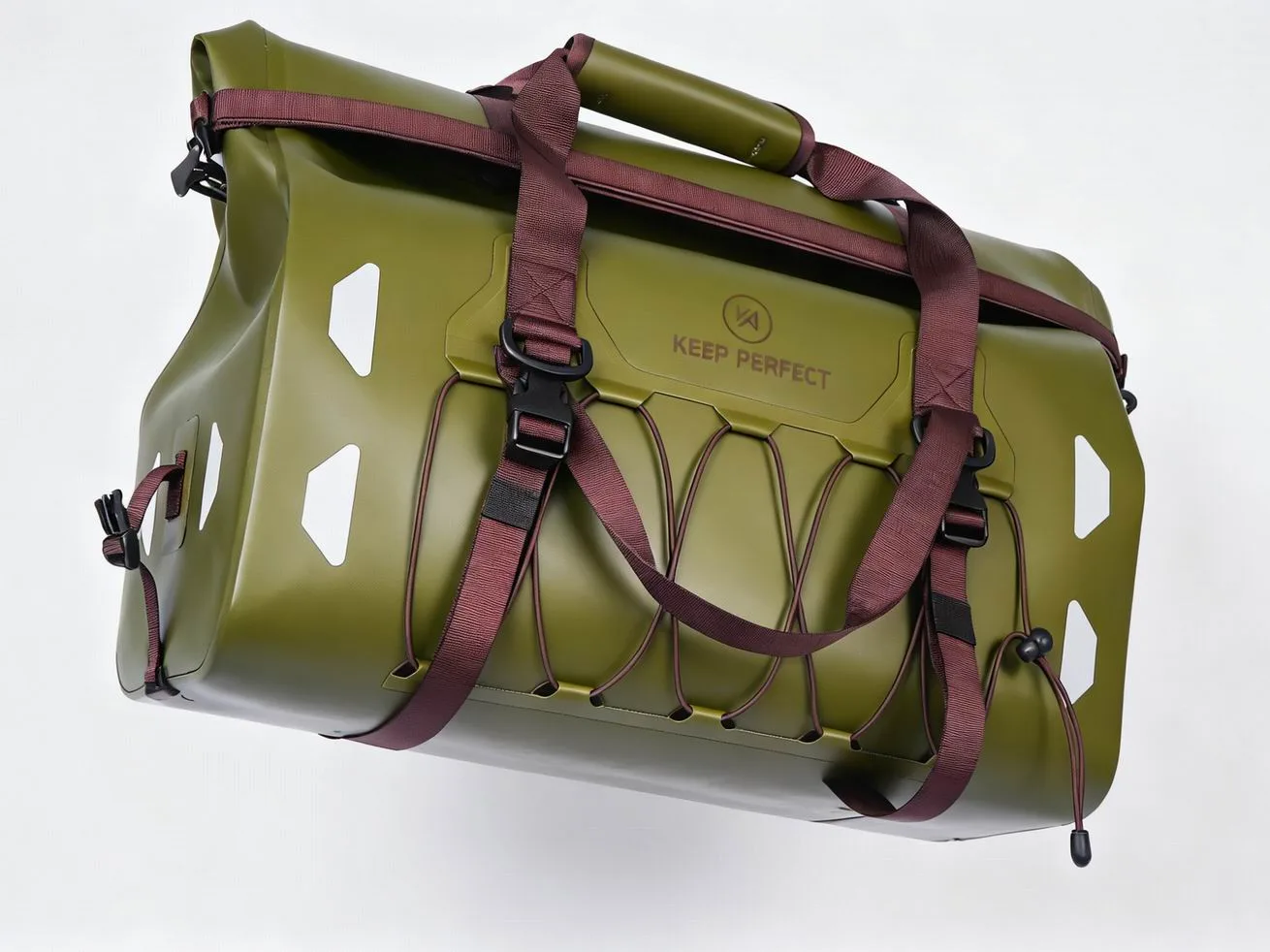
Two comparisons finish the job. Read the bands side by side in our economy versus premium guide, and check what a rating is worth in practice in our tested rating guide. Then apply the checklist to the listing in front of you: our buying checklist runs through the same four spec lines in the order that catches problems fastest, and the spec sheet guide explains what each number on a quotation actually means. Compare platforms across our roll-top range before you decide that a higher price is a higher band.
Frequently asked questions
Q1. How much should a dry bag cost?
Budget USD 18 to 32 for a good 10L roll-top with welded seams and a 0.4 mm film, and USD 55 to 95 for a 30L waterproof backpack. Below USD 12 for a 10L bag you are buying coated fabric with stitched seams.
Q2. Why are some dry bags so cheap?
Because the film is thin, the seam is stitched rather than welded, and the hardware is generic with no cycle rating. None of those show in a photograph, and all of them decide how long the bag lasts.
Q3. Is an expensive dry bag worth it?
Yes when the contents are worth more than ten times the bag or it is used more than twenty days a year. A USD 28 bag lasting eight years costs USD 3.50 a year, against USD 5.50 for a USD 11 bag lasting two seasons.
Q4. What is the best value size of dry bag?
The 10L to 20L band. Fixed costs such as the closure and hardware are spread over more litres, so price per litre falls from 5L through to 40L, and the 10L is the size people carry most.
Q5. How can I tell if a cheap bag is welded?
Look at the seam. A welded join is a smooth pressed band with no thread; a stitched seam shows thread and often a raised taped strip. If the listing does not say welded, assume stitched.
Q6. What film thickness should I pay for?
Pay for 0.45 mm TPU if the bag will be folded daily and dragged, which adds about USD 6 to a 20L bag. A 0.25 mm coated shell is fine for a gym bag used four times a year.
Q7. Do waterproof zippers justify the extra cost?
Only for access speed. A waterproof zip adds USD 8 to 15 on a mid-size bag and needs regular rinsing and lubrication. A roll-top closure is cheaper, more reliable in sand and easier to repair.
Q8. How much does a waterproof rating add to the price?
Roughly USD 300 to 600 for a test package on one size, which is why small top-end bags look expensive. When one rating covers a 2L and a 90L bag, ask which size was actually tested.
Q9. Are branded buckles worth paying for?
Yes. The buckle is the part that ends a bag, not the fabric. A branded acetal buckle with a published cycle rating costs more and can be replaced without replacing the bag.
Q10. Is PVC cheaper than TPU for a reason?
Yes. PVC is cheaper per square metre and welds easily, but it carries plasticiser that migrates out over years, so the bag stiffens and smells. TPU costs more and keeps its flexibility.
Q11. What should a 20L dry bag cost?
Between USD 26 and 42 at retail for a welded TPU build of 280 to 400 g. Anything more than 25% below that range deserves a close look at the seam and the film claim.
Q12. When is a cheap dry bag the right buy?
When the bag will be used a handful of times a year, stored indoors, and the contents are not valuable. It is also right when the risk is loss, as with event giveaways and loaner kit.
Q13. How do I sanity-check a price?
Weigh the bag and divide by its area. A 20L bag at 0.9 m2 weighing under 300 g cannot have a 0.45 mm laminate, whatever the listing claims.
Q14. Does a higher price mean a better rating?
Not necessarily. Price tracks fabric, hardware and harness quality more closely than rating. Check the rating separately, and ask for the test method and the size that was tested.
Q15. What are fair contract prices for dry bags?
At 1,000 pieces, roughly USD 2.90 for a 2L, USD 4.80 for a 10L, USD 6.90 for a 20L and USD 11.40 for a 40L, before tooling, samples and freight.
Q16. Should I buy one expensive bag or three cheap ones?
One good bag plus one small cheap bag. A single good bag protects the valuable kit, and a cheap second bag handles wet or dirty items without risking the one you rely on.
People also ask
Are expensive dry bags worth the money?
Usually, if you use them often. Cost per year is the right measure: a bag that costs twice as much and lasts four times as long is half the price per year, and it fails less often mid-trip.
What is a reasonable price for a 10L dry bag?
USD 18 to 28 for a welded TPU build of 160 to 230 g with a named buckle. Under USD 14 usually means a coated shell with a stitched seam.
Why do dry bag prices vary so much?
Film thickness, seam method, hardware quality and testing are the four variables. Colour, packaging and brand margin move the number only slightly compared with those four.
How long should a dry bag last for the money?
Six to ten years for a mid-band welded TPU bag used on weekends, three to five for a welded PVC bag, and one to three seasons for a stitched budget bag.
Can you tell bag quality from the price?
Partly. Price tracks fabric and hardware reliably, but not ratings. Check the four spec lines yourself: film thickness, welded seams, named buckle, and a rating with a standard.
Do I need to buy the most expensive dry bag?
No. Buy to the use. A mid-band welded bag covers kayaking, sailing, beach and travel; premium builds only pay back for daily carrying, professional abrasion or a tested depth rating.
Need this in production volume?
QUANZHOU JUNYUAN BAGS has produced waterproof bags since 2014 in an SGS-verified 4,950 m2 facility in Fujian, China. Minimum order 500 pieces, sampling in 6–10 working days, bulk in 35–50 days, FOB Xiamen — write to service@junyuanbags.com with your spec and target market.