Waterproof Packing List for Fly Fishing
A fly fishing day keeps an angler standing in moving water for four to seven hours, and the day kit weighs 2.5 to 4 kg across 8 to 14 litres once fly boxes, tippet spools, leaders, a rain shell, food and a camera are counted. Water arrives from three directions: wading depth, rain, and spray off the line, so the practical answer is two sealed bags rather than one, with the small items double-bagged.
This list is built around consequence rather than weight. Lose a fly box and the day continues; lose a licence, a phone or a reel and it does not. The tables below give packed volume, weight and a wet-risk rating for every item, plus where each belongs in a wading or boat setup, so you can match bag sizes to the water you actually fish rather than to a generic list.
- What water does to fly fishing kit
- The two-bag rule for wading
- The core packing list with volumes and weights
- Fly boxes, tippet and the small items that vanish
- Reels, rods and hard gear
- Electronics: phone, camera and fish finder
- Licence, documents and the wallet problem
- Boat, raft and drift boat setups
- Wading: keeping the bag out of the current
- Salt versus freshwater: what changes
- Loading order: how to pack the bag
- Drying and maintenance after the day
- A fly fishing waterproof checklist
What water does to fly fishing kit
Fly fishing is unusual among watersports because the angler is in the water rather than on it. Wading to thigh depth in a river with a 1.5 m/s current puts constant hydrostatic pressure on anything carried below the chest, and a slip that fills a wader top soaks everything in a chest pack within seconds. Rain is the second exposure, and it is the one that catches people out because a light drizzle still wets a fly box left open on a bank.
The third exposure is specific to the sport: water off the line. Every cast pulls a wet fly line through the air and drips onto whatever is below it, and over a six-hour session that drip is a steady trickle rather than a splash. A bag that would survive a shower can still end a day damp, which is why welded construction and a sealed closure matter more here than a high denier face fabric.

The two-bag rule for wading
One bag cannot serve both jobs. The bag you access constantly, holding fly boxes, tippet and nippers, needs to be on your chest or hip and openable with one wet hand. The bag holding the things that must not get wet, such as a licence, a phone, a spare layer and food, needs to be sealed and out of the water entirely, which in practice means behind you or on the bank.
Splitting the load also changes the failure maths. A single 20L bag that fails wets everything; two bags of 8 to 12 litres mean a failure costs half the day rather than all of it. Two smaller bags also sit better when wading, because a bulky bag on the hip catches the current and pushes you off balance in a way a low, tight bag does not.
| Bag | Size | Position while wading | Contents | Access |
|---|---|---|---|---|
| Working bag | 5-10 L | Chest or hip, above wading depth | Fly boxes, tippet, nippers, floatant | Constant, one hand |
| Sealed bag | 10-20 L | Back or bank, out of the water | Licence, phone, spare layer, food | Rare, two hands |
| Documents pouch | 1-2 L | Inside the sealed bag | Licence, cards, keys, permit | Once a day |
| Wet compartment | 5 L | Outside the pack | Wading socks, wet shell | End of day |
The core packing list with volumes and weights
Below is a full day kit measured as actually packed, not compressed. The total comes to roughly 11 litres and 3.4 kg before water, which fits comfortably in a 15L sealed bag plus a 5L working bag. Anglers who carry a camera or a second reel should add 2 litres and 1.2 kg, and move to a 20L sealed bag.
The wet-risk column is the one to read carefully. High risk means an item stops working if it gets wet: a phone, a licence, a down jacket. Medium risk means it degrades: a fly box rusts hooks, tippet spools swell, floatant washes off. Low risk means it tolerates water, which is why those items belong on the outside of the system.
| Item | Packed volume | Weight | Wet risk | Where it lives |
|---|---|---|---|---|
| Two fly boxes | 1.1 L | 280 g | Medium, hooks rust | Working bag, chest |
| Tippet spools and leaders | 0.6 L | 120 g | Medium, spools swell | Working bag, chest |
| Nippers, forceps, floatant | 0.4 L | 180 g | Low | Working bag, chest |
| Fishing licence and permit | 0.1 L | 30 g | High | Documents pouch, sealed |
| Phone and car key | 0.3 L | 210 g | High | Documents pouch, sealed |
| Rain shell | 1.6 L | 290 g | Low | Top of sealed bag |
| Insulated mid layer | 2.4 L | 420 g | High, loses loft | Centre of sealed bag |
| Food and water | 2.2 L | 1.1 kg | Low | Sealed bag, base |
| First-aid and repair pouch | 0.9 L | 400 g | Medium | Sealed bag, side |
| Camera body and one lens | 1.8 L | 1.1 kg | High | Padded pouch, sealed bag |
Fly boxes, tippet and the small items that vanish
Small items are the real packing problem on the water, not large ones. A tippet spool dropped in a river is gone, a nipper on a retractor is fine, and a fly box left open on a wet rock will rust every hook in it within an hour. The working bag therefore needs structure rather than volume: a flat main compartment, one zipped or rolled inner pouch, and a lanyard point for tools.
The pattern that works is to keep every small item attached or contained. Tippet spools on a retractor, nippers on a zinger, forceps on a lanyard, and fly boxes in a single flat compartment that closes with one motion. That discipline matters more than bag capacity, because the most common way to lose kit on a river is setting it down on a rock and wading away.
Rust is the specific threat to fly boxes. Modern hooks are usually chemically sharpened steel and will show rust within 24 hours of contact with water if the box does not drain and dry. Choose fly boxes with drain holes, open them every evening, and keep silica gel in the working bag. Our gear protection guide covers the same issue for lure boxes.
Reels, rods and hard gear
Hard gear is mostly water-tolerant, which is why it is usually carried exposed. A reel on a rod will survive a full day of rain and a dunking; it needs rinsing, not bagging. A spare reel in its case is different, because a neoprene case holds water against the spool and the drag stack for days, and that is where corrosion starts.
The exceptions worth bagging are a spare reel, a landing net handle with any metal ferrule, and any polarised sunglasses, which scratch and fog. Polarised lenses are also the single most expensive item most anglers carry and the easiest to lose, so a hard case clipped to the outside of the working bag is worth the 90 grams. Rod tubes are a separate question: a welded tube keeps a four-piece rod dry in transit but is not needed for a day on the water.
Electronics: phone, camera and fish finder
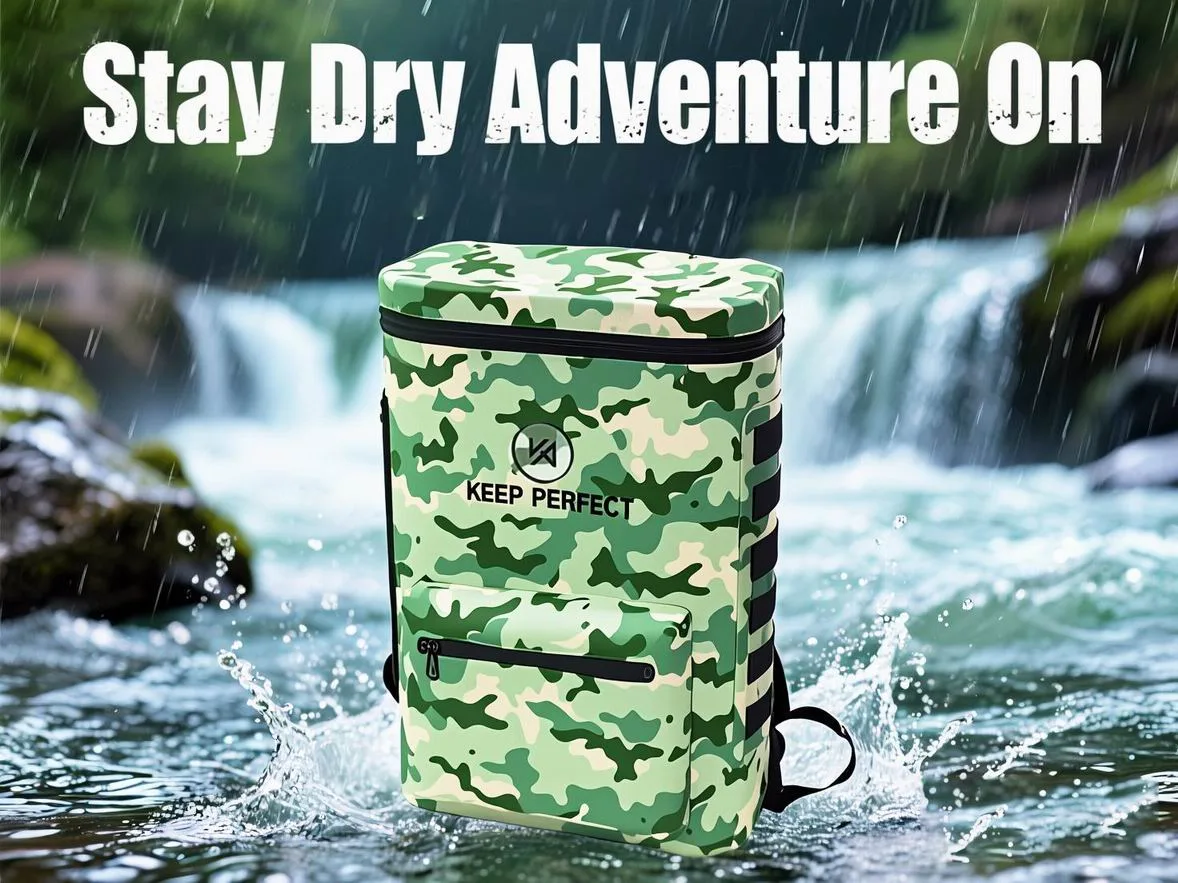
Electronics are the items that turn a wet day into an expensive one. A phone in a hip pocket is at real risk the moment you wade deeper than the pocket, which on most rivers happens within the first hour. A sealed 1L or 2L pouch inside the main bag gives two independent barriers: the pouch and the bag closure.
Cameras need more than waterproofing. A body and one lens in a padded insert inside a 20L sealed bag is the standard approach, and the bag must be opened on the bank rather than in the water. Fish finder batteries and display units are designed for splash but their connectors are not, so bag the unit separately from the transducer cable and dry both before storage. Our camera kit sizing guide gives volume figures by lens count.
Licence, documents and the wallet problem
A fishing licence is the item most likely to end a day early. Paper licences dissolve, and a plastic card in a wallet survives water but not being dropped in a river. The fix is a small welded pouch carried inside the sealed bag, with the licence and a photo ID together, and a second copy photographed on your phone as a fallback.
Keep the car key in the same pouch. Anglers lose keys at a rate that surprises people who have not fished: a key in a wader pocket goes into the water the first time you step deeper than expected. A pouch with a clip point inside the bag, plus a spare key hidden outside the vehicle, costs nothing and saves a long walk.
Boat, raft and drift boat setups
Boat fishing changes the geometry completely. The angler is out of the water, so the wading risk disappears and is replaced by splash, spray and the constant damp of a boat floor. The working bag moves to a seat or a casting platform where it can be opened one-handed, and the sealed bag goes under a seat or in a dry compartment where it stays out of the bilge.
The important addition on a boat is a tether. Anything not lashed will move when the boat does, and a bag that slides across a casting platform at the wrong moment is both a hazard and a loss risk. Use a short leash to a fixed point, keep the working bag within arm reach, and never leave a bag on a gunwale where a wake can take it.
| Position on a boat | Exposure | Bag size | Tether? | Note |
|---|---|---|---|---|
| Casting platform | Splash, spray | 5-10 L | No, within reach | Working bag, one-handed access |
| Under the seat | Bilge damp | 15-20 L | Yes, short leash | Sealed bag, clothing and food |
| Dry compartment | Low | 10-20 L | No | Documents and electronics |
| Gunwale | High, loss risk | Nothing | Never leave here | A wake will take it |
| Anchor or bow bag | Constant spray | 20-30 L | Yes, two points | Spare layers, rain gear |
Wading: keeping the bag out of the current
Position beats specification when wading. A bag worn high on the back stays dry in water that would soak the same bag on a hip belt, because wading depth is the exposure and height is the control. Aim to keep the sealed bag above the level you expect to wade, and accept that a deep crossing means either turning back or carrying the bag above your head.
Current pressure is the second factor. A bulky bag on a hip acts as a sail in a 1.5 m/s flow and it is genuinely tiring over a long day; more importantly, it shifts your balance at exactly the moment you need it. Keep the wading load low, tight and symmetric, and put anything bulky in a backpack-style harness rather than on a sling.
Salt versus freshwater: what changes
Saltwater fly fishing is harder on gear in every dimension. Salt accelerates corrosion on hooks, reel seats and any exposed steel by roughly an order of magnitude compared with freshwater, and it crystallises in zips, buckles and reel drags. The packing list barely changes; the maintenance routine changes completely.
The material choice shifts too. Freshwater anglers can use almost any welded bag; saltwater anglers should specify TPU over PVC, coated or stainless hardware over plain steel, and a rinse routine that happens on the day rather than at the end of the trip. The table below sets out the practical differences.
| Factor | Freshwater | Saltwater | Action for salt |
|---|---|---|---|
| Hook corrosion | Rust in 24-48 h | Rust in 2-6 h | Rinse boxes, dry open, silica gel |
| Hardware on the bag | Any coated metal | Stainless or coated only | Rinse buckles every trip |
| Reel and drag | Rinse weekly | Rinse every session | Fresh water at ambient temperature |
| Fabric choice | TPU or PVC acceptable | TPU preferred | PVC stiffens and holds salt |
| Closure care | Occasional check | Rinse the fold every trip | One crystal defeats the seal |
| Drying | Air dry, shade | Rinse first, then air dry | Never dry salty gear |

Loading order: how to pack the bag
- Put documents, licence, phone and keys in the 1L or 2L pouch and seal it first.
- Place dense and low-risk items at the base: food, water, first-aid pouch.
- Add the insulated layer in the centre, folded rather than stuffed to save volume.
- Put the rain shell on top where it is reachable without unpacking.
- Press the air out from the base upward, then roll three folds and clip the buckle.
- Load the working bag last, with fly boxes flat and every tool on a retractor.
- Check the fold line with a thumb for grit before the final close, every time.
The order is about access and about consequence. Items you need during the day sit at the top or in the working bag; items you only need in an emergency sit at the centre where they are protected by everything around them. Insulation in the centre is deliberate: a wet insulated layer is a cold-weather safety problem, and the centre of a packed bag is the last place water reaches.
One habit separates anglers who stay dry from those who do not: the fold-line check. A single grain of sand or a fragment of grit in the roll-top fold creates a capillary path that moves water into the bag over an hour. Running a thumb along the fold before the final close takes two seconds and prevents most of the leaks people blame on the bag.
Drying and maintenance after the day
The day is not over when you leave the water. Empty both bags completely, turn them inside out, and wipe the interiors dry with a cloth. Rinse the exterior at ambient temperature, paying particular attention to the closure fold and any buckle, then hang both bags open in shade with the mouth rolled back.
Fly boxes need their own routine: open every box, shake out water, and leave them open overnight with a sachet of silica gel in the working bag. Reels get a fresh-water rinse and a loose drag before storage. Wading boots and socks go in the wet compartment, not into the sealed bag, and should be dried within 24 hours to prevent odour and mildew setting in.
A fly fishing waterproof checklist
- Run two bags: a 5-10 L working bag you can open one-handed and a 10-20 L sealed bag.
- Double-bag the licence, phone and car key in a 1-2 L welded pouch.
- Keep all small tools on retractors or lanyards so nothing gets set down on a rock.
- Choose fly boxes with drain holes and dry them open every evening.
- Wear the sealed bag above the depth you plan to wade; height is the control.
- Tether every bag on a boat and never leave anything on a gunwale.
- Check the fold line for grit before every close; one grain defeats the seal.
- In salt water, specify TPU, coated hardware and a rinse on the day, not later.
- Match sizes against the full product range before the season starts.
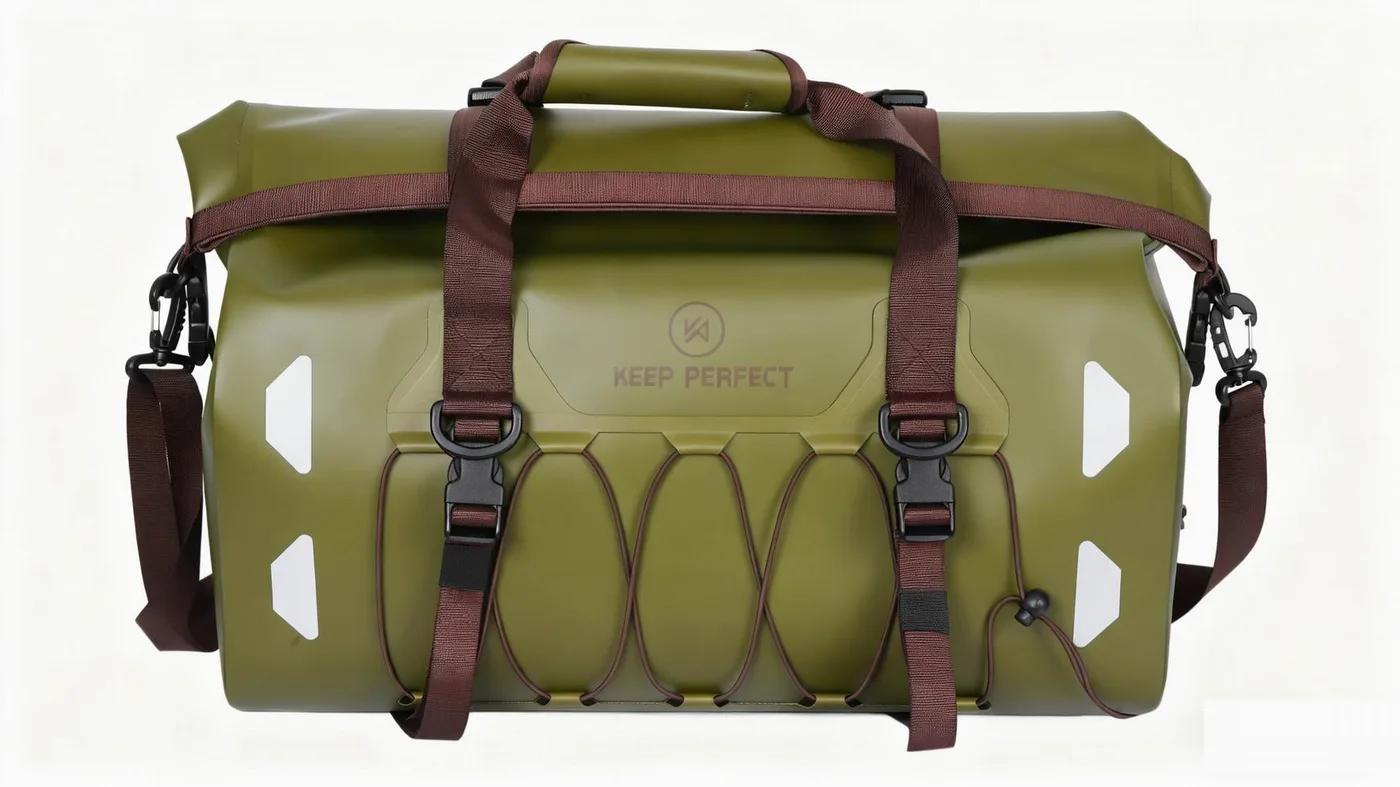
Two additions are worth considering for anyone fishing from a boat or a raft. A compression strap setup helps a 20L bag sit flat under a seat, and a clear window helps identify a bag in a dry compartment without opening it on a wet deck. Neither is essential for wading, which is why the same list produces different bag choices for a river angler and a flats angler fishing from a skiff.
Conditions decide more than gear does, so check them properly. The NOAA service publishes river and coastal forecasts that matter for wading safety, and the EPA publishes fish consumption advisories worth reading where you intend to keep fish. For the packing side, our canoeing packing list covers the boat-based variant, and the spearfishing guide covers full-immersion use.
Anglers fishing from a kayak or a raft will want the capacity detail in our hatch packing guide, which sets out which sizes pass through which openings.
Frequently asked questions
Q1. What size dry bag do I need for fly fishing?
Two bags: a 5 to 10 L working bag for fly boxes and tools that you can open one-handed, and a 10 to 20 L sealed bag for clothing, food, documents and electronics. A full day kit is about 11 litres and 3.4 kg.
Q2. Should I use one big bag or two smaller ones?
Two smaller ones. A failure in a single large bag wets everything, while two bags halve the loss. Smaller bags also sit lower and tighter when wading, so they catch less current against your hip.
Q3. How do I keep my fishing licence dry?
Put it in a 1L or 2L welded pouch inside the sealed bag, together with photo ID and the car key. Photograph it on your phone as a fallback; a paper licence that dissolves ends the day regardless of how well you packed.
Q4. Do fly boxes need to be waterproof?
They need to drain and dry rather than be sealed. Modern hooks rust within 24 hours of contact with water, so choose boxes with drain holes, open them each evening and keep silica gel in the working bag.
Q5. Where should I carry my phone when wading?
In a sealed pouch inside the main bag, never in a wader pocket. A hip pocket goes under water the first time you step deeper than expected, which on most rivers happens within the first hour.
Q6. What is the best bag position for wading?
High and tight. Keeping the sealed bag above the depth you plan to wade is the single most effective control, and a low, symmetric load catches far less current than a bulky bag on a hip.
Q7. Do I need different gear for saltwater fly fishing?
The list barely changes and the maintenance does. Rinse everything in fresh water on the day, specify TPU over PVC, use coated or stainless hardware, and dry fly boxes open with silica gel every night.
Q8. How much does a fly fishing day kit weigh?
About 3.4 kg across 11 litres for a standard kit: fly boxes, tippet, tools, licence, phone, rain shell, insulated layer, food and first-aid. Add 1.1 kg and 1.8 litres if you carry a camera body and one lens.
Q9. Should I tether my bag in a boat?
Yes, always. Use a short leash to a fixed point and keep the working bag within arm reach. Never leave a bag on a gunwale, because one wake is enough to take it over the side.
Q10. Can I bring wet wading boots home in a dry bag?
Yes, in a dedicated wet compartment. A roll-top keeps water in as reliably as it keeps water out, so a 5L bag for boots and wet socks protects everything else in the vehicle.
Q11. How do I stop grit getting into the closure?
Run a thumb along the fold line before the final close. A single grain of sand creates a capillary path that moves water into the bag over about an hour, and it is the cause of most leaks blamed on the bag itself.
Q12. Is a clear window worth having on a fishing bag?
On a boat, yes: it lets you identify a bag in a dry compartment without opening it on a wet deck. For wading it adds an unnecessary second weld, so colour coding is the better choice.
Q13. What should I do with a reel after a saltwater session?
Rinse it in fresh water at ambient temperature, back the drag off to store it, and dry it before the next trip. Reels rinsed weekly in freshwater will corrode badly if that routine is carried over to salt use.
Q14. How quickly do hooks rust after getting wet?
Rust can appear within 2 to 6 hours in saltwater and 24 to 48 hours in freshwater. Open every box, shake out the water and dry them with a sachet of silica gel in the bag.
Q15. Do I need a rod tube for a day on the water?
Not usually. A rod on a rod holder or carried assembled is designed for rain and spray. Welded tubes matter for air travel and long vehicle journeys, not for a day session.
Q16. How do I dry everything after a day on the river?
Empty both bags, wipe the interiors, rinse the exterior at ambient temperature, and hang them open in shade with the mouth rolled back. Open every fly box overnight and dry wading boots within 24 hours.
People also ask
How do you pack a dry bag for fly fishing?
Put documents and electronics in a sealed inner pouch first, dense items at the base, insulation in the centre and the rain shell on top, then press out the air, roll three folds and clip. Keep fly boxes in a separate working bag you can open one-handed.
What should you always carry fly fishing?
Fly boxes, tippet and leaders, nippers and forceps, floatant, a licence and photo ID, a phone and car key, a rain shell, an insulated layer, food and water, and a small first-aid and repair pouch.
Are dry bags worth it for wading?
Yes, because wading depth is the exposure and a slip fills a wader top. Keeping a sealed bag above the depth you plan to wade is the single most effective protection for clothing, documents and electronics.
How do you keep a phone dry while fishing?
Use a sealed 1L or 2L pouch inside the main dry bag so there are two independent barriers. Never rely on a wader pocket, which goes under water as soon as you step deeper than expected.
What size dry bag fits a fly fishing day kit?
About 11 litres and 3.4 kg, which fits a 15L sealed bag plus a 5L working bag. Anglers carrying a camera or a second reel should move to a 20L sealed bag and add roughly 2 litres.
Can you use the same dry bag for freshwater and saltwater?
Yes, but maintain it differently. In saltwater, rinse the bag, the closure fold and every buckle with fresh water on the day, and dry fly boxes open with silica gel, because corrosion is roughly ten times faster.
Need this in production volume?
QUANZHOU JUNYUAN BAGS has produced waterproof bags since 2014 in an SGS-verified 4,950 m2 facility in Fujian, China. Minimum order 500 pieces, sampling in 6–10 working days, bulk in 35–50 days, FOB Xiamen — write to service@junyuanbags.com with your spec and target market.