Home / Blog / Waterproof Technology
How Brands Claim Waterproofing
A waterproofing claim is only as good as the test behind it, and the four families of test in common use differ by a factor of roughly 40 in severity. A spray test passes a fabric at 300 mm of water column; a genuine IPX7 immersion needs a welded seam and a closure that holds for 30 minutes at one metre, which is equivalent to a sustained 10,000 mm or more across the whole construction. Between those two extremes sit most of the adjectives on hangtags: showerproof, stormproof, all-weather, water-repellent, and water-resistant, none of which has a defined test attached.
This guide maps every common claim to the test that should support it, explains how the same fabric can be honestly quoted at four different numbers depending on conditioning, and shows how temperature, duration and sample state change a result by 20 to 50%. It also lists the wording that signals a weak result, the questions to put to a bag maker before a volume order, and the ten-minute field checks that reproduce the essentials of a laboratory protocol without a water column rig.
- The vocabulary of waterproof claims, ranked by strength
- The four test families behind the numbers
- IP and IPX ratings in plain language
- Hydrostatic head: reading the millimetres
- How test conditions change a result
- Claims that sound technical but carry no information
- Why a rating on new material is not a rating in year three
- Immersion testing and the 30-minute convention
- Reading a specification sheet like an engineer
- Questions to put to a bag maker before a volume order
- Ten-minute field checks that mirror the lab
- Writing an honest claim for your own product
The vocabulary of waterproof claims, ranked by strength
Claims form a rough hierarchy, and the useful habit is to translate each one into the test it implies. At the bottom sits water-repellent, which means a finish that makes water bead and run off; it has no pressure rating at all and fails within seconds of contact under load. Water-resistant is the next step up and usually implies some spray testing, but no standard threshold exists, so two products with the same label can differ by an order of magnitude.
Waterproof is the strongest common word and should mean the item resists water penetration under defined pressure for a defined time. Above it sit the rated claims: IPX6, IPX7 and IPX8 from the ingress protection system, and hydrostatic head figures quoted in millimetres. These are the only claims that can be checked against a written protocol, and they are the only ones worth comparing across two products.
Everything else is decoration. Stormproof, all-weather, monsoon-ready and marine-grade are marketing constructions with no test method behind them. That does not make them dishonest by definition, but it does mean they carry no information, and a brand quoting them instead of a number has told you something about the strength of its evidence. Our water-resistant versus waterproof comparison sets out where the real line sits.
| Claim wording | Implied performance | Test that should support it | Verifiable? | Typical gap |
|---|---|---|---|---|
| Water-repellent finish | Beading, no pressure | Spray rating, optional | No | None declared |
| Water-resistant | Light spray, short contact | Spray test, no threshold | Rarely | Wide |
| Showerproof | Brief light rain | Shower test, 5 min | Rarely | Wide |
| Stormproof | Sustained rain | No defined method | No | Unbounded |
| Waterproof | Pressure for a stated time | Hydrostatic head or IPX | Sometimes | Moderate |
| IPX6 | Powerful jets | IEC 60529 jet test | Yes | Small |
| IPX7 | 30 min at 1 m | IEC 60529 immersion | Yes | Small |
The four test families behind the numbers
Almost every waterproof claim traces back to one of four methods. A spray test wets the surface from a fixed nozzle and rates beading against a photographic standard. A shower test is its bigger sibling, spraying a larger volume from above for a set duration, often five minutes at 10 litres per minute. A hydrostatic head or water column test presses water against a clamped fabric sample and records the height in millimetres at which the third drop appears.
The fourth family is immersion, which is what IPX7 and IPX8 describe: the whole finished article goes under water for a defined period at a defined depth. This is the only family that tests the seams, the closure and the geometry rather than a flat swatch, which is why it is the only one that predicts field behaviour on a boat. A fabric that scores 20,000 mm on a column test can still belong to a bag that leaks, because the water did not enter through the fabric.
Understanding which family produced a number is the whole skill. A 5,000 mm hydrostatic head sounds impressive and means the fabric resists a 5-metre column of static water at that spot; it says nothing about a seam, a buckle, or a rolled closure. A bag quoting IPX7 has had its whole construction tested, including the weak points. See the mechanics in our hydrostatic head explainer and the water column test basics.
IP and IPX ratings in plain language
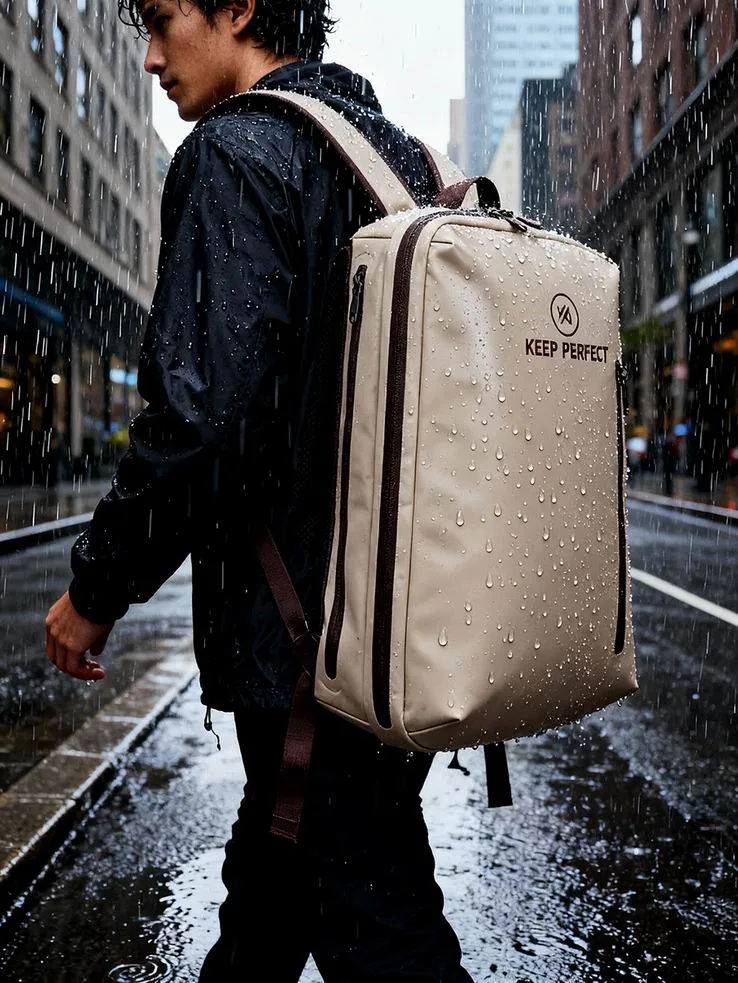
The ingress protection code is published by the IEC as IEC 60529 and grades enclosures against solid objects and liquids. The second digit is the water grade, and an X in the first position means the solid grade was not tested, which is normal for bags. IPX4 covers splashing from any direction, IPX5 covers low-pressure jets, IPX6 covers powerful jets, IPX7 covers temporary immersion, and IPX8 covers continuous immersion at a depth the producer specifies.
Two details trip people up. IPX7 is not automatically better than IPX6 for a surface use case, because the two tests measure different things: a bag can pass a 30-minute immersion and still fail a directed jet if its closure geometry deflects water under pressure. And IPX8 is not a fixed depth; the standard requires the producer to state the depth and duration, so an IPX8 claim without those two numbers is incomplete by definition.
| Grade | Test description | Duration | Real-world equivalent | Where it matters |
|---|---|---|---|---|
| IPX4 | Splashing from any direction | 5 min | Light rain, paddle drip | Day packs, liners |
| IPX5 | 6.3 mm nozzle, 12.5 L/min | 3 min | Heavy rain at speed | Cycling, commuting |
| IPX6 | 12.5 mm nozzle, 100 L/min | 3 min | Bow spray, storm rain | Deck bags, coastal paddling |
| IPX7 | Immersion at 1 m | 30 min | Wet exit, capsize | Sea kayaking, canoe |
| IPX8 | Immersion at stated depth | Stated by producer | Extended submersion | Dive support, rescue |
Hydrostatic head: reading the millimetres
A hydrostatic head figure is the height of a water column a fabric withstands before leaking, measured on a clamped swatch with the water pressure rising at a standardised rate. Ten thousand millimetres corresponds to about 0.98 bar, and it is a genuinely useful number for comparing fabrics. It is not, however, a measure of the finished bag, and it degrades with abrasion, folding and contamination far faster than most people expect.
The useful threshold depends on where the pressure comes from. Sitting on a wet groundsheet generates roughly the equivalent of 1,000 to 2,000 mm under a kneeling load. A shoulder strap pressed against a wet back under a loaded pack reaches perhaps 3,000 to 5,000 mm. Immersion at one metre is near 10,000 mm at the deepest point. So 5,000 mm is adequate for rain and questionable for submersion, and 10,000 mm or more is the sensible floor for a bag that will genuinely go under.
Abrasion is the hidden variable. Measured after 5,000 rubs on a standard abradant, a coated fabric that started at 6,000 mm can drop below 3,000 mm, while a 0.50 mm laminated film holds most of its figure because the barrier is thick. Any serious specification should quote hydrostatic head after abrasion as well as new, and that second number is the one that predicts a complaint two years later.
How test conditions change a result
| Variable | Typical protocol | Effect on result | What a weak claim omits |
|---|---|---|---|
| Water temperature | 20 °C ± 2 | ±10% at 5 °C vs 30 °C | Temperature not stated |
| Rate of pressure rise | 10 mm/s or 60 mm/s | Up to 25% difference | Rate not stated |
| Sample conditioning | 24 h at 20 °C, 65% RH | ±15% if damp | Conditioning skipped |
| Number of specimens | 5 minimum, median reported | Best-of-five inflates by 20% | Best result quoted |
| Fabric after abrasion | Retest after 1,000-5,000 rubs | Down 30-50% | Only new material tested |
| Seam included in sample | Whole article or swatch | Swatch can be 3x higher | Flat swatch only |
Taken together, these variables mean an honest 8,000 mm result can be presented as anything from 6,000 to 12,000 mm without technically lying, simply by choosing the rate of rise, the conditioning and whether the best or the median specimen is reported. That is why the method reference matters more than the headline figure, and why ISO 811 and ASTM D751 exist: they pin the conditions down so two numbers are comparable.
Claims that sound technical but carry no information
- Military-grade waterproofing: no recognised military standard for bags exists; the phrase has no test attached.
- Tested to extreme conditions: no depth, duration or temperature, so nothing can be reproduced.
- Waterproof fabric: true of the material and silent about the seams, which is where bags leak.
- Sealed seams: sealed with what, tape or weld, and tested to what pressure?
- Submersible to 10 metres: for how long, and did the closure hold or was the sample clamped shut?
- Laboratory certified: certified by whom, against which protocol, and is the certificate dated?
Each of these can be rescued by adding two numbers, and a credible brand will add them when asked. If the answer to what depth and for how long is a shrug, treat the claim as untested and price the product accordingly. This is not cynicism; it is simply the difference between a specification and a slogan, and only one of the two survives contact with water.
Why a rating on new material is not a rating in year three
Waterproof performance declines with use, and the decline is measurable. Welded seams lose strength mainly at corners and fold lines, typically retaining 85 to 95% of initial peel value after three seasons of weekend use. Coated fabric loses hydrostatic head through abrasion and hydrolysis, sometimes by half. Closures are the fastest-degrading element of all, because the roll-top mouth is folded and unfolded hundreds of times a year.
A sensible way to express this is a two-number claim: the rating when new and the rating the product is designed to hold after a defined service period. Very few brands publish the second figure, which is a shame, because it is the one that matters to a buyer deciding between two products at similar prices. Our own guidance on how waterproof ratings degrade goes through the mechanisms in detail.
There is a maintenance dimension too. A bag rated IPX7 when new will not pass that test with sand in the closure, with a fold taken across a crease, or with a buckle that has lost tension. Every one of those is user-preventable in under a minute, which is why the care instructions that ship with a bag are part of the claim rather than an afterthought to it.
Immersion testing and the 30-minute convention
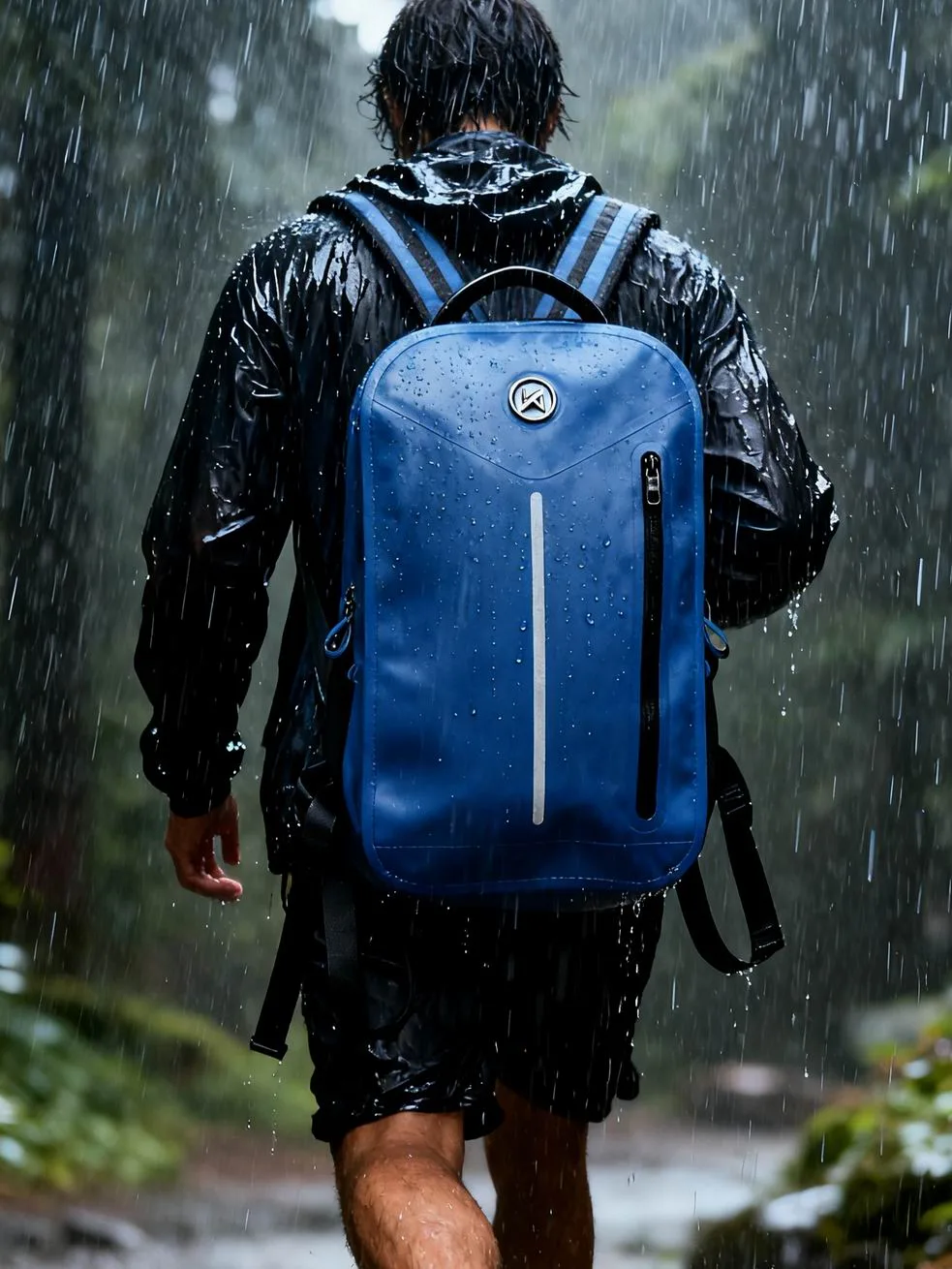
The IPX7 immersion test is deceptively simple: submerge the article so its lowest point is one metre below the surface, hold for 30 minutes, then inspect the inside. Simple as it is, the result depends on details that are easy to get wrong. A bag with trapped air floats, so it must be weighted or held down; a bag that is overfilled has a strained closure that would not be closed that way in use; and a bag tested at 5 °C behaves differently from one tested at 30 °C.
Pressure is the reason depth matters. At one metre the outside pressure is about 1.10 bar, a 10% differential against the air inside the bag, and that differential is what pushes water through any microscopic path. At five metres the differential is 50%, which is why a depth rating without a duration is meaningless: many constructions survive a deep dip and fail a long shallow soak, because time lets capillary action do the work that pressure alone cannot.
For a buyer, the practical version of this test takes a bath and a brick. Fill the bag to about 85%, close it exactly as you would on the water, weigh it down, wait 30 minutes, then dry the outside and open it over a towel. That reproduces the essentials of the laboratory protocol and catches nearly every closure problem. More variants are in our immersion testing guide and the at-home test routine.
Reading a specification sheet like an engineer
A good specification sheet answers five questions without being asked: which test, at what value, on what part of the product, in what condition, and measured by whom. Anything less leaves room for interpretation, and interpretation always favours whoever wrote the sheet. The fastest audit is to look for a standard number: IEC 60529, ISO 811, ASTM D751, or an internal protocol that is described in enough detail to repeat.
Look next for the sample definition. A fabric result on a flat swatch is a material property; a result on a finished bag with seams and a closure is a product property. The second is typically 40 to 70% of the first, and the gap is where warranty claims live. If a sheet quotes only the swatch figure, assume the product figure is substantially lower and ask for it directly.
Finally, check who measured it. An in-house result is fine if the protocol is stated and the date is recent; a third-party laboratory report is better, and for programme buying it is worth requesting the certificate rather than the summary. Inspection standards matter here too: production is sampled to AQL 2.5 in our own line, which means the bag you receive is not a hand-picked sample. The relationship between lab and reality is explored in our field versus lab testing guide.
Questions to put to a bag maker before a volume order
- Which standard and which grade, named exactly: IEC 60529 IPX7, ISO 811 at a stated head, or an internal protocol?
- Was the test run on a flat swatch or on a finished bag including seams and the closure?
- What were the water temperature, the duration and the depth, and how many specimens were measured?
- Was the median or the best result reported, and can I see the full set?
- What is the hydrostatic head after 1,000 and 5,000 abrasion cycles, not only on new material?
- Is there a dated third-party report, or is this an in-house result?
- What performance is the product designed to retain after three seasons, and is that written down?
A serious production partner answers all seven in a day and sends supporting documents without being chased. A vague answer to the second question, about finished product versus swatch, is the single most informative response you will get, because it tells you whether the brand has ever tested the thing it actually sells. Everything else follows from that.
It also pays to ask about inspection rather than design. A product can be well designed and inconsistently made, and in waterproof goods inconsistency is fatal, because one weak seam in a thousand is one ruined trip. Ask what sampling level is applied, what the acceptance number is, and whether every unit or a sample is leak checked. We have produced waterproof bags since 2014 in an SGS-verified 4,950 m2 facility, and we document the full process for every programme: sampling takes 6 to 10 working days and bulk runs 35 to 50 days.
Ten-minute field checks that mirror the lab
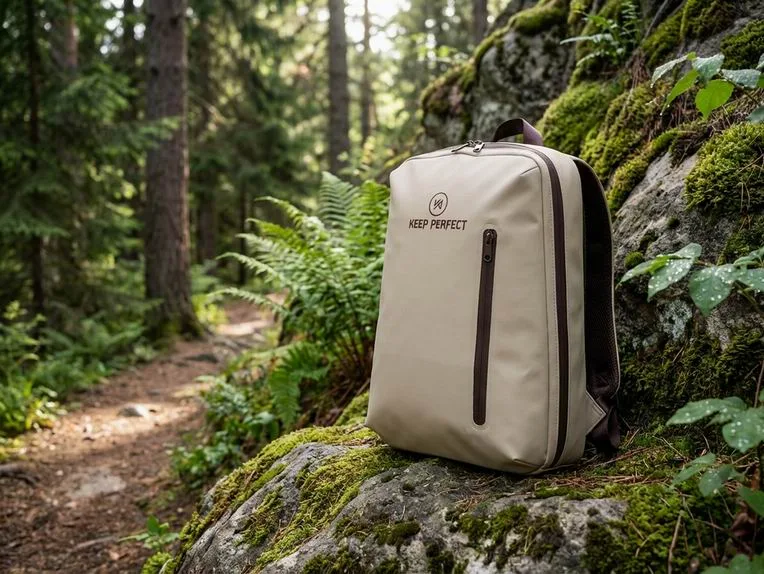
- Bath immersion: fill to 85%, close normally, weigh down, wait 30 minutes, dry the outside, open over a towel.
- Shower test: hold the closed bag under a running shower for five minutes from all sides, then check the inside.
- Air squeeze: close the bag and press firmly; a hiss at the closure means the fold is not sealing.
- Base pressure: place the loaded bag on a wet surface for an hour and check the base panel from the inside.
- Seam tug: pull firmly on both sides of each welded joint and look for whitening, which indicates stress.
Run the bath test twice a season and after any repair. It takes almost no time and it is the only check that exercises the whole construction, seams and closure together. A bag that passes in year five has told you something real about its material; a bag that fails has told you early enough to do something about it, which is the entire point of testing at all.
Writing an honest claim for your own product
If you are putting a claim on your own packaging, the discipline is simple and it costs nothing: state the test, the value, the duration and the condition. IPX7 to IEC 60529, 30 minutes at one metre, tested on finished bags, is a sentence that any competitor can verify and no regulator can challenge. Waterproof to 5,000 mm ISO 811 after 1,000 abrasion cycles is equally defensible and far more useful than a superlative.
Avoid the temptation to quote the strongest number you can find anywhere in the data set. Overstating a rating converts a satisfied buyer into a warranty claim the first time the product meets real water, and the reputational cost of one failed bag exceeds the margin on a hundred correctly labelled ones. Under-promise slightly, publish the method, and let the field results do the arguing.
Whatever the claim, the closure remains the weak link, and the honest thing is to say so in the instructions: three folds, no trapped air, no sand in the fold line. Our roll-top closure guide explains the mechanics, and the roll count analysis puts a number on the margin. Sizes and ratings for every platform are listed in the full product line, and the academy hub collects the testing material in one place.
Frequently asked questions
Q1. How do brands claim waterproofing?
Most claims come from one of four test families: spray, shower, hydrostatic head on a fabric swatch, or immersion of the finished article. Only immersion tests the seams and closure, which is why IPX7 and IPX8 are the claims that predict real performance on the water.
Q2. What does IPX7 actually mean?
Immersion at one metre for 30 minutes under IEC 60529, published by the IEC. The whole finished product is submerged, so seams and the closure are included. It does not guarantee resistance to a directed jet, which is IPX6.
Q3. Is waterproof better than water-resistant?
Yes, by a wide margin, but both words are unregulated. Water-resistant usually means light spray with no threshold; waterproof should mean resistance to water under defined pressure for a defined time, backed by a named test method.
Q4. What is a good hydrostatic head for a dry bag?
Ten thousand millimetres or more for a bag that will be submerged, and 5,000 mm is adequate for rain and ground contact. Insist on the figure after abrasion, because a coated fabric can lose half its head after 5,000 rubs.
Q5. Can a fabric be waterproof while the bag leaks?
Yes, and this is the most common gap in the market. Water enters through seams, closure folds and hardware, not through the panel fabric. A hydrostatic head figure on a swatch says nothing about the finished product.
Q6. Why do two brands quote such different numbers for similar bags?
Because they are using different test families and different conditions. Rate of pressure rise, sample conditioning, specimen count and whether the best or median result is reported can move a figure by 20 to 50% without any dishonesty.
Q7. Does IPX8 mean a bag is better than IPX7?
Not automatically. IPX8 is continuous immersion at a depth the producer states, so the claim is incomplete without the depth and duration. A bag rated IPX8 at 1.5 m may fail a powerful jet that an IPX6 bag survives.
Q8. What should a waterproof claim always include?
Four things: the standard or protocol, the value, the duration, and what was tested. IPX7 to IEC 60529 for 30 minutes on a finished bag is complete; waterproof to extreme conditions is not.
Q9. How long should a waterproof rating last?
A welded TPU construction typically retains 85 to 95% of seam strength after three seasons of weekend use. Coated fabric degrades faster through abrasion and hydrolysis, and the closure degrades fastest of all because it is folded constantly.
Q10. Are there legal rules about waterproof claims?
General consumer protection rules require claims to be substantiated, and the test standards themselves are voluntary. That is precisely why the method reference matters: a claim backed by ISO 811 or IEC 60529 is defensible, an invented adjective is not.
Q11. How can I test a dry bag claim at home?
Fill to 85%, close normally, weigh it down in a bath for 30 minutes, dry the outside and open over a towel. That reproduces the essentials of IPX7 and catches almost every closure and seam problem.
Q12. What does sealed seams mean on a bag?
It should mean the stitched path is covered by welded tape or, better, that the panels are welded with no thread at all. Ask which one, and ask what pressure the seam was tested at, because taped seams are weaker than welded ones.
Q13. Does a higher IP rating always cost more?
Usually, because it needs welded seams instead of stitched ones and a closure that holds under pressure. In material terms the premium is modest; most of the cost sits in the welding equipment and in the yield lost to rejects.
Q14. Why does my bag leak when the fabric is rated 10,000 mm?
Because the water is not coming through the fabric. Check the closure fold for sand, count the rolls, look for a strained fold from overfilling, and inspect the base panel where ground contact creates pressure.
Q15. Should I trust in-house test results?
Yes if the protocol is stated, the specimen count is given and the report is dated. Ask whether the median or the best result was reported, and whether a third-party laboratory has confirmed it for programme buying.
Q16. What is the difference between shower and jet testing?
A shower test sprays water from above at low pressure for a few minutes and is the weakest family. A jet test fires a defined volume from a nozzle at a defined distance, as in IPX5 and IPX6, and is far more demanding.
People also ask
How do you know if a waterproof claim is real?
Look for a named standard, a value, a duration and a definition of what was tested. IEC 60529, ISO 811 and ASTM D751 are the common references; an adjective with no numbers attached is not a testable claim.
What is the difference between water-resistant and waterproof?
Water-resistant usually means light spray with no defined threshold, while waterproof implies resistance under stated pressure for a stated time. Both words are unregulated, so the test method is what makes the difference meaningful.
Is IPX7 enough for kayaking?
Yes for a wet exit or capsize, which is a short immersion at shallow depth. If you paddle in surf where breaking waves act as jets, look for IPX6 as well, because jet and immersion resistance are separate tests.
Why do waterproof ratings drop over time?
Abrasion thins the barrier, hydrolysis softens coatings, UV oxidises surfaces and fold lines fatigue. Seams retain 85-95% of strength after three seasons on welded TPU, while coated fabric can lose half its hydrostatic head.
Can you test waterproofing without laboratory equipment?
Yes. A bath immersion for 30 minutes with the bag weighted down, a five-minute shower test and an air-squeeze check reproduce the essentials and catch nearly every closure and seam fault.
Do all brands use the same waterproof test?
No. Spray, shower, hydrostatic head and immersion are four different families with wildly different severity, and even within one family the conditions can move a result by 20-50%, which is why the method must be named.
Need this in production volume?
QUANZHOU JUNYUAN BAGS has produced waterproof bags since 2014 in an SGS-verified 4,950 m2 facility in Fujian, China. Minimum order 500 pieces, sampling in 6–10 working days, bulk in 35–50 days, FOB Xiamen — write to service@junyuanbags.com with your spec and target market.