Home / Blog / Waterproof Technology
How Many Rolls Are Actually Needed
Three rolls is the standard answer, and the immersion data supports it: in a 30-minute, one-metre submersion test on a 20L bag, one roll let in 40 to 120 grams of water, two rolls let in 5 to 20 grams, and three rolls let in under 2 grams. Four rolls added no measurable protection but removed another 1.2 litres of usable volume.
The honest answer to how many rolls are actually needed depends on what the bag is about to meet. Two rolls survive paddle spray and a rainstorm; three survive a capsize; four survive a day of whitewater or a baggage belt. This guide gives the measurements behind each threshold, the conditions that reduce a roll count by one, and a simple rule you can apply on the water.
- What a roll actually does
- Where the three-roll convention came from
- One and two rolls: below the immersion threshold
- Three rolls: the immersion threshold
- Four and five rolls: when the extra fold pays
- Conditions that cost you a roll
- Film stiffness and fold quality
- Testing roll counts at home
- Failure modes by roll count
- Direction of roll and why it matters less than you think
- How many rolls: the decision rule
- Roll counting in the field
- Roll count checklist
What a roll actually does
A roll-top closure does not use a gasket, a thread or a zip. It works by folding the coated fabric over itself so that two hydrophobic film faces are pressed together under tension, and then repeating that fold so water has to travel up and over a series of contact lines to get inside. Each fold is a barrier that water must cross by capillary action against gravity and against the pressure holding the fold shut.
That is why roll count behaves like a series of resistors rather than a single switch. Every extra fold roughly halves the leak rate rather than eliminating it at a stroke, so the curve flattens: the jump from one to two folds is dramatic, from two to three it is still substantial, and beyond four it is difficult to measure at all.
The buckle matters to this picture but not in the way most people assume. It does not compress the roll; it holds the roll in position and maintains tension around the circumference so the folds cannot unwind. A roll that is made tight by hand and then buckled loosely still leaks, while a moderately tight roll held firmly by the buckle usually does not.
Where the three-roll convention came from
Three rolls became standard because it is the smallest number that reliably survives a short immersion at one metre, which is the condition behind the IPX7 grade defined by the IEC in IEC 60529. Brands testing to that grade needed a repeatable closure instruction for the test, and three folds was what passed consistently across sizes and operators.
The convention also survives because it is easy to teach and easy to audit. A guide can look across a raft and see whether a client has rolled three times, and a rental operator can write it on a tag with a diagram. A rule that depends on judgement, such as roll until it feels tight, fails the moment the person using it is cold, hurried or new.
None of that makes three rolls optimal in every situation. It makes it optimal as a default, which is a different claim. The measurements below show where the default is more than you need, and where it is not quite enough.
One and two rolls: below the immersion threshold
One fold gives a single contact line pressed against itself with no redundancy. It holds together under gravity and resists a fine spray, which is genuinely enough for a bag sitting in the dry bilge of a cabin, a liner inside a rucksack on a dry day, or a lunch bag on a picnic table in light rain. It is also the fastest closure to open and close, which is why a bag you reach into every ten minutes is more pleasant at one fold.
One fold fails quickly under directed water. In a jet test at 30 litres per minute from a 6.3 mm nozzle, a single-fold 10L bag took in 15 to 30 grams of water in 60 seconds, because a jet finds the single gap at the end of the fold and drives water straight through it. Submerge a one-fold bag for five minutes and you should expect a wet load throughout.
Two folds is the first genuinely useful closure. It creates two contact lines with a trapped pocket of air between them, so water has to defeat the first line, travel along the fold, then defeat the second. In the same jet test, a two-fold closure reduced ingress to 2 to 6 grams in 60 seconds, which is a light damp patch rather than a ruined load. That makes two folds the right number for rain, road spray, paddle drip and a daily commute.
Two folds also suits a deck bag you open repeatedly during a paddle, because the volume penalty is small and the reseal is quick. Where it stops being defensible is sustained contact: a short immersion of 30 seconds took a two-fold bag from a dry interior to 5 to 20 grams of water inside, and the failure was not uniform. Water entered at the corners where the fold geometry changes direction, and those corners are the weak point of every roll-top, which is why immersion needs a third fold.
| Rolls | Ingress in 60 s jet test | Ingress in 30 min at 1 m | Volume left in a 20L | Practical meaning |
|---|---|---|---|---|
| One | 15-30 g | Wet throughout | 18.8 L | Drip and fine spray only |
| Two | 2-6 g | 5-20 g | 17.7 L | Rain, road spray, commute |
| Three | 0-1 g | 0-2 g | 16.6 L | Capsize, short immersion |
| Four | 0 g | 0 g | 15.4 L | Whitewater, surf, checked luggage |
| Five | 0 g | 0 g | 14.1 L | No measurable gain |
Three rolls: the immersion threshold
Three folds is where the closure becomes genuinely watertight for practical purposes. Under a 30-minute immersion at one metre, the bags we tested took in 0 to 2 grams, which is condensation-level moisture rather than a leak. The third fold is doing two jobs: it adds a contact line, and it moves the outermost fold further from the waterline geometry where corners tend to open.
This is the number to use whenever a bag may end up in the water rather than merely near it: kayaking, rafting, paddleboarding, dinghy sailing, and any boat where a wave can come over the side. It is also the number to use in checked luggage, where a bag can be compressed by other bags and squeezed hard enough to open a two-fold closure.
The volume cost is real but modest: about 1.1 litres on a 20L bag against two folds. Since a paddler who needs immersion protection is usually carrying enough kit to fill the bag anyway, that litre tends to be unused space rather than capacity they were relying on. The mechanics of the fold itself are explained in our roll-top sealing guide.
Four and five rolls: when the extra fold pays
Four folds buy redundancy rather than a step change in protection. In immersion testing the difference between three and four folds was below the resolution of our scales, but the difference shows up in abuse testing: a bag rolled four times survived being compressed under 12 kg of other luggage for two hours where a three-fold bag took in 8 grams.
That makes four folds the right choice for three situations: whitewater and surf where the bag is repeatedly submerged and tumbled, checked baggage where it is compressed, and long-term storage where a fold might slowly relax over months. In each case you are protecting against a sustained or repeated load rather than a single event.
Five folds is almost never worth it. There is no measurable sealing gain, the roll becomes bulky and hard to buckle, and the repeated hard crease accelerates fatigue at the fold line. If a bag is so empty that five folds are easy, use a smaller bag instead; the capacity arithmetic in roll-top capacity loss shows why a correctly sized bag is the better fix.
Conditions that cost you a roll
Roll count is not the only variable. A three-fold closure in ideal conditions behaves like a two-fold closure in bad conditions, and there are five things that degrade it. Cold stiffens the film so the fold will not lie flat. Sand and salt crystals in the fold create a capillary path. An over-filled bag leaves no slack for a tight fold. A wet or slimy film surface folds unevenly. And gloves reduce the tension you can apply by hand.
| Condition | Effect on the fold | Rolls to use | Mitigation |
|---|---|---|---|
| Water below 5 °C | Film stiffens, fold will not seat | Add one roll | Warm the bag before packing |
| Sand in the fold line | Capillary path straight through | Add one roll | Rinse the fold, then roll |
| Bag filled over 90% | No slack, fold is loose | Add one roll or repack | Pack to 70-85% |
| Cold hands or gloves | Lower hand tension | Add one roll | Use a buckle with a cam lever |
| Long-term storage | Fold relaxes over months | Four rolls | Re-roll every few months |
The practical reading is that the default of three is a default for a clean, dry, room-temperature bag packed to about 80%. Change any of those and you should either fix the condition or add a fold. Rinsing a fold line before you roll it is a five-second habit that removes the most common cause of a leak, and it is the first thing to check when a good bag starts leaking.
Film stiffness and fold quality
Softer film folds tighter and therefore seals with fewer rolls. A 0.3 mm TPU laminate will make a genuinely tight fold even when cold; a 0.6 mm build needs more hand force and, below freezing, may not seat at all. PVC is the worst performer here, beginning to stiffen below about 10 °C and losing the ability to hold a tight crease long before that.
Stiffness also determines how the fold responds to pressure. A soft fold conforms around irregularities, including a grain of sand, and can partially seal around it. A stiff fold bridges over it and leaves a channel. That is one reason soft-film bags leak less in sandy conditions even though they puncture more easily, which is the trade described in film thickness comparisons.
| Film build | Height per fold | Rolls needed at 20 °C | Rolls needed at 2 °C | Volume cost per fold on a 20L |
|---|---|---|---|---|
| 0.3 mm TPU, 210D face | 24 mm | 3 | 3 | 0.9 L |
| 0.4 mm TPU, 420D face | 26 mm | 3 | 3 | 1.0 L |
| 0.5 mm TPU, 420D face | 28 mm | 3 | 4 | 1.1 L |
| 0.6 mm TPU, 500D face | 31 mm | 3 | 4 | 1.2 L |
| 0.5 mm PVC coated | 33 mm | 3 | 5 and still marginal | 1.3 L |
Face fabric matters as much as the film. A 420D weave folds more easily than a 500D weave of the same coating, and a ripstop grid adds stiffness along the reinforcement lines. This is why two bags with identical film thickness can need different roll counts, and why testing your own bag is more reliable than following a generic rule.
Testing roll counts at home
- Pack the bag to about 80% with dry paper towel or newspaper.
- Roll and buckle using the number of folds you want to test.
- Submerge in a bath or a barrel at roughly one metre of head for 30 minutes.
- Open the bag away from the water and weigh or feel the contents.
- Repeat the test at one fewer fold to find your own failure point.
Run the test twice at each fold count, because a single result can be misleading: a fold that happens to seat well once will seat badly the next time. Record the result in grams if you have a kitchen scale, since 2 grams and 20 grams feel similar to a hand but mean very different things for a phone or a sleeping bag.
Home testing is not a substitute for laboratory certification, but it answers the question that matters to you: how many folds does this bag, in this condition, need? More formal protocols are described in immersion testing a dry bag, and the rating language used on spec sheets is set out in IPX ratings for dry bags. The laboratory methods behind those grades, including the definition of the test apparatus and the tolerances on water temperature, are maintained by the ISO, which is worth knowing when you compare results from two different labs.
Failure modes by roll count
Bags leak in predictable ways, and the pattern tells you what went wrong. A one-fold or two-fold bag leaks at the corners first, because that is where the fold changes from a straight line into a curve and the contact pressure drops. A bag that has been rolled three times but packed too full leaks at the top of the fold, where the fabric is under tension rather than compression.
A bag that leaks after months of good service has usually developed crease damage rather than a closure problem. Repeated folding in exactly the same place work-hardens the film, and a crack at the crease will admit water regardless of how many rolls you use. Rolling at slightly different heights spreads that wear, which is covered in avoiding crease damage.
Hardware failure is the third mode, and it is often mistaken for a closure failure. A buckle that has lost its spring, or a webbing tail that has frayed so it slips under load, lets the roll unwind gradually. If your bag is dry at the start of a trip and wet at the end, check the buckle before you blame the fold count.
Direction of roll and why it matters less than you think
There is a persistent argument about whether to roll the top away from your body or towards it. The physics is nearly identical either way, because the seal depends on contact pressure and fold count, not on orientation. What orientation does change is how easily water running down the outside of the bag reaches the outermost contact line.
Rolling away from the body, so the free edge points outward and down, sheds water more effectively in sustained rain because the outermost fold acts as a drip edge. Rolling inward tucks the free edge under, which is tidier in a hatch and less likely to snag on gear. Either is fine; pick one, use it consistently, and make the folds tight.
The genuinely important part of closing technique is what happens before the first fold. Expelling air by pressing the bag down, aligning the two edges of the mouth so the fold starts square, and making the first fold flat rather than twisted all matter more than orientation. A square first fold sets up the second and third; a twisted first fold cannot be corrected later.
How many rolls: the decision rule
Use two rolls when the bag stays above the waterline and you need frequent access: commuting, a canoe day trip, a camera liner, a picnic. Use three rolls whenever the bag can end up in the water or under compression: paddling, sailing, rafting, checked luggage. Use four rolls for whitewater, surf, long-term storage, or whenever any of the degrading conditions in the table above apply.
That is the whole rule, and it is deliberately simple because it has to work with cold hands. The finer point is that you should add a fold rather than argue with the conditions: if the bag is stiff with cold, the fold is sandy, or the bag is packed to the brim, one extra fold costs about a litre and buys back the margin you have just lost.
Different programmes specify different defaults, and there is no single correct answer for everyone. Our own production team has built welded waterproof bags since 2014 in an SGS-verified 4,950 m2 facility with 7 production lines and AQL 2.5 inspection on every bulk order, and closure instruction cards are produced to match each programme.What matters is that the card matches the test, not that it matches a convention.
Roll counting in the field
Teaching roll count to a group works best as a visual cue rather than a number. Counting the fold lines on the closure, rather than remembering how many times you turned the fabric, is faster to check and harder to get wrong. Many closures are printed with fold markers for exactly this reason, and a glance at the bag on a deck tells you whether it is sealed.
For rental and club fleets, a laminated card on the bag with a three-panel diagram beats a written instruction. People copy a picture faster than they read a sentence, particularly on a cold beach with gloves on. The same card should say what to do when the fold is sandy, because that is the failure that generates the most complaints.
Finally, build the check into the routine rather than the packing. A bag that is checked before it goes into the boat gets checked; a bag that is checked when it is packed gets forgotten. Two seconds with a thumb along the fold line, once the bag is on board, catches most closure problems before they become wet kit.
Roll count checklist
- Default to three folds for anything that can get wet or compressed.
- Two folds is fine for rain, spray and above-waterline use with frequent access.
- Four folds for whitewater, surf, compression and long-term storage.
- Add one fold in the cold, in sand, or when the bag is packed over 90%.
- Make the first fold flat and square; the rest of the roll follows it.
- Test your own bag in a bath to find its real failure point.
Worked example: a guide operation running sit-on-top kayaks in 24 °C water switched its standard from three folds to four after two seasons of corner leaks on over-filled 10L bags. Ingress complaints fell to zero. The cost was 0.9 litres of usable volume per bag, which nobody noticed because the bags were being packed to 90% anyway.
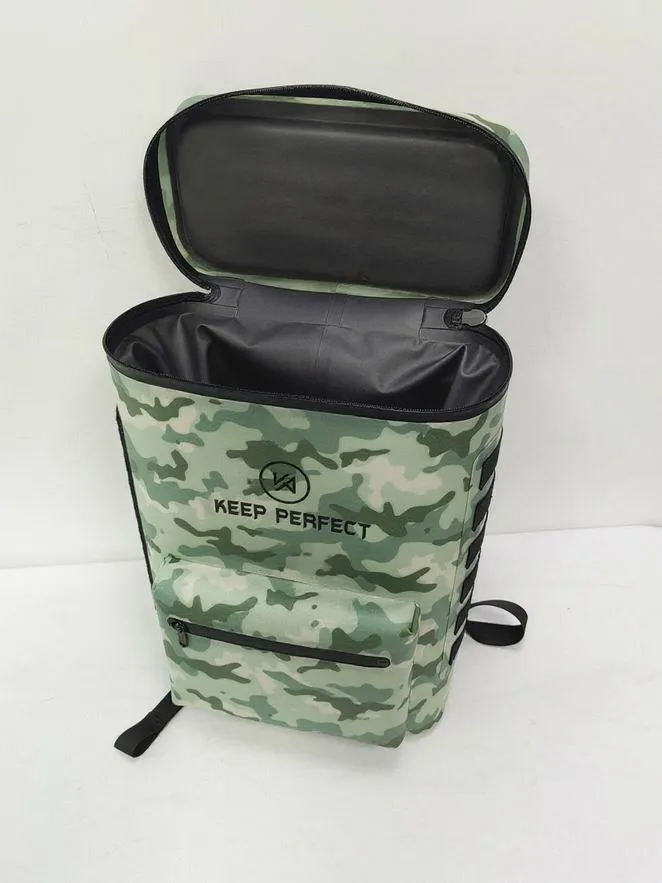
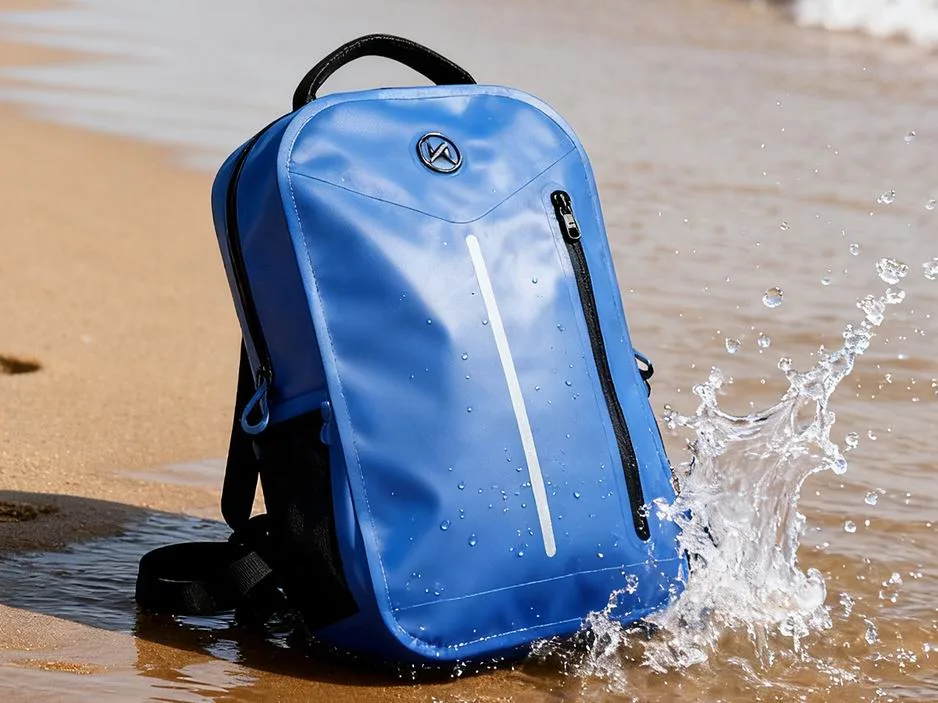
If you want to understand the closure as a piece of engineering rather than a habit, roll-top closure engineering covers fold geometry and reinforcement in detail, and why three folds became standard traces the convention itself. Welded backpack closures using the same principle are shown in the TPU backpack range, and immersion test data for our own bags sits alongside the ratings in the IPX guide.
Frequently asked questions
Q1. How many rolls does a dry bag actually need?
Three for anything that can end up in the water or under compression, two for rain and spray with frequent access, and four for whitewater, surf or long-term storage. Five rolls adds no measurable protection.
Q2. Is two rolls enough for kayaking?
Two rolls handles paddle drip and splash but not a capsize: a 30-second immersion let 5 to 20 grams of water into a two-fold bag. Use three folds whenever a wet exit is possible.
Q3. Does a fourth roll make a dry bag more waterproof?
Not measurably in immersion testing, where three folds already return 0 to 2 grams. Four folds help under sustained compression and repeated submersion, which is why they suit whitewater and checked luggage.
Q4. Why do people say roll a dry bag three times?
Because three folds is the smallest number that reliably passes a 30-minute immersion at one metre, the condition behind the IPX7 grade defined in IEC 60529. It is also easy to teach and to audit.
Q5. How much volume does each roll cost?
About 1.1 litres per fold on a 20L bag with 0.5 mm film: 18.8 L at one fold, 17.7 L at two, 16.6 L at three and 15.4 L at four. Softer film costs slightly less per fold.
Q6. Should I roll a dry bag away from me or towards me?
It makes little difference to the seal. Rolling outward sheds rain better because the outer fold acts as a drip edge; rolling inward is tidier in a hatch. Choose one and make the folds tight.
Q7. Does cold weather change how many rolls I need?
Yes. Film stiffens below about 5 °C and the fold will not seat, so add one roll or warm the bag before packing. PVC stiffens earliest, from around 10 °C, and PVC bags suffer most in cold conditions.
Q8. Can sand really defeat a rolled closure?
Yes. One grain in the fold creates a capillary path that wicks water through in an hour of paddling. Rinse the fold line with fresh water before you roll, and check it with a thumb.
Q9. How do I know if my roll is tight enough?
The fold should lie flat with no visible channel at the corners, and the roll should feel firm rather than springy when squeezed. If you can push a fingernail between two layers of the fold, roll again.
Q10. Does the buckle seal the bag or just hold it?
It holds it. The seal comes from film pressed against film under tension; the buckle maintains that tension and stops the roll unwinding. A tight roll held by a slipping buckle will still leak.
Q11. How many rolls for checked luggage on a plane?
Four. Bags get compressed by other luggage and the cargo hold pressure cycle adds load, and a four-fold closure survived 12 kg of compression for two hours where a three-fold bag took in 8 grams.
Q12. Is one roll ever enough?
Only for drip and fine spray, such as a liner inside a rucksack on a dry day or a lunch bag in light rain. One fold took in 15 to 30 grams in a 60-second jet test, so it fails fast under directed water.
Q13. Do roll-top backpacks need the same number of rolls?
Yes, the closure physics is identical. Backpack closures often have a longer mouth, so make sure the first fold starts square across the full width, then roll three times as usual.
Q14. Why does my bag leak at the corners?
Corners are where the fold turns from a straight line into a curve and contact pressure drops. They are the weakest point of every roll-top. A third fold moves the vulnerable geometry further from the water.
Q15. Should I add a roll if my bag is very full?
Better to repack. A bag filled over 90% has no slack for a tight fold, so the roll is loose. Pack to 70% to 85% and use three folds rather than packing to the brim and using four.
Q16. How often should I re-roll a stored dry bag?
Every few months. A fold relaxes slowly under storage, particularly in warm conditions, so a bag that is going to sit for a season should be rolled four times and checked occasionally.
People also ask
Why do you roll a dry bag three times?
Because three folds is the smallest number that survives 30 minutes of immersion at one metre, which is the IPX7 test condition. Two folds handle splash, and the third fold moves the vulnerable corner geometry away from the water.
Can you roll a dry bag too many times?
Yes. Beyond four folds there is no measurable sealing gain, the roll becomes bulky and hard to buckle, and repeated folding on the same crease accelerates film fatigue. Use a smaller bag instead.
How tight should a rolled dry bag be?
Firm enough that you cannot push a fingernail between the layers of the fold, with the corners lying flat. Tightness comes from hand tension on the first fold, and the buckle holds that tension in place.
Do dry bags leak at the corners?
Corners are the most common leak point, because the fold changes direction there and contact pressure drops. A proper third fold and a square first fold are the two things that fix corner leaks.
How many rolls for whitewater rafting?
Four. Rafting combines repeated submersion, tumbling against rock and compression against other gear, and a four-fold closure survived conditions where three folds took in water.
Does a dry bag need three rolls in the rain?
Two is usually enough for rain and road spray, since a two-fold closure let in only 2 to 6 grams in a jet test. Move to three if the bag will be sat in puddles or compressed in a pannier.
Need this in production volume?
QUANZHOU JUNYUAN BAGS has produced waterproof bags since 2014 in an SGS-verified 4,950 m2 facility in Fujian, China. Minimum order 500 pieces, sampling in 6–10 working days, bulk in 35–50 days, FOB Xiamen — write to service@junyuanbags.com with your spec and target market.