Home / Blog / Buying & Comparisons
The Value of a Tested Waterproof Rating
A tested waterproof rating converts a marketing adjective into a repeatable measurement, and that is worth real money: a bag that carries an IPX7 result verified to IEC 60529 has been immersed at one metre for 30 minutes, while an untested bag described as fully waterproof has only the seller's word. In field returns the difference shows up as a 5 to 12% failure rate against 1 to 2% for documented and inspected production.
This guide explains what each grade actually proves, why hydrostatic head answers a different question from immersion, which failure modes no laboratory test covers, and how to price the true cost of a bag that lets water in. It also sets out the spec-sheet questions that separate a documented claim from an invented one, and the inspection gates that keep a rated production run consistent from the first carton to the last.
- What a tested rating actually buys you
- The rating language, from IPX4 to IPX8
- Hydrostatic head answers a different question
- What a laboratory test does not cover
- Where untested bags fail first
- Reading a spec sheet like a buyer
- The economics: what a failed bag actually costs
- Inspection gates that keep a rated run consistent
- Field testing versus laboratory testing
- Ratings and what they mean for warranty terms
- How to verify a claim before you buy
- Matching the rating to the exposure you actually face
- A buyer's checklist for waterproof claims
What a tested rating actually buys you
A rating is a contract in three parts: a method, a condition and a result. When a bag carries an IPX7 statement, the method is immersion, the condition is one metre for 30 minutes, and the result is that no water entered in that specific test. That is narrower than most buyers assume and far more useful than the word waterproof, which has no method, no condition and no result attached to it at all.
The value is not the number itself but the discipline behind it. To issue a rating, someone has to build a sample the same way every time, test it on a schedule, and keep a record. That discipline tends to correlate with everything else you care about: consistent weld parameters, controlled material lots and an inspection gate before packing. A bag with a real rating is usually a bag made by a controlled process; a bag with a loud adjective usually is not.
The rating language, from IPX4 to IPX8
Ingress protection grades are defined by the IEC in standard 60529, and the second digit describes liquid ingress. The X in IPX7 means the solid-particle digit was not tested, which is normal for bags. The useful grades for dry bags run from IPX4, splash from any direction, through IPX6, powerful water jets, to IPX7, temporary immersion, and IPX8, continuous immersion at a depth the brand declares.
The key point is that these are different tests, not a ladder of quality. A bag can pass IPX6 and fail IPX7, because a jet test loads the closure in shear while an immersion test loads it with sustained pressure. Choosing between them depends on use: a bag carried through a storm needs jet resistance, while a bag that may go overboard needs immersion resistance. The honest answer for most watersports is both.
| Grade | Test condition | What it proves | Realistic use |
|---|---|---|---|
| IPX4 | Splash from any direction, 10 min | Resists rain and spray | Urban commute, light shower |
| IPX5 | 6.3 mm nozzle, 12.5 L/min, 3 m | Resists a low-pressure jet | Deck spray, paddle drip |
| IPX6 | 12.5 mm nozzle, 100 L/min, 3 m | Resists powerful jets | Bow wave, storm rain, jet wash |
| IPX7 | 1 m depth, 30 min immersion | Survives a short submersion | Capsize, swim, dropped overboard |
| IPX8 | Declared depth, continuous | Survives sustained pressure | Towed bags, dive support |
Hydrostatic head answers a different question
Hydrostatic head measures the water pressure a fabric can resist before it leaks, expressed in millimetres of water column. A 10,000 mm rating means the fabric held a 10-metre column of water before penetration. It is a fabric test, not a product test, and that distinction matters enormously: a fabric can post an impressive hydrostatic figure and still be assembled into a bag that leaks through its seam or its closure.
This is why the two numbers should be read together. Hydrostatic head tells you the film and face fabric will not soak through under pressure; an IPX grade tells you the finished construction resists a defined exposure. Asking for only one is the single most common spec mistake, and it is how a brand ends up with a bag that passes a fabric test in the lab and fails in the first hour on a boat. Our hydrostatic head guide sets out the method in detail.

What a laboratory test does not cover
Every standard test uses a new sample, clean water and a controlled temperature. Real bags meet grit, salt, sunscreen, fuel and UV, and they meet them after months of folding. A closure that passes IPX7 on day one can fail at month eight because the fold line has taken a permanent set, because sand has scored the film, or because the buckle no longer pulls the same tension. No laboratory immersion test predicts any of that.
Abrasion is the largest gap. There is no waterproof grade for dragging a bag across a concrete ramp or a boat deck, yet abrasion is what actually ends service life for most bags. The sensible response is to treat the rating as a baseline and then specify abrasion and UV performance separately, using cycle counts and exposure hours rather than relying on an ingress grade to imply durability it never measured.
Where untested bags fail first
Across returned product, the pattern is consistent and it is almost never the fabric panel. Leaks start at the closure, at a seam corner, at a hard point or at a window or valve. Each of those is a joint, and each joint is where assembly skill shows. A bag with a documented rating has been through a gate that catches joint failures; a bag without one has not.
The practical reading is that you should ask which joints were tested and how often, rather than whether the product is waterproof. A production line running an air-inflation check on every unit and a water immersion check on a sampling plan will find corner failures before they ship. Ours runs both, on seven production lines, with AQL 2.5 as the release gate.
| Failure point | Share of field leaks | Typical cause | Detection method |
|---|---|---|---|
| Roll-top closure | 35-45% | Overfilled, grit in fold, worn fold line | Air-inflation check, 100% |
| Seam corner | 20-30% | Weld parameter drift, wrong dwell | Immersion sampling, AQL 2.5 |
| Hard point or D-ring | 10-15% | Weld patch undersized for load | Pull test to 250 N on samples |
| Window or valve | 8-12% | Second weld, film mismatch | Immersion plus visual audit |
| Fabric panel puncture | 5-10% | Abrasion, sharp load inside | No standard test; specify abrasion |
| Buckle or slider | 5-8% | Fatigue, salt crystallisation | Cycle test, 5,000 opens |
Reading a spec sheet like a buyer
A spec sheet is a document about a company's process as much as about a product. The presence of a standard number, a test frequency and a sampling plan tells you more than any headline figure. What you are looking for is traceability: if you asked for the report behind the claim, could it be produced, and would it name a method, a date and a sample size?
The inverse is also informative. Claims that describe intensity rather than method, that quote a depth without a duration, or that present a fabric rating as a product rating are all signals that no test exists. This is where a tested rating earns its cost: it removes the entire category of argument about what a word was supposed to mean.
| Claim on the sheet | What to ask for | Red flag |
|---|---|---|
| Waterproof | Method, condition, sample size | No standard named |
| IPX7 | IEC 60529 report, date, lab | Depth given without duration |
| 10,000 mm fabric | Separate product immersion result | Fabric figure used as product claim |
| Welded seams | Weld parameters and peel values | No peel strength recorded |
| Tested in-house | Third-party report or raw data | No record available |
| Lifetime coverage | Definition of lifetime and exclusions | Abrasion excluded entirely |
The economics: what a failed bag actually costs
A bag that lets water in costs far more than the price of the bag. For an individual, the loss is the contents: a phone at 700 to 1,200, a camera body at 1,500 or more, a sleeping bag that stops insulating when wet. For a retailer or a rental fleet, the cost is the return handling, the replacement unit, the staff time and the review, which routinely adds up to three to five times the unit price.
Set against that, the premium for a documented, tested and inspected bag is modest: typically 8 to 20% on unit cost for the combination of third-party testing, in-line air checks and an AQL release gate. Spread over a service life of five to ten years, that premium is a fraction of a single avoided failure. This is the actual argument for a tested rating, and it is a financial one rather than a technical one.
| Cost line | Untested bag | Tested and inspected bag | Note |
|---|---|---|---|
| Unit price | Baseline | +8 to 20% | Testing, inspection, controlled lots |
| Field leak rate | 5 to 12% | 1 to 2% | Typical spread over a season |
| Return handling per unit | 20 to 40 | 4 to 8 | Staff time, postage, admin |
| Contents at risk | 700 to 3,000 | Same, but far less likely | Phone, camera, insulation |
| Service life | 2 to 4 seasons | 5 to 10 seasons | Controlled weld and material |
| Review and reputation cost | Unquantified, large | Near zero | Hardest line to recover |
Inspection gates that keep a rated run consistent
A test on one sample proves nothing about the ten thousandth bag. What keeps a rated run consistent is a gate applied during production: an air-inflation or vacuum-decay check on every closure, a visual and dimensional audit on a sampling plan, and a destructive peel test on weld coupons taken at set intervals. Ask how often each runs and what happens when a result fails.
Sampling plans are worth naming. AQL 2.5 is the common commercial gate for soft goods and it defines how many units are inspected and how many minor or major defects are tolerated before a lot is rejected. A production partner who can state their AQL level, their lot definition and their corrective-action path is describing a controlled process; one who cannot is describing hope. The full framework is set out in our AQL inspection guide.
Field testing versus laboratory testing
Laboratory tests are repeatable and narrow; field tests are broad and messy. Both earn a place. A lab immersion result lets you compare two bags on equal terms, which is its whole value. A field programme tells you what happens after 60 days of salt, sun and sand, which no standard covers. The mistake is treating either as complete on its own.
A cheap field protocol works well for any serious buyer: put ten units into real service, log hours, log exposures, and inspect at 30, 60 and 90 days. Record fold-line wear, weld-corner condition, hardware corrosion and any leak. Ten units over 90 days will surface the failure modes that matter far faster than a single laboratory pass, and the data makes warranty terms negotiable rather than assumed.
Ratings and what they mean for warranty terms
A rating should shape the warranty, and the warranty should tell you what the brand believes about its own product. If a bag is sold as IPX7 and the warranty excludes immersion, the two documents contradict each other and the rating is decorative. Read the exclusions before the headline: the coverage that matters is the coverage for the exposure the rating describes.
Abrasion exclusions are normal and reasonable, because abrasion is not an ingress test. What is not reasonable is a warranty that excludes seam failure while advertising welded construction, or one that defines service life in months for a product marketed for years. Where the two documents agree, you are usually looking at a product whose rating was measured rather than written.

How to verify a claim before you buy
- Ask for the standard number behind the grade; if none is given, treat the claim as decoration.
- Ask whether the rating covers the finished product or only the fabric, and read the two separately.
- Request the test report with a date, a lab name and a sample size rather than a summary statement.
- Confirm the inspection gate: is every closure air-checked, and what is the AQL release level?
- Run a home immersion check on the sample you receive: 30 minutes at one metre, then look inside.
- Log ten units in real service for 90 days and inspect at 30, 60 and 90 day intervals.
- Read the warranty exclusions against the rating, and reject any pair that contradicts itself.
Those seven steps take little time and remove almost all of the uncertainty from a buying decision. They also change the conversation with a seller: asking for a method rather than an assurance moves the discussion from opinion to evidence, and a partner with a controlled process will answer quickly. One who cannot is telling you something just as useful.
The home check deserves a note on method. Use a bath or a clean bin, submerge the bag with a weight, and leave it for 30 minutes at about one metre of head. Put a dry paper towel inside first so a few millilitres of ingress is visible. This will not reproduce a laboratory result but it will catch the gross failures that account for most field leaks, and it costs one evening. Our home testing guide gives the full procedure.
Matching the rating to the exposure you actually face
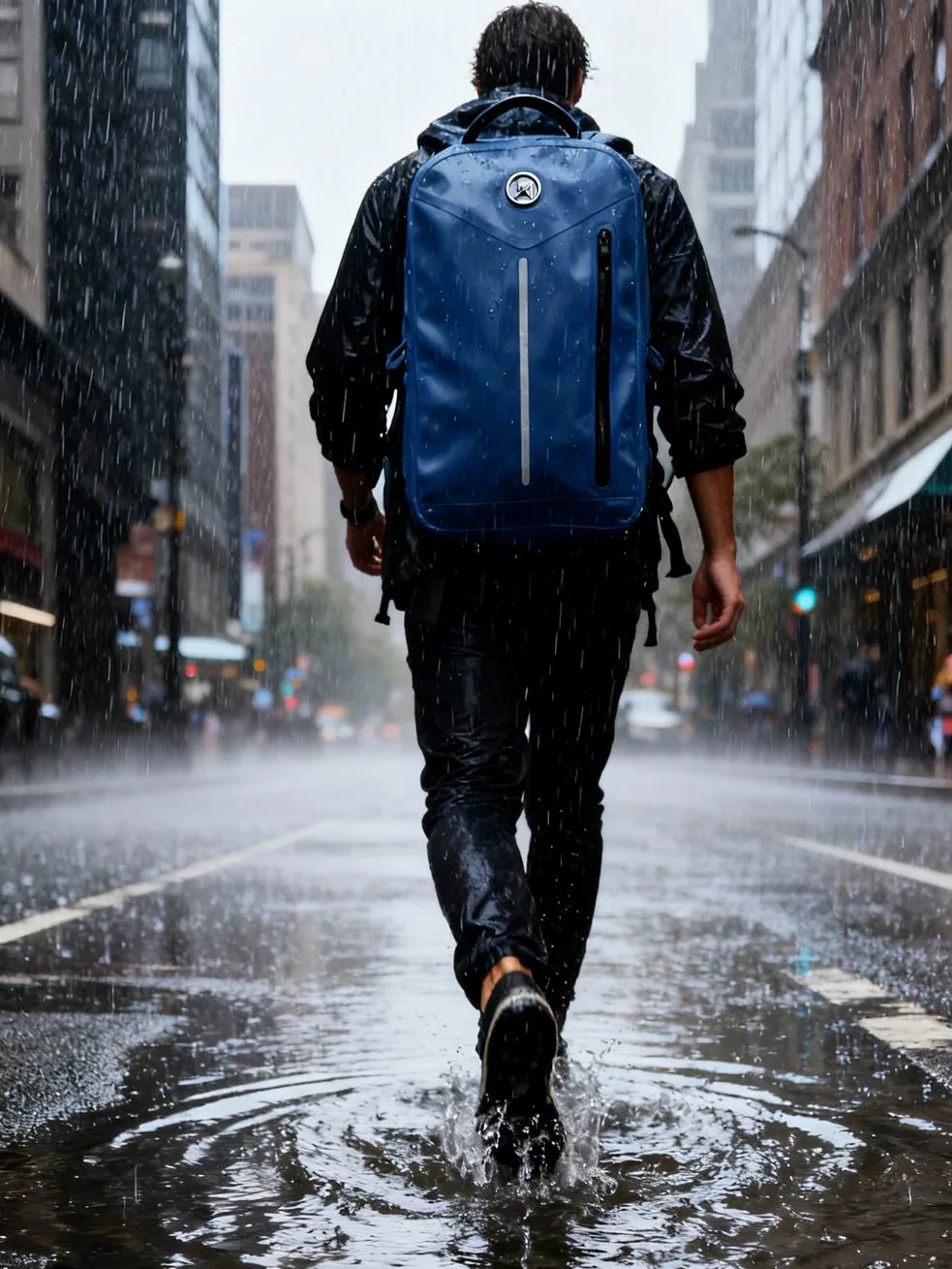
Over-specifying costs money and weight; under-specifying costs kit. The right question is not what the highest grade is but what the worst realistic exposure is, and how often it occurs. A commuter who walks 20 minutes in rain needs jet resistance for maybe 30 days a year; a sea kayaker needs immersion resistance for perhaps one event per season, but that one event destroys a phone if the bag is not rated for it.
A useful rule of thumb: buy to the worst credible single event, not to the average day. Average days are survivable with almost any bag; it is the one capsize, one dropped bag or one storm that decides whether the rating was worth paying for. That is the whole economic argument, and it is why IPX7 is the sensible floor for anything that will be within two metres of open water.
A buyer's checklist for waterproof claims
- Name the standard: IEC 60529 for ingress grades, plus a hydrostatic method for the fabric.
- Separate product ratings from fabric ratings and require both.
- Require a test report with a date, a lab and a sample size, not a marketing summary.
- Confirm a 100% closure check in production and an AQL 2.5 release gate.
- Ask which joints were tested: closure, seam corners, hard points, windows and valves.
- Specify abrasion and UV separately; no ingress grade covers either.
- Read the warranty exclusions against the advertised rating and reject contradictions.
- Run a 90-day field log on ten units before committing to a large order.
- Compare shortlisted options across the full product range on the same criteria.
Two further reading paths close the gaps this article leaves open. For the language of grades and what each test physically does, our IPX ratings guide is the detailed reference; for the difference between a product that resists rain and one that survives submersion, read rain protection versus submersion. Both are worth reading before you write a specification.
Standards bodies publish the methods themselves, and it costs nothing to read the abstract before you rely on a claim. The ASTM catalogue covers textile and coating test methods used alongside ingress grades, and the ISO catalogue covers the water-resistance and ageing series.
Frequently asked questions
Q1. Is a tested waterproof rating worth paying for?
Yes, because it moves the claim from opinion to evidence. A documented IPX7 result with inspection behind it typically cuts field leak rates from 5-12% to 1-2%, for a unit cost premium of around 8 to 20%.
Q2. What does IPX7 actually mean?
It means the product survived immersion at one metre for 30 minutes in a test defined by IEC 60529. It says nothing about abrasion, UV, salt or how the bag will perform after a season of folding.
Q3. Is hydrostatic head the same as an IPX rating?
No. Hydrostatic head is a fabric test measured in millimetres of water column; an IPX grade is a finished-product test. A strong fabric figure says nothing about whether the seams or the closure hold.
Q4. Which rating do I need for kayaking?
IPX7 as a floor, because a capsize is a short immersion. IPX6 covers bow spray and breaking waves, so the honest specification for open water is resistance to both jets and immersion.
Q5. Why do rated bags still leak in real use?
Because standard tests use clean water, a new sample and controlled temperature. Real bags meet grit, salt, UV and abrasion, and most long-term leaks start at a worn fold line or a scored weld corner, not in the lab-tested panel.
Q6. What is AQL 2.5 and why should I care?
AQL 2.5 is a sampling plan that defines how many units are inspected and how many defects are tolerated before a lot is rejected. It is the gate that keeps the ten thousandth bag consistent with the tested sample.
Q7. How can I check a waterproof claim at home?
Put a dry paper towel inside, close the bag as you would in the field, submerge it at about one metre for 30 minutes, then look inside. This catches gross closure and seam failures, which account for most field leaks.
Q8. Does a higher IPX grade mean a better bag?
Not necessarily. The grades are different tests rather than a quality ladder: IPX6 is a jet test and IPX7 is an immersion test. Buy to your worst realistic exposure, which for open water is immersion.
Q9. Should I buy IPX8 instead of IPX7?
Only if you need sustained depth. IPX8 is declared by the brand under its own conditions, so the depth and duration must be stated on the report. For most paddling and travel, IPX7 is sufficient and easier to verify.
Q10. How much does a failed bag actually cost?
For an individual, the contents: roughly 700 to 3,000 for a phone, camera or down bag. For a retailer or rental fleet, add return handling of 20 to 40 per unit plus the reputation cost of a bad review.
Q11. What should a warranty say about the rating?
It should cover the exposure the rating describes. If a bag is sold as IPX7 but the warranty excludes immersion, the two documents contradict each other and the rating is decorative.
Q12. Do welded seams guarantee a waterproof bag?
No. Welding is a process with parameters, and parameter drift produces weak seams. Ask for peel-strength values and a weld coupon test frequency rather than treating the word welded as a guarantee.
Q13. Which parts of a bag fail most often?
The closure at 35-45% of field leaks, seam corners at 20-30%, hard points at 10-15%, and windows or valves at 8-12%. Fabric panels account for only 5-10%, which is why product testing matters more than fabric testing.
Q14. How often should a production run be tested?
Every closure should be air-checked at 100%. Immersion testing runs on an AQL sampling plan, and destructive peel tests run on weld coupons taken at set intervals through each shift.
Q15. Can I rely on in-house testing?
Yes if the raw data, method and frequency are available and consistent. Ask for the report and the sample size; a controlled process will produce records quickly, while an uncontrolled one cannot.
Q16. Does a rating cover abrasion and UV?
No. No ingress grade covers either. Specify abrasion in cycles and UV in exposure hours separately if the bag will see deck contact, sand or strong sun.
People also ask
How do you know if a waterproof rating is real?
Ask for the standard number, the test report with a date and sample size, and the inspection gate used in production. A real claim comes with a method and a record; an invented one comes with adjectives.
What is the difference between water-resistant and waterproof?
Water-resistant describes a fabric or coating that sheds light moisture for a short time. Waterproof as a claim should be backed by a standard that names an exposure, such as immersion at one metre for 30 minutes under IEC 60529.
Is IPX7 enough for a dry bag?
For most paddling, travel and beach use, yes. It covers the realistic worst case, a short immersion after a capsize or a bag dropped overboard. Go higher only if you need sustained depth.
Why does my waterproof bag leak after a season?
Long-term leaks usually come from wear at the fold line, grit scored into the film, or a weld corner fatigued by repeated flexing. None of those is covered by the original laboratory test on a new sample.
How much should you pay for a tested bag?
Expect an 8 to 20% premium over an untested equivalent for third-party testing, in-line closure checks and an AQL release gate. Against a 5 to 12% failure rate for untested product, the premium is usually recovered in one season.
Do all waterproof bags use the same test?
No. Some are tested as finished products to IEC 60529, others only as fabric to a hydrostatic head method, and some are not tested at all. Always confirm which of the three you are being shown.
Need this in production volume?
QUANZHOU JUNYUAN BAGS has produced waterproof bags since 2014 in an SGS-verified 4,950 m2 facility in Fujian, China. Minimum order 500 pieces, sampling in 6–10 working days, bulk in 35–50 days, FOB Xiamen — write to service@junyuanbags.com with your spec and target market.