How Much Weight Can a Dry Bag Strap Take?
A 25 mm polyester webbing strap woven into a dry bag harness breaks at roughly 700 to 1,100 kg, but the webbing is almost never what fails. The welded anchor it pulls against releases at 60 to 140 kg and a 25 mm side-release buckle starts to deform at 45 to 90 kg, so the real limit is set by anchors and hardware. Plan on 25 to 40 kg of safe working load for a padded shoulder strap and 15 to 25 kg for a single grab handle.
That distinction matters because the failure is usually sudden and happens at the point furthest from where you are looking. A strap that tears out of a welded panel dumps the whole load onto the ground in one motion, often in water or on rock. This guide walks through webbing ratings, anchor pull-out numbers, buckle limits, shock load multipliers and the duty limits that follow from them, so you can match a carrying system to the load you actually carry.
- The short answer, and why it is not one number
- Webbing width versus break strength
- Where the load actually fails
- Buckles and hardware set the practical ceiling
- Static load versus shock load
- Harness and shoulder strap geometry
- Welded anchors versus stitched loops
- How load spreads across a strap
- Reading a load rating on a specification sheet
- Testing a strap without destroying the bag
- Duty limits for common bag sizes
- Carrying comfort versus carrying capacity
- When to stop loading and re-pack
The short answer, and why it is not one number
Ask how much weight a dry bag strap can take and the honest reply is a range with three different ceilings. The webbing itself has a break strength measured in hundreds of kilograms. The anchor that fixes the webbing to the bag has a pull-out strength measured in tens of kilograms. The buckle or adjuster in the load path has a deformation limit that sits lower again. The weakest of the three decides, and on nearly every dry bag that is the anchor.
Safe working load applies a safety factor to the weakest link rather than to the strongest. For load-bearing textile systems a factor of five against break strength is the conventional figure, which turns a 700 kg webbing into a 140 kg working limit and a 90 kg anchor pull-out into roughly 18 kg. That is far below what most people assume, and it is why a heavily packed 40 L bag carried by one handle feels risky even when the handle looks substantial.
Shock loading compresses the margin further. A 12 kg bag dropped from half a metre onto its strap generates a peak load roughly five to eight times the static weight for a few milliseconds, so a 12 kg load briefly presents as 60 to 95 kg. Anything in the load path rated below that will deform or tear, which explains why straps fail during loading and unloading rather than during steady carrying.
Webbing width versus break strength
Polyester webbing is the default for dry bag carrying systems because it absorbs little water, resists UV reasonably well and holds a stitch or a weld without fraying. Nylon webbing is slightly stronger for the same width and noticeably more elastic, which is useful on a harness but less useful on a lashing point where stretch is unwanted. Width is the primary driver of strength; weave density and yarn quality move the figure by perhaps 15 percent either side.
The table below gives typical ranges for flat polyester webbing tested in tension with a 200 mm free length. Treat them as planning figures for new webbing: a strap that has been abraded against rock or baked in strong sun for two seasons will sit at the bottom of the range or below it, and UV degradation is largely invisible until the failure.
| Webbing width | Typical break strength | Safe working load at 5:1 | Common use on dry bags | Weight per metre |
|---|---|---|---|---|
| 15 mm | 350-500 kg | 70-100 kg | Grab loops, lid lash | 18-24 g |
| 20 mm | 520-720 kg | 104-144 kg | Compression straps | 26-34 g |
| 25 mm | 700-1,100 kg | 140-220 kg | Shoulder straps, handles | 34-46 g |
| 38 mm | 1,100-1,600 kg | 220-320 kg | Padded harness | 52-70 g |
| 50 mm | 1,600-2,300 kg | 320-460 kg | Duffel sling, raft tie-down | 70-95 g |
Two things follow from those numbers. First, there is no reason to specify webbing wider than 25 mm on a dry bag harness, because the anchor fails first anyway and the extra width only adds weight and bulk. Second, compression and lashing straps can be narrower than you might expect, because their job is to resist a modest static tension rather than to carry the bag.
Where the load actually fails
Field and bench data point to the same conclusion repeatedly: the textile survives and the joint does not. Across pull tests on production samples, the strap-to-body attachment accounts for the large majority of failures, and buckle or adjuster deformation accounts for most of the remainder. A webbing break in the middle of a run is genuinely rare and usually indicates pre-existing abrasion or a cut rather than an overload.
The reason is geometry. A strap pulls on a small patch of film, and the film is being asked to resist a load concentrated along a weld line rather than distributed across a panel. The weld is strong in shear along its length and comparatively weak in peel, which is exactly the direction a strap applies when it is loaded at an angle. Every degree away from the flat increases the peel component and reduces the effective pull-out strength.
| Attachment type | Typical pull-out or failure load | Failure mode | Best duty |
|---|---|---|---|
| Welded D-ring, 40 mm patch | 110-140 kg | Film tears around patch edge | Harness, raft lashing |
| Welded D-ring, 25 mm patch | 60-90 kg | Patch peels from panel | Deck lashing, light duty |
| Welded webbing tail, 50 mm | 85-120 kg | Peel from the weld root | Grab handle |
| Stitched webbing loop | 25-60 kg | Stitch tears through film | Non-critical only |
| Bar-tacked webbing on hem | 40-75 kg | Hem separates from body | Light shoulder carry |
| Plastic loop riveted to panel | 30-55 kg | Rivet pulls through | Accessory attachment |
If you take one number from this table, take the difference between the 40 mm and 25 mm welded patches. Doubling the patch width raises pull-out by roughly 60 percent, which is the cheapest strength increase available anywhere in a dry bag carrying system. It costs a few grams of film and a slightly longer weld cycle.

Buckles and hardware set the practical ceiling
Hardware is the third limit and the one most often overlooked, because a buckle looks solid and gives no warning before it lets go. A standard 25 mm acetal side-release buckle typically holds 45 to 90 kg in tension before the male prong deforms or the body cracks, and that figure drops by 20 to 35 percent after two years of UV exposure. Cold matters too: acetal becomes noticeably more brittle below about minus 10 degrees.
Cam buckles behave differently. They rarely break; they slip. A 25 mm cam buckle on polyester webbing typically begins to slip between 60 and 120 kg depending on tooth condition and webbing stiffness, and slipping is progressive rather than sudden. That is a useful property for lashing, where a slow release is preferable to a fracture, and a frustrating one for load-bearing adjustment. Our buckle type guide sets out the full comparison.
Metal hardware changes the picture but not the conclusion. A 25 mm aluminium ladderlock or triglide will outlast the film it is attached to, which means adding metal simply relocates the failure to the anchor. Spend the budget on a bigger welded patch rather than on an expensive buckle, and specify stainless or anodised fittings only where saltwater corrosion is the real risk.
Static load versus shock load
Every load figure quoted for a strap is a static figure measured on a test machine that pulls slowly and steadily. Real loads are rarely static. Setting a loaded bag down hard, dropping it into a boat, catching it on a rock or stopping suddenly while wearing it all introduce shock, and shock multiplies the effective load by a factor that depends on how quickly the load is arrested.
The physics is straightforward: the kinetic energy of the falling mass has to be absorbed by the strap and anchor, and the shorter the stopping distance the higher the peak force. Soft webbing and a little give in the system stretch the stopping distance and lower the peak; a taut strap on a rigid anchor gives almost no stretch and produces the highest peaks. This is why a slack strap is genuinely safer than a tight one during a drop.
| Event | Load | Stopping distance | Peak force multiplier | Peak force |
|---|---|---|---|---|
| Set down gently | 12 kg | 80 mm | 1.2x | 14 kg |
| Set down hard | 12 kg | 25 mm | 3.0x | 36 kg |
| Drop 0.5 m, slack strap | 12 kg | 60 mm | 5.0x | 60 kg |
| Drop 0.5 m, taut strap | 12 kg | 15 mm | 8.0x | 96 kg |
| Drop 1.0 m, taut strap | 12 kg | 12 mm | 11.0x | 132 kg |
| Step off a ledge wearing it | 18 kg | 40 mm | 6.0x | 108 kg |
Read the drop rows together and the lesson is clear: a 12 kg bag dropped a metre on a taut strap produces a peak load above the pull-out strength of most 25 mm welded anchors. Nothing about that bag is defective; the event simply exceeded the design envelope. Handle loaded bags down rather than dropping them, and keep a little slack in any strap that might catch a shock.
Harness and shoulder strap geometry
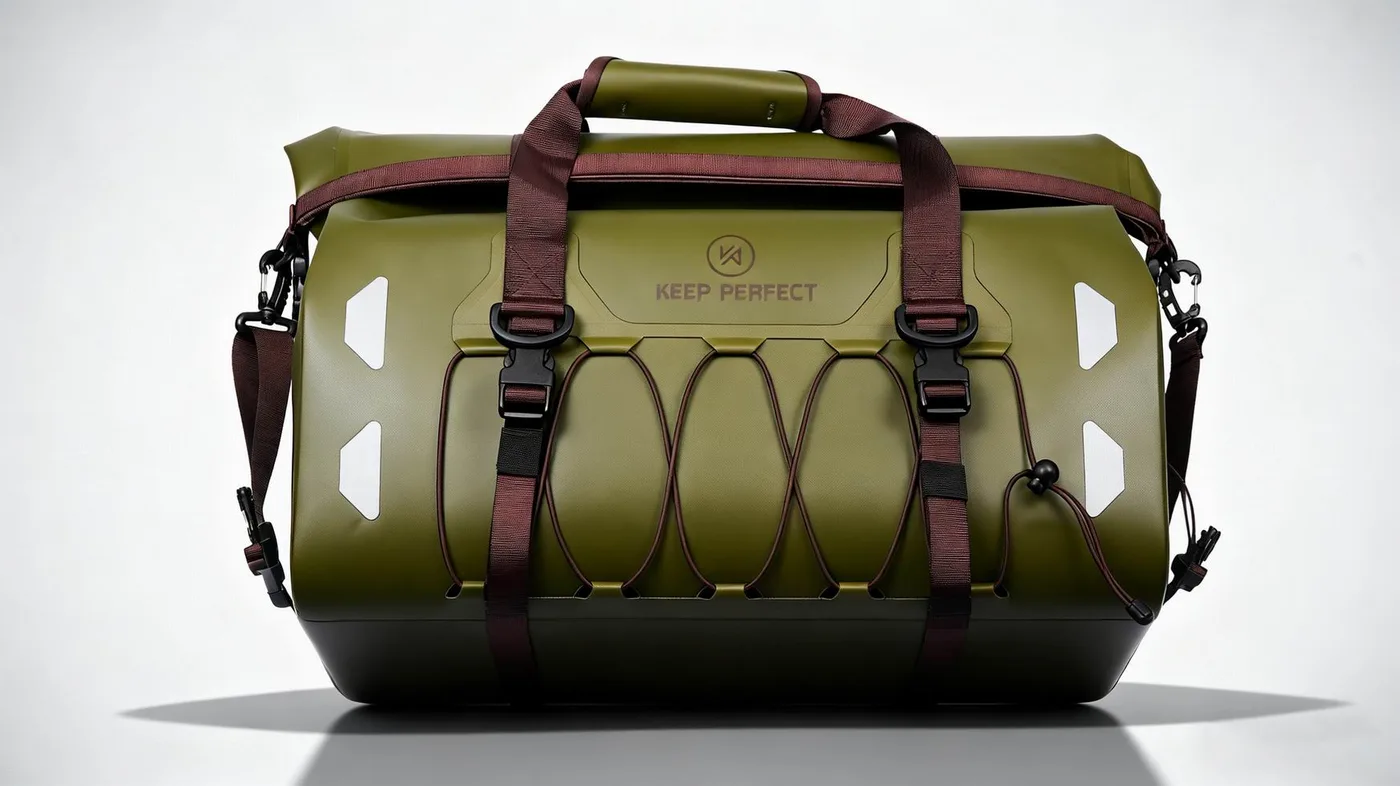
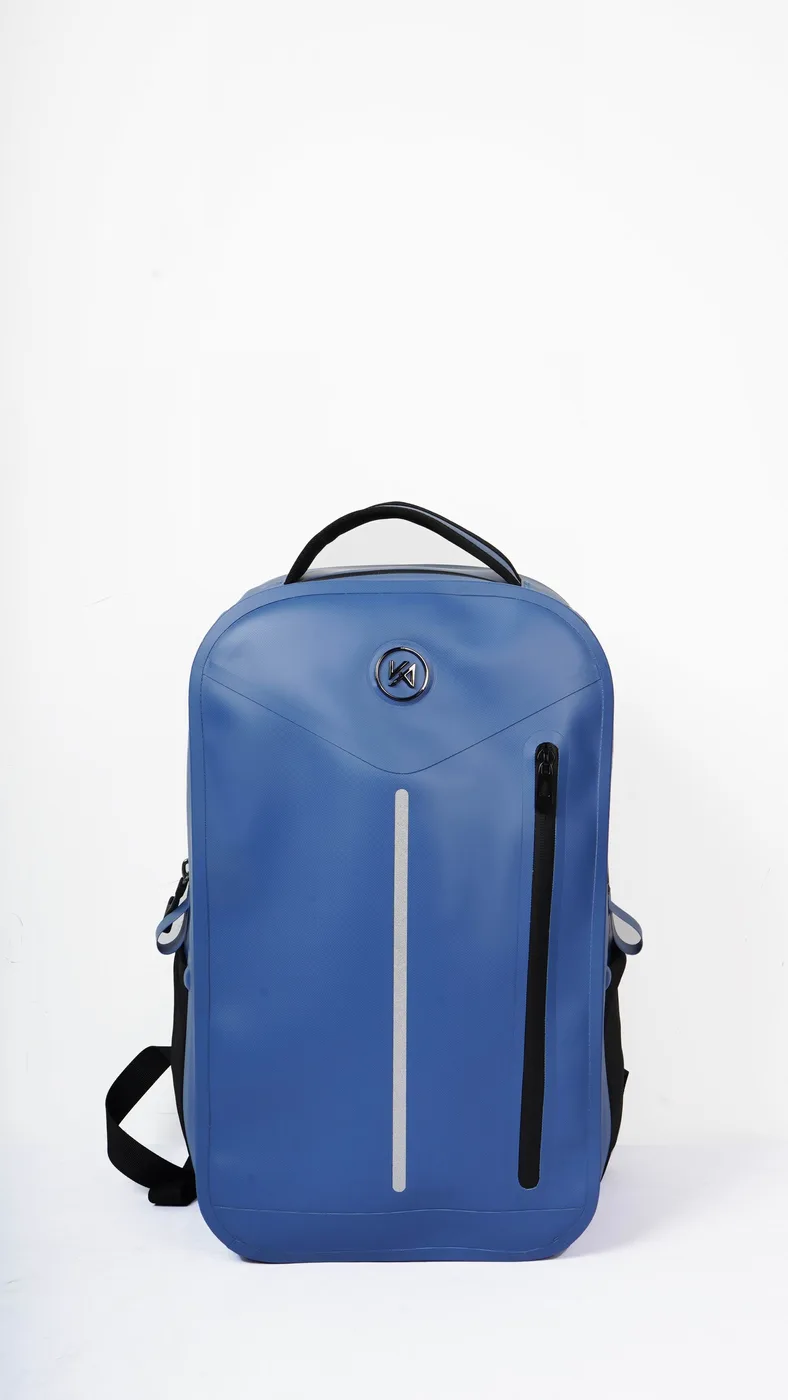
On a waterproof backpack the load path runs from the shoulder strap, through the upper anchor, down the body panel and into the hip belt or lower anchor. Load is shared, so each individual anchor sees less than the total. That sharing is what allows a 38 mm padded harness to carry 18 kg comfortably on anchors that would fail individually at 12 kg.
Sharing only works if the geometry is right. If the upper strap anchor sits more than about 60 mm above the shoulder line, the load path angles backwards and the bag swings, converting a static load into a dynamic one with every step. If the two upper anchors are too close together, the straps sit on the neck rather than the shoulder and the wearer unconsciously shrugs, which doubles the vertical movement and the shock component.
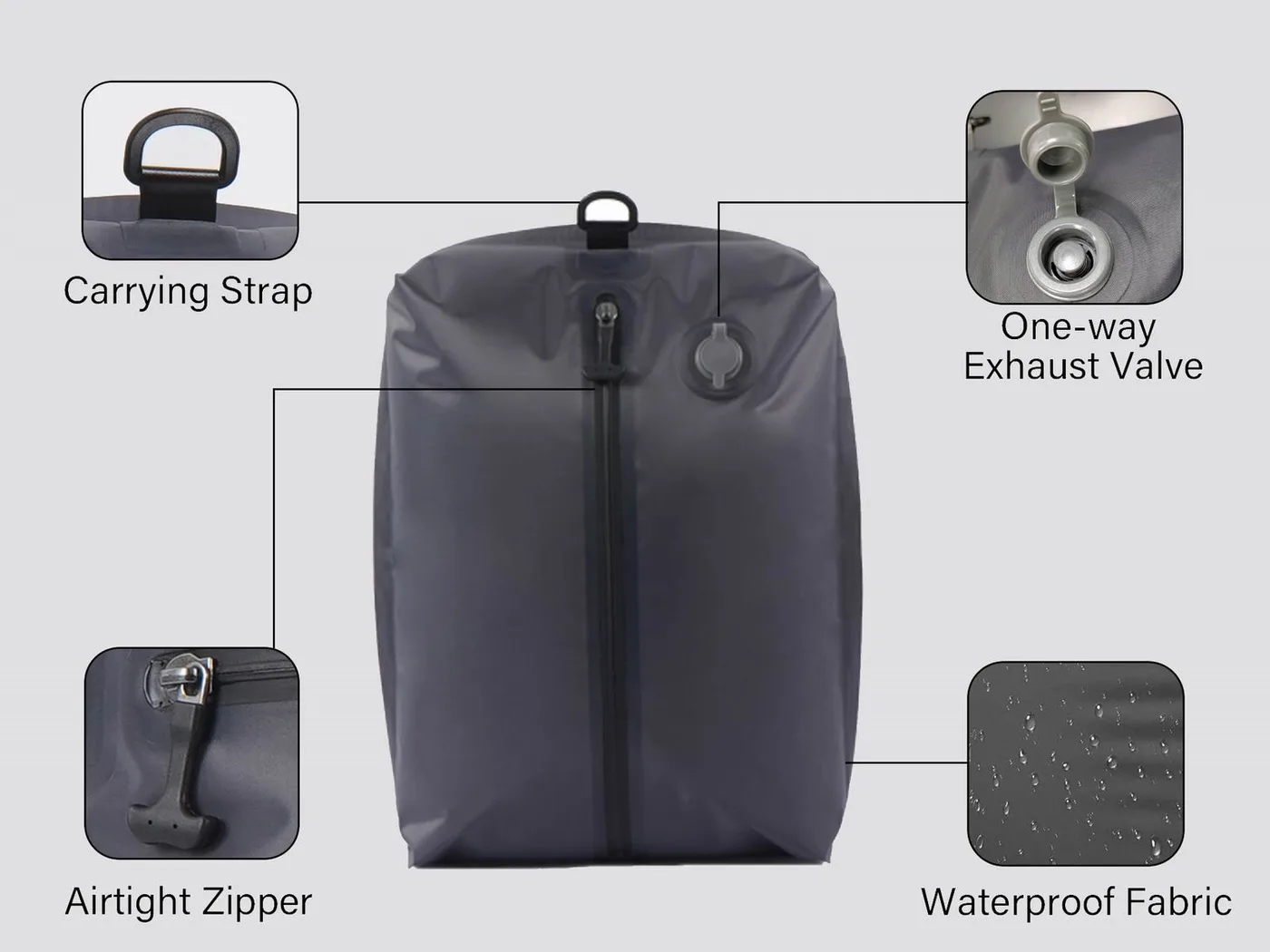
Detachable harness systems deserve a specific warning. The removable hook or gate that attaches the strap to the bag is an extra joint in the load path, and a typical 25 mm gate assembly tested alone fails at 50 to 80 kg. If you convert a duffel to a pack for a long carry, check the gate rating rather than the strap rating, and inspect the gate for cracking at the moulding seam every season. More on harness layout is in our harness design notes.
Welded anchors versus stitched loops
A welded webbing anchor bonds the strap directly to the film with radio-frequency energy, creating a continuous joint with no perforations. A stitched loop passes a needle through the film dozens of times, and every hole is a stress concentration and a potential water path. On dry seam samples the welded anchor consistently outperforms the stitched equivalent on both strength and waterproofness, and the gap widens after wet conditioning.
The failure mode differs as well, and this is the practical argument. A welded anchor tends to fail by tearing the surrounding film, which is visible, progressive and leaves the bag repairable. A stitched loop tends to fail by the stitch tearing through the film in one motion, which leaves a line of holes that is difficult to patch and often runs further than the original damage. Repairability is worth more than a few kilograms of initial strength.
There is one case where stitching is defensible: a hem or binding where the load is shared along a long line rather than concentrated at a point, and where the seam is not required to be waterproof. Bar-tacked webbing tails on a hem fall into this category and perform acceptably at 40 to 75 kg. Everything load-bearing on a waterproof bag should be welded. Our welded handle guide covers the geometry in detail.
How load spreads across a strap
A strap does not pull on a single point; it pulls on a line, and how that line is oriented changes everything. A webbing tail welded flat against the panel for 50 mm distributes load along the full weld, and the pull-out strength scales roughly with weld length. The same webbing welded for 15 mm concentrates the same force into a third of the length and fails at roughly half the load.
Angle is the second variable. Loaded parallel to the panel surface, a welded anchor is loaded in shear and performs near its maximum. Loaded at 45 degrees, the peel component appears and strength drops by 30 to 45 percent. Loaded at 90 degrees, straight out from the panel, the joint is in pure peel and can lose 60 percent or more. Grab handles are the worst case, which is why they should be welded with a generous patch and reinforced on both faces.
Reading a load rating on a specification sheet
Load claims on bag specifications are rarely wrong and frequently meaningless. A figure quoted without a test method, a sample size and a failure definition cannot be compared with anything. Ask four questions before accepting any number: was the test static or dynamic, what failed, what was the sample size, and was the sample conditioned. A single coupon pulled to destruction tells you almost nothing about a production run.
The most useful specification is not a load figure at all but an anchor geometry: patch dimensions in millimetres, weld width, webbing width and the attachment method. Those four lines are verifiable by eye on a sample, they do not drift with test method, and they predict the load figure closely once you have the pull-out table above. Insist on geometry and treat any load claim as secondary.
Testing a strap without destroying the bag
You can get a usable read on a carrying system with simple equipment, provided you accept that you are ranking rather than certifying. The safest approach is to load incrementally and watch for the early warning signs, which appear well before failure: film whitening around a weld, a buckle body that flexes more than it did new, or webbing that creeps under constant load.
- Hang the empty bag and add weight in 5 kg steps, holding each step for 60 seconds.
- Inspect the anchor area with a bright light at every step for film whitening or weld lift.
- Photograph the anchor at 0 kg and at each step so small movement is visible side by side.
- Note the load at which the buckle first flexes visibly; that is your practical ceiling, not the break point.
- Stop at 2.5 times your intended carry weight and never test to destruction on a bag you plan to use.
- Repeat the whole sequence at an angle, because most real failures happen off-axis.
A bag that shows any whitening at the weld root below about 1.5 times its intended carry weight is under-specified for that duty, regardless of what the webbing is rated for. Retest after any repair, and replace rather than re-weld any anchor that has partially lifted, because a re-weld over a stretched film rarely recovers full strength. Inspection routines for harnesses are covered in our harness maintenance guide.
Duty limits for common bag sizes
Safe working load should follow the bag size and the way it will be carried, because both determine the real load. A 10 L bag carried by its grab handle rarely sees more than 6 kg in normal use, while a 60 L expedition bag carried on a harness routinely sees 20 kg and occasionally more when wet gear is added. The limits below assume welded anchors, sound webbing and no shock loading.
| Bag size | Typical packed weight | Recommended carry method | Safe working load | Anchor patch |
|---|---|---|---|---|
| 5 L | 1.5-3 kg | Grab handle or wrist loop | 15 kg | 25 mm welded |
| 10 L | 3-6 kg | Single shoulder strap | 20 kg | 25 mm welded |
| 20 L | 6-11 kg | Single or twin straps | 28 kg | 32 mm welded |
| 30 L | 9-15 kg | Twin padded straps | 35 kg | 40 mm welded |
| 40 L | 12-20 kg | Full harness | 45 kg | 40 mm welded, reinforced |
| 60-90 L | 18-30 kg | Harness plus grab handles | 55 kg | 50 mm welded, both faces |
The weight column is the one people underestimate. A 60 L bag packed with wet rope, a wet tent and food easily reaches 30 kg, and wet gear gains 20 to 40 percent against its dry weight. If your load sits near the top of the range, split it across two smaller bags rather than pushing one bag to its limit; two 30 L bags are easier to carry, easier to lash and far more survivable if one anchor fails.
Carrying comfort versus carrying capacity
Strength and comfort pull in different directions. A wider, thicker strap spreads load over more skin and feels better, but it adds weight and bulk and it increases the leverage applied to the anchor, which reduces the practical pull-out strength. Padding helps up to about 12 mm of thickness, after which it mainly adds bulk without further benefit on loads under 20 kg.
Comfort also depends on load placement inside the bag. A bag packed with heavy items at the bottom and away from the back panel pulls the harness backwards and increases the effective moment on the upper anchors by roughly 25 percent against the same weight packed close to the spine. Pack heavy items high and close to the back and the same anchors see materially less load. Our carrying comfort guide goes further into this.
When to stop loading and re-pack
The decision to stop adding weight is a judgement about the weakest link, and there are four signals that say you have passed it. The strap adjuster creeps under load and will not hold tension. The buckle body visibly flexes when you lift. The film around an anchor shows whitening or a raised edge. The bag no longer holds its shape and the roll-top cannot be closed with three folds. Any one of these is enough; you do not need two.
- Split loads above 20 kg across two bags rather than overloading one carrying system.
- Keep any strap slightly slack while lifting so a slip produces a slow arrest, not a shock peak.
- Inspect every welded anchor once a season for whitening, lift or a raised weld edge.
- Replace acetal buckles every three to four years in strong sun; UV damage is invisible until failure.
- Reinforce or retire any anchor that has partially lifted; a re-weld over stretched film rarely holds.
- Never use a grab handle to lift a bag above 15 kg, whatever the webbing is rated for.
Brands and buying groups that put these limits into a product brief avoid most warranty claims on carrying systems, because the claims almost always trace back to an anchor geometry that was never specified. Our line has been produced since 2014 in an SGS-verified 4,950 m2 facility with seven production lines, and the same anchor dimensions appear in every brief we receive.Minimum order is 500 pieces, sampling takes 6 to 10 working days, and bulk runs 35 to 50 days.
Two external references are worth keeping open when you write a specification. Test methods for textile webbing and straps are published by the ASTM, and general guidance on sampling and acceptance levels comes from the ISO. Neither replaces a pull test on your own sample, but both stop a production partner quoting a number you cannot verify. Start from our waterproof backpack line to see how the anchor geometry above looks on a finished product, and use the size tables in the capacity guide to set realistic packed weights.
Frequently asked questions
Q1. How much weight can a dry bag strap take?
The webbing takes far more than the bag can deliver: 25 mm polyester breaks at 700 to 1,100 kg. The welded anchor fails first at 60 to 140 kg, so a shoulder strap on a dry bag has a safe working load of roughly 25 to 40 kg.
Q2. What is the safe working load of a 25 mm strap?
With a 5:1 safety factor against a 700 to 1,100 kg break strength, the webbing allows 140 to 220 kg. In practice the anchor limits you to about 25 to 40 kg, and the buckle to less again.
Q3. Why do straps tear out of the bag rather than snap?
The joint is loaded in peel and concentrates the whole force along a short weld line, while the webbing distributes it across hundreds of yarns. Pull-out typically occurs at 60 to 140 kg against a webbing break of 700 kg or more.
Q4. How much weight can a grab handle take?
Plan on 15 to 25 kg for a single welded grab handle, even though the webbing is far stronger. Handles are loaded in pure peel, the weakest direction for a welded joint, and are often lifted with a jerk.
Q5. Does a wider strap carry more weight?
Only up to the anchor limit. Widening the webbing from 25 mm to 38 mm nearly doubles webbing strength but changes nothing if the 25 mm welded patch still pulls out at 60 to 90 kg.
Q6. How much does shock loading increase the force?
Dropping a 12 kg bag half a metre on a taut strap produces a peak of roughly 96 kg, about eight times the static weight. The same drop with a slack strap peaks near 60 kg because the stopping distance is longer.
Q7. Are metal buckles stronger than plastic ones?
Yes in isolation, but the anchor still fails first, so metal hardware mostly relocates the failure. Spend the budget on a larger welded patch, and choose metal only where saltwater corrosion is the real risk.
Q8. How strong is a welded D-ring?
A 40 mm welded patch typically pulls out at 110 to 140 kg, while a 25 mm patch manages 60 to 90 kg. Doubling the patch width raises pull-out by roughly 60 percent for a few grams of film.
Q9. Can I stitch a strap onto a dry bag instead of welding it?
You can, but a stitched loop fails at 25 to 60 kg and perforates the film, which is both weaker and no longer waterproof. Stitching is acceptable only on a non-waterproof hem where load is shared along a long line.
Q10. How do I test a strap without ruining the bag?
Hang the bag and add weight in 5 kg steps, holding each for 60 seconds and photographing the anchor. Stop at 2.5 times your intended carry weight and watch for film whitening rather than testing to destruction.
Q11. Why does my strap slip under load?
Cam buckles slip rather than break, typically between 60 and 120 kg on 25 mm webbing depending on tooth condition and webbing stiffness. Clean the teeth, check the webbing for glazing, and replace if slip continues.
Q12. Does UV weaken dry bag straps?
Yes. Acetal buckles lose 20 to 35 percent of their strength after two years of strong sun, and webbing sits at the bottom of its strength range. Neither change is visible, so replace hardware on a schedule rather than on inspection.
Q13. How much weight can a 20 L dry bag carry?
A 20 L bag typically packs to 6 to 11 kg and should be carried on twin straps with a safe working load around 28 kg, using a 32 mm welded anchor patch. Heavy wet gear can push the load higher, so split it if needed.
Q14. Is it safe to lift a loaded dry bag by one handle?
Only up to about 15 kg. Above that, the peel load on a single anchor exceeds its working margin, and a jerk or a slip can multiply the force by five times or more.
Q15. Does packing position affect the load on the straps?
Yes. Heavy items packed low and away from the back panel increase the moment on the upper anchors by roughly 25 percent against the same weight packed high and close to the spine.
Q16. How often should I replace buckles and straps?
Replace acetal buckles every three to four years in strong sun and inspect welded anchors once a season. Retire any anchor showing whitening, lift or a raised weld edge rather than attempting a re-weld.
People also ask
How much weight can a dry bag hold?
The bag film holds far more than the carrying system: a 40 L bag with a full harness has a safe working load around 45 kg, while a 5 L grab bag is limited to about 15 kg by its handle anchor.
What breaks first on a dry bag strap?
The anchor. Welded patches pull out at 60 to 140 kg and buckles deform at 45 to 90 kg, while the polyester webbing itself does not break until 700 kg or more.
Are dry bag shoulder straps strong enough for heavy loads?
Yes up to roughly 25 to 40 kg with a 40 mm welded anchor patch. Above 20 kg, split the load across two bags so a single anchor failure does not drop everything.
How do you reinforce a dry bag strap anchor?
Increase the welded patch size first: going from 25 mm to 40 mm raises pull-out by about 60 percent. Then lengthen the weld tail so load is shared along the joint rather than concentrated at its root.
Do wider straps carry more weight on a dry bag?
Not beyond the anchor limit. The webbing is already ten times stronger than the joint, so widening from 25 mm to 38 mm adds weight and bulk without raising the real carrying capacity.
Can you drop a loaded dry bag without damaging the straps?
Occasionally, but a 12 kg bag dropped half a metre on a taut strap peaks near 96 kg, above most welded anchor limits. Keep straps slightly slack and set bags down rather than dropping them.
Need this in production volume?
QUANZHOU JUNYUAN BAGS has produced waterproof bags since 2014 in an SGS-verified 4,950 m2 facility in Fujian, China. Minimum order 500 pieces, sampling in 6–10 working days, bulk in 35–50 days, FOB Xiamen — write to service@junyuanbags.com with your spec and target market.