How Do You Carry a Dry Bag Comfortably?
A loaded dry bag is comfortable for about 400 m on a 25 mm unpadded strap and for roughly 2 km on padded 38 mm straps worn on both shoulders, at the same 8 kg load. The difference is contact pressure: a 25 mm webbing strap carrying 10 kg presses at around 30 kPa across the shoulder, while a padded 38 mm strap spreads the same weight to about 14 kPa, and discomfort accelerates sharply above 20 kPa. Fit and load height matter nearly as much as width.
This guide sets out every practical carry method for a roll-top, a duffel and a waterproof backpack, with the distance and load each one tolerates before it starts to hurt. It covers where the load should sit relative to your hips, why a wet bag carried against the back causes more problems than people expect, how to carry two bags without twisting, and the adjustments worth making before a long walk. Numbers are pressure and distance figures rather than opinions.
- Why a dry bag is uncomfortable by design
- Hand carry: when it works and when it hurts
- Shoulder straps: width, padding and slip
- Backpack harnesses and how load transfers
- Crossbody and sling carry
- Duffel handles and the two-hand carry
- Where the load should sit on your body
- Carrying two bags without twisting
- A wet bag against your back
- Distance rules: 300 m, 2 km and a full day
- Carrying on a bike, board or boat
- Fitting and adjustment before you set off
- Which carry method suits which bag
Why a dry bag is uncomfortable by design
A dry bag is a sealed tube with a closure at one end, and that shape is the reason it carries badly. There is no frame, no back panel and no structure, so the load moves independently of your body and the whole mass slumps toward the lowest point with every step. A hiking pack solves this with a frame sheet and a hip belt; a roll-top solves nothing and expects you to adapt.
The seal makes it worse. A welded shell does not breathe, so the panel resting against your back becomes a vapour barrier within about fifteen minutes of walking. That is a comfort problem rather than a waterproofing problem, and it is why carry comfort on a waterproof pack depends on sweat management at least as much as on strap padding.
None of this means a dry bag cannot be carried comfortably. It means the comfort has to come from the harness and from the packing rather than from the bag. Pack so the contents form a stable block, position that block high and close to your spine, and choose a strap width that matches the load, and a 12 kg bag becomes manageable for a couple of kilometres.
Hand carry: when it works and when it hurts
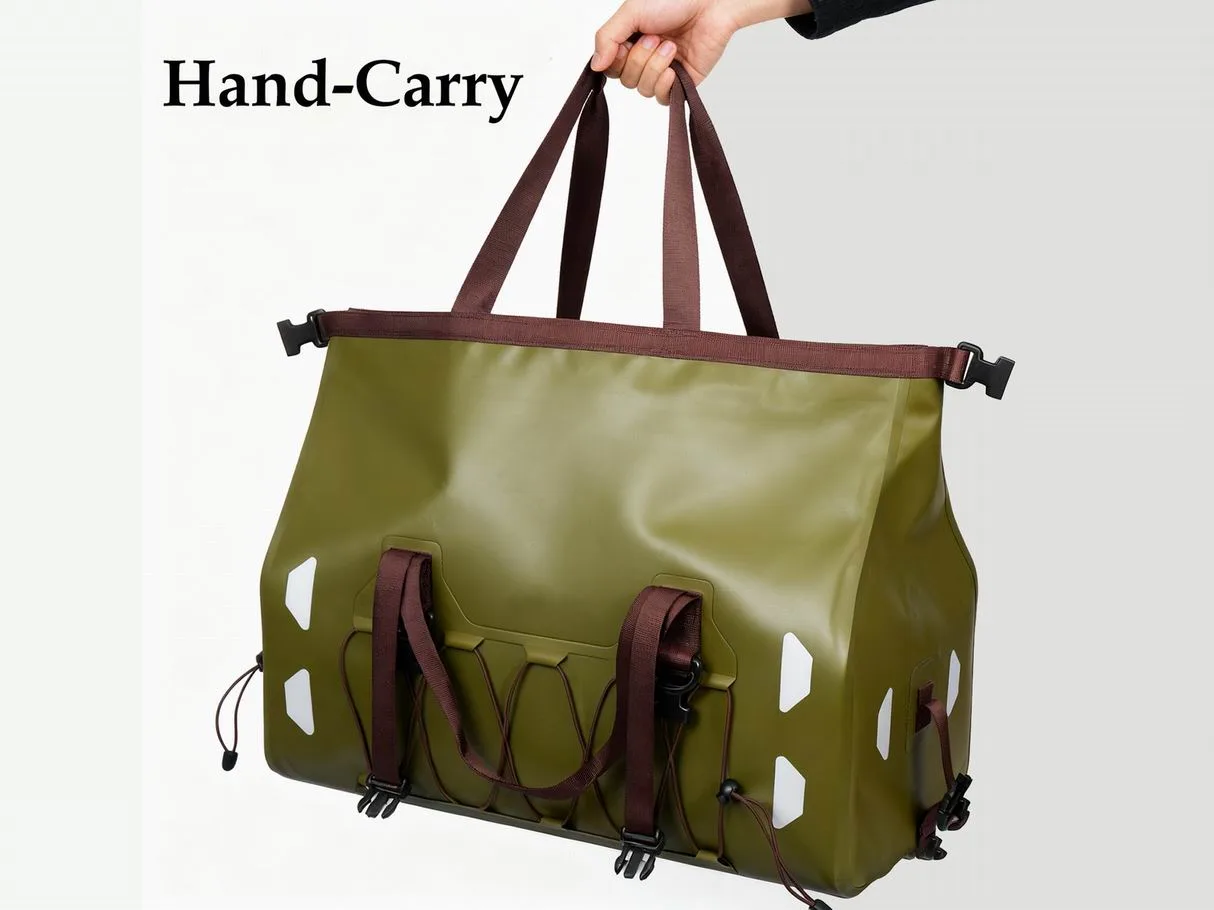
Carrying a roll-top by the rolled mouth is the default because the closure forms a natural grip, and it is genuinely fine for short distances. The limit is set by forearm fatigue and by grip diameter: a rolled mouth is 45 to 60 mm across, which is close to the ideal power grip, but the load hangs from one hand and swings, so walking rhythm suffers after about 200 m.
The failure point is the closure, not your hand. Hanging 12 kg from a rolled mouth puts a peeling load on the top fold, and the fold is the seal. Carry a heavy bag by the mouth for long enough and you are testing the closure in the least favourable direction it will ever see. Use a handle or a strap above roughly 8 kg, even for a short walk.
| Carry method | Comfortable distance | Comfortable load | Hands free | Best situation |
|---|---|---|---|---|
| Hand carry by the roll | 150-300 m | Up to 6 kg | No | Car park to boat |
| Single shoulder strap | 300-800 m | 4-8 kg | One hand | Short portage |
| Crossbody sling | 0.8-2 km | 5-9 kg | Both hands | Town and travel |
| Two-strap backpack harness | 2-10 km | 8-15 kg | Both hands | Trail and commute |
| Duffel handles, two hands | 200-500 m | 10-20 kg | No | Boat to vehicle |
| Clipped to an existing pack | Any | 3-6 kg outside | Both hands | Adding volume |
If you must hand carry, use a handle rather than the roll. A welded webbing handle on the side or end of the bag keeps the load off the closure and gives a grip that does not unroll. Handles rated for this job are welded into a reinforced patch rather than stitched; the construction details are in our welded handles guide.
Shoulder straps: width, padding and slip
One strap is the most common way people carry a mid-size dry bag and the one that causes the most discomfort, because the load pulls the strap off the shoulder and forces a postural correction with every step. That correction is a continuous isometric contraction of the trapezius, and it is what produces the neck ache people attribute to the weight itself.
Width is the first lever. A 25 mm webbing strap is standard on a 10L bag and adequate up to about 5 kg over short distances; 38 mm is the minimum worth having above 8 kg; and 50 mm padded is what makes a 15 kg load tolerable. Padding without width does very little, because a narrow pad still concentrates load on a narrow band of tissue.
Slip is the second lever and it is easier to fix. A slippery TPU shell means the bag slides down the back and the strap rides up the shoulder, so the carry position drifts every few hundred metres. A strap with a grippy underside, or a small silicone print on the strap face, holds position without any change to the padding. Our strap and harness guide covers the construction options.
Backpack harnesses and how load transfers
Two straps change the problem completely because the load is shared and, more importantly, because it is centred. A single strap pulls the trunk sideways; two straps pull it backward, and the back is far better at resisting backward load than at resisting rotation. That is why a 12 kg bag on two straps feels lighter than an 8 kg bag on one.
Load transfer is the mechanism. A proper harness moves 60 to 80% of the weight onto the hips through the strap geometry and, where fitted, a hip belt, leaving the shoulders to stabilise rather than to support. A dry bag worn on two unpadded straps puts nearly all of the weight back on the shoulders, which is why harness quality matters more than bag volume for anything over a kilometre.
| Strap specification | Contact area | Pressure at 10 kg | Comfortable load | Comfortable distance |
|---|---|---|---|---|
| 25 mm webbing, no pad | 30 cm2 | 30 kPa | 4-5 kg | 400 m |
| 25 mm with thin pad | 35 cm2 | 26 kPa | 5-7 kg | 800 m |
| 38 mm webbing, no pad | 46 cm2 | 20 kPa | 7-9 kg | 1.5 km |
| 38 mm with 8 mm pad | 68 cm2 | 14 kPa | 10-13 kg | 3-5 km |
| 50 mm with 12 mm pad | 95 cm2 | 10 kPa | 14-18 kg | 8-12 km |
Above about 20 kPa the shoulder starts to complain within twenty minutes, and the response is usually to shrug, which rotates the shoulder girdle and starts the neck ache. That is the practical threshold behind the table: it is not the weight that decides comfort, it is the pressure, and pressure is a function of width and contact length rather than of padding thickness alone.
Crossbody and sling carry
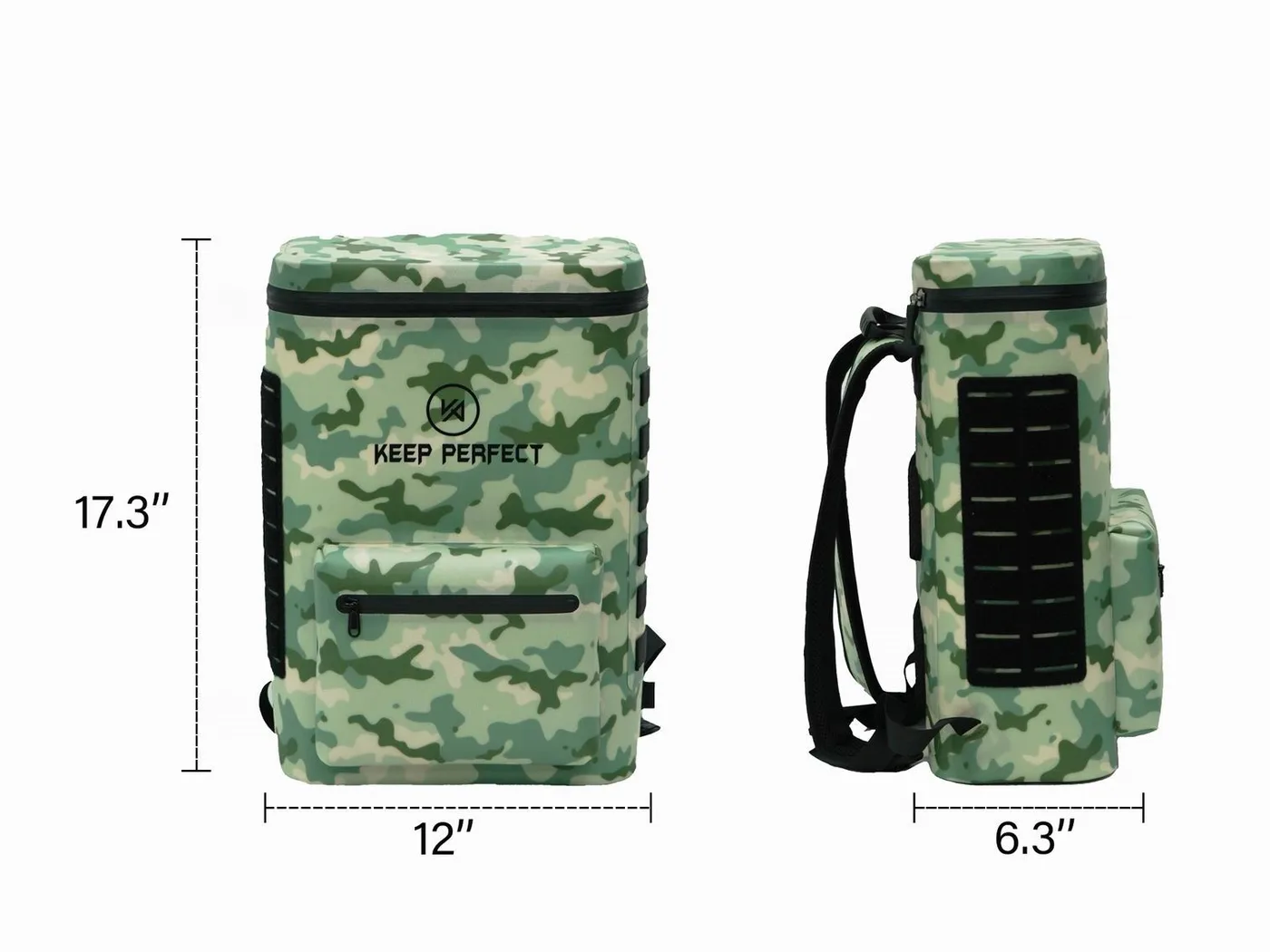
A crossbody carry puts the strap across the chest and the bag at the opposite hip, and it is the best compromise when you need both hands free but do not want a full harness. The diagonal geometry stops the strap sliding off the shoulder, which removes the postural correction that makes single-shoulder carry tiring. It is the right choice for airport, town and campsite use.
The trade-off is access and swing. A bag worn crossbody swings away from the body when you bend, so it catches on door frames and on vegetation, and reaching into it means rotating the whole bag around your torso. For a bag you open ten times an hour, that is irritating; for a bag you open twice a day, it is irrelevant.
Set the length so the bag sits at the top of the hip rather than down at mid-thigh. A bag riding low increases the moment arm on every step and rocks against the leg, and the fix is five centimetres of strap adjustment rather than a different bag. Our backpack versus duffel comparison looks at which formats suit which carry.
Duffel handles and the two-hand carry
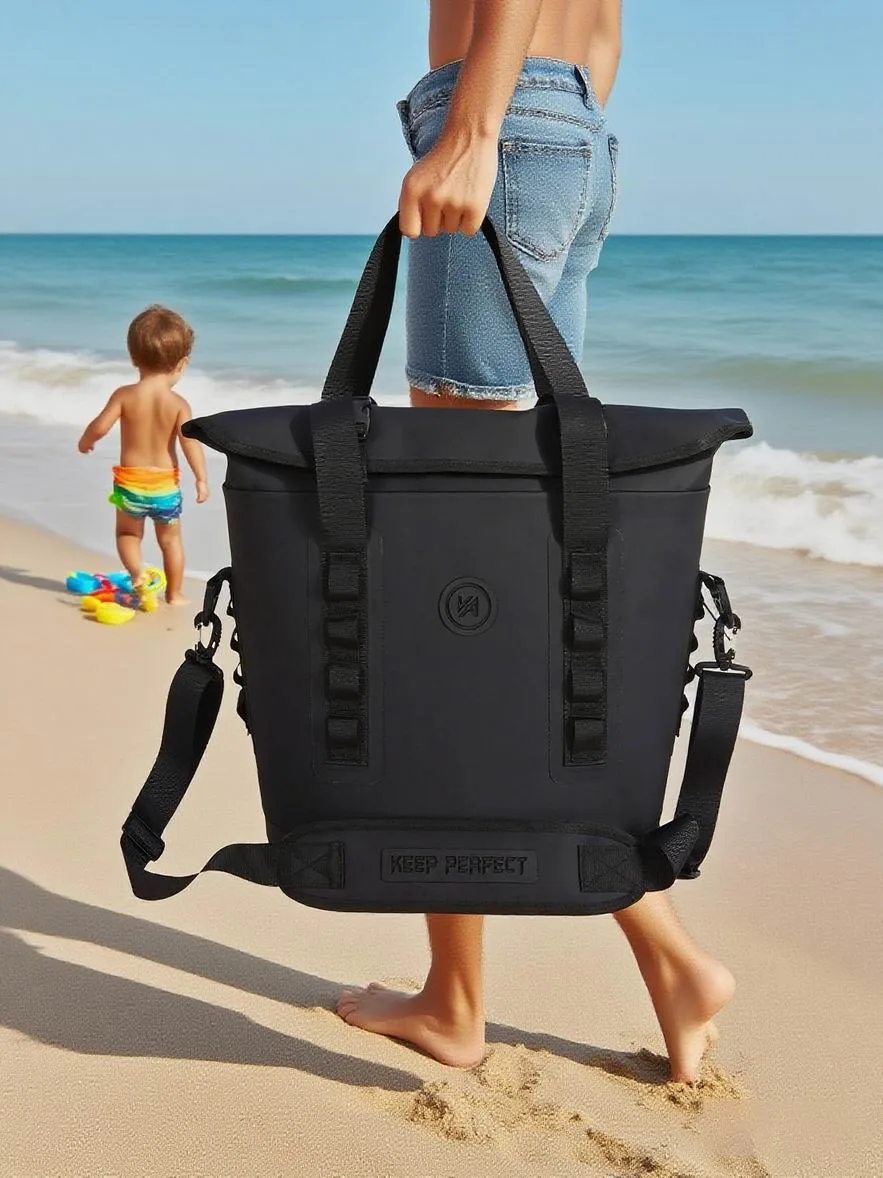
A dry duffel with two handles carries heavy loads well over short distances because both hands share the weight and the load sits low and centred. Twenty kilograms in two hands for 300 m is comfortable; the same load on one shoulder for 300 m is not. The weakness is that the hands are occupied and the bag has to be set down before you can do anything else.
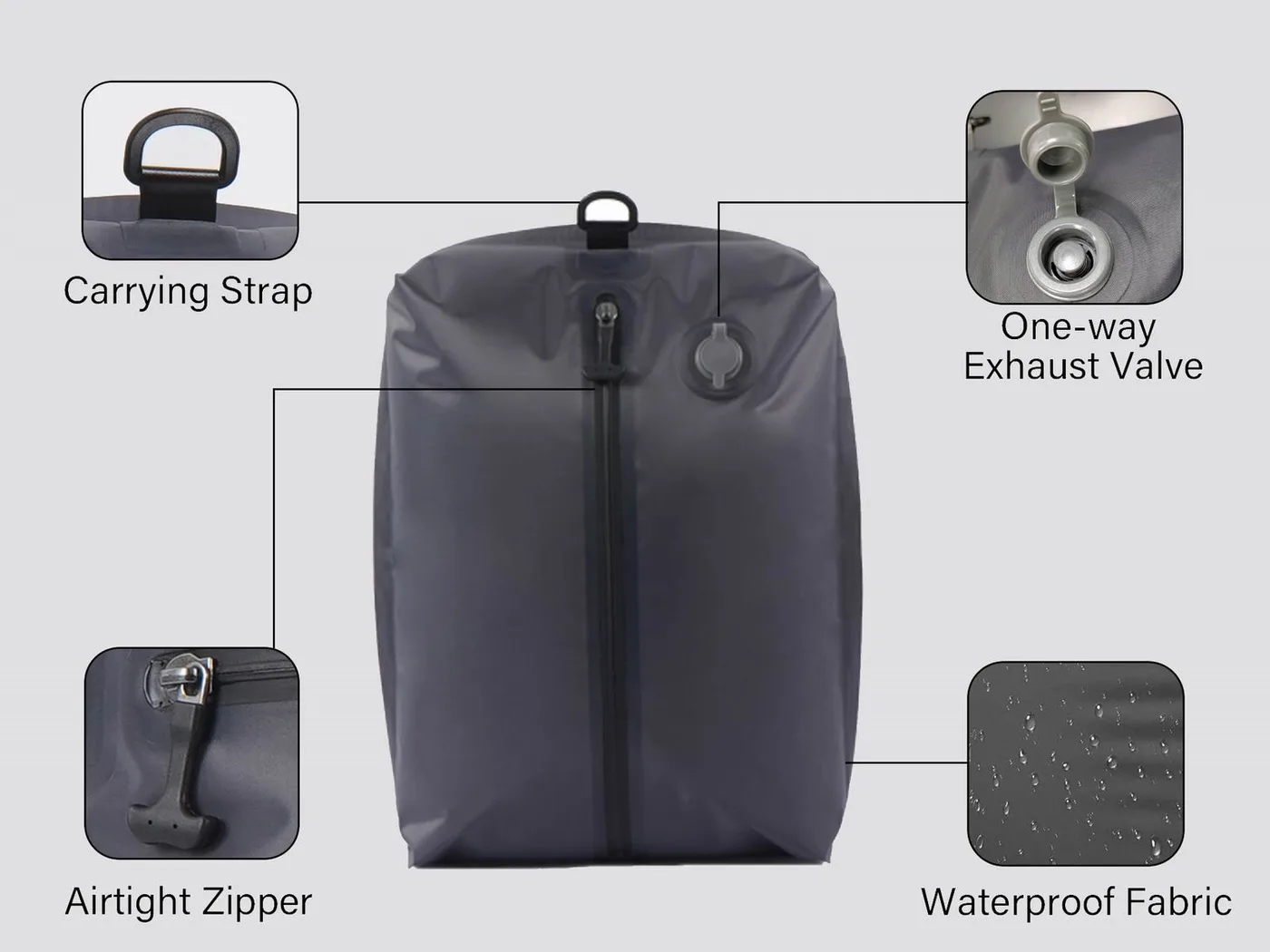
Duffels with detachable backpack straps solve the distance problem, and the quality of that conversion is worth inspecting. Straps that clip to welded D-rings at both ends and cinch together with a sternum strap convert properly; straps that attach at one end and dangle convert badly and end up unused. Look for a sternum strap, because it is what stops the two shoulder straps spreading apart.
Handle geometry deserves a look too. A wrapped handle with a 25 to 30 mm diameter spreads load across the palm, while a flat webbing handle concentrates it into two lines and cuts into the hand above about 12 kg. On a bag meant to be carried loaded, a padded wrap handle is a small cost for a large comfort gain.
Where the load should sit on your body
Height is the single biggest variable after strap width. A bag carried with its centre of mass high, between the shoulder blades, keeps the load close to the spine and lets the back carry it. The same bag slumping to the lumbar region increases the lever arm on the lower back by roughly 40%, which is the difference between a comfortable hour and an aching one.
Horizontal distance matters just as much. Every 10 cm the load sits away from the spine raises the effective moment on the lower back by about 10% of the load, so a bulky bag worn away from the body feels dramatically heavier than a compact one of identical mass. Pack flat items against your back and bulky items away, and pull the load in with a compression strap if the bag has one.
| Load position | Effect on posture | Discomfort onset at 10 kg | Verdict |
|---|---|---|---|
| High, tight to the spine | Neutral, load carried by the back | 60-90 min | Ideal |
| High but 15 cm off the back | Slight backward lean | 30-45 min | Acceptable |
| Mid back, loose | Rounded shoulders | 20-30 min | Poor |
| Lumbar, swinging | Lordosis, hip hike | 10-15 min | Avoid |
| One shoulder only | Lateral trunk lean | 15-25 min | Short distances only |
The practical test is a mirror or a photograph from the side. If the bag sits behind your spine rather than on it, and if your shoulders have come forward to compensate, adjust before you set off rather than after. Two minutes of adjustment at the start of a walk buys an hour of comfort at the end.
Carrying two bags without twisting
Two bags are better than one large bag for redundancy and for access, but they are harder to carry. The mistake is one bag on each shoulder, which looks balanced and is not: any difference in weight produces a lateral lean that the body corrects with every step, and a 1 kg difference over two kilometres is a genuinely tiring asymmetry.
The better arrangement is a matched pair worn front and back, or two bags clipped together and carried on one axis. Front-and-back balances within about 500 g and keeps the hands free, and it is the standard approach for long portages. If you must carry one in each hand, keep within 1 kg of each other and swap sides every few hundred metres.
Weight matters more than balance when the total climbs. Two 7 kg bags are not equivalent to one 14 kg bag on a proper harness, because the harness transfers load to the hips and two hand-carried bags do not. Split the load only when splitting improves balance or access; otherwise consolidate into the best harness you have.
A wet bag against your back
A waterproof shell does not breathe, so a bag worn against the back becomes a vapour barrier. Within fifteen minutes of moderate walking the skin under the contact patch reaches saturation, and the result is a soaked shirt that chafes and, on a long day, macerates. This is the complaint people describe as the bag being uncomfortable when the actual problem is sweat with nowhere to go.
Three things help. A harness with a raised mesh or spacer panel keeps a 10 to 15 mm air gap, which is enough for convective drying on the move. A bag worn over a synthetic base layer rather than cotton moves moisture away from the skin. And stopping every hour to let the back air for two minutes prevents the cumulative effect that causes the real damage.
Cold changes the problem. In low temperatures a wet back loses heat roughly 25 times faster than a dry one, so the vapour barrier becomes a hypothermia risk rather than a comfort issue. On a winter carry, keep the bag off the back where possible, or add an insulating layer between the two, and carry a dry layer in the bag for the moment you stop moving.
Distance rules: 300 m, 2 km and a full day
Comfort is a function of load multiplied by distance, and the relationship is not linear because fatigue compounds. A practical rule derived from load carriage data is that discomfort roughly doubles for every 50% increase in distance at a constant load. That makes the choice of carry method a function of how far you are going rather than of how much you are carrying.
Under 300 m, almost anything works and the fastest method wins: hand carry, one strap, whatever gets you moving. Between 300 m and 2 km, a sling or a two-strap harness on a 10 kg load is the threshold zone where the wrong choice starts to cost. Beyond 2 km, a proper harness with a hip belt and a load above 8 kg, or a load under 8 kg on padded straps, is the only comfortable answer.
Occupational load-carriage guidance and ergonomics standards are published by the ISO, and the webbing and strap strength testing that underpins hardware ratings sits with the ASTM. Both are worth citing in a specification so that a comfort claim and a strength claim are tested to something rather than asserted.
Carrying on a bike, board or boat
On a bicycle, a dry bag on the back changes the centre of gravity and the handling, and the effect is larger than most riders expect. A 10 kg load at shoulder height raises the combined centre of mass noticeably and slows steering response, so it belongs low: panniers, a handlebar roll, or a frame bag rather than a backpack. Our bikepacking handlebar setup covers the mounting detail.
On a paddleboard or in a kayak the carry question becomes a lashing question. A bag worn while paddling raises the centre of gravity and restricts rotation of the torso, both of which are wrong for the stroke. Lash it within reach and carry it only between water and vehicle, which is exactly the short-distance case where hand carry is fine.
On a motorcycle or an ATV, the constraint is not comfort but retention. A bag carried on the back shifts under acceleration and throws the rider off balance, so it goes on the rack, strapped down at two points minimum with a strap rated for the shock load rather than the static weight. Check strap tension after the first 20 km and again after every stop.
Fitting and adjustment before you set off
- Pack heavy items first so they sit high and against the panel that will face your back.
- Close the roll with three folds and check the bag forms one stable block with no loose corner.
- Put the bag on and set strap length so the load sits between the shoulder blades, not at the waist.
- Fasten the sternum strap at mid-chest height and tighten until the straps stop spreading.
- Lean forward 30 degrees; if the bag swings away from you, tighten the load lifters or shorten the straps.
- Walk 50 m and re-adjust once before you commit to the full distance.
The fifty-metre rule is the one people skip and it is the one that works. Almost every fit problem shows up inside fifty metres: straps that spread, a bag that swings, a sternum strap at the wrong height, a load that has already slumped. Fixing at fifty metres costs thirty seconds; discovering the same problem at three kilometres costs the rest of the day.
Retention hardware deserves a check at the same time. Every strap anchor, buckle and D-ring on a loaded bag is carrying the full weight plus a dynamic component when you step off a kerb, and a strap that slips under load is worse than no strap at all. Rated loads for these components are set out in our strap load guide.
Which carry method suits which bag
- 2L to 5L: hand carry or clip to a pack; a strap is unnecessary below 3 kg.
- 10L to 20L: single padded strap for short walks, two-strap harness beyond 1 km.
- 20L to 40L: two-strap harness always; a hip belt above 12 kg.
- 40L to 90L: duffel handles for vehicle-to-vehicle, harness with hip belt for distance.
- Cooler and bucket formats: two handles, carried low and centred, never by the roll.
- Any bag above 15 kg: split the load or make two trips rather than upgrading the strap.
The pattern is that carry method should follow distance first and load second, because distance is what people underestimate. Most carry discomfort reported on dry bags is not a heavy-load problem; it is a 6 kg bag carried 3 km on the wrong strap, which is entirely avoidable with a 38 mm padded harness.
Dry bags and waterproof packs have been produced since 2014 in an SGS-verified 4,950 m2 facility, with harness options sampled on the same 6 to 10 working day cycle as the bag itself and bulk in 35 to 50 days at a 500-piece minimum.For harness maintenance over a season, read our waterproof harness care guide, and compare formats across the full product line and the waterproof backpack range.
One last practical point: a comfortable carry is also a safer one. A load that swings or pulls you sideways on wet rock, a boat ramp or a busy street is a hazard to you and to anyone beside you, and the adjustments above take about two minutes. Do them before the first step rather than after the first ache, and match the method to the distance you are actually walking.
Frequently asked questions
Q1. How do you carry a dry bag comfortably?
Match the strap to the load and the distance: a 25 mm unpadded strap is comfortable to about 400 m at 5 kg, a padded 38 mm two-strap harness handles 10 kg for 3 to 5 km. Keep the load high and tight to the spine.
Q2. What strap width is comfortable for a dry bag?
25 mm for loads under 5 kg, 38 mm padded between 7 and 13 kg, and 50 mm padded above 14 kg. Pressure under the strap is what matters: under about 20 kPa the shoulder tolerates it for an hour.
Q3. Can you carry a dry bag like a backpack?
Yes, if it has two straps and ideally a sternum strap and hip belt. Two straps centre the load and let the back resist it, which is why 12 kg on two straps feels lighter than 8 kg on one.
Q4. Is it safe to carry a heavy dry bag by the roll?
Not above roughly 8 kg. Hanging weight from the rolled mouth puts a peeling load on the seal, which is the least favourable direction the closure will ever see. Use a welded handle or a strap instead.
Q5. How far can you carry a 10 kg dry bag?
About 800 m on a single padded strap and 3 to 5 km on a padded 38 mm two-strap harness. Discomfort roughly doubles for every 50% increase in distance at a constant load, so method matters more than weight.
Q6. Why does my dry bag slide off my shoulder?
A TPU shell is smooth and the strap has nothing to grip, so the bag drifts down the back and the strap rides up. A grippy strap underside or a silicone print holds position without changing the padding.
Q7. Should a dry bag sit high or low on the back?
High, between the shoulder blades. A bag that slumps to the lumbar region increases the lever arm on the lower back by about 40% and turns a comfortable hour into an aching twenty minutes.
Q8. Does a waterproof bag make your back sweaty?
Yes, because a welded shell does not breathe. A spacer or mesh harness panel with a 10 to 15 mm air gap, a synthetic base layer, and a two-minute airing break each hour all help.
Q9. Is it better to carry one large bag or two small ones?
One large bag on a good harness, unless splitting improves balance. Two bags carried on separate shoulders create a lateral lean, and a 1 kg difference over two kilometres is genuinely tiring.
Q10. How do I carry a dry bag on a bicycle?
Low, not on your back. A 10 kg load at shoulder height raises the centre of mass and slows steering, so use panniers, a handlebar roll or a frame bag rather than a backpack.
Q11. What is a hip belt for on a dry bag?
Load transfer. A properly fitted harness moves 60 to 80% of the weight onto the hips, leaving the shoulders to stabilise. Above 12 kg it is the difference between carrying and enduring.
Q12. How tight should a sternum strap be?
Mid-chest height, tightened until the shoulder straps stop spreading apart but not so tight that it restricts breathing. It prevents the straps sliding outward, which is the main cause of shoulder rub.
Q13. Can children carry their own dry bag?
Yes from about age six, in a 5L bag loaded to 2 kg or less on padded straps. Keep the load under 10% of body weight and use a chest strap so the bag cannot swing.
Q14. How do I stop a duffel swinging when carried?
Shorten the strap so the bag sits at the top of the hip rather than mid-thigh, and cinch any compression strap so the contents form one block. Low-riding bags rock against the leg with every step.
Q15. Are padded handles worth it on a duffel?
Yes above about 12 kg. A flat webbing handle concentrates load into two lines across the palm; a wrapped handle 25 to 30 mm across spreads it and can be carried twice as far.
Q16. What is the most common carry mistake?
Carrying a 6 kg bag three kilometres on the wrong strap. Most reported discomfort is a distance and pressure problem rather than a weight problem, and a 38 mm padded harness solves it.
People also ask
What is the most comfortable way to carry a dry bag?
A padded two-strap harness with the load high and tight to the spine, plus a sternum strap and a hip belt above 12 kg. Two straps centre the load and let the back carry it rather than the shoulders.
How heavy is too heavy to carry a dry bag by hand?
About 6 to 8 kg. Beyond that the weight puts a peeling load on the rolled closure and forearm fatigue sets in within 200 to 300 m, so switch to a welded handle or a strap.
Why does my shoulder hurt after carrying a dry bag?
Pressure, not weight. A narrow strap concentrates load above 20 kPa, and the natural response is to shrug, which rotates the shoulder girdle and starts neck ache. Widen the strap before reducing the load.
Should a dry bag be worn high or low on the back?
High, between the shoulder blades. Slumping to the lumbar region lengthens the lever arm on the lower back by roughly 40%, which cuts comfortable carry time from an hour to about twenty minutes.
Do waterproof backpacks make your back sweat more?
Yes, because a welded shell does not breathe and becomes a vapour barrier within fifteen minutes. Choose a harness with a spacer panel that holds a 10 to 15 mm air gap against the back.
How do you carry two dry bags at once?
Front and back as a matched pair within about 500 g of each other, or clipped together on one axis. Avoid one bag on each shoulder, because any imbalance produces a lateral lean you correct on every step.
Need this in production volume?
QUANZHOU JUNYUAN BAGS has produced waterproof bags since 2014 in an SGS-verified 4,950 m2 facility in Fujian, China. Minimum order 500 pieces, sampling in 6–10 working days, bulk in 35–50 days, FOB Xiamen — write to service@junyuanbags.com with your spec and target market.