Home / Blog / Sustainability & Compliance
Recyclable Dry Bag Design Trends
A conventional dry bag is roughly 62% film, 21% face fabric, 11% hardware and 6% ink and adhesive by weight, and those four fractions cannot be separated once welded, which is why the category has a recycling rate close to zero. The design trends changing that are concrete and measurable: mono-material TPU shells raise the recyclable fraction from under 10% to about 80%, snap-in hardware removes the metal and polyoxymethylene contamination in under two minutes, and post-industrial recycled TPU now runs at 30 to 50% content with a property loss of less than 5% on tensile strength.
This guide walks through the current design movements in order of how much recyclability each one actually delivers, from mono-material construction and recycled feedstocks to solvent-free inks and take-back schemes. It also separates the trends that are shipping at volume today from the ones that are still pilot-scale, explains what extended producer responsibility rules mean for a bag programme selling into Europe, and gives a specification checklist for anyone commissioning a range. Where a trend is more marketing than material, this guide says so plainly.
- Why the dry bag is a genuinely hard recycling problem
- The material bill of a typical dry bag
- Mono-material design: the central trend
- Recycled TPU: post-industrial versus post-consumer
- rPET face fabrics and what recycled content means
- Designing hardware for disassembly
- Adhesives, inks and coatings that contaminate the stream
- Mechanical, chemical and feedstock routes compared
- What regulation is pushing
- Certifications and how to read them
- Design choices that raise or kill recyclability
- Measuring it: recycled content and end-of-life accounting
- What to specify now and what to watch
Why the dry bag is a genuinely hard recycling problem
A drinks bottle is one polymer and one closure; a dry bag is a bonded composite designed never to come apart. Waterproofing depends on welding a film to a woven face fabric, and the whole point of a weld is that the joint is as strong as the materials it joins. That is exactly the property that makes separation impossible, so the recyclability problem here is not laziness or cost cutting: it is the functional requirement of the product working against the end-of-life requirement.
Add hardware and the picture worsens. A buckle is polyoxymethylene or nylon, a D-ring may be stainless steel, a strap is polyester webbing, and a purge valve is a mix of silicone and polypropylene. A single 20L bag can contain five polymer families and one metal, and a mechanical recycling stream that receives that mixture produces a low-grade output that nobody wants to buy.
Scale matters too. A dry bag weighs 300 to 700 g and a household buys one every five to ten years, so the category generates a small, diffuse waste stream that no municipal sorting system is tuned to capture. The realistic path is therefore not better kerbside sorting but design that makes the product acceptable to an industrial stream, plus take-back routes that collect it in one place. Our overview at how recyclable are dry bags sets out the baseline.
The material bill of a typical dry bag
| Component | Share of weight | Material | Separable? | Recyclable alone? |
|---|---|---|---|---|
| Waterproof film | 38% | TPU or PVC | No, welded | Yes, if clean TPU |
| Face fabric | 24% | Nylon or polyester | No, laminated | Yes in theory |
| Hardware | 11% | POM, nylon, steel | Partly | Steel yes, mixed no |
| Webbing and straps | 14% | Polyester | Yes | Yes |
| Ink and adhesive | 6% | Mixed organics | No | No |
| Packaging | 7% | Card, plastic film | Yes | Card yes |
The two lines that decide everything are the film and the face fabric, because together they are 62% of the bag and they are inseparable once laminated. If those two are different polymer families, the whole 62% is unrecyclable. If they are the same family, the whole 62% can in principle be reprocessed, which is why mono-material construction is the single most important trend in this category and why it sits at the top of every list.
Hardware is the second priority, and it is the easiest to fix. Eleven percent of weight in mixed polymers and metal is enough to contaminate a batch and downgrade the output, yet it is also the fraction that a designer can remove with a snap fitting rather than a rivet. That asymmetry, high contamination impact and low redesign cost, makes it the highest return change available.
Mono-material design: the central trend
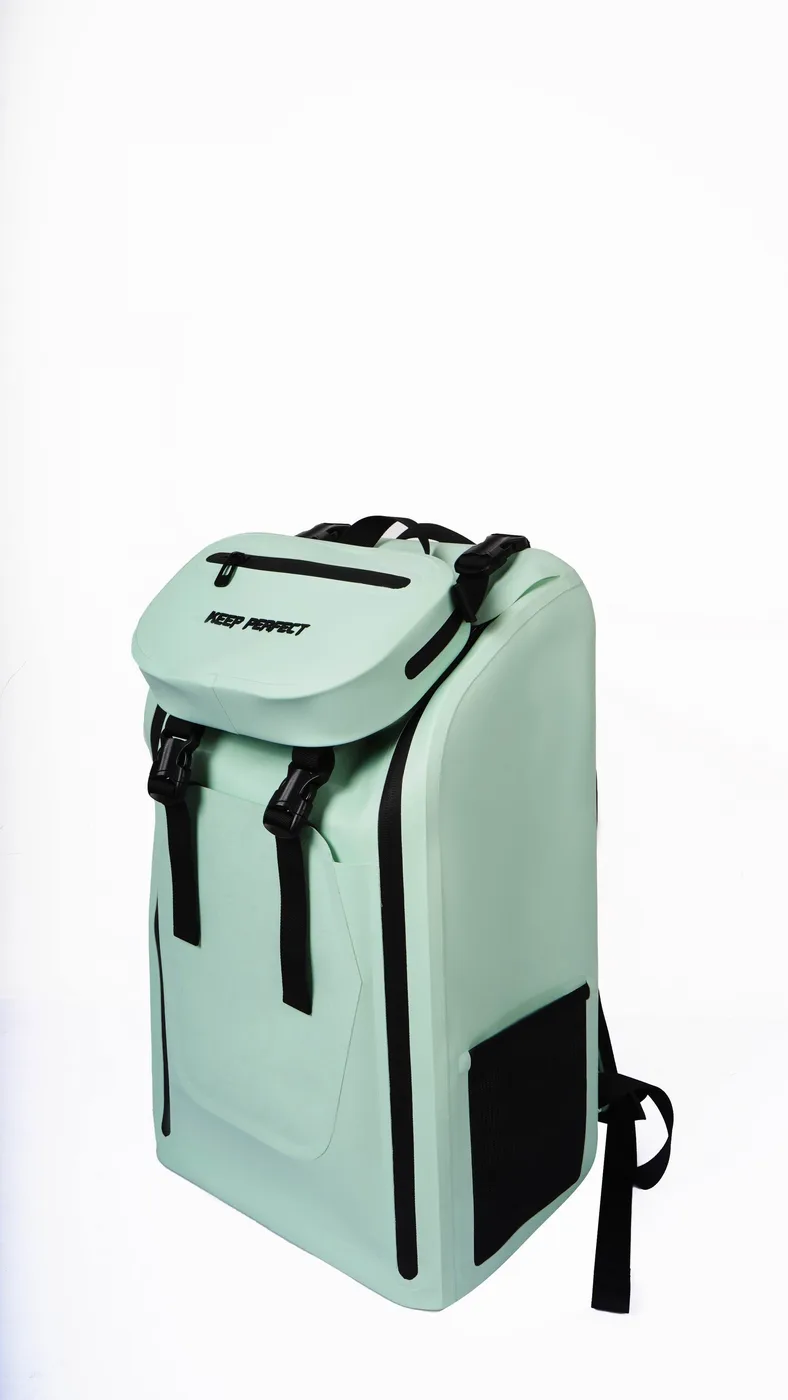
Mono-material construction means the film, the face fabric, the webbing and the thread all belong to one polymer family, so the whole soft structure can be ground and reprocessed together. The commercially available version pairs a thermoplastic polyurethane film with a polyurethane-compatible face fabric and polyester-free webbing, and it currently reaches about 80 to 85% of total bag weight. The remaining 15 to 20% is hardware and ink.
The performance cost is real but small. Early mono-material shells ran 8 to 12% lower on tear strength and about 5% heavier for the same hydrostatic head, figures that have improved to 3 to 5% and 2 to 3% respectively over three years of development. For most users the difference is invisible, and for a programme it buys a claim that is defensible against a standard rather than a slogan.
There is a manufacturing argument as well. Welding one polymer family to itself removes the adhesion uncertainty of bonding dissimilar materials, which widens the process window and raises yield. In our experience the weld strength spread narrows noticeably on mono-material runs, and fewer rejects partly offset the material premium. The trade-offs are covered in more depth in our dry bag material recyclability guide.
Recycled TPU: post-industrial versus post-consumer
Recycled TPU comes in two grades and the difference matters more than the headline percentage. Post-industrial material is offcut and start-up waste collected inside a converting plant, so it is clean, traceable and chemically identical to the virgin polymer. It is routinely used at 30 to 50% content with a tensile strength loss under 5% and no measurable change in weld behaviour.
Post-consumer TPU comes from collected products, which means unknown additives, unknown service history and contamination. Practical loadings today sit at 15 to 30%, with a tensile loss of 8 to 15% and a wider spread between batches. For a product with a warranty, that spread is the problem: a bag that fails at 5,000 folds instead of 8,000 is a complaint, and the sorting infrastructure to guarantee consistency does not exist yet at scale.
| Feedstock | Typical loading | Tensile strength change | Weld behaviour | Availability |
|---|---|---|---|---|
| Virgin TPU | 100% | Baseline | Excellent | Immediate |
| Post-industrial recycled | 30-50% | -3% to -5% | Equivalent | High, in volume |
| Post-consumer recycled | 15-30% | -8% to -15% | Wider spread | Limited, regional |
| Chemically recycled | 20-40% | -2% to -4% | Equivalent | Pilot scale |
| Bio-based TPU | 30-70% bio content | Neutral to -3% | Equivalent | Moderate, premium |
The honest position for a programme today is post-industrial recycled at 30 to 50%, declared as such, with post-consumer trialled in a non-critical component. Claiming post-consumer content without mass-balance documentation is the fastest way to attract a regulatory challenge, and the documentation burden is the real barrier rather than the polymer chemistry. See our dedicated recycled TPU guide for the detail.
rPET face fabrics and what recycled content means
Recycled polyester face fabric is the maturest part of this picture. Bottle-flake rPET at 50 to 100% content is available at scale, performs within a few percent of virgin polyester on tensile and abrasion, and is documented through a transaction certificate chain. A 500D rPET face with a 0.50 mm TPU film is a genuinely better environmental outcome than a virgin equivalent and costs a premium of roughly 8 to 15% on the fabric line.
Two caveats apply. First, rPET is still polyester, so it does nothing for the mono-material goal unless the film is also polyester-based, which brings its own weld and flexibility penalties. Second, bottle-flake rPET uses a feedstock that already had a functioning recycling stream, so the marginal benefit is smaller than the marketing implies. Textile-to-textile feedstock is the more valuable direction and is still supply-constrained.
Nylon face fabrics have a weaker recycled offering, mainly because post-consumer nylon collection is less organised and the chemistry of depolymerisation is more demanding. If nylon performance is genuinely required for abrasion, the honest approach is to say so and to compensate elsewhere in the design rather than to substitute a lower-performing recycled polyester and shorten the product life. A bag that lasts twice as long beats a marginally greener bag that wears out, a point our repair over replace guide develops.
Designing hardware for disassembly
- Snap-in buckles on a webbing tab instead of riveted or welded permanent fittings.
- Single-polymer hardware, all POM or all nylon, so the removed fraction is one material.
- Stainless D-rings on a removable webbing loop rather than welded directly into the panel.
- Purge valves with a threaded body that unscrews by hand in under thirty seconds.
- No metal eyelets, no mixed-material trims and no glued-on labels on the shell.
- A resin identification code moulded into every hard part, not printed on a tag.
The target in practice is two minutes with no tools to strip a bag down to its soft structure, and the designs that achieve it also happen to be more repairable, because a removable buckle is a replaceable buckle. That overlap is not a coincidence: repairability and recyclability both reward reversible joints, and a designer optimising one is usually improving the other at the same time.
Cost is the predictable objection. A snap-in fitting adds 0.10 to 0.25 US dollars per attachment point against a rivet, and it introduces a part that could be lost. Against that, a removable hardware set cuts the contaminated fraction of the bag by about 11% of weight and lets a user replace the component most likely to break, which is the buckle. Over a fleet life that is a clear win.
Adhesives, inks and coatings that contaminate the stream
The 6% of weight that is ink and adhesive does far more damage than its share suggests. Solvent-based inks leave residues that survive reprocessing and discolour the output, and cross-linked adhesives form particles that do not melt, leaving visible defects in the reprocessed material. Both push a recycler to downgrade the whole batch rather than the contaminated fraction.
The trends here are water-based ink systems, which have closed the abrasion gap for most bag applications, and hot-melt adhesives compatible with the base polymer rather than reactive cross-linked systems. A compatible hot-melt melts alongside the substrate instead of surviving it as a defect, and that single substitution can lift the quality of the reprocessed output by a grade. Our water-based printing ink guide covers the current performance envelope.
Coatings deserve a mention because they are easy to overlook. A durable water-repellent finish applied over the face fabric is a small mass but a chemically distinct one, and fluorinated versions are being withdrawn from many markets for persistence reasons. Non-fluorinated alternatives now reach acceptable performance for a shell that is already waterproofed by a film underneath, which makes the face finish largely optional on a laminated construction.
Mechanical, chemical and feedstock routes compared
| Route | Input tolerance | Output quality | Energy demand | Readiness for TPU |
|---|---|---|---|---|
| Mechanical grinding | Low, needs clean single polymer | Downgraded, 70-85% properties | Low | Available now |
| Reprocessing with virgin blend | Moderate, 20-40% recycled | Near-virgin at 30% loading | Low | Available now |
| Solvent-based dissolution | Moderate, tolerates some mix | High, near-virgin | Moderate | Pilot scale |
| Depolymerisation | Low, needs pure feedstock | Virgin-equivalent monomer | High | Limited |
| Thermal conversion | High, tolerant | Feedstock oil, not polymer | High | Not preferred |
For a TPU dry bag the practical destination today is mechanical reprocessing blended with virgin polymer at 20 to 40% recycled loading, which delivers near-virgin properties and uses existing equipment. Dissolution routes produce better output and tolerate more contamination, and several plants are running at pilot scale, but availability is regional and volumes are booked well ahead. Depolymerisation is the long-term answer and is not yet an option a brand can plan a season around.
Thermal conversion deserves scepticism. It tolerates mixed input, which makes it attractive on paper, but it converts a polymer back into feedstock oil rather than into material, and it is classified as recovery rather than recycling under most frameworks. If a claim depends on thermal conversion being counted as recycling, it will not survive contact with a regulator.
What regulation is pushing
Extended producer responsibility schemes are the main driver, and they work by making the brand pay a fee per unit placed on the market, modulated by how recyclable the product is. A mono-material bag with removable hardware can attract a materially lower fee than a mixed construction, which turns design-for-recycling from a marketing choice into a line item. The rules differ by market, and the fee modulation schedules are being tightened on a published timetable.
Chemical restrictions matter as well. Restrictions on intentionally added per- and polyfluoroalkyl substances affect face finishes, plasticiser rules affect PVC shells, and both push the category toward TPU and non-fluorinated finishes. A programme that specifies PVC today is likely to face a reformulation cost within a few years, which is an argument for choosing the more durable chemistry now.
Waste shipment rules affect take-back schemes, because moving collected bags across borders for reprocessing is regulated. Programs that collect in the market where they sell and reprocess in the same region avoid that complexity entirely. Guidance on chemical and waste policy in the United States is published by the EPA, and the standards framework for environmental claims and testing sits with the ISO, notably the ISO 14020 series on environmental labelling.
Certifications and how to read them
Four marks appear regularly on bag specifications and they certify different things. Recycled-content certification verifies the chain of custody from feedstock to finished roll, usually through transaction certificates, and says nothing about performance or end-of-life. Chemical-safety certification tests the finished textile for restricted substances against a limit list, which is about human exposure rather than recycling.
Process certifications cover inputs such as energy, water and emissions at the material production stage, and they are valuable but narrow: a certified fabric can still be welded into an unrecyclable product. End-of-life or recyclability assessments are the closest thing to what a brand actually wants, and they are the least standardised, which means the assessment method should be named on the document rather than assumed.
Marine contexts add one more consideration. Bags used on the water end up in the water, and litter that enters the sea fragments rather than degrades on any useful timescale. Guidance on marine debris and its sources is published by NOAA, and the practical design response is the same as everywhere else: fewer materials, reversible joints, and a product worth collecting at the end of its life.

Design choices that raise or kill recyclability
| Design choice | Effect on recyclable fraction | Cost impact | Verdict |
|---|---|---|---|
| Mono-material shell | +60 to +70 points | +12-20% material | Do it first |
| Removable single-polymer hardware | +8 to +11 points | +0.10-0.25 USD per point | Do it |
| Water-based ink | +2 to +4 points | Neutral | Do it |
| Compatible hot-melt adhesive | +2 to +3 points | Neutral to slight | Do it |
| Clear window panel | -3 to -6 points | +0.30-0.60 USD | Use sparingly |
| Metal eyelets or rivets | -6 to -9 points | Neutral | Avoid |
| PVC shell | -40 to -55 points | Lower material cost | Avoid for new programmes |
The two negative entries deserve comment. A clear window is useful for identifying kit inside a hatch, but it introduces a second polymer and a second weld path, so the design response is to offer it as an option rather than a default. A PVC shell is cheap and performs acceptably, but it is the single change that most reduces end-of-life value, and the regulatory direction of travel is against it. Our PVC-free alternatives guide lists the practical substitutes.
Measuring it: recycled content and end-of-life accounting
Two numbers belong in a specification. The first is recycled content as a percentage of total product weight, calculated on the finished bag including hardware and trims rather than on the fabric alone, because quoting the fabric figure inflates the result by roughly 20 to 30 points. The second is the recyclable fraction, meaning the share of weight that a named reprocessing route will accept.
Both need a boundary statement. Is packaging included? Is hardware included? Is the calculation per unit or per average across a size range, since a 5L bag has a higher hardware share than a 60L bag? Without those three answers, two brands reporting 60% recycled content may be describing quite different products, and a buyer comparing them is comparing nothing.
A useful internal target for 2026 is 30 to 50% post-industrial recycled content and a recyclable fraction above 75%, both documented per SKU. Below 25% recycled content the claim is not worth the certification cost; above 75% recyclable fraction, the remaining gains come from take-back rather than from design. The eco-friendly dry bag range shows where current constructions sit against those thresholds.
What to specify now and what to watch
- Specify a mono-material shell with one named polymer family for film, face fabric and webbing.
- Require 30-50% post-industrial recycled content with transaction certificates per batch.
- Require removable single-polymer hardware and a resin code moulded into each part.
- Specify water-based ink and a hot-melt adhesive compatible with the base polymer.
- Avoid metal eyelets, mixed-material trims and PVC shells on new programmes.
- Ask for recycled content calculated on the finished bag, not on the fabric alone.
- Plan a take-back route in the market where you sell, to avoid waste shipment complexity.
The trends worth watching over the next two years are chemical recycling capacity, which would lift output quality without demanding purity, and textile-to-textile feedstock, which would give rPET a genuine additional benefit rather than borrowing from bottle collection. Both are supply-side developments that will show up as availability before they show up as price, so the practical move is to design a product that can accept a higher recycled loading when the material becomes available.
The trend to be sceptical of is biodegradability. A bag that breaks down in soil is not a bag that can be recycled, and additives that promote fragmentation mostly produce microplastic faster rather than solving anything. For a product designed to keep water out for a decade, controlled end-of-life through collection and reprocessing is the honest goal, and our analysis in biodegradability claims explained sets out why.
Our production line has built waterproof bags since 2014 in an SGS-verified 4,950 m2 facility, and recycled and mono-material constructions are sampled on the same 6 to 10 working day cycle as standard shells, with bulk in 35 to 50 days and inspection to AQL 2.5.For the wider picture, read our sustainable buying checklist, the rPET fabric guide, and the carbon footprint analysis, then compare constructions across the full product line.
Frequently asked questions
Q1. What makes a dry bag recyclable?
A mono-material shell, where the film, face fabric and webbing are one polymer family, plus removable single-polymer hardware. That combination lifts the recyclable fraction from under 10% to about 80% by weight.
Q2. Are dry bags recyclable today?
Most are not. A conventional laminated shell with mixed hardware and solvent inks cannot be separated into clean fractions, so the practical recycling rate for the category is close to zero without a take-back scheme.
Q3. What is mono-material design?
Building the whole soft structure from one polymer family so it can be ground and reprocessed without separation. For dry bags that usually means a TPU film on a compatible face fabric with matching webbing, reaching 80 to 85% of bag weight.
Q4. How much recycled TPU can be used?
Post-industrial recycled TPU runs at 30-50% loading with under 5% tensile loss and equivalent weld behaviour. Post-consumer material is limited to 15-30% with an 8-15% loss and a much wider batch spread.
Q5. Is recycled polyester face fabric worth it?
Yes as a mature, well-documented option: bottle-flake rPET at 50-100% performs within a few percent of virgin and costs 8-15% more on the fabric line. It does not help mono-material goals unless the film is also polyester-based.
Q6. Why is PVC a problem for recycling?
It is a different polymer family from the usual face fabrics, it contains plasticisers that are increasingly restricted, and it contaminates a TPU or polyester stream. Choosing PVC typically lowers the recyclable fraction by 40 to 55 points.
Q7. Does hardware really matter for recycling?
Yes, disproportionately. Hardware is about 11% of bag weight but enough mixed polymer and metal to downgrade a whole reprocessing batch. Removable single-polymer fittings are the cheapest high-impact change available.
Q8. What is extended producer responsibility?
A policy approach that makes the brand pay a fee per unit placed on the market, usually modulated by how recyclable the product is. It turns design-for-recycling from a marketing decision into a measurable cost line.
Q9. Are biodegradable dry bags better?
No. Fragmentation additives mostly accelerate microplastic formation, and a bag that breaks down cannot be recycled. For a product meant to keep water out for a decade, collection and reprocessing is the honest end-of-life route.
Q10. How should recycled content be calculated?
On the finished bag including hardware and trims, not on the fabric alone, which inflates the figure by 20-30 points. State the boundary: packaging, hardware and whether the figure is per unit or averaged across sizes.
Q11. What certifications should I look for?
A recycled-content certification with transaction certificates for the chain of custody, a chemical-safety certification against a restricted substance list, and ideally an end-of-life assessment that names its method. Each covers a different thing.
Q12. Is chemical recycling available for TPU?
At pilot scale. Dissolution routes produce near-virgin output and tolerate more contamination than mechanical grinding, but capacity is regional and booked ahead. Depolymerisation is the long-term option and not yet plannable.
Q13. Do clear windows hurt recyclability?
Yes, by 3 to 6 points, because they add a second polymer and a second weld path. Offer a window as an option rather than a default, and avoid it on bags destined for a take-back stream.
Q14. What is a realistic recycled content target for 2026?
30-50% post-industrial recycled content with a recyclable fraction above 75%, both documented per SKU. Below 25% the certification cost outweighs the claim; above 75% the gains come from take-back rather than design.
Q15. Does repairability overlap with recyclability?
Strongly. Both reward reversible joints, so a removable buckle is both a replaceable part and a separable material fraction. Designers optimising one are usually improving the other at the same time.
Q16. Which single change has the biggest effect?
A mono-material shell. It moves 60 to 70 percentage points of bag weight from unrecyclable to recyclable in one decision, which is more than every other available change combined.
People also ask
Are dry bags recyclable?
Most conventional dry bags are not, because a welded laminated shell and mixed hardware cannot be separated into clean fractions. Mono-material shells with removable hardware reach about 80% recyclable by weight.
What is mono-material dry bag design?
Building the film, face fabric, webbing and thread from one polymer family so the whole soft structure can be ground and reprocessed together, typically reaching 80-85% of bag weight.
Why are laminated fabrics hard to recycle?
The weld that makes the bag waterproof also makes the film and fabric inseparable. Unless both layers are the same polymer family, the combined 62% of bag weight is unrecyclable.
Does recycled content make a bag sustainable?
Only partly. Recycled content addresses the input; recyclability addresses the end. A bag with 50% recycled content and a PVC shell is still largely unrecyclable, so both numbers matter and both should be declared.
Should I choose PVC-free dry bags?
Yes for new programmes. PVC reduces the recyclable fraction by 40-55 points, carries plasticiser restrictions that are tightening, and contaminates other polymer streams during reprocessing.
What happens to dry bags at end of life?
Today, mostly landfill or incineration, because no sorting stream captures them. The realistic improvements are mono-material design in the product and a take-back scheme that collects bags in one place for reprocessing.
Need this in production volume?
QUANZHOU JUNYUAN BAGS has produced waterproof bags since 2014 in an SGS-verified 4,950 m2 facility in Fujian, China. Minimum order 500 pieces, sampling in 6–10 working days, bulk in 35–50 days, FOB Xiamen — write to service@junyuanbags.com with your spec and target market.