Home / Blog / Buying & Comparisons
Kids' Dry Bags vs Adult Sizes
A child should carry no more than ten per cent of their body weight, which puts an eight-year-old at 26 kg on a 2.6 kg load and a 5L to 8L dry bag, while the same child handed a 20L adult bag will fill it to 5 or 6 kg whether they intended to or not. The difference between a kids dry bag and an adult one is not really volume: it is torso fit, strap width, buckle release force and roll reach. Adult bags assume a 450 to 520 mm torso, a 40 mm strap and 40 to 55 N of pinch force at the buckle, none of which a nine-year-old comfortably has.
This comparison sets out where the two categories genuinely diverge and where they do not, using numbers you can check in a shop: torso measurement, load limits by age, empty weights, mouth width, roll length and the hardware forces involved. It also covers the point at which a child should simply move onto a small adult bag, because that crossover arrives earlier than most parents expect, usually at 13 or 14 or when the torso passes 430 mm.
- What actually changes between a kids bag and an adult bag
- How much a child can realistically carry
- Torso length and strap geometry
- Buckle release force and small hands
- Empty weight and the packed weight budget
- Closure reach: mouth width and roll length
- Buoyancy, flotation and where the line sits
- Colour, visibility and the name panel
- Fabric and film weight for how children use bags
- Safety details that should differ
- When a child should simply move to an adult bag
- What grows with them: buying once rather than twice
- Checklist before you buy
What actually changes between a kids bag and an adult bag
The obvious difference is litres, and it is the least important one. A child of eight and an adult differ by maybe 15 litres of capacity and by about 200 mm of torso length, 15 mm of strap width, 20 newtons of buckle force and 100 mm of reach across the mouth of the bag. Those four measurements decide whether the bag is comfortable, whether the child can close it, and whether it can be closed at all with cold hands on a wet beach.
This is why scaling a bag down is not simply a matter of making everything smaller. A kids bag needs the same closure geometry an adult bag has, because waterproofing does not scale, but it needs a narrower mouth, a shorter roll and softer film so the closure can actually be made by someone with a 380 mm reach. It needs a harness that sits on a 320 mm torso rather than a 480 mm one, and hardware that releases before the child gives up and asks an adult to do it.
How much a child can realistically carry
Use body weight, not age, as the starting point. The ten per cent rule is the conservative figure used for loaded packs in youth outdoor programmes, and it scales cleanly: a 22 kg six-year-old tops out at 2.2 kg, a 32 kg ten-year-old at 3.2 kg, a 50 kg fourteen-year-old at 5.0 kg. Fill a bag past that figure and the child leans forward to compensate, which puts the load on the shoulders rather than the hips and makes them noticeably less stable on wet rock or a moving deck.
Translate the weight into litres with a packing density figure. Soft clothing and a towel pack at roughly 0.25 kg per litre, a lunch box and a water bottle at 0.9 kg per litre. A 2.6 kg load for an eight-year-old is therefore about 8 litres of clothing and towel plus a small bottle, which is exactly a 10L bag rolled properly rather than a 20L bag half full, because a half-full large bag slumps and swings.
| Age | Body weight | 10% load limit | Bag capacity | Packed weight target |
|---|---|---|---|---|
| 5-6 | 22 kg | 2.2 kg | 5 L | 1.4-2.0 kg |
| 7-8 | 26 kg | 2.6 kg | 8 L | 1.8-2.6 kg |
| 9-10 | 32 kg | 3.2 kg | 10 L | 2.2-3.2 kg |
| 11-12 | 40 kg | 4.0 kg | 12-15 L | 2.8-4.0 kg |
| 13-14 | 50 kg | 5.0 kg | 20 L | 3.5-5.0 kg |
Torso length and strap geometry
Measure the torso rather than the height: from the seventh cervical vertebra at the base of the neck down to the top of the hip bones. Children aged six to twelve typically measure 320 to 420 mm; adults measure 450 to 520 mm. A harness built for the adult range puts the shoulder strap anchor below the child’s shoulder blade, so the strap slides outward and the bag rides on the neck instead of the shoulders.
Strap width follows torso width, and this is the detail that gets missed. A 40 mm webbing strap sits across a 300 mm shoulder and migrates; a 25 mm strap stays put. The sternum strap matters more on a child than on an adult, because children have narrower shoulders and less developed trapezius muscle to hold a strap in place, so a sternum slider that adjusts between 120 and 220 mm of vertical travel is genuinely useful rather than decorative.
Buckle release force and small hands
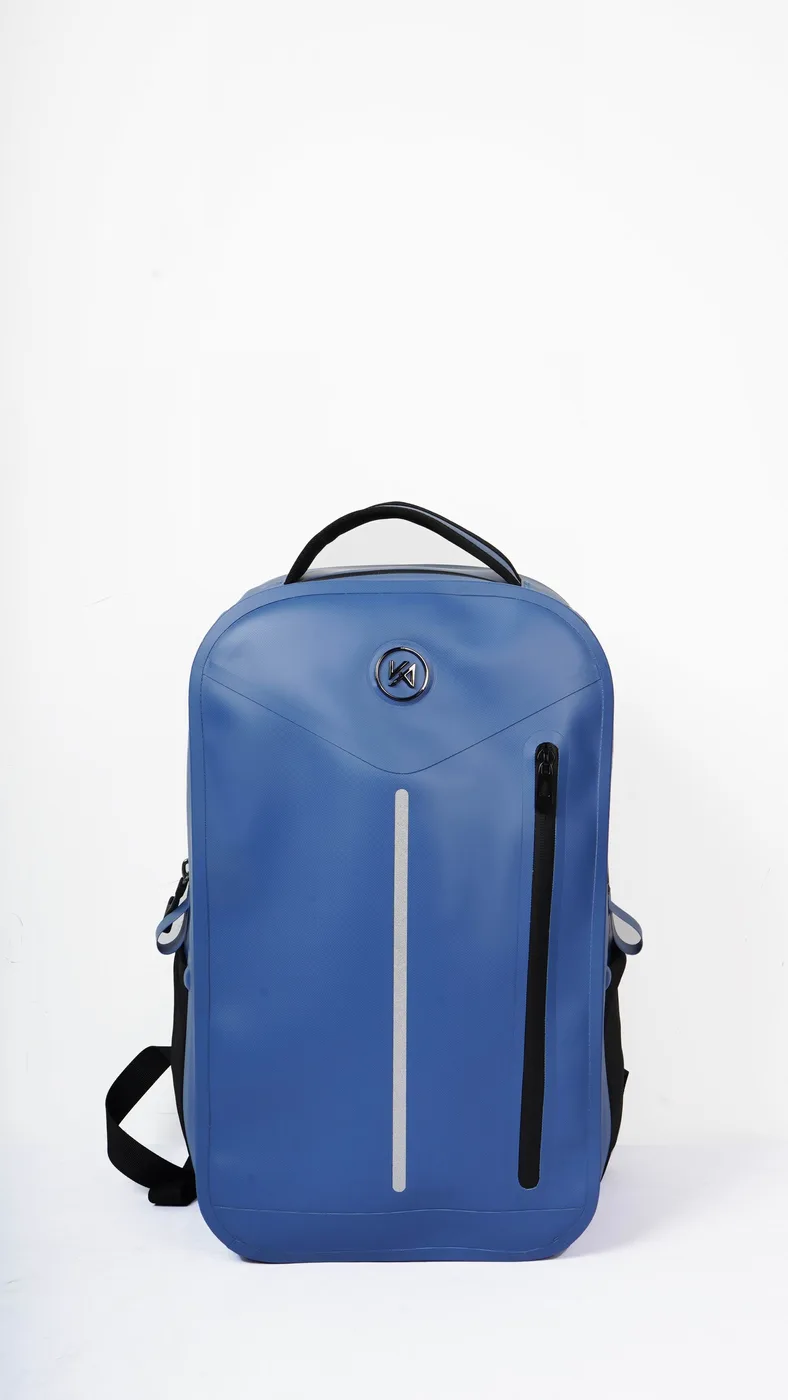
Pinch force is the number nobody publishes and everybody feels. Adult side-squeeze buckles on dry bags commonly need 40 to 55 N to release; a nine-year-old can deliver roughly 25 to 35 N with a thumb and forefinger pinch, and considerably less with cold or wet hands. The result is a child who cannot open their own bag, or who opens it by levering the buckle against the frame, which cracks the housing within a season.
Specify or choose hardware rated for lower release force and test it in the shop with the child who will use it. A buckle that opens with a firm pinch but stays shut under a 5 kg pull is the target. The same logic applies to the roll itself: a 0.5 mm film takes noticeably more finger strength to fold crisply than a 0.35 mm one, and a stiff fold is the single most common reason a child’s bag ends up closed with only one and a half rolls.
Empty weight and the packed weight budget
Empty weight comes out of the load budget, so it matters twice as much on a kids bag as on an adult one. A 10L kids bag with 0.35 mm film, 25 mm webbing and light hardware weighs about 260 g. An adult 20L with 0.5 mm film, 40 mm webbing, a padded harness and a moulded back panel weighs 620 to 780 g. On a 2.6 kg total budget that difference is 20 to 30 per cent of what the child is allowed to carry, spent before a single item goes inside.
That is also why a padded harness is usually the wrong trade below about twelve. Padding adds 150 to 250 g and, on a 2.6 kg load, provides almost no benefit, because padding only starts to matter above roughly 6 kg. A simple 25 mm webbing harness with a sternum slider and a light hip belt does the job at half the weight, and the saved grams go into the packed load where they are actually useful.
| Parameter | Kids bag, 8-12 L | Adult bag, 20-30 L | Why it matters |
|---|---|---|---|
| Empty weight | 240-320 g | 620-780 g | Comes out of a 2.6 kg load budget |
| Torso fit range | 320-430 mm | 450-520 mm | Decides whether the harness sits on the shoulders |
| Strap width | 25 mm | 38-40 mm | Narrow shoulders need narrow webbing |
| Buckle release force | 20-30 N | 40-55 N | Decides whether the child can open it |
| Film thickness | 0.30-0.40 mm | 0.45-0.60 mm | Stiff film is hard to fold crisply |
| Mouth width | 200-240 mm | 300-350 mm | Reach across the mouth when rolling |
| Roll length | 140-180 mm | 220-300 mm | Two-handed reach to close it |
| Typical rolls used | 2-3 | 3-4 | More rolls need more reach and strength |
Closure reach: mouth width and roll length
Closing a roll-top is a two-handed operation with a reach requirement that rarely gets considered. On an adult 20L the mouth is 300 to 350 mm wide and the roll length 220 to 300 mm, so the hands travel across the mouth, meet in the middle and fold down together: a working reach of about 450 mm. A nine-year-old has an arm span that makes that awkward but possible; a six-year-old does not, and the fold ends up lopsided and unsealed at one end.
Kids bags solve this by narrowing the mouth to 200 to 240 mm and shortening the roll to 140 to 180 mm, which brings the working reach down to about 300 mm. The compromise is capacity and access: a narrow mouth makes it harder to find things at the bottom of the bag and rules out packing a bulky item such as a rolled-up wetsuit. For a bag that holds a towel, a lunch and a spare top, that is the right trade.
Buoyancy, flotation and where the line sits
A sealed dry bag floats, and a 10L bag with most of its air left in displaces close to 10 kg of water, which is more than enough to support a small child’s weight in theory. In practice it is not a flotation device: the air escapes as soon as the mouth is below water and the bag is squeezed, the shape is unstable, and it provides no support to the head. Personal flotation devices are specified to their own standard, ISO 12402, published by the ISO, and a dry bag meets none of it.
The practical rule is that a dry bag is a buoyancy aid for kit and never for a person. Children should wear a properly fitted life jacket on any boat, dock or open-water activity regardless of what is in their bag, and adults should supervise within arm’s reach in shallow water. Drowning prevention guidance for children is published by the CDC, and the distinction is set out in more detail in our life jacket comparison.
Colour, visibility and the name panel
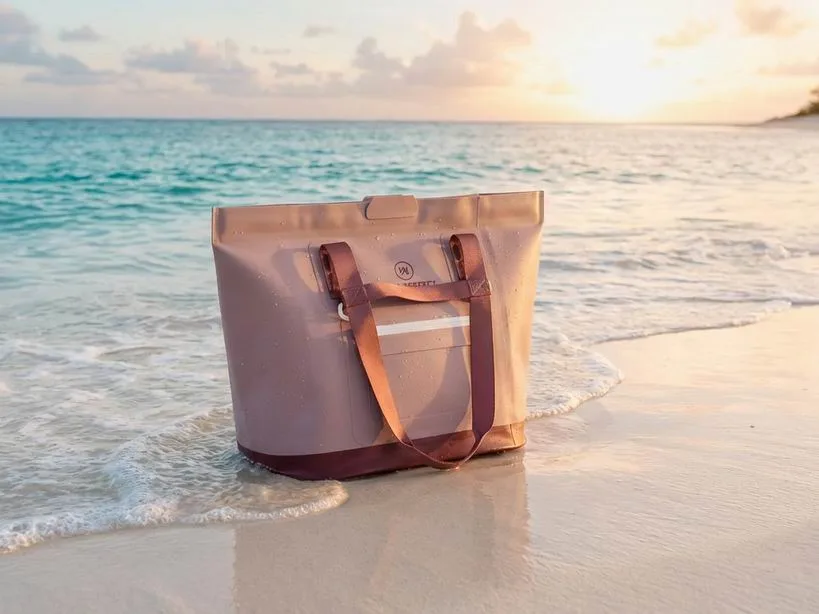
Visibility is a safety feature for children rather than a style choice. A high-chroma colourway reads at distance through spray and rain in a way black and olive do not, and a retroreflective panel of at least 50 square centimetres on the front panel makes a child visible to a boat or a vehicle at dusk. Our reflective accents guide gives placement geometry that survives being washed and dried.
The second reason for a bold colour is identification. On a beach day with thirty bags of the same shape, a child finds a mint or pink bag in seconds and cannot find a black one at all, and adults spend the last twenty minutes of every beach day sorting through lookalike kit. Add a write-on name panel on the side of the bag rather than on the closure, because the closure is the part that gets handled, abraded and re-rolled most often.
Fabric and film weight for how children use bags
Children use bags differently: they are dragged across sand, sat on, overfilled, used as a step and left in the sun for a whole afternoon. That argues for a slightly heavier film than the weight budget alone would suggest. A 0.30 mm film is fine for a bag that lives inside a boat locker; 0.40 mm is the point at which a bag survives being dragged across a concrete pool deck for a season, and it adds only about 60 g to a 10L bag.
Face fabric matters less than film, but a 420D weave with a TPU laminate is the sensible baseline because it stays flexible when wet and cold. A stiff PVC bag that has been left in a cold car overnight is genuinely hard for a child to roll, and the resulting half-closure is the failure mode that gets blamed on the bag. Film thickness trade-offs are set out in our 0.3 mm versus 0.5 mm comparison.
Safety details that should differ
Three design details separate a bag built for children from a scaled-down adult bag. The first is cord and webbing length: any dangling loop near the head or neck should be under 150 mm so it cannot catch on a rail, a branch or a boat fitting. The second is hardware placement, with no hard buckle or D-ring positioned where it would press into the spine when the bag is carried against the back. The third is a breakaway or easily released sternum strap.
Ventilation and access matter for a different reason. Children do not plan: they put wet things in with dry things, and then everything is damp by the afternoon. A bag with a single compartment is easier to keep dry than one with pockets, because there is one closure to check, and a light-coloured interior makes it obvious when something wet has been put in. Teach one rule, wet items go in the second bag, and give them a second small bag to do it with.
When a child should simply move to an adult bag
The crossover is the torso measurement, not the birthday. Once a child measures over 430 mm from the seventh cervical vertebra to the hip bone, an adult small bag fits, and from that point an adult 10L or 20L will be more durable, cheaper per litre and usable for the next fifteen years. Pushing a child into an adult bag before that measurement arrives produces the classic failure: straps at their shortest adjustment, bag riding low on the lower back, sternum strap across the stomach.
Load is the second trigger. A teenager carrying a 4 kg wetsuit, booties and a towel for a surf session has outgrown the kids category on weight rather than fit, because the kids harnesses are not built to stabilise 4 kg. At that point choose an adult 20L with a hip belt and adjust it properly; the extra 400 g of empty weight is repaid in stability the first time they walk 800 m along a wet path.
| Activity | Ages 6-8 | Ages 9-12 | Ages 13 and up | Adult alternative |
|---|---|---|---|---|
| Beach or pool day | 5 L | 8-10 L | 20 L | 20 L roll-top |
| Kayak or canoe day trip | 5-8 L | 10 L | 20 L | 20 L with D-rings |
| Camping weekend | 10 L plus adult bag | 15 L | 30-40 L | 40 L duffel |
| Rainy school commute | 8 L | 10-12 L | 20 L | 20 L backpack |
| Boat or ferry trip | 5 L | 10 L | 20 L | 30 L duffel |
What grows with them: buying once rather than twice
If you want one bag to last, buy a 10L with a harness that adjusts across the full 320 to 460 mm torso range and a removable waist strap. That combination covers a child from about seven to about fourteen, which is seven seasons of use, and the removable waist strap is what makes the difference, because it can be taken off entirely when it is too high and refitted lower as the torso lengthens.
The other buy-once decision is colour choice. A colourway that a seven-year-old loves and a thirteen-year-old will still carry is usually mint, blue or a mid green rather than a character print or a pastel. Pick a colour that survives taste changes and the bag survives the whole span, which matters because the second-hand value of a plain-colour 10L in good condition is meaningful, while a printed one is close to zero.

Checklist before you buy
- Weigh the child and take ten per cent of body weight as the absolute load limit.
- Measure the torso from the base of the neck to the hip bone, not the height.
- Check that the harness adjusts across that measurement with room to grow.
- Test the buckle with the child’s own hands, ideally wet and cold.
- Confirm the child can make three full rolls across the mouth unaided.
- Weigh the empty bag and subtract it from the load budget before packing.
- Choose 0.40 mm film and a 420D face if the bag will be dragged on sand or concrete.
- Look for a retroreflective panel of at least 50 square centimetres and a name panel.
For clubs, schools and holiday programmes the same list becomes a purchasing brief, and the two lines that get specified least often are the ones that cause the most complaints: buckle release force and torso adjustment range. Our production lines have built waterproof bags since 2014 in an SGS-verified 4,950 m2 facility with seven lines and 149 machines, at 200,000 pieces per month, with a 500-piece minimum per colourway, sampling in 6 to 10 working days and bulk in 35 to 50 days from FOB Xiamen at AQL 2.5 inspection.
Once the bag is chosen, spend ten minutes teaching the closure properly, because technique explains most of the leaks reported with children’s bags. Show them how to press the air out before the first fold, how to count three folds out loud, and how to check that the buckle is centred rather than pulled to one side. A child who learns that at seven closes bags correctly for life, and it eliminates the most common failure, which is a fold that is tight at one end and open at the other.
Finally, size the bag for the trip, not for the cupboard. A 10L that is right for a beach day is wrong for a camping weekend, and a 20L that is right for a camping weekend is wrong for a seven-year-old on a boat. Our kids size guide breaks this down activity by activity, the 10L packing list shows exactly what that capacity holds, and the 5L versus 10L comparison settles the most common decision in this category. Start with the full product line if you are kitting out more than one child.
Frequently asked questions
Q1. What size dry bag should a child have?
Take ten per cent of body weight as the load limit and match capacity to it: 5L for a 22 kg six-year-old, 8L at 26 kg, 10L at 32 kg and 12 to 15L at 40 kg. Buy the size that fills properly rather than a larger bag half full.
Q2. Is a kids dry bag just a smaller adult bag?
No. It has a shorter torso fit of 320 to 430 mm, 25 mm straps, buckles releasing at 20 to 30 N, a narrower mouth of 200 to 240 mm and thinner film so small hands can fold it. Adult bags assume 450 mm torsos and 40 to 55 N buckles.
Q3. At what age should a child move to an adult dry bag?
When the torso measures over 430 mm from the base of the neck to the hip bone, usually around 13 or 14. Load is the second trigger: a 4 kg wetsuit and towel kit has outgrown the kids harnesses regardless of fit.
Q4. How much weight can a child carry in a dry bag?
Ten per cent of body weight: 2.2 kg at 22 kg, 2.6 kg at 26 kg, 3.2 kg at 32 kg, 4.0 kg at 40 kg. Remember to subtract the empty bag weight, which is 240 to 320 g for a kids bag and 620 to 780 g for an adult 20L.
Q5. Why can my child not open their dry bag buckle?
Adult side-squeeze buckles need 40 to 55 N to release and a nine-year-old can deliver about 25 to 35 N. Choose hardware rated for 20 to 30 N and test it in the shop with the child, ideally with wet hands.
Q6. Do kids dry bags keep water out as well as adult ones?
Yes, if the closure is made properly. Waterproofing does not scale, so the same welded seams and film apply; the risk is that a stiff film or a wide mouth means the child only manages one and a half rolls instead of three.
Q7. Can a dry bag be used instead of a life jacket for a child?
Never. A sealed 10L bag displaces about 10 kg of water but loses air as soon as the mouth goes under and offers no head support. Life jackets are built to ISO 12402 and dry bags meet none of that standard.
Q8. What film thickness is right for a kids dry bag?
0.40 mm is the practical minimum if the bag will be dragged on sand or concrete; 0.30 mm is fine for a bag that lives in a boat locker. The heavier film adds about 60 g to a 10L and survives a season of abuse.
Q9. How do I measure my child for a dry bag harness?
Measure the torso from the seventh cervical vertebra at the base of the neck down to the top of the hip bones. Children aged six to twelve measure 320 to 420 mm; buy a bag whose harness adjusts across that range with room to grow.
Q10. Should a kids dry bag have a padded harness?
Usually not. Padding adds 150 to 250 g and only helps above about 6 kg of load. On a 2.6 kg budget that weight is better spent on contents, so choose 25 mm webbing with a sternum slider instead.
Q11. What colour dry bag is best for a child?
A high-chroma colour such as mint, blue or pink, plus a retroreflective panel of at least 50 square centimetres. Bold colour is also how a child finds their bag among thirty identical ones at the end of a beach day.
Q12. How many rolls should a child use on a dry bag?
Three, the same as an adult, but on a kids bag the roll is shorter so three folds are within a 300 mm reach. Teach them to press the air out first and to count the folds out loud.
Q13. Can a child carry a 20L dry bag?
Only from about 13 or 14, once the torso passes 430 mm and the load is over 3.5 kg. Below that the adult harness slides off the shoulder and the bag rides on the lower back.
Q14. What is the smallest useful dry bag for a child?
A 5L bag, which holds a towel, a spare top and a snack at about 1.4 to 2.0 kg for a 22 kg six-year-old. Anything smaller is better used as an inner pouch for a phone and keys inside a larger bag.
Q15. How do I stop a kids dry bag smelling?
Empty it the same day, rinse with fresh water, dry in shade with the mouth open and store it unrolled. Wet swimwear is the usual cause, so give the child a second small bag for wet items.
Q16. Are kids dry bags worth buying, or should I just buy a small adult bag?
Buy the kids bag below a 430 mm torso, because the strap anchor, buckle force and mouth width are all wrong on an adult bag. Above that measurement the adult 10L or 20L is more durable and will last fifteen years.
People also ask
What is the difference between kids and adult dry bags?
Capacity is the small difference. The real ones are torso fit range of 320 to 430 mm versus 450 to 520 mm, strap width of 25 mm versus 40 mm, buckle release force of 20 to 30 N versus 40 to 55 N, and a shorter roll that a child can actually make.
How do you size a dry bag for a child?
Weigh the child, take ten per cent as the load limit, measure the torso from the base of the neck to the hip bone, and pick a capacity that fills properly at that weight. Then check the child can close three rolls unaided.
Can a child carry a 10L dry bag?
Yes, from about nine years or 32 kg, where the load limit is 3.2 kg and a 10L packed with clothing and a bottle lands at 2.2 to 3.2 kg. Below that, a 5L or 8L is the better fit.
Are kids dry bags waterproof?
Yes, when the closure is made correctly. Kids bags use the same welded seams and TPU film as adult bags; the failure is almost always a partial fold caused by a mouth that is too wide or film that is too stiff.
Why does my child's dry bag leak?
Usually a lopsided fold: the mouth is too wide for their reach, so one end is tight and the other is open. Rinse the fold line, press the air out, count three folds and centre the buckle before clipping.
Do kids need a special dry bag for kayaking?
Yes, a 5L to 10L bag that they can open and re-roll while seated, with a short leash rather than a long one. The bag should be small enough to sit in the footwell without raising the centre of gravity.
Need this in production volume?
QUANZHOU JUNYUAN BAGS has produced waterproof bags since 2014 in an SGS-verified 4,950 m2 facility in Fujian, China. Minimum order 500 pieces, sampling in 6–10 working days, bulk in 35–50 days, FOB Xiamen — write to service@junyuanbags.com with your spec and target market.