Home / Blog / Design & Branding
Reflective Accents for Night Use
A dark roll-top dry bag with no reflective is first picked up by a driver on dipped beam at roughly 35 to 45 m; add 150 cm2 of 20 mm retroreflective tape on the front panel and the same bag is detected at 90 to 120 m, which at 50 km/h is the difference between 2.5 seconds of reaction time and 7 seconds. That extra margin is the entire argument for reflective accents, and it is measurable: coefficient of retroreflection, expressed in candela per lux per square metre, typically runs 50 to 120 for glass bead tape and 300 to 700 for microprismatic film.
The design problem is that reflective is rarely the look a brand wants in daylight. It reads grey, it sits awkwardly on a curved welded panel, and cheap versions crack after 25 washes. This guide sets out the two retroreflective families, how to read the numbers on a material data sheet, which zones on a roll-top bag actually face oncoming light, how reflective is attached to TPU without breaking the waterproof barrier, and what the treatment survives in five years of daily commuting.
- What a reflective accent really does after dark
- Glass bead versus microprismatic: the two families
- Reading the numbers on a reflective spec sheet
- Where reflective belongs on a roll-top bag
- Reflective on webbing, buckles and moving parts
- Attaching reflective to TPU without breaking the barrier
- Wash life and abrasion: how long the return lasts
- Reflective and colour: keeping the day look intact
- Fluorescent by day, retroreflective by night
- Standards and test methods worth citing
- Safety cases that justify the cost
- Cost, minimums and the spec-sheet lines that matter
- Checklist before you sign off a reflective design
What a reflective accent really does after dark
Reflective does not glow and it does not store light. A retroreflective surface takes light from a source, bends it through roughly 180 degrees and sends it back toward the source rather than scattering it. To a driver sitting almost directly behind the headlights, a 20 mm band of glass bead tape can appear several hundred times brighter than the black TPU panel beside it, even though both are lit by exactly the same lamp at exactly the same distance.
This is why reflective works for a bag and fails for a tent. A bag worn on a back is close to the height of a car headlamp and roughly perpendicular to the road, so the return geometry is good. A bag lying flat on a beach is illuminated at a shallow angle and returns almost nothing. Design for the geometry the object will actually be in, not for how bright the tape is in a studio photograph.
The second thing to understand is that reflective is a passive system. In a car park with no lighting and no vehicle, it contributes nothing at all. If your users walk unlit trails or work on a dark dock, reflective has to be paired with something emissive; see our notes on glow-in-the-dark treatments for where photoluminescent pigment does real work and where it disappoints.
Glass bead versus microprismatic: the two families
Nearly every reflective product on a bag falls into one of two constructions. Glass bead tape suspends microscopic glass spheres in a resin layer over a fabric or film backing; light enters a sphere, refracts, bounces off the back surface and exits toward the source. Microprismatic film embeds an array of cube-corner prisms in a PVC or TPU face, and returns light by three internal reflections instead of refraction.
The trade is brightness against flexibility. Microprismatic film returns three to six times more light per unit area, which is why it dominates high-visibility workwear, but it is stiff, it does not like being folded, and it will craze if it is welded at the wrong temperature. Glass bead tape drapes over the curve of a roll-top mouth, survives being rolled three times every day, and still returns enough light to be detected well beyond the stopping distance of a car at 60 km/h.
| Material | Construction | Typical RA (cd/lx/m2) | Flexibility | Best use on a bag |
|---|---|---|---|---|
| Glass bead tape | Spheres in a resin layer | 50-120 | High, drapes over curves | Curved panels and roll-top mouth |
| Microprismatic film | Cube-corner prisms in PVC | 300-700 | Moderate, cracks if folded | Flat front panels |
| Reflective yarn | Beaded filament woven in | 10-30 | Very high | Webbing, binding, elastic |
| Reflective transfer print | Beads carried in an ink binder | 5-25 | Very high | Logos and small motifs |
| Reflective piping | Beaded cord inside a TPU sleeve | 20-60 | High | Seam lines and edge definition |
There is a third route that is often overlooked: weaving reflective yarn directly into the webbing used for straps. The return per unit area is low, but straps move with the body, and motion is one of the strongest cues a driver uses to recognise a person. A 20 mm strap with a reflective thread running down its centre often outperforms a larger static patch on the panel.
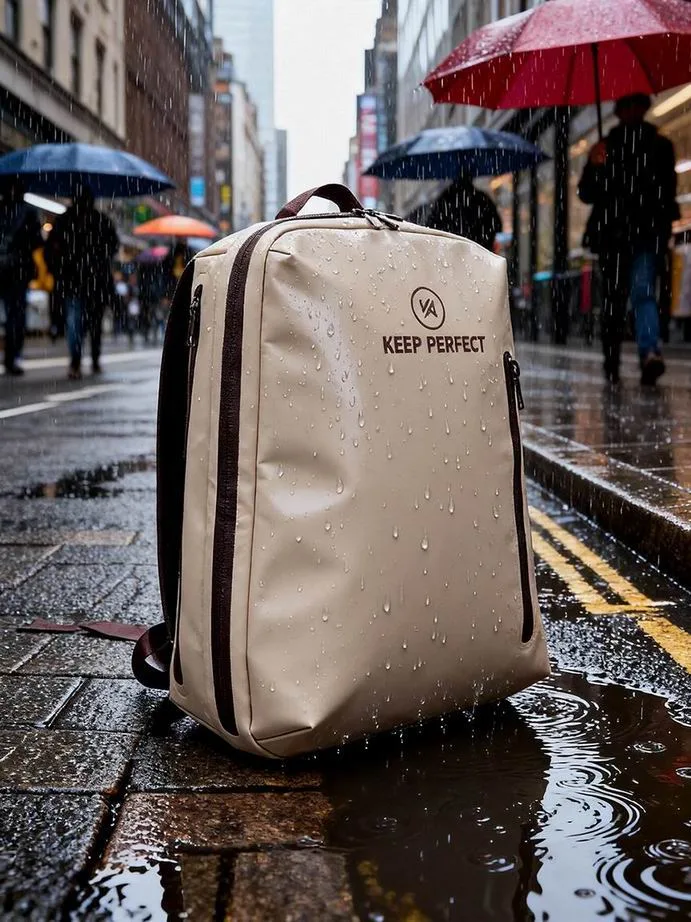
Reading the numbers on a reflective spec sheet
Two numbers decide everything: the coefficient of retroreflection, RA, in candela per lux per square metre, and the angle pair at which it was measured. RA is meaningless without the observation angle and the entrance angle, because retroreflective return collapses as those angles widen. A tape quoted at 500 cd/lx/m2 at 0.2 degrees observation may fall below 60 at 1.0 degrees, which is the geometry of a driver looking at a bag 25 m away.
Ask for the full matrix rather than the headline figure. A serious data sheet lists RA at observation angles of 0.2, 0.5 and 1.0 degrees and entrance angles of 5, 20, 30 and 40 degrees. If a sheet quotes one number with no angles, assume it was taken at the most flattering geometry available and discount it by half when you plan the design.
The standard method behind these measurements matters as much as the values. Retroreflective sheeting for high-visibility clothing is specified in EN ISO 20471, maintained under the ISO system, while sheeting performance and its measurement are covered by the ASTM retroreflection series. Naming the method on a data sheet is what separates a tested claim from a marketing adjective.
Where reflective belongs on a roll-top bag
Placement beats quantity. Every bag has zones that face oncoming light and zones that are shielded by the wearer or the object itself, and material put in a shielded zone is pure cost. On a roll-top dry bag carried on the back, the usable zones are the front panel, the two side gussets, the shoulder strap webbing and the flap edge above the closure.
The front panel is the single most valuable surface, and the lower third of it is more valuable than the top. Headlights are low and angled slightly downward, so light reaches the lower part of a panel more directly. A 25 mm horizontal band placed 80 to 120 mm up from the base of a 20L bag will typically outperform the same band placed near the top edge by a wide margin.
| Zone | Visible area on a 20L bag | Typical width | Why it works | Abrasion risk |
|---|---|---|---|---|
| Front panel, lower third | 120-200 cm2 | 25-50 mm | Square to oncoming headlights | Medium |
| Side gusset | 60-120 cm2 | 20-25 mm | Seen from side roads and crossings | High |
| Shoulder strap webbing | 80-150 cm2 | 20 mm woven in | Moves with the body, adds motion cue | Low |
| Flap edge above the closure | 40-90 cm2 | 20 mm piping | Catches light from above and behind | Low |
| Bottom panel | 0-30 cm2 | Not recommended | Shielded by the wearer and the ground | High |
Side gussets earn their place on a bag carried at a crossing, where a turning vehicle approaches at 90 degrees to the wearer. They are also the highest-abrasion zone, because a bag set down on concrete lands on its side. If you only have budget for two reflective hits, take the front panel and the strap webbing, and treat the gussets as an upgrade once the base specification is proven.
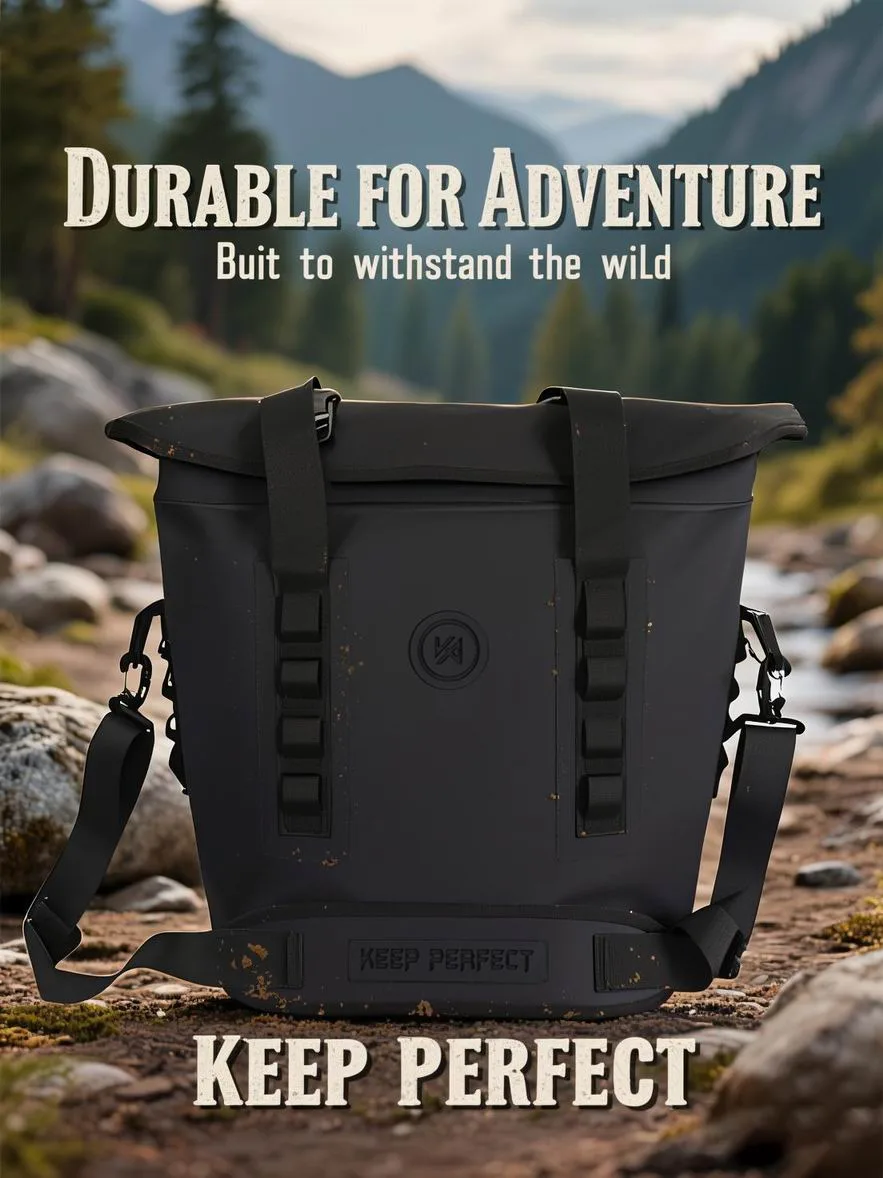
Reflective on webbing, buckles and moving parts
Static panels are easy; the parts that flex, roll and clip need more thought. Webbing is the best carrier for reflective because it is flat, it is already load-bearing, and it can be woven with a reflective thread during production rather than finished afterwards. A 25 mm strap with a 6 mm reflective stripe down the centre survives years of abrasion because the reflective element sits between the weave and the shoulder rather than on the surface.
Buckles and hardware are a different matter. Reflective tape applied over a buckle fails quickly, because the surface flexes every time the buckle is opened and adhesive-backed film has almost no tolerance for that. Reflective moulded into a buckle body works but requires a tooling change and a minimum that only makes sense at high volume. For most ranges, the answer is a reflective band on the webbing immediately adjacent to the buckle, not on the buckle itself.
The roll-top mouth deserves special mention. This is the part of the bag that is folded three times on every single use, so any treatment here must survive repeated tight creasing. Glass bead tape on a TPU carrier is the safe choice; microprismatic film will craze at the fold within a season. Keep the band 20 mm or narrower and stop it at least 15 mm short of the fold line so the crease lands on plain film.
Attaching reflective to TPU without breaking the barrier
Every hole you put in a dry bag is a potential leak, which rules out the obvious approach of sewing reflective tape onto the panel. There are three routes that keep the barrier intact: high-frequency welding of a weldable reflective tape directly onto the TPU face, heat-transfer application of a reflective film under controlled temperature and pressure, and bonding with a solvent-based adhesive designed for TPU.
Welding is the strongest and the most durable, provided the reflective tape has a weldable TPU backing rather than a fabric or PET one. A 27.12 MHz weld at 20 to 25 mm width fuses the tape carrier into the bag film in one to three seconds, and the joint survives the same peel and immersion tests as the rest of the shell. Heat transfer is gentler on the prism structure and works well on flat panels, but the bond is only as good as the surface preparation and the pressure profile.
Adhesive is the fallback, and it should be treated as one. Applied to a clean, lightly abraded TPU surface with a primer, a good adhesive reaches 60 to 70% of the peel strength of a weld, but it ages badly in heat and it is the first thing to lift at the corners. If a design needs the coverage of adhesive application, specify a 3 mm radius on every corner of the tape; sharp corners are where lifting always starts.
Wash life and abrasion: how long the return lasts
Reflective is a consumable, and the useful question is not whether it works but how long it keeps working. Glass bead tape on a TPU carrier typically holds more than 50% of its original RA through 50 domestic wash cycles at 40 °C; microprismatic film holds its number longer in the wash but loses it faster to creasing and flex cracking. Abrasion is the dominant failure mode in field use rather than washing, and it shows first at the corners.
Real-world commuting is harder on reflective than any lab cycle. A bag that is set down on concrete twice a day, dragged through a station barrier and squeezed into a locker will abrade the front panel band far faster than a wash test suggests. In five years of daily commuting we expect a welded 25 mm band to stay visually effective for three to four years, with the last year being a slow decline rather than a sudden failure.
| Construction | Washes to 50% RA | Field life, daily commute | Dominant failure | Repairability |
|---|---|---|---|---|
| Welded glass bead tape, 25 mm | 50-70 cycles | 3-5 years | Corner abrasion | Patch weld over the top |
| Heat-transfer film, flat panel | 30-50 cycles | 2-4 years | Edge lift | Re-apply with heat |
| Adhesive tape, rounded corners | 20-30 cycles | 1-2 years | Adhesive creep | Replace the band |
| Woven reflective yarn in webbing | 80-120 cycles | 5-8 years | Weave flattening | Replace the strap |
| Microprismatic film on a fold | 60-90 cycles | 6-18 months | Flex cracking | Not repairable |
One failure mode is worth planning against because it is invisible: hydrolysis. Polyester-based TPU carriers and some adhesive systems break down in warm, humid climates, and the tape can delaminate from the inside out while the surface still looks intact. If a range ships to tropical markets, specify a polyether-based carrier and ask for a humidity-ageing result rather than a wash result.
Reflective and colour: keeping the day look intact
Reflective is grey in daylight, and grey is not a colour most outdoor ranges want. The two ways to soften it are to reduce the area and to integrate it into the design language. A 20 mm band that follows an existing seam or panel break reads as a design line; the same area dropped as a rectangle in the middle of a panel reads as a compliance sticker and gets criticised in reviews.
Colour position matters too. Reflective on a black bag is a high-contrast hit that buyers notice and, in our experience, appreciate. Reflective on a light mint or pale grey bag almost disappears by day, which can be exactly what a lifestyle range wants. Think about the full colour range before deciding on a single reflective treatment for every colourway; a mint bag may justify twice the reflective area of a black one.
Printed reflective is the option that does the most for a brand look. A beaded transfer print can carry a logo, a wordmark or a pattern at 5 to 25 cd/lx/m2, which is a tenth of tape performance but still three to five times brighter than the fabric around it. Use printed reflective as a secondary layer over the top of structural tape, never as the only night-time treatment on a bag aimed at commuters.
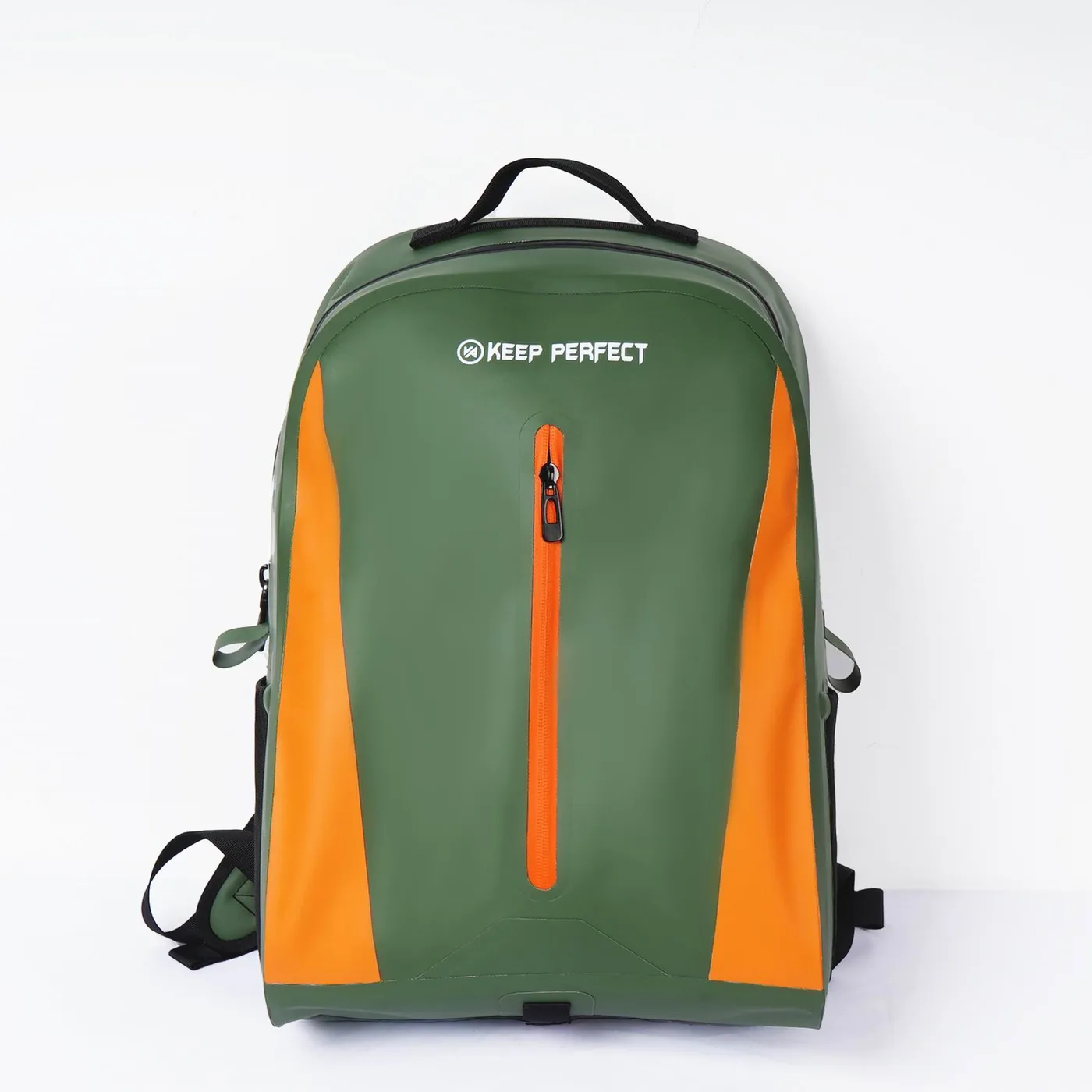
Fluorescent by day, retroreflective by night
Daytime conspicuity and night-time conspicuity are separate problems solved by separate materials. Fluorescent fabric converts invisible ultraviolet into visible light and is dramatically more visible than a normal colour in the hour before sunset, in rain and in flat overcast light. It does nothing at all after dark, because there is no ultraviolet left to convert. Reflective does nothing for daylight and everything at night.
A bag range aimed at year-round commuting benefits from both. Fluorescent yellow-green or orange on the upper panels, paired with 20 mm glass bead tape on the lower front panel and reflective in the straps, covers the full 24-hour cycle. The cost is real: fluorescent pigment has poor light fastness compared with standard disperse dyes, and a fluorescent panel exposed to strong sun will fade measurably within two seasons.
If you have to choose one, choose reflective. The night case is the one where the consequence of not being seen is severe, and reflective is cheaper, more durable and easier to source at a consistent quality. Fluorescent is a daylight upgrade that makes sense once the night treatment is already specified and tested.
Standards and test methods worth citing
Being able to name the standard is what turns a design decision into a defensible claim. EN ISO 20471 defines three performance classes for high-visibility clothing and sets minimum areas and RA values for each; a bag rarely qualifies as a garment, but the material requirements in the standard are still the reference point for what counts as genuine retroreflective performance.
On the measurement side, the ASTM retroreflection series defines how RA is measured, what geometry applies, and how specimens are preconditioned. Ask the tape maker which method their RA values were obtained under, and reject any sheet that does not say. For wash durability, the domestic washing procedure in the ISO 6330 series gives a common language for the number of cycles a treatment survives before its return falls below half.
ISO and ASTM references are also useful internally: they give a buying team something to argue with. When two tapes look identical on a sample card and differ by a factor of four in measured return, the test method is the only thing that settles the argument, and it settles it before tooling is cut rather than after a recall.
Safety cases that justify the cost
Reflective costs money per bag: roughly 0.35 to 0.60 USD for a welded 25 mm glass bead band on a front panel, plus 0.10 to 0.20 for reflective yarn in the straps, plus a small application cost. On a bag retailing at 45 USD that is under 2% of retail and around 6% of landed cost, which is a small number for the single largest visibility gain available in the whole construction.
The cases where it pays back fastest are commuting, school runs, waterfront work at dawn and dusk, event use where crowds spill onto roads at night, and any rental or club fleet where the operator carries a duty of care. The cases where it adds least are bags used exclusively on water in daylight or bags sold purely as a storage accessory. Match the treatment to the exposure, and do not spend on a 50 mm band for a bag that lives in a garage.
| Use case | Lighting at time of use | Recommended treatment | Added cost per bag | Priority |
|---|---|---|---|---|
| Urban cycle commute | Street lighting plus headlights | 25 mm front band plus strap yarn | 0.45-0.80 USD | High |
| School and club kit | Dawn and dusk, mixed lighting | 25 mm band, two sides | 0.55-0.90 USD | High |
| Waterfront work at night | Floodlights, vehicle headlights | 50 mm band, front and sides | 1.10-1.60 USD | High |
| Daytime beach and pool | Full sun | None required | 0 USD | Low |
| Festival and event bag | Low light, crowds near roads | Printed logo plus 20 mm band | 0.40-0.70 USD | Medium |
Cost, minimums and the spec-sheet lines that matter
Reflective adds one line to the bill of materials and three lines to the spec sheet. The commercial variables are tape width, tape length per bag, whether the tape needs a weldable carrier, and whether the tape is a stock item or a colour-matched special. Stock silver glass bead tape in 20 and 25 mm has essentially no minimum; a colour-matched or printed reflective usually carries a roll minimum that translates into 1,000 to 3,000 bags.
The spec sheet is where projects go wrong. Write the placement as a dimensioned drawing, not as a description: band width, distance from the panel base, distance from the fold line, and corner radius. Write the material by construction and by measured RA at a stated angle pair. Write the attachment method by name. A sheet that says reflective trim with no numbers will be quoted three different ways and delivered as the cheapest of them.
- State the retroreflective family: glass bead or microprismatic, never just reflective.
- State RA in cd/lx/m2 with the observation and entrance angle it was measured at.
- State the attachment method: weld, heat transfer or adhesive, plus the carrier material.
- Dimension every band: width, position, distance from the fold line, corner radius.
- State the wash or abrasion standard the treatment was tested to and the cycle count.
- Confirm the carrier is hydrolysis-resistant if the range ships to humid markets.
- Keep reflective at least 15 mm clear of any fold line on a roll-top mouth.
Placement of a logo alongside reflective is worth a separate decision, because the two compete for the same high-value panel. The usual resolution is a printed or welded brand mark on the upper panel with the reflective band below it, which keeps both visible without either crowding the other; our logo placement notes cover the geometry in more detail, and the printing trade-offs are set out in the digital versus screen guide.
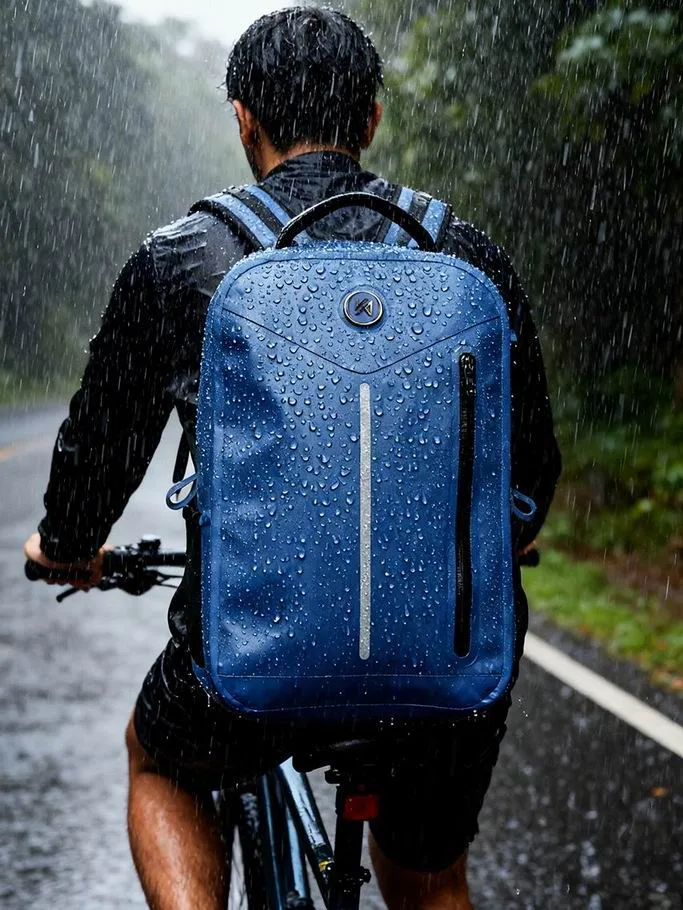
Checklist before you sign off a reflective design
- Decide the exposure case first: commuting, workwear, event or daylight only.
- Pick the family from the geometry: glass bead for curves and folds, microprismatic for flat panels.
- Choose two or three zones at most, led by the lower front panel and the strap webbing.
- Specify a weldable TPU carrier and confirm the weld window with the bag film.
- Write RA with its angle pair on the spec sheet and require a test report with the first bulk lot.
- Dimension every band, including clearance from fold lines and corner radii.
- Approve a washed and abraded sample, not just a fresh one.
- Confirm the treatment survives the clean-the-bag routine you recommend to owners.
Sign-off should always be on a treated sample that has been through the wash cycle, not on a pristine one. A reflective band looks identical on day one whether it was welded properly or tacked on with the wrong temperature profile; the difference appears at cycle 20. Testing the washed sample costs one extra week and removes the single most common quality dispute in this category.
Our production team has built waterproof bags since 2014 in an SGS-verified 4,950 m2 facility with 137 staff across seven lines, and reflective application is one of the operations where that matters: the weld window for a reflective carrier is narrower than the window for the bag film, and it has to be held on every piece. Sampling for a treated bag runs 6 to 10 working days, bulk runs 35 to 50 days, and inspection is AQL 2.5. The production process is documented and the current product line shows where reflective is applied across sizes.
Two related reads close the loop. The night-commute waterproof setup guide covers how a reflective bag fits into a wider visibility plan, and the colour matching notes explain how to keep a reflective treatment consistent when the same bag is produced in five colourways. Neither is a substitute for testing the bag you actually intend to sell.

Frequently asked questions
Q1. Do reflective accents make a dry bag visible at night?
Yes, and measurably. A dark bag with no reflective is detected at about 35 to 45 m on dipped beam; 150 cm2 of 20 mm glass bead tape moves that to 90 to 120 m. That is roughly 2.5 seconds versus 7 seconds of driver reaction time at 50 km/h.
Q2. What is the difference between glass bead and microprismatic reflective?
Glass bead tape uses microscopic spheres in a resin layer and returns 50 to 120 cd/lx/m2, with high flexibility on curved or folded surfaces. Microprismatic film uses cube-corner prisms and returns 300 to 700, but it is stiff and crazes if it is folded repeatedly.
Q3. Can reflective tape be welded onto a TPU dry bag?
Yes, if the tape has a weldable TPU carrier. A 27.12 MHz weld at 20 to 25 mm fuses the carrier into the bag film in one to three seconds. Fabric-backed or PET-backed tape will not fuse and will peel at the edge within weeks.
Q4. Where should reflective go on a roll-top dry bag?
The lower third of the front panel first, then reflective yarn in the shoulder strap webbing, then the side gussets. Skip the bottom panel entirely, and keep any band at least 15 mm clear of the fold line on the roll-top mouth.
Q5. How much reflective area is enough?
Around 150 cm2 on the front panel gives most of the available gain. Going from nothing to 150 cm2 roughly triples detection distance; going from 150 to 380 cm2 adds another 40 to 50%, which is why the second zone is better spent on straps than on a wider panel band.
Q6. Does reflective tape survive washing?
Welded glass bead tape typically holds more than half its original return through 50 to 70 domestic washes at 40 °C. Woven reflective yarn in webbing lasts longest at 80 to 120 cycles. Adhesive-backed tape is shortest at 20 to 30 cycles because the adhesive creeps.
Q7. What does RA mean on a reflective spec sheet?
RA is the coefficient of retroreflection in candela per lux per square metre. It is meaningless without the angle pair: return collapses as the observation angle widens, so a tape quoted at 500 at 0.2 degrees may fall below 60 at 1.0 degrees, which is the real geometry at 25 m.
Q8. Which standards apply to reflective material on bags?
EN ISO 20471 sets material performance requirements for high-visibility clothing and is the usual reference point, the ASTM retroreflection series defines how RA is measured, and the ISO 6330 series provides the domestic wash procedure used for durability claims.
Q9. Can reflective be printed as a logo?
Yes. A beaded transfer print carries a logo or pattern at 5 to 25 cd/lx/m2, which is a tenth of tape performance but still several times brighter than the fabric around it. Use it as a secondary layer over structural tape, never as the only night treatment.
Q10. Does reflective work in daylight?
No. Retroreflective material only returns light that is aimed at it, so in daylight it reads as a flat grey trim. For daytime conspicuity you need fluorescent material, which converts ultraviolet into visible light and does nothing after dark.
Q11. How long does reflective last in daily commuting?
A welded 25 mm glass bead band on the front panel typically stays visually effective for three to five years of daily commuting, with a slow decline rather than a sudden failure. Abrasion from being set down on concrete is the dominant failure mode, not washing.
Q12. Why does reflective crack at the fold on a dry bag?
Because the roll-top mouth is creased tightly every time the bag is closed. Microprismatic film has almost no tolerance for that and crazes within a season. Glass bead tape on a TPU carrier handles the crease, provided the band stops short of the fold line.
Q13. Does reflective affect the waterproof rating?
Not if it is welded or heat-transferred onto the outside of the shell. Sewing reflective onto a panel would puncture the barrier and void the rating, which is why sewing is not used on a genuine dry bag body.
Q14. How much does reflective add to the cost of a bag?
Roughly 0.35 to 0.60 USD for a welded 25 mm front band, plus 0.10 to 0.20 for reflective yarn in the straps. On a 45 USD retail bag that is under 2% of retail and around 6% of landed cost.
Q15. What colour bag suits reflective best?
Black and other dark colourways, because the contrast makes the band read as a deliberate design line. On mint, pale grey or light blue the same band almost disappears by day, which some lifestyle ranges prefer and which may justify a larger area.
Q16. Should reflective go on the buckle?
No. Buckle surfaces flex every time they are opened and adhesive-backed film lifts quickly. Put a reflective band on the webbing immediately next to the buckle instead, or specify reflective moulded into the buckle body if volume justifies the tooling.
People also ask
How does reflective tape work?
It is retroreflective rather than reflective: glass spheres or cube-corner prisms bend incoming light back toward the source instead of scattering it. To a driver sitting behind the headlights, a narrow band can appear hundreds of times brighter than the fabric beside it.
Are reflective bags safer for night cycling?
Yes. Detection distance typically rises from about 40 m to 90 to 120 m with 150 cm2 of tape, and reflective in the strap webbing adds a motion cue that drivers recognise faster than a static patch.
Can you sew reflective tape onto a dry bag?
No, not on the body. A needle punctures the waterproof film and voids the rating. Weld a tape with a TPU carrier, apply it by heat transfer, or bond it with a TPU-compatible adhesive.
What is the brightest reflective material for bags?
Microprismatic film, at 300 to 700 cd/lx/m2 against 50 to 120 for glass bead tape. It is stiffer though, and it cracks if it is folded, so glass bead is usually the better choice on a roll-top bag.
How do you test reflective material?
Measure RA in candela per lux per square metre at stated observation and entrance angles, using the ASTM retroreflection method, then run the ISO 6330 domestic wash procedure and re-measure. Insist on the angle pair, not a single headline number.
Does reflective tape fade?
The return degrades rather than fading. Abrasion flattens the bead surface and adhesive creep lifts the edges, so a welded band loses roughly half its return after 50 to 70 washes. Hydrolysis in humid climates can delaminate a polyester carrier from inside.
Need this in production volume?
QUANZHOU JUNYUAN BAGS has produced waterproof bags since 2014 in an SGS-verified 4,950 m2 facility in Fujian, China. Minimum order 500 pieces, sampling in 6–10 working days, bulk in 35–50 days, FOB Xiamen — write to service@junyuanbags.com with your spec and target market.