Kiteboarding: 7 Dry Bag Mistakes to Avoid
Kiteboarding destroys dry bags through sand and wind rather than water: a 35 km/h onshore breeze moves roughly 0.4 to 1.2 g of sand per hour onto any horizontal surface, and a single grain in a roll-top fold creates a capillary path that wets a bag within an afternoon. Add seven repeatable mistakes, an open bag on the beach, a sandy closure, car-sized capacity, a splash-proof pack, no tether, hot-car storage and a skipped rinse, and a bag that should last eight seasons fails in two.
This guide goes through each mistake in the order it happens across a session, from rigging on the sand to loading the car at dusk, with the numbers behind them: sand load by wind speed, capacity by session length, internal car temperatures, and a rinse schedule that takes about 60 seconds. It finishes with a buying checklist written specifically for kite use rather than for general paddlesport.
- Why kiteboarding is harder on bags than other wind sports
- Mistake 1: leaving the bag open on the beach while you rig
- Mistake 2: rolling a closure with sand in the fold
- Mistake 3: choosing capacity for the car, not for the session
- Mistake 4: trusting a splash-proof pack during water starts
- Mistake 5: no tether or lash point in the water
- Mistake 6: storing a wet bag in a hot car
- Mistake 7: skipping the rinse because the water was only brackish
- Sand, wind and hardware: the beach reality
- Where to keep the bag during a session
- What actually earns its space in a kite bag
- A 60-second post-session routine
- Buying checklist for kite use
Why kiteboarding is harder on bags than other wind sports
A kite beach combines three stresses that rarely appear together. There is airborne abrasive in constant motion, there is a hard, gritty surface that a bag is dragged across, and there is a long passive window while you rig and wait for the wind, during which the bag sits on the ground doing nothing. Paddling exposes a bag to water; kiteboarding exposes it to abrasion first and water second.
The exposure is also longer than the session suggests. A two-hour kite session is typically four hours on the beach once rigging, pumping, a wind wait and de-rigging are counted, and that is four hours of a bag sitting in moving sand. Most bag failures in this sport are therefore storage and handling failures rather than in-water failures, which is why the fixes below are mostly about where the bag sits and how it is closed.
Mistake 1: leaving the bag open on the beach while you rig
An open bag on a kite beach fills with sand. At 30 to 40 km/h of onshore wind the saltation layer, the band of moving grains just above the surface, is active for most of the day, and an open mouth facing into the wind collects grams of sand per hour. Close the bag before you start pumping, and keep it closed for the whole rigging window.
The second half of this mistake is orientation. A closed bag lying on its side has its fold line horizontal and facing the wind, which is exactly the surface that needs to stay clean. Stand the bag upright with the mouth rolled down, or hang it from a post or a fence rail if the beach has one. Ten seconds of orientation saves a closure clean-out and, more importantly, saves the film from a season of grit abrasion at the crease.
Mistake 2: rolling a closure with sand in the fold
One grain is enough. A roll-top seals by pressing two film faces into continuous contact along three lines; a hard particle of 0.2 to 0.5 mm held between those faces opens a gap that is microscopic in one direction and continuous in the other, and water uses it as a capillary. The symptom is deceptive: the bag passes a splash test and then quietly wets its contents over an hour in a hull or a board bag.
The fix is a habit rather than a technique. Before every roll, run a thumb along both faces of the fold line, and if the beach is dusty, wipe the mouth with a damp hand and shake it out. Our sand and buckle guide covers the hardware side of the same problem; the film side is simply that a fold should never be closed over anything you can feel.
| Wind speed | Conditions | Sand reaching a bag per hour | Exposure risk | What to do |
|---|---|---|---|---|
| 10-15 km/h | Light breeze | Under 0.1 g | Low | Normal handling |
| 20-30 km/h | Typical kite wind | 0.2-0.5 g | Moderate | Keep the bag closed and upright |
| 30-40 km/h | Strong onshore | 0.4-1.2 g | High | Hang the bag, wipe the fold |
| 40-50 km/h | Hard onshore, gusty | 1.0-2.5 g | Very high | Bag in a car or a closed bin |
| Offshore, any speed | Sand blowing seaward | Under 0.2 g | Low | Still close the bag for splash |

Mistake 3: choosing capacity for the car, not for the session
Kite kit is bulky in the car and small in the water. A harness, a pump, a bar bag and a spare kite bag look enormous on the drive to the beach, so people buy a 40L or 60L bag, and then find that the bag they actually want on the water is a 5L to 10L one holding a phone, keys, a snack and a spare leash. The result is one oversized bag that never goes near the water and no small bag at all.
Buy for the session, and let the car take care of itself. A two-hour session needs 5 to 8 litres; a full day with a lunch and a dry layer needs 10 to 15 litres; a downwinder needs whatever fits in a board bag, which is usually a 10L strapped to the board. Two bags, a 5L and a 15L, cover every session type and cost less than one large one.
| Session type | Time on the water | Waterproof volume | Typical load | Bag |
|---|---|---|---|---|
| Freeride loop | 1-2 h | 5-8 L | Phone, keys, snack, leash | 1 x 5L or 1 x 10L |
| Full day at the spot | 4-6 h | 10-15 L | Lunch, dry layer, tools | 1 x 15L |
| Downwinder | 2-4 h | 8-12 L | Phone, water, repair kit | 1 x 10L strapped to board |
| Travel trip, two kites | Multi-day | 40-60 L | Kites, harness, wetsuits | 1 x 60L plus 1 x 5L |
| Teaching or coaching | All day | 20-30 L | Radio, first aid, spare parts | 1 x 30L duffel |
Mistake 4: trusting a splash-proof pack during water starts
A water start, a body drag and a failed jump all put a bag briefly under moving water, which is a different exposure from spray. A pack described as water resistant, or one with a coated shell and stitched seams, will survive spray and fail a submersion, because needle holes and seam tape are the path of least resistance once external pressure is applied.
Look for a named rating and welded seams. IPX6 covers powerful jets, which is what a face-plant at 30 km/h produces, and IPX7 covers 30 minutes at one metre, which covers a body drag and a swim back to a board. The ISO and IEC systems both publish the test methods, and a listing that names one is worth more than any adjective.
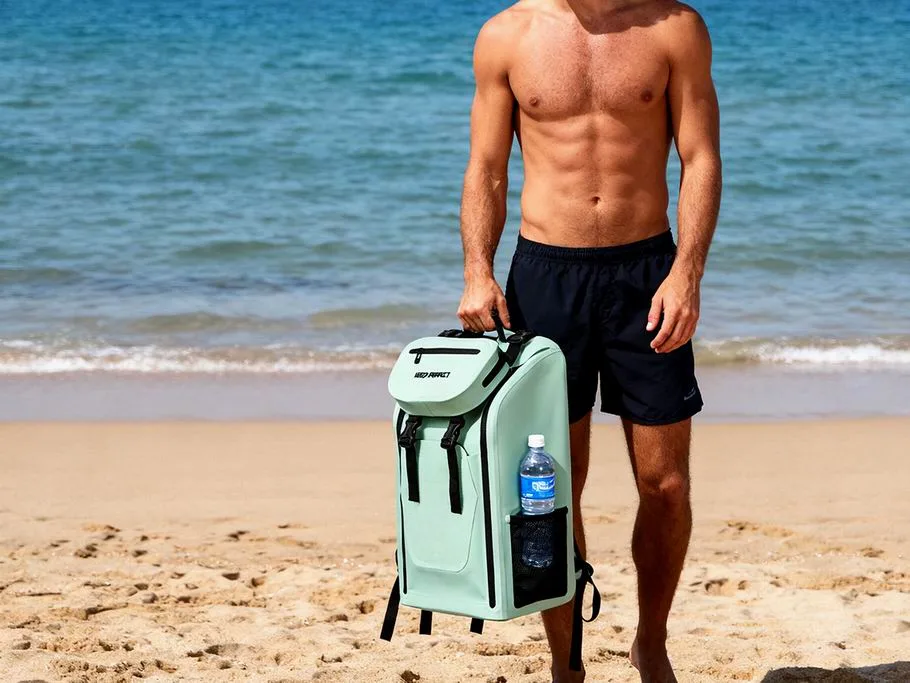
Mistake 5: no tether or lash point in the water
A sealed bag with air in it floats, and a floating bag on a kite beach is gone within minutes. If you carry anything on a board, on a harness or strapped behind you, it needs a lash point and a leash. Welded D-rings on a TPU body take a 40 mm strap and a cam buckle without deforming; a sewn loop on a light bag tears at 60 to 80 kg of shock load, which a wipeout generates easily.
Tethering is also a safety issue for other people on the water. A bag that breaks free during a jump becomes flotsam in a busy area, and a rider behind you cannot see a low-lying dark bag in chop. Use a short leash, keep the bag close to the board or the harness, and never rely on buoyancy alone to keep track of your kit.
Mistake 6: storing a wet bag in a hot car
A car parked in 28 °C sun reaches 50 °C to 65 °C internally within an hour, and a wet bag in a closed boot is worse than a dry one because the moisture is retained against the film. Heat at that level accelerates hydrolysis in TPU and drives plasticiser out of any coated fabric, and it does it fastest exactly where a bag is folded. A bag stored wet and folded in a hot car will show crease damage in weeks rather than seasons.
The fix takes thirty seconds at the end of a session. Empty the bag, shake the sand out, leave it open on a back seat or in the shade of a tailgate for the drive home, and finish drying it at home with the mouth open. Never leave a bag rolled and buckled for the drive: that traps moisture in the fold, which is the single most reliable way to create a permanent leak path.
Mistake 7: skipping the rinse because the water was only brackish
Salt is the mechanism, not the taste. Even a brackish estuary spot carries enough dissolved salt to leave crystals in a fold once the water evaporates, and those crystals do two kinds of damage: they abrade the film every time the closure is rolled, and they hold moisture against the surface between sessions. A bag used twice a week at a brackish spot without rinsing shows the same wear as one used at a beach with full-strength seawater.
Rinse with fresh water at ambient temperature, not with a hot hose and not with detergent. A two-litre bottle of fresh water is enough for a small bag: pour it in, slosh it around the interior, pour it out, wipe the fold line with a hand, and hang the bag open. The whole routine takes under a minute and it is the difference between two seasons and eight.
| Interval | Task | Time | Why it matters |
|---|---|---|---|
| After every session | Shake out sand, rinse with fresh water, hang open | 60 s | Stops crystal abrasion in the fold |
| Weekly, heavy use | Wipe buckles and cam levers, work them through travel | 5 min | Salt makes cam buckles slip |
| Monthly | Inspect corner welds and the fold line for whitening | 5 min | Fatigue shows at corners first |
| Every 3 months | Air test: close, squeeze, listen for a hiss | 2 min | Finds a leak before it wets kit |
| End of season | Full wash, dry 24 h open, store loosely rolled | 30 min | Prevents set creases in storage |
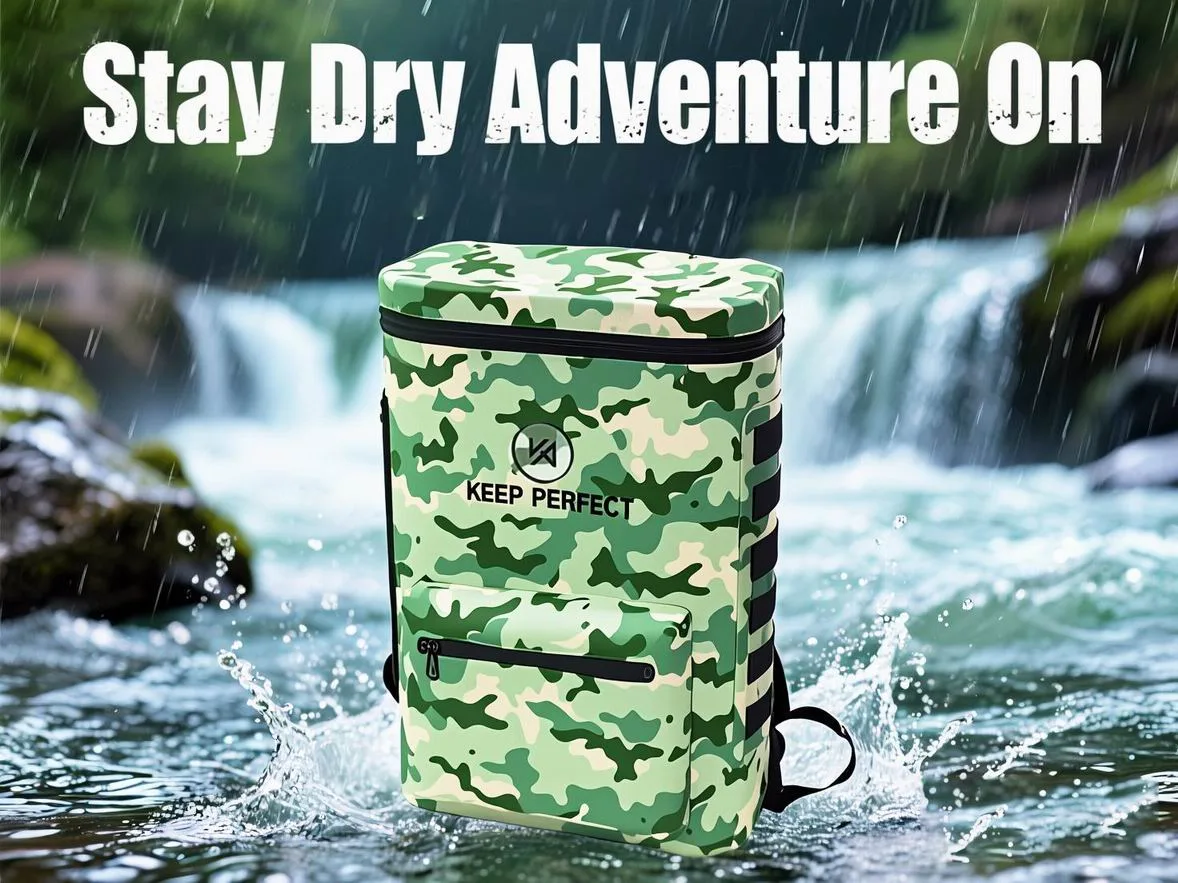
Sand, wind and hardware: the beach reality
Hardware fails on a kite beach long before fabric does. Sand works into a side-release buckle and into a cam lever, and a cam that has been gritty for a month will slip under load even though it looks fine. Rinse buckles with fresh water, work them through their full travel while wet, and accept that a buckle on a kite bag is a consumable part with a service life of roughly two to four seasons.
Zips are worse. A sand grain in a waterproof zip deforms the sealing surface and the slider, and once that has happened the zip will leak for the rest of its life. If you must have a zip for quick access, choose a bag where the zip does not sit in the water path, or simply use roll-tops for everything that goes near the water. For most kite use, roll-top is the correct answer on every bag under 30 litres.
Where to keep the bag during a session
Three options exist and they rank clearly. Best is off the ground and out of the wind: hanging from a fence, a post or a rigged kite bag, which removes both sand and the risk of being kicked. Second is inside a closed car or a beach box, which costs you access but removes all exposure. Third is on the ground, upright and closed, behind a windbreak or a dune, which is the default at most spots.
Never leave a bag downwind of a rigging area. Lines being walked out drag sand and occasionally a fin or a board edge across anything in their path, and a bag sitting in that corridor will be scuffed and eventually punctured. Pick a spot upwind of the rigging lane and at least two metres from where boards are being carried, which is roughly the width of a board plus a person walking.
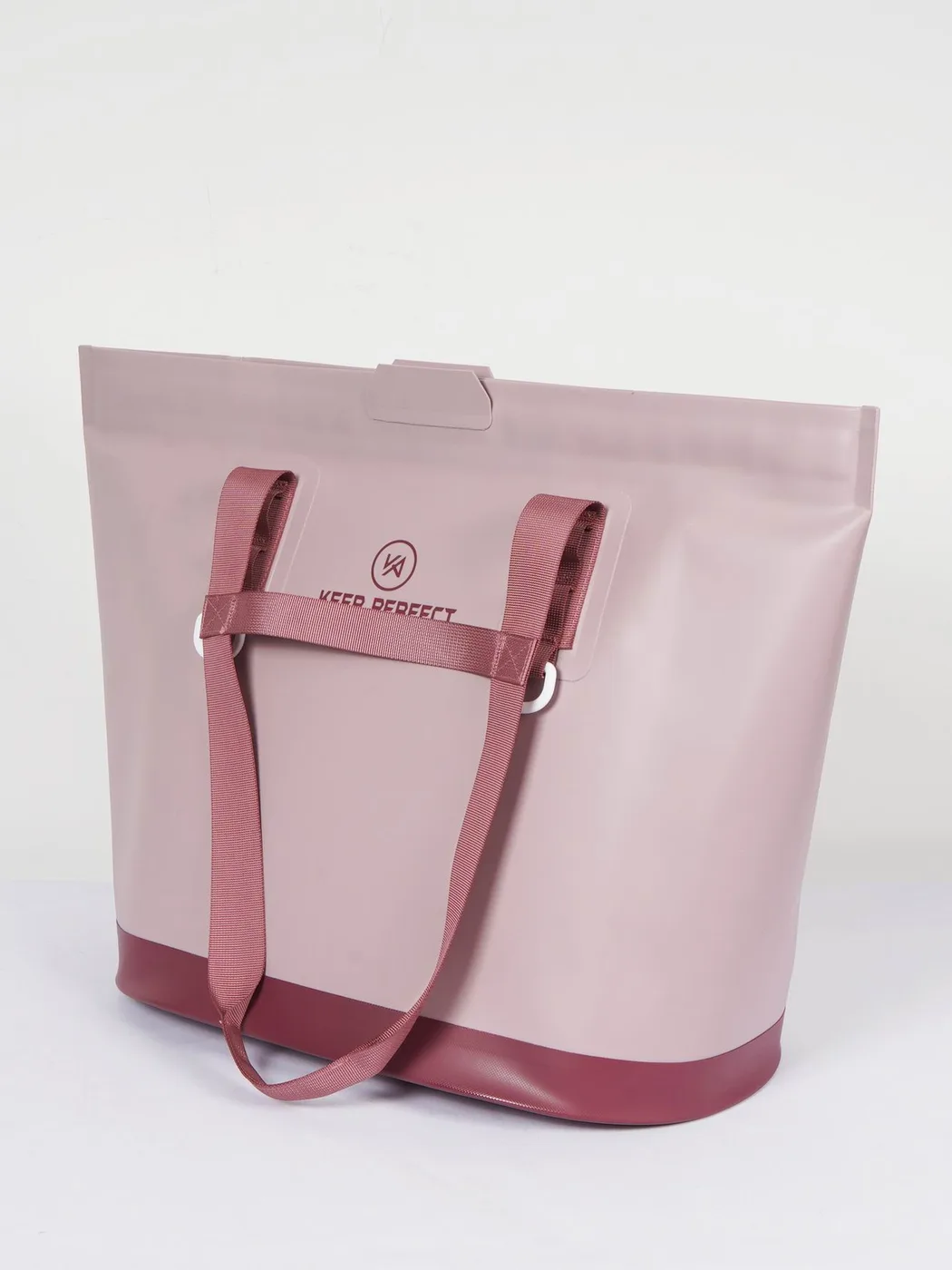
What actually earns its space in a kite bag
Space on the water is limited, so everything in the bag has to justify itself. A phone in a 0.5L inner pouch, a set of car keys, a small multi-tool with a fin-key bit, a bladder repair patch and a short length of webbing earn their place. A full first-aid kit, a second wetsuit top and a 1.5-litre bottle do not; they belong in the car.
Weight matters more than people expect if the bag is carried on a board or a harness. Add 2 kg to a board and the nose behaves differently in a jump; add it to a harness and it pulls on your back through a two-hour session. Aim for under 1.5 kg of carried waterproof kit, and put everything else in a bag that stays on the beach.
A 60-second post-session routine
- Tip the bag out completely and shake it upside down to clear sand from the corners.
- Rinse the interior with about two litres of fresh water and pour it out.
- Run a thumb along the fold line and wipe both faces with a wet hand.
- Rinse buckles and cam levers, then work them through their full travel.
- Hang the bag open, mouth down, in shade or in a ventilated car.
- Leave it open at home until the interior is completely dry, then store loosely rolled.
The order matters because sand comes out far more easily dry than wet. Shake first, rinse second, and never put a bag away closed. If you ride several days in a row, the routine is the same every day; skipping it for a week is enough to embed grit in a fold permanently, and no amount of later cleaning reverses that.
Buying checklist for kite use
- Welded seams, no stitching in the water path, radiused corners with a wide weld.
- Roll-top closure on every bag under 30 litres; avoid zips in the water path.
- Welded D-rings rather than sewn loops, plus a short leash for anything carried.
- 0.5 mm film for bags dragged on sand; 0.3 mm is acceptable for a light on-board grab bag.
- A bright colourway for visibility, or reflective detailing for a dawn or dusk session.
- 5L and 15L rather than one large bag, sized for the session rather than the car.
- A stated rating that names a test method, not a general waterproof claim.
Two external references help with planning a session and with reading a spec. NOAA publishes the wind, tide and water temperature data that decide both session length and how much sand is going to be moving, and the ISO standards behind waterproof and colour-fastness claims are what a listing should cite. Closer to home, our saltwater rinse guide and the UV prevention notes cover the two maintenance tasks that decide service life.
Kite use shares most of its failure modes with the other wind and board sports, so it is worth reading across: the windsurfing kit guide covers the same beach exposure, the surf setup guide covers shore storage, and the wakeboarding comparison covers what changes when the water is flat and fresh. Compare any candidate against our roll-top range and the wider product line before buying.

Frequently asked questions
Q1. What size dry bag do I need for kiteboarding?
Five to eight litres for a one-to-two hour freeride session and 10 to 15 litres for a full day with lunch and a dry layer. Buy a 5L and a 15L rather than one large bag, because the car-size bag never goes near the water.
Q2. How do I keep sand out of my dry bag closure?
Keep the bag closed and upright while rigging, run a thumb along the fold line before every roll, and wipe the mouth with a damp hand on a dusty day. One 0.2 to 0.5 mm grain in a fold is enough to wick water into the bag.
Q3. Do I need a waterproof rating for kiteboarding?
Yes, IPX6 or IPX7. A face-plant at 30 km/h produces a powerful water jet, and a body drag is a brief submersion, so a water-resistant pack with stitched seams is not sufficient.
Q4. Should I tether my dry bag when kiting?
Yes. A sealed bag with air floats and will be gone in minutes on a windy beach. Use welded D-rings with a short leash; sewn loops tear at 60 to 80 kg of shock load, which a wipeout generates easily.
Q5. Can I leave my dry bag in a hot car after a session?
Not wet and not rolled. A car in 28 °C sun reaches 50 °C to 65 °C internally, and a wet folded bag at that temperature shows crease damage in weeks. Empty it, open it, and let it dry in shade.
Q6. How often should I rinse a kiteboarding dry bag?
After every session: shake out sand, rinse the interior with about two litres of fresh water, wipe the fold line and hang it open. Even a brackish spot leaves salt crystals that abrade the film.
Q7. Is a roll-top or a zip better for kite use?
Roll-top on every bag under 30 litres. Sand in a waterproof zip deforms the sealing surface permanently, while a roll-top has no teeth to jam and can be wiped clean in seconds.
Q8. Where should I put my bag during a kite session?
Off the ground and out of the wind: hanging from a fence or a rigged kite bag is best, a closed car is second, and upright on the ground behind a windbreak is the default. Never leave it downwind of a rigging lane.
Q9. Will sand damage the fabric of my dry bag?
Yes, gradually. Airborne sand abrades the film at any crease and works into buckles and cam levers, which is why hardware on a kite bag has a service life of about two to four seasons.
Q10. How much weight should I carry on a board or harness?
Under 1.5 kg of waterproof kit. Two kilograms changes how a board behaves in a jump and pulls on your back through a long session, so everything except essentials belongs in a bag on the beach.
Q11. What should go in a kiteboarding dry bag?
A phone in a 0.5L inner pouch, keys, a small multi-tool with a fin-key bit, a bladder patch and a short length of webbing. A full first-aid kit and a 1.5-litre bottle belong in the car.
Q12. Does a bright bag matter for kiteboarding?
Yes for visibility. A dark bag in chop is invisible from a kite line away, and a bag that breaks free becomes a hazard for other riders. A bright colourway or reflective detailing is a genuine safety feature.
Q13. How long should a kiteboarding dry bag last?
Five to eight seasons with a rinse after every session and shaded storage, and two or fewer if it is stored wet, rolled and hot. Abrasion at the fold and buckle wear are the two things that end it.
Q14. Can I use the same dry bag for kiteboarding and kayaking?
Yes, if it is welded with a roll-top closure; the same bag simply works harder on a kite beach because of sand. Rinse more often, keep it off the ground, and check the fold line every session.
Q15. What film thickness suits a kite beach?
0.5 mm for any bag dragged across sand, which resists a 3 mm probe at 140 to 190 newtons. A 0.3 mm film is acceptable only for a light grab bag that lives strapped to a board and rarely touches the ground.
Q16. How do I know when to retire a kite dry bag?
Retire it when the fold line whitens and stays white, when a buckle slips under load after rinsing, or when corner welds show any peel. Any of those means the bag will fail when you next need it.
People also ask
How do you keep sand out of a dry bag?
Keep it closed and upright while rigging, wipe the fold line with a damp hand before every roll, and shake sand out dry before rinsing. One grain between the folded faces is enough to wick water into the bag.
What size dry bag is best for kiteboarding?
Five to eight litres for a short session, 10 to 15 for a full day. Two bags beat one large one, because a car-sized 40L bag is too big to take on the water or strap to a board.
Are dry bags necessary for kiteboarding?
Yes for anything that must stay dry near the water. A water start or a body drag is a submersion event, and a coated pack with stitched seams will not survive it; look for welded seams and a stated rating.
How do you clean a dry bag after the beach?
Shake it out dry, rinse the interior with fresh water, wipe the fold line, rinse the buckles and work them, then hang the bag open mouth-down in shade. The whole routine takes about 60 seconds.
Can you leave a dry bag in a hot car?
Only dry and open. A car parked in 28 °C sun reaches 50 °C to 65 °C, and a wet bag rolled shut at that temperature develops crease damage within weeks.
Why does my dry bag leak after a beach session?
Because sand sat in the fold, or because the bag was left open and collected grit, or because a buckle was not pulled tight. Wipe the closure, re-roll three folds, and run an air test before the next session.
Need this in production volume?
QUANZHOU JUNYUAN BAGS has produced waterproof bags since 2014 in an SGS-verified 4,950 m2 facility in Fujian, China. Minimum order 500 pieces, sampling in 6–10 working days, bulk in 35–50 days, FOB Xiamen — write to service@junyuanbags.com with your spec and target market.