Choosing a Dry Bag for Wakeboarding
A wakeboarding day needs less waterproof volume than almost any other water sport: 5 to 10 litres for a half-day session on a boat and 15 to 20 litres if you are bringing a wetsuit, a towel and a change of clothes for the drive home. What it needs more of is impact tolerance. A fall behind the boat at 32 to 40 km/h puts a short, sharp load of 40 to 60 kg on whatever the bag is clipped to, and a bag on an open deck also sits at 35 °C in direct sun for five hours.
That combination rules out most of the obvious choices. A lightweight splash sack is fine for paddle drip and fails on the first hard fall; a heavy 40L expedition bag survives everything and is too big to leave on a bow deck. The right answer is usually one 10L welded roll-top clipped under the bimini plus a 2L to 5L grab bag for keys and a phone, both in a colourway you can spot in the water. This guide works through each decision with the numbers behind it.
- What wakeboarding does to a bag that other sports do not
- Where the bag lives on the boat
- Sizing for a session rather than a trip
- Falls at speed: what the closure has to survive
- Buoyancy: what happens if it goes overboard
- Keys, phone and the boat fob
- Wet kit: wetsuit, towel and the drive home
- Sun, heat and what a deck does to film
- Straps, clips and lashing on a moving boat
- Dock, launch and the shore routine
- End-of-day care for a wake boat bag
- Checklist before you buy
What wakeboarding does to a bag that other sports do not
Three things separate a wake boat from a kayak or a paddleboard. The first is impact: a wakeboarder falling at 32 to 40 km/h hits the water with roughly 40 to 60 kg of peak load on the body, and anything attached to the rider or the boat sees a fraction of that as a shock. The second is repetition, because a good session involves twenty to forty falls in four hours, so the bag is wetted and dried and wetted again all day. The third is sun, because a bow deck has no shade.
Spray is the easiest of the three to solve and the one most people over-specify for. Water thrown by a wakeboard at speed is a jet event, which IPX6 covers; it is not sustained immersion. The exposure that actually matters is the bag being knocked off a seat, scraped along a nonslip deck and soaked repeatedly for five hours, which is an abrasion and fatigue problem rather than a waterproofing one.
That reframes the buying decision. Look for a welded seam and a 0.4 to 0.5 mm film, which handles abrasion and repeated wetting, rather than chasing the highest immersion rating on the shelf. A bag rated IPX7 in a 0.5 mm TPU film is the sensible target; anything thinner will scuff through on a nonslip deck within a season.
Where the bag lives on the boat
Position decides exposure, and on a wake boat there are only four realistic spots. Under the bimini is the best: shaded, out of the spray path and close enough to reach between rides. The bow deck is convenient and terrible, because that is where the spray lands hardest and where the deck temperature peaks. A locker or under-seat compartment is dry and cool but slow to reach. Clipping to the tower or rail is fast and exposes the bag to everything.
Pick one main position and one fallback. The main position should be shaded and reachable without standing up; the fallback should be a closed compartment for the items that must not get wet at all. Do not carry the bag on your person: a dry bag clipped to a life jacket or a board is a snag hazard in a fall, and it changes how you land.
| Position on the boat | Spray exposure | Deck temperature | Reach time | Verdict |
|---|---|---|---|---|
| Under the bimini | Low | 30-34 °C | 3 s | Best for the day bag |
| Bow deck, open | High | 40-48 °C | 2 s | Fine for a water bottle only |
| Under-seat locker | None | 26-30 °C | 12 s | Best for phone and keys |
| Clipped to the tower | Very high | 38-45 °C | 4 s | Avoid for anything valuable |
| Transom swim platform | Constant | 30-36 °C | 5 s | Only for a wet-kit bag |
Sizing for a session rather than a trip
Volume for wakeboarding is driven by how long you are on the water and whether you are changing afterwards. A half-day session with a boat nearby needs almost nothing: a towel, sunscreen, a water bottle and a phone, which is 4 to 6 litres. A full day with a wetsuit, a change of clothes and food for four people is a different proposition, and it should be split across two bags rather than one large one.
Splitting matters because a wake boat is a shared space. One 20L bag for the group and one small personal bag per rider keeps the deck clear and means nobody is digging through someone else's kit between rides. It also means that if a bag goes overboard, only one person loses a towel rather than the whole group losing lunch.
| Session | Riders | Day bag | Personal bag | Packed weight | Notes |
|---|---|---|---|---|---|
| Two-hour session | 1-2 | 5 L | 2 L | 1.2-1.8 kg | Towel, bottle, sunscreen |
| Half day on the boat | 3-4 | 10 L | 2 L each | 3.0-4.2 kg | Food and spare rash vest |
| Full day, mixed crew | 4-6 | 20 L | 5 L each | 6.5-8.0 kg | Wetsuits and towels |
| Full day with a wetsuit | 2 | 20 L | 5 L | 5.0-6.5 kg | Wet bag separate |
| Weekend at the lake | 4 | 40 L | 5 L each | 11.0-13.0 kg | Leave the big bag ashore |
Falls at speed: what the closure has to survive
The load case that destroys bags on a wake boat is not immersion, it is a shock applied to a full bag. A 10L bag holding 3 kg of kit, knocked from a seat onto a deck, lands with a contact load several times its own weight for a few milliseconds. A roll-top survives that because the closure is a fold rather than a mechanical joint; a zip, a magnetic seal or a clip closure does not, because the impact momentarily deforms the sealing line.
This is the practical argument for the roll-top over every alternative on a boat, and it is why every size in our roll-top dry bag range uses the same three-fold geometry. A waterproof zip is excellent for access on a backpack and it is the item most often returned after a season on a wake deck, because grit from a nonslip surface gets into the teeth and the slider then deforms under a knock. A roll-top has no moving parts in the seal; it has a fold, and a fold re-seats itself.
Buoyancy: what happens if it goes overboard
A sealed roll-top with air inside floats, and that is worth designing for deliberately. A 10L bag rolled with about 4 litres of trapped air displaces enough water to support roughly 4 kg, so it sits high in the water and is easy to spot from the boat. The same bag squeezed flat and rolled tight will float low or sink, which is why you should not press all the air out before closing a bag that might end up in the lake.
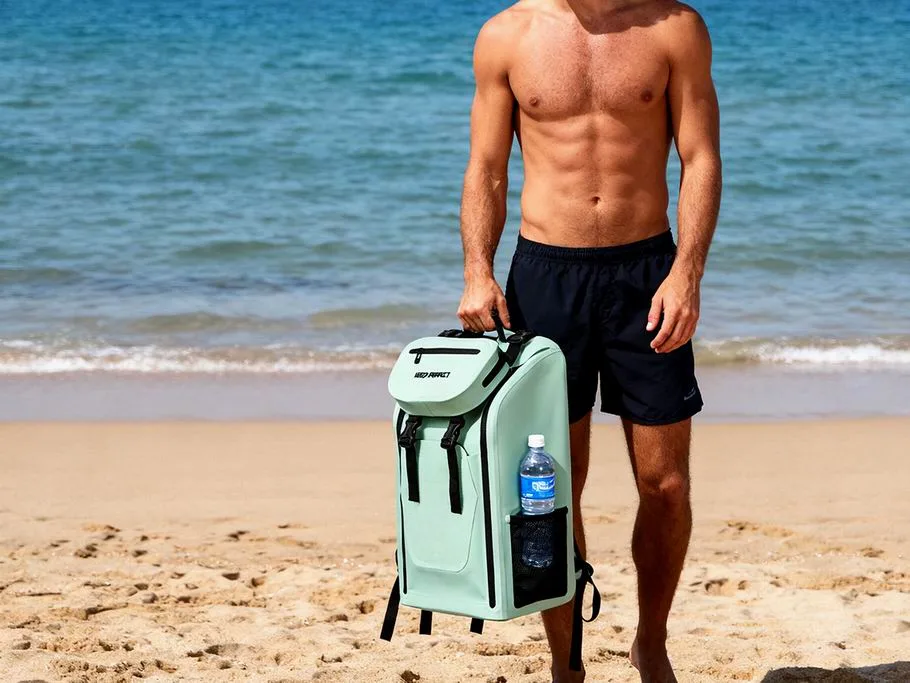
Colour is the other half of recovery. A black bag on the water is close to invisible from a moving boat; a bright blue, orange or mint shell is visible from 200 m or more. If you are buying one bag for a crew, buy it in a light or saturated colourway and put a reflective patch on it, because the most likely recovery scenario is spotting it from a distance at the end of a run.
Do not treat the bag as a flotation device for a person. It is not rated for that and it will not hold a rider up; a life jacket does that job. The bag is worth recovering because of the keys and phone inside it, not because of any buoyancy it offers you; if flotation is the actual requirement, look at purpose-built floating dry bag formats with rated buoyancy rather than relying on trapped air.
Keys, phone and the boat fob
Three items decide the day, and all three are small. The car keys and the boat fob are the difference between getting home and waiting for help; the phone is the difference between a minor inconvenience and a lost afternoon. Both should live in a small welded pouch inside the main bag, giving two independent seals, and the pouch should be bright enough to find in a hurry.
A 2L roll-top is the right size and it costs very little. Put the keys and fob in it, clip it to a D-ring inside the main bag so it cannot be tipped out, and make a rule for the crew: the pouch goes back in the bag, not on the seat. Most lost-key stories on wake boats are about a bag that was opened for a towel on a hot deck.
For the phone, add one further layer. A phone in a sealed 2L pouch inside a 10L bag is protected by two closures and about 6 litres of trapped air, which is genuinely redundant. A phone in a pocket of a boardshort is not protected at all, and it is the single most common casualty of a wakeboarding day.

Wet kit: wetsuit, towel and the drive home
The end of a session is where bags get misused. A wetsuit that has been in the lake holds 1.5 to 2.5 litres of water, and putting it in with dry clothes wets everything within twenty minutes. Either wring it in a towel first, which brings it down to about 0.4 litres, or give it its own bag. A 20L bag dedicated to wet kit is the cleanest solution on a shared boat.
There is a second reason to separate wet kit, and it is the car. A bag of wet gear left in a closed vehicle at 30 °C for two hours will generate enough humidity to fog the windows and start mildew on any fabric in the same space. Keep wet kit in the boot or on a rack, and open the bag as soon as you get home. Our wet kit storage notes cover the routine that prevents the smell.
Towels are the volume hogs rather than the wetsuits. A standard beach towel packs to about 3 litres and a microfibre one to about 1 litre, so four riders with microfibre towels save 8 litres of bag space over a day. That is the single easiest way to drop from a 20L bag to a 10L bag.
Sun, heat and what a deck does to film
A dark vinyl deck in direct sun reaches 55 to 65 °C, and a black bag lying on it can exceed 60 °C on its surface. That is above the temperature at which a PVC coating starts to soften and well above the point at which a plasticiser begins to migrate. A UV-stabilised TPU film handles the same conditions with far less change, which is the practical reason to avoid cheap PVC bags on a wake boat.
Sunscreen is the other chemical hazard and it is underrated. Spray-on sunscreens contain solvents and oils that soften coatings and can leave permanent marks on a TPU face; several common formulations will haze a clear window within a season. Keep the sunscreen in the bag rather than on it, wipe any overspray off the shell with fresh water at the end of the day, and accept that a bag on a wake boat is a consumable that will look tired after three summers.
Heat also changes how the closure behaves. A film warmed to 45 °C is softer and conforms better when you roll it, which is helpful, but it also creases more easily, so do not fold a hot bag sharply for storage. Let it cool in shade first, then store it loosely rolled with the buckle unclipped.
Straps, clips and lashing on a moving boat
Attachment is where most wake-boat bags are lost. A bag resting on a seat will leave during the first hard turn; a bag clipped to a fixed point stays. Use a welded D-ring and a screw-gate carabiner or a cam buckle on 25 mm webbing, and clip to something structural such as a bimini frame or a seat base, never to a rail that moves or a rope that is used for towing.
Avoid long lanyards. A bag on a 1 m strap becomes a projectile in a fast turn and can hit a rider in the water. Keep the attachment short enough that the bag cannot travel more than 30 cm, and check it at every stop as part of the routine rather than once at the start of the day.
| Attachment | Holds in a hard turn | Risk | Best use |
|---|---|---|---|
| Short clip to a bimini frame | Yes | Low | Day bag, main position |
| Cam buckle around a seat base | Yes | Low | Group 20L bag |
| Bungee on a bow rail | Sometimes | Medium, can snag | Water bottles only |
| Loose on a seat | No | High, lost bag | Never with valuables |
| Long lanyard to a cleat | No | High, becomes a projectile | Never |
Dock, launch and the shore routine
The bag works hardest in the twenty minutes either side of the session. At the launch you are carrying it across a slipway or a dock with a board under one arm, which is when a harness or a shoulder strap earns its place, and at the end you are loading it into a wet car. A bag with a single carry handle is awkward in the first case and fine in the second; a small welded backpack is the opposite.
One habit prevents most dock problems: close the bag before you pick it up. A bag carried open across a wet dock collects whatever is on the dock, and a bag closed on a wet dock keeps its contents dry for the whole day. It sounds obvious and it is routinely ignored when four people are unloading at once.
End-of-day care for a wake boat bag
- Empty the bag completely, including the small pouch, and shake out any sand or grit.
- Rinse with fresh water at ambient temperature, paying attention to the fold line.
- Wipe off sunscreen overspray with a soft cloth and fresh water, not with a solvent.
- Check the D-rings and the clip for wear while the hardware is still wet.
- Dry in shade with the mouth open and the fold unfolded; never on a hot deck.
- Store loosely rolled with the buckle unclipped, away from direct sun.
Freshwater lakes are kinder to gear than the sea, but they are not neutral. Algae and silt leave a film on the fold line that holds the fold apart by a fraction of a millimetre, and that is enough to weep on the next trip. The rinse takes two minutes and it is the difference between a bag that seals for years and one that dribbles.
Once a month during the season, do an air test. Roll the bag closed, squeeze it and listen for a hiss, then leave it squeezed for thirty seconds to see whether it holds pressure. That single check will catch a small puncture from a board fin or a dock splinter long before it becomes a wet towel.
Checklist before you buy
- Welded seams on a 0.4 to 0.5 mm TPU film; avoid thin PVC on a sun-exposed deck.
- Roll-top closure with three folds and a stiffened mouth; no zip in the sealing line.
- 10L for a small crew, 20L for four to six riders, plus a 2L pouch per person for keys.
- A bright or light colourway so the bag can be spotted in the water from a distance.
- Welded D-rings and 25 mm webbing for a short clip to the bimini or a seat base.
- Enough trapped air to float with about 4 litres of air in a 10L bag.
- A separate wet-kit bag for wetsuits and towels, never mixed with dry clothes.
- Compare the spec against the full product line before you commit.
Work through that list against what you already own before spending anything. Most riders need a 10L welded bag and a 2L pouch, which is a modest purchase, and the single most valuable habit is the rule that keys and phone live in the pouch inside the bag. Kit that is protected by two independent seals does not go missing on a wake boat.
Our own waterproof line has been produced since 2014 in an SGS-verified 4,950 m2 facility in Fujian, running seven production lines with a monthly capacity of 200,000 pieces, and the film and weld specification is identical across sizes so a 2L pouch behaves like a 20L deck bag. Sampling takes 6 to 10 working days and bulk runs 35 to 50 days at a 500-piece minimum.
Two safety notes finish the picture. Water temperature and immersion time drive hypothermia risk far more than any bag does, and the CDC publishes open-water safety guidance worth reading before a cold-season session. For planning around tides, currents and water temperature in US waters, NOAA is the reference most crews use. And for the riding position itself, our mistakes guide for towed sports covers the habits that lose gear, while the powered-watercraft care guide applies the same closure and rinse routine to a faster boat.
Frequently asked questions
Q1. What size dry bag do I need for wakeboarding?
A 10L welded roll-top for a half-day session with two to four riders, plus a 2L pouch per person for keys, fob and phone. Step up to 20L for a full day with wetsuits, towels and food for four to six people.
Q2. Where should the bag go on a wake boat?
Under the bimini: shaded, out of the spray path and reachable in about three seconds. The bow deck is open and hot at 40 to 48 °C, and clipping to the tower exposes the bag to everything.
Q3. Will a dry bag survive a fall at speed?
The bag will, if it is clipped to something structural. A roll-top survives the shock because the seal is a fold with no moving parts; a zip closure is the item most often damaged after a season on a nonslip deck.
Q4. Are roll-top bags better than zippered ones for wakeboarding?
Yes. Grit from a nonslip deck gets into zip teeth and the slider deforms under a knock, while a rolled fold re-seats itself. Keep any zip for the outer pocket of a bag, never in the sealing line.
Q5. Does a dry bag float if it goes overboard?
A sealed 10L bag with about 4 litres of trapped air supports roughly 4 kg and floats high enough to spot. The same bag squeezed flat and rolled tight will float low or sink, so do not press all the air out.
Q6. What colour dry bag is best on a wake boat?
A bright or light colourway. A black bag on the water is almost invisible from a moving boat, while a saturated blue, orange or mint shell is visible from 200 m or more, which is what matters during recovery.
Q7. How do I stop losing keys on the boat?
Put keys and the boat fob in a 2L welded pouch clipped to a D-ring inside the main bag, and make a crew rule that the pouch goes back in the bag after every stop. Two independent seals beat any single closure.
Q8. Can I put a wet wetsuit in with dry clothes?
No. A wetsuit from the lake holds 1.5 to 2.5 litres of water and will wet everything within twenty minutes. Wring it in a towel first, down to about 0.4 litres, or give it a dedicated wet bag.
Q9. Is TPU or PVC better for a sun-exposed deck?
TPU. A dark deck in direct sun reaches 55 to 65 °C and a black bag on it can exceed 60 °C, above the point where PVC softens and plasticiser migrates. A UV-stabilised TPU film changes far less.
Q10. Does sunscreen damage a dry bag?
Yes over time. Spray formulations contain solvents and oils that soften coatings and haze clear windows within a season. Keep sunscreen inside the bag and wipe overspray off the shell with fresh water at the end of the day.
Q11. How should I attach the bag on a moving boat?
A short clip from a welded D-ring to a bimini frame or a seat base, with no more than 30 cm of travel. Avoid long lanyards, which become projectiles in a hard turn, and never clip to a tow rope or a moving rail.
Q12. Do I need an IPX7 bag for wakeboarding?
It is the sensible target but the spray itself only needs IPX6. What matters more is abrasion resistance and repeated wetting, so choose a welded seam on a 0.4 to 0.5 mm film rather than chasing the highest rating.
Q13. How much water does a wetsuit add to a bag?
About 1.5 to 2.5 litres straight from the lake, or roughly 0.4 litres after being wrung in a towel. That difference is why a towel-wring before packing keeps the rest of the load dry.
Q14. Should I bring a cooler bag on a wake boat?
Yes, and it works well: ice applies no pressure until it melts and 4 kg of ice gives about 4 litres of water in a 20L bag, only 20% full. Decant the melt water before you move it.
Q15. How often should I test the bag?
Once a month during the season. Roll it closed, squeeze it and listen for a hiss, then hold the squeeze for thirty seconds. That catches a small puncture from a board fin or a dock splinter early.
Q16. Is freshwater easier on gear than saltwater?
Yes, but not neutral. Algae and silt leave a film on the fold line that holds the fold slightly apart, so rinse with fresh water at ambient temperature and dry in shade with the mouth open.
People also ask
How do you choose a dry bag for wakeboarding?
Pick a welded 0.4 to 0.5 mm TPU roll-top in a bright colour, 10L for a half day and 20L for a full crew, clip it under the bimini with a short lead, and keep keys and phone in a 2L pouch inside the main bag.
What size dry bag is best on a wake boat?
Ten litres for two to four riders on a half-day session, twenty litres for four to six on a full day with wetsuits and food. Split across a group bag and a 2L personal pouch so one loss does not cost everyone lunch.
Are dry bags worth it for wakeboarding?
Yes, because the deck is wet, the sunscreen is corrosive and the phone and keys are expensive to replace. A 10L welded bag costs less than a phone screen and lasts several seasons if it is rinsed and dried in shade.
Can a dry bag survive a wipeout at 35 km/h?
Yes if it is clipped to the boat rather than carried. The load case destroys zips and magnetic closures, not folds, which is why a roll-top with three folds is the standard choice on a nonslip deck.
Where do you put a dry bag on a wake boat?
Under the bimini for the day bag, in an under-seat locker at 26 to 30 °C for phone and keys, and in a separate wet bag on the swim platform for wetsuits and towels. Never loose on a seat.
How do you keep a dry bag from blowing away on a boat?
Clip it short. A welded D-ring with a screw-gate carabiner to a bimini frame or seat base, limited to 30 cm of travel, holds through hard turns; a bag resting loose on a seat leaves on the first turn.
Need this in production volume?
QUANZHOU JUNYUAN BAGS has produced waterproof bags since 2014 in an SGS-verified 4,950 m2 facility in Fujian, China. Minimum order 500 pieces, sampling in 6–10 working days, bulk in 35–50 days, FOB Xiamen — write to service@junyuanbags.com with your spec and target market.