Wet-Weather Kit for Windsurfing
Windsurfing exposes kit to a combination most other water sports do not produce: 30 to 45 km/h of onshore wind driving spray almost horizontally, followed by a beach stage where everything sits in blowing sand. A three-hour session in 33 km/h of wind and 14 degree C water needs 12 to 18 litres of waterproof space split across two bags at 3 to 5 kilograms, and the item that most often ends up damaged is the phone in a harness pocket rather than anything in the bag.
This guide covers the exposure by wind speed, the volume you need by session length, what stays on the beach and what goes in the car, how to attach a bag so it does not take off in a gust, the ratings that actually hold up to driven spray, and a cold-water layering plan. There are four tables with real weights and volumes, plus a pre-session checklist and a rinse routine that keeps sand out of the closure for a whole season.
- What wind and spray actually do to your kit
- The three zones of a windsurfing day
- Volume by session length, not by board size
- What goes on the beach and what stays in the car
- Rigging gear and the items that never go in a bag wet
- Keeping a bag on a windy beach
- Ratings and seams that survive driven spray
- Cold water, wind chill and the layers that must stay dry
- A packing order for a windy launch
- Mistakes that soak a windsurf kit
- Board, car and roof rack: where the bag travels
- Sand, salt and the post-session rinse
- Building the kit around one season
What wind and spray actually do to your kit
Spray on a windsurf board is not the same as spray on a kayak, because the wind gives it horizontal velocity. At 30 km/h of onshore wind, water driven off the chop travels at close to the wind speed and arrives at your kit as a stream rather than a shower, which is why a bag that hangs off a fence or sits on a dune gets soaked from the side rather than the top. Vertical rain protection tells you nothing about this exposure.
Then there is the beach stage, which is arguably worse. Between rigging and launching, a bag sits on sand in a wind that moves grains at ankle height for 20 to 40 minutes, and sand is the enemy of every closure. One grain in the fold line creates a capillary path that wicks water into a bag over an hour, so a bag that was perfectly sealed at the car can leak by lunchtime without anyone touching it.
| Wind speed | Beaufort | What the spray does | Exposure class | Rating that holds |
|---|---|---|---|---|
| 15-20 km/h | 4 | Light chop splash | Splash | IPX4 |
| 20-28 km/h | 5 | Driven spray on the beach | Jet | IPX6 |
| 29-38 km/h | 6 | Horizontal spray, board wash | Jet | IPX6 |
| 39-49 km/h | 7 | Continuous driven water | Jet and brief immersion | IPX7 |
| 50-61 km/h | 8 | Full board wash, capsize | Immersion | IPX7 |
| Over 62 km/h | 9 | Repeated wipeouts | Sustained immersion | IPX7-IPX8 |
The three zones of a windsurfing day
Think of the day as three zones with different risks, because one bag cannot serve all of them. Zone one is the car, where the dry change of clothes, the car keys and anything electronic should stay, sealed and out of the wind entirely. Zone two is the rigging area, where the bag sits in sand and needs to close cleanly despite grit. Zone three is the water, where only what you can lose should go.
The mistake most windsurfers make is carrying one bag between all three. A bag that has been open on a sandy beach carries grit into the car and into the dry layers, and a bag that has been on the water carries salt into everything else. Two bags, colour-coded, solves it: a beach bag that lives on the sand and a car bag that never leaves the vehicle until you change.
Volume by session length, not by board size
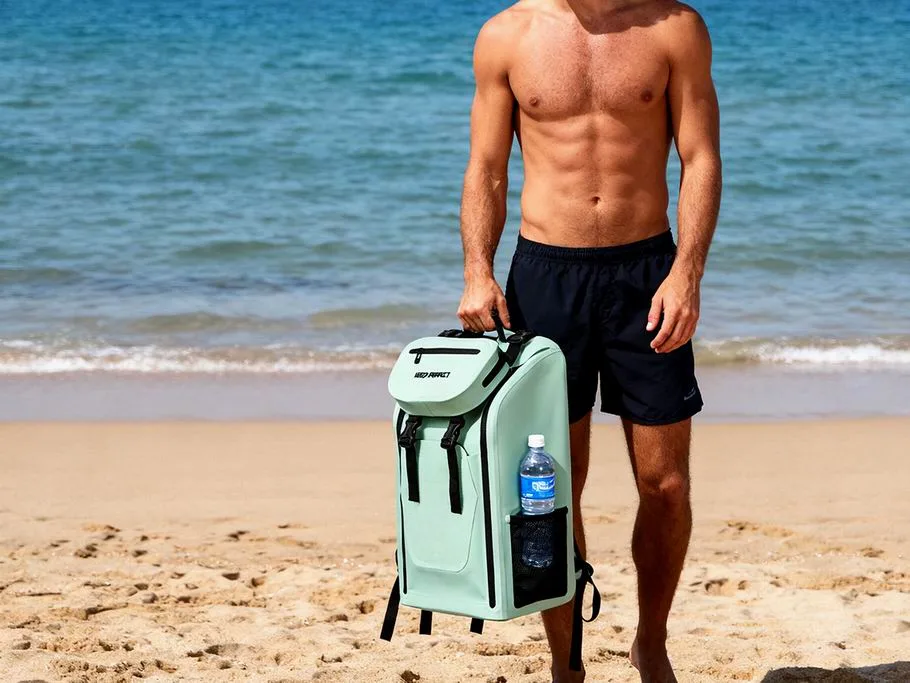
Volume follows time on the water and air temperature, not the size of your kit. A one-hour session in warm water needs very little: a towel, a drink and a dry top for the drive home, around 6 litres and 1.5 kilograms. A three-hour session in 14 degree C water needs a dry base layer, a fleece, a hat, a thermos, a towel and a spare neoprene accessory, which is 12 to 18 litres at 3 to 5 kilograms.
The jump happens when you add a second session. Two sessions in one day means the first set of wet kit has to be contained while the second set is being used, and that is when a wet pouch inside the dry bag earns its place. Budget 4 litres for the wet pouch and 10 to 14 for the dry layer and food, and you land on a 20 litre bag for a full day rather than the 10 litre that suits a single session.
| Session | Waterproof volume | Loaded weight | Bag split | Wet load |
|---|---|---|---|---|
| 1 h, warm | 5-7 L | 1.2-1.8 kg | 1 x 10L | Towel and drink |
| 2 h, temperate | 8-12 L | 2.0-3.0 kg | 1 x 10L + 1 x 5L | Wetsuit top |
| 3 h, 14 C water | 12-18 L | 3.0-5.0 kg | 1 x 15L + 1 x 5L | Full wetsuit |
| Full day, two sessions | 18-24 L | 4.5-7.0 kg | 1 x 20L + wet pouch | Two wetsuits |
| Coastal road trip | 30-45 L | 8-12 kg | 1 x 30L + 1 x 10L | Everything, daily |
| Winter session | 15-22 L | 4.0-6.5 kg | 1 x 20L | Dry suit and gloves |
What goes on the beach and what stays in the car
The beach bag holds the things you need within ten metres of the waterline: a drink, an energy bar, a spare strap or rope, a multi-tool for the rig, sunscreen and a towel. It should be the smaller of the two bags, because it is the one exposed to spray and sand, and it should close with one hand while you are holding a boom. A 5 to 10 litre roll-top with a wide mouth does this best.
The car bag holds the things that ruin a drive home if they get wet: a dry base layer, a fleece, a beanie, dry socks, a thermos and the car keys. It never opens on the sand, it is not carried down to the water, and it lives in the boot or behind a seat. Keeping this split absolute is the single most effective thing you can do for comfort, because warm dry layers matter far more after the session than during it.
Rigging gear and the items that never go in a bag wet
Rigging hardware deserves its own rule: nothing metal goes into a dry bag wet and salty. A multi-tool, a mast foot pin, shackles and a harness spreader bar will start surface corrosion within hours in a sealed salty bag, and the rust then stains the interior film. Rinse them in fresh water, dry them, and keep them in a separate mesh pouch that can drain rather than in the waterproof shell.
The same rule applies to the wetsuit. Neoprene is closed-cell foam and holds very little free water once wrung, but it holds salt, and a salty wetsuit sealed inside a bag will leave crystals on the film that abrade the fold line afterwards. If the car has a mat or a lined boot, the wetsuit travels better there than inside the good bag; if it has to go in, wring it and give it its own pouch.
Keeping a bag on a windy beach
Unsecured light objects leave windy beaches, and an empty roll-top is exactly the wrong shape for a gust. Weight the bag: put the drink bottle and the tool pouch in the bottom, or sit the bag inside an upturned board bag. If you use a fence or a post, clip it with a short leash rather than hanging it by the strap, because a bag hanging by a strap in 40 km/h of wind swings and rubs through its own webbing in an afternoon.
Orientation matters too. Lay the bag with the closure facing downwind and the mouth pointing away from the water, so airborne spray hits the welded base rather than the fold. Better still, put it behind a windbreak: behind a car, a dune or a board stacked on its fin reduces the sand load by more than half, and sand is what eventually defeats the closure rather than water.
Ratings and seams that survive driven spray
Driven spray is a jet event, which is what the IPX6 grade describes: powerful water jets from any direction. A bag marketed as splash-proof or shower-resistant is IPX3 or IPX4 and will pass a vertical rain test while failing completely against water arriving sideways at 33 km/h. For windsurfing, IPX6 is the practical floor for the beach bag and IPX7 is the sensible floor for anything that might go in the water with you.
Seam construction decides whether the rating survives the season. Welded seams have no needle holes, so a jet cannot find a path through them, while a stitched and taped seam relies on an adhesive that sand and flex gradually lift. Check the corners, where two weld lines meet, because that is where fatigue shows first, and look for a reinforced collar band rather than a folded and sewn one at the mouth.
Cold water, wind chill and the layers that must stay dry
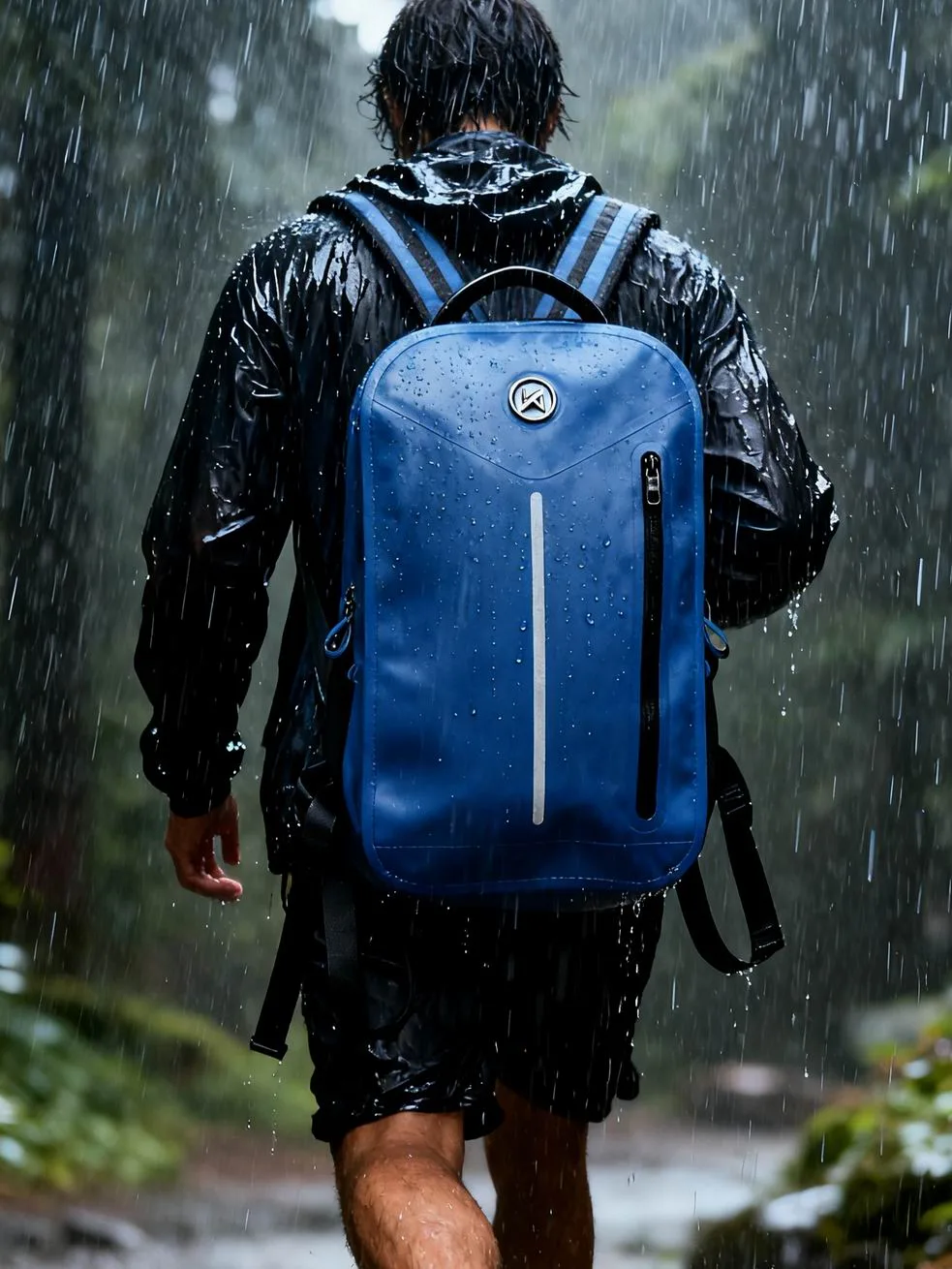
Wind is the reason windsurfing cold-water risk is worse than swimming in the same temperature. At 14 degree C water and 35 km/h of wind, the apparent temperature on wet skin drops below 5 degrees C within a minute of leaving the water, and fine motor control goes not long after. Dry layers are not a comfort item in those conditions, they are the difference between a normal drive home and a genuinely bad afternoon.
Plan the layers as a system: a dry base layer, an insulating mid layer and a windproof shell, with a hat, because most heat loss from a wet head in wind is convective. Keep all three in the car bag, sealed, and change in the lee of the car before the wind dries and chills you. Public health guidance on cold exposure and hypothermia is published by the CDC and is worth reading before a winter season.
| Water temperature | Suit | Session limit | Dry layers needed | Notes |
|---|---|---|---|---|
| 22-26 C | Shorty or none | 3-4 h | Towel and dry top | Wind chill still real |
| 18-21 C | 3/2 mm full suit | 3 h | Base layer and fleece | Hat for the drive |
| 14-17 C | 4/3 mm suit, gloves | 2-3 h | Full three-layer set | Thermos worth carrying |
| 10-13 C | 5/4 mm suit, boots | 1.5-2 h | Insulated shell, hat | Change in the lee |
| 6-9 C | 5/4 mm or dry suit | 1-1.5 h | Full set plus blanket | Short sessions only |
| Below 6 C | Dry suit | Under 1 h | Full set, warm vehicle | Never sail alone |

A packing order for a windy launch
Check three numbers before you load anything: wind speed in kilometres per hour, water temperature, and wind direction relative to the beach. Onshore wind means driven spray and a wet beach stage, offshore means a dry beach but a long swim if things go wrong, and cross-shore means you may land hundreds of metres from where you launched, which is a strong argument for carrying less on the water.
Observed coastal conditions are published by NOAA, and the gap between a forecast and the reading at the beach is frequently 8 to 10 km/h. Load the bag for the wind you can feel rather than the wind that was predicted, because the beach stage is where exposure actually happens and it is the stage everyone forgets to plan for.
- Fill the beach bag first, with the heaviest items at the bottom and the mouth clear.
- Check the fold line for sand with a thumb, then rinse it with a splash of fresh water.
- Close with three folds, clip the buckle, and lay the bag mouth-downwind behind a windbreak.
- Leave the car bag sealed in the vehicle with the dry layers on top of it, not under it.
- Keep keys in a pocket, not in either bag, so a lost bag never strands you.
- On the water, carry nothing more than a leash and a whistle; everything else stays ashore.
- After the last run, rinse both bags before anything goes back into the car.
That sequence takes about four minutes and it is designed around the two failure modes that actually cost people their kit: sand in the fold and a bag taken by the wind. Neither is dramatic, both are avoidable, and both happen on the beach rather than in the water. The sequence also fixes a place for the car keys, which is the item that strands people when a bag is lost or taken by a gust.
Mistakes that soak a windsurf kit
- Hanging the bag by its strap on a fence where it swings in the wind and abrades its own webbing.
- Packing the wetsuit and the dry layers in the same bag, so the dry set is damp before you need it.
- Putting salty tools and shackles into a sealed bag, which rusts metal and stains the film.
- Closing the bag on the sand without wiping the fold line, which wicks water in within an hour.
- Using a splash-proof beach bag for a day that develops into force 6 conditions.
- Purging every bit of air, then leaving the bag where a gust can move it across the sand.
- Driving home with wet kit sealed in the good bag and discovering the smell two days later.
Four of those seven mistakes happen before you launch, which is the point: windsurfing gear damage is a beach problem far more often than a water problem. The cure is routine rather than equipment, and it costs minutes rather than money. The remaining three are storage decisions made in the car park, and all three are solved by opening the bag for the drive home instead of sealing it and dealing with the smell two days later.
One more belongs on the list: sealing a bag that is still damp from the previous day. A film closed while wet will develop odour far faster than one dried properly, and no amount of rinsing afterwards undoes a week of sealed damp. If the bag genuinely has to be packed wet, leave the mouth open for the first hour at home and finish the drying later.
Board, car and roof rack: where the bag travels
Getting the bag from the car to the beach is where a lot of wear happens. A roll-top carried by its top handle across 200 metres of soft sand is fine; the same bag dragged behind you is not, because the welded base takes the abrasion and the corners take the impact. If the walk is long, use a backpack format with welded straps, which is the reason a TPU waterproof backpack earns its place in a windsurf kit.
On the drive home, wet kit should never be sealed. Open the bag, lay it on its side in the boot with the mouth propped, and let air move through it for the length of the journey; that alone prevents most of the smell problems people blame on the bag. If the drive is longer than an hour, that airflow is usually enough to arrive with the interior genuinely dry.
Sand, salt and the post-session rinse
Rinse in fresh water at ambient temperature, and do the closure first. Open the bag, run fresh water along the fold line, then work a thumb along it to feel for grit before the film dries. Sand left in the fold is what cuts the film over a season, and it is invisible until you look for it deliberately. Do this at a beach tap if there is one, or in the car park before anything goes into the boot.
Rinse the exterior next, paying attention to the base corners and the D-rings, then dry in shade with the mouth open. Never use a hot hose or a pressure washer: heat softens the film and pressure forces water past a closure that was never designed to take a jet from the outside at close range. A full walk-through of the rinse sequence is in rinsing saltwater off dry bags.
| Step | Time | Water temperature | Why | Skip risk |
|---|---|---|---|---|
| Rinse closure line | 60 s | Ambient | Removes grit from the fold | Leaks and cut film |
| Rinse exterior panels | 90 s | Ambient | Removes salt crystals | Abrasion in storage |
| Rinse hardware | 30 s | Ambient | Stops buckle corrosion | Slipping buckles |
| Dry open in shade | 2-4 h | Ambient air | Prevents odour and hydrolysis | Sour interior |
| Inspect welds | 60 s | Dry | Catches fatigue early | Failure mid-season |
| Store loose, unclipped | 10 s | Dry | Protects the fold line | Permanent creases |

Building the kit around one season
A workable windsurf kit is two bags and a rinse habit. A 5 to 10 litre roll-top for the beach stage, a 15 to 20 litre roll-top or backpack for the car stage, and a 3 to 5 litre wet pouch for the wetsuit once the session is over. That combination covers a one-hour summer blast and a full winter day without repacking, and it keeps the dry layers dry in both.
Replace the pouch before you replace the bag: pouches take the abuse and cost a fraction as much. Inspect the main shell twice a season, at the collar and the base corners, and retire it when the film shows crazing at the fold rather than when it leaks, because by the time it leaks you have already lost whatever was inside.
Clubs, schools and rental centres specifying this kit should write the beach-stage requirements into the brief, since that is where bags fail: jet-rated closure, welded collar, sand-tolerant fold geometry and a colour that reads on a busy beach. Our team has produced waterproof bags since 2014 in an SGS-verified 4,950 m2 facility with 7 production lines, sampling in 6 to 10 working days and bulk in 35 to 50 days at a 500-piece minimum.Related setups are covered in surfing dry bag setup, kiteboarding dry bag mistakes and gear protection on a paddleboard, and the full range sits under products.
Frequently asked questions
Q1. What size dry bag do I need for windsurfing?
A 5 to 10 litre bag for the beach stage and a 15 to 20 litre bag for the car. A three-hour session in 14 degree C water needs 12 to 18 litres total at 3 to 5 kilograms.
Q2. Is a splash-proof bag enough for windsurfing?
No. Water driven by 30 km/h of wind is a jet event, which is IPX6, not IPX4. Use IPX6 as the floor for the beach bag and IPX7 for anything that might end up in the water.
Q3. Why does my dry bag leak at the beach but not at home?
Sand. One grain in the fold line creates a capillary path that wicks water in over about an hour. Rinse the closure and run a thumb along it before you roll the top.
Q4. Should I keep my wetsuit in the same dry bag as my clothes?
No. A salty wetsuit leaves crystals that abrade the film, and damp neoprene will make the dry layers damp. Use a separate 3 to 5 litre wet pouch, or the boot of the car.
Q5. How do I stop my bag blowing away on a windy beach?
Weight it with the drink bottle and tool pouch, lay it mouth-downwind behind a windbreak, and never hang it by the strap. A bag hanging by a strap abrades its own webbing in an afternoon.
Q6. Can I take a dry bag on the board with me?
Only small ones, and only with a leash. Everything else stays ashore, because a bag lost off a board in 35 km/h of wind is unrecoverable and a trailing strap is a hazard.
Q7. What should never go in a windsurf dry bag?
Wet salty metal: multi-tools, mast foot pins, shackles and harness bars. Surface corrosion starts within hours in a sealed salty bag and stains the interior film.
Q8. Do I need a waterproof backpack or a roll-top bag?
A backpack with welded straps for the walk across soft sand, and a roll-top for the beach and car stages. The harness earns its place on the carry, not on the water.
Q9. How cold is too cold for windsurfing without dry layers?
Below about 14 degree C water, dry layers stop being comfort. At 14 degree C water with 35 km/h of wind, the apparent temperature on wet skin falls below 5 degrees C within a minute.
Q10. How much air should I leave in the bag?
Leave some. Purging every bit of air makes the bag pack flat and be easier to move by the wind, while a little trapped air keeps it buoyant and helps it ride out a gust.
Q11. How do I rinse a bag after a salty session?
Fresh water at ambient temperature, closure first: run water along the fold line, wipe it with a thumb, rinse the panels and hardware, then dry open in shade for two to four hours.
Q12. Can I use a pressure washer on a salty dry bag?
No. Pressure forces water past a closure designed to resist water from the inside, and heat softens the film. Use a hose at ambient pressure and temperature.
Q13. What is the best colour for a windsurf bag?
A bright or contrasting colour that reads against sand and dunes from 50 metres, with a second colour for the car bag so the two never get confused on a busy beach.
Q14. How long does a bag last in this environment?
Five to ten years of weekend use with a rinse after every session, and about half that if sand is left in the fold. UV and sand abrasion, not salt water, are what end a bag.
Q15. Should I drive home with wet kit sealed in the bag?
Never. Prop the mouth open, lay the bag on its side and let air move through it for the journey. An hour of airflow usually arrives with the interior genuinely dry.
Q16. What is the single most useful extra for a windsurf kit?
A 3 to 5 litre welded wet pouch. It takes the wetsuit after the session, keeps salt off the main shell, and costs a fraction of what a replacement bag does.
People also ask
How do you keep gear dry while windsurfing?
Split the kit into a beach bag and a car bag, both roll-top with welded seams, rated IPX6 or better. Keep dry layers sealed in the vehicle and never open the car bag on sand.
What size dry bag for a windsurf session?
Five to ten litres for the beach stage and 15 to 20 litres for the car. A three-hour session in cold water totals 12 to 18 litres at 3 to 5 kilograms.
Are dry bags worth it for windsurfing?
Yes, because driven spray at 30 km/h plus is a jet event that soaks any ordinary beach bag. A welded roll-top also keeps sand out of the closure if you rinse it first.
Why does sand ruin a dry bag closure?
A single grain in the fold line holds the film apart and creates a capillary path, so water wicks in over about an hour. Rinse the closure and wipe it with a thumb before rolling.
How do you dry wetsuit kit after windsurfing?
Wring the suit, rinse it in fresh water, and keep it in its own welded pouch or the boot of the car. Do not seal a salty wetsuit inside the bag that holds dry clothing.
Can you windsurf in cold water without dry layers?
Not safely below about 14 degree C. Wind drops the apparent temperature on wet skin below 5 degrees C within a minute of leaving the water, and fine motor control follows quickly.
Need this in production volume?
QUANZHOU JUNYUAN BAGS has produced waterproof bags since 2014 in an SGS-verified 4,950 m2 facility in Fujian, China. Minimum order 500 pieces, sampling in 6–10 working days, bulk in 35–50 days, FOB Xiamen — write to service@junyuanbags.com with your spec and target market.