Dry Bag Setup for Surfing
A surf day needs two dry bags and a wet bag: a 5L welded roll-top for keys, phone and wallet that never goes on the sand, a 10L for the dry kit you want afterwards, and a third container for a wet wetsuit on the drive home. The exposure is harder than it looks, because wading through a shore break puts a bag under a wave at chest height, and a wipeout in the impact zone holds it under for three to eight seconds at a time.
Water temperature decides the rest. In 14 °C water with a 5/4 mm suit you carry a thermos, gloves and a dry change, which is about 9 litres; in 27 °C water with boardshorts you carry a towel and a bottle, which is about 3 litres. This guide covers the exposure by zone, what goes in each bag, where the bags physically go during a session, sand management, tethering and theft, and a rinse routine that gets a beach bag through five seasons instead of two.
- What a surf day actually exposes your kit to
- The car-park problem: keys, phone and the bag you cannot lose
- Sizing for a surf session: 5L, 10L or a dry backpack
- Where the bag physically goes during a session
- Wetsuit, towel and the wet-load problem
- Ratings that match surf-zone exposure
- Sand: the enemy of every closure
- Tethering and theft: two separate problems
- Board bags, roof racks and the drive home
- The post-session rinse and dry routine
- Salt, sun and how fast a beach bag ages
- Checklist and the mistakes that cost the most
What a surf day actually exposes your kit to
Surfing is a harsher environment for a bag than kayaking, and the reason is the shore break. Paddling out means wading to chest depth with a bag in your hand or on your shoulder while sets come through, and each wave that breaks on you drops the bag under half a metre of moving water for two or three seconds. Do that eight times and you have an immersion test with impact, not a splash test.
Then there is the sand. A bag set on a beach picks up grit on every surface, and grit is what kills closures: one grain in the fold line creates a capillary path that wicks water into the bag within an hour. Sand also works into buckles and into the weave of any webbing, and it stays there unless it is rinsed out. Surf is the activity where the rinse routine matters most.
And then the sun. A black TPU bag lying on sand at midday can reach 60 °C at the surface, and a bag left in a car park for a three-hour session sits in a greenhouse. Heat accelerates plasticiser migration in PVC and UV thinning in any film, which is why surf bags age faster per hour of use than almost any other category of bag.
The car-park problem: keys, phone and the bag you cannot lose
Start with the smallest and most valuable load. Keys, phone and a card are what surfers hide under a tyre or bury in the sand, and both of those fail regularly: sand hides things from the person who buried them, and a key under a tyre is visible to anyone watching. A 5L roll-top, rated IPX7, tethered to something fixed, is a better answer and it costs less than a phone.
The bag should be small for a reason. A 5L is easy to wedge under a seat, in a wheel well or inside a board bag, and it is light enough that you will actually take it with you rather than leaving it in plain sight. A 10L is too bulky to hide well, which is why the 5L plus a hidden position is the right combination for valuables.
| Item | Bag | Size | Where it goes during a session | Notes |
|---|---|---|---|---|
| Car key and house key | 5L roll-top | 5 L | Wedged under a seat or in a wheel well | Never on the sand, never visible |
| Phone | 5L roll-top, inner 2L pouch | 2 L inside 5 L | Same bag as keys | Two independent seals |
| Wallet and cards | 5L roll-top | 5 L | Same bag | Leave what you do not need at home |
| Dry change of clothes | 10L roll-top | 10 L | Boot of the car, out of the sun | Folded flat, rolled closed |
| Towel | 10L roll-top | 10 L | Boot, opened after the session | Dry in, wet out, see below |
| Water and food | 5L cooler-style roll-top | 5 L | Shaded side of the car | Insulated if iced; see the cooler notes |
| Wax, fins, leash | Mesh or wet bag | 10 L | On the sand, it is already wet | No dry bag needed |
| Wet wetsuit on the drive home | Wet bag or 20L with air pressed out | 20 L | Boot, on a tray or mat | Never inside a bag with dry kit |
Note the second row: put the phone in a small 2L roll-top inside the 5L. Two independent seals are worth far more than one thick film, because a failed closure is much more likely than a failed shell. The 2L also means that if you need the phone on the beach, you open one small bag rather than exposing your keys and wallet to the wind and the sand.

Sizing for a surf session: 5L, 10L or a dry backpack
Most surfers are served by a 5L and a 10L, and the split is by job rather than by volume. The 5L holds what must not get wet and must stay with the car. The 10L holds the dry change, the towel and the food, and it can sit in the boot for the whole session without being touched. Neither bag needs to go in the water with you, which is the important insight: this is a shore-based kit, not an on-board kit.
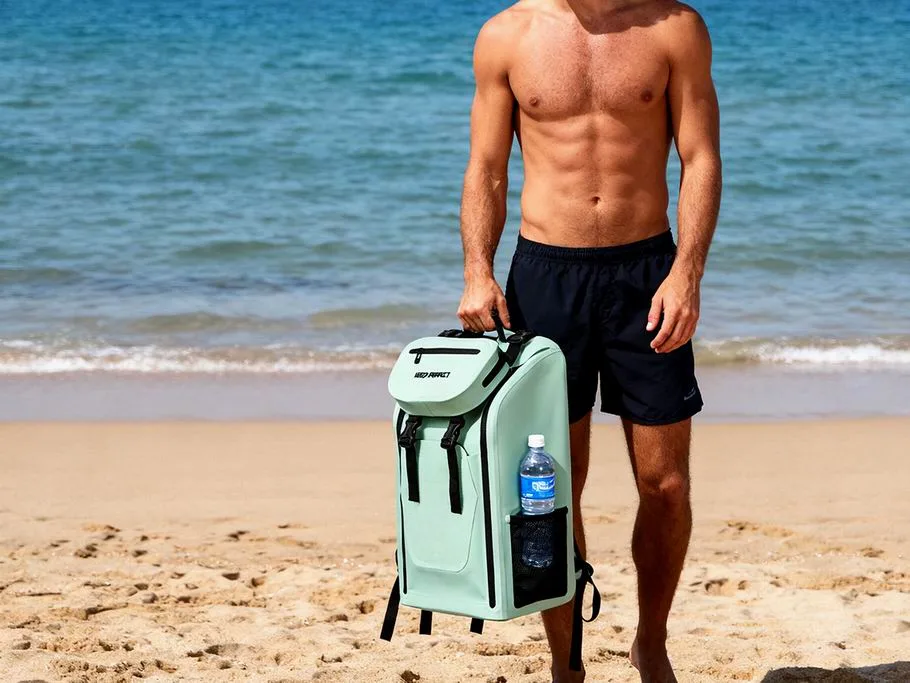
A waterproof backpack earns its place if you walk to the break. A 20L welded pack carries a wetsuit, a towel, fins and a water bottle over 800 m of soft sand far more comfortably than two soft bags, and it keeps your hands free for a board. If you drive to within sight of the water, the backpack is redundant weight and a soft 10L is better.
Water temperature is the variable that changes the answer, because cold-water surfing carries real bulk. A 5/4 mm suit, booties, gloves and a hood take about 6 litres to transport dry and more when wet, and a thermos adds another litre. In cold water, size up: a 10L for the dry change plus a 20L for the wet suit afterwards is a realistic pair.
| Water temperature | Typical exposure protection | Dry kit volume | Wet kit volume | Suggested pair |
|---|---|---|---|---|
| 12-16 °C | 5/4 mm suit, boots, gloves, hood | 8-10 L | 6-8 L | 10L plus 20L |
| 17-20 °C | 4/3 mm suit, booties | 6-8 L | 4-6 L | 10L plus 10L |
| 21-24 °C | 3/2 mm suit or springsuit | 4-6 L | 3-4 L | 5L plus 10L |
| 25-28 °C | Shorty or boardshorts | 3-4 L | 1-2 L | 5L plus 5L |
| 29 °C and above | Boardshorts, rash vest | 2-3 L | 1 L | 5L only |
These are planning figures with the closure already accounted for, so they are the real numbers rather than nominal ones. A 10L bag holds about 8.4 litres once it is rolled three times, which is why the cold-water row suggests a 10L plus a 20L rather than two 10s. If your dry kit and wet kit are ever in the same bag, you have under-bought.
Where the bag physically goes during a session
The best position is inside the car, out of sight and out of the sun. A bag on a beach is a bag that gets sand in its closure, works loose in the wind and advertises that you are in the water. Put the 5L under a seat or in the wheel well, put the 10L in the boot, and accept the 60-second walk back to the car when you want something.
If there is no car, use height and shade. A bag wedged into a rock crevice 1.5 m above the sand stays out of the wind-blown grit and out of the reach of the highest tide line, and a bag hung from a fence post does the same. Do not bury it: buried bags get forgotten, and digging one out in front of an audience is exactly the moment you reveal where your valuables are.
Tether anything that could float or blow away. A 5L sealed with air displaces about 5 kg of water and a gust of 40 km/h will move an untethered soft bag across a beach surprisingly fast. Two metres of light cord and a welded D-ring solves it, and the cord can be clipped around a fence, a board leash plug or a wheel spoke.
Wetsuit, towel and the wet-load problem
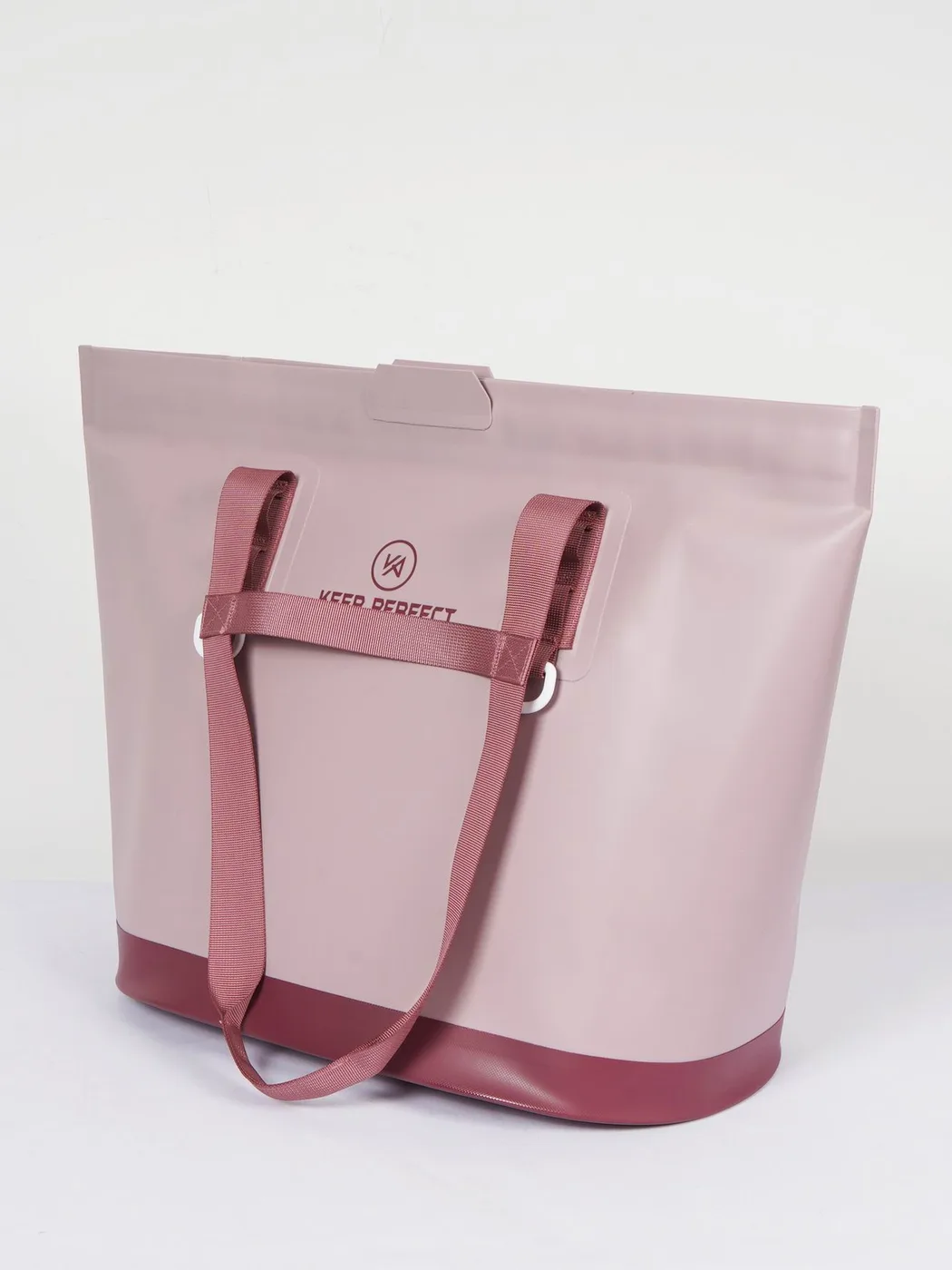
A dry bag is a water barrier in both directions, which makes it an excellent wet bag and a terrible place to put wet kit alongside dry kit. A wet 4/3 mm suit holds 1.5 to 2.5 litres of water and weighs 3 to 4 kg; sealed in a bag with your dry clothes, it will have them damp within 20 minutes and smelling within 48 hours.
The clean solution is two containers with clearly different jobs. The wet suit goes in a bag that is dedicated to wet use, sealed with the air pressed out so it sits flat in the boot, and emptied and rinsed the same day. The dry change stays in a bag that never sees a wet item. Colour-code them if you own two similar bags, because the failure mode here is a moment of confusion in a cold car park.
If you can only carry one bag, put the wet suit in a separate liner inside it. A cheap 10L liner, or even a heavy-duty bag tied at the neck, keeps the water away from the dry kit and can be turned inside out and dried on its own. A wet suit left in a sealed bag for two days will produce odour that takes weeks to remove from TPU.
Ratings that match surf-zone exposure
Surf-zone exposure is graded by where you are in the water, and the interesting case is the paddle out rather than the session itself. Once you are in the lineup, a bag on the beach faces spray and wind-blown sand, which is an IPX6 event at worst. Wading out through the shore break is the immersion event, and it lasts two or three seconds per wave.
| Zone | What happens to the bag | Realistic rating needed | Closure |
|---|---|---|---|
| Car park, raining | Rain from all directions | IPX4 | Three folds, or any closure |
| Beach, above the tide line | Wind-blown sand, spray | IPX6 | Three folds, rinsed |
| Wading out, waist depth | Sets break on the bag | IPX7 | Three folds, pressed air out |
| Wipeout in the impact zone | 3-8 s under moving water | IPX7 | Three folds, clipped tight |
| Bag dropped off a rock | Sustained immersion | IPX7, then recover it | Three folds plus a tether |
IPX7 is the sensible target and it is affordable. Under IEC 60529, published by the IEC, IPX7 means 30 minutes at one metre, which is far more than a surf session will ever demand. Buy it anyway, because the margin is what covers the day you drop the bag off a rock and spend ten minutes finding it.
The rating only holds if the bag is closed properly, and surf is the activity where people close bags badly because their hands are cold and salty. Three folds, mouth levelled, air pressed out, and a thumb run along the fold line to check for grit before you clip. Four seconds of care is the difference between a dry phone and a dead one.
Sand: the enemy of every closure
Sand does three damaging things. It creates a capillary path across the fold line, it abrades the film where a bag is dragged, and it packs into buckles so they no longer seat properly. All three are preventable with the same two habits: keep the bag off the sand, and rinse the fold line in fresh water before you close it.
A small rinse bottle in the car is the highest-value accessory in this whole setup. One litre of fresh water, kept in the boot, lets you rinse the mouth of the bag before closing it and rinse your hands before you touch the closure. Surfers who carry a rinse bottle have dramatically fewer leak stories than surfers who do not, and the reason is entirely about grit.
For buckles, the fix is a soak rather than a rinse. Salt and sand together pack into the mechanism, and a clip that will not seat fully is a clip that will slip. Drop the buckle end of the bag into a bucket of fresh water for ten minutes at the end of the day, work the mechanism through its full travel while it is wet, and let it dry before storage.
Tethering and theft: two separate problems
Tethering stops loss; concealment stops theft; they are not the same thing and you need both. A tethered bag that is visible in a car park is an invitation to a broken window. A hidden bag with no tether will blow away or, if it is near the water, float away. The combination that works is a hidden position plus a tether to something that cannot be moved quickly.
Do not tether to the car in an obvious way. A cord running to a door handle tells a thief exactly where to look. Tether inside the vehicle where possible, wedged under a seat and clipped to the seat frame, which is both concealed and secure. If the bag must stay outside, choose a natural anchor such as a fence or a rock crevice rather than something obviously connected to your vehicle.
And do not put the bag in the car in the first place if you can avoid it. The cheapest anti-theft measure in surfing is to leave valuables at home and carry a single key on a wrist strap. The second cheapest is a 5L bag hidden in a rock crevice 50 m from the car park, where nobody thinks to look.
Board bags, roof racks and the drive home
The drive home is where a lot of kit quietly dies. A wet suit thrown in the boot, a damp towel on a seat and a bag of wet fins left sealed for two days will produce odour, mildew and, in a hot car, condensation that reaches every dry item in the vehicle. Ten minutes of sorting in the car park prevents it.
Use a dedicated wet container in the boot, ideally a rigid tray or a 20L bag that you do not mind smelling. Put the wet suit in it, press the air out, close it, and open it the moment you get home. Towels go on a rack, not in a bag. Fins and leashes get a fresh-water rinse and dry loose.
Roof racks and board bags are the other half of the transit problem. A dry bag strapped to a roof rack at 90 km/h is exposed to rain, road spray and UV for the whole journey, and a bag that has been vibrating against a rack for three hours will abrade at the contact point. Use a board bag or a cargo box if the drive is long, and check the abrasion points when you arrive.
The post-session rinse and dry routine
- Empty every bag completely in the car park; do not carry sealed bags home.
- Rinse the mouth and fold line with fresh water before you close anything.
- Rinse the whole bag outside with fresh water at ambient temperature.
- Soak the buckle end for ten minutes and work the mechanism through its travel.
- Turn the bag inside out over a rail and let it drip in shade.
- Dry open, mouth down, out of direct sun; two to four hours is usually enough.
- Check the corner welds once a month by backlighting them.
- Store rolled loosely, buckle undone, in a cool dry place.
Step one is the one people skip and it is the one that matters most, because a sealed wet bag is a mildew incubator. Sealed at 30 °C with a damp suit inside, a bag will produce visible microbial growth within 48 hours and odour that survives several washes. Empty it in the car park, even if you are cold and it is getting dark.
Never rinse a TPU bag with a hot hose. Water above about 60 °C softens the film and can distort a weld line, and it is unnecessary: salt dissolves perfectly well in cold water. Full detail on the chemistry and the technique is in the saltwater rinsing guide.
Salt, sun and how fast a beach bag ages
Beach use is roughly twice as hard on a bag as freshwater use, and the two agents are salt crystals and UV. Salt that is left on a surface keeps drawing moisture and concentrating at the fold; UV breaks polymer chains in the outer face and thins the film over years. Together they turn a ten-year bag into a four-year bag if neither is managed.
| Factor | Effect on a TPU bag | Rate | Mitigation | Extension gained |
|---|---|---|---|---|
| Salt left on the closure | Crystal growth at the fold | Damage within weeks | Fresh-water rinse every session | 3-5 years |
| Direct sun, midday | UV thinning of the film | Measurable in 2 seasons | Shade, or a light colourway | 2-3 years |
| Hot car interior | Heat ageing, weld softening | One summer is significant | Never leave bags in a closed car | 2-4 years |
| Sand abrasion | Film thinning at contact points | One season on a rack | Rinse, avoid dragging | 1-2 years |
| Storage folded flat | Permanent crease | Loss within one off-season | Store rolled loosely | 2-3 years |
Choose the colourway with this in mind. A black bag on a tropical beach reaches 60 °C at the surface; the same bag in mint or pale grey runs 10 to 15 °C cooler, which measurably slows heat ageing. Dark bags look better and hide wear; light bags last longer in strong sun. Our sun and sea storage guide covers this in more depth.
Plan on a service life and inspect toward the end of it. A 0.5 mm TPU bag rinsed every session and stored in shade gives five to nine years of surf use; the same bag left salty and stored in a hot garage gives two to three. The difference is almost entirely habit, and it is worth more than any specification you can buy.

Checklist and the mistakes that cost the most
- Leave valuables at home; carry one key and a 5L bag with a phone in a 2L inner pouch.
- Rated IPX7 with welded seams, and closed with three folds every time.
- Rinse bottle in the boot: rinse the fold line before closing, always.
- Keep bags off the sand; use a rock, a fence or the car, never the ground.
- Separate wet and dry: a wet suit never shares a bag with dry clothes.
- Empty every bag in the car park, before the drive home.
- Rinse in cold fresh water; never a hot hose, never a machine.
- Store rolled loosely in shade, and backlight the welds once a month.
The mistakes that cost the most are all variations on the same two themes. The first is treating the bag as waterproof in circumstances it was never rated for: a bag under a breaking wave for three seconds is fine, a bag left submerged on a rock shelf for an hour is not. The second is letting sand into the closure, which converts a good bag into a leaking one at no cost to anyone but you.
Two external references are worth keeping for the conditions rather than the kit. Surf and rip-current forecasts for US waters are published by NOAA, and beach water quality and post-exposure health guidance is covered by the CDC; neither tells you what to pack, but both change what the day will demand of you. Our floating dry bag range covers the sizes referenced here, and the full product line shows the film and closure options across them.
Related reads for the same conditions: the paddleboarding gear guide covers similar exposure with a board under your feet, the beach day setup covers the family version of this load, and the lake day mistakes list covers the freshwater version. Production has run since 2014 in an SGS-verified 4,950 m2 facility with seven lines and AQL 2.5 inspection.

Frequently asked questions
Q1. What size dry bag do I need for surfing?
A 5L for keys, phone and wallet, and a 10L for a dry change and a towel. Cold water below 16 °C adds a wetsuit, gloves and boots, which pushes the dry kit to 8 to 10 litres, so size up to a 10L plus a 20L.
Q2. Can I take a dry bag in the water while surfing?
You should not. A bag on your person or on a board is a hazard in a wipeout and will be torn off within a session. Keep the bag on shore, hidden and tethered, and accept the walk back to the car.
Q3. Where do I put my keys when surfing?
In a 5L welded roll-top, wedged under a car seat or in a wheel well, tethered to the seat frame. Avoid burying them in the sand, which is how people lose them, and avoid anything visible from the car park.
Q4. Will a dry bag survive a wipeout?
If it is on shore, it never needs to. If it is with you in the impact zone, a welded IPX7 bag with a properly rolled closure handles three to eight seconds under water. A bag left submerged for an hour will not hold, and no bag is designed for that.
Q5. Should I put a wet wetsuit in a dry bag?
Yes, but only in a bag dedicated to wet use, and never with dry kit. A wet 4/3 mm suit holds 1.5 to 2.5 litres of water and will damp everything beside it within 20 minutes. Empty and rinse it the same day.
Q6. How do I keep sand out of the closure?
Keep the bag off the sand, and rinse the fold line with fresh water before you close it. A one-litre rinse bottle in the boot is the highest-value accessory in the whole setup, because one grain of sand in the fold wicks water in within an hour.
Q7. What rating do I need for a surf trip?
IPX7, meaning 30 minutes at one metre under IEC 60529. Surf exposure rarely demands that much, but the margin covers the day you drop the bag off a rock. Below IPX6 the bag will not reliably survive wading out through a shore break.
Q8. Is a waterproof backpack better than a dry bag for surfing?
Only if you walk to the break. A 20L welded pack carries a suit, towel and fins comfortably over soft sand. If you drive to within sight of the water, a soft 5L and 10L are lighter and easier to hide.
Q9. How do I stop my car smelling after a surf session?
Empty every bag in the car park, put the wet suit in a dedicated container or tray, and open it the moment you get home. A wet suit sealed in a bag for 48 hours at 30 °C produces odour that takes weeks to remove.
Q10. Can I rinse a dry bag with a hot hose?
No. Water above about 60 °C softens TPU film and can distort a weld line, and it is unnecessary because salt dissolves perfectly well in cold water. Rinse at ambient temperature and dry in shade.
Q11. How long does a dry bag last with surf use?
Five to nine years for a 0.5 mm TPU bag rinsed every session and stored in shade, and two to three years for the same bag left salty and kept in a hot garage. Sand abrasion and UV are the two factors that shorten it.
Q12. Does bag colour matter at the beach?
Yes. A black bag on tropical sand can reach 60 °C at the surface, while the same bag in mint or pale grey runs 10 to 15 °C cooler. Dark bags hide wear better; light bags age more slowly in strong sun.
Q13. Should I tether my bag at the beach?
Yes, for loss rather than theft. A 5L sealed with air displaces about 5 kg of water and a 40 km/h gust will move an untethered soft bag across sand quickly. Tether inside the vehicle or to a natural anchor.
Q14. How do I dry a wet wetsuit bag?
Empty it, rinse it in cold fresh water, turn it inside out over a rail and let it drip in shade with the mouth down. Two to four hours is usually enough. Never seal a damp bag for storage.
Q15. Can I leave a dry bag on the roof rack?
You can, but check the abrasion points when you arrive. Three hours vibrating against a rack at 90 km/h abrades the film at the contact point, and the bag is also exposed to road spray and full UV for the whole drive.
Q16. What is the smallest useful dry bag for surfing?
A 2L, used as an inner pouch for a phone inside a 5L. Two independent seals are worth more than one thick film, and the small pouch means you open one bag on the beach rather than exposing your keys and wallet to the wind.
People also ask
How do you keep your keys dry while surfing?
Use a 5L welded roll-top rated IPX7, wedge it under a car seat or in a wheel well, and tether it to the seat frame. Do not bury keys in the sand, and do not leave anything visible from the car park.
Do you need a dry bag for surfing?
Yes, for everything that stays on shore. A surf session exposes a bag to wind-blown sand, spray and, on the paddle out, brief immersion in the shore break. A phone in a coat pocket on the beach will not survive either.
Can a dry bag go in the ocean?
It can survive brief immersion if it is rated IPX7 and closed with three folds. It is not designed for sustained submersion, and carrying one on your body during a surf session is a hazard in a wipeout.
What should I pack for a surf day?
A 5L for keys, phone and wallet, a 10L for a dry change and towel, a wet container for the suit, a litre of fresh water for rinsing the closure, and a 2 m tether. Add gloves and a thermos below 16 °C.
How do you get sand out of a dry bag?
Rinse the mouth and fold line with fresh water before closing, then rinse the whole bag and soak the buckle end for ten minutes while working the mechanism. Turn it inside out and dry in shade.
Why does my surf dry bag leak?
Almost always sand in the fold line, or a bag closed with one fold because it was over-filled. Rinse the fold, press the air out, level the mouth, and make three folds. Genuine weld failure is rare by comparison.
Need this in production volume?
QUANZHOU JUNYUAN BAGS has produced waterproof bags since 2014 in an SGS-verified 4,950 m2 facility in Fujian, China. Minimum order 500 pieces, sampling in 6–10 working days, bulk in 35–50 days, FOB Xiamen — write to service@junyuanbags.com with your spec and target market.