Home / Blog / Travel & Packing
Multi-City Travel Packing
Multi-city travel means packing the same bag five to seven times in fourteen days, so the system that wins is the one that rebuilds fastest at 06:40 in a hotel room. Plan on one 35L to 40L waterproof base bag plus four internal pouches of 2L, 5L, 8L and 10L, with a 2.8 kg to 4.2 kg laundry cycle run every third night. Waterproof pouch logic beats packing cubes here, because every transfer day involves rain, a wet bathroom floor or a bottle that was not quite closed.
Singapore to Bangkok to Bali is not a packing problem, it is a turnaround problem. The bag that is easiest to unpack is also easiest to repack, which means rigid walls, dark linings and compression cubes lose to soft pouches you can tip out on a bed and put back blind. This guide covers the pouch maths, the laundry timetable that keeps you to three shirts, what travels against your back, and how roll-top closures behave in airport screening.
- Why multi-city trips punish ordinary packing
- The repack count: how often you touch every item
- One base bag and four pouches
- Duffel, backpack or roll-top for city hops
- The wet and dirty split that saves every bathroom floor
- Three climates in one route
- Laundry maths: sink wash, spin and dry windows
- The always-on pouch: what never goes in the base bag
- Screening, roll-tops and the trolley problem
- Carrying comfort between stations
- Leaks and spills: what actually destroys a trip
- The twelve-minute hotel repack
- Before you leave: the multi-city checklist
Why multi-city trips punish ordinary packing
A single-destination trip optimises for the last hour of packing at home. A five-city trip optimises for the ninety seconds before a taxi arrives, repeated six times, usually in low light and usually with something damp that has to go somewhere. Every item that needs its own decision at that moment becomes a decision you will get wrong twice, so the goal is to reduce choices on transfer day rather than to reduce total weight by 200 grams.
Moisture is the second difference. One week in one hotel lets a wet swimsuit dry on a balcony; a multi-city loop takes that same wet suit across three rooms, two of which have no balcony and one of which has a carpet you will pay for. A waterproof pouch inside the base bag solves it permanently, which is why this is the rare travel context where waterproof beats water-resistant by a wide margin.
Weight behaves differently too. Multi-city travel usually mixes rail, budget airlines and walking transfers, so the apparent saving of a heavier bag is paid back with interest in stairs, cobblestones and a sprint across a platform. Keep the loaded base bag under 9 kg including itself and you can carry it for 25 minutes without stopping, which covers most transfers except the genuinely unfortunate ones.
The repack count: how often you touch every item
Count repacks before choosing a system. A fourteen-day trip with five cities involves five full unpack cycles, five full repack cycles, and roughly ten partial opens for chargers, documents and a jacket. Anything buried at the bottom of a 40L bag gets touched thirty times, and every one of those touches costs about two minutes of digging plus the patience of whoever is waiting in the lobby.
So the rule is simple: items touched most often live highest and closest to the opening. Documents, chargers, medication and a compact rain shell go in a top pouch. Clothing that is only needed once per city goes low. Anything you might reasonably need on a train goes in an external pocket rather than inside the roll-top at all, even if it costs a little internal volume.
There is a packing-order trick that helps here. Lay the pouches out on the bed in the same order every single morning, always clockwise from the base bag opening, and after three days you can rebuild the bag in ninety seconds without looking. It sounds trivial; over six repacks it saves about twenty minutes and removes almost every instance of arriving without a charger.
One base bag and four pouches
Build the system around one soft, waterproof base bag in the 35L to 40L range and four pouches that never change job. The 10L pouch carries clothing, the 8L carries the wash bag and anything that could leak, the 5L carries electronics and cables, and the 2L carries what must survive a downpour: passport, cards, phone and a paper ticket you have not used in six years but refuse to stop carrying.
| Pouch | Volume | Contents | Typical weight | Where it sits |
|---|---|---|---|---|
| Documents and valuables | 2 L | Passport, cards, one backup card, paper copies | 0.35 kg | Top, against the lid |
| Electronics | 5 L | Chargers, power bank, camera, adapter | 0.9 kg | Mid, easy side access |
| Wash and leakables | 8 L | Toiletries, small bottle, sunscreen | 1.1 kg | Low, away from paper |
| Clothing | 10 L | Three shirts, two shorts, base layers | 1.4 kg | Bottom, fills the corners |
| Dirty and damp | 2 L | Worn kit, swimsuit, sink-wash items | 0.5 kg | External pocket |
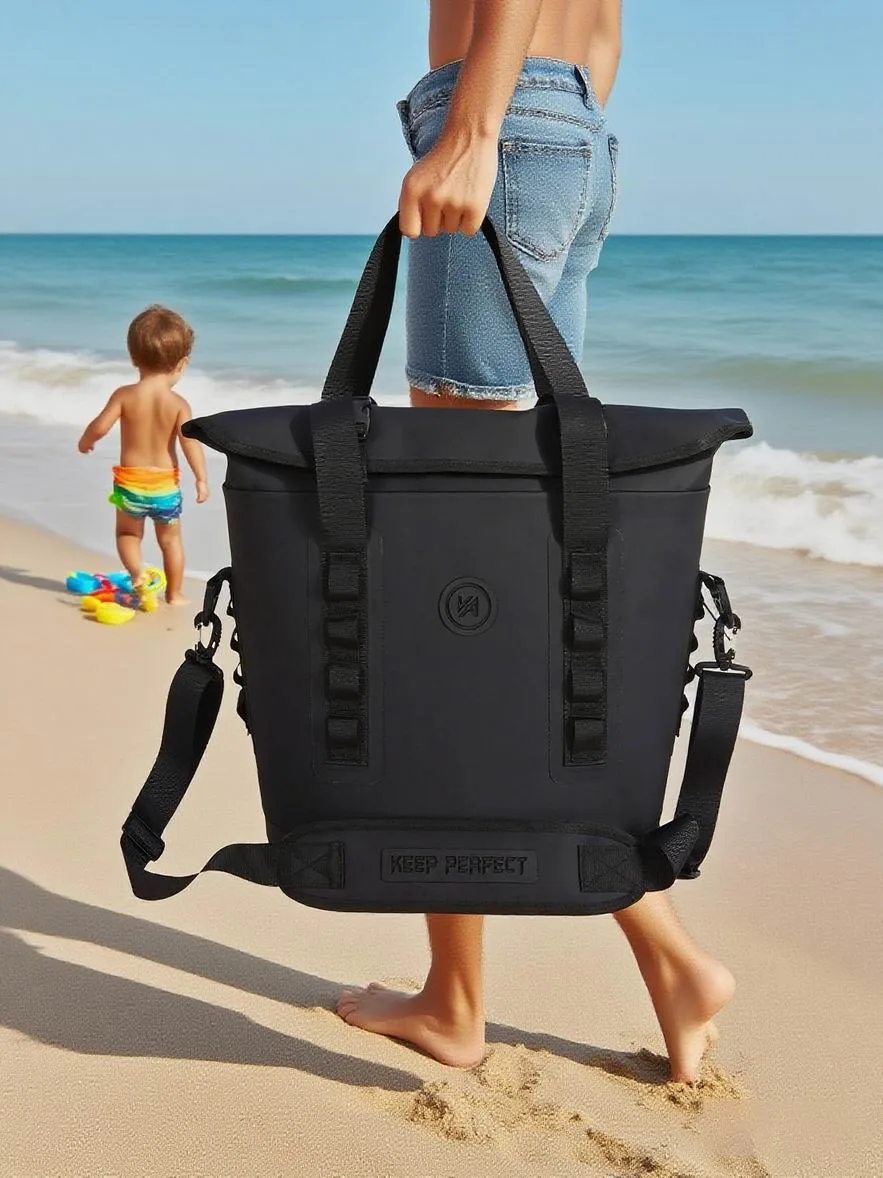
Notice the total: about 4.3 kg of contents in a bag that itself weighs 1.2 kg to 1.8 kg depending on construction. That leaves room for a pair of shoes without crossing the 7 kg cabin limit most Asian and European carriers enforce for smaller aircraft, and it leaves your shoulders in reasonable condition after a 900 metre walk from a regional station to a guesthouse in the rain.
Colour-code the pouches rather than labelling them. A blue pouch for wet kit, a black one for electronics and a bright one for documents reads instantly at 06:40 without reading anything, and it means another person can find your passport for you. Labelled pouches work too, but print rubs off and a scuffed label is worse than none because it actively misleads.
Duffel, backpack or roll-top for city hops
Each format has one job on a multi-city loop. A roll-top dry bag wins when rain or boat transfers are likely, because a three-fold closure has no zip to fail and no gutter for water to sit in. A duffel with welded handles wins when you are mainly moving between cars and desks, because it opens fully and packs like a suitcase. A waterproof backpack wins only when you genuinely walk long distances with it every day.
Hybrids exist for good reason. A roll-top duffel with detachable backpack straps covers most multi-city reality: pack it like a suitcase at the hotel, carry it like a pack through the transfer, then detach the straps and stow them so they cannot snag in an overhead bin. Detachable straps also dry separately, which matters when they have been pressed against a wet shirt for two hours.
Whatever you pick, check the opening width against your forearm. If you cannot get your whole forearm and a closed fist through the mouth while the bag is half-packed, you will unpack by tipping everything onto a bed, and in a small city hotel that bed is the only free surface. A wide mouth is worth more on a multi-city trip than any other single feature.
The wet and dirty split that saves every bathroom floor
Every multi-city trip generates three kinds of contaminated item: genuinely wet swimwear or rain shell, damp sink-washed clothing, and dry-but-worn kit that you do not want next to clean clothes. Give them one dedicated external 2L pouch and nothing else ever goes in it. This single habit is the difference between a bag that smells clean on day twelve and one you air out on a balcony in shame.
| Item state | Goes where | Risk if mixed | Handling rule |
|---|---|---|---|
| Soaking wet swimwear | External wet pouch | Soaks clothing pouch in 30 minutes | Squeeze and roll in a towel first |
| Damp sink wash | External wet pouch, rolled loose | Mildew smell in 24 hours | Roll in a towel, then hang at night |
| Worn but dry | Same pouch, separate side | Odour transfer only | Keep for maximum three days |
| Rain shell after use | Hang on the outside for 20 minutes | Wets the whole bag lining | Shake, then pack outside-in |
| Shoes on a transfer day | Separate shoe sleeve | Grinds grit into film | Brush soles, then bag |
Wringing matters more than people expect. A swimsuit rolled tightly in a microfibre towel and squeezed loses most of its water without a machine, dropping from perhaps 180 g of retained water to around 40 g. Do that once before it enters the pouch and the pouch stays functional for three cities instead of becoming a wet sponge after one.
Air it every night even if it is not yet dirty. Open the wet pouch in the bathroom while you shower, then re-roll and clip it closed before sleep. Two minutes of steam and airflow per day keeps bacterial odour below the threshold you can smell, and it prevents the damp pouch from becoming the thing that ruins everything packed beside it.
Three climates in one route
A route like Osaka, Taipei and Manila crosses three climate bands and two seasons in eleven days. Packing for the coldest and hottest stops separately doubles your load, so pack for the mean and add one thin layer that covers the cold tail: a 280 g shell or a 320 g midlayer that compresses into the 5L pouch when it is 29 °C at the next stop.
| Stop profile | Day temperature | Rain pattern | What the layers change |
|---|---|---|---|
| Temperate city, spring | 12-18 °C | Showers every second day | Midlayer out, shell in the top pouch |
| Tropical city, wet season | 28-32 °C | Heavy daily bursts at 16:00 | Shell only, no midlayer |
| Highland stop | 8-14 °C | Persistent drizzle | Both layers, damp pouch empties daily |
| Coastal island hop | 26-30 °C | Short squalls | Shell plus wet swimsuit rotation |
| Desert city | 22-38 °C swing | Almost none | Dust protection instead of rain layers |
Humidity decides drying time more than temperature does. A shirt washed in a 30 °C room at 85% relative humidity takes 14 to 18 hours to dry, while the same shirt in a 22 °C room at 45% takes six. Plan your laundry around whichever stop has a dehumidifier or a fan, and never assume that the hottest city is the fastest drying one.
Put the layering decision on the calendar rather than leaving it to judgement. Note the expected afternoon temperature for each stop on your phone and pack the night before accordingly, moving the 320 g midlayer between the base of the bag and the top pouch. It costs forty seconds and stops you carrying a spare layer through four tropical cities just in case.
Laundry maths: sink wash, spin and dry windows
A laundry cycle has three variables: wash time, available drying window and how many wears each garment survives before it offends anybody. Three shirts rotated over fourteen days requires two sink washes, each taking twelve minutes including filling and rinsing, plus one drying window of at least eight hours overnight. Everything else follows from those numbers.
| Garment | Wash method | Water used | Dry time at 50% RH | Wears between washes |
|---|---|---|---|---|
| Synthetic tee | Sink, mild soap | 4 L | 5-7 h | 2 |
| Merino base layer | Sink, cool water | 4 L | 8-10 h | 4 |
| Underwear | Sink, hand scrub | 2 L | 4-6 h | 1 |
| Shorts | Sink, spot treat | 5 L | 10-14 h | 3 |
| Light trousers | Sink or service wash | 6 L | 14-18 h | 5 |
Roll wet clothing in a dry towel and walk on it for sixty seconds. That removes roughly half the retained water and cuts drying time by about a third, which is the difference between a shirt being wearable in the morning and being wearable the following night. No hotel hairdryer technique beats this simple pre-step, and none of them damages welded fabric nearby.
Schedule the service wash once, in the middle city, rather than at each stop. A same-day service wash costs two to three times what a sink wash costs but resets odour properly and takes an item out of your rotation for only six hours. One service wash at the midpoint plus two sink washes keeps a fourteen-day loop clean with zero emergency purchases.
The always-on pouch: what never goes in the base bag
Documents, cards, a phone and the medication you cannot replace locally belong in one 2L pouch that leaves the room in your hand, not on your back. If a bag goes missing at a station, the pouch is still with you; if it does not leave your hand during boarding, no overhead-bin dispute can take it. This is the single highest-value item in a multi-city packing system.
Treat passport and paper protection as a moisture problem and a theft problem at the same time. A roll-top closure plus a second inner sleeve gives two seals against a downpour, while keeping the pouch in a front pocket addresses the other risk. Photocopies go in a different pouch entirely, so one loss never takes both the original and the copy.
Screening, roll-tops and the trolley problem
Security is easier with a roll-top than people expect. The closure opens fully, which means an officer can see straight into the bag without unpacking it, and there is no zip line to catch in a tray. The one genuine issue is that a rolled and clipped mouth looks like a closed opaque mass to anyone behind you, so unclip it before you reach the belt.
Electronics still come out, so keep them in one pouch you can lift with two fingers. A dedicated airport screening pouch turns a 90-second fumble into a 15-second lift, and prevents the horrible moment of watching your charger disappear down the belt inside somebody else’s tray. Put a laptop flat against the panel nearest your back for both screening and carrying.
Ingress ratings matter here more than usual because trays get wet. Protecting devices inside a bag rated to the IPX7 grade defined by the IEC means a soaked tray is a nuisance rather than a disaster; the deeper question of whether a sealed bag can carry electronics at all is answered in our note on airtight storage for devices.
Carrying comfort between stations
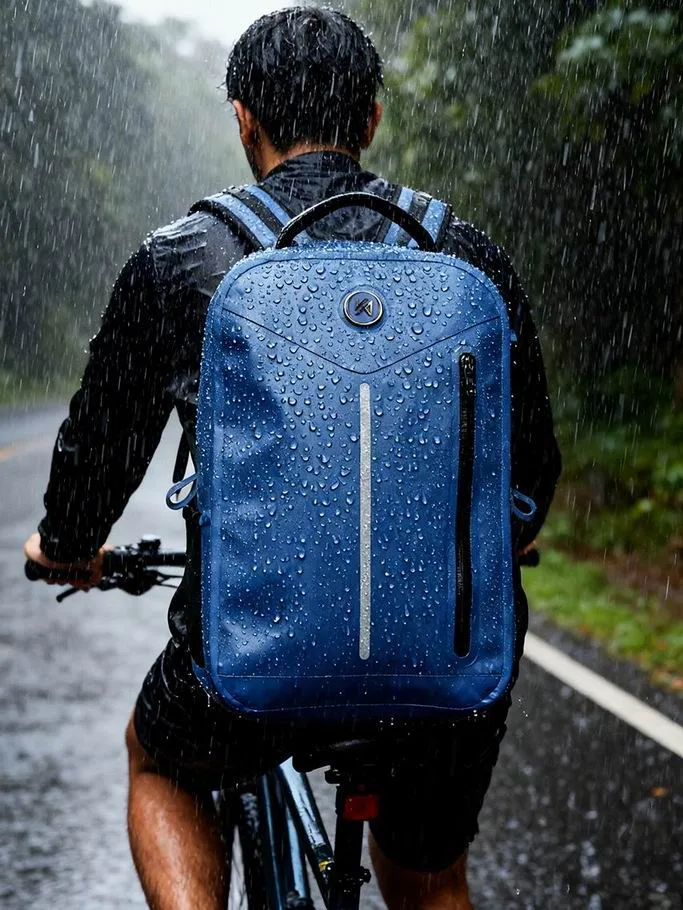
Most multi-city pain is not kilometres, it is minutes. A 9 kg bag carried for 25 minutes feels fine with a padded hip belt and dreadful with shoulder straps alone, and virtually every transfer falls inside that window: station to guesthouse, ferry pier to bus terminal, long-stay car park to terminal. Judge the harness by the twenty-minute test rather than by how it feels in a shop.
Load order does the rest. Keep dense items such as a charger brick, a power bank and shoes against the panel nearest your back and roughly level with your shoulder blades, with clothing filling the space furthest away. That arrangement pulls the bag into your body rather than away from it, which reduces perceived weight by a noticeable margin on stairs and escalators.
Use external compression straps on transfer days only. Straps that stay tight for two weeks crease a laminated film along the same lines every time and shorten its life; straps that get pulled tight for the twenty-minute walk and released at the hotel do the job without permanent damage. Release them fully before the bag goes into any overhead bin.
Leaks and spills: what actually destroys a trip
Rank your leak risks by damage rather than by likelihood. A 100 ml sunscreen bottle that opens in transit is far more destructive than a water bottle leaking, because sunscreen films every surface it touches and does not rinse off a laminate easily. Keep all liquids in one welded pouch with the caps taped down, and carry anything pressurised above 100 ml separately at the very top.
Water bottles deserve their own rule: never inside the same pouch as anything absorbent, and ideally in an external sleeve where a failure costs you one damp panel. A half-litre bottle failing inside a 40L bag means 500 ml distributed across everything you own, which at the density of a packed clothing pouch reaches every item within about twenty minutes of walking.
Food is the third risk and the one people forget. A ripe mango, a jar of chilli paste bought in a night market or a leaking yoghurt will do more damage than any rainstorm, and none of them announce themselves until hours later. Dedicate the same external pouch to food, wipe it down at each stop, and never let anything with liquid go into the base bag loose.
The twelve-minute hotel repack
- Tip clothing onto the bed in the same four-pile layout used every morning.
- Refold to pouch volume, heaviest shirts first, and close each pouch as you go.
- Check the wash pouch for leaks, then tape any cap that moved in transit.
- Empty the wet pouch, wipe it out, hang anything still damp for the night.
- Top-load documents, chargers and the shell for tomorrow’s weather.
- Roll three times, clip, and set the bag by the door with shoes beside it.
Twelve minutes is realistic once the pouch jobs are fixed, and it includes the two-minute check that catches almost every failure: looking at the wash pouch before it goes back in. The routine also removes decision-making at night, which is where most packing mistakes are made, because nobody edits a system while tired if the system is already written down.
Do the same inventory every second morning. Count pouches: two, five, eight and ten litres plus the external wet pouch makes five items. If the count is wrong before you leave the room, you are about to leave something valuable in a drawer, and chasing a charger across two cities costs more than the whole inventory check ever will.
Before you leave: the multi-city checklist
- One soft base bag of 35L to 40L, wide mouth, no rigid frame.
- Four pouches with fixed jobs: 2L documents, 5L electronics, 8L wash, 10L clothing.
- One external wet pouch that nothing clean ever enters.
- Two compressible layers covering the coldest stop on the route.
- A microfibre towel for the roll-and-wring step that halves drying time.
- One spare bank card stored separately from the main documents pouch.
- Cabin-weight knowledge for the smallest airline on the itinerary.
The final check is arithmetic. Loaded base bag under 9 kg, five pouches present, one layer adaptable to the coldest forecast stop, and liquids all in one welded pouch. Compare your setup against the cabin size and weight limits guide before you book a low-cost leg, and review the carry-on-only system if the route is likely to grow a sixth stop.
Health planning belongs in the same checklist. Multi-city travel multiplies exposure to unfamiliar food and water sources, so check destination advice published by the CDC before each leg rather than once before departure. Pack a small blister strip and rehydration sachets in the documents pouch; they weigh 60 grams and solve the two problems that most often derail a day.
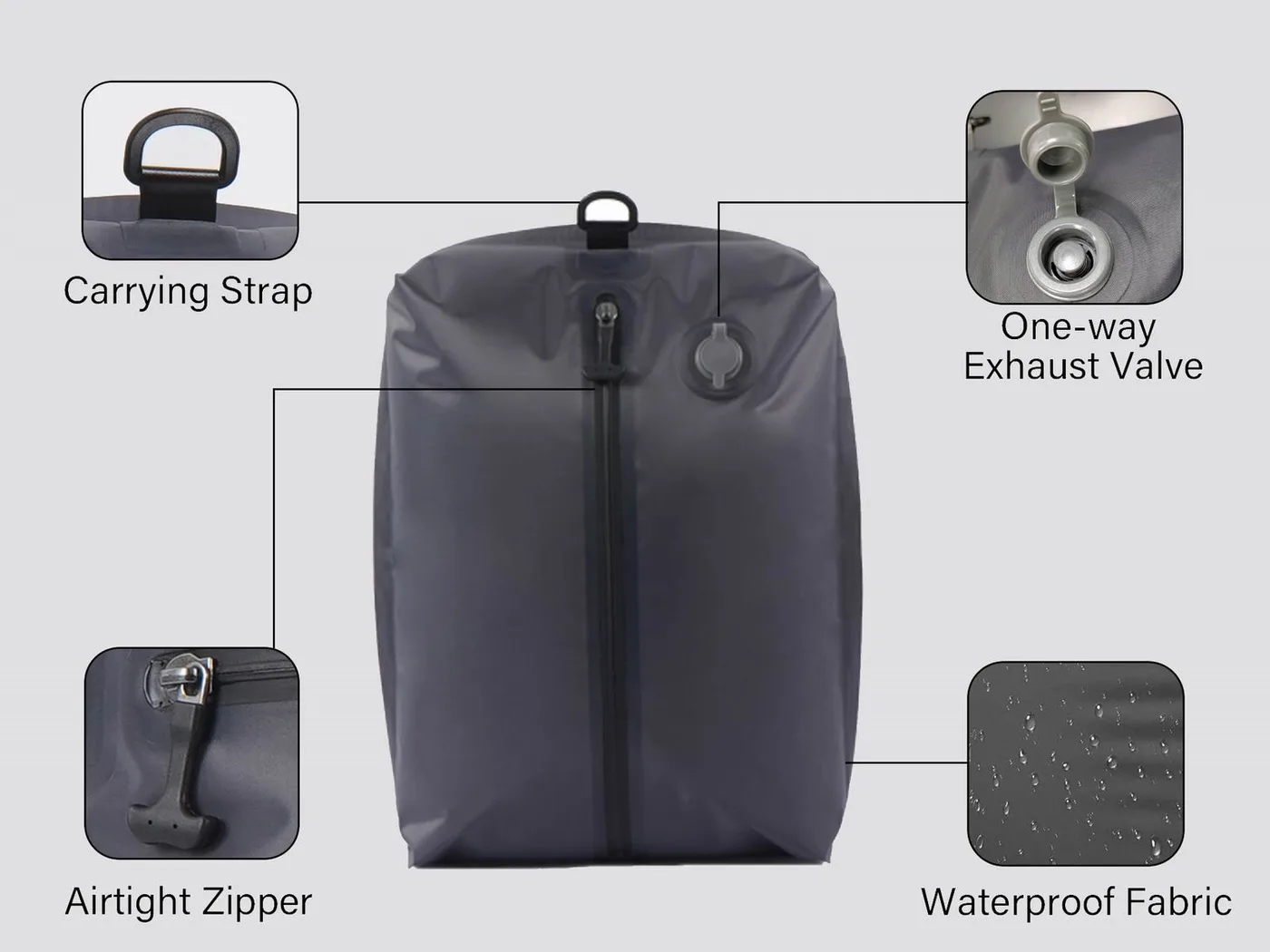
Our own travel format range uses the same pouch logic: welded construction, no internal gutter for water to hide in, and closure geometry shared across sizes so the 2L pouch works identically to the 40L base. Pool and city kit advice continues in the hotel, gym and pool guide.
Frequently asked questions
Q1. How do you pack for a multi-city trip?
Use one 35L to 40L soft waterproof base bag plus four fixed-job pouches: 2L documents, 5L electronics, 8L washables and 10L clothing. Rebuild the bag identically every morning, laid out in the same order, and add one external pouch for anything damp or worn.
Q2. What size bag suits two weeks across five cities?
Thirty-five to forty litres, loaded to about 4.5 kg of contents. That volume holds three shirts, two pairs of shorts, one pair of trousers, a compact layer and a wash pouch while staying under most 7 kg cabin limits for smaller regional aircraft.
Q3. Should I use packing cubes or waterproof pouches?
Waterproof pouches. Cubes organise but do nothing about a leaking bottle, wet swimwear or a rainstorm on a transfer day. A welded pouch contains failures that would otherwise spread through the whole bag in minutes.
Q4. How often should I do laundry on a two-week trip?
Two sink washes plus one service wash at the midpoint. Synthetic tees manage two wears, merino manages four, so three shirts rotated correctly cover fourteen days without any emergency clothing purchase in a foreign city.
Q5. How long does sink-washed clothing take to dry?
Between five and eighteen hours depending on fabric and humidity. A synthetic tee dries in five to seven hours at 50% relative humidity, while trousers can take fourteen to eighteen. Rolling in a towel first cuts that by about a third.
Q6. Is a roll-top bag awkward at airport security?
No, and often easier than a zip pack, because the mouth opens fully and contents are visible. Unclip the closure before your tray goes through, keep electronics in one liftable pouch, and lay laptops flat against the back panel.
Q7. Where should documents go on a multi-city route?
In a 2L pouch that leaves the room in your hand, never inside the base bag. Keep photocopies in a separate pouch so one loss never takes the original and the backup at the same time.
Q8. What is the biggest packing mistake on multi-city trips?
Buying rigid, framed bags. Every transfer involves stairs, cobbles and overhead bins, so a soft, wide-mouthed bag that rebuilds in ninety seconds beats a structured case that photographs well and cannot be repacked in the dark.
Q9. Can I carry wet swimwear in the same bag?
Only in a dedicated external wet pouch. Wring it in a microfibre towel first to take retained water from about 180 g to 40 g, then open the pouch every night so it can air rather than turning sour.
Q10. How heavy should my base bag be?
Under 9 kg loaded, including the bag itself. That figure is the practical ceiling for carrying for twenty-five minutes without stopping, which covers most station-to-hotel and pier-to-terminal transfers in real cities.
Q11. Do I need different bags for tropical and temperate stops?
No. Keep one system and swap one 320 g layer between the top pouch and the bag base as the forecast changes. Packing separate loads for each climate doubles your weight for no real benefit.
Q12. How do I stop liquids leaking inside my bag?
Keep every liquid in one welded pouch, tape caps down before each flight or train, and never put a water bottle alongside anything absorbent. A 500 ml failure inside a packed bag reaches every item within twenty minutes of walking.
Q13. What should stay out of the base bag entirely?
Documents, cards, replaceable-by-nobody medication and your phone. Those live in the hand-carried 2L pouch, so a bag left behind at a station does not take your ability to travel with it.
Q14. Are compression straps safe on laminated fabric?
Use them only during transfers and release them at the hotel. Straps left tight for two weeks crease the same film lines daily and shorten service life noticeably, especially at the corners of a welded seam.
Q15. How early should I repack before a transfer?
The night before, every time. A twelve-minute evening routine plus a five-item pouch count removes nearly every lost-charger and missing-passport incident that otherwise happens during a 06:40 departure.
Q16. Is one big bag or two smaller bags better?
One base bag with internal pouches. Two bags means two things to lose, two sets of straps digging in, and a juggling act on any escalator. Fixed-job pouches give the organisation benefits without the second handle.
People also ask
How do you pack light for several cities?
Take one 35L to 40L soft bag, three tops, two shorts, one pair of trousers and one compressible layer, then wash every third night. Keep every item in a fixed pouch so repacking takes minutes rather than a fresh round of decisions each morning.
What is the best way to carry wet clothes while travelling?
A dedicated external waterproof pouch, wrung in a towel first and opened nightly to air. Never mix wet items with clean clothing: they transfer moisture across a whole bag within half an hour of being packed together.
Do roll-top bags work as travel bags?
Yes, particularly in wet seasons. A three-fold closure has no zip to fail and no gutter where water collects, and it opens wide enough to see everything at once. The trade-off is slightly slower access than a full-length zip.
How many clothes do you need for two weeks?
Three tops, two shorts or skirts, one pair of trousers, four changes of underwear and one light layer, laundered twice. Merino or synthetic fabrics stretch those numbers further than cotton, which dries slowly and holds odour.
How do you keep electronics safe on the road?
Keep everything in one 5L pouch you can lift with two fingers, with cables in a smaller sleeve inside it. During transfers, lay the pouch flat against the back panel and keep a laptop in a sleeve rated IPX7 against soaked security trays.
Should you check luggage on a multi-city route?
Avoid it. Checked bags lose time at every connection and raise the odds of a bag missing a short layover. A well-organised carry-on of 35L to 40L covers fourteen days with two sink washes and one service wash.
Need this in production volume?
QUANZHOU JUNYUAN BAGS has produced waterproof bags since 2014 in an SGS-verified 4,950 m2 facility in Fujian, China. Minimum order 500 pieces, sampling in 6–10 working days, bulk in 35–50 days, FOB Xiamen — write to service@junyuanbags.com with your spec and target market.