Home / Blog / Travel & Packing
Airport Security With Dry Bags
Clearing airport security with a dry bag comes down to three numbers: 100 ml per liquid container, one transparent resealable bag of about 1 litre per passenger, and a cabin footprint near 55 x 40 x 20 cm on most European and Asian carriers. A 20L roll-top packed with the liquids pouch at the mouth, the laptop in a separate sleeve and nothing metal buried in the middle clears a standard lane in roughly 90 seconds, because the operator sees one flat organic mass and one obvious metal cluster instead of a tangle of cables and foil.
This guide covers what the X-ray operator actually sees when a welded waterproof bag goes through, how to stage liquids and electronics so the bag is not pulled for a hand search, which dry bag sizes stay inside cabin limits once they are rolled, and what has to travel in the cabin rather than the hold. It also sets out a 60-second repack routine for the bench on the far side of the tray, plus the checks worth running the night before a flight.
- What the operator sees when a dry bag goes through
- Liquids, gels and the 100 ml rule inside a waterproof bag
- Electronics: laptops, tablets and power banks
- A packing order that clears in one pass
- Closure type and how long it takes at the tray
- Metal hardware and the false-alarm problem
- Choosing a cabin-legal dry bag size
- Cabin or hold: what has to fly with you
- Water, ice and the bottle question
- Medication, documents and the passport pocket
- Repacking in 60 seconds on the far side
- Checks worth running the night before
What the operator sees when a dry bag goes through
Cabin-screening X-rays separate materials by density and show them in colour: organic material in shades of orange, mixed or light metal in green, and dense metal as dark or blue shapes. A TPU-laminated nylon shell is uniformly organic, so an empty roll-top is about the easiest soft item on the belt to read. What makes an operator reach for a hand search is an unexplained dense shape, and a rolled closure produces exactly that: three layers of film plus a buckle compressed into a bar across the top of the bag.
The practical rule that follows is simple. Pack a few large, obvious items rather than twenty small ones, and keep every dense object either at the mouth of the bag or in a separate tray. A pump, a multitool and a power bank stacked in the middle of a 20L bag read as a single unidentifiable block; the same three items at the mouth, visible against the background, read as three objects and go through.
Liquids, gels and the 100 ml rule inside a waterproof bag
The standard liquids rule at most international checkpoints is 100 ml or 100 g per container, all containers inside one transparent resealable bag of roughly 1 litre capacity, one bag per passenger, presented separately at the tray. Sunscreen, toothpaste, contact lens solution, lip balm and aerosol deodorant all count as liquids or gels for this purpose, and a half-full 200 ml tube is treated as a 200 ml container because the rule applies to the container, not the contents.
Give the liquids pouch a fixed home at the mouth of the bag, above the roll, where it can be pulled out in three seconds without unpacking anything else. A 10L or 20L roll-top has enough slack at the top for a flat pouch to sit crosswise; a duffel with a long zip opening is worse for this because the pouch tends to slide to one end. Anything bought after the checkpoint in a sealed tamper-evident bag stays sealed until you reach the aircraft, and opening it early can mean surrendering it at a transfer point.
Wet fabric is the other thing that confuses a scanner and a screener. A soaked swimsuit or a damp towel packed at the bottom of a dry bag adds weight, density and a faint organic blob that looks like a gel. Wring everything out, roll it in a small dry bag of its own, and put that pouch at the mouth next to the liquids; the wet-kit note goes through the same problem for beach trips.
Electronics: laptops, tablets and power banks
At most checkpoints a laptop and any large tablet still come out of the bag and go into a tray of their own, while phones, cameras and small electronics can stay inside. A growing number of lanes use computed tomography scanners that build a three-dimensional image and allow electronics to remain packed, but the rule is not universal and is not announced consistently, so pack as though you will have to unpack.
Power banks and spare lithium cells are the item people get wrong: they must travel in the cabin, never in the hold, because a thermal event in a cargo compartment cannot be reached. Most airlines accept cells up to 100 Wh without paperwork and between 100 and 160 Wh with approval given at check-in. Write the capacity on the cell with a marker before you fly; an unlabelled power bank is the single most common reason a cabin bag is opened.
Cable discipline saves more time than anything else at the tray. Coil each cable, hold it with a short Velcro tie, and keep them in one flat pouch rather than loose in the bag, because a loose cable crossing a laptop reads as a second dense object. See the laptop protection guide for sleeve sizing inside a dry bag, and keep the sleeve at the top so the machine slides out without disturbing the packed layers underneath.
A packing order that clears in one pass
- Put the liquids pouch flat across the mouth of the bag, above the roll line, not at the bottom.
- Slide the laptop sleeve in last, against the back panel, so it lifts straight out at the tray.
- Keep every metal object - buckle, carabiner, torch, power bank - at the mouth or in a side pocket.
- Coil cables into one flat pouch and lay it flat rather than letting them cross the electronics.
- Roll the bag with three folds only after you are through, or leave it open if the lane is busy.
- Carry boarding pass and passport in a pocket you can reach without opening the main compartment.
That order is not about tidiness, it is about the shape of the image on the monitor. A bag with a flat, layered structure - liquids on top, electronics flat against one wall, soft goods filling the middle - produces a picture an operator can resolve in seconds. A bag where everything is mixed produces overlapping densities, and overlapping densities are what get pulled aside.
One more habit helps: leave the roll open until you are past the tray. A closed roll-top is a sealed mass that cannot be inspected from the outside, and an operator who cannot resolve the top of the bag will ask you to open it anyway. Carrying the bag with the mouth folded but the buckle undone takes no extra effort and removes the most common trigger for a manual check.
Closure type and how long it takes at the tray
| Closure | What the scanner shows | Time to open and re-close | Best practice at the lane |
|---|---|---|---|
| Roll-top, three folds, side buckle | Dense bar across the top | 8-12 s | Carry unbuckled through the lane |
| Roll-top with centre clip | Small dense point, easy to read | 6-9 s | Leave clip undone until past the tray |
| Waterproof zip, coated teeth | Thin bright line along the opening | 5-8 s | Leave the zip open 10 cm |
| Roll-top with purge valve | Small dense ring on the panel | 10-14 s | Point the valve towards the operator |
| Clip-top duffel with stiff mouth | Rigid rectangle, contents hidden | 12-18 s | Unclip both ends before the belt |
Every closure in that table is genuinely waterproof when closed, so the choice at the checkpoint is really about inspection speed rather than protection. The slowest format is a rigid-mouth duffel, because the stiff opening hides the contents from every angle and has to be opened fully to be read. The fastest is a coated waterproof zip left ajar, because the operator can see straight into the bag.
Film and seam strength quoted by serious bag makers come from published test methods maintained by ASTM and ISO rather than in-house rules, which is worth knowing when a specification claims a sealed closure without naming a standard. For travel the practical consequence is simple: a welded seam survives being opened and rolled ten times a day on a multi-leg itinerary, where a taped seam starts to lift at the corners by the third week.
Metal hardware and the false-alarm problem
Hardware is the second reason a waterproof bag gets pulled. A metal cam buckle, a steel D-ring and an aluminium carabiner clustered together create a dense mass that blocks the image behind it, and the operator has to resolve what is on the far side. Choosing acetal or POM hardware instead of metal removes most of the problem, at a cost of about 15 g per buckle and no loss of strength at the loads a cabin bag ever sees.
| Hardware | Metal mass | Alarm risk | Travel recommendation |
|---|---|---|---|
| Acetal side-release buckle | 0 g | Very low | Default choice for cabin bags |
| Aluminium carabiner | 8-12 g | High | Leave it at home or put it in the tray |
| Steel D-ring, welded | 6-9 g | Medium | Fine if it sits at the mouth |
| Metal cam lever | 14-22 g | High | Swap for polymer on travel bags |
| Brass purge valve | 10-16 g | Medium | Acceptable, point it towards the operator |
If your bag has a metal buckle and you are not willing to replace it, position it. A dense object at the mouth of the bag reads against the background of the belt; the same object buried under two litres of clothing blocks everything behind it. Two minutes spent moving the buckle, the torch and the multitool to the top of the load is worth more than any packing cube.
Walk-through detectors are a separate matter. A dry bag on your back sets off almost nothing, because the shell is polymer and the frame is usually flexible, but a belt buckle, a watch and coins in a side pocket will. Empty your pockets into the bag before you reach the lane, and remember that the bag itself goes on the belt: taking it off and putting it in a tray upside down keeps the strap webbing from tangling on the roller.
Choosing a cabin-legal dry bag size
| Bag | Rolled dimensions | Inside 55 x 40 x 20 cm | Loaded cabin weight | Best trip length |
|---|---|---|---|---|
| 10L roll-top | 34 x 20 x 18 cm | Yes, with room | 2.5-3.5 kg | Weekend |
| 20L roll-top | 42 x 26 x 22 cm | Yes, tight on depth | 4.5-6.0 kg | Four to five days |
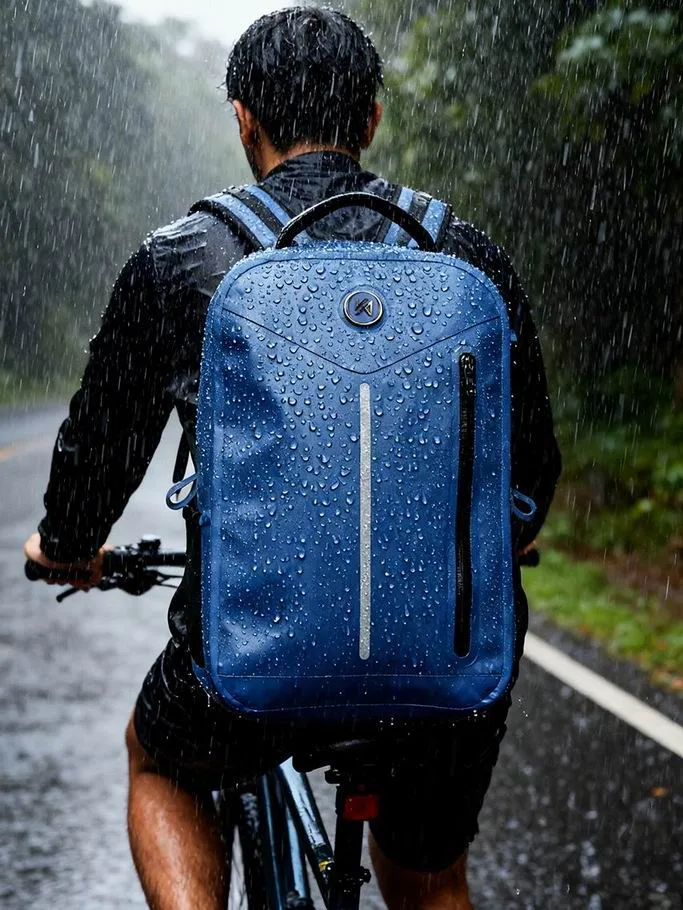
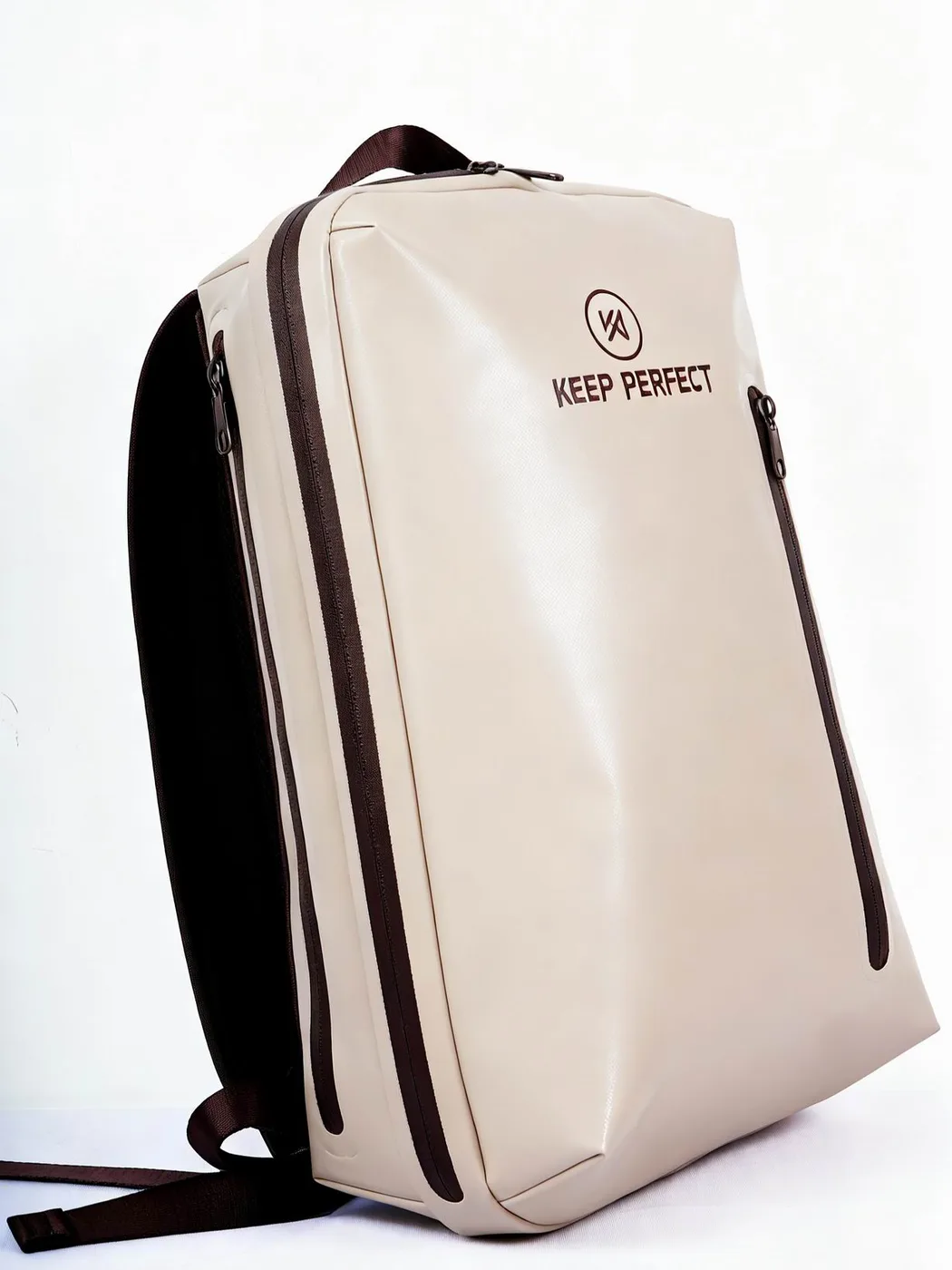
| 25L waterproof backpack | 46 x 28 x 24 cm | Usually, check the airline | 6.0-8.0 kg | One week |
| 30L dry duffel | 50 x 30 x 26 cm | Depends on the carrier | 8.0-10.5 kg | Ten days, hold only |
| 40L dry duffel | 56 x 34 x 30 cm | No | 11.0-15.0 kg | Checked baggage |
Cabin limits are set by the airline, not by the airport, and they differ more than travellers expect: a common short-haul allowance is 55 x 40 x 20 cm at 7 to 10 kg, some carriers allow 56 x 45 x 25 cm, and a few low-cost tickets include only a small personal item of about 40 x 30 x 15 cm under the seat. Measure the bag rolled and packed, not empty, because a 20L bag stuffed to capacity gains 2 to 3 cm in every dimension.
A dry bag has one advantage at the gate: it compresses. If a sizer looks marginal, press the air out through the mouth and take one more fold, and a 20L that measured 24 cm deep empty will often drop to 21 cm. That trick only works with a roll-top and a purge valve or a squeezable load, which is why a rigid-framed backpack of the same nominal volume is the harder bag to defend at the gate. The cabin size and weight guide covers the same arithmetic for mixed itineraries.
Cabin or hold: what has to fly with you
| Item | Cabin | Hold | Note |
|---|---|---|---|
| Power bank and spare cells | Required | Not allowed | Up to 100 Wh, 160 Wh with approval |
| Liquids over 100 ml | Not allowed | Allowed | Checked bags have no 100 ml limit |
| Laptop and camera bodies | Recommended | Allowed, at your risk | Theft and pressure changes |
| Passport, visa, medication | Required | Never | Keep in a reachable pocket |
| Sharp tools and multi-tools | Not allowed | Allowed | Even a small blade is refused |
| Dry bag with food | Usually allowed | Allowed | Powders over 350 g may be checked separately |
The hold is a harsher environment than most people assume, and it is where a dry bag earns its keep. Hold compartments run cold and damp, baggage is stacked under other bags, and a leak from a neighbour travels. A 40L roll-top used as checked baggage keeps a sleeping bag and clothing dry through a delayed trolley on a wet apron, which is exactly the failure a normal suitcase does not survive.
The one thing to avoid is checking a bag that looks valuable. A welded waterproof duffel with a metal buckle and a dense packed load attracts attention both from thieves and from handlers, so keep the passport, the laptop and the medication with you and check only clothing and equipment. Our note on checking a dry bag as hold baggage covers the strap and lock questions in more detail.
Water, ice and the bottle question
An empty bottle is free to carry through the checkpoint and is the cheapest travel decision available: fill it at a fountain on the airside and you avoid paying the terminal markup on every leg. A 750 ml bottle weighs 25 g empty and 775 g full, and it belongs in an outer pocket of the dry bag rather than inside, so a leak cannot reach the electronics. Insulated bottles are heavier, at 340 to 480 g, but they hold ice through a six-hour delay.
Ice is the grey area. Frozen solid at the checkpoint it is generally treated as a solid and waved through; melting or slushy, it is a liquid and has to meet the 100 ml rule. If you are carrying a frozen cooler insert for medication, declare it at the lane rather than arguing the physics at the belt, and keep it in the original packaging with any prescription label visible.
Medication, documents and the passport pocket
Liquid medication above 100 ml is permitted in the cabin when it is declared, and it is the one genuine exception most travellers forget exists. Declare it at the lane, keep it separate from the resealable liquids pouch, and carry a prescription or a clinic letter where the destination requires one. Solid medication has no volume limit, but it should stay in its labelled packaging rather than a pill organiser.
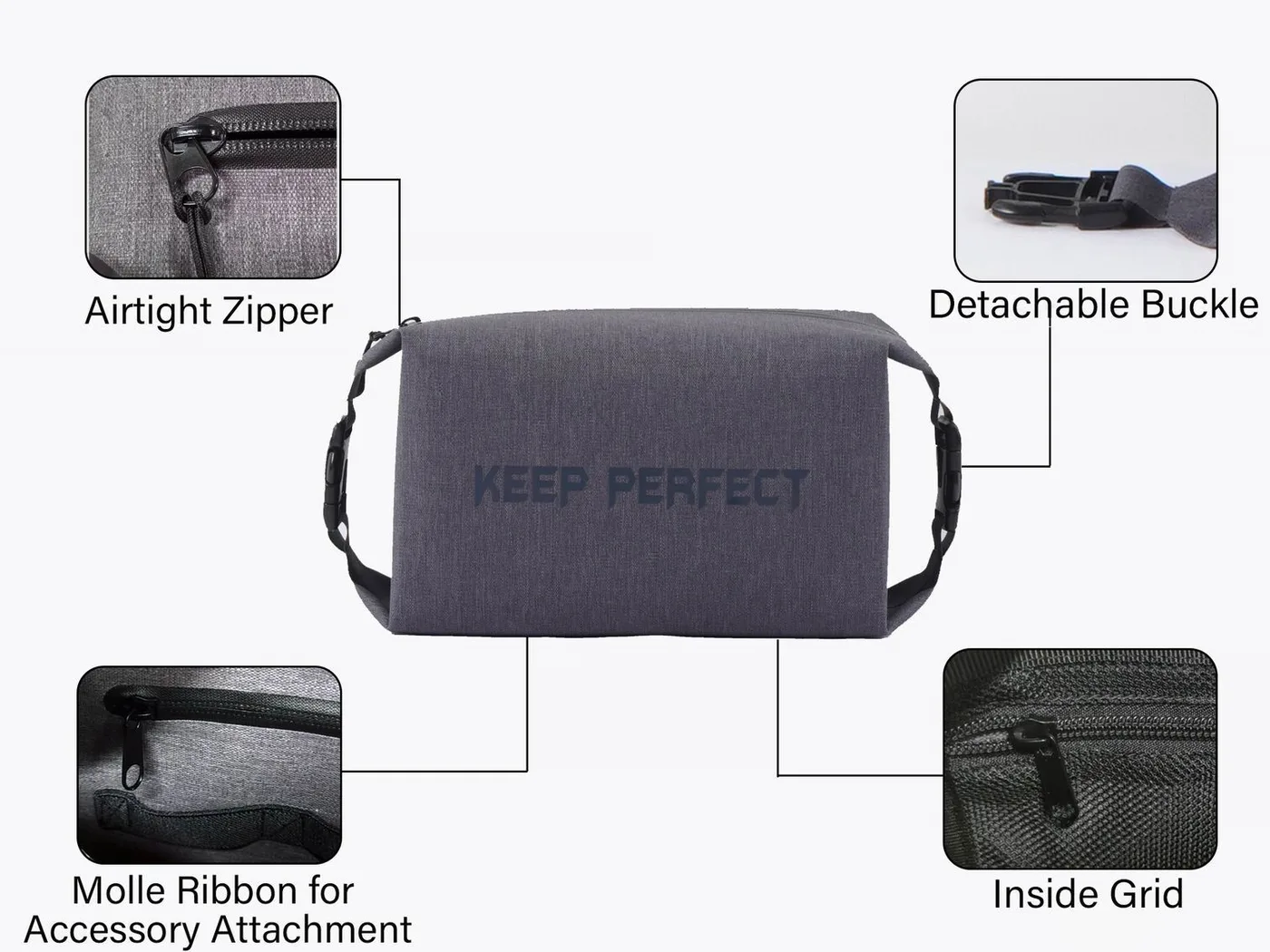
Documents want their own small waterproof home. A 2L roll-top holds two passports, boarding passes, an insurance card and a phone, and it can be lifted out at the desk without opening the main bag at all. That matters on a wet regional transfer where the desk is outdoors: the paper stays dry and you are not unpacking a 20L bag in the rain. The document protection guide sets out the sizes for families travelling on one booking.
Repacking in 60 seconds on the far side
- Walk two metres past the tray before you stop; blocking the belt is how bags get knocked off.
- Buckle the roll-top first, then press the air out, so the bag drops to its packed size.
- Slide the laptop back into the sleeve against the back panel, screen facing your back.
- Drop the liquids pouch back at the mouth, where it can be found at a transfer point.
- Pocket the passport and boarding pass, and check the tray is empty before you leave.
Repacking badly is what turns a smooth screening into a lost phone. The routine above takes about a minute and puts three items - passport, boarding pass, phone - into the same two pockets every single time, which means you never have to think about where they are at the gate. The roll-top closes last because closing it first makes everything else harder to reach.
If you were pulled aside for a search, take the extra thirty seconds to rebuild the packing order rather than stuffing things in at random. A bag that has been searched once is more likely to be searched again on the same trip if the image looks chaotic at a transfer point, and the fix is the same flat layering you started with. Multi-leg itineraries make this worse; the multi-city packing guide covers routines for three flights in a week.
Checks worth running the night before
- Weigh the packed bag on a bathroom scale against the airline cabin limit, not the bag spec sheet.
- Count liquid containers and confirm each is 100 ml or under, and that the pouch closes.
- Charge and label every power bank with its watt-hour rating in marker pen.
- Coil cables into one flat pouch so the laptop image is clean on the monitor.
- Move metal hardware to the mouth of the bag and leave the buckle undone for the lane.
- Check the airline cabin dimensions, not the airport website, and measure the bag rolled.
- Pack passport, medication and boarding pass within reach of one hand.
The overnight check takes five minutes and removes roughly nine out of ten checkpoint problems. Weight is the one people skip: a 25L waterproof backpack packed for a week can reach 9.5 kg, which is over a 7 kg cabin allowance and triggers a gate check and a fee of USD 40 to 75 on many short-haul carriers. Weighing it at home is cheaper than arguing at the gate.
Travel is also where dry bags get used hardest and cleaned least, and a bag that smells of a wet trip is unpleasant to reopen at a hotel. Rinse it, dry it open in shade and store it loosely between trips; the carry-on-only travel guide covers the same routine for long itineraries. Our waterproof line has produced travel bags since 2014 in an SGS-verified 4,950 m2 facility, with welding and inspection standards described and the formats suited to cabin use are listed under products.

Frequently asked questions
Q1. Do dry bags have to be opened at airport security?
Not automatically, but a closed roll-top is a dense, opaque mass that operators often cannot resolve, so they ask you to open it. Carry the bag unbuckled through the lane, roll it once past the tray, and leave the liquids pouch at the mouth.
Q2. Can I take liquids through security in a dry bag?
Yes, under the same 100 ml rule as any other bag: 100 ml per container, all containers in one transparent resealable pouch of about 1 litre, one pouch per passenger, presented separately in the tray.
Q3. Do laptops come out of a dry bag at security?
At most checkpoints yes, laptops and large tablets go into a separate tray. Some lanes now use CT scanners that let electronics stay packed, but the rule is inconsistent, so keep the laptop in a sleeve at the top of the bag.
Q4. Is a 20L dry bag carry-on size?
Usually yes. Rolled and packed, a 20L roll-top measures about 42 x 26 x 22 cm, which fits a 55 x 40 x 20 cm allowance on depth only if you press the air out. Weigh it loaded: 20L packed for five days reaches 4.5 to 6 kg.
Q5. Can I check a dry bag as hold baggage?
Yes, and it is a good idea for clothing and equipment, because holds are damp and bags get stacked under leaking neighbours. Keep passport, medication, laptop and power banks in the cabin instead.
Q6. Are power banks allowed in a dry bag in the cabin?
Power banks must travel in the cabin and never in the hold. Most airlines accept up to 100 Wh without paperwork and 100 to 160 Wh with approval. Label the capacity in marker; an unlabelled cell is a common reason bags are opened.
Q7. Will a metal buckle set off the scanner?
It will not set off the detector, but a dense metal buckle blocks the X-ray image behind it and often triggers a manual search. Polymer or acetal hardware removes the problem and saves about 15 g per buckle.
Q8. How do I carry medication over 100 ml?
Declare it at the lane, keep it separate from the standard liquids pouch, and carry a prescription or clinic letter. Frozen cooler inserts for medication are treated as solids while frozen and as liquids once they melt, so declare them early.
Q9. Can I take an empty water bottle through?
Yes. An empty bottle of any size passes the checkpoint, and filling it at an airside fountain avoids the terminal markup. Keep it in an outer pocket so a leak cannot reach the electronics inside the bag.
Q10. Does a waterproof zip or a roll-top clear security faster?
A coated waterproof zip left slightly open is fastest, because the operator can see into the bag in about five to eight seconds. A three-fold roll-top takes eight to twelve seconds to open and re-close, mostly because the buckle has to be undone.
Q11. What size dry bag fits under the seat?
A 10L roll-top at roughly 34 x 20 x 18 cm fits a typical 40 x 30 x 15 cm personal-item allowance. A 20L does not fit under-seat at full capacity, though pressing the air out and taking an extra fold can gain two to three centimetres.
Q12. Why was my dry bag swabbed at security?
Swabs test for explosive trace and are routine on soft bags, especially those that have been near fuel, sunscreen aerosol or camping stoves. It takes about 40 seconds and is not a penalty; keep the bag accessible and do not argue the point.
Q13. Can I take wet swimwear through security in a dry bag?
Yes, but wring it out first. Soaked fabric adds density and reads as an unexplained organic mass on the monitor, and it will soak the rest of the load. Roll it into a small dry bag of its own at the mouth of the main bag.
Q14. Do dry bags need to be see-through for security?
No. Only the liquids pouch has to be transparent. A clear window panel on the bag itself is optional and helps you identify kit, but operators rely on the X-ray image, not on sight, so an opaque shell is fine.
Q15. How early should I arrive with a waterproof backpack?
Allow the standard two hours for short-haul and three for long-haul, plus five extra minutes if you are carrying a bag over 30L or more than four electronic devices. Repacking on the far side of the tray takes about 60 seconds.
Q16. Can airport scanners damage a dry bag?
No. Cabin X-ray and CT doses are far below anything that affects TPU or nylon film. The damage risk at an airport is mechanical: conveyor rollers abrading the base and metal sizers scraping the weld line, both of which are reduced by packing flat.
People also ask
How do you pack a dry bag for airport security?
Put the liquids pouch at the mouth, slide the laptop sleeve in last against the back panel, keep metal objects near the top, and leave the buckle undone until you are past the tray. Flat layering gives the operator a clean image.
Are dry bags allowed as carry-on?
Yes. A 10L or 20L roll-top fits most cabin allowances once rolled, and a 25L waterproof backpack usually passes. Check the airline dimensions and weigh the bag loaded, because a full 25L can exceed a 7 kg limit.
Do you have to take electronics out of a dry bag?
Usually yes for laptops and large tablets, though CT scanners at some airports let them stay packed. Phones and cameras can normally remain inside. Pack as though you will have to unpack, because the rule is not applied consistently.
Why does security open my dry bag?
Most often because a rolled closure, a metal buckle or a cluster of cables creates a dense shape the operator cannot identify. Carrying the bag unbuckled and moving hardware to the mouth removes most of those triggers.
Can you take a power bank in a dry bag on a plane?
Yes, in the cabin only, never in the hold. Airlines generally accept cells up to 100 Wh without approval and 100 to 160 Wh with it. Write the watt-hour rating on the cell so staff can read it without opening the bag.
Is a waterproof backpack better than a suitcase for flying?
For damp destinations and multi-leg trips, yes: welded seams survive a wet apron, the shell compresses to fit a sizer, and it weighs 1 to 2 kg less than a wheeled case. A suitcase still wins on structure for formal clothing.
Need this in production volume?
QUANZHOU JUNYUAN BAGS has produced waterproof bags since 2014 in an SGS-verified 4,950 m2 facility in Fujian, China. Minimum order 500 pieces, sampling in 6–10 working days, bulk in 35–50 days, FOB Xiamen — write to service@junyuanbags.com with your spec and target market.