Home / Blog / Travel & Packing
Dry Bags on a Raft Support Rig
A support raft carries the group kit that a paddling raft cannot, and the bags on its frame work harder than any bag in a day boat: six people over four days need 320 to 420 litres of waterproof volume packed into 55 to 75 kg, lashed to a frame that flexes and gets wet from first light to camp. Two 25 mm cam straps per bag, checked at lunch and again at the put-out, is the working rule, and every bag has to sit in a position where it can be reached without unstrapping the one next to it. A rigged load that shifts is a rowing problem long before it is a packing problem.
This guide maps the frame into five rigging positions, gives the litres-per-person arithmetic for trips from two to seven days, sets strap widths and mass limits against real loads, and finishes with a worked plan for a six-person, four-day trip. It also covers the two things that end trips early: sand in the closure and a bag that is strapped where the rower cannot see it. Use the tables to plan the load before you rig, not while the boat is in the eddy.
- What a support rig asks of a dry bag
- Rig positions: the frame in five zones
- Capacity per person per day, and the group arithmetic
- Choosing the format: duffel, roll-top or rigid box
- Straps, tension and the lunch check
- Waterproof rating for a long soak, not an immersion
- Packing order for a shared load
- Sand, grit and the closure in a desert corridor
- Colour coding and labelling a group kit
- Weight distribution and what it does to the rower
- The daily rig routine at launch, lunch and camp
- Access discipline: the bag everybody needs
- A worked load plan for six people over four days
What a support rig asks of a dry bag
A support raft is a floating trailer. It sits behind or beside the paddling craft, carries the group kitchen, the group shelter and everybody’s sleeping kit, and it is rowed by one person who has to be able to see past the load and move the boat through a rapid. That combination produces three demands a day bag never faces: constant low-level water in the floor, continuous vibration against an aluminium frame, and a load that must be reachable from the rowing position.
Water in the raft floor is the one people underestimate. A raft with a self-bailing floor still keeps 10 to 30 mm of water moving across the bottom, and every bag within 120 mm of that floor sits in it for eight hours a day. That is not an immersion event, it is a long soak, and it is exactly where a stitched seam with a taped back fails while a welded seam does not.
Vibration is the second. A frame transmits the whole hull’s movement into the strap contact points, and a bag that is strapped tight against a crossbar will polish a flat spot through 0.3 mm film in roughly 400 km of river. Anything raised, from a buckle to a badge, becomes a wear point once it is pressed against a tube at 4 bar and left there for a week.
Rig positions: the frame in five zones
Divide the frame the way the rower experiences it: what is behind, what is beside, what is under the seat, what is on the bow crossbar and what is on top. Each zone has a different access cost, a different splash exposure and a different mass limit. The zones are not equal, and treating them as equal is why a rig ends up with the stove buried behind the sleeping bags.
| Frame zone | Access cost | Water exposure | Mass limit | Best cargo |
|---|---|---|---|---|
| Bow crossbar | Easy, from shore | High, bow spray | 18 kg | Day bag, group first aid |
| Forward bay | Easy, from the rowing seat | Medium | 35 kg | Kitchen, lunch, water |
| Rower footwell | Hard, needs a stop | Low, drains | 12 kg | Spares, tools, repair kit |
| Stern bay | Medium, from behind | Medium, wave wash | 30 kg | Sleeping bags, clothing |
| Top of the stack | Instant | Rain and splash | 8 kg | Rain shells, dry bag for today |
The forward bay is the workhorse. It is the only zone that is reachable from the rowing seat and big enough for the group kitchen, so it gets the bag you will open at lunch. The stern bay takes the cargo you only touch in camp. The bow crossbar holds the two things that must be reachable in the first ten seconds after anything goes wrong: the group first-aid kit and a throw-line pouch.
Capacity per person per day, and the group arithmetic
Work from a per-person figure rather than a total. On a warm river with no technical layer, one person needs 55 to 70 litres of waterproof volume for a four-day trip: a sleeping bag and pad at 22 litres, clothing at 14, a personal dry bag at 10, and a shared share of the group kitchen and shelter at 12 to 20. Cold water or a cold night pushes the clothing figure to 22 litres and the per-person total to 80.
| Trip length | Litres per person | Group of six, total | Bag split | Packed weight |
|---|---|---|---|---|
| 2 days, warm | 38 L | 230 L | 2 x 60L + 4 x 30L | 38 kg |
| 3 days, warm | 50 L | 300 L | 2 x 60L + 6 x 30L | 49 kg |
| 4 days, cool nights | 65 L | 390 L | 3 x 60L + 7 x 30L | 62 kg |
| 5 days, cold water | 78 L | 470 L | 4 x 60L + 8 x 30L | 74 kg |
| 7 days, expedition | 96 L | 575 L | 5 x 60L + 9 x 30L | 91 kg |
Notice the shape of the split: the number of large bags grows faster than the number of small ones, because the bulky items stack up while the personal items do not. Plan on one 30L personal bag per person plus group bags in the 60L range, and keep at least one 30L free as the day bag that lives on the bow crossbar. A rig with no spare capacity ends up with someone’s sleeping bag strapped to the outside of the stack, which is where bags get lost.
Choosing the format: duffel, roll-top or rigid box
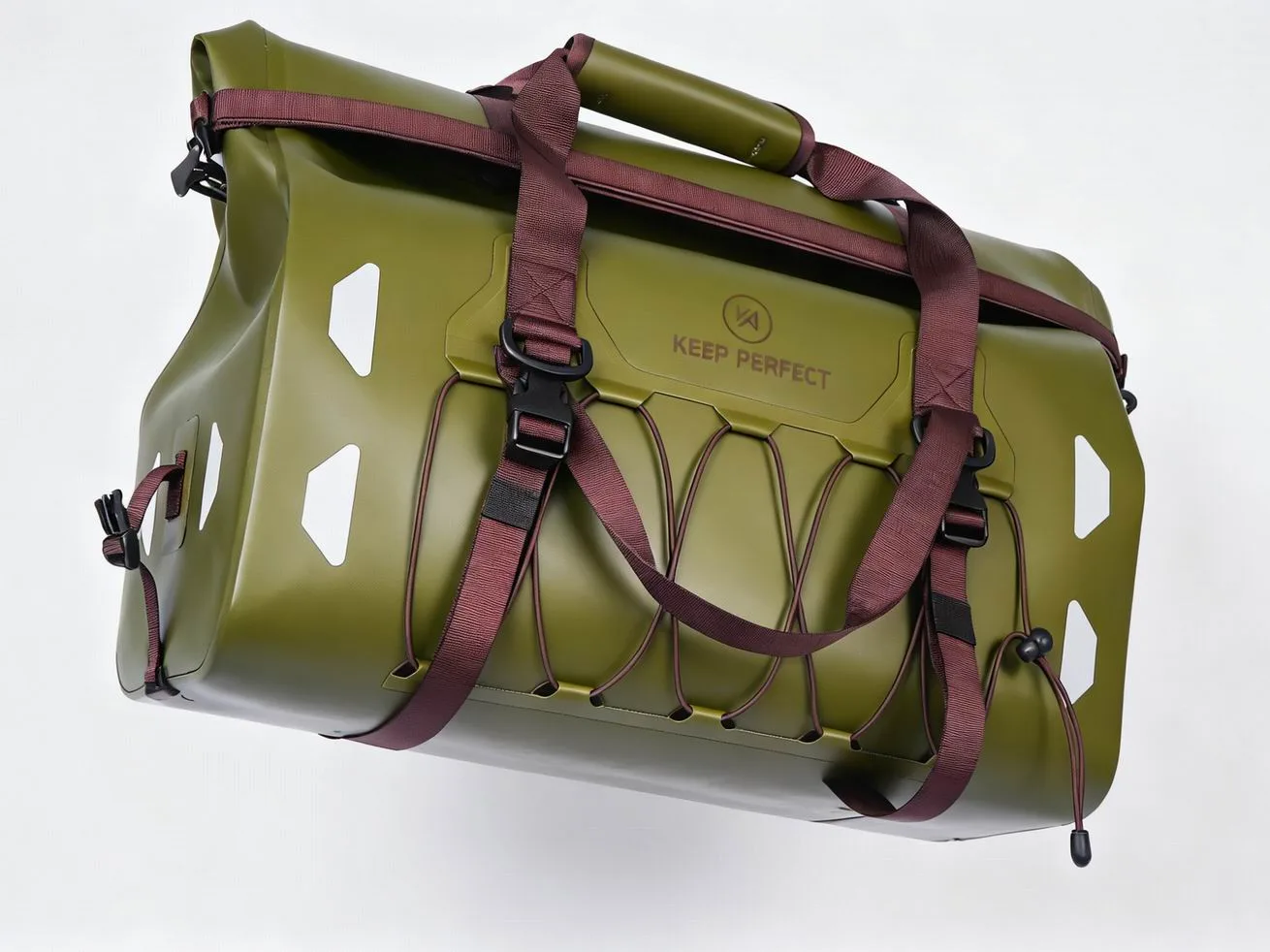
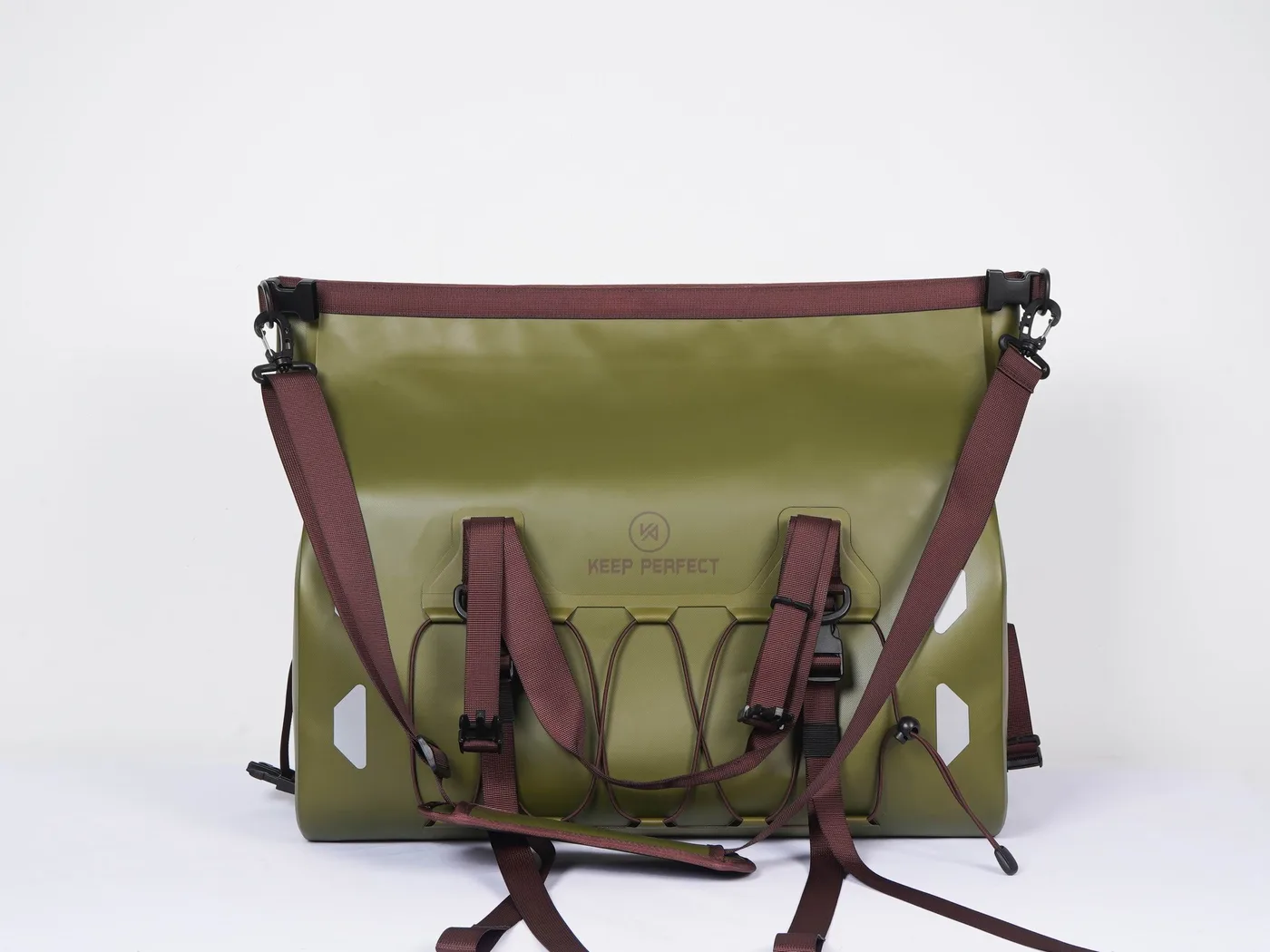
Duffels win on a frame. A rectangular duffel packs to a flat top, stacks two high without rolling, and opens along its length so the lunch kit can be found without unpacking the whole bag. A cylindrical roll-top is easier to squeeze into an odd gap and cheaper per litre, but it rolls on a frame and it has to be unstrapped to open, which defeats the point of a forward bay.
Rigid boxes are the exception, not the rule. A welded dry box protects a camera or a satellite messenger far better than any soft bag, and it doubles as a cutting board and a table, but it weighs 3.5 to 5 kg empty and takes the same frame space as a 60L duffel. Carry one box for fragile items and soft bags for everything else. The full format trade-off is set out in the dry bag versus dry sack versus duffel comparison.
Straps, tension and the lunch check
Two straps per bag, minimum, and one of them should pass over the top of the bag rather than around it. A single strap lets the bag rotate out of the frame under a lateral load, which is what happens when the raft slides sideways through a hole. Straps should be 25 mm webbing with a cam buckle rated to at least 250 kg working load, not the 16 mm ratchet straps sold for roof racks, which cut into film and stretch when wet.
| Bag size | Strap width | Straps per bag | Working load needed | Check interval |
|---|---|---|---|---|
| 10-20 L | 20 mm | 2 | 150 kg | Every 2 hours |
| 30-40 L | 25 mm | 2 | 250 kg | At lunch and put-out |
| 60 L | 25 mm | 2 plus one cross strap | 300 kg | At lunch and put-out |
| Dry box | 25 mm | 2 plus one cross strap | 350 kg | At lunch and put-out |
| Top-stack day bag | 20 mm | 2 | 120 kg | Every 2 hours |
Tension is the part most crews get wrong. A wet webbing strap stretched over a bag at 07:00 will relax by 15 to 20% within two hours as the bag settles and the webbing stretches, so the ritual is: tighten at launch, re-tension at lunch, re-tension at the put-out. Crews that only tighten once lose a bag roughly one trip in eight on a technical river.
Waterproof rating for a long soak, not an immersion
A support rig does not need an immersion rating for most of its cargo. It needs a bag that survives eight hours sitting in 20 mm of moving water, plus spray from a bow wave at 30 km/h, plus rain. That is an IPX6 profile with a long duration, and the failure mode is slow wicking through a stitched seam rather than a dramatic flood.
Save the IPX7 welded bags for the two or three things that genuinely must survive going overboard: the group first-aid kit, the satellite messenger and the sleeping bags. Everything else can be a welded IPX6 bag, which is lighter per litre and costs less. The distinction matters because the rating is bought with film thickness and seam construction, both of which add grams to a load you are rowing for six days.
Packing order for a shared load
Pack each bag to about 85% of its stated volume so it can still roll three times and sit flat. A 60L duffel holding 51 litres of kit closes easily; the same bag holding 58 litres bulges, and the bulge is what catches on a crossbar and wears through. Heavy items go low and toward the centre of the bag, and anything sharp goes in its own pouch before it goes near a film wall.
- Sort the group kit into piles on the beach before anything goes in a bag.
- Load the group bags first, heavy items low, and close them before the personal bags come out.
- Pack each personal bag to 85% volume, press the air out, then roll three times and clip.
- Stack the group bags in the forward bay, kitchen on top of the pile.
- Strap the stern bay with sleeping bags and clothing, cross strap over the top.
- Leave the day bag, first-aid kit and throw line on the bow crossbar, last on and first off.
The order matters because access is a property of the stack, not of the bag. If the kitchen bag is under the sleeping bags, lunch becomes a 15-minute operation in the wind, and the crew starts opening bags they did not plan to open. Rig the stack in reverse: last thing you need goes in first, and the things you need every hour go on the crossbar.

Sand, grit and the closure in a desert corridor
Desert rivers put a fine, hard grit on every horizontal surface within minutes, and a roll-top closure rolled over a single grain of that grit has a capillary path straight into the bag. Rinse the fold line with river water before each close, run a thumb along it, and roll on a clean surface rather than on the sand. On a six-day trip this adds perhaps 20 seconds per bag and prevents the one complaint that cannot be fixed downstream.
Grit also works into cam buckles, where it acts as a grinding paste. Rinse buckles in the evening, work them through their full travel while wet, and expect a cam that has been gritty for a week to slip at 40 to 60% of its rated load. Carry four spare cam buckles on any trip longer than four days; they weigh 60 g each and they are the most commonly replaced part on a rigged frame.
Colour coding and labelling a group kit
A shared rig needs a system that works when the bags are wet, muddy and strapped in the dark. Two levels are enough: colour for the category and a number for the owner. Give the kitchen bags one colour, the group shelter another, and let every personal bag carry its owner’s number in two places, on the body and on the closure, so it can be identified when it is rolled and strapped.
Avoid relying on the smallest sizes for identification. On a frame, a 10L bag in one colour looks exactly like another 10L bag in the same colour from the rowing seat, and the crew will open three bags to find the right one. Add a 40 mm number panel on the end of each duffel rather than a tag, because tags tear off within two days against a frame.
Weight distribution and what it does to the rower
The rower feels the load through the way the boat spins and how hard it is to ferry. Weight forward of the rowing seat makes the raft pivot slowly and track well; weight aft makes it spin fast and wander. The practical target is 55 to 60% of the load ahead of the rower’s seat, with the heaviest single item, usually the water container, as low and as central as the frame allows.
Keep the stack height below the rower’s eye line when seated. A stack above shoulder height blocks the downstream view, which is a safety issue in a technical rapid, and it raises the centre of gravity so a side wave moves the whole load. If the volume will not fit under that line, the trip is overloaded and the answer is a second support raft or fewer group comforts, not a higher stack.
The daily rig routine at launch, lunch and camp
The routine is short and it is the difference between a rig that stays together and one that sheds bags. At launch: every strap tight, day bag and first aid on the crossbar, stack under the eye line. At lunch: re-tension every strap, check the closure of any bag that got wet, and swap anything that needs drying to the top of the stack.
At camp the sequence reverses. Unstrap from the top down, carry bags above the waterline to the kitchen area, open every bag that will be opened that night and leave them open until dew falls. Any bag that took water inside gets emptied, rinsed and dried before it is closed again, because a sealed wet bag is a mildew problem by the second morning.
Access discipline: the bag everybody needs
Every rig needs one bag that is not part of the plan: the bag with the rain shells, the sunscreen, the group snack and the spare dry bag. It lives on the top of the stack or the bow crossbar, it is the only bag anyone opens without asking, and it is the reason the rest of the stack stays strapped. Rigs without it get unpacked four times a day and re-packed badly.
Give that bag a fixed home and a fixed size, 20L to 30L, and make it the same colour on every trip so the crew learns where to reach. If two people are responsible for it, nobody is; assign it to the rower, who is the one person who cannot leave the boat to look for anything.
A worked load plan for six people over four days
Six paddlers, four days, cool nights at 6 °C, daytime highs around 26 °C, one support raft with a four-bay frame. The plan below totals 388 litres and 61 kg, which fits the 390-litre and 62 kg figures from the capacity table and leaves one spare 30L bag for the day kit.
| Cargo | Bags | Volume | Weight | Frame position |
|---|---|---|---|---|
| Group kitchen, stove and fuel | 1 x 60L duffel | 52 L | 11 kg | Forward bay, on top |
| Group tent and tarp | 1 x 60L duffel | 48 L | 9 kg | Stern bay, bottom |
| Group food, four days | 1 x 60L duffel | 55 L | 14 kg | Forward bay, bottom |
| Six sleeping bags | 2 x 60L duffels | 96 L | 13 kg | Stern bay, top |
| Six clothing rolls | 6 x 30L roll-tops | 132 L | 10 kg | Stern bay, sides |
| Day bag, first aid, spares | 1 x 30L roll-top | 25 L | 4 kg | Bow crossbar |
Rig it in this order: tent and food first in the bottom of their bays, kitchen on top of the forward pile, sleeping bags across the stern, clothing rolls in the gaps along the sides, then the day bag last on the crossbar. That gives 58% of the mass ahead of the rowing seat and a stack height about 150 mm below the seated eye line, which is the target from the distribution section.
For comparison, the same group on a two-day trip drops to 230 litres and 38 kg, which is three bags fewer and a stack low enough that the bow crossbar can carry the kitchen instead of the day bag. Similar arithmetic applies to other multi-day water trips: the canoe camping load plan uses the same per-person figures, the river tubing plan covers the lighter end of the range, and the sailing plan covers the case where the bags get wetter but move less.
Two external checks belong in the planning week. River level and flow forecasts drive both the trip and the rigging, and in US waters those come from NOAA; water quality advisories after heavy rain are published by the EPA and matter because a rigged raft means six people washing, cooking and drinking from the same source for four days. Size the bag inventory against the full product line before you buy, and use the 20L versus 30L comparison to settle the personal bag question.
Frequently asked questions
Q1. How do you rig dry bags on a raft support frame?
Divide the frame into five zones, then strap two 25 mm cam straps per bag with one passing over the top. Kitchen and lunch go in the forward bay, sleeping kit in the stern bay, and the day bag and first aid on the bow crossbar.
Q2. How many litres does a support raft need for a four-day trip?
About 65 litres per person, so 390 litres for six people, split into three or four 60L group bags plus one 30L personal bag each. Cold water or cold nights push that to 78 litres per person.
Q3. Should I use duffels or roll-top bags on a raft?
Duffels for the group kit, roll-tops for personal kit. A rectangular duffel stacks flat, opens along its length and can be reached without unstrapping, while a cylindrical roll-top is easier to squeeze into an odd gap in the frame.
Q4. How many straps does each bag need?
Two minimum, and a third cross strap over the top on anything 60L or larger. Wet webbing relaxes 15 to 20% within two hours, so re-tension at lunch and at the put-out rather than once at the ramp.
Q5. What strap width is right for a raft frame?
25 mm webbing with a cam buckle rated to at least 250 kg working load for a 30L to 60L bag, and 20 mm for a 10L to 20L bag. Avoid 16 mm ratchet straps, which cut into film and stretch when wet.
Q6. Do raft dry bags need to be IPX7?
Only for the items that must survive going overboard: first-aid kit, satellite messenger and sleeping bags. Everything else can be an IPX6 welded bag, which is lighter per litre and cheaper, because the real exposure is a long soak rather than an immersion.
Q7. How full should a bag be before it goes on a frame?
About 85% of stated volume. A 60L duffel holding 51 litres closes flat; at 58 litres it bulges, catches on a crossbar and wears through the film.
Q8. How much weight can go in each frame zone?
Bow crossbar 18 kg, forward bay 35 kg, rower footwell 12 kg, stern bay 30 kg, and 8 kg on top of the stack. Keep the stack below the rower’s seated eye line so the downstream view stays clear.
Q9. Where does the weight belong on a support raft?
Roughly 55 to 60% ahead of the rowing seat, with the heaviest single item low and central. Forward weight makes the raft track and pivot slowly; aft weight makes it spin fast and wander.
Q10. How do you keep sand out of roll-top closures on a desert river?
Rinse the fold line with river water before each close, run a thumb along it to check for grit, and roll on a clean surface instead of the sand. One grain in the fold is enough to create a capillary path into the bag.
Q11. How often should straps be checked during the day?
Straps on the top stack and the crossbar every two hours, and everything else at lunch and at the put-out. Crews that tighten only once at the ramp lose roughly one bag in eight trips on technical water.
Q12. What is the most commonly replaced part on a rigged frame?
The cam buckle. Grit acts as a grinding paste, and a buckle that has been gritty for a week can slip at 40 to 60% of its rated load. Carry four spares on any trip longer than four days.
Q13. Should a support raft carry a rigid dry box?
One, for fragile items such as a camera or a satellite messenger. A box weighs 3.5 to 5 kg empty and takes the space of a 60L duffel, so it earns its place for protection and as a camp table, not for bulk storage.
Q14. How do you label bags so a crew can find things fast?
Colour for the category and a number for the owner, applied as a 40 mm panel on the end of the bag rather than a tag. Tags tear off within two days against a frame, and two 10L bags of the same colour look identical from the rowing seat.
Q15. What is the access bag and why does a rig need one?
A single 20L to 30L bag holding rain shells, sunscreen, snacks and a spare dry bag, kept on the crossbar and assigned to the rower. Without it the crew unpacks the stack four times a day and re-packs it badly.
Q16. What should happen to the bags at camp?
Unstrap from the top down, carry bags above the waterline, and open every bag that will be opened that night until dew falls. Any bag that took water gets emptied, rinsed and dried before it is closed, because a sealed wet bag sours by the second morning.
People also ask
How do you strap a dry bag to a raft?
Use two 25 mm cam straps with one passing over the top of the bag, tighten at launch, and re-tension at lunch and at the put-out because wet webbing relaxes by 15 to 20% in two hours.
What size dry bags for a multi-day raft trip?
One 30L personal bag per person plus one 60L group bag for roughly every 130 litres of shared kit. Six people over four days need about 390 litres in total.
Are duffels better than roll-tops on a raft?
For group kit, yes: a duffel stacks flat and opens from the side without unstrapping. Roll-tops are better for personal kit because they squeeze into the gaps between crossbars.
How do you keep bags dry in a self-bailing raft?
Keep them off the floor. A self-bailing raft still carries 10 to 30 mm of moving water, so any bag within 120 mm of the floor soaks for eight hours and needs a welded seam rather than a stitched one.
What waterproof rating does a raft trip need?
IPX6 for most of the cargo, which covers spray and a long soak, and IPX7 welded bags for the first-aid kit, messenger and sleeping bags that must survive going overboard.
How much weight can a raft support frame carry?
A four-bay frame handles 55 to 75 kg of bagged kit for a six-person trip, split about 58% ahead of the rowing seat, provided the stack stays below the rower’s seated eye line.
Need this in production volume?
QUANZHOU JUNYUAN BAGS has produced waterproof bags since 2014 in an SGS-verified 4,950 m2 facility in Fujian, China. Minimum order 500 pieces, sampling in 6–10 working days, bulk in 35–50 days, FOB Xiamen — write to service@junyuanbags.com with your spec and target market.