Multi-Day Dry Bag Plan for Sailing
A four-day coastal passage needs 60 to 90 litres of waterproof volume per crew member, and it works far better split across four bags than concentrated in one: a 30L personal bag in the berth, a 10L foul-weather bag by the companionway, a 5L watch bag in the cockpit, and a share of the 40 to 60 litres of dry stores. Stretch the same trip to seven days offshore and the figure rises to 90 to 130 litres per person. The failure that ends passages early is rarely a shortage of volume; it is one unsealed bag at the bottom of a wet berth wicking through a sleeping bag in about two hours.
This plan is written for crew on coastal and offshore passages of three to fourteen days, in boats from 7 m day sailors to 12 m cruisers. It sets out the volume arithmetic per day and per crew, the four-zone stowage system that keeps a wet boat manageable, what has to be dry at three in the morning, galley and water planning, the lashing that survives a knockdown, and a ten-minute routine at each watch change. Use the tables to size your own kit before you load, not on the pontoon an hour before departure.
- Volume arithmetic: litres per day, per crew
- The four-zone system
- Watch kit: what has to be dry at three in the morning
- Clothing: one dry set, one wet set, one rescue set
- Electronics, charts and papers
- Food, water and the galley
- The wet-boat scenario: 36 hours of spray
- Salt, sun and chafe
- Sizing the plan to the boat
- Lashing and stowage that survive a knockdown
- Weight distribution and trim
- The ten-minute watch-change routine
- Pre-departure checklist
Volume arithmetic: litres per day, per crew
| Passage length | Personal dry volume per crew | Shared dry stores | Total per crew | Suggested bag split |
|---|---|---|---|---|
| Weekend, 2 nights | 30-40 L | 20-30 L | 40-55 L | 1 x 30L + 1 x 10L |
| Four-day coastal | 45-60 L | 40-60 L | 60-90 L | 1 x 30L + 1 x 20L + 1 x 5L |
| Seven-day offshore | 70-95 L | 60-90 L | 90-130 L | 1 x 40L + 2 x 20L + 1 x 5L |
| Ten-day passage | 95-125 L | 90-130 L | 120-165 L | 1 x 60L + 2 x 20L + 1 x 5L |
| Fourteen-day ocean leg | 120-160 L | 130-180 L | 150-200 L | 2 x 40L + 2 x 20L + 1 x 10L |
Shared dry stores are the line people forget. On a four-day trip for four crew, the collective load is not four personal bags; it is four personal bags plus 40 to 60 litres of food, charts, spares, documentation and first-aid equipment that nobody individually owns. Divide that shared figure by the number of crew before you conclude that your allocation is generous, because a 30L personal bag is usually closer to 45 litres of real responsibility once the group kit is counted in.
Work from a realistic packing list rather than from a volume target. Offshore clothing for one person is roughly 12 litres: two thermal base layers at 2.0 L each, a fleece at 3.5 L, a foul-weather jacket at 4.0 L and two pairs of socks. Add a sleeping bag at 8 to 14 L compressed and a wash kit at 2 L and you are at 24 to 28 litres before a single shared item. Our weekend sizing guide gives the same arithmetic for short passages.
The four-zone system
| Zone | Wetness | Bag size per crew | What lives there | Closure discipline |
|---|---|---|---|---|
| Cockpit, watch bag | Constant spray | 5 L | Gloves, cap, knife, phone, snack | Three folds, checked every watch |
| Companionway, foul-weather bag | Heavy at the top of a wave | 10-15 L | Jacket, trousers, boots | Rolled after every use, hung open |
| Berth, personal bag | Damp, occasional flood | 30-40 L | Sleeping bag, clothing, wash kit | Three folds, clipped, stowed low |
| Forepeak or bilge, dry stores | Dry if lashed high | 20-60 L shared | Food, spares, documents, first aid | Three folds, inspected daily |
The point of the zones is that each one has a different failure consequence. A watch bag that leaks costs you a cold, uncomfortable four hours and nothing else. A personal bag that leaks costs you a sleeping bag, and on a seven-day passage with no way to dry anything, that is the difference between rest and exhaustion. Stow to that principle: the further a bag is from the companionway, the more it has to be trusted.
Give each zone its own colour so nobody searches in the dark. Four crew with four 30L bags in four colours can find their own kit in a wet cabin in under ten seconds, which matters at three in the morning with the boat heeled 20 degrees. Colour coding also stops the classic error of one crew member quietly using another’s dry layers because they are closest to the hatch.
Watch kit: what has to be dry at three in the morning
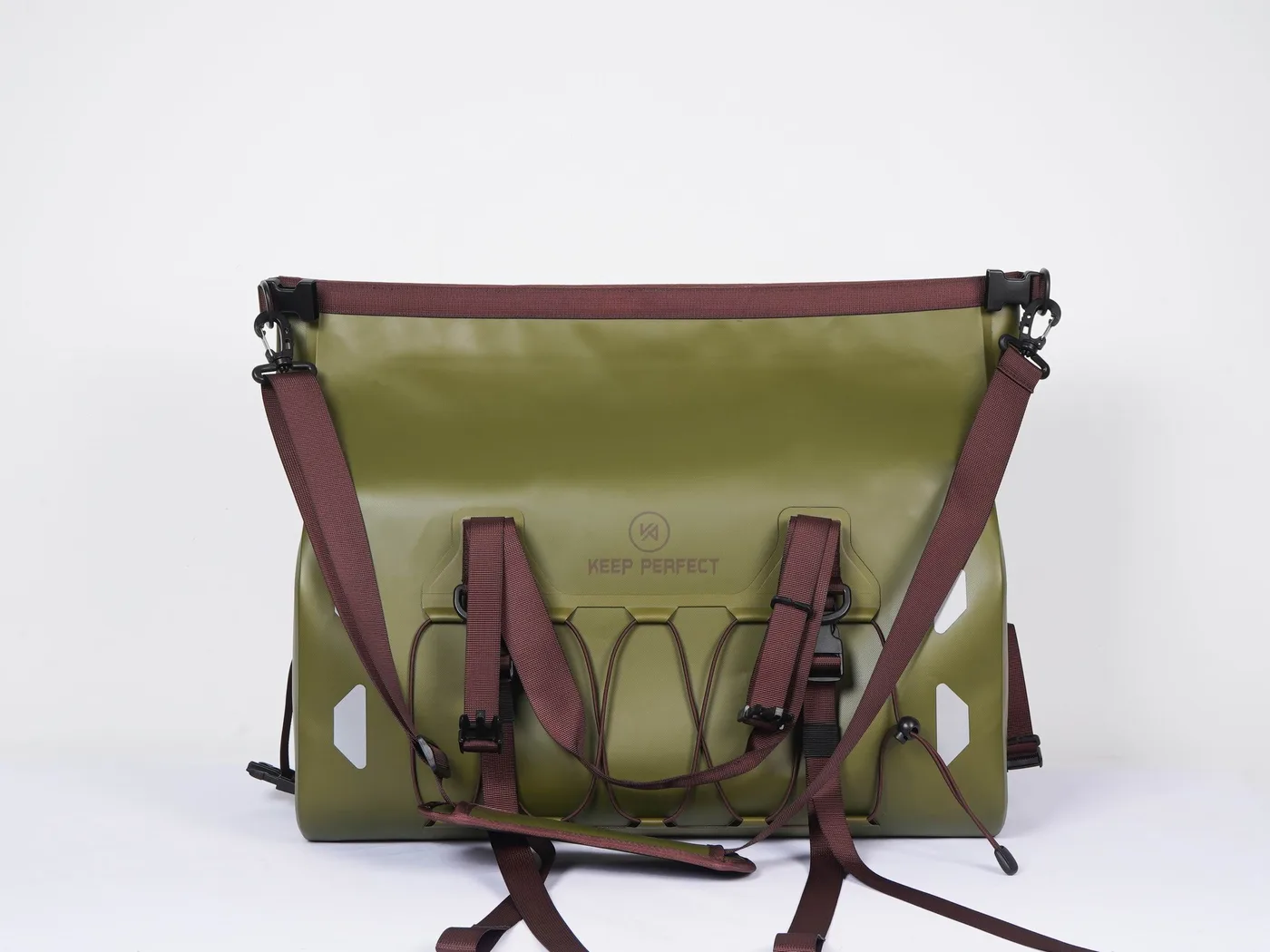
The watch bag is small and disproportionately important. Five litres holds a pair of sailing gloves, a warm hat, a multitool on a lanyard, a head torch, a phone in a secondary 1L pouch, a cereal bar and a small flask. Everything in it must be reachable with cold, wet hands while wearing a lifejacket and a harness, which rules out anything that needs two hands to unclip or a bag that must be rolled closed again before you can move.
Two rules make the watch bag work. First, a secondary pouch for the phone, because it is the item that gets pulled out most often and every opening is a chance to close the bag badly. Second, a fixed home in the cockpit that is not the winch side: a bag tethered to the base of the helm pedestal or clipped inside a coaming locker stays dry, while a bag on the bench gets soaked every time water comes over the rail.
Keep a spare dry set for the watch that follows. On a three-watch system with four hours on and eight off, each crew member is on deck twice in twenty-four hours, and a jacket that went wet at 02:00 is still wet at 22:00 if the boat has been shipping water. Two sets of gloves and hats per watch bag is the cheapest comfort available, and it costs about 1.5 litres.
Clothing: one dry set, one wet set, one rescue set
The clothing system that works offshore is three sets per person, not two. One is worn, one is drying, and one is sealed and untouched, and that third set is the one that saves a passage when a crew member goes in the water or gets thoroughly soaked on a foredeck job in the dark. Pack it in a 10L bag at the bottom of the personal bag and do not open it until it is needed; label it so nobody borrows a layer out of it on night two.
Foul-weather gear deserves separate treatment because it is the item that is wet every single day. Hang the jacket and trousers open in the companionway or the heads so they drain, and use a 10L to 15L bag for the boots and gloves rather than the jacket, since boots are what makes the rest of the locker filthy. Never seal wet oilskins in a dry bag: with no airflow, mildew starts in about 48 hours at 20 °C and the smell then transfers to everything in the bag.
Sleeping kit is the highest-value thing you own on a passage and the easiest to protect. A compressed sleeping bag occupies 8 to 14 litres and fits in a 20L roll-top with room for a pillow liner; double-bagging it, a 20L inside a 30L, costs 200 g and means the bag stays dry even if the outer closure is left badly rolled after a tired night watch. See sleeping bag sizing for compressed-volume figures by fill type.
Electronics, charts and papers
Water and electronics do not mix, and a sailing boat is a wet environment even in fair weather: condensation runs down the inside of the coachroof, a hatch is always open somewhere, and one wave through the companionway soaks the chart table. The working system is a 5L roll-top for handheld electronics, a 2L pouch for passports and ship papers, and a separate dry sleeve for the tablet or laptop used for navigation.
Charts are a special case because paper, once wet, is unusable and irreplaceable at sea. Keep paper charts flat in a 10L duffel or a dedicated chart wallet with a welded closure, and keep the handheld VHF, the GPS and a spare phone in the 5L bag with a silica sachet. Silica is cheap insurance: a 20 g sachet absorbs the condensation that forms inside any sealed bag on a boat where the temperature swings 15 °C between day and night.
Power is the other half of the problem. A passage of seven days with a chart tablet, two phones and a VHF needs roughly 60 to 100 Wh per day, so a 200 Wh power bank covers two days and a 400 Wh unit covers five. Store batteries in a dry bag, never loose in a wet locker, and keep them away from the bilge where standing water and heat shorten their life. The airtight question for electronics covers the condensation issue in detail.
Food, water and the galley
| Item | Per person per day | Four crew, four days | Dry storage | Notes |
|---|---|---|---|---|
| Drinking water, temperate | 2.5-3.0 L | 40-48 L | Not bagged, tanks | Fill from tanks, not bottles |
| Drinking water, tropical | 4.0-5.0 L | 64-80 L | Not bagged, tanks | Plan for 20% reserve |
| Dry food, freeze-dried | 0.8-1.2 kg | 13-19 kg | 30 L, two bags | Split by day, labelled |
| Fresh food, first 48 h | 0.6-0.9 kg | 10-14 kg | 20 L, cool bag | Eat the soft fruit first |
| Snacks for night watches | 0.25 kg | 4 kg | 5 L | One-handed, no cooking |
| Cooking fuel, spare canister | n/a | 2 canisters | 5 L, vented | Never below decks unsealed |
Food storage on a boat fails in a predictable order: packaging fails first, then fresh produce, then dry goods. Strip cardboard and paper before loading, decant everything into sealed bags, and split the dry stores into day-labelled 5L bags so the cook does not open the main store in a seaway. Dry food packed this way occupies about 10% less volume and survives a wet forepeak without loss.
Galley organisation is worth an hour before departure and is covered properly in the sailboat galley guide. The two rules that matter most for a dry bag plan: keep one bag designated as the day bag, refilled each morning from the main store, and keep fuel canisters out of any sealed bag that lives below decks. A leaking canister in a sealed dry bag turns it into a hazard rather than a store.

The wet-boat scenario: 36 hours of spray
Every passage plan should assume a day and a half of continuous water. Sailing upwind at 25 to 30 knots with 2 to 3 m seas puts spray over the coachroof on every wave, and in those conditions the companionway is wet, the cockpit drains constantly, and anything within 400 mm of the hatch gets soaked. Ratings matter here: a bag sitting in that environment needs to survive jets rather than immersion, which is the IPX6 case defined under IEC 60529.
The practical defence is height and position rather than a higher rating. Stow bags on the leeward side, as high and as far inboard as the space allows, and never on the sole where the bilge water collects. A 20L bag at knee height in the main cabin will be standing in 20 to 40 mm of water within six hours of a rough beat; the same bag on a berth above the waterline stays dry through the whole passage.
Have one completely sealed bag that is never opened at sea. Twelve litres, holding a full dry clothing set, a towel, a head torch and a paper copy of the passage plan, stored high and lashed. That bag is the recovery plan for a knockdown, a flooded cabin or a crew member overboard, and its value depends entirely on nobody having borrowed a layer from it on day two.
Salt, sun and chafe
Saltwater sailing is harder on bags than freshwater paddling because salt crystals survive rinsing badly and work into the fold line. Rinse every bag with fresh water at the end of a passage, including the closure, then dry in shade with the mouth open; two hours of direct tropical sun is enough to stiffen a PVC film noticeably. Hardware suffers worst: a cam buckle left salty for a fortnight slips under load, and the fix is to work it through its travel while wet and let it dry open.
Chafe is the mechanical enemy and it is entirely predictable. A bag lashed against a stanchion base, a toe rail or a sharp hatch lip will wear a hole through 0.5 mm film in two to three days of constant motion. Wrap the contact point in a length of spare webbing or an old sock, and check the four corners of every bag at each watch change: those corners are where the welds take the load and where wear shows first.
Sizing the plan to the boat
| Boat | Berths used | Total waterproof volume | Largest single bag that fits | Stowage notes |
|---|---|---|---|---|
| 7 m day sailer | 2 | 60-90 L | 20 L | Everything in the forepeak, one bag per person |
| 9 m coastal cruiser | 4 | 130-190 L | 30 L | Berths plus one forepeak store |
| 10 m cruiser, four crew | 4 | 150-220 L | 40 L | Split forepeak and quarter berth |
| 12 m offshore cruiser | 6 | 250-350 L | 60 L | Forepeak, pilot berth, wet locker |
| 14 m passage maker | 8 | 350-500 L | 60 L | Dedicated dry store, colour by watch |
The largest bag that fits is a real constraint, not a preference. A 60L dry duffel will go through a forepeak hatch on a 12 m boat and will not go through the same hatch on a 9 m boat, so the plan has to be built around the apertures available. Measure every hatch opening before you buy, and remember that a full bag is 3 to 5 cm larger in each dimension than the same bag empty.
Boat type also sets which format works. A deep, narrow forepeak favours long duffels, a wide quarter berth favours roll-tops that can be squeezed into an irregular space, and an open cockpit locker favours small bags that can be lashed individually. The boat-type matching guide covers these geometry problems hull by hull, and the dinghy notes apply if you are also racing in something smaller during the week.
Lashing and stowage that survive a knockdown
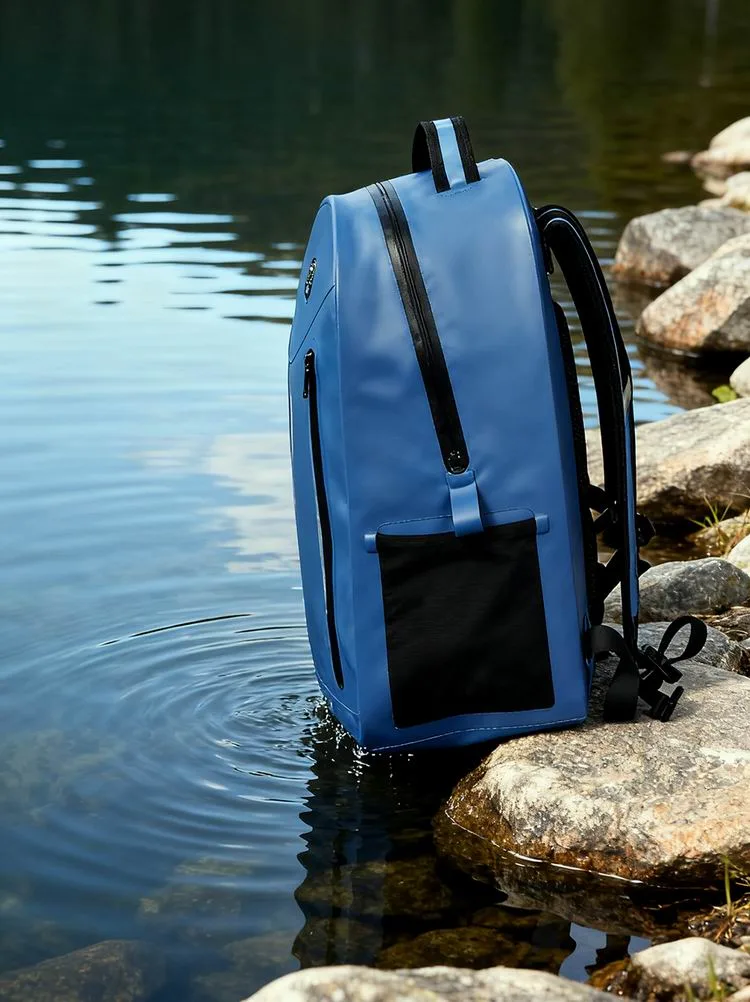
A knockdown at 60 degrees of heel throws everything not tied down across the cabin, and a 6 kg bag moving at that angle will bruise a crew member and break a hatch board. Lash every bag to a fixed point: a berth frame, a padeye, or a strong point under a cushion, using 25 mm webbing and a cam buckle rated well above the bag weight. A single strap through a welded D-ring and around a frame member takes about 20 seconds to fit and holds through anything short of a full inversion.
Avoid long leashes. A bag on a 1.5 m strap becomes a projectile in a knockdown; a bag on a 200 mm strap stays put. The same applies inside lockers: fill the space so bags cannot move, using a rolled-up foul-weather jacket as wadding if needed, because movement is what abrades film and loosens closures. Locker doors should shut against a full load, not rattle: a locker that opens in a seaway empties its contents onto the sole in seconds.
Two points deserve emphasis because they are counter-intuitive. Never lash a bag to a lifeline or a guardrail, because those are not structural and a falling crew member needs them intact. And never leave a bag on top of a hatch board or on the companionway steps, because that is the route everyone takes in the dark and a bag there is a trip hazard on a boat that is already moving under you.
Weight distribution and trim
On a sailing boat, where weight goes matters as much as how much there is. Twenty kilograms of dry stores placed in the forepeak of a 10 m cruiser pushes the bow down, increases wetted surface and costs roughly 0.3 to 0.5 knots upwind. Split the stores: two thirds amidships and low, one third forward, and load the heaviest bags first so they end up at the bottom of the locker and the lightest bags are the ones you reach for daily.
Personal bags should be stowed on the leeward side before a long beat, and moved across at each tack on a short one. That sounds fussy and it is worth about the same as a well-trimmed sail: a 15 kg difference between the two sides of a 10 m boat translates into a degree or two of heel and, on a windward leg, several miles over a day. Crew weight already does this job for you; bag weight should not fight it.
The ten-minute watch-change routine
- Check the watch bag: three folds, buckle clipped, contents dry, phone pouch sealed.
- Hang the previous watch’s foul-weather gear open to drain; do not seal it wet.
- Wipe the closure lines of every bag you touched with a fresh-water cloth to remove salt.
- Inspect the four corners of the two bags nearest the companionway for chafe.
- Confirm the sealed emergency bag is still sealed, lashed and where it should be.
- Log the fresh-water reserve and restack the day food bag for the next watch.
Run at handover rather than at the end of a watch, because that is when two crew are awake and both know where things should be. The whole routine takes about ten minutes for four crew and it is what keeps a boat dry on day six. Most flooding and most ruined sleeping bags happen through small failures that a ten-second closure check would have caught the previous day.
Add one weekly task for passages longer than five days: open every bag, turn it inside out, and dry it in the sun for an hour if the weather allows. Even a well-sealed bag accumulates condensation on a boat, and a week of trapped humidity is what produces mildew in clothing that was packed dry. A dry-bag plan is a system of routines as much as a set of sizes.
Pre-departure checklist
- Measure every hatch opening and confirm the largest bag on the list actually fits.
- Colour-code by crew and label the shared stores by day, not by contents.
- Pack one sealed 12L emergency bag: dry clothing, towel, torch, paper passage plan.
- Decant all food out of cardboard into sealed bags and split into day-labelled 5L bags.
- Charge and dry-bag every power bank, and keep them off the bilge sole.
- Lash every bag to a structural point with 25 mm webbing; no long leashes.
- Rinse all closures with fresh water, then re-roll and re-check each one.
- Download the latest coastal forecast before you go; NOAA publishes US waters at noaa.gov.
Run the checklist the day before, not on the morning of departure, because two items on it will always fail. The hatch measurement is the one that catches people: a bag that does not fit through the aperture has to be repacked on the pontoon, in the wind, with everyone watching. The emergency bag check is the one that saves passages, and it is almost always skipped on short trips.
The last thing to get right is the bag specification itself. For a multi-day passage, 0.5 mm TPU on a 500D face with radio-frequency welded seams is the working default: it survives chafe against a stanchion, stays flexible on a cold night watch and takes a field patch in five minutes. Our roll-top platforms run from 5L to 90L on one closure geometry, so a club or a charter fleet can standardise on a single system; the sizes are listed under products, and the saltwater rinsing guide covers the care side once you are back alongside.

Frequently asked questions
Q1. How many litres of dry bag space do I need for a sailing trip?
Plan 45 to 60 litres of personal dry volume plus a share of 40 to 60 litres of group stores for a four-day coastal passage, so 60 to 90 litres per crew in total. Seven days offshore needs 90 to 130 litres per person.
Q2. What size dry bag for a week of sailing?
A 40L personal bag plus two 20L bags and a 5L watch bag covers a seven-day offshore passage for one crew member. A 40L is usually the largest bag that fits through a forepeak hatch on a 9 to 10 m boat.
Q3. Should I use a duffel or a roll-top on a sailboat?
Duffels for the forepeak and flat berths, because they lie flat and fill a rectangular space; roll-tops for irregular quarter berths and cockpit lockers, because they can be squeezed. Both seal equally well.
Q4. How do I keep a sleeping bag dry on a passage?
Compress it into a 20L roll-top and put that inside a 30L for a second barrier. Stow it high and inboard, never on the sole, and leave the bag closed unless you are actually taking something out of it.
Q5. Where should dry bags be stowed on a sailing boat?
As high and as inboard as possible, on the leeward side, lashed to a structural point. Never on the cabin sole where bilge water collects, and never on lifelines, which are not structural and must stay clear for crew safety.
Q6. Do I need waterproof bags if the boat has lockers?
Yes. Lockers leak at the hinges and the lid seal, condensation runs down the coachroof, and one wave down the companionway soaks everything within 400 mm of the hatch. Lockers reduce the water; they do not remove it.
Q7. How do I stop bags chafing through on a passage?
Pad every contact point against a stanchion base, toe rail or hatch lip with spare webbing or cloth, and inspect the four corners of each bag at every watch change. Constant motion can wear through 0.5 mm film in two to three days.
Q8. What goes in a 5L watch bag?
Sailing gloves, a warm hat, a multitool on a lanyard, a head torch, a phone in a secondary 1L pouch, a cereal bar and a small flask. Everything must be reachable with cold, wet hands while wearing a harness.
Q9. Can I seal wet foul-weather gear in a dry bag?
No. With no airflow, mildew starts in about 48 hours at 20 °C and the smell transfers to the rest of the bag. Hang the jacket and trousers open to drain and bag only the boots and gloves.
Q10. How much water should I plan per person per day?
Two and a half to three litres in temperate climates and four to five litres in the tropics, plus a 20% reserve. For four crew over four days that is 40 to 48 litres temperate and 64 to 80 litres tropical.
Q11. What is the emergency bag and how big should it be?
Twelve litres, holding a complete dry clothing set, a towel, a head torch and a paper copy of the passage plan, sealed and lashed high. It is opened only after a knockdown, a flood or a crew member going in the water.
Q12. How should bags be lashed on a boat?
Use 25 mm webbing and a cam buckle to a structural point such as a berth frame or a padeye, with a short 200 mm strap rather than a long leash. A long strap turns a 6 kg bag into a projectile in a knockdown.
Q13. Do dry bags help with trim and boat speed?
Yes, if you think about placement. Twenty kilograms in the forepeak of a 10 m cruiser can cost 0.3 to 0.5 knots upwind; stow two thirds of the stores amidships and low, and move personal bags to the leeward side on a long beat.
Q14. How often should I check bags on a passage?
A ten-minute check at every watch change: closures, salt on the fold lines, chafe at the four corners, and the emergency bag still sealed. Add a weekly full open-and-dry session on passages longer than five days.
Q15. What film thickness should a sailing dry bag use?
0.5 mm TPU on a 500D face, radio-frequency welded. It resists chafe against hardware, stays flexible on a cold night watch and takes a heat-bonded patch that restores most of the film strength in the field.
Q16. Can I take a dry bag as hand luggage on a fly-and-flotilla trip?
Yes if it is 20L or under: a packed 20L roll-top measures roughly 42 x 26 x 22 cm and fits most cabin allowances. Weigh it loaded, because a 20L packed for a week of sailing reaches 4.5 to 6 kg.
People also ask
How do you pack for a multi-day sailing trip?
Split the load across four zones: a 5L watch bag in the cockpit, a 10L foul-weather bag at the companionway, a 30L to 40L personal bag in the berth, and a share of the group dry stores. Label shared bags by day.
What size dry bag do you need for sailing?
Thirty litres personal plus a share of group stores covers a weekend; 40L plus two 20L covers a week offshore. The limiting factor is often the hatch aperture, so measure it before buying anything larger than 20L.
How do you keep gear dry on a sailboat?
Stow high and inboard, lash to structural points with short webbing straps, keep closures rolled with three folds, and rinse salt off the fold lines daily. Assume one wave down the companionway on every passage.
Should you use dry bags on a sailing yacht?
Yes. Lockers leak at the lid, condensation runs down the coachroof and bilge water collects on the sole. Dry bags also compartmentalise the load, so one leak costs one bag rather than a week of clothing.
What should be in a sailing watch bag?
Gloves, a warm hat, a multitool on a lanyard, a head torch, a phone in a sealed secondary pouch, a snack and a small flask. Keep it in a fixed cockpit spot that is not the winch side or the bench.
How do you stop dry bags smelling on a long passage?
Never seal wet gear, hang foul-weather clothing open to drain, and open every bag for an hour of air drying once a week. Mildew starts in about 48 hours in a sealed bag at 20 °C.
Need this in production volume?
QUANZHOU JUNYUAN BAGS has produced waterproof bags since 2014 in an SGS-verified 4,950 m2 facility in Fujian, China. Minimum order 500 pieces, sampling in 6–10 working days, bulk in 35–50 days, FOB Xiamen — write to service@junyuanbags.com with your spec and target market.