Home / Blog / Travel & Packing
Sailboat Galley Organisation
Four crew on a fourteen-day passage eat about 2.1 kg of food per person per day and drink 4 litres of water, which comes to roughly 420 litres of dry stores and 220 litres of water before you add cooking kit, fuel and spare provisions. The practical way to carry that is eight to twelve soft dry bags between 10L and 60L rather than rigid boxes, because a soft bag conforms to the curve of the hull and uses the 0.6 to 0.9 cubic metres of locker space a 34-foot boat actually has, where a stack of crates wastes a third of it on air.
Organising a galley is a moisture problem before it is a storage problem. Lockers sit at 26 to 30 degrees Celsius in the tropics with 70 to 85 per cent humidity, cardboard packaging wicks that moisture in and collapses within a week, and a sealed bag holding food at 12 per cent moisture will condense 10 to 30 millilitres of water on its inner wall in the same period. This guide covers the provisioning maths, the four galley zones, bag formats, labelling, condensation control, cooler duty and the lashing that keeps 40 kg of stores where you put it in a seaway.
- Why a galley defeats ordinary storage
- Provisioning volume per person per day
- Four galley zones and what lives in each
- Roll-top, duffel or backpack for galley duty
- Labelling and the two-second find
- Condensation inside a sealed galley bag
- Glass, tins and the weight of packaging
- Cooking kit, fuel and what never goes below
- Cooler duty: using a dry bag as an ice chest
- Stowage position and lashing in a seaway
- Fresh produce: how long it actually lasts
- Restocking at a marina mid-passage
- Passage provisioning checklist and timings
Why a galley defeats ordinary storage
A galley is the wettest, hottest and most violently moving storage space on a boat. Lockers sit against the hull, so they are cooler than the cabin by day and wetter by night; they are opened four to six times a day by someone with wet hands; and in a seaway anything loose inside them is subject to two to three times its own weight in acceleration every time the bow drops. Cardboard, glass and rigid plastic all fail in that environment for different reasons, and soft welded bags fail least.
The second problem is shape. Galley lockers are not rectangular: they follow the hull, they are interrupted by frames, plumbing and wiring runs, and they are often only 300 to 450 mm deep at the outboard edge. A rigid crate that fits the opening leaves a wedge of unusable space behind it. A 40L dry duffel pushed into the same locker deforms into the wedge and fills it, which is why soft storage routinely adds 20 to 30 per cent usable volume to the same physical locker.
Provisioning volume per person per day
Provision from weight and volume at the same time, because they diverge sharply. Rice is dense and heavy for its volume; breakfast cereal is bulky and light; canned goods are the worst of both, adding roughly 28 per cent of the food weight in steel. For planning, work on 2.1 kg and 1.9 litres per person per day for dry and canned goods, and add water separately at 4 litres per person per day for drinking and cooking in warm latitudes.
Multiply by crew and days, then round up. A four-crew, fourteen-day passage needs 118 kg of dry and canned food occupying about 106 litres, plus 224 litres of water. That is the number that decides how many bags you carry: eight 20L bags will hold the food with air left for the roll, and it is better to have eight bags in four lockers than four bags in one locker, because you can then open a locker without unpacking the whole galley.
| Category | Per person per day | 4 crew x 14 days | Pack in | Repack needed |
|---|---|---|---|---|
| Rice and pasta | 180 g / 0.25 L | 10.1 kg / 14.0 L | 20 L | Decant from cardboard |
| Canned protein | 200 g / 0.30 L | 11.2 kg / 16.8 L | 20 L | Keep in the can |
| Pulses and grains | 90 g / 0.13 L | 5.0 kg / 7.3 L | 10 L | Decant and label |
| Coffee, tea, sugar | 45 g / 0.10 L | 2.5 kg / 5.6 L | 5 L | Double bag, it smells |
| Dried fruit and nuts | 70 g / 0.15 L | 3.9 kg / 8.4 L | 10 L | Seal tight, fats go rancid |
| Oil and condiments | 35 g / 0.05 L | 2.0 kg / 2.8 L | 5 L | Bottle inside the bag |
| Breakfast cereal | 60 g / 0.35 L | 3.4 kg / 19.6 L | 20 L | Crush the bag flat first |

Four galley zones and what lives in each
Split the galley by access frequency, not by food type. Anything opened more than three times a day belongs at waist height in the locker nearest the companionway; anything opened once a day or less belongs deep and low. This sounds obvious and it is violated constantly, usually because the bag that happened to fit the locker was the one that got used for breakfast.
The four-zone split that works on most cruising boats is a daily locker, a bulk locker under the settee, a hanging locker for light bulky items and a cockpit locker for drinks and cooler duty. Each zone gets its own bag sizes and its own lashing method, because the loads are different: the daily locker sees constant opening and closing, the bulk locker sees almost none, and the cockpit locker sees the most water by a wide margin.
| Zone | Bag size | Contents | Openings per day | Restraint |
|---|---|---|---|---|
| Daily locker | 10-20 L | Breakfast, coffee, snacks | 4-6 | Wedged with a rolled towel |
| Bulk under settee | 40-60 L | Rice, flour, spare tins | 0.5 | Strapped to a frame |
| Hanging locker | 5-10 L | Tea, spices, medicines | 3-4 | Hook, single turn |
| Cockpit locker | 20-30 L | Cooler bag, drinks | 6-8 | Cleat and shock cord |
| Forepeak | 30-40 L | Spare provisions, paper goods | 0.2 | Lashed to a bulkhead eye |
Roll-top, duffel or backpack for galley duty
Format follows mouth size and opening frequency. A roll-top with a 300 mm mouth lets you reach in and pull out a specific tin; a duffel with a 500 mm opening lets you see the whole contents at once, which is better for a bulk locker you open twice a week. For the daily locker, the roll-top wins because it can be opened and closed one-handed while you are holding a pan.
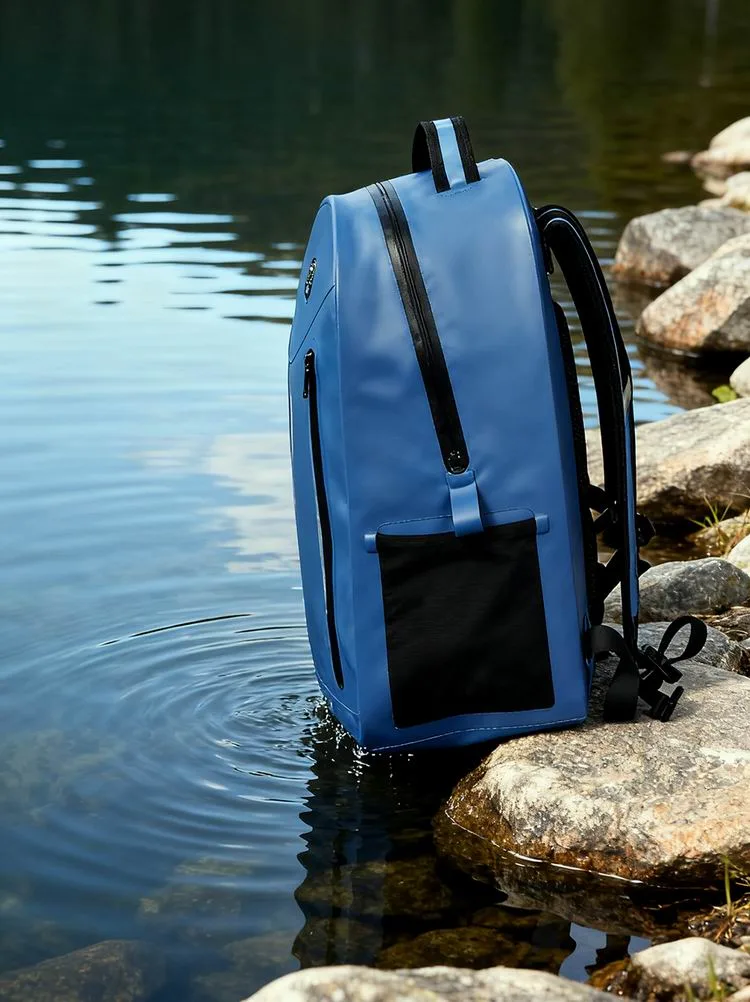
The waterproof backpack earns its place on provisioning day rather than in the galley. A 30L welded backpack carries 12 to 18 kg from a supermarket to the dinghy without any of the boxes getting wet on the way, and it can then be emptied into the locker bags and flattened for storage. Keeping one backpack dedicated to shore trips stops the habit of carrying wet packaging into the cabin, which is how a galley starts to smell by week two.

Labelling and the two-second find
At sea nobody reads small print, and a bag lying on its side in a dark locker presents one face to the person searching. Label two faces, not one: the top of the roll and the side of the body. Use a write-on patch rather than a marker on the film, because permanent marker on TPU fades within a season of handling and salt, and a patch can be wiped and rewritten at every restock.
Colour coding beats text for speed. Assign one colour per category and keep it consistent for the whole passage: blue for carbohydrates, olive for canned protein, pink for breakfast and snacks, black for bulk spares. A cook reaching into a locker at 3 am finds a colour in about two seconds and reads a 12 mm label in about six, which does not sound like much until you are doing it in a seaway with a hot pan in the other hand.
Condensation inside a sealed galley bag
A welded bag is waterproof in both directions, which means moisture released by the food has nowhere to go. Rice and pasta at 12 per cent moisture in a sealed 20L bag at 28 degrees Celsius will put 10 to 30 millilitres of water on the inner film within a week, most of it as droplets along the coolest panel, which is usually the one against the hull. That is enough to start mould on the surface of the food at the bottom of the bag.
The fix is ventilation on a schedule rather than a permanent opening. Open every food bag for ten minutes every third day during the coolest part of the day, wipe the inner film, and add a 20 g silica sachet to any bag holding dried fruit, nuts or spices for the first week. Full detail on why this happens and how to test for it is in our condensation guide, which also covers the electronics case.
In order of frequency, the failures are moisture, chafe and pests. Moisture shows up as mould on food or a damp patch on the bottom of a bag, and it is caught by the three-day opening routine. Chafe shows up as a grey scuff on the film at the point where a bag touches a frame, and it is caught by looking. Pests show up as gnawed packaging, and they are caught by never storing food in a locker that also holds lines or flares.
Glass, tins and the weight of packaging
Packaging weight is the easiest saving on any provisioning list and the one most crews ignore. A litre of food in a glass jar carries about 1.35 kg of glass; the same litre in a tin carries 0.28 kg; in a retort pouch, 0.06 kg. On a 118 kg food load, moving everything out of glass into pouches or decanted bags typically removes 8 to 14 kg and almost all of the breakage risk, which matters far more than the weight.
Decanting is not universal, though. Cans survive a knockdown, do not need a second container and can be crushed flat after use, so canned protein and tomato products travel as they are. Glass jars, cardboard boxes and rigid plastic tubs should all be decanted into labelled dry bags before departure, because glass shatters, cardboard collapses when damp, and tubs crack at their corners after a few weeks of vibration.
| Container | Packaging per litre of food | Breakage risk | What to do |
|---|---|---|---|
| Glass jar | 1.35 kg | High | Decant before departure |
| Tin can | 0.28 kg | Low | Travel as is, crush after use |
| Retort pouch | 0.06 kg | Low | Best weight-to-volume ratio |
| Rigid plastic tub | 0.19 kg | Medium | Only for leftovers |
| Decanted into a dry bag | 0.04 kg | Very low | Best for all dry goods |
Cooking kit, fuel and what never goes below
Stove fuel is the single item that must not be sealed into a bag in the cabin. A 500 ml bottle of alcohol stove fuel or a 230 g gas cartridge belongs in a vented cockpit locker or a dedicated gas locker that drains overboard, because any leak inside a sealed bag below decks accumulates in the bilge rather than dispersing. Keep fuel in its original container, inside an open-top bag, in a locker you can reach from the cockpit.
The rest of the cooking kit travels well in soft storage. A 20L bag holds a two-burner stove, two pans, a kettle and the utensils for four people at about 6 kg; a second 10L holds plates, mugs and cutlery. Sizing that kit properly is its own calculation, and our food and cooking kit sizing guide gives the volumes item by item.
Cooler duty: using a dry bag as an ice chest
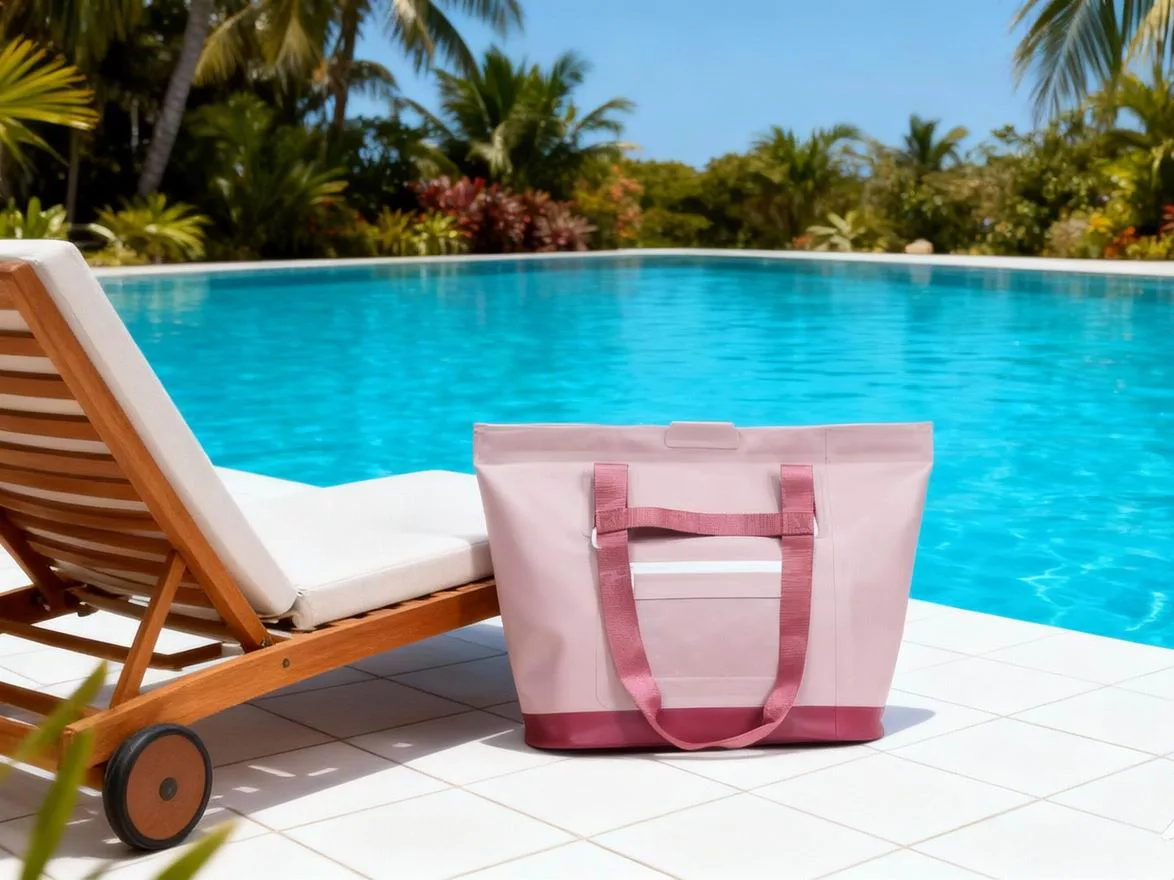
A roll-top bag makes a serviceable cooler because it is genuinely watertight, so melt water stays inside instead of draining into the bilge and onto everything below it. Five kilograms of block ice in a 20L bag in 28 degree ambient air lasts 18 to 24 hours; the same ice in an insulated bag with a reflective liner lasts 30 to 40 hours. Block ice always beats cubes, by roughly a factor of two, because the surface area is far smaller.
Two rules make cooler duty work. First, keep the cooler bag in the cockpit or on the sole where the melt water is contained and can be tipped overboard, never on a bunk. Second, never put food that must stay dry in the same bag: a welded bag holding ice and a bag of rice is a bag of wet rice the moment the ice is half gone. The trade-offs are set out in full in our cooler guide.
Stowage position and lashing in a seaway
Forty kilograms of stores sounds like a lot and is not: on a 5,000 kg displacement boat it is under one per cent of total weight, but placed high and outboard it changes the motion noticeably, and placed low and central it disappears. Put the heaviest bags, which are the rice and tins, under the settee or in the bilge-adjacent lockers, and keep light bulky items such as cereal and paper goods high.
Restraint is about stopping movement, not about holding weight. In a slamming seaway a 12 kg bag experiences two to three times its weight in peak load, so the lashing has to resist 25 to 35 kg of intermittent force. A bag wedged against a hull frame with a rolled towel or an inflated fender behind it does not move at all, and that is better than any strap, because a strap allows a few millimetres of travel and a few millimetres repeated ten thousand times is what abrades a weld.
Chafe is the failure that destroys a bag rather than its contents. A 40L duffel resting on a fibreglass tabbing edge for a two-week passage can wear through a 0.4 mm film in one spot, and that bag is then no longer usable for anything that must stay dry. Put a folded towel, a piece of closed-cell foam or an old sailcloth sleeve under every contact point at the start of the passage; it takes ten minutes and it is the difference between a bag lasting one season and five. Our pest protection notes cover the third failure in detail.
Fresh produce: how long it actually lasts
Fresh food is where a sealed bag is the wrong answer. Vegetables respire, releasing both moisture and ethylene, and in a fully sealed bag that combination turns a two-week supply of carrots into a bag of slime inside four days. The rule is simple: nothing that respires goes into a fully rolled bag. Leave one fold open, or use a mesh hammock, and accept that this is the one place where a locker is better than a bag.
Temperature does more than packaging. Produce held at 12 degrees Celsius in a shaded, ventilated space lasts roughly two and a half times as long as the same produce at 24 degrees in a closed locker, which is why a cockpit locker on the shaded side of the boat outperforms a cool cabin locker. Buy for the first five days fresh, then move to root vegetables, cabbage, citrus and vacuum-packed items for the rest of the passage.
| Storage method | Days at 24 degrees C | Days at 12 degrees C | Condensation risk |
|---|---|---|---|
| Sealed roll-top, 20 L | 2-3 | 6-8 | High |
| Mouth left open one fold | 3-4 | 8-10 | Medium |
| Ventilated mesh hammock | 4-6 | 10-14 | Low |
| Original cardboard box | 3-5 | 7-9 | Medium, collapses when damp |
| Cooler bag with 5 kg block ice | 6-9 | 12-16 | Medium, melt water contained |
Restocking at a marina mid-passage
A mid-passage restock is a logistics exercise with a tide window attached. Two people, one 60L duffel and one 30L backpack can move about 18 kg of provisions per trip from a supermarket to a dinghy, which means a 60 kg restock is three or four trips and about ninety minutes. Decant and label at the dock rather than on the boat, because cardboard and plastic wrap are the two things you most want to leave behind.
Take the inventory sheet with you. A single laminated card listing every bag by colour, contents and remaining quantity turns a restock from guesswork into a shopping list, and it is also the document you hand to whoever does the next passage. Pair it with the passage plan in our multi-day sailing plan, and keep papers and passports in a separate small bag as described in our document protection guide.
Passage provisioning checklist and timings
- Weigh and measure the full food load; plan on 2.1 kg and 1.9 litres per person per day.
- Decant glass, cardboard and rigid plastic into labelled bags before loading day.
- Assign four zones by access frequency, not by food type, and colour code each category.
- Label two faces of every bag with a write-on patch, not a marker on the film.
- Keep stove fuel in a vented cockpit or gas locker, never sealed below decks.
- Pad every contact point where a bag rests against a frame, tabbing or through-hull.
- Schedule a ten-minute opening and wipe for every food bag every third day.
- Carry one laminated inventory card and hand it on at the end of the passage.
If you are provisioning a charter fleet, a delivery crew or a boat that changes hands every season, the same checklist becomes a specification: bag sizes, colour coding, label type, film thickness and closure geometry are the five lines that decide whether the system survives a season of use. Our production lines have built waterproof bags since 2014 in an SGS-verified 4,950 m2 facility with 137 staff, seven lines and 149 machines, at 200,000 pieces per month, with a 500-piece minimum per colourway, sampling in 6 to 10 working days and bulk in 35 to 50 days from FOB Xiamen at AQL 2.5.
Weather planning determines the provisioning volume more than anything else on this list. A fourteen-day passage planned around a weather window may become a twenty-one-day passage, and the difference is 300 litres of stores, so provision for the longest plausible passage and treat the short one as a bonus. Passage forecasts and routing guidance are published by NOAA for most cruising grounds, and food safety limits for stored provisions at ambient temperature are set out by the CDC.
The last thing to check is that the system is legible to someone who has never sailed your boat. Walk a friend into the galley, ask them to find the coffee and the rice without opening more than two bags, and time them. If it takes more than thirty seconds, the labelling or the zoning is wrong, and fixing it before departure is far cheaper than fixing it at sea with four people waiting for breakfast. Start from the full product line if you are building the set from scratch, and use the capacity guide to match bag sizes to the locker measurements you have taken.
Frequently asked questions
Q1. How much dry bag capacity does a sailboat galley need?
For four crew on a fourteen-day passage, plan on about 106 litres of dry and canned food, which is eight 20L bags with room to roll. Add a 30L to 60L bag for bulk spares. Always provision for the longest plausible passage, not the planned one.
Q2. Should I keep food in its original packaging on a boat?
No. Cardboard absorbs moisture and collapses within a week at 70 to 85 per cent humidity, and glass adds 1.35 kg of packaging per litre of food. Decant into labelled dry bags and keep cans as they are.
Q3. How many dry bags should a galley have?
Eight to twelve. Splitting stores across more bags means fewer than a third of the provisions are exposed when you open one locker, and it spreads the weight low and central rather than in one heavy block.
Q4. Why does condensation form inside a sealed food bag?
Food releases moisture, and a welded bag is waterproof in both directions, so it has nowhere to go. Rice at 12 per cent moisture in a sealed 20L bag at 28 degrees Celsius puts 10 to 30 ml of water on the inner film in a week.
Q5. How often should I open food bags at sea?
Every third day, for about ten minutes, during the coolest part of the day. Wipe the inner film and add a 20 g silica sachet to bags holding dried fruit, nuts or spices for the first week.
Q6. Can a dry bag be used as an ice cooler on a boat?
Yes, and it is better than a draining cooler because melt water stays inside. Five kilograms of block ice lasts 18 to 24 hours in a 20L bag at 28 degrees, or 30 to 40 hours with a reflective liner. Keep it in the cockpit.
Q7. Where should stove fuel be stored?
In a vented cockpit locker or a gas locker that drains overboard, in its original container. Never seal a fuel bottle or cartridge inside a bag below decks, where a leak accumulates in the bilge instead of dispersing.
Q8. How do I label dry bags so the crew can find things?
Label two faces, the top of the roll and the side of the body, using a write-on patch rather than a marker. Colour code by category: a cook finds a colour in about two seconds and reads a label in about six.
Q9. What is the best bag format for a galley locker?
A roll-top of 10L to 20L for the lockers you open four to six times a day, because it opens one-handed. A duffel of 40L to 60L for bulk stores you open twice a week, because you can see the whole contents at once.
Q10. How much weight do provisions add to a boat?
About 118 kg of food plus 224 litres of water for four crew over fourteen days. On a 5,000 kg boat that is small in total but noticeable if placed high and outboard, so put rice and tins low and central.
Q11. How do I stop bags chafing through in a seaway?
Pad every contact point. A 40L duffel resting on a fibreglass tabbing edge can wear through a 0.4 mm film in one two-week passage. Use a folded towel, closed-cell foam or a sailcloth sleeve under every hard edge.
Q12. Can fresh vegetables be stored in a sealed dry bag?
No. Vegetables respire and release ethylene, so a fully sealed bag turns a two-week supply of carrots into slime within four days. Leave one fold open, or use a ventilated mesh hammock, and buy for five days fresh.
Q13. How long does fresh produce last at sea?
At 24 degrees Celsius, 2 to 3 days sealed and 4 to 6 days in a mesh hammock. At 12 degrees in a shaded ventilated space, 6 to 8 days sealed and 10 to 14 days ventilated. Temperature does more than packaging.
Q14. How should I restrain provisions in a locker?
Stop movement rather than hold weight. A 12 kg bag sees two to three times its weight in peak load when the bow slams, so wedge it against a frame with a rolled towel or an inflated fender. A strap alone allows travel that abrades the film.
Q15. What should be in a galley restock kit?
One 60L duffel, one 30L backpack and a laminated inventory card. Two people move about 18 kg per trip, so a 60 kg restock is three or four trips. Decant and label at the dock, never on the boat.
Q16. How do I plan provisions for a longer passage than expected?
Provision for the longest plausible passage, because a weather delay can turn fourteen days into twenty-one, a difference of around 300 litres of stores. Check routing guidance before you commit and keep spares in a separate labelled bag.
People also ask
How do you organise a sailboat galley?
Zone by access frequency rather than food type: a daily locker of 10L to 20L bags, a bulk locker of 40L to 60L bags, a hanging locker for light items and a cockpit locker for drinks and ice. Colour code and label two faces.
What size dry bag is best for boat provisions?
20L for daily dry goods, 10L for breakfast and snacks, and 40L to 60L duffels for bulk rice and spare tins. A four-crew, fourteen-day passage needs roughly 106 litres of food, which is eight 20L bags.
Do dry bags keep food fresh longer?
Only for dry goods. A sealed bag keeps rice and pasta dry for months, but the same seal traps moisture around respiring vegetables and spoils them in two to three days at 24 degrees Celsius.
Why does food go mouldy in a dry bag at sea?
Because a welded bag is waterproof in both directions. Moisture released by the food condenses on the coolest panel, usually the one against the hull, and mould starts on whatever sits at the bottom. Open bags every third day.
Can you use a dry bag as a fridge on a boat?
No, but you can use it as an ice chest. Five kilograms of block ice lasts 18 to 24 hours in a 20L bag at 28 degrees, and 30 to 40 hours with a reflective liner. Keep it where melt water is contained.
How much water should you carry per person per day?
Plan on 4 litres per person per day for drinking and cooking in warm latitudes, which is 224 litres for four crew over fourteen days. That is separate from the 1.9 litres per person per day of food volume.
Need this in production volume?
QUANZHOU JUNYUAN BAGS has produced waterproof bags since 2014 in an SGS-verified 4,950 m2 facility in Fujian, China. Minimum order 500 pieces, sampling in 6–10 working days, bulk in 35–50 days, FOB Xiamen — write to service@junyuanbags.com with your spec and target market.