Protecting Gear During Stand-Up Paddleboarding
A stand-up paddleboard throws water at your kit in three ways: paddle drip at roughly 5 to 10 litres an hour off the blade, bow slap of 10 to 20 litres every time the nose drops into chop, and a full dunking when the board flips. A two-hour session therefore needs a bag rated to IPX6 as a minimum, with a 10L roll-top carrying 2.5 kg lashed inside the bungee triangle at the tail, because the nose is where the water lands and the tail is where it drains. Add a 2L pouch on your person for phone and keys, and the whole kit survives a swim with the board.
Board type changes the answer more than anything else. A 3.4 metre touring hull has a flat cargo area and crossed bungees rated to about 6 kg, while a surf-shaped board has a narrow nose and a single bungee pad that will not hold a loaded 10L bag at planing speed. This guide sets out the bag sizes that fit each board, the lashing geometry that survives a wipeout, the deck-heat limits that matter for batteries, and a load plan for a full-day downwind run.
- How much water a paddleboard actually throws at your kit
- Board type decides the bag before you choose a size
- What a two-hour flat-water session really needs
- Bungee geometry that survives a wipeout
- Leash, tether and the scenario where you swim with the board
- Closure choice on a board: roll-top, bucket or zip
- Phone, keys and the deck-pouch decision
- Heat: what a 45 degree deck does to your kit
- Reading wind and chop before you load
- Falling in: the sequence that saves the camera
- Rinse, dry and inspect after every session
- A load plan for a full-day downwind run
How much water a paddleboard actually throws at your kit
Start with the drip, because it is constant and it is what most people underestimate. A paddle blade carries 3 to 8 millilitres off the water on every stroke, and at a cruising cadence of 30 to 35 strokes a minute that is 5 to 10 litres an hour landing on the deck and rails. Most of it runs off the rounded hull, but a bag sitting in the drip line directly behind your feet takes a steady 200 to 400 millilitres an hour, which is enough to soak a splash-proof pack in a single session.
Bow slap is the second source and it is intermittent. Every time the nose drops into a 0.3 metre chop at 4 knots, the deck forward of the standing area takes a burst of 10 to 20 litres. That is a jet event, which is exactly what an IPX6 rating describes, and it is why a bag placed in the forward third of a board gets wet even on a calm-looking day with wind against tide.
The third source is the one that decides your specification: the board going over. A flip dumps the entire contents of the deck into the water for 10 to 30 seconds, and a bag that is not tethered is gone within two minutes of drifting. That scenario is a short immersion, which is IPX7 territory, and it is the rating to buy for anything you carry on a board rather than on your body.
| Water source | Volume per event | Rating needed | Where it lands | Bag position that avoids it |
|---|---|---|---|---|
| Paddle drip | 200-400 mL per hour | IPX4 | Behind the feet | Under the bungee, off the centreline |
| Bow slap in chop | 10-20 L per wave | IPX6 | Forward third | Tail cargo area |
| Spray in 18 kt wind | Continuous, fine | IPX5 | Whole deck | Any lashed position |
| Board flip | Full immersion, 10-30 s | IPX7 | Everything | Tethered, welded seams |
| Swim with the board | Immersion, minutes | IPX7 | Everything | Tethered plus buoyant |
Board type decides the bag before you choose a size
Three board families dominate and each has a different cargo reality. A touring or expedition board of 3.4 to 4.3 metres has a flat deck, four to six D-ring insert points and a crossed bungee net at the tail that will hold 6 kg without stretching. That board can carry a 20L bag and a dry duffel at the same time, and it is the only family where capacity is not the limiting factor.
An all-round inflatable of 3.0 to 3.4 metres usually has a single bungee pad at the nose and four D-rings at the tail. The nose pad is rated for light loads and is constantly in the spray, so the tail is the working position, and total deck load should stay under 4 kg to avoid dragging the tail and slowing the board. A surf-shaped hard board is the hardest case: narrow nose, minimal bungee, and everything must be under 2 kg and lashed low.
| Board type | Deck load limit | Best bag size | Attachment point | Main risk |
|---|---|---|---|---|
| Touring hull, 3.4-4.3 m | 6 kg | 10-20L | Tail bungee cross | Overloading slows the board |
| All-round inflatable | 4 kg | 5-10L | Tail D-rings | Tail drag and nose lift |
| Surf-shaped hard board | 2 kg | 2-5L | Single nose pad | Bag caught in a turn |
| Race board, 4.3 m plus | 2 kg | 2-5L | Behind the feet | Weight aft hurts trim |
| Fishing platform | 10 kg | 20-30L | Frame or crate | Gear shifting in chop |

What a two-hour flat-water session really needs
A two-hour session on flat water in 22 °C air and 18 °C water needs a short list: a phone in a waterproof pouch, a key on a wrist coil, a light wind shell, 500 millilitres of water, a snack and sunscreen. That is 1.4 kg and about 4 litres packed, which fits a 5L bag with room for three folds. Most paddlers carry far more than this and pay for it in deck load and in trim.
Go to three hours, or to water below 15 °C, and the list changes character. A spare thermal top, a hat, a towel and a dry bag for wet layers add 1.6 kg and 4 litres, so a 10L becomes the right size and the deck load approaches 3 kg. At that point check the board trim by paddling 200 metres: if the tail sits lower and the nose lifts, move 1 kg forward or drop an item.
The item people forget is the one that saves the day: a small dry pouch with a phone, a whistle and an emergency contact card, carried on the body rather than on the board. If you separate from the board in wind, the board and everything lashed to it goes downwind faster than you can swim. Guidance on cold water and immersion is worth reading before the season starts, and the CDC publishes practical material on water and sun safety.
Bungee geometry that survives a wipeout
Two crossed bungee cords, each passing over the bag twice, hold a 5 kg load through a flip. A single cord over the top lets the bag roll out sideways when the board goes over, because the bag rotates around the line rather than being captured by it. Cross the cords in an X over the centre of the bag, with the ends anchored to two D-rings on each side, and the load is held in four directions.
Position matters as much as the pattern. Lash the bag in the tail third, centred on the stringer, with at least 150 mm of clearance to the rail so it cannot be caught by a paddle blade or by your own foot during a pivot turn. Keep the roll-top closure facing aft and slightly up, so any water that does land on it runs off the fold rather than into it.
- Check the four D-ring insert points are tight and free of salt crust before you load.
- Set the bag on the deck centred on the stringer, at least 150 mm from either rail.
- Pass the first cord over the bag diagonally and hook it to the opposite pair of D-rings.
- Cross the second cord over the first in an X, pulling both tight enough to stop rotation.
- Tuck the loose cord ends under the net so nothing trails in the water.
- Push down hard on the bag from four directions; if it moves more than 20 mm, re-tension.
Add a secondary tether whenever the bag holds anything irreplaceable. A 6 mm cord from a welded D-ring on the bag to a board D-ring weighs 40 g and means that even if the bungee fails the bag stays with the board. That is cheap insurance for a phone or a camera, and it is the single modification most likely to save a kit on a windy day.
Leash, tether and the scenario where you swim with the board
Your leash attaches you to the board; the bag tether attaches the bag to the board. Both are needed, because the failure mode on a windy day is separation, not sinking. In 18 knots of wind a board with a paddler hanging on it drifts downwind at roughly 0.4 to 0.6 metres per second, which is faster than most people swim over 100 metres, so an untethered bag that goes over the side is effectively gone within two minutes.
Choose the leash for the conditions rather than for comfort. A coiled ankle leash is right for flat water and surf under 1 metre; a straight leash reduces drag in chop; a quick-release belt leash is the correct choice in moving water or around obstacles, because an ankle leash that snags is a hazard. Never attach a bag tether to your body or to your leash, only to the board, so that a snag cannot pull you in.
Closure choice on a board: roll-top, bucket or zip
A roll-top is the default for a board, and the reason is grit. Sand gets onto a deck within minutes of launching from a beach, and a waterproof zip that has sand in its teeth will not seal and cannot be fixed in the water. A roll-top has no moving parts, tolerates a sand grain in the fold better than a zip tolerates one in its track, and can be re-rolled with wet hands in 15 seconds.
A bucket-style bag with a wide mouth and a clip lid is the better choice when you need one-handed access while standing. It opens in 5 seconds, stands by itself on a beach, and the lid closure is easy to operate with a paddle in the other hand. The trade-off is that a lid is a rigid component with a gasket, and a gasket that has been left salty for a season will leak; rinse it every session.
| Closure | Open time, wet hands | Sand tolerance | Rating achievable | Best use on a board |
|---|---|---|---|---|
| Roll-top, three folds | 15-20 s | High | IPX7 | General cargo, tail lashing |
| Bucket with clip lid | 5 s | Medium | IPX6 | Snacks, sunscreen, one-hand use |
| Waterproof zip | 3 s | Low | IPX6 | Flat-water only, rinsed daily |
| Roll-top plus inner pouch | 20-25 s | Very high | IPX7 | Phone, keys, camera |
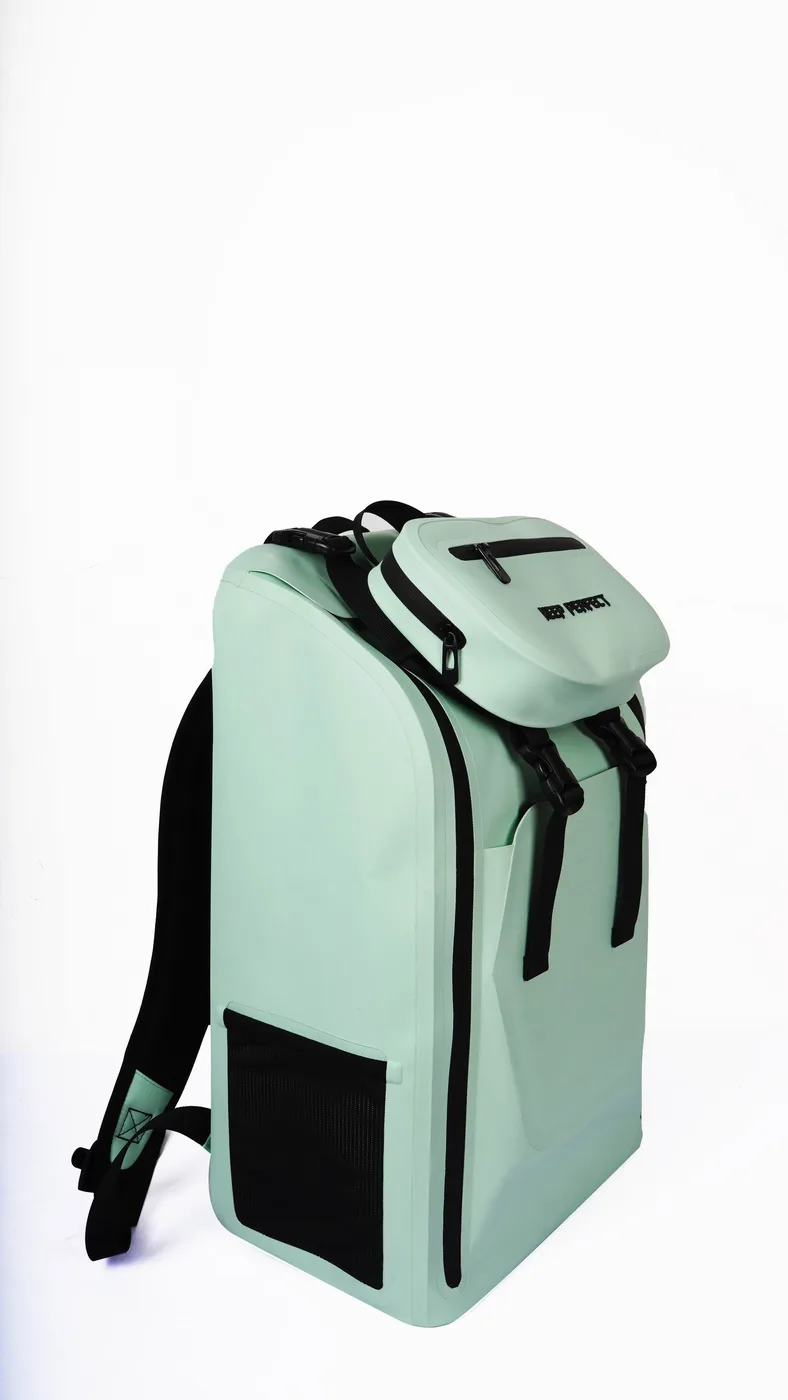
Phone, keys and the deck-pouch decision
Split the small essentials into two places. Anything you might need in the water, or that you cannot replace, goes on your body in a 1 to 2 litre pouch clipped to a PFD or a belt: phone, whistle, emergency contact, and a key on a coil. Everything else goes in the deck bag. That split means a lost board costs you a dry bag and a snack rather than a phone and a car key.
A phone pouch is worth buying properly rather than improvising. Look for a welded TPU pouch rated to IPX8 with a welded window that still responds to touch, and test it in a sink before you trust it. Put a 10 g silica sachet inside if you paddle in humid conditions, because condensation fogs a window from the inside and a fogged window means unreadable screen.
Keys deserve specific mention because they are the most commonly lost item in the sport. A floating key coil with 30 g of buoyancy costs a few grams and turns a dropped key into a visible one. Never put a car key with a remote fob in a bag that is lashed to the board and nothing else; keep it on your person or leave it locked in a dry box at the launch.
Heat: what a 45 degree deck does to your kit
A dark deck in direct summer sun reaches 45 to 55 °C within an hour of launch, and that surface temperature is a real constraint on what you carry. Lithium cells should not be stored above about 45 °C, and a phone left in a black pouch on a dark deck in 32 °C air will hit thermal shutdown within 20 to 30 minutes. That is a genuine failure mode on a hot afternoon, and it is why electronics belong in a light-coloured pouch in shade.
The film itself is fine. TPU and PVC both tolerate 60 °C without damage, and a welded seam does not soften until well above that, so the bag is not the thing at risk. What is at risk is the contents: chocolate, sunscreen, lithium cells and any adhesive label. Keep the bag under a light towel or on the shaded side of the board if you are stopping for more than ten minutes.
Sun exposure is a person problem as much as a gear problem, and paddling on reflective water roughly doubles ultraviolet load compared with the same time on grass. A long-sleeve rash vest, a brimmed hat and zinc on the face are more effective than reapplying sunscreen to wet skin, and reapplication every two hours is the minimum. Worth checking the published sun and heat guidance before a long summer session.

Reading wind and chop before you load
Wind is the variable that decides how much you can safely carry. Below 10 knots the water is mostly smooth and a 4 kg deck load is uneventful. Between 10 and 15 knots whitecaps start to form and the bow slap becomes continuous, so the forward third of the deck is out of action. Above 18 knots, which is about 33 km/h, most paddlers are fighting for position and any bag over 2 kg turns the board into a weather vane.
Check the forecast in the hour before you launch rather than the night before, and read the trend rather than the instantaneous value. A wind that builds from 8 to 16 knots during your session means you will be paddling home into conditions twice as hard as the ones you left in, with a tired body and a loaded deck. Plan the session upwind first and downwind last, which is the whole principle of a downwind run.
Tidal flow against wind is the combination that catches people out. A 2-knot current against a 15-knot wind produces short, steep chop that wets everything on the deck regardless of how well it is lashed. Marine forecasts and coastal observations are published by NOAA, and a five-minute check before loading is worth more than any bag upgrade.
Falling in: the sequence that saves the camera
Falling is routine, and the sequence you follow is what decides whether the kit survives. First, hold the paddle or let it go deliberately; never grab for the paddle and the bag at the same time. Second, stay with the board rather than swimming after anything floating, because the board is your flotation and your visibility. Third, recover the board, then the paddle, then the bag, in that order, remounting only when all three are accounted for.
Time underwater is shorter than it feels. A bag rolled three times and rated IPX7 survives 30 minutes at a metre, so a 20-second dunking is not the threat; the threat is a bag that was never sealed properly, which is why the pre-launch squeeze test matters. Close the bag, squeeze it, listen for a hiss and only then lash it down. That takes ten seconds and prevents the majority of wet-kit incidents people blame on the bag.
If a bag does go in and separates, act inside thirty seconds. Note a bearing to a fixed object on shore before the board turns, point continuously, and move only after someone else is pointing. A floating bag in a chop is visible for perhaps 80 metres in a dark colourway and 150 metres or more in a bright one, and every minute doubles the area you have to search.
Rinse, dry and inspect after every session
- Unlash the bag before you leave the water and check the closure for sand or salt crystals.
- Rinse the whole bag with fresh water at ambient temperature, paying attention to the fold line.
- Open the bag, empty it completely and turn it inside out over a rail or a fence.
- Wipe the D-rings and any buckle, then work each buckle through its full travel while wet.
- Dry in shade with the mouth open, never in direct sun on a hot deck.
- Store loosely rolled with the buckle undipped and off the ground.
Salt is what destroys hardware, not water. A cam buckle left salty over a winter will slip under load the following spring; the same buckle rinsed after every session still holds after five years. Work the mechanism while it is wet, then let it dry completely before storage, and check webbing for stiffness, which is the earliest sign of salt saturation.
Inspect the film at the four bottom corners once a month if you paddle weekly. Those corners take the abrasion from sand and from being set down on a hard launch, and grey scuffing there precedes pinholes by roughly a season. A 30-second air test, rolling the bag closed, squeezing it and listening for a hiss, catches a pinhole long before it becomes a wet-kit incident.
A load plan for a full-day downwind run
A 12 to 18 kilometre downwind run with a shuttle at the far end is a different packing problem: four to six hours on the water, wind at the back, and no chance to re-pack mid-route. The load splits into three bags, each with a job. A 2L body pouch carries phone, keys, whistle and emergency contact. A 10L tail bag carries food, water, sunscreen and a shell, lashed in the bungee X. A 20L bag carries the dry layers and the post-paddle kit, lashed behind the standing area with a secondary tether.
Weight distribution on a downwind run should be slightly aft, because the wind helps push the nose down and a tail-heavy board tracks better in following seas. Keep total deck load under 5 kg on a touring hull and under 3 kg on an inflatable, and keep the heaviest bag closest to the centre stringer. Check trim at the 1 kilometre mark and adjust before you commit to the rest of the route.
| Item | Bag | Size | Attachment | Needed at |
|---|---|---|---|---|
| Phone, keys, whistle | Body pouch | 2L | PFD or belt | Every minute |
| Water, 1 L, and snacks | Tail bag | 10L | Bungee X, aft | Every hour |
| Sunscreen and lip balm | Tail bag | 10L | Bungee X, aft | Every 2 hours |
| Wind shell and hat | Mid bag | 10L | Tail D-rings | On demand |
| Dry layers and towel | Main bag | 20L | Behind standing area | At the finish |
| Repair kit and whistle | Body pouch | 2L | PFD pocket | Emergency only |
Two items earn their place on every long run and are almost always left behind: a 20 g whistle clipped to the PFD, which carries further than a shout in wind, and a 60 g space blanket in the body pouch, which turns a forced swim into an uncomfortable hour rather than a dangerous one. Both weigh less than a second water bottle and neither takes space from the cargo bags.
Choosing the bags themselves comes down to three lines on a spec sheet: welded seams rather than stitched, a closure that reaches IPX7 with three folds, and welded D-rings for lashing rather than sewn loops. Our team has built waterproof bags since 2014 in an SGS-verified 4,950 m2 facility with seven production lines, sampling takes 6 to 10 working days and the minimum is 500 pieces per colourway.The paddleboard day trip guide covers the shorter version of this load plan, the surfing setup guide handles the case where the board is short and the deck is small, and the kiteboarding mistakes guide lists the seven errors that account for most wet kit on the water. Compare sizes against the current range before you order, and check the floating dry bag options if recovery in open water matters to you.
Frequently asked questions
Q1. What size dry bag do I need for stand-up paddleboarding?
A 10L bag for a two-hour session and a 20L for a full day. A two-hour flat-water load of phone, keys, shell, water and snack weighs about 1.4 kg and packs to 4 litres, so a 5L to 10L covers it with room for three folds.
Q2. Where should I lash a dry bag on a paddleboard?
In the tail third, centred on the stringer and at least 150 mm from either rail, using two bungee cords crossed in an X. Keep the closure facing aft and slightly up so water runs off the fold rather than into it.
Q3. How much weight can I put on a paddleboard deck?
Up to 6 kg on a touring hull, 4 kg on an all-round inflatable and 2 kg on a surf-shaped board. Above those figures the tail drags, the nose lifts and the board slows measurably over a 5 km paddle.
Q4. Will a dry bag stay on the board if I fall in?
Yes, if it is lashed with a crossed bungee and a secondary tether. A single cord over the top lets the bag roll out sideways when the board flips. Add a 6 mm cord from a welded D-ring to a board D-ring as insurance.
Q5. Is a roll-top or a waterproof zip better on a board?
A roll-top, because sand gets onto a deck within minutes of a beach launch and a zip with grit in its teeth will not seal. A roll-top has no moving parts and can be re-rolled with wet hands in about 15 seconds.
Q6. Should I keep my phone on the board or on my body?
On your body, in a 2L pouch clipped to a PFD or belt, with a whistle and an emergency contact card. In 18 knots of wind a board drifts downwind at 0.4 to 0.6 metres per second, faster than most people can swim.
Q7. How hot does a paddleboard deck get?
45 to 55 °C on a dark deck in direct summer sun. TPU and PVC tolerate that easily, but lithium cells should not be stored above about 45 °C and a phone in a black pouch will hit thermal shutdown in 20 to 30 minutes.
Q8. What waterproof rating do I need for paddleboarding?
IPX6 as a minimum for paddle drip and bow slap, and IPX7 if there is any chance of the board going over. IPX7 covers 30 minutes at one metre, which is far more than a 20-second flip requires.
Q9. How much water does a paddle drip onto the deck?
About 5 to 10 litres an hour at a cruising cadence of 30 to 35 strokes a minute, with 3 to 8 millilitres coming off the blade each stroke. Most runs off the hull, but a bag in the drip line takes 200 to 400 millilitres an hour.
Q10. What should I do first if I fall in with gear on the deck?
Stay with the board, because it is your flotation and your visibility. Recover the board, then the paddle, then the bag, and remount only when all three are accounted for. Never grab for the paddle and the bag at the same time.
Q11. Do I need a buoyant dry bag for paddleboarding?
It helps. A bag that floats is visible for 80 metres in a dark colourway and 150 metres or more in a bright one, and it can be recovered rather than dived for. Reserve about 40% of the volume as air and leave the purge valve closed.
Q12. How do I stop sand getting into the closure?
Rinse the fold line with fresh water before you roll it and run a thumb along it to check for grit. One grain in the fold creates a capillary path that wicks water into the bag over an hour of paddling.
Q13. Can I use a backpack on a paddleboard?
For carrying kit to the launch, yes. On the water, no: a harness adds 400 to 500 g, raises the load centre and catches wind. Carry a waterproof backpack to the beach and lash a smaller roll-top bag to the deck.
Q14. How often should I rinse a paddleboard dry bag?
After every session. Salt destroys buckles rather than film, and a cam buckle left salty over a winter will slip under load the following spring. Rinse at ambient temperature, work the mechanism while wet, then dry in shade.
Q15. What wind speed changes how I load the board?
Above 18 knots, about 33 km/h, keep the deck load under 2 kg because the board becomes a weather vane. Between 10 and 15 knots whitecaps form and the forward third of the deck is out of action; below 10 knots a 4 kg load is uneventful.
Q16. What two items are most often forgotten on a long run?
A 20 g whistle clipped to the PFD, which carries further than a shout in wind, and a 60 g space blanket in a body pouch, which turns a forced swim into an uncomfortable hour rather than a dangerous one.
People also ask
How do you keep gear dry while paddleboarding?
Use a welded roll-top bag rated IPX7, lash it in the tail third with crossed bungees plus a secondary tether, and keep phone and keys in a small pouch on your body. Close with three folds and squeeze-test the seal before launching.
What size dry bag fits on a paddleboard?
A 5L to 10L for a two-hour session and a 20L for a full day. Check the deck load limit first: 6 kg on a touring hull, 4 kg on an all-round inflatable and 2 kg on a surf-shaped board.
Do dry bags float if they fall off a paddleboard?
Most do, since a clothing load packs at about 0.25 kg per litre. Reserve roughly 40% of the volume as air and keep the purge valve closed, and choose a bright colourway so the bag stays visible at 150 metres.
Can you paddleboard with a backpack on?
On the water, no. A harness raises the load centre, catches wind and adds weight to a deck that has a low load limit. Use a waterproof backpack to carry kit to the launch and lash a compact roll-top bag to the deck instead.
How do you attach a dry bag to an inflatable paddleboard?
Centre it on the stringer in the tail third, at least 150 mm from the rail, then cross two bungee cords in an X over the bag and hook them to the four tail D-rings. Add a 6 mm tether to a board D-ring for anything irreplaceable.
Is it safe to take a phone paddleboarding?
Yes if it rides in a welded IPX8 pouch on your body rather than in a deck bag, so a separation from the board does not cost you the phone. Add a 10 g silica sachet in humid conditions because condensation fogs a touch window from the inside.
Need this in production volume?
QUANZHOU JUNYUAN BAGS has produced waterproof bags since 2014 in an SGS-verified 4,950 m2 facility in Fujian, China. Minimum order 500 pieces, sampling in 6–10 working days, bulk in 35–50 days, FOB Xiamen — write to service@junyuanbags.com with your spec and target market.