Dry Bag Care After Coasteering
A two to three hour coasteering session leaves roughly 10 to 15 grams of dried salt on a 20L bag, sand packed into every buckle channel, and grit ground into the corner welds, and the care window is short: crystals start forming in the roll-top fold about 40 minutes after you leave the water. Ten minutes of freshwater rinsing in the right order removes essentially all of it and is the single biggest factor in whether a 0.5 mm TPU bag lasts three coasteering seasons or ten.
This guide is written for people who run the same stretch of coast every week from May to September and whose bags are dragged over barnacles rather than stowed in a hatch. It covers what the sea actually deposits, the rinse sequence and water temperature that work, how to clear sand from hardware without breaking it, drying temperatures that do not cook the film, seam inspection after rock contact, and the monthly routine that tells you when a bag is finished.
- What a coasteering session leaves behind
- The three places damage actually starts
- The first 30 minutes: what to do at the takeout
- Rinse technique, water temperature and time
- Getting sand out of buckles, valves and folds
- Drying coasteering kit without cooking the film
- Rock abrasion: inspecting welds after every session
- Hardware, webbing and salt-air corrosion
- Keeping genuinely wet gear out of the dry system
- Mildew and odour control in a coastal climate
- UV, heat and where the bag spends the week
- Monthly deep care and the retirement call
- A care plan that fits a coasteering season
What a coasteering session leaves behind
Coasteering treats a dry bag more roughly than almost any other coastal pursuit, because the bag is not simply splashed: it is dragged across barnacle-covered granite, dropped into surge after a 3 m jump, worn across the shoulders while you swim a channel, and then shut in a car boot for the drive home. Every one of those events deposits something. Seawater holds about 35 grams of dissolved salt per litre, so a bag that comes out carrying 300 ml of residual water on the film and in the folds leaves 10 to 15 grams of salt behind once it dries.
Three residues matter and they behave differently, which is why a single rushed dunk is not enough. Salt is hygroscopic, so it pulls moisture from the air and keeps the fold line permanently damp. Sand and shell fragments are harder than the film and abrade it wherever pressure is applied, which on a coasteering bag means the base corners and the side that faces the rock. Organic matter from kelp and rock pools feeds the microbial growth that turns into mildew, and it is the reason coastal bags smell worse than river bags.
The three places damage actually starts
Failures after coasteering cluster in three locations and none of them is the middle of a panel. The roll-top fold is first, because that is where salt crystals form and where one grain is enough to break the seal. Buckle and valve channels come second: packed sand raises the force needed to release a side-squeeze buckle from roughly 20 N to over 60 N, which is how levers crack. Weld corners come third, where grit held against the seam by a strap or a wet palm works through the film over a season of weekly use.
| Residue | Where it collects | Damage mechanism | Action window |
|---|---|---|---|
| Sea salt | Roll-top fold, webbing | Hygroscopic, keeps surfaces damp | Rinse within 40 minutes |
| Sand and shell grit | Buckle channels, valve threads | Raises release force, abrasive | Flush while still wet |
| Kelp and plankton | Panel surfaces, corner welds | Feeds mildew, stains pale colours | Wipe before it dries |
| Silt from surge pools | Inside the bag, base corners | Grinding paste against welds | Empty and rinse same day |
| Sunscreen residue | Handles and strap faces | Leaves a tacky film that holds grit | Wipe with a damp cloth |
The capillary point deserves emphasis because it explains most reports of a bag that leaked after a coastal session. A single 0.5 mm grain sitting in the third fold creates a channel about that wide for water to wick along, so a bag that passed an air test in the morning can take in 30 to 60 ml over three hours in the water. Running a finger along the inside of every fold while rinsing is a five-second action and removes the risk completely.

The first 30 minutes: what to do at the takeout
The clock starts when you leave the water, and the commonest mistake is letting a bag dry shut in the boot. Salt crystallises as soon as the surface film of water evaporates, which on a warm, windy headland takes about 40 minutes, and once crystals have formed inside the fold they are far harder to shift than dissolved salt. Open every bag at the takeout, shake out standing water, and if the car park has a tap or a beach shower, dunk the whole bag once before you load the car.
Order matters because rinsing the panels first and the closure second simply moves grit from one place to another. Work from the dirtiest part outward: empty and invert, flush the fold and the mouth, then the buckle channels, then the panels, then the base. Anything you cannot do on the headland has a twelve-hour window before salt damage becomes measurable, so a proper rinse the same evening still works. Tide and swell planning for the session itself is worth checking through NOAA before you commit to a route.
Rinse technique, water temperature and time
Use ambient fresh water, not hot, and give the job ten minutes rather than two. Agitation does most of the work, so a bucket with a soft cloth beats a trickling tap, and a second clean-water pass at the end is what decides whether the bag smells in three weeks. The sequence below is sized for one 20L bag after a two-hour session; scale the durations rather than skipping stages when you have four bags to do.
| Rinse stage | Water temperature | Duration | What it removes | Note |
|---|---|---|---|---|
| Invert and shake out | Not applicable | 30 s | Loose sand, kelp | Do this before any water touches the bag |
| First body flush | 15-25 °C | 2 min | Surface salt, silt | Bucket or low-flow hose, no jet |
| Fold and mouth | 15-25 °C | 2 min | Crystals in the fold | Run a finger along every fold |
| Buckle and D-ring flush | 15-25 °C | 1 min | Packed sand | Work the buckle through full travel |
| Second clean-water pass | 15-25 °C | 3 min | Remaining salt film | Final pass decides long-term odour |
Two habits ruin an otherwise good rinse. Pressure washers deliver 80 to 120 bar at the nozzle, which is enough to lift the edge of a radio-frequency weld and to drive water past a closure that would otherwise seal; keep the nozzle at least 500 mm away or do not use one at all. Water hotter than about 45 °C softens the film locally and can distort a welded corner, so a hosepipe that has sat in the sun all afternoon is worse than no rinse at all.
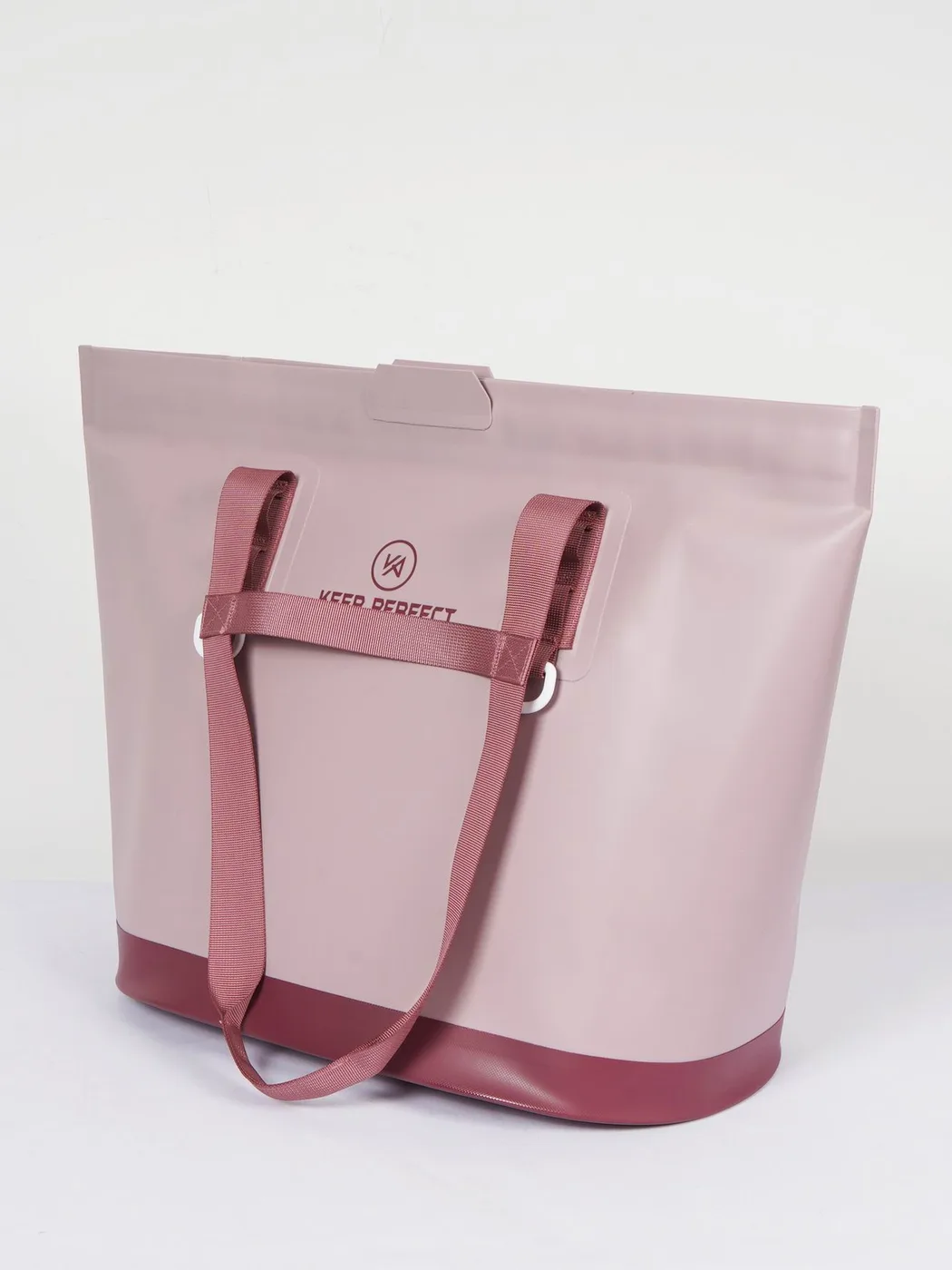
Getting sand out of buckles, valves and folds
- Hold the bag mouth-down and tap the buckle body against your palm to loosen packed grains.
- Flush the channel with a 200 ml squeeze bottle while working the release at least ten times.
- For a purge valve, press the button under running water and rotate the housing a quarter turn twice.
- Run a soft brush along the roll-top fold, then rinse and dry the fold before rolling it closed.
- Work every buckle dry through its full travel, then store the bag open so nothing re-packs overnight.
Buckles are the part people forget and the part that fails first in a guiding fleet. Sand in a buckle behaves like lapping paste: each release cycle grinds the grain against the acetal body, and a fitting that needed 20 N when new can require 60 N after a season of unwashed use. That is not merely unpleasant, it is how levers crack and how a strap releases under load at the wrong moment.
Valves need a gentler hand than the rest of the bag, because the membrane inside a purge valve tears if you prise at it with a blade or a fingernail. Let running water do the work, pressing the button repeatedly rather than picking at the seat. If a valve still weeps after cleaning, the answer is a replacement part rather than force; the full range of fittings and how each is serviced is set out in our dry bag valve guide, and stubborn grit in side-release fittings is handled in keeping sand out of buckles.
Drying coasteering kit without cooking the film
Dry the bag open, in shade, with air movement, and give it overnight. The reason is not tidiness: a closed bag at 25 °C with 90% internal humidity grows visible mildew in 48 to 72 hours, and the spores then colonise the corner welds where no rinse ever reaches. Turn the bag inside out for the first two hours, because the inner face holds more water than people expect and is the last part to dry.
| Drying method | Surface temperature | Time to dry | Risk to the bag |
|---|---|---|---|
| Shaded outdoor line, mouth open | 18-24 °C | 4-8 h | None if out of direct sun |
| Indoor rack with airflow | 20-25 °C | 6-10 h | Slow, needs moving air |
| Direct sun on a rock | 45-60 °C | 1-2 h | Film stiffening, print fade |
| Car boot or sealed crate | 30-40 °C | Does not dry | Mildew within 48 hours |
| Radiator or heater cabinet | 50-70 °C | 1-3 h | Weld distortion, shrinkage |
Once the surface feels cool and matte rather than slick, turn the bag back the right way, hang it by a handle rather than by the harness, and leave it until the next morning before rolling it for storage. If you run sessions several times a week, a simple rack with 200 mm of clearance between bags cuts drying time by roughly a third compared with bags laid on a floor. Detailed rack and airflow setups are covered in drying racks and airflow.
Rock abrasion: inspecting welds after every session
Coasteering abrades harder than paddling because the bag is pressed against rock rather than a smooth hull, and rock does not move. A season of twice-weekly sessions means around 60 outings and well over 100 hours of loaded contact, most of it concentrated on the base corners and one side panel. Inspect in raking light rather than overhead light, because the early warning sign is a change in surface texture, not a hole.
| Inspection point | Warning sign | Threshold | Action |
|---|---|---|---|
| Base corners | Fuzz on the face fabric | Patch over 10 mm across | Patch, or retire from load use |
| Side panel | Glossy polish where it was matte | Palm-sized area | Rotate the carry position |
| Weld edge | A step you can catch with a nail | Any run over 5 mm | Re-weld assessment |
| D-ring base | Webbing lifts at one corner | Any lift at all | Stop using it as a lash point |
| Roll-top fold | Pale line with fine cracks | Visible cracking | Vary roll height and monitor |
A panel that has gone from matte to glossy has lost its surface texture, which typically means 0.05 to 0.1 mm of film has been removed, enough to halve remaining tear strength at exactly the point that gets loaded next time. Catch it there and the fix is simply to change how you carry the bag; miss it and the same patch becomes a leak three sessions later. Weighing helps too, since an unexplained drop of more than 8 g on a 20L bag points to material loss somewhere.

Hardware, webbing and salt-air corrosion
Metal fittings are the weak link in a salt-air climate, and the grade matters more than most buyers realise. Marine-grade 316 stainless resists pitting roughly three to five times longer than 304 in a coastal environment, while anodised aluminium is light but will seize in a buckle body once salt gets between the two metals. Any fitting that shows orange spotting at the pivot should be replaced rather than lubricated, because the corrosion is already inside the joint.
Webbing holds salt as well, and drying without rinsing makes it boardy: a 25 mm strap soaked and dried ten times without a freshwater flush loses around 15% of its flexibility and starts to feel stiff against the shoulder. Rinse straps in place rather than removing them, work the adjuster through its travel while wet, and check the stitched or welded root of each strap at the end of every month. The full picture on fitting grades is in corrosion resistance in dry bag hardware.
Keeping genuinely wet gear out of the dry system
A coasteering day produces items that are wet by definition: a 3 mm wetsuit, boots, a helmet, gloves and sometimes a buoyancy aid. None of these belongs inside the bag that holds your dry layers, because a wetsuit carries 1.5 to 2.5 litres of water that will wick through everything else in under ten minutes. Work on a two-volume rule: one sealed volume for what must stay dry and one open, drainable volume for everything that comes out of the sea.
In practice that means a 20L roll-top for clothing, electronics and food, plus a separate 40L bag or a crate for the wet pile, and a 5L bag for keys, phone and a small first-aid kit that never leaves the dry side. Rinse the wet-volume bag as well: it is the one that smells first, because it is the one that holds seawater longest. Grazes from rock deserve attention too, since seawater in an open cut is a real infection risk; the CDC publishes guidance on that which is worth reading before a season of saltwater sessions.
Mildew and odour control in a coastal climate
Coastal summer air commonly sits between 70% and 85% relative humidity, and at those levels a bag stored closed will smell within three days even if it looked clean when you put it away. The remedy is dilution and airflow before chemistry: rinse, dry open overnight, and store loosely rolled with the mouth unclipped. If odour has already taken hold, wipe the interior with a solution of one part white vinegar to three parts water, leave it for ten minutes, then rinse again.
Avoid chlorine bleach on TPU. It attacks the polymer surface, leaves the film chalky, and the damage is permanent even though the smell goes away. Isopropyl alcohol at 70% is safe for a quick wipe of the interior and evaporates without residue, which makes it the better choice for a bag that has to be back in service the next morning. Stubborn cases, and the difference between surface growth and growth inside a seam, are set out in removing mildew and deodorising safely.
UV, heat and where the bag spends the week
Most ultraviolet damage happens between sessions rather than during them. A bag left on a dashboard reaches 60 to 70 °C internally, and repeated cycles at that temperature accelerate plasticiser movement in PVC and surface oxidation in TPU. Six hours of midday summer sun delivers a meaningful fraction of the annual dose a bag would otherwise receive over a season of careful storage, so the boot of a car is the worst storage location on the list.
Store cool, dark and dry, loosely rolled rather than folded flat, with the buckle unclipped and the mouth open. If you must store a bag compressed, do it for days rather than months, because a tight fold held for a full winter puts a permanent crease in the film. Long-term storage and the seasonal checklist are covered in off-season storage, and the science of what sunlight does to film sits in preventing UV damage.
Monthly deep care and the retirement call
Once a month through the season, give each bag fifteen minutes rather than ten seconds. Inflate it through the mouth until it is firm, close with three rolls, squeeze hard for ten seconds and listen for a hiss, then leave it for an hour and check that it is still firm. That test finds pinholes and marginal welds that a visual check never will, and it takes one minute per bag once you have a pump or a good set of lungs.
Retire a bag when any of four things is true: film thickness at a contact patch has dropped below 0.3 mm, a weld edge lifts when you flex it, the closure will not hold an air test after three clean rolls, or a buckle slips under load when worked dry. Two of those are repairable and two are not, and confusing them is how people lose dry clothing mid-season. The formal thresholds are set out in when to retire a dry bag, with the test method in the air inflation leak test.
A care plan that fits a coasteering season
- Rinse within 40 minutes of leaving the water, or at least before the bag dries shut.
- Flush the fold, buckles and valve before the panels, never the other way round.
- Use ambient fresh water only; no pressure washer, nothing above 45 °C.
- Dry open and in shade overnight, inside out for the first two hours.
- Inspect base corners and side panels in raking light after every rock session.
- Run an air test monthly and weigh each bag each quarter.
- Store cool, dark and loosely rolled with hardware unclipped.
For guiding operators and clubs running the same coastline several times a week, that list turns into a fixed station: a 200 litre freshwater drum with a tap, a shaded rack with 200 mm spacing, a soft-brush bucket, and a laminated log sheet with one line per bag per month. Bags that are cared for in a batch get cared for at all, which is the difference between a fleet that lasts two seasons and one that lasts eight.
If you are specifying bags for a fleet or a retail range that will see this kind of use, the durable facts are worth having in the brief: production since 2014 in an SGS-verified 4,950 m2 facility with 137 staff across 7 lines, a 500-piece minimum, sampling in 6 to 10 working days and bulk in 35 to 50 days, FOB Xiamen, inspected to AQL 2.5.
Two further reads complete the picture. Salt removal in detail, including what happens when a bag has already dried salty, is in rinsing saltwater off dry bags, and the baseline cleaning method is in how to clean a roll-top dry bag. Compare constructions in the roll-top dry bag range or browse the full product line with these care requirements in hand.
Frequently asked questions
Q1. How soon should I rinse a dry bag after coasteering?
Within about 40 minutes of leaving the water, or at least before the bag dries shut. Salt crystallises as the surface water evaporates, and crystals inside the roll-top fold are much harder to remove than dissolved salt.
Q2. Can I use a pressure washer on a salty dry bag?
No. Nozzle pressures of 80 to 120 bar can lift the edge of a welded seam and force water past a closure that would otherwise seal. Use a bucket, a low-flow hose or a 200 ml squeeze bottle instead.
Q3. What water temperature is safe for rinsing TPU?
Ambient, roughly 15 to 25 °C. Water above about 45 °C softens the film locally and can distort a welded corner, so a hosepipe that has been sitting in the sun is worse than no rinse.
Q4. How much salt does one session actually leave behind?
A 20L bag carrying 300 ml of residual seawater leaves 10 to 15 grams of salt once dry, since seawater holds about 35 grams per litre. Most of it collects in the fold, the webbing and the buckle channels.
Q5. Why does my bag leak after coasteering when it passed an air test?
Almost always a grain of sand in the fold. One 0.5 mm grain creates a capillary channel that can admit 30 to 60 ml over three hours of immersion, so rinse the fold with a finger along its full length.
Q6. How do I get sand out of a buckle without breaking it?
Tap the buckle body against your palm while the bag is inverted, flush the channel with a squeeze bottle, and work the release ten times. Dry it through full travel afterwards so nothing re-packs overnight.
Q7. Should I dry my dry bag in the sun after a sea session?
Only briefly and only if shade is unavailable. Direct sun on rock pushes the surface to 45 to 60 °C, which stiffens film and fades print. A shaded line with airflow takes 4 to 8 hours and costs nothing.
Q8. How long does mildew take to appear in a closed wet bag?
Between 48 and 72 hours at 25 °C with 90% internal humidity, which is exactly what a sealed coastal bag achieves. Dry open overnight and store loosely rolled with the mouth unclipped to prevent it.
Q9. Is bleach safe for cleaning a smelly dry bag?
No. Chlorine bleach attacks the polymer surface and leaves TPU chalky, and the damage is permanent even though the smell disappears. Use one part white vinegar to three parts water, or a 70% isopropyl wipe.
Q10. How often should I inspect a bag used for coasteering?
Visually after every session, in raking light, focusing on base corners and the side that touches rock. Run a full air inflation test monthly and weigh each bag quarterly to catch material loss.
Q11. What does a worn contact patch look like?
It goes from matte to glossy, which usually means 0.05 to 0.1 mm of film is gone and tear strength at that point has roughly halved. Later it fuzzes, then the face fabric frets grey, then it leaks.
Q12. Which hardware grade survives salt air best?
Marine-grade 316 stainless resists pitting three to five times longer than 304 in coastal air. Anodised aluminium is light but seizes once salt gets between it and the buckle body, so it needs more frequent flushing.
Q13. Can I put a wet wetsuit in my dry bag?
No. A 3 mm wetsuit carries 1.5 to 2.5 litres of water that wicks through the rest of the load in under ten minutes. Keep a separate open, drainable volume for everything that comes out of the sea.
Q14. How should I store a dry bag between weekly sessions?
Cool, dark and dry, loosely rolled rather than folded flat, buckle unclipped and mouth open. The boot of a car reaches 60 to 70 °C and is the worst common storage place for a bag.
Q15. When should a coasteering dry bag be retired?
When film at a contact patch drops below 0.3 mm, a weld edge lifts under flex, the closure fails an air test after three clean rolls, or a buckle slips under load when worked dry. The first is repairable; the last three generally are not.
Q16. Does rinsing really extend a bag’s life that much?
Yes. Chemical damage from salt left in the fold outweighs mechanical wear from an extra season of correctly rinsed use, which is why the ten-minute routine is the highest-value habit in coastal bag care.
People also ask
How do you clean a dry bag after sea use?
Empty and invert it, flush the roll-top fold and mouth, then the buckle channels, then the panels and base, using ambient fresh water for about ten minutes. Finish with a second clean-water pass, then dry open in shade overnight.
Can you machine wash a dry bag after coasteering?
No. Machine washing abrades the film and twists welded seams, and it cannot clear grit packed into buckle channels. Hand rinsing with a soft brush reaches the places that actually fail and takes about the same time.
Why does my dry bag smell after a coastal trip?
Because organic matter from kelp and rock pools stayed in the corner welds while the bag dried closed. Coastal air at 70 to 85% humidity lets surface growth appear within three days in a sealed bag.
What temperature damages a dry bag?
Anything above about 45 °C during washing, and 60 to 70 °C in storage such as a car boot. Both soften or oxidise the film; ambient water and shaded drying avoid both problems entirely.
How do you dry a dry bag without a garden?
Hang it mouth-open on a rack with at least 200 mm of clearance, inside out for the first two hours, in a room with moving air. Six to ten hours of airflow dries a 20L bag without any heat at all.
Do salt and sand damage dry bag welds?
Sand does, by grinding against the seam under strap or hand pressure until the film thins at the weld edge. Salt damages indirectly by keeping surfaces damp and feeding the growth that colonises weld corners.
Need this in production volume?
QUANZHOU JUNYUAN BAGS has produced waterproof bags since 2014 in an SGS-verified 4,950 m2 facility in Fujian, China. Minimum order 500 pieces, sampling in 6–10 working days, bulk in 35–50 days, FOB Xiamen — write to service@junyuanbags.com with your spec and target market.