TPU Dry Bags for Dinghy Racing: Durability Notes
Dinghy racing is the hardest duty a waterproof bag can be given: five to ten capsizes in a training session, a hull that hits 20 knots downwind, non-slip deck under it and a righting sequence that drags the bag through the water at 0.5 to 1 m depth. A skiff at 10 m per second generates roughly 51 kPa of dynamic pressure on a bag left in the airflow, which is five times the load of a static one-metre immersion test, and that is before the shock load of a capsize.
These notes cover what actually fails: film thickness against abrasion, weld corners against capsize shock, closures against a righting sequence, and hardware against salt. There are figures for service life measured in race seasons rather than years, a pressure table by boat speed, an abrasion ranking by contact surface, and a specification list for class associations and training centres ordering fleet bags. Everything here assumes a 0.4 to 0.5 mm TPU laminate on a 420D or 500D face fabric with radio-frequency welded seams.
- What dinghy racing does that no other sailing does
- Dynamic pressure: why a fast skiff is harder than a cruiser
- Film thickness: 0.3 mm against 0.5 mm in a racing cockpit
- Welded seams versus stitched seams under capsize cycles
- Abrasion ranking: what a dinghy does to the outside of a bag
- Cold water, cold air and the stiffness question
- Salt, UV and the boat park
- Closures during a righting sequence
- Hard points and shock load
- Service life measured in race seasons
- Colour, deck temperature and identification
- Between-regatta inspection
- What to specify for a fleet order
What dinghy racing does that no other sailing does
A cruising bag is tested by spray and the occasional wave. A dinghy bag is tested by repetition. A training day on a 420 or a Laser produces five to ten capsizes, each one an immersion event followed by a recovery that drags the bag through the water while a crew member pulls on the mast. The bag goes under, comes up full of water on the outside, is thrown into a self-draining cockpit and is then expected to protect a dry set of thermals.
The second difference is contact. Dinghy cockpits are lined with non-slip: a moulded or painted surface with an abrasive aggregate that is designed to grip a wet foot and is therefore close to sandpaper against a soft film. A bag sliding across that surface for six hours a day does more damage in one season than three years of cruising.
The third difference is that the bag is often the thing being grabbed. During a righting sequence, during a quick tack, during a capsize when a coach boat arrives, the bag is what hands reach for, which means hard points and closures see shock loads that have nothing to do with holding gear.
Dynamic pressure: why a fast skiff is harder than a cruiser
Water pressure from motion scales with the square of speed. A bag clipped in the cockpit of a 49er running at 20 knots sees roughly 51 kPa of dynamic pressure where the airflow and spray load it, against about 12.8 kPa at 10 knots and 3.2 kPa at 5 knots. A static IPX7 immersion test at one metre applies roughly 10 kPa, so a fast skiff can exceed the test load by a factor of five without the bag ever going underwater.
This is why the rating alone is a poor guide for dinghy use. A bag can pass a 30-minute immersion at one metre and still let water through a closure during a reaching leg, because the load is directional and sustained rather than hydrostatic and brief. The practical answer is a closure that completes three full folds and a film heavy enough not to deform under the load.
| Boat speed | Dynamic pressure | Versus IPX7 test | Closure required | Film guidance |
|---|---|---|---|---|
| 5 kn (2.6 m/s) | 3.5 kPa | 0.35x | Two folds | 0.3 mm acceptable |
| 10 kn (5.1 m/s) | 13.3 kPa | 1.3x | Three folds | 0.4 mm recommended |
| 15 kn (7.7 m/s) | 30.4 kPa | 3.0x | Three folds, clipped | 0.5 mm recommended |
| 20 kn (10.3 m/s) | 54.3 kPa | 5.4x | Three folds, clipped low | 0.5 mm, reinforced mouth |
| Capsize and righting | 5-10 kPa plus shock | Variable | Three folds, tethered | 0.5 mm, welded D-rings |
Film thickness: 0.3 mm against 0.5 mm in a racing cockpit
Film thickness is the single specification that predicts service life in this sport, and 0.3 mm is the wrong answer for anything that lives in a cockpit. A 0.3 mm TPU laminate is light, packs small and is entirely adequate for a bag that sits in a dry box between races. Against non-slip deck, a toestrap and a centreboard trunk, it abrades through at the corners in a single busy season.
A 0.5 mm film adds roughly 90 grams to a 20 L bag and roughly doubles the abrasion life, because wear is a surface phenomenon and most of the extra thickness is sacrificial depth rather than stiffness. The weight penalty is worth it on a racing boat, where 90 grams against 8 kg of kit is noise and a wet sleeping bag on a training weekend is not.
Face fabric matters less than people assume, but it is not irrelevant. A 420D face under a 0.5 mm film gives a good balance of packability and tear resistance; a 500D face adds roughly 60 grams and noticeably better resistance to a puncture from a shackle or a trolley bolt. For fleet bags that will be dragged across a concrete slipway daily, 500D is worth the grams.

Welded seams versus stitched seams under capsize cycles
A needle hole is a hole. A stitched seam on a waterproof bag relies on a coating or a tape to close thousands of perforations, and both of those degrade: tape lifts after repeated flexing, and coating cracks at the fold. Under the specific load of a capsize, where the bag is squeezed while submerged, a stitched seam is pressed with water on one side and air on the other, which is the exact condition that pushes liquid through a pinhole.
Radio-frequency welding fuses the two TPU faces into a continuous film with no perforation at all. The weld is also, in a well-made bag, stronger than the material either side of it, which means a failure propagates through the field of the fabric rather than along the seam. That is the failure mode you want, because a field tear is patchable and a seam peel often is not.
The place to inspect is the corner. Weld geometry turns through 90 degrees at the base of a dry bag, and that is where stress concentrates during a righting sequence when the bag is full of air and being dragged. A white stress line at a weld corner is the earliest visible sign, and it appears long before the bag actually leaks.
| Seam type | Capsize cycles to first leak | Patchable | Weight penalty | Typical use |
|---|---|---|---|---|
| Stitched, no tape | Under 20 | Poor | None | Budget bags, dry storage |
| Stitched with seam tape | 80-150 | Fair | +15 g per metre | Light recreational use |
| RF welded, single pass | 400-700 | Good | +5 g per metre | Club and fleet bags |
| RF welded, reinforced corner | 800-1,200 | Good | +20 g per bag | Racing and training fleets |
| Welded plus corner radius detail | 1,200 plus | Good | +30 g per bag | Skiff and coach boat kit |
Abrasion ranking: what a dinghy does to the outside of a bag
Not all contact is equal. The worst surface on a racing dinghy is the non-slip, followed by the aluminium or GRP edge of a centreboard trunk, followed by a toestrap under tension. Contact with a smooth hull or a buoyancy bag is comparatively harmless, and contact with a wet sail is effectively nothing at all. Ranking contact surfaces tells you where to put a pad and which size of bag should live where.
Sand is the multiplier. A bag that has been on a beach or a slipway carries a film of grit, and that grit is then ground into the film by the next contact with the deck. Rinsing before stowing is not cosmetic; it removes the abrasive that turns a low-wear contact into a high-wear one.
| Contact surface | Wear rate | Seasons to visible wear | Mitigation | Where it happens |
|---|---|---|---|---|
| Moulded non-slip deck | Very high | 1-2 | Stow in a bag or a pod | Cockpit sole |
| Centreboard trunk edge | High | 2-3 | Pad the edge or move the bag | Mid cockpit |
| Toestrap under tension | High | 2-3 | Keep bags aft of the strap | Hiking area |
| GRP hull, smooth | Low | 6-8 | None needed | Side tanks |
| Wet sail or buoyancy bag | Negligible | 10 plus | None needed | Forepeak |
| Concrete slipway, dragged | Very high | Under 1 | Carry, never drag | Launch and recovery |
Cold water, cold air and the stiffness question
Dinghy racing happens in water that is often 8 to 14 °C and in air that can be colder, and the practical concern is whether a bag can still be rolled shut with cold hands. PVC coated fabric stiffens sharply below about 5 °C because the plasticiser that keeps it flexible slows down as temperature falls. TPU remains workable well below freezing, which is the single most important reason racing fleets specify it.
The cold-crack question is separate from stiffness and is largely solved in modern film. Quality TPU laminates stay flexible to roughly minus 30 °C, so genuine cracking in cold is rare; what crews actually experience is a stiff fold that will not press flat, which produces a leak that looks like a fabric failure but is a handling failure. Warming the fold line in a jacket for thirty seconds solves it completely.
Salt, UV and the boat park
The boat park is where most of the damage happens, not the water. Boats sit mast-up in an open yard for six days a week with bags stowed inside them, and a dark bag in a cockpit under full sun reaches 60 to 65 °C within an hour. Repetition matters more than peak: 40 regatta and training days a year at 5 peak UV hours each is roughly 200 hours of high-dose exposure annually.
Two habits change the outcome. Rinse with fresh water at the end of every session, which takes twenty seconds and removes the salt that holds moisture against the film and abrades the fold, and store bags out of the boat in shade rather than in the cockpit. A bag left permanently in a parked boat ages roughly twice as fast as the same bag rinsed and stored indoors.
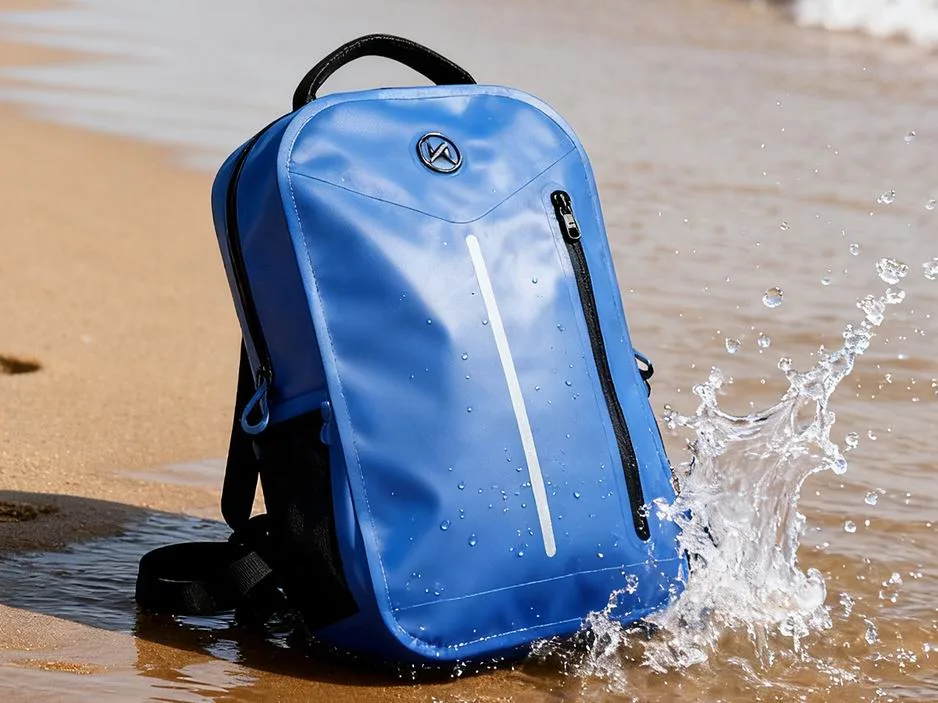
Closures during a righting sequence
The righting sequence is the hardest thirty seconds in the sport for a closure. The bag is submerged, it is full of air so it is buoyant and fighting to rise, a crew member is pulling on the mast, and the whole assembly is rotating through the water. A closure held only by a side-release buckle can be levered open by the buoyancy of the bag itself.
Three folds plus a buckle that clips across the top rather than along the side is the configuration that survives. The top-clip geometry resists the levering force, because the load from buoyancy pushes the fold closed rather than prising it apart. Bags with a side buckle work fine in a kayak and noticeably worse in a dinghy.
Trapped air deserves separate attention. A bag with air in it floats, and a floating bag in a capsized boat is a nuisance that blocks the cockpit and gets in the way of the recovery. Press the air out before the first fold, and if the bag has a purge valve, use it after packing rather than after rolling.
Hard points and shock load
Hard points on a racing bag are loaded in ways a hiking strap never is. A capsize puts a shock load on whatever the bag is clipped to, because the bag is full of air, the boat is rotating, and the water is resisting the bag in the opposite direction. A sewn webbing loop on a light bag tears at 60 to 80 kg of shock; a radio-frequency welded D-ring on a 0.5 mm film takes that load and more.
The rule for attaching is one clip to a fixed point and one to the bag, never a long tether. A long tether lets the bag accelerate before it loads the clip, and the resulting shock is several times the static weight of the bag. A short tether keeps the bag in the cockpit, limits the acceleration and keeps it out of the centreboard trunk.
| Hard point | Static load | Shock load tolerance | Fits dinghy use | Note |
|---|---|---|---|---|
| Sewn webbing loop | 25 kg | 60-80 kg | No | Tears at the stitch line |
| Bar-tacked webbing tab | 40 kg | 100-120 kg | Marginal | Check bar-tack monthly |
| Welded D-ring, 25 mm | 60 kg | 180-220 kg | Yes | Standard fleet spec |
| Welded D-ring, 40 mm | 90 kg | 250-300 kg | Yes | Coach and support boats |
| Clip through the rolled mouth | 20 kg | 50 kg | No | Deforms the fold |
Service life measured in race seasons
Years are the wrong unit for this sport. A club sailor races 40 days a year and capsizes perhaps thirty times; a training centre runs the same boats 150 days a year with far more capsizes. Both want to know how many seasons a bag will give, and the honest answer depends almost entirely on whether the bag is rinsed and stored indoors.
The figures below assume a 0.5 mm TPU laminate with welded seams and a reinforced mouth, used in saltwater. The dominant variable is not use intensity but the rinse-and-shade routine, which is worth roughly a factor of two across the whole table.
| User | Days per year | Capsizes per year | Rinsed and stored indoors | Stored in the boat |
|---|---|---|---|---|
| Club racer, weekend only | 35-45 | 20-40 | 7-9 seasons | 3-4 seasons |
| Class association fleet bag | 60-90 | 80-150 | 5-6 seasons | 2-3 seasons |
| Training centre, daily | 120-160 | 300-600 | 3-4 seasons | 1-2 seasons |
| Coach boat and safety kit | 80-120 | 10-30 | 6-8 seasons | 3-4 seasons |
| Skiff crew, high speed | 50-70 | 60-120 | 4-5 seasons | 2 seasons |
Colour, deck temperature and identification
Colour is not only a branding decision on a dinghy. A dark shell absorbs most of the incident radiation and a light shell reflects much of it, which translates into a 12 to 15 °C difference in surface temperature on the same boat in the same sun. Over 200 hours of annual exposure that difference is measurable in service life, and it also decides whether a bag is comfortable to grab.
Identification is the other half of the argument. A fleet of identical black bags is a lost twenty minutes every morning. Distinct colourways per boat or per crew role, plus a clear window for a laminated name card, turn a pile of bags into a system that a coach can read from the water. Our colour range guide covers how to build that scheme without exploding the order.
Between-regatta inspection
- Turn each bag inside out in good light and read the weld corners for a white stress line.
- Close the empty bag with three folds, squeeze it and listen for a hiss at the fold and at each corner.
- Run a thumb along the fold line for salt crystals and grit; rinse if you find either.
- Pull-test every buckle and D-ring by hand and replace anything that slips.
- Check the mouth reinforcement, which is the first place a racing bag frays.
- Log the bag out of service if a corner shows a stress line longer than 10 mm.
A five-minute inspection between regattas catches nearly everything that becomes a wet sleeping bag later, and it is the cheapest insurance in the sport. Welded TPU bags are repairable as well: a 100 x 150 mm patch and polyurethane adhesive fix punctures to 20 mm in about five minutes, which is covered step by step in the puncture repair guide.
What to specify for a fleet order
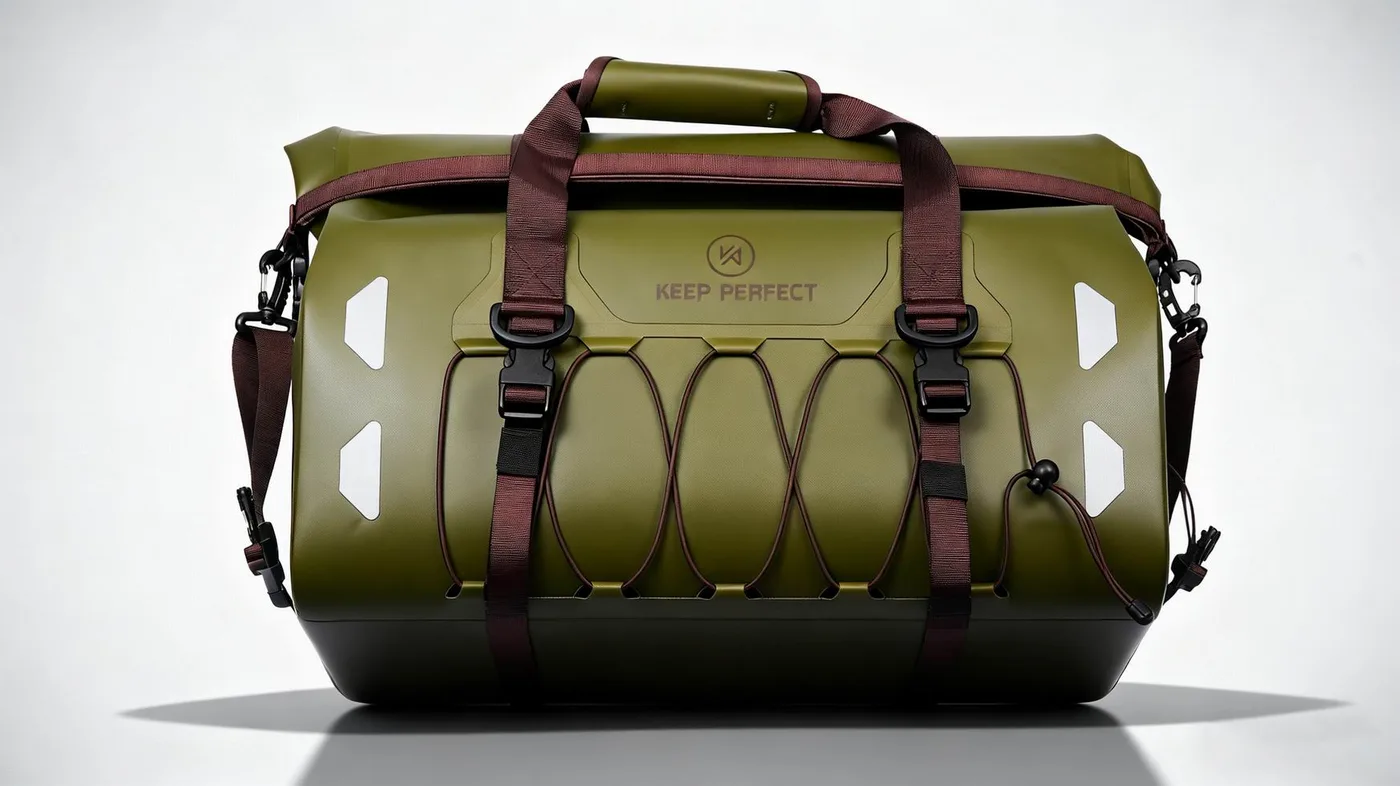
- 0.5 mm TPU laminate on a 420D or 500D face, radio-frequency welded, reinforced corners.
- Three-fold closure geometry with a top-clipping buckle, not a side buckle.
- Welded D-rings rather than sewn loops, sized to the lashing you actually use.
- A light colourway for anything that lives in a cockpit; dark only for shore kit.
- A clear window or a name panel so a fleet can be identified from the water.
- IPX7 tested and stated against a named standard, not described with adjectives.
- A patch kit with every ten bags, because field repair is normal in this sport.
- Compare the draft against the full product line before you commit.
Class associations, training centres and sailing schools turn that list into a purchasing brief, and volume, film thickness, closure geometry, colour and hard points are the five lines that decide whether the bags survive a season. Our production partner has produced waterproof bags since 2014 in an SGS-verified 4,950 m2 facility, with a 500-piece minimum, sampling in 6 to 10 working days and bulk in 35 to 50 days FOB Xiamen.
Two standards are worth naming in any brief. The IEC defines the ingress protection code in IEC 60529, so an IPX7 claim means immersion at one metre for 30 minutes rather than whatever the listing implies, and the ASTM maintains the abrasion test methods that make a wear claim checkable. Ask which method and which load a film was tested at, because a number without a method is not a specification.
For the cruising version of the same decisions, read the general dinghy sailing notes, and for the film decision in isolation see 0.3 mm versus 0.5 mm. Seam construction is compared in welded versus stitched seams, hardware in the buckle and load rating guide, and salt routine in the rinsing notes. Every size in the roll-top range shares one closure geometry, so a fleet can standardise on a single system across classes.
Frequently asked questions
Q1. Are TPU dry bags better than PVC for dinghy racing?
Yes. TPU stays flexible at 8 to 14 °C water and below freezing, has no plasticiser to migrate under UV, and welds into a continuous seam. PVC stiffens sharply below about 5 °C, which is exactly when a cold fold stops sealing properly.
Q2. What film thickness should a racing dinghy bag use?
0.5 mm. A 0.3 mm laminate abrades through at the corners within one busy season against non-slip deck, while 0.5 mm adds about 90 grams to a 20 L bag and roughly doubles abrasion life.
Q3. How much pressure does a fast skiff put on a bag?
About 54 kPa at 20 knots, which is roughly five times the 10 kPa of a static one-metre immersion test. At 10 knots it is about 13 kPa, still above the test load, which is why three folds are mandatory.
Q4. Do welded seams really outlast stitched seams?
By a wide margin in this sport. A stitched and taped seam typically reaches 80 to 150 capsize cycles before first leakage; a reinforced welded corner reaches 800 to 1,200 and fails in the fabric field, which is patchable.
Q5. Where does a dinghy dry bag fail first?
At the weld corner and at the mouth reinforcement. The corner takes the stress when a buoyant bag is dragged through the water during a righting sequence, and the mouth frays from being grabbed with wet hands.
Q6. Should a dry bag be clipped down in a dinghy?
Yes, with a short tether to a fixed point. A long tether lets a buoyant bag accelerate before it loads the clip, and the resulting shock is several times the bag weight. Never clip through the rolled mouth.
Q7. How do I stop a closure opening during a capsize?
Use a top-clipping buckle and press the air out before the first fold. Buoyancy in an air-filled bag levers a side buckle open, while a top clip is pushed closed by that same force.
Q8. Does cold water damage TPU?
Not in the cracking sense; quality laminates stay flexible to about minus 30 °C. What crews experience is a stiff fold that will not press flat, which looks like a fabric failure but is a handling one. Warm the fold for thirty seconds.
Q9. How long does a bag last in a training fleet?
Three to four seasons if rinsed and stored indoors, one to two if left in the boat. Training centres run 120 to 160 days a year with 300 to 600 capsizes, so the rinse and shade routine is worth about a factor of two.
Q10. What colour should a racing dry bag be?
Light. A dark shell in a parked dinghy cockpit reaches 60 to 65 °C within an hour; grey or mint in the same spot runs 12 to 15 °C cooler. Distinct colourways also let a coach identify boats from the water.
Q11. Is a clear window worth having on a fleet bag?
Yes for identification. A laminated name card behind a window means a pile of identical bags becomes a readable system, and the extra weld is not a meaningful risk on a bag that is not being squeezed under load.
Q12. Can I drag a loaded bag across a slipway?
No. Concrete with grit on it is the highest wear contact in the sport and will visibly damage a bag in under one season. Carry it, or use a trolley, and rinse afterwards if it does touch the ground.
Q13. What should a club specify when ordering fleet bags?
0.5 mm TPU on a 420D or 500D face, radio-frequency welded with reinforced corners, a three-fold top-clipping closure, welded D-rings, a light colourway and an IPX7 claim tied to a named standard.
Q14. How do I inspect a bag between regattas?
Turn it inside out in good light, read the weld corners for a white stress line, close it and squeeze while listening for a hiss, run a thumb along the fold for grit, pull-test the buckles and retire it if a stress line exceeds 10 mm.
Q15. Do dry bags float and get in the way of a capsize recovery?
An air-filled one does, and it is a genuine nuisance in the cockpit. Press the air out before folding and use a purge valve if the bag has one, after packing rather than after rolling.
Q16. How much does hardware matter on a dinghy bag?
More than on any other boat. A capsize puts shock load on the clip point; a sewn loop tears at 60 to 80 kg while a welded D-ring takes 180 to 220 kg. Always specify welded hard points.
People also ask
Why do dry bags wear out so fast in dinghies?
Non-slip deck, capsize shock and salt. The moulded abrasive cockpit sole abrades the film, righting sequences load the weld corners with shock, and grit carried from a slipway turns ordinary contact into grinding.
What thickness TPU is best for dinghy racing?
0.5 mm. It adds about 90 grams over 0.3 mm and roughly doubles abrasion life, which matters because wear is a surface phenomenon and most of the extra thickness is sacrificial depth.
Are welded seams necessary for racing dinghy bags?
Yes. A stitched seam depends on tape or coating to close thousands of needle holes, and a capsize squeezes the bag while it is submerged, which is the exact condition that pushes water through a pinhole.
How do you keep a dry bag from opening when a dinghy capsizes?
Three folds, a top-clipping buckle and the air pressed out before folding. Buoyancy levers a side buckle open and pushes a top clip closed, so the geometry is the difference.
Can you repair a racing dry bag at the club?
Yes, in about five minutes for punctures to 20 mm. Clean with an isopropyl wipe, key both faces lightly, apply polyurethane adhesive, press the patch and clamp it for two hours. Full cure takes 24 hours.
How many seasons should a club fleet bag last?
Five to six for class association use and three to four in a daily training centre, provided bags are rinsed and stored indoors. Leaving them in parked boats roughly halves every figure.
Need this in production volume?
QUANZHOU JUNYUAN BAGS has produced waterproof bags since 2014 in an SGS-verified 4,950 m2 facility in Fujian, China. Minimum order 500 pieces, sampling in 6–10 working days, bulk in 35–50 days, FOB Xiamen — write to service@junyuanbags.com with your spec and target market.