TPU Dry Bags for Dinghy Sailing: Durability Notes
A dinghy exposes bags to 20 to 30 knots of apparent wind, continuous spray and repeated chafe against a centreboard trunk or thwart. A build that survives this uses 0.45 to 0.55 mm TPU film on a 500D shell, radio-frequency welded seams rather than stitched ones, and welded D-rings instead of sewn loops. Expect 300 to 500 capsizes or dunkings per season to be routine, and plan for two full seasons from a mid-weight bag with weekly use before film fatigue appears at the folds.
The failure modes are specific and predictable: webbing abrades where it crosses a gunwale, closures leak when rolled over salt crystals, and UV degrades the outer face long before the membrane fails. This guide sets out the construction choices that resist each of them, the attachment geometry that survives a capsize, and the rinsing and inspection routine that distinguishes a bag lasting two seasons from one lasting eight. Every recommendation is tied to a measurable condition rather than a general impression of toughness.
- What a dinghy does to a bag
- Choosing film build and face fabric
- Why welded beats stitched in this environment
- Lash points, straps and hardware that survive a capsize
- Closure technique for long wet sessions
- Salt, sun and the care routine that decides service life
- Where bags fail first on a dinghy
- Matching bag format to boat and crew
- Cold water, wind chill and what to pack
- Testing a bag before the season starts
- Repair, replacement and fleet records
- Specifying bags for a club or class programme
- A season plan for bag durability
What a dinghy does to a bag
A sailing dinghy combines three stresses rarely found together. Spray arrives continuously at the bow, so any closure is wet for hours rather than minutes. The hull flexes and slams, which cycles every lashing and strap. Finally the boat is capsized and righted repeatedly, submerging bags under a metre of water while the crew hangs on the centreboard. A bag that only has to survive rain in a car park is not tested by any of these conditions.
Add abrasion from the surfaces themselves. Gritted nonslip deck, aluminium toe rails, hiking straps and the edge of a thwart all cut into coated fabric. The worst location is usually where a bag rests against the centreboard trunk, because the boat pivots there under load. Any durability plan should start by identifying which surface the bag actually touches, then reinforcing that zone rather than thickening the whole product.
| Stress | Typical condition | Effect on a bag | Design response |
|---|---|---|---|
| Continuous spray | 2-4 h per session | Closure stays wet, wicking risk | Three folds, cleaned roll line |
| Hull slam | Hundreds of cycles | Lashings loosen, straps stretch | Welded D-rings, cam buckles |
| Capsize submersion | 1 m, 2-10 min | Pressure at folds and welds | 0.5 mm film, continuous welds |
| Deck chafe | Gritted nonslip surface | Face yarn wear, pinholes | 500D shell, reinforced base |
| UV exposure | 400-900 h per season | Chalking, stiffening, colour fade | UV-stabilised face, shaded storage |

Choosing film build and face fabric
For dinghy sailing, 0.45 to 0.55 mm TPU laminated to a 500D woven face is the practical centre. Thinner film saves 150 to 200 g on a 20L bag but punctures too easily when a bag is shoved against a cleat or a shackle. Heavier 0.70 mm builds resist puncture well but stiffen the roll and add weight high in the boat, which matters when every kilogram affects how the hull sits in a breeze.
The face fabric deserves equal attention because abrasion usually attacks it first. A 500D weave with a tight construction resists the gritted deck better than an open 420D, and a UV-stabilised yarn slows the chalking that appears after a few hundred hours of sun. Where a bag rests against the centreboard trunk, look for a reinforced base panel or a second layer at the contact zone rather than a heavier build overall.
Why welded beats stitched in this environment
A needle hole is a capillary. Stitched seams rely on tape or coating to close those holes, and both degrade under salt, flex and sun. Radio-frequency welding fuses TPU films into a continuous bond with no perforation, so the seam is as waterproof as the panel. For a bag that spends hours wet and is periodically submerged, that difference decides whether contents stay dry in week one or week twenty.
Weld quality still varies. Look for a consistent bond width, usually 8 to 12 mm, clean corner transitions and reinforcement where webbing attaches. Corners and attachment points are where failures begin, because stress concentrates there rather than along a straight run. Our welded versus stitched comparison sets out the trade-offs, and seam integrity over service life describes how ageing appears first at those points.
Lash points, straps and hardware that survive a capsize
Attachment is the most common weak point on a sailing dinghy. Sewn loops pull out under shock load, and a bag that breaks free during a capsize becomes a recovery problem in a breeze. Welded D-rings spread load into the panel and, when correctly specified, hold shock loads far better than a stitched tab. Pair them with 20 to 25 mm webbing and a cam buckle or a screw-gate clip rated above the expected snatch load.
Geometry matters as much as strength. Lash the bag low, close to the centreline, and keep webbing away from hiking straps and the centreboard. Two points of attachment stop rotation; a single point allows the bag to swing and chafe. Route straps so they do not cross a sharp edge, and check tension every time the boat is righted, because cycles of loading and unloading slowly work a buckle loose.
| Component | Minimum specification | Why | Failure sign |
|---|---|---|---|
| Lash point | Welded D-ring, 25 mm | Spreads shock load | Lifting at the weld edge |
| Webbing | 20-25 mm polyester | Low stretch when wet | Fraying, glazed fibres |
| Buckle | Cam or ladderlock, acetal | Holds tension when wet | Slip under load |
| Clip | Screw-gate, metal | Cannot open by snagging | Corrosion or rough thread |
| Handle | Welded or bar-tacked | Survives a wet grab | Peeling from the panel |
Closure technique for long wet sessions
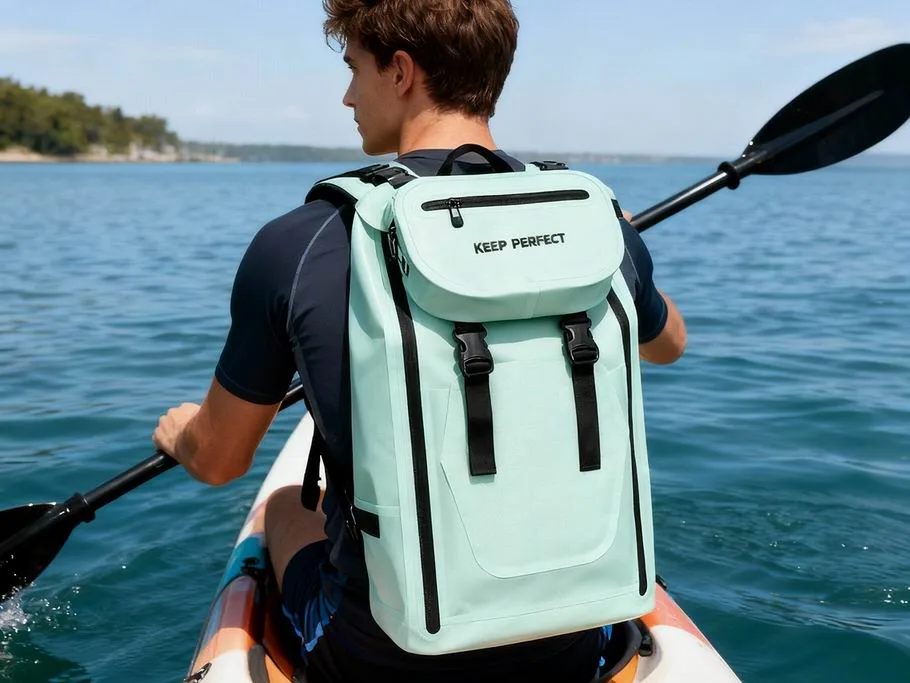
Three folds is the working standard, but technique decides whether they hold. Rinse the roll line with fresh water before closing, because salt crystals create a wicking path and abrade the film at the crease. Expel air before the first fold so the bag is not buoyant on deck, then close the buckle firmly. A bag rolled over grit will leak slowly for hours, which is exactly the failure most sailors blame on the fabric.
Pack to around 85% of nominal volume. An overfilled bag cannot make three clean folds, and the resulting closure is the single biggest cause of wet kit after a long session. Leave the mouth accessible for the items needed during the race: water, tape, a spare line. A small 2L pouch inside the main bag gives electronics two independent seals when the boat goes over.
Salt, sun and the care routine that decides service life
Salt is the quiet destroyer. Crystals left in a fold abrade the film every time the bag is opened, and dried salt on buckles makes them stiff and eventually unreliable. Rinse with fresh water after every sail, work the buckles through their travel while wet, and dry the bag open in shade. The full routine is set out in our saltwater rinsing guide, which covers what to do when no hose is available.
Ultraviolet exposure is the second factor. A season of weekend sailing easily delivers 400 to 900 hours of direct sun, and the outer face chalks and stiffens long before the membrane fails. Store bags out of sunlight, avoid leaving them on a hot deck between races, and never dry them on a radiator. Our UV damage prevention notes explain how to recognise early surface degradation before it becomes structural.
| Care step | Frequency | Time needed | Benefit |
|---|---|---|---|
| Fresh water rinse | After every sail | 3 min | Removes salt crystals |
| Buckle exercise | After every sail | 1 min | Prevents stiff or slipping hardware |
| Shaded open drying | After every sail | 2-4 h | Stops mildew and UV damage |
| Seam and corner check | Monthly | 10 min | Finds weld fatigue early |
| Full air test | Start of season | 15 min | Confirms waterproof integrity |
| Deep clean | End of season | 30 min | Prepares the bag for storage |
Where bags fail first on a dinghy
Field experience points to three locations. The first is the fold line, where repeated rolling concentrates stress and salt accelerates wear. The second is the corner welds, especially at the base where the bag sits on a gritted deck. The third is any webbing attachment, because shock loads from a capsize are far higher than the static weight of the bag suggests. Inspect these three areas monthly and you will catch nearly every developing problem.
Pinholes are the usual symptom, and they are easy to miss because they only leak under pressure. Inflate the bag, close it, and listen near the corners; a faint hiss is enough to locate a defect with soapy water. Small punctures in TPU film can be repaired, and our puncture repair guide and patch kit notes explain which damage is worth fixing and which means retirement.
Matching bag format to boat and crew
Single-handed dinghies have little storage, so one 10L to 20L bag lashed low and central is usually the whole system. A roll-top works best because it can be squeezed into a tight space and still closes cleanly. Two-handed boats allow a second small bag, one for food and water and one for spare clothing, which keeps the essentials reachable without unpacking everything on a wet deck.
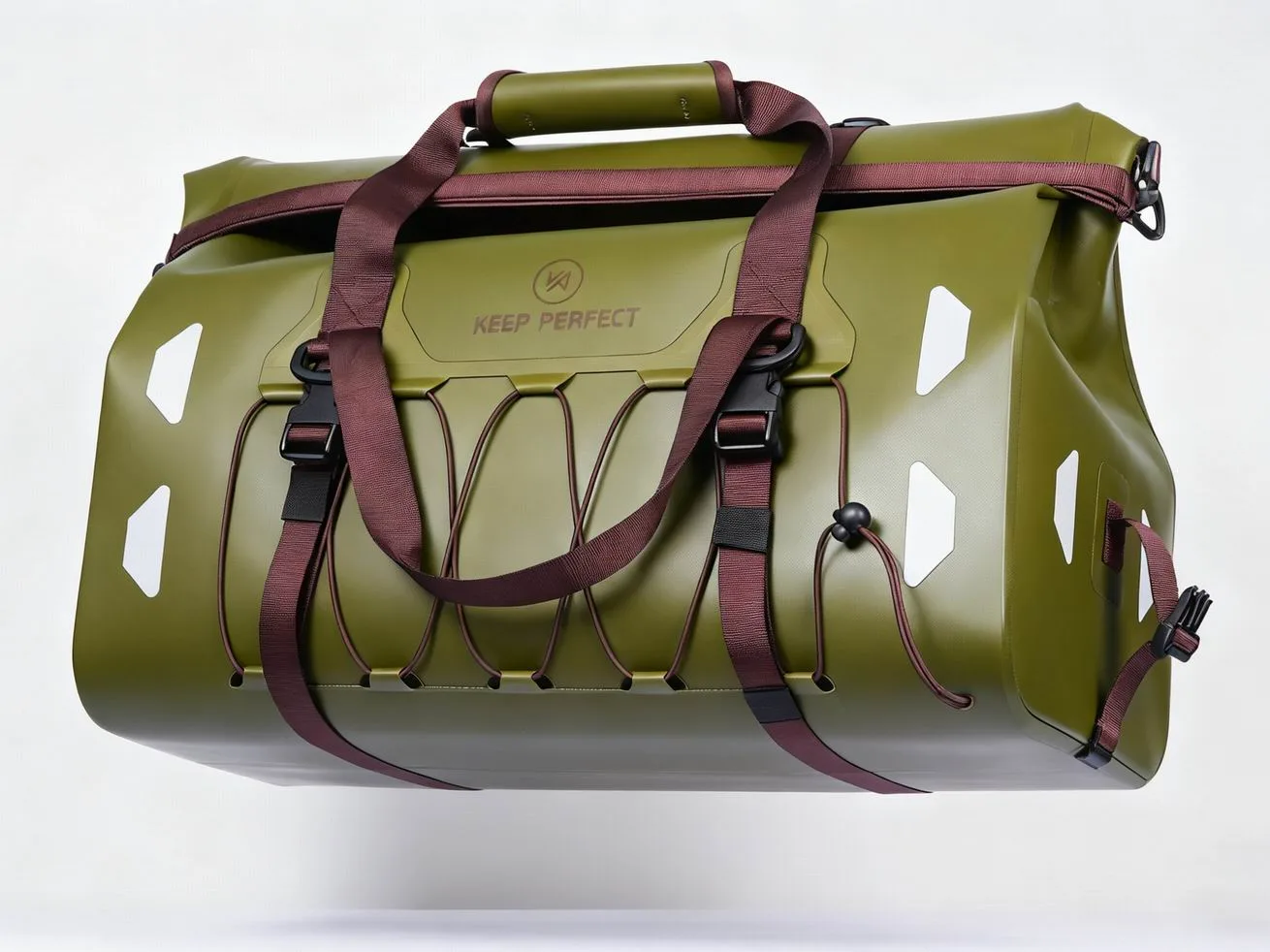
Bigger keelboat-style dinghies and training fleets can use dry duffels under a thwart or in a bow locker, where the long opening is easier to load than a narrow roll-top mouth. Backpack straps earn their place carrying kit from the car to the dinghy park, less so while sailing. Compare formats in the backpack versus duffel guide before standardising a club fleet on one shape.
| Boat type | Crew | Recommended format | Volume | Lashing |
|---|---|---|---|---|
| Single-hander, racing | 1 | Roll-top bag | 10-20 L | Two welded D-rings, low |
| Two-hander, training | 2 | Roll-top plus small pouch | 20 L plus 5 L | Under the thwart |
| Dinghy cruiser | 2-3 | Dry duffel | 40-60 L | Bow locker, loose |
| Club safety boat | 2-3 | Heavy duffel, 0.6 mm | 60-90 L | Tethered to the rail |
| Junior training fleet | 1-2 | Small roll-top, bright colour | 5-10 L | Single point, easy release |
Cold water, wind chill and what to pack
Spring and autumn sailing adds cold-water risk. Water below 15 °C reduces hand function within 20 to 30 minutes, and a wet bag that cannot be opened with cold hands is a practical problem as well as a comfort one. Choose closures that can be worked with gloves, keep essential items in an outer or top pouch, and pack a spare thermal layer in its own small bag rather than at the bottom of a large one.
Wind chill compounds the effect, because a wet crew sailing at 20 knots of apparent wind loses heat faster than the air temperature alone suggests. Carry a means of calling for help in a pocket, not in a bag. Coastal sailors in the United States can check conditions and forecasts through NOAA, and cold-water immersion guidance should be part of every club briefing. A dry bag protects gear; it does not protect a person from hypothermia.
Testing a bag before the season starts
Run three checks in the week before the first race. Fill the bag with dry paper, close it with three folds, submerge it in a bath or a clean dock tank for 30 minutes and inspect the paper. Then inflate it, seal it and leave it overnight to confirm it holds air. Finally load it to the expected race weight and shake it hard for two minutes to see whether the lashings or hardware shift.
Record the results and repeat the air test at the midpoint of the season. A bag that passed in spring and fails in August has usually developed a corner weld defect or a fold-line crack, both of which are repairable if caught early. For programmes specifying fleet equipment, a documented test method matters more than a marketing rating; the standards catalogues published by ISO help define repeatable procedures.
Repair, replacement and fleet records
Decide repair or replace by location and size. A puncture under 10 mm on a flat panel is worth patching; damage at a weld corner, along a fold line or at a webbing attachment is not, because the stress that caused it will reopen the repair. Keep a small kit aboard: TPU patches, alcohol wipes, a roller and a spare buckle. A 15-minute repair ashore saves a race day and keeps a marginal bag in service as a spare.
Fleets should log every bag with purchase date, format, film build and inspection results. A simple spreadsheet showing which bags failed and where reveals patterns quickly, such as one lashing position causing repeated corner damage. That record also supports replacement budgeting: if 40% of a fleet needs attention after 18 months, the specification or the lashing arrangement needs changing rather than the buying frequency.

Specifying bags for a club or class programme
Write the specification around the failure modes, not around a price target. State film thickness, face fabric, weld type and width, lash point construction, hardware material and the test that defines acceptance. Ask whether the closure can be worked with cold, wet hands and whether the bag can be identified by colour when several are stacked in a locker. Those details decide how the product performs long after the purchase decision.
Bulk planning should follow the sailing calendar rather than the buying calendar. Allow 6 to 10 working days for a sample once artwork and materials are approved, then 35 to 50 days for production, and hold the buffer before the first regatta rather than after it. We document production detail for welded TPU builds, and format options can be compared in the product range before a fleet order is placed.
A season plan for bag durability
Set four checkpoints. In week one, run the immersion and air tests and record lashing positions. Mid-season, inspect fold lines and corners and repair anything found. After any capsize involving a dragged or snagged bag, re-test that bag before the next outing. At the end of the season, deep clean, dry thoroughly, store loosely rolled out of sunlight, and write down what failed so next year the specification changes.
The payoff is measurable. A mid-weight TPU bag rinsed after every sail and inspected monthly commonly gives five to eight seasons of club use, while the same bag left salty and stored wet can fail within two. That difference is worth more than any upgrade in film thickness. For more on coastal kit routines, see our sun and sea storage guide, and for a wider view of material behaviour, read TPU versus PVC for dry bag fabric. Welded roll-top formats for this use are shown in the roll-top range.
Frequently asked questions
Q1. What makes TPU good for dinghy sailing bags?
TPU stays flexible when cold, welds into continuous seams and resists the repeated folding that sailing demands. A 0.45 to 0.55 mm film on a 500D face handles spray, capsize submersion and deck chafe better than thinner or much stiffer builds.
Q2. How thick should the film be for a sailing dinghy?
Around 0.45 to 0.55 mm for general club and racing use. Thinner film punctures too easily around hardware, while 0.70 mm adds weight high in the boat and makes rolling harder with wet hands.
Q3. Are welded seams necessary for sailing?
Yes. Stitched seams rely on tape or coating to close needle holes, and both degrade under salt and flex. Welded seams are continuous, so the join is as waterproof as the panel after hours of spray.
Q4. How should a dry bag be lashed in a dinghy?
Low and close to the centreline, with two attachment points so the bag cannot rotate. Use welded D-rings, 20 to 25 mm webbing and a cam buckle, and keep straps clear of hiking straps and the centreboard.
Q5. How many folds should I use on a sailing bag?
Three, after rinsing salt from the roll line and expelling most of the air. Pack to about 85% of volume so the folds are clean, because an overfilled bag is the most common cause of wet kit.
Q6. Where do sailing dry bags fail first?
At the fold line, at base corner welds and at webbing attachment points. Monthly inspection of those three areas catches nearly every developing problem before it becomes a leak under pressure.
Q7. Can a punctured TPU bag be repaired?
A puncture under 10 mm on a flat panel is worth patching. Damage on a weld corner, along a fold line or at a lash point should lead to retirement, because the stress that caused it will reopen any repair.
Q8. How long does a TPU bag last in dinghy sailing?
With rinsing after every sail, shaded drying and monthly checks, five to eight seasons of club use is realistic. Left salty and stored wet, the same bag can fail within two seasons.
Q9. Should I use a duffel or a roll-top on a dinghy?
A roll-top suits a lashed deck position because it compresses into tight spaces. A dry duffel works better under a thwart or in a bow locker, where the long opening is easier to load.
Q10. What size bag suits a single-handed dinghy?
One 10L to 20L bag lashed low and central is usually the whole system. Add a 2L pouch inside for a phone and keys so electronics have two independent seals if the boat goes over.
Q11. How do I stop salt damaging the closure?
Rinse the roll line before closing, exercise the buckles under fresh water after every sail, and dry the bag open in shade. Salt crystals in the fold abrade the film and create a wicking path.
Q12. Do I need UV protection for sailing bags?
Yes. A season can deliver 400 to 900 hours of direct sun, which chalks and stiffens the outer face. Store bags out of sunlight and never dry them on a hot deck or a radiator.
Q13. How do I test a bag before the season?
Fill it with dry paper, submerge it for 30 minutes and check the paper, then inflate it overnight to confirm air retention. Finish by loading it to race weight and shaking it to check the lashings.
Q14. Is a dry bag a buoyancy aid when capsized?
No. A sealed bag may support gear briefly, but it has no certified force and no head support. Wear an approved buoyancy aid and keep a means of calling for help on your person.
Q15. What should a club record about its bags?
Purchase date, format, film build, lashing position and inspection results. Patterns in that record show whether the specification or the lashing arrangement needs to change.
Q16. How should bags be stored between seasons?
Clean thoroughly, dry completely with the mouth open, then store loosely rolled in a dark, cool place. Avoid flat folds that create permanent creases and never store a bag while it is damp.
People also ask
Are TPU dry bags good for sailing?
They are well suited: TPU welds into continuous seams, stays flexible in cold wind and tolerates repeated folding. Choose 0.45 to 0.55 mm film on a 500D face with welded D-rings for deck lashing.
How do you stop a dry bag chafing on a dinghy?
Identify the contact surface, usually the centreboard trunk or a gritted deck, and use a reinforced base panel or a protective layer there. Keep lashings tight so the bag cannot move and rub.
Why do sailing dry bags leak after a few months?
Usually from salt crystals in the roll line, an overfilled bag that cannot make three clean folds, or a corner weld working loose. Rinse, repack to 85% and re-test with an air check.
What is the best dry bag size for dinghy sailing?
Ten to twenty litres for a single-hander, with a small pouch for electronics. Two-handed boats can add a second 5L bag for food and water so essentials stay reachable on a wet deck.
How often should sailing dry bags be inspected?
Check fold lines, corner welds and lash points monthly during the season, and run a full immersion and air test at the start of each season and after any capsize involving a snagged bag.
Can welded TPU seams be repaired at a club?
Small punctures on flat panels can be patched with the right kit, but weld or corner damage is not reliably repairable. Retire those bags and use them for shore storage only.
Need this in production volume?
QUANZHOU JUNYUAN BAGS has produced waterproof bags since 2014 in an SGS-verified 4,950 m2 facility in Fujian, China. Minimum order 500 pieces, sampling in 6–10 working days, bulk in 35–50 days, FOB Xiamen — write to service@junyuanbags.com with your spec and target market.