Do Dry Bags Keep Water In as Well as Out?
Largely yes, with one important exception. The welded shell of a dry bag is symmetric: a radio-frequency weld and a 0.5 mm TPU film resist water moving in either direction, and a hydrostatic head of 10,000 mm works both ways. The roll-top closure is not symmetric. Three folds are shaped so that outside pressure presses the folds tighter, which is why the same closure that survives 30 minutes at one metre can dribble when a bag full of water is squeezed, laid on its side or carried by one corner.
So the practical answer is that a dry bag holds water in when it is upright, static and not compressed, and weeps when it is not. A 20L roll-top filled to 12 litres and stood on a boat floor will hold for hours; the same bag carried by its strap through a campsite will wet your leg. This guide explains the physics, gives the measured limits, and shows what to use instead when keeping water in is the actual job.
- The short answer, and the one exception
- Why the shell is bidirectional and the closure is not
- How much pressure the fold actually sees
- Using a dry bag as a bucket or a wash basin
- Wet kit: the case where people get it wrong
- Ice, coolers and the melt-water question
- Condensation: water that appears without any leak
- Zippered and bucket formats: when holding water in is the job
- How to test whether your bag holds water
- What the ratings do and do not say
- Diagnosing a leak before you blame the bag
- Care after using a bag with water inside
- The decision rule
The short answer, and the one exception
Water crossing a barrier is governed by pressure difference and by the path available to it. A welded seam and an intact film offer no path in either direction, so the fabric is genuinely bidirectional. The closure is the asymmetry, and it is directional by design: the fold is rolled downward and inward so that external water pushing on the outside of the roll compresses the layers together. Reverse the direction and the same pressure opens the layers apart.
That single piece of geometry explains every anecdote on the subject. A dry bag used as a bucket on a calm deck works. The same bag slung over a shoulder with 8 litres of water in it drips from the fold within a minute, because the water is sitting against the inside of the roll and the weight of the load is pulling the fold open at the buckle end. It is not a defect; it is the closure doing the job it was shaped for.
The second caveat is certification. An IPX7 rating is a test of ingress under IEC 60529: the bag is immersed and then opened and checked for water inside. Nothing in that standard measures egress, so an IPX7 bag has no certified ability to hold water in, even though in practice most welded bags will do so under static conditions.
Why the shell is bidirectional and the closure is not
Consider what happens to each part of the bag when there is water on one side. The film carries load the same way regardless of which face is wet; a 0.5 mm TPU laminate bonded to 420D nylon does not know or care about direction. The weld is a fused region of the same two films, so it is a single piece of material rather than a joint, and hydrostatic pressure acts on it identically from either side.
The closure is a mechanical seal made by folding, and folding creates a labyrinth rather than a bond. Water trying to get in has to travel up and over three folds against gravity and against the compression created by the roll. Water trying to get out has to do the same, which is why a static upright bag holds well, but any force that deforms the roll shortens the labyrinth dramatically. Squeezing a full bag is the fastest way to make it leak outward.
How much pressure the fold actually sees
The numbers here are small and that is the surprise. Water pressure rises by about 0.1 bar per metre of depth, so a bag submerged to one metre sees 0.1 bar pressing inward on the closure, and the folds tighten. A bag lying on its side with 12 litres of water inside sees almost no static pressure at the fold unless the water level reaches it, but if you pick that bag up by one corner, the local pressure at the lowest point of the roll briefly exceeds 0.05 bar from the weight of the water alone.
Movement is the multiplier. Carrying a bag of water generates slosh, and slosh produces short pressure spikes several times the static head. A 20L bag carried at walking pace can see momentary spikes around 0.15 bar at the fold, which is more than a one-metre immersion applies, and it arrives as a pulse rather than a steady load. That is why a bag that held perfectly while you packed it starts weeping as soon as you walk.
| Situation | Direction of water | Pressure at the fold | Result | Practical verdict |
|---|---|---|---|---|
| Immersed at 1 m | Inward | 0.10 bar steady | Folds tighten | Holds, as rated |
| Standing upright, filled | Outward | 0.02-0.04 bar | Slow creep at fold | Holds for hours |
| Laid on its side, 60% full | Outward | 0.01-0.03 bar | Weeps if level reaches fold | Risky |
| Carried by one strap | Outward | 0.10-0.15 bar spikes | Pulses open the roll | Leaks within a minute |
| Squeezed in a car boot | Outward | 0.20 bar or more | Labyrinth collapses | Leaks immediately |
| Frozen as an ice block | Outward | Near zero when solid | Holds, then weeps on thaw | Holds until it melts |
Using a dry bag as a bucket or a wash basin
This is the common case and it mostly works. Fill a 20L roll-top to about 60%, which is roughly 12 litres, roll three folds, clip the buckle loosely or not at all, and set it on a flat surface. The water sits below the fold line, the fold is not under load, and the bag becomes a perfectly serviceable wash basin, a foot bath or a container for soaking a wetsuit. On a boat deck it is better than a rigid bucket because it stows flat when empty.
Three rules make the difference between works and damp sleeping bag. Keep the fill at 60% or less so the water never reaches the fold. Set the bag down flat rather than propping it at an angle. And lift it with two hands under the base, never by the strap, because lifting by the strap is exactly the loading case that opens the roll.
Wet kit: the case where people get it wrong
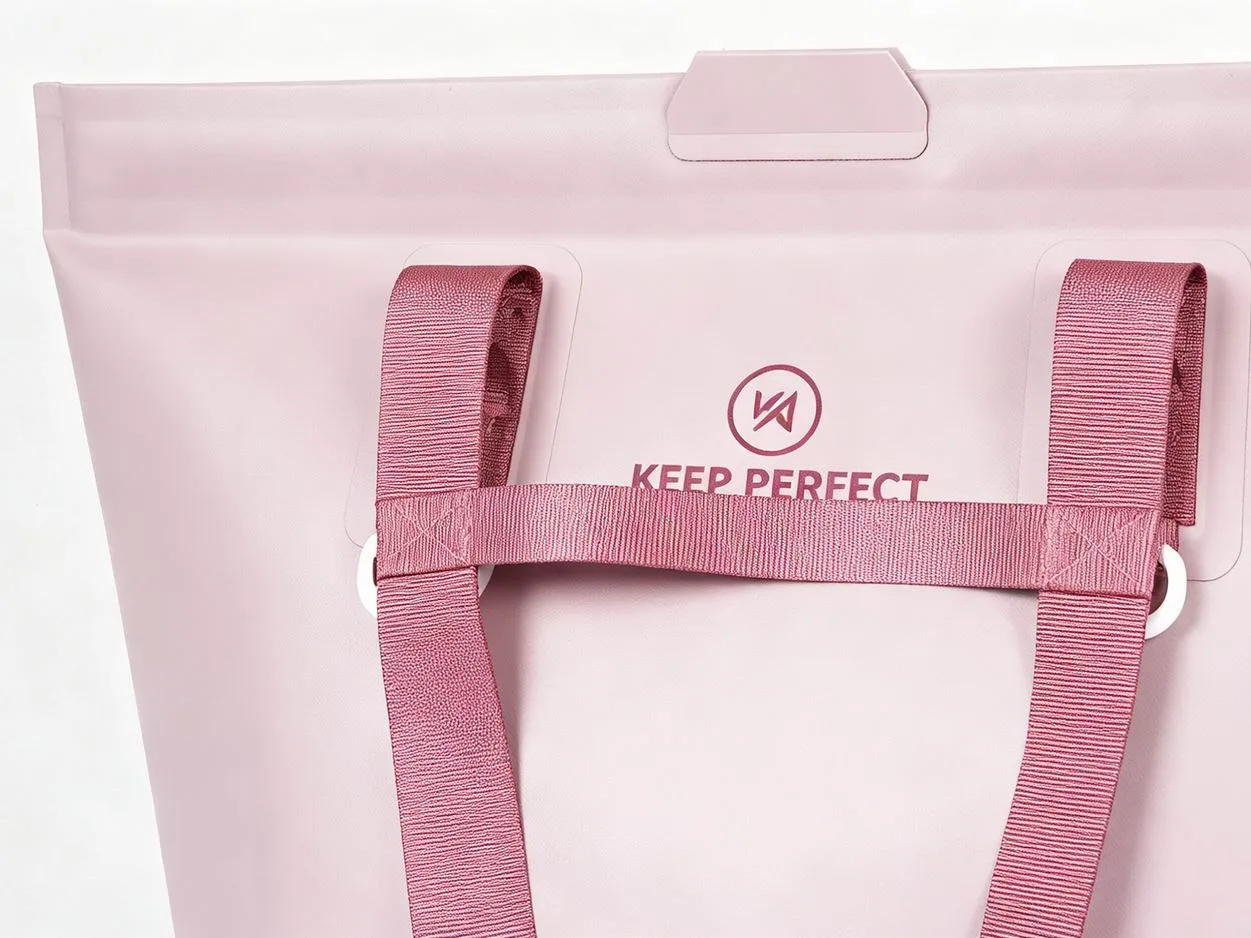
Putting a wet swimsuit or a soaked rain shell into a dry bag is the most common misuse of a bidirectional seal. The item holds perhaps 300 ml of water, and over an hour that water drains out of the fabric, pools at the bottom of the bag and starts to wick along the fold. The bag does not fail; the water simply finds the lowest point of the roll and works its way along it. Park the bag on its side in a car boot and it will leave a puddle.
The fix is a dedicated wet bag, and there are two good options. A bucket-style bag with a stiffened base and a drainage grommet keeps the water away from the closure entirely and can be hosed out. Alternatively, use a separate small roll-top for wet items, squeeze the air out, and keep it upright in a holder or a crate. Both are cheap; what does not work is putting wet kit in with dry kit and hoping.
There is a third option worth knowing for a long drive: wring the item in a towel first. A towel-wrung swimsuit retains about 60 ml rather than 300 ml, and 60 ml will sit in a corner without reaching the fold of a 10L bag. That is often enough to make the difference on a two-hour transfer.
Ice, coolers and the melt-water question
Dry bags are sold as coolers and the claim is mostly fair, because the failure case is different. Ice is solid, so it applies no hydrostatic pressure until it melts, and the melt water that forms sits at the bottom of the bag well below the fold. A 20L bag with 4 kg of ice and six cans holds for a day in shade, and by the time the ice has fully melted you typically have 4 litres of water in a 20L bag, which is only 20% full.
The risk arrives later, when someone picks the bag up. At 20% fill the water level is low and safe; once melt water plus warmer contents reaches roughly 60% of the volume, carrying the bag becomes the leak case described above. Decant the melt water through the mouth before you move the bag, or move it in a crate. Our cooler guide covers the thermal side, including the insulation figures.
| Use case | Water volume | Fill level | Holds? | What to do instead |
|---|---|---|---|---|
| Wash basin on a deck | 12 L in a 20 L bag | 60% | Yes, static | Leave it standing, lift with two hands |
| Wet swimsuit in transit | 0.3 L | Under 5% | Yes if upright | Wring in a towel, use a wet bag |
| Ice and drinks all day | 4 L melt water | 20% | Yes until moved | Decant before carrying |
| Soaking a wetsuit overnight | 10 L | 50% | Yes, static | Use a bucket format with a base |
| Carrying water to camp | 8 L in a 10 L bag | 80% | No | Use a rigid container or a bladder |
| Emergency water carrier | 15 L | 75% | Briefly | Two hands, short distance, upright |
Condensation: water that appears without any leak
A bag that has never been near a puddle can still be wet inside, and that surprises people enough to think the seal has failed. Warm air holds more water than cold air: air at 30 °C and 90% humidity carries about 27 g of water per cubic metre, and when that air cools to 15 °C overnight much of it condenses on the coolest surface, which is the inside of the bag. A 20L bag can generate 0.3 to 0.5 ml of visible condensation in a night.
The same mechanism explains wet gear after a temperature change. Kit that is damp from sweat, sealed into a bag at 25 °C and left in a 10 °C tent, will deposit moisture on the inside film and then reabsorb it into fabric. Nothing leaked. The fix is ventilation and a sachet: dry the contents before packing, leave a little air space, and add 10 g of indicating silica per 10 litres if the bag will be sealed for days.
Condensation is also the reason a bag used as a water carrier in cold conditions can appear to weep from the outside. Water vapour migrating through the film is negligible, but vapour condensing on a cold outer surface is not, and it is easily mistaken for a leak. Wipe the outside dry, leave the bag for an hour and check again before you condemn the seam.
Zippered and bucket formats: when holding water in is the job
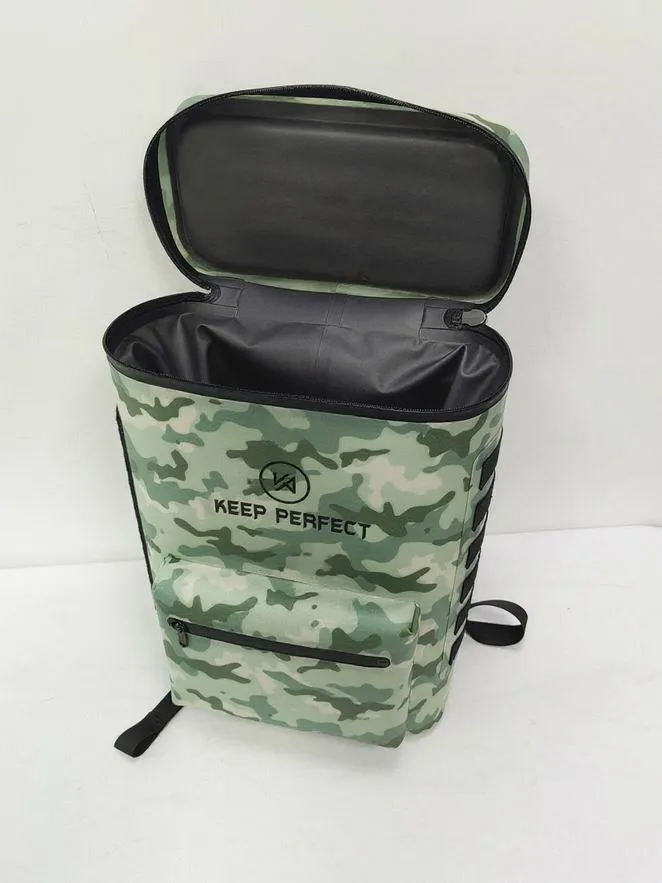
If keeping water in is a regular requirement rather than an occasional convenience, buy for that job. A bucket-format bag with a welded base and a stiff collar holds water standing and is easy to pour from. A bag with a waterproof zip closes along a straight line rather than a roll, and a good welded zip will hold water in when the bag is upright; it will still weep if you squeeze it, because no closure survives compression.
A roll-top with a purge valve behaves slightly differently again. The valve is designed to let air out, so it is a one-way path that will also pass water under pressure. If you plan to carry water, choose a bag with no valve, or close the valve before you fill it. This is one of the few cases where a feature that helps the primary job actively hurts the secondary one.
For genuine water carriage over distance, the honest answer is that a rigid container or a hydration bladder is simply better. A dry bag is a compromise that works for a few hundred metres on flat ground. Our valve comparison and the bucket versus roll-top guide both cover this choice in more detail.
How to test whether your bag holds water
- Stand the empty bag upright and fill it to 60% of its stated volume with water at room temperature.
- Roll three folds, clip the buckle loosely, and set the bag on a flat, dry surface.
- Mark the water level, leave it for four hours, and check the floor and the outside of the fold.
- Lift it with two hands under the base and carry it 20 m on the flat, then check the fold again.
- Finally lay it on its side for ten minutes with the fold at the low edge and look for a drip.
That sequence separates the three cases cleanly. Most welded bags pass the first two steps and fail the fifth, which tells you the bag is fine as a basin and unsuitable as a carrier. Nothing about that result means the bag is faulty; it means the closure was shaped for ingress. If it fails step two, however, you do have a problem with the fold line or a creased mouth, and that is worth fixing before a trip.
Do the test at the temperature you will use the bag at. A film that is supple at 20 °C is noticeably stiffer at 5 °C, and a stiff fold does not conform as well, so a bag that holds in a warm kitchen can weep on a cold morning. Allow ten extra minutes for the film to relax after rolling.
What the ratings do and do not say
Ingress protection grades are defined in IEC 60529 and they measure one direction only. IPX6 is a jet test, IPX7 is 30 minutes at one metre, and IPX8 is a depth agreed with the tester. Every one of those is water going in. There is no egress grade, and there is no requirement in the standard that a bag behave symmetrically, so a maker cannot honestly claim an IPX rating for holding water in.
Hydrostatic head is closer to symmetric and is worth quoting for this question. A laminate tested to 10,000 mm of water column resists a column of that height regardless of which face is loaded, and a welded seam tested to the same figure behaves the same way. The ISO textile test series covers the method, and it is the number to ask for if bidirectional performance genuinely matters.
For anyone planning around water on boats or at the coast, tidal and depth context matters too. A bag left on a drying mooring or a floodable deck is subject to far more than 0.1 bar once waves and weight combine, and tidal predictions published by NOAA are the sensible reference for planning in US waters. Both directions of the seal matter more when the bag is moving.

Diagnosing a leak before you blame the bag
Most outward leaks are traced to one of five sources and only one of them is a fault. Working through them in order saves a good bag from being thrown away. Start with the roll itself, because a fold that was closed off-centre leaves a channel at the buckle end that drips under the slightest load. Re-roll from the centre outward and the drip usually disappears.
The last two rows of the table are the ones people misread. Water that appears only when the bag is carried is normal directional behaviour, not a defect, and dampness inside a dry bag in humid weather is condensation. Both get bags retired unnecessarily every season. Test before you condemn: a static four-hour test and a dry overnight test with silica separate the two cases in a single evening.
| Symptom | Likely source | Test | Fix |
|---|---|---|---|
| Drip at the buckle end | Fold rolled off-centre | Air squeeze, listen for a hiss | Re-roll from the centre outward |
| Slow weep along the fold | Grit or a hard crease | Run a thumb along the fold line | Rinse, warm the film, re-roll |
| Water at a base corner | Weld cold spot or puncture | Submerge and watch for bubbles | Patch with TPU film or retire |
| Leak only when carried | Normal directional behaviour | Static four-hour test | Carry upright with two hands |
| Damp inside, dry outside | Condensation | Overnight dry test with silica | Ventilate, add 10 g silica |
| Water through the valve | Valve open or fouled | Blow into the valve body | Close it, or service the seal |
Care after using a bag with water inside
A bag that has held water needs the same care as one that has been in the sea, and one extra step. Empty it completely, then turn it inside out if the mouth allows, because water left in the fold line will sit there for days and eventually soften the film at the crease. Dry in shade with the mouth open and the fold unfolded, not rolled.
Check the fold line for mineral deposits if you filled it with hard water. A white crust along the fold is a salt or lime deposit that will hold the fold apart by a fraction of a millimetre, which is enough to compromise the seal on the next trip. Wipe it with diluted white vinegar at one part to three parts water, rinse, and dry thoroughly.
Finally, store it loose. A bag that has been used wet and then stored rolled for a month will develop a permanent set in the fold, and a fold with a memory does not seal as well. Store it flat or loosely rolled, with the buckle unclipped, and the closure will be as good next season as it was this one.
The decision rule
- Static and upright, filled to 60% or less: a welded roll-top holds water in reliably.
- Carried, squeezed or laid on its side with water at the fold: expect it to weep.
- Wet kit in transit: use a separate wet bag, and wring items in a towel first.
- Ice and melt water: fine all day standing, decant before you move the bag.
- Regular water carriage: buy a bucket format or a rigid container instead.
- Sealed for days in humid heat: add 10 g of indicating silica per 10 litres.
- Any bag with a purge valve: close the valve before filling, or pick a valveless bag.
- Compare formats against the full product line before you buy.
That rule reduces to one sentence: a dry bag holds water in under the conditions in which you would use a bucket, and not under the conditions in which you would use a jerry can. If your use case is the second one, no amount of film thickness changes the answer, because the limit is the closure geometry rather than the material.
Our own waterproof line has been produced since 2014 in an SGS-verified 4,950 m2 facility in Fujian, with seven production lines and a monthly capacity of 200,000 pieces, and the closure geometry is the same across every size from 5L to 90L so that behaviour is predictable whichever capacity you pick. Sampling takes 6 to 10 working days with bulk at 35 to 50 days.
Two further readings finish the picture. Our guide to the three-fold roll explains why the fold is directional in the first place, and the condensation guide covers the water that appears inside a sealed bag without any leak at all. For wet kit specifically, the wet storage notes give the packing routine that keeps the fold dry.
Frequently asked questions
Q1. Do dry bags keep water in?
Yes when upright, static and filled to about 60% or less. The welded film resists water in both directions, but the roll-top fold is directional, so the bag weeps if it is squeezed, carried by one strap or laid on its side with water at the fold.
Q2. Why is the closure directional?
Three folds are rolled so outside pressure compresses the layers together. Water inside pushing outward does the opposite, and compression or slosh collapses roughly 60 mm of contact path, which is why a submerged bag holds and a carried one leaks.
Q3. Can I use a dry bag as a bucket?
Yes. Fill a 20L bag to about 12 litres, roll three folds, set it flat and lift it with two hands under the base. It works as a wash basin or a soak container and stows flat when empty, which is better than a rigid bucket on a boat.
Q4. Will a dry bag hold water if I carry it?
Not reliably. A 20L bag carried at walking pace sees pressure spikes around 0.15 bar at the fold, more than a one-metre immersion applies, and slosh pulses open the roll within about a minute.
Q5. Does an IPX7 rating mean the bag holds water in?
No. IEC 60529 measures ingress only, so IPX7 certifies that water stayed out during 30 minutes at one metre. There is no egress grade in the standard, and no maker can honestly claim an IPX rating for holding water in.
Q6. Is the fabric itself bidirectional?
Yes. A 0.5 mm TPU laminate and a radio-frequency weld form a single fused piece with no path in either direction, and a hydrostatic head of 10,000 mm applies regardless of which face is loaded. The closure is the only asymmetric part.
Q7. Can I put a wet swimsuit in a dry bag?
You can, but wring it in a towel first and keep the bag upright. A wet swimsuit holds about 300 ml, which pools at the bottom and wicks along the fold; wrung in a towel it holds about 60 ml and stays in a corner.
Q8. Why is my dry bag wet inside when it never got wet?
Condensation. Air at 30 °C and 90% humidity carries about 27 g of water per cubic metre, and cooling it overnight deposits moisture on the inside film. A 20L bag can generate 0.3 to 0.5 ml overnight with no leak at all.
Q9. Can a dry bag be used as a cooler with ice?
Yes. Ice applies no pressure until it melts, and 4 kg of ice produces about 4 litres of water in a 20L bag, only 20% full. Decant the melt water before you move it, because once it reaches roughly 60% the carrying case applies.
Q10. Should I choose a bag with a purge valve for carrying water?
No. A purge valve is a one-way path for air that will also pass water under pressure. Choose a valveless bag for holding water in, or close the valve before you fill it.
Q11. Which format is best for holding water?
A bucket format with a welded base and a stiff collar, or a bag with a waterproof zip. Both hold water standing; neither survives being squeezed, because no closure does. For regular carriage use a rigid container.
Q12. How do I test whether my bag holds water?
Fill it to 60%, roll three folds, set it flat for four hours, then carry it 20 m and lay it on its side for ten minutes. Most welded bags pass the first two steps and fail the last, which is normal rather than a fault.
Q13. Does temperature change whether a bag holds water?
Yes. A film that is supple at 20 °C is stiffer at 5 °C, and a stiff fold conforms less well, so a bag that holds in a warm kitchen can weep on a cold morning. Allow ten minutes for the film to relax after rolling.
Q14. How do I care for a bag that has held water?
Empty it, turn it inside out if the mouth allows, and dry it in shade with the fold unfolded. Wipe any white mineral crust off the fold with diluted vinegar at one part to three, then store the bag loose and unbuckled.
Q15. How much pressure does the fold see when submerged?
About 0.1 bar per metre of depth, so 0.10 bar at one metre pressing inward, which tightens the folds. The same bag squeezed in a car boot sees 0.20 bar or more pushing outward, which is why inward and outward behave differently.
Q16. Will a welded seam leak outwards if the bag is full?
Rarely. The weld is a fused region with no thread channel and it behaves identically in both directions. Outward leaks start at the fold or at a valve, not at the seam, which is the strongest part of the bag.
People also ask
Are dry bags watertight in both directions?
The shell is, the closure is not. Film and weld resist pressure from either side, while the roll-top fold is shaped so outside pressure compresses it and inside pressure opens it, so a static upright bag holds and a squeezed one weeps.
Can you carry water in a dry bag?
Only statically. A 20L bag filled to 12 litres and left standing holds for hours, but carrying it produces slosh spikes around 0.15 bar at the fold and it will leak within a minute. Use a rigid container for distance.
Why does my dry bag leak from the top when it is full of water?
Because the roll is directional. Water inside pushes the folds apart, and movement or squeezing collapses about 60 mm of contact path. It is not a defect; the closure was designed to resist ingress, not egress under load.
Is a dry bag a substitute for a bucket?
For standing water, yes. Fill to 60%, keep it flat and lift with two hands under the base, and it works as a wash basin or soak container. For pouring, carrying or repeated handling, a bucket format with a stiff collar is better.
Does IPX7 mean a bag holds water in?
No. IEC 60529 tests ingress only, so the rating certifies that water stayed out during 30 minutes at one metre. There is no egress grade, and hydrostatic head is the figure to ask for if bidirectional behaviour matters.
Why is there water inside a sealed dry bag?
Condensation, not a leak. Warm humid air holds about 27 g of water per cubic metre at 30 °C and 90% humidity, and cooling deposits it on the inside film. Dry contents before packing and add 10 g of silica per 10 litres.
Need this in production volume?
QUANZHOU JUNYUAN BAGS has produced waterproof bags since 2014 in an SGS-verified 4,950 m2 facility in Fujian, China. Minimum order 500 pieces, sampling in 6–10 working days, bulk in 35–50 days, FOB Xiamen — write to service@junyuanbags.com with your spec and target market.