Wet-Weather Kit for Ice Fishing
On a frozen lake the wet threat is not snow, it is slush. A 20 cm auger through 60 cm of ice produces about 8 litres of slush per hole, and a day of moving between six holes puts 40 to 50 litres of freezing water onto the ice surface around you, into boot tops and onto the floor of a shelter. At minus 12 °C that water does not drain or evaporate; it refreezes into a rough surface that abrades gear and soaks anything left standing in it.
A working kit therefore separates wet from dry twice: once at the shelter door and once inside every bag. Two roll-top bags per person, one for dry spares that never open and one for wet outer layers, plus a small inner bag for electronics kept near body heat, covers a full day at minus 12 °C. The numbers below cover slush volumes, cold-crack limits, battery capacity loss by temperature and a load plan that has been tested on a 1.5 m sled hauling 45 kg.
- Slush, not snow: what actually wets your kit
- Temperature bands and what each one does to gear
- Cold crack: why the film choice matters here
- The two-bag system: dry spares and wet layers
- Electronics and the body-heat pouch
- Condensation: the water that arrives from inside
- Sled organisation: zones for dry, damp and wet
- Closures with gloves on
- Keeping the shelter floor and the hole dry
- A load plan for a full day at minus 12 °C
- Immersion: planning for the worst case
- Boots, gloves and the wet-gear routine
- Post-trip drying and storage
Slush, not snow: what actually wets your kit
Snow on a frozen lake is manageable because it brushes off and stays cold. Slush is different. It forms when snow load flexes the ice sheet and lake water pushes up through cracks, heater holes and old auger holes, then mixes with the snow above. The result is a 2 to 8 cm layer of ice-water slurry at 0 °C sitting on a surface that is 10 to 20 °C below freezing, which means it refreezes the moment it stops being disturbed.
That behaviour drives every decision in this guide. Slush wicks upward into fabric by capillary action, so a bag standing in it is wet within ten minutes regardless of how waterproof the base is, because the water comes over the top of the fold. It refreezes around buckles and zips, so a closure left in slush cannot be opened until it is thawed. And it adds weight: a pair of boots that weighs 1.2 kg dry carries 600 to 900 g of frozen slush home.
The practical response is elevation and separation. Nothing that must stay dry is ever placed on the ice surface; it stays in the sled, on a mat, or on a raised shelf inside the shelter. Everything that has been wetted goes into one designated bag that is expected to be wet, and that bag is the only one allowed to touch the floor. It is a simple rule and it is the difference between a comfortable day and a miserable one.
Temperature bands and what each one does to gear
Ice fishing spans a wide temperature range and the failure mode changes with it. Near freezing, the problem is liquid water everywhere. Between minus 5 and minus 15 °C, slush refreezes fast and closures start to stiffen. Below minus 20 °C, polymers approach their glass transition, batteries lose a large share of their capacity, and any moisture on skin becomes a hazard within minutes.
Plan the kit for the coldest hour of the day rather than the average. A morning at minus 6 °C that ends at minus 22 °C at dusk needs the battery strategy and the closure strategy of the colder figure, because that is when you are packing up, tired, and most likely to make a mistake with a buckle you cannot feel through a glove.
| Air temperature | Slush behaviour | Closure and fabric risk | Battery capacity retained | Kit priority |
|---|---|---|---|---|
| 0 to -5 °C | Liquid, wicks freely | Water over the fold line | 85-90% | Elevation and a mat |
| -5 to -12 °C | Refreezes in 20-40 min | Buckles stiffen, slush ices zips | 70-85% | Two-bag separation |
| -12 to -20 °C | Refreezes in 5-15 min | PVC hardens, TPU still flexible | 55-70% | Body-heat electronics pouch |
| -20 to -30 °C | Freezes almost instantly | Frozen closures need thawing | 40-55% | Spare cells inside the jacket |
| Below -30 °C | No liquid phase | Polymers near glass transition | 30-40% | Short sessions, redundancy |

Cold crack: why the film choice matters here
Every polymer has a temperature at which it stops being flexible and starts behaving like a rigid sheet. Polyether-based TPU keeps its flexibility down to roughly minus 30 to minus 40 °C, which is colder than any ice fishing day anyone fishes voluntarily. PVC-coated fabric stiffens noticeably below about 0 °C and becomes board-like by minus 15 °C, and because ice fishing involves folding the bag top at least twice a day, that stiffening concentrates exactly where the seal is made.
The failure looks like a leak and is actually a crack. A PVC bag folded at minus 20 °C develops a white stress line along the fold, and once that line appears the film has lost its ability to recover flat, so every subsequent fold seals a little worse. A TPU bag folded at the same temperature rolls normally and recovers. This is why cold-weather anglers who switch to TPU report the change as a waterproofing improvement when what they actually bought was a lower glass transition temperature.
Weld behaviour follows the film. A radio-frequency weld on TPU has essentially the same cold flexibility as the parent material, so the seam does not become the weak point in the cold. On a PVC-coated fabric the coating and the weld behave differently at low temperature, and the seam line is where a stiffened bag usually splits. Our cold crack data gives the measured figures by formulation, and freezing conditions guide covers the same question more broadly.
The two-bag system: dry spares and wet layers
Assign one bag per person to spares and never open it unless someone goes through the ice. It holds a complete change of base layer, a mid layer, dry socks, a hat and a pair of mittens, packed at home and compressed so it takes under 12 litres. The second bag is the wet bag: it takes outer layers, wet gloves and anything that has been in slush, and it lives on the shelter floor where it is expected to be wet.
The discipline is the point. A single bag used for both jobs becomes a damp bag holding damp spares, which is worse than no bag at all because it looks like it is doing something. Keep the spares bag closed, elevated on a shelf or a sled, and identifiable by colour so nobody opens it by mistake in a dim shelter. A 20L roll-top in a bright shade with the word spare marked on it in permanent marker is the standard field solution.
Electronics and the body-heat pouch
Lithium cells do not fail in the cold, they underperform. A phone that reads 100% indoors can show 55% of usable capacity at minus 20 °C, and the drop is reversible: warm it back up and most of the capacity returns. A cell that is genuinely cold also cannot deliver high current, which is why a phone shuts down at 30% in the cold and then reads 30% again once it has warmed inside a jacket.
The working strategy is a chest pouch. Keep the phone, a spare power bank and the car keys in an inner jacket pocket or a small roll-top worn under the outer layer, where ambient temperature is 25 to 30 °C rather than minus 15 °C. Keep a camera or a flasher unit in its own bag inside the shelter, and bring it out only when in use. Anything left on the ice surface for an hour will be too cold to trust when you need it.
| Device | Usable capacity at -10 °C | At -20 °C | Where to keep it | Recovery time indoors |
|---|---|---|---|---|
| Phone, lithium polymer | 80-85% | 55-65% | Inner jacket pocket | 10-15 min |
| Power bank, 10,000 mAh | 70-80% | 45-55% | Inner jacket pocket | 20-30 min |
| Headlamp, lithium AA | 85-90% | 70-80% | Hat band or pocket | 10 min |
| Headlamp, alkaline AA | 50-60% | 25-35% | Spare cells inside the jacket | Not recoverable |
| Fish finder battery, SLA | 60-70% | 40-50% | Insulated box in the shelter | 2-4 h |
| Camera body and spare cells | 75-85% | 50-60% | Inside the shelter bag | 30-45 min |
Condensation: the water that arrives from inside
A dry bag is a vapour barrier, which is a benefit outdoors and a problem when warm, damp kit goes inside it. A fleece worn for two hours holds 100 to 200 g of moisture; seal it in a welded chamber at minus 15 °C and that moisture migrates to the coldest surface, which is the inside of the film, where it condenses and then freezes as a frost layer. Open the bag the next morning and you find ice crystals on the walls and a damp fleece.
Two habits fix it. Let damp layers air-dry in the shelter before they go into any bag, using the warmth of a heater for ten minutes rather than sealing them wet. And when a bag must hold damp kit, leave the top rolled to two folds rather than three, which slows the vapour seal without letting liquid water in. The frost that forms on the inside of a film is not a leak and should not be reported as one.
Sled organisation: zones for dry, damp and wet
A 1.5 m sled hauling 45 kg is the standard ice transport, and it is a wet environment by default because melted slush runs off the auger, the heater and the boots into the sled floor. Treat the sled as three zones: a raised dry zone at the front where the spares bags sit on a mat, a middle zone for gear in transit, and a rear wet zone where the auger, the slush scoop and wet boots live.
Elevation is the mechanism that makes this work. A 2 cm closed-cell foam mat cut to the sled floor lifts the dry zone above the water that collects at the bottom, and three or four bags strapped down with a single 25 mm cam strap do not shift on the walk out. Put the auger in the wet zone with the blade cover on, because auger teeth and a TPU film in the same sled is a puncture waiting for a rough patch of ice.
| Sled zone | Contents | Bag type | Elevation | Strapping |
|---|---|---|---|---|
| Front, dry | Spares bag, food, first-aid pouch | 20 L roll-top, bright colour | On a 2 cm foam mat | One 25 mm cam strap |
| Middle, transit | Shelter, poles, chair, tackle | Mixed, no bags needed | Directly on the sled floor | Cross-strapped |
| Rear, wet | Auger, slush scoop, wet boots | Open 30 L duffel or bare | None, drains over the tail | Loose, easy to dump |
| Shelter shelf | Electronics, camera, lunch | 5 L to 10 L roll-top | On the shelf or a bin | None, within reach |
| Personal carry | Phone, keys, spare cells | 2 L inner roll-top | Inside the jacket | None |
Closures with gloves on
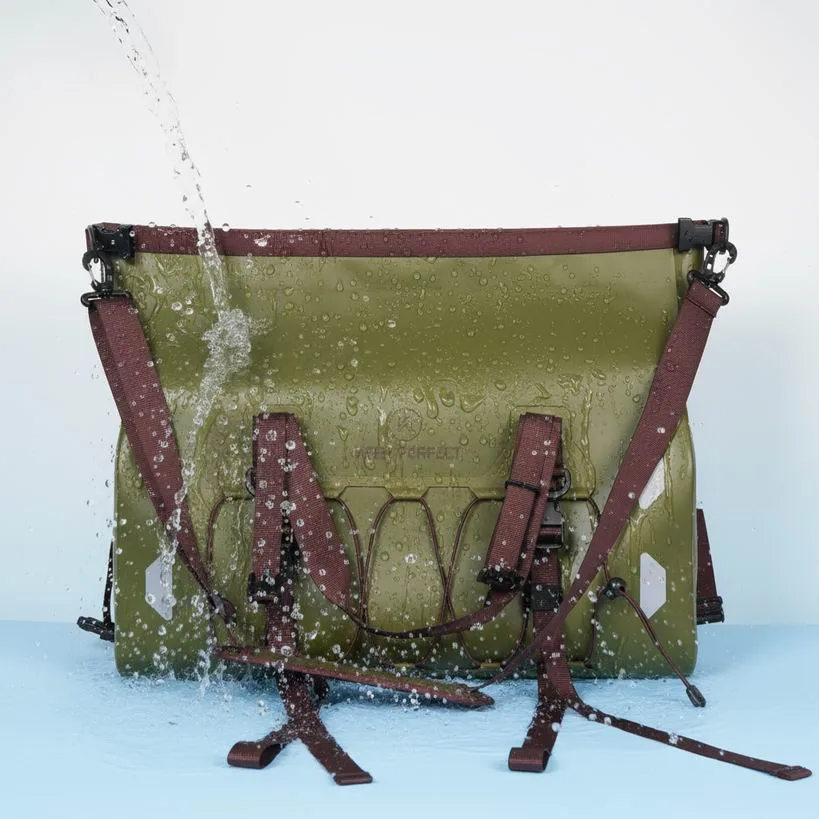
Fumbling a small buckle with a mitten on is the most common cold-weather complaint, and it is a hardware problem rather than a clothing one. A side-release buckle with a 25 mm body can be operated with a gloved thumb; a 15 mm buckle cannot. A cam lever on a 25 mm strap works with a palm push. Anything that needs a fingernail to release should not be on a cold-weather bag.
Three field modifications help. Replace small buckles with 25 mm or 38 mm hardware; add a 10 cm webbing pull tab to the buckle so it can be hooked with a finger; and leave the closure at two folds with the buckle clipped rather than three folds tensioned, which halves the effort needed to reopen. Also warm the buckle before closing it: a clip brought in from the cold carries frost on its mating faces and will not seat until that frost melts.

Keeping the shelter floor and the hole dry
A shelter floor is a bathtub. Snow dragged in on boots melts against a heater running at 2 to 4 kW and becomes a shallow pool that refreezes into a skating rink overnight. The fix is a floor mat plus a scoop routine: a 30 cm plastic scoop and five minutes every two hours keeps the floor walkable, and a bag placed directly on that floor is wet by the end of the session.
Around the hole, keep a 1 m dry apron. Slush pushed out of a fresh hole spreads further than people expect, and a bag sitting 40 cm from the rim will be splashed by the first fish landed. Put a mat or a board beside each hole, stand buckets and bags on it, and skim the hole every 30 minutes so the ice around it does not build into a raised rim that trips you in the dark.
A load plan for a full day at minus 12 °C
Two anglers, one shelter, a 1.5 m sled, six holes over seven hours, no permanent shack. Total haul is about 45 kg including the shelter and the auger. The waterproof portion is 34 litres across four bags, which is smaller than most people expect because the bulky items, the shelter and the chair, do not need to be in a bag at all.
| Bag | Contents | Volume | Weight | Where it lives |
|---|---|---|---|---|
| 20 L spares, bright colour | Base layer, mid layer, socks, hat, mittens | 12 L | 2.1 kg | Front sled zone, on the mat |
| 20 L wet layer bag | Outer layers, wet gloves, spare boots | 14 L | 3.4 kg | Shelter floor by the door |
| 10 L food and hot drinks | Thermos, food, stove, matches | 8 L | 3.8 kg | Shelter shelf |
| 5 L electronics | Camera, flasher, spare cells | 4 L | 1.6 kg | Shelter shelf, insulated |
| 2 L personal pouch | Phone, keys, power bank | 1.5 L | 0.5 kg | Inside the jacket |
| 30 L open duffel | Auger, scoop, wet boots | 20 L | 9.2 kg | Rear sled zone, drains |
That plan leaves the spares bag genuinely dry for the whole day, which is the entire objective. Note that the wet layer bag is the heaviest soft item at 3.4 kg and gets heavier as the day goes on; put it nearest the shelter door so it is not carried across the sled, and empty it in a heated porch or a garage rather than in a cold truck bed where the contents will freeze solid overnight.
Immersion: planning for the worst case
Ice fishing has a failure mode that no bag solves, which is going through. Cold-water immersion produces an uncontrollable gasp reflex in the first minute and loss of useful hand function within five to ten minutes in water at 2 °C. The kit that matters is not a dry bag: it is ice picks worn on the chest, a throw rope in the sled, a buddy within voice range, and spares kept dry so that a person who is rescued can change immediately.
That is what the sealed spares bag is really for. A person pulled out of 2 °C water at minus 12 °C air temperature has minutes, not hours, and a bag that opens immediately to deliver a dry base layer, a hat and mittens is the difference between an incident and a tragedy. Keep it where anyone can reach it, tell everyone where it is, and check the ice thickness as you go. Cold exposure guidance is published by the CDC and ice and weather conditions by NOAA.
Boots, gloves and the wet-gear routine
- Knock slush off boots on a board outside the shelter before entering.
- Keep a dedicated wet bag open by the door and put outer layers straight into it.
- Dry gloves on a heater guard at 30 to 50 cm, never directly on a hot surface.
- Hang the wet bag's mouth open so vapour escapes instead of frosting the film.
- Empty and air the wet bag within six hours of getting home, before it freezes solid.
- Check the spares bag is still sealed and repack it only at home, in the warm.
Boots deserve particular attention because they carry most of the water. A pair that holds 700 g of slush will freeze overnight in a truck bed and be unusable the next morning; empty them, stuff them loosely with newspaper and dry them at room temperature rather than on a heater, which cracks leather and delaminates glued soles. If you fish several days running, carry two pairs and rotate them.
Post-trip drying and storage
Drying a dry bag after an ice fishing trip is mostly about patience. Open every bag wide, invert it over a rail and leave it at room temperature for twelve hours; wiping the inside with a cloth removes most of the frost in one pass and speeds the rest. Do not use a heater or a hair dryer, because local heat above 60 °C softens a TPU film and can distort a weld line.
Store bags loosely rolled rather than folded flat, with buckles unclipped, in a dry place out of sunlight. Salt is not a factor on freshwater ice, so the routine is simpler than a coastal one: dry thoroughly, check the fold line for white stress marks, and inspect the corners where the weld meets the body. A bag used twenty days a season on ice should be checked twice, at the start and at the end, and the same care routine is set out for snow machines in our snowmobiling care guide.
The two adjacent cases are worth reading before you finalise a kit. Winter travel slush protection covers the same slush problem in an urban setting, and backcountry skiing covers the cold-crack and battery questions when the load has to be carried rather than hauled. For the bag itself, the 20L and 30L sizes do almost all of the work on ice, and both appear across the full product line.
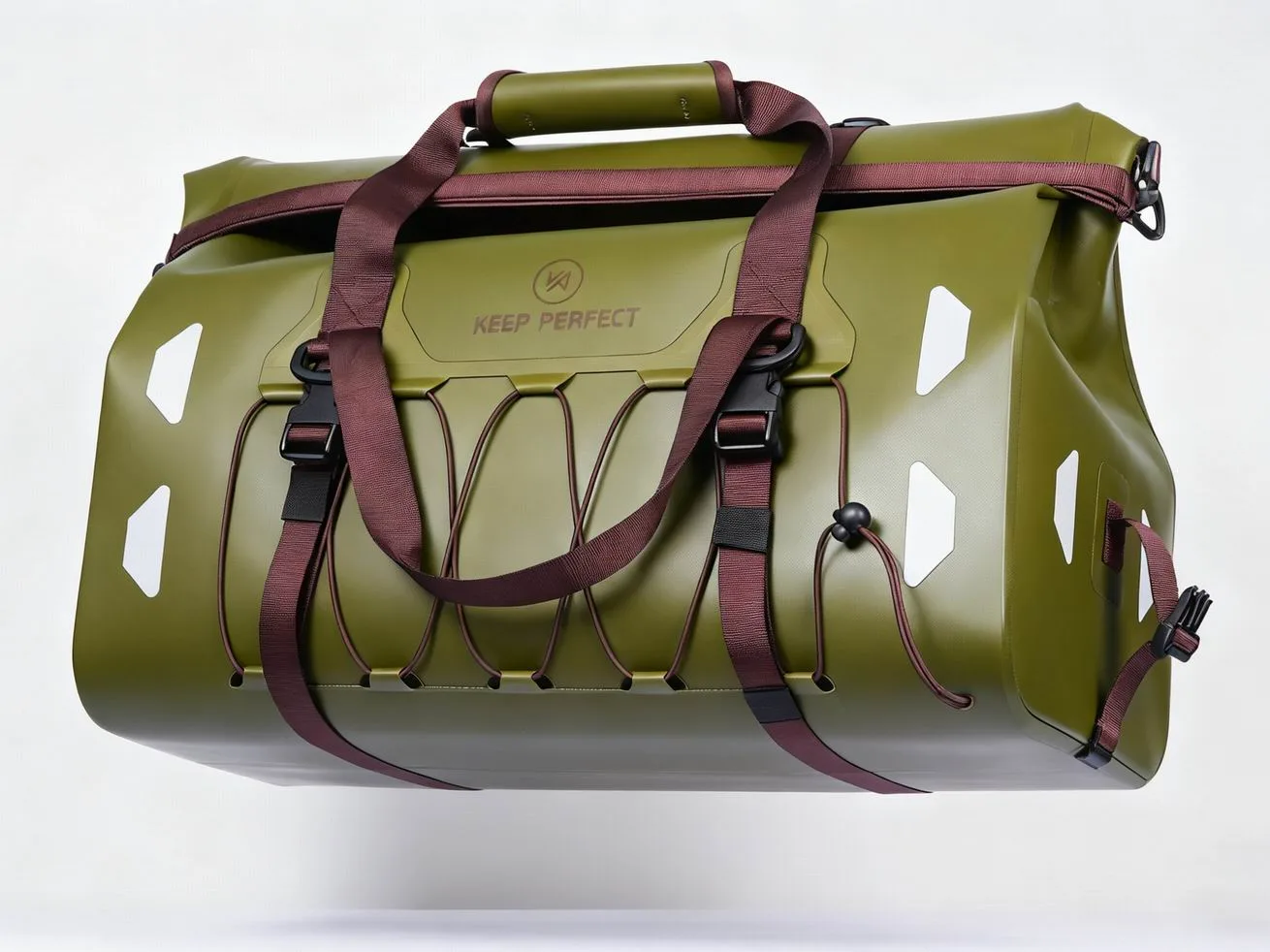
One specification note for anyone kitting out a group or a guide operation. The five lines that decide whether a cold-weather bag survives are film type, film thickness, hardware size, closure geometry and colour coding, and they are all measurable before an order is placed.
Finally, keep the spares bag habit even on mild days. Ice conditions change, a boot goes through a hidden seam, and the angler who has been dry all season is the one most likely to be under-dressed when it happens. Twelve litres of dry clothing in a sealed bag weighs 2.1 kg and is the cheapest insurance on the ice. The roll-top range covers the sizes in a single closure system so a group can share spares, and cold-weather sizing explains why the same logic applies in any sub-zero activity.
Frequently asked questions
Q1. What should be in a wet-weather kit for ice fishing?
Two roll-top bags per person: a sealed 20L spares bag holding a full change of base layer, socks, hat and mittens, and a 20L wet bag for outer layers. Add a 2L pouch inside the jacket for phone, keys and spare cells.
Q2. Why is slush worse than snow on a frozen lake?
Slush sits at 0 °C on a surface 10 to 20 °C colder, so it wicks upward into fabric and refreezes around buckles and zips. Snow brushes off; slush soaks anything standing in it within ten minutes.
Q3. Do dry bags work in freezing temperatures?
Yes, if the film is TPU. Polyether TPU stays flexible to about minus 30 to minus 40 °C, while PVC stiffens below 0 °C and becomes board-like by minus 15 °C, which cracks the fold line where the seal is made.
Q4. How much slush does an auger hole produce?
A 20 cm auger through 60 cm of ice produces roughly 8 litres of slush. Six holes in a day put 40 to 50 litres of freezing water on the ice surface, which is why nothing dry is ever placed on the ground.
Q5. How do I keep my phone working in the cold?
Keep it in an inner jacket pocket where the ambient temperature is 25 to 30 °C rather than minus 15 °C. Capacity drops to 55 to 65% at minus 20 °C and recovers within 10 to 15 minutes indoors.
Q6. Should I use lithium or alkaline batteries for a headlamp?
Lithium. A lithium AA retains 70 to 80% of capacity at minus 20 °C against 25 to 35% for alkaline, and alkaline cells that have been frozen do not recover their capacity when warmed.
Q7. Why is there frost inside my dry bag?
Condensation, not a leak. A damp fleece sealed in a welded chamber releases 100 to 200 g of moisture that migrates to the coldest surface, the inside of the film, and freezes there. Air-dry layers before packing.
Q8. How do I organise a sled for ice fishing?
Use three zones: a raised dry zone at the front on a 2 cm foam mat for spares, a middle transit zone for the shelter and chair, and a rear wet zone for the auger, scoop and wet boots.
Q9. Can I open a dry bag buckle with gloves on?
Yes if the hardware is 25 mm or larger with a webbing pull tab. A 15 mm buckle needs a fingernail and should not be on a cold-weather bag; warm the clip first so frost on the mating faces melts.
Q10. How many folds should I use in the cold?
Two folds with the buckle clipped for a bag you will reopen, three for a bag that stays shut. Folding film at minus 20 °C takes real effort and extra folds shorten the crease life of the fabric.
Q11. What size dry bag do I need for a day of ice fishing?
Two 20L bags cover a full day: 12 litres of spares and 14 litres of wet layers. Add a 10L for food and a 5L for electronics, and a 2L pouch that stays inside your jacket.
Q12. Should I dry my gear in the shelter?
Yes, using a heater guard at 30 to 50 cm rather than directly on a hot surface, and with the bag mouth open so vapour escapes. Seal damp kit only after ten minutes of airing.
Q13. What is the most important safety item on the ice?
Ice picks worn on the chest, a throw rope in the sled and a buddy within voice range. A dry spares bag matters because a person rescued from 2 °C water needs dry clothing within minutes.
Q14. How do I stop slush getting into my boots?
Knock slush off on a board outside the shelter, keep a mat beside each hole, and skim holes every 30 minutes so the ice does not build into a raised rim. Rotate two pairs of boots on multi-day trips.
Q15. Can I dry a dry bag on a heater?
No. Local heat above 60 °C softens TPU film and can distort a weld. Open the bag, invert it over a rail and leave it at room temperature for about twelve hours instead.
Q16. How often should I inspect an ice fishing dry bag?
Twice a season: before the first trip and after the last. Check the fold line for white stress marks and the corners where the weld meets the body, since those are where cold-fold damage appears first.
People also ask
How do you keep gear dry while ice fishing?
Keep dry gear elevated on a sled mat or shelter shelf, never on the ice surface, and separate wet outer layers into their own bag. Slush refreezes on the ground and wicks upward into anything standing in it.
Do dry bags crack in extreme cold?
TPU films do not at ice fishing temperatures, staying flexible to about minus 30 to minus 40 °C. PVC-coated fabric stiffens below 0 °C and develops white stress lines along the fold once it is folded while cold.
What temperature kills a phone battery?
Usable capacity falls to about 80% at minus 10 °C and 55 to 65% at minus 20 °C, and high-current delivery collapses before that. The loss is reversible; warming the phone indoors restores most of it.
How much slush does ice fishing produce?
About 8 litres per 20 cm auger hole through 60 cm of ice, so six holes in a day produce 40 to 50 litres. That is why the sled, not the ice surface, is the only acceptable place for dry gear.
Why does my dry bag get frost inside?
Water vapour from damp clothing condenses on the coldest surface, which is the inside of the film, and freezes there. It is condensation rather than a leak; air-dry layers before sealing them.
What size dry bag is best for ice fishing?
Two 20L bags per person plus a 2L pouch worn inside the jacket. One 20L holds 12 litres of spares and stays sealed; the other holds 14 litres of wet layers and lives on the shelter floor.
Need this in production volume?
QUANZHOU JUNYUAN BAGS has produced waterproof bags since 2014 in an SGS-verified 4,950 m2 facility in Fujian, China. Minimum order 500 pieces, sampling in 6–10 working days, bulk in 35–50 days, FOB Xiamen — write to service@junyuanbags.com with your spec and target market.