Home / Blog / Waterproof Technology
Dry Bag Terminology Glossary
A dry bag specification uses roughly sixty terms, and five of them decide whether the bag works: hydrostatic head in millimetres, the IPX grade, film thickness in millimetres, face fabric denier, and weld peel strength in newtons per 25 millimetres. Everything else on the sheet is either a restatement of those five or a commercial term about ordering and shipping. Learn the five and you can read any bag sheet in about two minutes.
This glossary groups the rest of the vocabulary into the categories buyers actually encounter: waterproofing and pressure, rating codes, film and fabric, seams, closures, hardware, capacity, strength and ageing, compliance, production and inspection, then care and end of life. Each group explains what the term means, what number is reasonable, and where the term is commonly used to mislead. Wherever a standard exists it is named, because a defined test is the only reliable way to compare two bags.
- How to read a dry bag specification
- Waterproofing and water pressure terms
- Rating codes and what the tests actually do
- Film, coating and fabric weight terms
- Seam and joining terms
- Closure and opening terms
- Hardware and attachment terms
- Capacity and dimension terms
- Strength, abrasion and ageing terms
- Compliance and chemical terms
- Production, sampling and inspection terms
- Care, failure and end-of-life terms
- A decoder for the five numbers that matter
How to read a dry bag specification
Start with the waterproof claim and work backwards to the test behind it. An honest sheet states a measurement, the method used to obtain it, and the conditions: 10,000 mm hydrostatic head by ISO 811, or IPX7 by IEC 60529 for 30 minutes at one metre. A weak sheet states an adjective: waterproof, stormproof, all-weather. The difference is not pedantry; an adjective cannot be audited, and unauditable claims are where quality problems hide.
The second habit is to separate performance terms from commercial terms. Hydrostatic head, denier, weld peel and cold crack describe the bag. Minimum order quantity, sampling time, lead time, FOB port and inspection level describe the transaction. They live on the same sheet and are frequently confused, especially by people reading a production document for the first time. If you only remember one thing from this glossary, remember which column each number belongs in.
Waterproofing and water pressure terms
Hydrostatic head is the height of a water column a fabric resists before water penetrates, expressed in millimetres. Ten thousand millimetres of water is roughly 0.98 bar, so the number sounds enormous and is often quoted as though it means a bag can be taken to ten metres. It does not: the test measures a flat, clamped sample under slowly increasing pressure, not a closure, a corner weld or a buckle hole. It is a fabric comparison tool, not a depth rating.
Water column is the same measurement under a different name, and the two are interchangeable on a spec sheet. Durable water repellent, abbreviated DWR, is something else entirely: a surface finish that makes water bead and roll off the face fabric. DWR reduces wetting-out and keeps a bag lighter because the face fabric does not soak, but it contributes nothing to immersion protection and it wears off after about 20 to 30 wash cycles or one season of hard use.
- Hydrostatic head: millimetres of water resisted before penetration, measured on clamped flat fabric.
- Water column: identical measurement, different name, common in European documentation.
- DWR: a surface finish that makes water bead; improves handling, not immersion protection.
- Wetting out: the point at which the face fabric absorbs water and the bag feels heavier.
- Wicking: water travelling along yarn rather than through the film, usually at cut edges.
- Penetration: the first appearance of water on the far side of the sample under test.
Rating codes and what the tests actually do
IP codes come from IEC 60529, published by the IEC. The first digit covers solid ingress and is usually replaced by X for bags, because nobody tests dust ingress on a roll-top. The second digit covers water, and the useful grades for dry bags run from IPX4, splashing from any direction, to IPX8, continuous immersion at a depth agreed between the tester and the brand. IPX7 is 30 minutes at one metre and is the standard target for a bag that can go overboard.
| Grade | Test | Real exposure it covers | What it does not cover |
|---|---|---|---|
| IPX4 | Splashing water, 10 min | Rain on a walk | Any pressure or jets |
| IPX5 | 6.3 mm nozzle, 12.5 L/min | Heavy rain, washdown | Immersion |
| IPX6 | 12.5 mm nozzle, 100 L/min | Bow spray, breaking waves | Immersion at depth |
| IPX7 | 1 m for 30 minutes | Capsize, bag overboard | Deeper or longer immersion |
| IPX8 | Depth agreed with tester | Sustained submersion | Anything not in the protocol |
Two traps follow from that table. First, IPX8 is not automatically better than IPX7, because the depth is whatever the brand and the laboratory agreed; an IPX8 claim at 1.5 metres for 30 minutes is weaker than an IPX7 claim tested independently at one metre for 60 minutes. Second, an in-house test is not a certification. Ask who ran it, on how many samples, and whether the report is available. The background on these grades is covered in more depth in our IPX ratings guide.
Film, coating and fabric weight terms
TPU is thermoplastic polyurethane, supplied as a film and bonded to a woven face fabric. It contains no plasticiser to migrate, stays flexible below freezing, and melts under radio-frequency energy, which is why it welds into a strong, clean seam. PVC is polyvinyl chloride, cheaper per square metre and heavier for the same thickness, softened with plasticisers that gradually migrate out and leave the sheet stiff and prone to cracking at folds. PEVA and TPE appear occasionally as lower-cost alternatives and behave closer to PVC.
Lamination bonds a ready-made film to cloth; coating spreads liquid polymer onto cloth and cures it in place. Denier is the mass in grams of 9,000 metres of a single yarn, so 420D and 500D describe yarn thickness rather than quality. Grams per square metre, written gsm, is the honest way to compare two laminates because it accounts for both layers, and it is the number to ask for when a sheet quotes only a denier.
- TPU film: plasticiser-free, cold-flexible, welds cleanly, the default for quality dry bags.
- PVC coating: low cost, heavier at equal thickness, stiffens as plasticiser migrates out.
- Laminate: pre-made film bonded to cloth, distinct layers, higher peel strength.
- Coating: polymer applied as liquid and cured, penetrates the weave, drapes better.
- Denier: yarn mass per 9,000 m; 210D light, 420D general, 840D heavy duty.
- gsm: total mass per square metre, the only fair way to compare two constructions.
- Ripstop: a grid of heavier yarns every 5 to 10 mm that stops small tears growing.
Seam and joining terms
RF welding, also called high-frequency welding, places the film layers between electrodes and uses radio-frequency energy to melt the polymer itself, which then fuses under pressure. It is the strongest way to join TPU and produces a seam that is as waterproof as the panel. Heat sealing uses a heated bar and works on coatings that melt predictably; it is cheaper and slightly less consistent. Seam tape is a strip of adhesive film pressed over a stitched seam, which is how a stitched bag is made waterproof.

Weld peel strength is measured in newtons per 25 millimetres and is the number that tells you whether a seam will survive being pulled apart: 45 N per 25 mm is typical for a 0.3 mm laminate and 70 N for a 0.5 mm one. Weld width is usually 8 to 15 mm, and corner radius should be at least 25 mm, because a tight radius concentrates strain at the stiffest line on the bag. The choice between taped and welded construction is argued in full in our seam tape versus welded seam guide.
- RF or HF welding: melting the film with radio-frequency energy, the strongest TPU joint.
- Heat sealing: a heated bar melt, lower cost, wider process window to control.
- Seam tape: adhesive strip over a stitched seam; the weak point is tape adhesion over time.
- Weld peel: force to separate a welded joint, quoted in newtons per 25 mm.
- Weld width: the bonded band, typically 8 to 15 mm on dry bag panels.
- Corner radius: minimum 25 mm to keep strain off the stiffest line on the bag.
Closure and opening terms
A roll-top is a closure in which the top of the bag is folded over itself and clipped, creating a series of contact lines that water must cross. Three folds is standard; each fold adds a barrier and removes usable volume. The fold line is the crease the fabric takes, and a stiffening band is a reinforced strip at the mouth that keeps the fold flat and prevents the fabric from rolling unevenly. A bag without a stiffening band tends to seal inconsistently, particularly when cold.
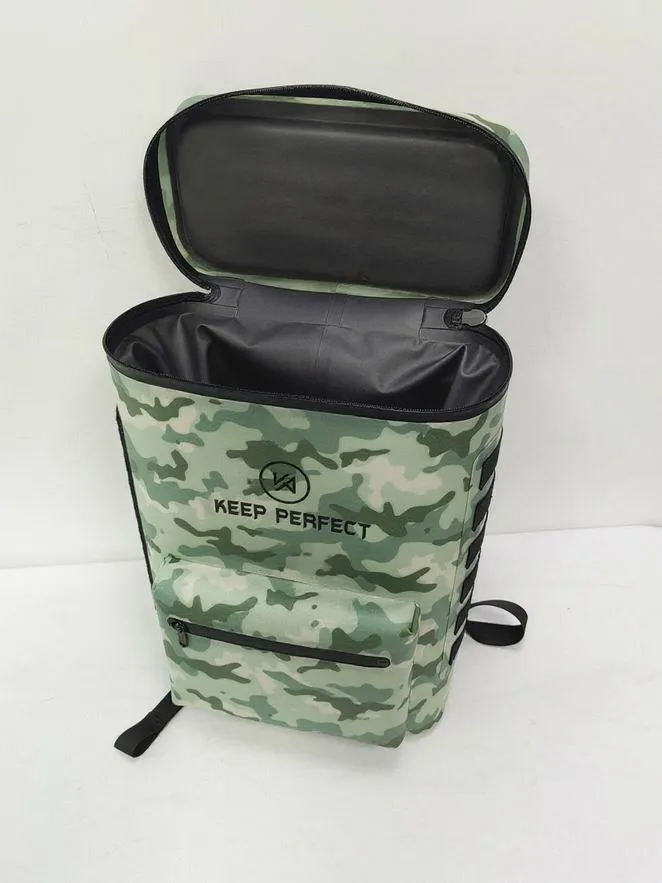
A purge valve is a one-way or screw valve that lets air out of a packed bag so it compresses flat; it is useful for sleeping bags and clothing and unnecessary for food and camera kit. A dry zip is a moulded or laminated zipper rated for water resistance, common on duffels and pockets, and always the most likely place on a bag to leak. Splash-proof means the bag survives rain and spray and is not rated for immersion at all.
- Roll-top: folding the mouth over itself, normally three folds, to create contact barriers.
- Fold line: the crease the fabric takes; the most common site of long-term cracking.
- Stiffening band: reinforcement at the mouth that keeps the fold flat and even.
- Purge valve: lets trapped air out so a packed bag compresses flat in a hatch.
- Dry zip: a water-resistant zipper; convenient, and the first place a bag tends to leak.
- Splash-proof: survives rain and spray, explicitly not immersion rated.
Hardware and attachment terms
Hardware is where warranty claims concentrate. A side-release buckle is the clip at the top of a roll-top; a cam buckle is the metal or plastic lever used on compression straps; a ladderlock is the flat fitting that adjusts webbing length. Load ratings matter: a small acetal side-release is often rated near 25 kg of static pull, while a sewn webbing loop can tear at 60 to 80 kg of shock load, so welded D-rings are the right choice for lash points.
A daisy chain is a ladder of webbing loops used to attach extra kit; a lash point is any reinforced attachment designed to take load. Bar tack is the dense zigzag stitch used to anchor webbing to fabric, and on a weldable bag the equivalent is a welded patch, which spreads load over a larger area and has no needle holes. Corrosion resistance is specified by salt spray hours, with 48 hours a reasonable minimum for coastal hardware.
- Side-release buckle: the clip that closes a roll-top; check the static load rating.
- Cam buckle: a lever fitting for compression straps; salt is what makes them slip.
- Ladderlock: a flat fitting for adjusting webbing length under light load.
- D-ring: a welded or sewn anchor for lashings; welded versions take far more load.
- Daisy chain: a ladder of webbing loops for attaching extra kit externally.
- Bar tack: dense zigzag stitching that anchors webbing; replaced by a weld patch on TPU.

Capacity and dimension terms
Litre figures on dry bags are external volumes measured with the mouth open, which is why usable volume is always smaller. Roll loss is the capacity consumed by folding the closure: about 1.2 litres on a 10 L bag and 2.5 to 4 litres on a 20 L bag. Bounding box is the smallest rectangular space the packed bag occupies, and it is the number that matters for hatches and panniers, because a bag that holds 15 litres but stands 600 mm tall will not fit a 480 mm hatch.
| Term | Definition | Typical figure | Why it misleads |
|---|---|---|---|
| Litre rating | External volume, mouth open | 10 L, 20 L, 40 L | Excludes closure loss |
| Usable volume | What fits after rolling | Rating minus 12-18% | Rarely printed |
| Roll loss | Capacity used by the fold | 1.2 L at 10 L, 3.5 L at 20 L | Grows with bag size |
| Bounding box | Smallest packed rectangle | 250 x 500 mm at 20 L | Decides hatch fit |
| Packed weight | Total mass when loaded | 3.5 kg for a day kit | Ignored in most briefs |
| Compression | Volume reduction with a valve | Up to 30% on soft goods | Does not apply to hard kit |
The practical rule is to size from usable volume and verify against bounding box. A bag that holds 18 usable litres but has a footprint too wide for your kayak hatch is the wrong bag no matter how good the litre figure looks. Our capacity measurement article explains how the published figure is derived, and the roll-top capacity loss guide gives the loss figures by size.

Strength, abrasion and ageing terms
Abrasion resistance is reported as cycles to failure on a standard rig; both the ASTM and the ISO publish textile abrasion methods, and a credible sheet names which one was used. Tear strength is the force needed to propagate an existing cut, measured in newtons. Puncture resistance is the force required to push a probe through the laminate, also in newtons, and it responds strongly to film thickness.
Ageing has its own vocabulary. Cold crack temperature is the point at which a folded sample cracks, and TPU sits near minus 35 °C while plasticised PVC fails near minus 10 °C. Hydrolysis is the breakdown of the polymer by moisture at elevated temperature, which is why a bag stored damp in a hot garage fails years before a rinsed and dried one. Chalking is a powdery surface residue left by UV degradation, and delamination is the separation of film from cloth, usually at a fold.
- Abrasion cycles: cycles to failure on a named rig; 15,000 is a solid mid-weight result.
- Tear strength: force to propagate a cut, in newtons; 34 N for 420D, 78 N for 840D.
- Puncture resistance: force to push a probe through, roughly 55 N at 0.3 mm, 95 N at 0.5 mm.
- Cold crack: temperature at which a folded sample cracks; TPU near minus 35 °C.
- Hydrolysis: moisture-driven breakdown, accelerated by warm damp storage.
- Chalking: powdery UV-degraded surface, the visible sign the film is ageing.
- Delamination: film separating from cloth, most often at a repeatedly folded crease.
Compliance and chemical terms
REACH is the European chemical regulation controlling substances of very high concern, abbreviated SVHC, in articles placed on the EU market. RoHS restricts specific hazardous substances, originally in electronics but now routinely applied to hardware and coatings on bags. OEKO-TEX is a textile certification that tests finished fabric for harmful residues, and PFAS refers to the broad family of fluorinated compounds historically used for water repellency and now being phased out.
Phthalates are the plasticisers used to soften PVC and are restricted in many markets, which is one reason TPU has displaced PVC in mid and high tier bags. Prop 65 is the California disclosure rule requiring warnings for listed substances. GRS certifies recycled content, rPET is recycled polyester made largely from bottle flake, and EPR is extended producer responsibility, the framework that makes a brand responsible for packaging and end-of-life costs. Our REACH compliance article covers the documentation a buyer should request.
- REACH and SVHC: EU chemical control; request a declaration, not a logo.
- RoHS: hazardous substance restriction applied to hardware, coatings and inks.
- OEKO-TEX: finished-fabric testing for harmful residues, widely recognised.
- PFAS: fluorinated water-repellent chemistry being phased out across the industry.
- Phthalates: PVC plasticisers restricted in several markets, a driver toward TPU.
- GRS and rPET: recycled-content certification and recycled polyester face fabric.
Production, sampling and inspection terms
These are commercial terms and they are frequently mistaken for quality terms. Minimum order quantity, or MOQ, is the smallest production run a line will accept; 500 pieces is typical for a welded bag because tooling and setup dominate the cost of a short run. Sampling is the stage where a prototype is made to the approved specification, normally 6 to 10 working days. Lead time is the period from order confirmation to completion, typically 35 to 50 days for bulk.
| Term | Meaning | Typical value | Who it affects |
|---|---|---|---|
| MOQ | Smallest accepted run | 500 pieces | Buyer planning and cash flow |
| Sampling | Prototype build to spec | 6-10 working days | Product development |
| Lead time | Order to completion | 35-50 days | Launch scheduling |
| FOB | Seller delivers to port | FOB Xiamen commonly | Freight and insurance cost |
| AQL | Acceptable quality limit | AQL 2.5 standard | Inspection pass or fail |
| T/T | Telegraphic transfer terms | 30% deposit, 70% before shipment | Payment scheduling |
AQL, the acceptable quality limit, is the statistical sampling standard used to decide whether a finished lot passes inspection; AQL 2.5 with a general inspection level II is the common default for bags, and it defines how many pieces are checked and how many minor or major defects are tolerated. A golden sample is the physical approved reference that all future production is compared against, and it is the single most useful document in a bag programme. Inspection detail is set out in our AQL inspection guide and the waterproof quality control article.
Care, failure and end-of-life terms
Service life is the period over which a bag remains fit for its stated use, typically five to ten years for a well-kept TPU bag used at weekends and two to three years for the same bag in daily commercial service. Retirement criteria are usually visual: a crack at the fold line that runs through the film, delamination over an area larger than a coin, or a weld that peels when pulled by hand. None of these is repairable reliably once it reaches that stage.
A patch is a piece of film bonded over a puncture, and it works well on flat panels and poorly at creases because the repair is stiffer than the surrounding material. Downcycling is reprocessing a worn bag into lower-value material such as matting or filler, which is the realistic end point for most laminated fabric because film and cloth cannot easily be separated. Rinse, shade-dry and loose storage remain the three habits that move service life the most.
- Service life: 5-10 years weekend use, 2-3 years daily commercial use for TPU.
- Retirement: through-thickness crease crack, large delamination, or hand-peeled welds.
- Patch: a bonded film repair; reliable on flat panels, unreliable at a crease.
- Downcycling: reprocessing into lower-value material, the usual end for laminates.
- Mildew: surface growth from damp storage, removed with diluted vinegar, not bleach.
A decoder for the five numbers that matter
If a sheet gives you only five numbers, make them these. Hydrostatic head tells you the fabric resists water: 5,000 mm is adequate, 10,000 mm is comfortable, and anything above that is marketing. IPX grade tells you the closure and seams were tested as a complete bag: IPX6 for spray, IPX7 for immersion. Film thickness in millimetres tells you how the bag will behave in use: 0.3 mm soft and packable, 0.5 mm tough and stiff.
| Number | What it really tells you | Adequate | Comfortable | Overspecified |
|---|---|---|---|---|
| Hydrostatic head | Fabric resistance only | 5,000 mm | 10,000 mm | Above 20,000 mm |
| IPX grade | Whole-bag test result | IPX6 | IPX7 | IPX8 without a protocol |
| Film thickness | Handling and fold behaviour | 0.30 mm | 0.40 mm | Above 0.60 mm |
| Face denier | Tear and abrasion life | 210D | 420D | Above 840D |
| Weld peel | Seam survival under load | 40 N/25 mm | 60 N/25 mm | Above 90 N/25 mm |
Read across the comfortable column and you have described a bag that suits most people: a 0.4 mm TPU laminate on 420D, welded, IPX7, with peel strength around 60 N per 25 mm. Everything else on a sheet is refinement. If you want to see how those numbers look on a real range, compare them against the full product line, and use the academy section for the longer explanations behind each test method.
For teams writing a brief, this glossary doubles as the checklist: state the test method with every number, name the standard behind every claim, and insist on a golden sample before bulk begins. The water column test article is the best starting point if you want to audit a claim yourself.
Frequently asked questions
Q1. What are the most important dry bag terms to know?
Five decide whether a bag works: hydrostatic head in millimetres, the IPX grade, film thickness in millimetres, face fabric denier, and weld peel strength in newtons per 25 millimetres. Everything else is refinement or commercial detail.
Q2. What does hydrostatic head mean on a dry bag?
It is the height of a water column the flat fabric resists before water penetrates, measured under ISO 811 and similar methods. 5,000 mm is adequate and 10,000 mm is comfortable; the figure does not describe a usable depth.
Q3. What is the difference between IPX6 and IPX7?
IPX6 covers powerful water jets such as bow spray, while IPX7 covers 30 minutes of immersion at one metre. Both are defined in IEC 60529. IPX8 is only meaningful when the tested depth and duration are stated.
Q4. What does denier mean?
Denier is the mass in grams of 9,000 metres of a single yarn. 210D is light, 420D suits most dry bags, 500D is a step up in abrasion life and 840D is heavy duty. It describes yarn thickness, not quality.
Q5. What is gsm and why does it matter?
Grams per square metre is the total mass of the finished laminate, film plus face fabric. It is the only fair way to compare two constructions, because a denier figure says nothing about how much film is bonded to the cloth.
Q6. What is weld peel strength?
The force required to separate a welded seam, quoted in newtons per 25 millimetres. Around 45 N is typical for a 0.3 mm laminate and 70 N for a 0.5 mm one. It is the best single indicator of seam durability.
Q7. What is the difference between lamination and coating?
Lamination bonds a pre-made film to the cloth, keeping the film properties intact and welding strongly. Coating applies liquid polymer that penetrates the weave, draping better but cracking along the weave under pressure.
Q8. What is RF welding?
Radio-frequency welding uses electromagnetic energy to melt the polymer film itself between electrodes, fusing it under pressure. It produces the strongest seam available on TPU and needs no thread or adhesive.
Q9. What is roll loss?
The capacity consumed by folding the closure: about 1.2 litres on a 10 L bag and 2.5 to 4 litres on a 20 L bag. It is why usable volume is always 12 to 18% below the printed litre figure.
Q10. What does MOQ mean?
Minimum order quantity, the smallest production run a line will accept. For welded dry bags 500 pieces is typical, because tooling, weld setup and inspection dominate the cost of a short run.
Q11. What is AQL?
Acceptable quality limit, the statistical standard used to accept or reject a finished lot. AQL 2.5 at general inspection level II is the usual default for bags and defines sample size and tolerated defect counts.
Q12. What does FOB mean?
Free on board, meaning the seller delivers goods to the named port and the buyer takes over freight, insurance and risk from that point. FOB Xiamen is a common term for bag shipments from Fujian.
Q13. What is a golden sample?
The physical approved reference that production is compared against. It is the most useful artefact in a bag programme, because it settles disputes about colour, hand feel, weld quality and closure geometry.
Q14. What is REACH?
The European Union chemical regulation governing substances of very high concern in articles sold in the EU. Buyers should request a written declaration and, for hardware and coatings, supporting RoHS documentation.
Q15. What are PFAS and why are they being removed?
PFAS are fluorinated compounds long used for water and stain repellency. They persist in the environment and are being restricted, so the industry is moving to hydrocarbon and silicone-based finishes.
Q16. What does splash-proof mean?
It means the bag resists rain and spray but is not rated for immersion. A splash-proof bag has no IPX immersion grade and will not protect contents if it goes overboard or is submerged.
People also ask
What does waterproof actually mean for a dry bag?
It should mean a tested result, not an adjective. Look for an IPX grade from IEC 60529 plus a hydrostatic head figure with the method named; IPX7 means 30 minutes at one metre and is the practical target for a bag that can go overboard.
How is hydrostatic head measured?
A clamped flat fabric sample is subjected to a rising water column until three drops penetrate, and the height in millimetres is recorded. ISO 811 and equivalent national methods define the rate of rise and the sample area.
What is a good denier for a dry bag?
420D for general use, where it gives around 34 N tear strength for only 110 gsm. 210D saves weight but tears near 18 N, and 840D adds mass and stiffness for a gain most users never need.
What does IPX7 mean on a dry bag?
The whole bag survived 30 minutes of immersion at one metre under IEC 60529. It covers a capsize or a bag going overboard; it does not cover greater depth, longer duration or the pressure of being dragged.
What is the difference between a welded and a taped seam?
A welded seam melts the film itself into a continuous joint, giving 45 to 70 N per 25 mm of peel strength. A taped seam covers stitching with an adhesive strip, which is waterproof at first and then depends on tape adhesion.
What should a dry bag spec sheet include?
Five performance numbers with methods: hydrostatic head and its standard, the IPX grade, film thickness, face denier and weld peel strength, plus commercial terms covering minimum quantity, sampling time, lead time and inspection level.
Need this in production volume?
QUANZHOU JUNYUAN BAGS has produced waterproof bags since 2014 in an SGS-verified 4,950 m2 facility in Fujian, China. Minimum order 500 pieces, sampling in 6–10 working days, bulk in 35–50 days, FOB Xiamen — write to service@junyuanbags.com with your spec and target market.