Home / Blog / Design & Branding
Festival Branded Dry Bags
Festival branded dry bags work best as three sizes built on one platform: a 5L roll-top for phone, cards and keys, a 15L tote for the arena, and a 30L backpack for the campsite, each carrying one mark that has to read from twenty metres and survive 72 hours of mud, dust, sunscreen and rain. At 500 to 3,000 pieces you should budget roughly USD 4 to 11 per unit depending on platform and decoration, allow 6 to 10 working days for a printed sample, and 35 to 50 days for bulk, which is the schedule that lets a February brief reach a June gate.
This guide walks through the exposure a festival bag really meets, the platform and size spread that gets carried rather than abandoned, where the mark can sit on a waterproof panel, which decoration method survives a wet weekend, and what the compliance file needs to contain for a giveaway or a resale bag. Each recommendation is tied to a number: a 90 mm print width, a 0.45 mm film, a 25 mm side-release buckle, 4,000 rubs of abrasion. Use the tables to build a one-page brief you can send out.
- What a festival bag has to survive
- Picking the platform: roll-top, tote, duffel or backpack
- Sizes people actually carry all weekend
- Where the mark goes on a waterproof panel
- Print methods that last past the first rainstorm
- Colourways that read at twenty metres
- Film, face fabric and seam build for a muddy field
- Closures and hardware a tired crowd can work one-handed
- Compliance paperwork for giveaway and resale bags
- What a unit really costs across quantity bands
- Timeline from brief to the festival gates
- Packaging, tags and the handover moment
- Measuring whether the bags came home
What a festival bag has to survive
A three-day open-air festival is a harsher test than a season of weekend paddling, because the bag meets every failure mode at once. A bag left on grass at midday sits on a surface that can reach 40 °C while the air is 28 °C, takes eight hours of direct sun at UV index 8, then gets rained on, dropped in mud, sat on, and stuffed into a tent that stays damp until Monday. Nothing about that environment is gentle on a laminated film.
The damage you see on Monday is predictable. Print cracks along the fold line where the roll-top is bent three times a day. Buckles lose tension after grit works into the spring. Light-colour panels pick up a grey film of dust and sunscreen that no amount of wiping removes. A bag specified for this environment needs a thicker film, a decoration method chosen for flex, and hardware that can be rinsed rather than replaced.
So the specification starts from exposure, not from artwork. Decide how many hours of sun, how much mud and how many open-close cycles the bag will see, and the platform, film, closure and print method follow from those numbers. The rest of this guide translates exposure into spec, with the cost attached at each step.
Picking the platform: roll-top, tote, duffel or backpack
Platform is decided by how the bag is handed over and what the holder does with it for the next three days. A roll-top dry bag is the cheapest printed panel per litre and the easiest to hang from a belt or a tent guy line, but it has one opening, so it suits kit that goes in and stays in. A tote has a wide mouth, fills fast at a merchandise tent and reads well in photographs, which is why it is the usual choice for a sponsor bag handed over at the gate.
A duffel earns its place when the bag has to hold a sleeping bag or a weekend of clothing rather than a day of essentials. It opens along its length, packs flat in a carton, and gives you the largest uninterrupted print area of any format. A waterproof backpack costs more per unit because of the harness, but it is the piece people keep using after the event, which is the entire point of a branded item that is meant to work as advertising for another three years.
Mixing platforms is common and usually wrong at low volume. Every extra platform adds a tooling set, a sample round and a colour-matching exercise, and the minimum run applies to each. At 500 pieces, one platform in two sizes will cost less and land sooner than three platforms in one size each. Our own roll-top range is the platform most festival programmes start on for exactly that reason.
Sizes people actually carry all weekend
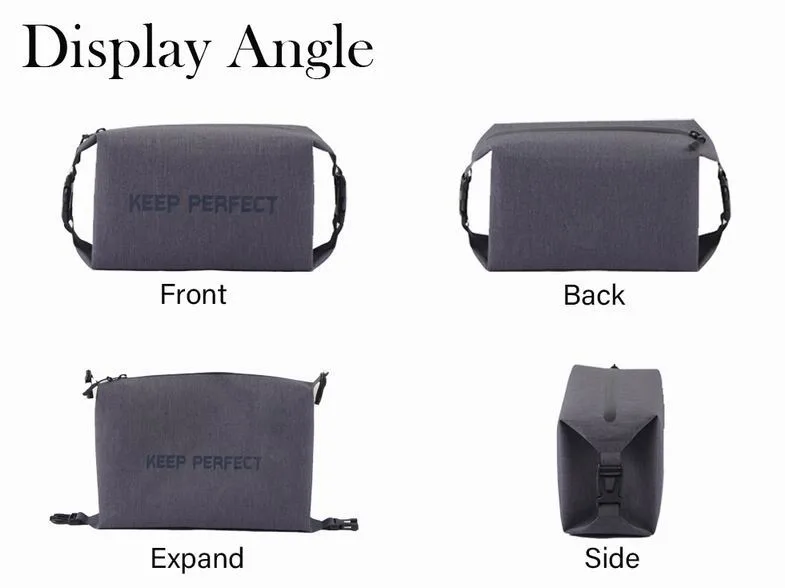
Festival volumes are smaller than people expect, because nobody wants to carry weight across a site for ten hours. The phone, cards, cash, lip balm and sunglasses that never leave a person amount to under 1 kg and fit in 2 to 5 litres. Add a light layer for the evening, a water bottle and a poncho and you reach 10 to 15 litres. Anything beyond 20 litres is a campsite bag, not an arena bag, and will be left in the tent by mid-afternoon.
A three-size spread covers the whole weekend: one small bag that goes everywhere, one mid-size bag for the day, and one large bag that lives at the tent and travels home in the car. If budget only stretches to two sizes, choose 5L and 20L rather than 10L and 15L, because the extremes do the jobs that no middle size does well.
| Format | Volume | Empty weight | What it holds at a festival | Carry style |
|---|---|---|---|---|
| Mini roll-top | 2 L | 70 g | Phone, cards, cash, lip balm | Clipped to a belt loop |
| Roll-top | 5 L | 110 g | Sunglasses, sunscreen, power bank | Hand or wrist loop |
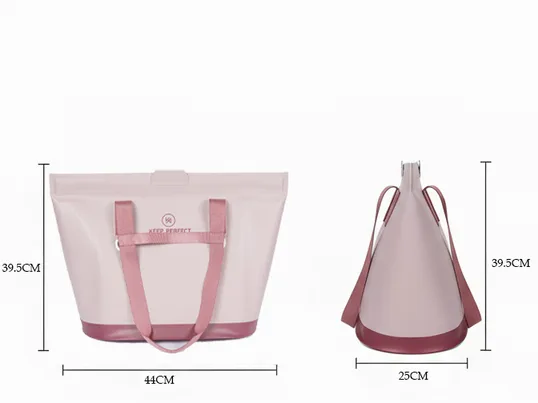
| Tote | 15 L | 320 g | Layer, poncho, water bottle, programme | Shoulder or hand |
| Roll-top backpack | 20 L | 480 g | Full day kit plus a light jacket | Two straps, all day |
| Duffel | 40 L | 760 g | Sleeping bag, clothing, towel | Tent or car |
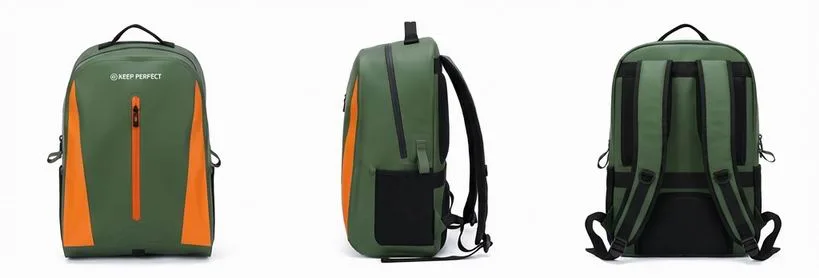
| Backpack | 30 L | 900 g | Campsite kit and the journey home | Two straps, padded |
Where the mark goes on a waterproof panel
The print area on a roll-top bag is not the whole front. The top third is folded three times every time the bag is closed, so any decoration there is bent and rubbed against itself dozens of times a weekend. The bottom third sits on the ground and drags through mud. That leaves a band across the middle of the body, roughly 90 to 140 mm tall, as the only area where a mark stays flat and visible.
Within that band, keep the mark clear of the two side welds by at least 15 mm, because the weld is thicker than the panel and creates a step that a squeegee or a print head cannot press evenly into. Keep it clear of any D-ring or lash tab by the same margin. On a tote the usable band is larger and includes the gusset, which is useful for a secondary line of text or an event date that does not need to fight for space with the main mark.
Size the mark for the distance it is read at, not for the artwork file. A 70 mm wide mark is legible at about 12 metres in good light; 90 mm reads at 20 metres; below 55 mm people have to be close enough to be handed the bag anyway. If the mark includes small text, keep the cap height above 4 mm or accept that it becomes texture rather than information once the bag is moving in a crowd.
Print methods that last past the first rainstorm
Decoration on a waterproof shell has to flex with the film and resist sunscreen, which attacks several ink systems. Screen print with a flexible ink is the default for flat colour on TPU and gives a thick deposit that survives abrasion. Heat transfer gives photographic detail but sits as a layer on top of the film, so it lifts first at the fold line. Digital print on a pre-treated panel suits short runs where screens are not economical.
The most durable option is not print at all. A welded TPU badge carrying the mark, applied with the same radio-frequency energy as the seams, becomes part of the shell and outlasts any ink layer. It costs more per unit and needs a tool, but for a bag meant to be used for years rather than a weekend it is the decoration that still looks right after a hundred open-close cycles. A woven label sewn into a seam allowance is a cheaper way to add a secondary mark without touching the print panel.
| Method | Best on | Flex cycles before cracking | Set-up cost | Economical from |
|---|---|---|---|---|
| Screen print, flexible ink | TPU and PVC panels | 8,000-12,000 | USD 40 per screen | 500 pieces |
| Heat transfer | Flat tote panels | 3,000-5,000 | USD 120 film | 300 pieces |
| Digital print, pre-treated | Small panels, photos | 4,000-6,000 | None | 100 pieces |
| Welded TPU badge | Any welded shell | 20,000 plus | USD 350 tool | 1,000 pieces |
| Woven label in seam | Any platform | Unlimited | USD 60 setup | 500 pieces |
Colourways that read at twenty metres
Festival colour behaves differently from retail colour. A bag is identified across a field, at dusk, against grass, mud or a crowd, so contrast matters more than fashion. Black reads as premium and hides mud but disappears against a dark crowd and absorbs heat on a 40 °C surface. Bright colour reads at distance and photographs well but shows every smudge of dust, which is why the usual answer is a bright body with dark webbing and hardware, or a dark body with a bright panel that carries the mark.
Plan the run as a split rather than a single colourway. A practical split for a 3,000-piece order is 60% in the core neutral, 30% in one bright accent, and 10% in a seasonal or limited colour that gives the merchandise tent something to talk about. Each extra colourway beyond three adds a fabric buy, a colour-matching round and a risk of drift between the body, the webbing and the hardware, so the tenth colourway is far more expensive than the third.
| Colourway | Reads at 20 m | Shows mud and dust | Surface heat gain in sun | Suggested share |
|---|---|---|---|---|
| Black | Poor against crowds | Low | +18 °C over air | 35% |
| Olive | Fair | Very low | +14 °C over air | 25% |
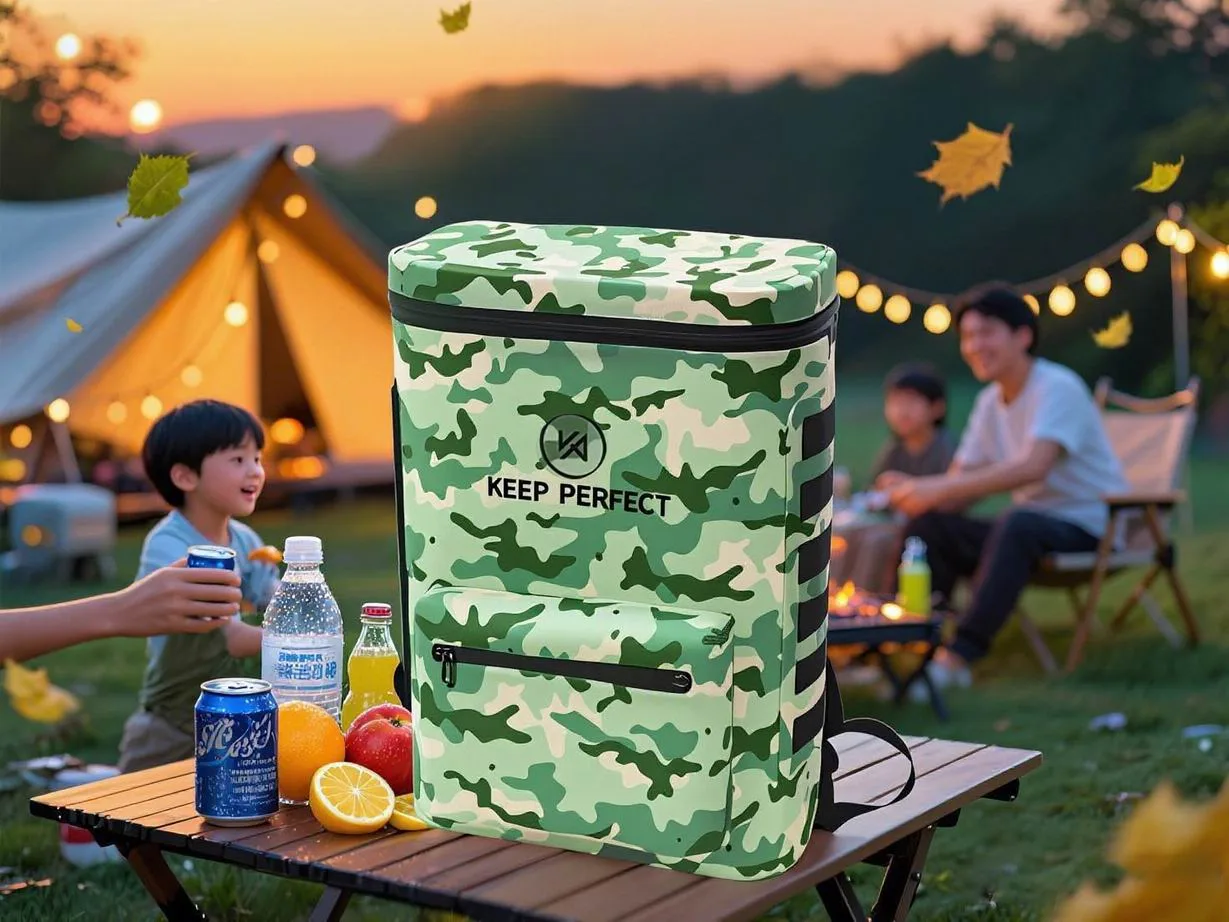
| Camo pattern | Poor at distance | Very low | +15 °C over air | 5% |
| Pink | Excellent | High | +9 °C over air | 15% |
| Mint | Excellent | Medium | +8 °C over air | 10% |
| Orange | Outstanding | Medium | +10 °C over air | 10% |
Film, face fabric and seam build for a muddy field
Film thickness is the spec line that decides whether a festival bag survives the weekend and the year after. A 0.28 mm TPU film is fine for a 2L pouch; on a 20L bag that is dragged across grass and sat on, it abrades through at the corners within a season. Moving to 0.45 mm adds roughly 90 g to a 20L bag and roughly triples abrasion life at the base corners.
The face fabric matters because mud is abrasive in a way that clean water is not. A 420D face is light and packs flat; a 500D face takes dragging across a muddy field for years and holds a print better because the weave gives the ink more to key into. Where the bag has a printed panel, ask for the face fabric to be specified by denier and by finish, not just by colour, because two fabrics with the same colour name can accept ink very differently.
Seams should be radio-frequency welded and continuous. A stitched seam with tape over it is cheaper to make and is the first thing to fail in a muddy, wet field, because every needle hole is a capillary and the tape edge lifts once grit gets under it. Ask for the peel strength of the weld in newtons per 25 mm and check that the number applies to the corner welds, which are the hardest joints to make and the ones that actually fail.
Closures and hardware a tired crowd can work one-handed
A festival closure is operated by someone holding a drink, in the dark, with cold hands. That rules out anything that needs alignment or fine motor control. A 25 mm side-release buckle with a single centre clip is the standard: it can be opened with one thumb and closed by feel. A 20 mm buckle is lighter and fine on a 5L bag; on a 40L duffel it is under-specified and will creep open under load.
Cycle-test the hardware before you commit. A buckle that survives 5,000 open-close cycles on a bench will typically survive a festival season, but ask whether the number was measured with grit in the mechanism, because clean-lab numbers and muddy-field numbers are not the same. The spring is the part that fails, and it fails by losing tension rather than by breaking, so the failure is a bag that quietly opens rather than a buckle you can see is broken.
Give the bag at least one D-ring or lash tab that is not doing structural work. People clip things to bags: a torch, a water bottle, a poncho, another bag. If there is no lash point, they clip to the webbing or the shoulder strap and shorten its life. A welded TPU tab costs a few cents and removes the most common abuse a giveaway bag meets.
Compliance paperwork for giveaway and resale bags
A bag handed out for free is still a product placed on a market, and the paperwork follows the destination, not the price. In the EU the file should cover REACH restricted substances for the film, the ink and the hardware, and a statement on phthalates where a PVC build is used. In California, a giveaway bag needs a Prop 65 assessment for the same three components, and the warning decision should be made before artwork is locked because it affects the label placement.
Two more items catch programmes out. Sunscreen and sanitiser are aggressive solvents, so a bag marketed for festival use should be tested against them rather than against water alone. And the end-of-life claim needs care: guidance published by the EPA is worth reading before any bag is labelled recyclable, because a laminated shell is not accepted in most kerbside streams. Our eco-friendly build options set out what can honestly be claimed.
What a unit really costs across quantity bands
Unit cost on a branded waterproof bag moves in steps rather than smoothly. The first step is the minimum order quantity, because below it the line set-up, the fabric buy and the print screens are amortised over too few pieces. The second step comes at roughly 3,000 pieces, where a fabric buy moves to a full roll and a dedicated print jig becomes worth making. The third is at 10,000, where carton and freight planning start to matter more than the bag itself.
Read any quote with the tooling, the sample cost and the freight treatment separated out. A unit price that looks 8% lower but excludes screens, a badge tool and a printed sample is not lower. Standard commercial terms on this kind of programme are FOB Xiamen with a 30/70 payment split, an AQL 2.5 inspection level, a 500-piece minimum and sampling in 6 to 10 working days, so a quote built on different assumptions is not comparable.
| Order quantity | 5L roll-top | 15L tote | 30L backpack | Tooling and samples | Bulk lead time |
|---|---|---|---|---|---|
| 500 pieces | USD 4.10 | USD 6.40 | USD 11.20 | USD 190 | 35-40 days |
| 1,000 pieces | USD 3.60 | USD 5.70 | USD 10.10 | USD 190 | 35-45 days |
| 3,000 pieces | USD 3.10 | USD 5.00 | USD 9.20 | USD 240 | 40-50 days |
| 10,000 pieces | USD 2.80 | USD 4.60 | USD 8.40 | USD 340 | 45-50 days |
| 30,000 pieces | USD 2.55 | USD 4.30 | USD 7.90 | USD 340 | 50 days plus |
Timeline from brief to the festival gates
Work backwards from the gate date and leave a buffer that is not negotiable. Freight from Xiamen to a European or North American warehouse is the least controllable line in the schedule, and a two-week delay there cannot be recovered by speeding up sampling. The realistic plan is to lock artwork six weeks before the event, approve a printed sample four weeks out, and have cartons in the country two weeks out.
The stage that slips is almost always artwork, not production. Vector artwork with the mark separated into its own layer, colours called out in a named system, and a stated print area in millimetres will go through pre-press in a day. A flattened bitmap with the mark sitting 8 mm from a weld will generate three rounds of questions, and each round costs a week you do not have.
| Stage | Working days | Who decides | Risk if skipped |
|---|---|---|---|
| Brief and platform sign-off | 2 | Buyer | Wrong format for the audience |
| Artwork to print-ready files | 3-5 | Designer | Re-spaced mark, extra sample round |
| Printed sample | 6-10 | Buyer | Colour and flex not verified |
| Compliance file review | 3 | Buyer and lab | Held at import or withdrawn later |
| Bulk production | 35-50 | Production planning | Late arrival at the gate |
| Inspection at AQL 2.5 | 2 | Inspector | Defective cartons found at the event |
Capacity matters when several events share a season. Our waterproof bag line has run since 2014 in an SGS-verified 4,950 m2 facility with 137 staff across 7 production lines and 149 machines, outputting around 200,000 pieces a month, which is what allows a 30,000-piece festival order to sit alongside other programmes without pushing a smaller order out. The step-by-step schedule is set out and the wider programme questions are covered in our promotional programme guide.
Packaging, tags and the handover moment
The bag leaves the carton into a queue, and that moment decides whether it looks like a gift or like freight. A bag folded flat in a polybag arrives creased along the fold line that carries the print. A bag rolled loosely in a kraft sleeve arrives flat, takes less space at the tent, and gives you a printable surface for the care card.
Put three things on the tag or the card: what the rating means in plain language, how to rinse the bag, and what not to do. A card that says 'rinse in fresh water, dry in shade, do not machine wash' removes the most common cause of a warranty complaint. A card that says nothing leaves a person to guess, and the guess is usually a washing machine.
Pack-out quantities should match the handover plan, not the carton count. If bags are handed out at four gates over three days, ask for inner cartons of 50 rather than master cartons of 200, so each gate can be topped up without opening a full case and counting in the rain. Labelling each inner carton by size and colourway saves more time at a busy tent than any other packing decision. Our packaging notes cover the options in more detail.
Measuring whether the bags came home
A branded bag is advertising, so judge it like advertising. The three numbers worth collecting are how many were handed over, how many were visible on site by the second day, and how many appear in photographs posted after the event. A bag that is carried on day two has passed the only test that matters; a bag left in a tent on day one was never going to advertise anything.
Two design decisions drive those numbers more than the artwork does. The first is usefulness on the day: a 5L roll-top that keeps a phone dry in a downpour is carried, and a novelty shape is not. The second is comfort across ten hours, which is why a 20L backpack with a real harness beats a 20L bag with webbing straps. Plan the reorder while the event is fresh: colour and fabric lots drift, so keep the approved sample, the fabric reference and the print drawdown in one file.
- Agree the platform before the artwork: one platform, two sizes, beats three platforms at 500 pieces.
- State the print area in millimetres and keep the mark 15 mm clear of welds and hardware.
- Choose decoration by flex life: welded badge over print if the bag should last years.
- Specify film at 0.45 mm and the face at 500D where the bag will meet mud and dragging.
- Rinse-test the print against sunscreen and sanitiser, not water alone.
- Separate tooling, samples and freight on every quote line before comparing prices.
- Set the timeline backwards from the gate date with a two-week freight buffer.
- Check the mark placement rules in our logo placement guide, plan the weekend load with our festival waterproof plan, and compare decoration routes in our digital versus screen print guide before you sign off.
One last practical check: heat. A festival bag is carried by people who are dehydrated, sunburned and on their feet for ten hours, and no bag specification changes that. Put water and shade information on the same card as the care instructions, and read the heat-illness guidance published by the CDC before finalising any on-site material. The bag is the useful part of the giveaway; the safety message is the responsible part.
When the brief is ready, send it as one page: platform, sizes, colourway split with percentages, print method with the artwork size in millimetres, film and face fabric, buckle size, compliance list by market, quantity, target unit price and the gate date. That page is what lets a full product line be quoted accurately the first time.
Frequently asked questions
Q1. What size dry bag is best for a festival giveaway?
A 5L roll-top is the size people carry all day, because it holds a phone, cards, cash and sunscreen without becoming a burden. Pair it with a 15L tote or a 20L backpack if the bag also has to serve at the campsite.
Q2. How much do branded dry bags cost per unit?
At 500 pieces expect around USD 4 for a 5L roll-top, USD 6.40 for a 15L tote and USD 11.20 for a 30L backpack. At 3,000 pieces those fall to roughly USD 3.10, USD 5.00 and USD 9.20, plus tooling from USD 190.
Q3. Which print method lasts longest on a waterproof bag?
A welded TPU badge lasts longest because it becomes part of the shell and survives more than 20,000 flex cycles. Screen print with a flexible ink is the practical default at 8,000 to 12,000 cycles; heat transfer is the least durable at 3,000 to 5,000.
Q4. Where should a logo go on a roll-top dry bag?
On the flat middle band of the body, between the fold line and the ground-contact zone, at least 15 mm clear of the side welds and any D-ring. The top third flexes with every closure and the bottom third sits in mud.
Q5. How big should the logo be?
Ninety millimetres wide reads at about 20 metres; seventy millimetres reads at about 12 metres. Keep cap height above 4 mm for any text that is meant to be read rather than recognised.
Q6. Can a branded dry bag be given away free without compliance paperwork?
No. A free bag is still a product placed on a market, so the file should cover REACH for the EU, a Prop 65 assessment for California, and restricted-substance testing for the film, ink and hardware.
Q7. What film thickness should a festival bag use?
Use 0.45 mm TPU for any bag larger than 10 litres that will be dragged or sat on. A 0.28 mm film is fine for a 2L pouch but abrades through at the base corners of a 20L bag within a season.
Q8. How many colourways should one festival order have?
Three: roughly 60% in a core neutral, 30% in one bright accent and 10% in a limited colour. Every colourway beyond three adds a fabric buy and a colour-matching round, and raises the risk of drift between batches.
Q9. What is the minimum order for branded dry bags?
The standard minimum is 500 pieces per platform and colourway. Below that, the line set-up, fabric buy and print screens are amortised over too few units for the price to make sense.
Q10. How long does a branded dry bag order take?
Allow 6 to 10 working days for a printed sample and 35 to 50 working days for bulk. Lock artwork six weeks before the event, approve the sample four weeks out, and have cartons in the country two weeks out.
Q11. Do festival bags need welded seams?
Yes for anything used outdoors for more than a weekend. A welded seam is continuous, while a stitched and taped seam has needle holes that act as capillaries and a tape edge that lifts once grit gets underneath.
Q12. What buckle size should a festival bag use?
A 25 mm side-release buckle is the standard because it opens with one thumb and can be closed by feel. A 20 mm buckle suits a 5L bag; a 40L duffel needs 25 mm or wider or it will creep open under load.
Q13. Will sunscreen damage the print on a dry bag?
It can. Sunscreen and hand sanitiser are aggressive solvents, so the print system should be tested against them rather than against water alone. Heat transfer layers lift first; welded badges and flexible screen inks hold up best.
Q14. Should festival bags be packed flat or rolled?
Rolled loosely in a kraft sleeve. Flat-folded bags arrive creased along the fold line that carries the print, and the crease is permanent on a laminated film.
Q15. How do I keep a reorder matching last year?
Keep the approved sample, the fabric reference number and the print drawdown together. Colour and fabric lots drift over eight months, so a reorder without those references will not match.
Q16. Is a backpack or a tote better for festival branding?
A tote is cheaper, faster to fill at a handover tent and gives the largest print area. A backpack costs more but is the piece people keep using afterwards, which is what makes it work as long-term advertising.
People also ask
What makes a good festival giveaway bag?
One that solves a problem on the day: a small waterproof bag that keeps a phone dry in a downpour, is comfortable to carry for ten hours, and carries a mark that reads from twenty metres.
How do you brand a waterproof bag?
Choose a decoration method that flexes with the film, place the mark on the flat middle band clear of welds and fold lines, and test the ink against sunscreen and abrasion before approving bulk.
Are branded dry bags worth the cost?
Yes if the bag is used after the event. A 5L roll-top at USD 3 to 4 that lasts three years costs far less per impression than printed material handed out and thrown away the same day.
Can you print a photograph on a dry bag?
Yes, using digital print on a pre-treated panel, which is economical from about 100 pieces. Place the image away from the fold line, because any surface layer lifts first where the bag is rolled.
Do branded dry bags need care instructions?
Yes. A short card covering rinse in fresh water, dry in shade and do not machine wash removes the most common cause of a complaint, and it is the one piece of paper a recipient reads.
How many dry bags should I order for an event?
Order to the handover plan, not the attendance figure. A site of 20,000 attendees with one bag per booking typically distributes 8,000 to 12,000, and inner cartons of 50 make topping up each gate practical.
Need this in production volume?
QUANZHOU JUNYUAN BAGS has produced waterproof bags since 2014 in an SGS-verified 4,950 m2 facility in Fujian, China. Minimum order 500 pieces, sampling in 6–10 working days, bulk in 35–50 days, FOB Xiamen — write to service@junyuanbags.com with your spec and target market.