Home / Blog / Design & Branding
Promotional Dry Bag Programs
A promotional dry bag program normally runs 500 to 5,000 pieces per drop and lands between USD 4.10 and 22.00 per unit, with 41 to 60 calendar days between approved artwork and cartons on site: 6 to 10 working days for a sample, 35 to 50 days for bulk, then 5 to 8 days by air or 28 to 38 days by sea. The three decisions that move those numbers are the bag platform, the decoration method and the packaging spec, and they need to be fixed in that order because each one constrains the next.
This guide is written for brand, event, resort and club teams ordering waterproof bags with a logo for the first time, and for buyers who have run one drop and want the second to cost less and arrive earlier. It covers quantity bands, print processes, colour control, the cost drivers behind a quotation, the compliance file per destination market, packaging, and the schedule gates that decide whether a program lands before an event date. Every figure is a working range from real programs rather than a quote; use the tables to build your own brief.
- What a promotional dry bag program actually covers
- Quantity bands and what they do to unit cost
- Choosing the platform: roll-top, duffel, tote or backpack
- Decoration methods: what lasts on a waterproof shell
- Artwork files, print areas and colour control
- Fabric, film and colourways that survive the summer
- Packaging, labels and the handover moment
- Compliance paperwork by destination market
- Timeline: brief through to delivered cartons
- Distribution models and how the bag is handed over
- Measuring whether the program paid for itself
- Where programs go wrong
- The one-page brief to send
What a promotional dry bag program actually covers
A promotional dry bag program is six deliverables, not one. There is the bag itself, the decoration applied to it, the handover packaging, the compliance file for the market you sell into, the freight and duty leg, and the sample approval cycle sitting in front of all of it. Buyers who budget only the first line are the ones who discover in week five that the hang tag, the carton barcode and the third-party test report were never costed at all.
On a 1,000-piece order of a 20L roll-top built in 0.5 mm TPU at USD 9.80 per unit, a realistic split is roughly 62% for the bag and film, 9% for decoration, 6% for packaging, 5% for cartons and inbound handling, 4% for compliance testing amortised across the run, and 14% for sea freight and duty. Move the same bag to air freight and the last line rises from about 14% to 27%, which is more than three times the decoration cost. Knowing the split before you brief anyone changes which levers are worth pulling.
Quantity bands and what they do to unit cost
Minimum order quantity on a made-to-order waterproof bag is usually 500 pieces per colourway, and the unit price curve is steepest between 500 and 2,000 pieces. Below 500 you are paying for a production line changeover that takes three to four hours regardless of how many units run above it. Above 3,000 the curve flattens because film, face fabric and cartons are being bought in full rolls and full container lots rather than cut quantities.
| Order quantity | 20L TPU roll-top, unit cost | 10L PVC roll-top, unit cost | Sampling | Bulk production |
|---|---|---|---|---|
| 500 pieces | USD 12.40 | USD 6.90 | 6-10 working days | 35 days |
| 1,000 pieces | USD 10.60 | USD 5.80 | 6-10 working days | 38 days |
| 2,000 pieces | USD 9.40 | USD 5.10 | 8-10 working days | 42 days |
| 5,000 pieces | USD 8.30 | USD 4.50 | 10 working days | 46 days |
| 10,000 pieces | USD 7.60 | USD 4.10 | 10 working days | 50 days |
Order the buffer up front. Event and resort programs lose 3% to 8% of units to transit damage, misprints and handover losses, and a reprint of 200 pieces after the main run costs two to three times the original per-unit price because it reopens the line and repeats the set-up. Adding 5% to the first order is cheaper than planning a top-up, and leftover stock is saleable through your own channels in a way that a second production slot is not.
Choosing the platform: roll-top, duffel, tote or backpack
Four platforms carry very different perceived value for surprisingly similar money. A 10L roll-top reads as a beach or boat accessory, a 20L to 30L waterproof duffel reads as a weekend bag, a tote with a padded sleeve reads as a work bag, and a welded waterproof backpack reads as a commuter item. Perceived value decides whether the bag is kept, and a bag that is kept for two seasons is the entire return on a promotional spend.

Match the platform to how the recipient actually lives for the next six months. A resort guest uses a tote or a 10L roll-top at the pool every day of a ten-day stay, so the logo travels; a conference attendee rarely reaches for a 30L duffel, so the same money buys far fewer impressions. Our roll-top dry bag range runs from 5L to 90L on one closure geometry, which means three sizes can share one print file and one approval cycle.
Weight and packed flatness matter more than buyers expect. A 10L roll-top ships flat and stacks 40 to a carton; a 20L waterproof backpack with a harness ships at roughly 70% of its assembled volume and stacks 12 to a carton, which nearly triples the freight cost per unit on a sea shipment. If the program is a mass handout, flat-packing is worth more than an extra litre of capacity.
Decoration methods: what lasts on a waterproof shell
Decorating a TPU or PVC laminate is not the same job as printing a cotton tote. The surface has low surface energy, the film moves with temperature, and the panel next to a weld line cannot take a rigid print without cracking. Four processes carry almost all promotional work: screen print with a flexible ink system, heat-applied transfer, a woven label set into a seam allowance, and a welded silicone or TPU patch.
| Method | Set-up cost | Cost per unit | Durability | Minimum quantity |
|---|---|---|---|---|
| Screen print, one colour | USD 45 | USD 0.35 | 40 wash cycles | 500 pieces |
| Screen print, three colours | USD 120 | USD 0.85 | 35 wash cycles | 500 pieces |
| Heat transfer, full colour | USD 90 | USD 1.10 | 25 wash cycles | 300 pieces |
| Woven label in seam | USD 60 | USD 0.28 | 60 wash cycles | 500 pieces |
| Silicone patch, welded | USD 160 | USD 1.40 | 75 wash cycles | 1,000 pieces |
Wash-cycle figures are measured at 30 °C with mild detergent over a 45-minute cycle, then inspected for edge lift and cracking; a print that survives 40 cycles generally still looks acceptable after two summers of pool and beach use. Anything printed within 25 mm of a radio-frequency weld line lifts first, because that is where the film flexes hardest each time the bag is rolled closed.
Choose the method by surface, not by habit. Full-colour transfers are the only practical route to a photograph or a gradient on a laminate, and they let you run 300 pieces of a regional variant without a second screen set. Woven labels survive the longest because the mark is a separate component rather than a coating, and they cost less than a single screen colour once you are past the set-up.
Artwork files, print areas and colour control
Send vector artwork with Pantone references, never a JPEG of a logo. A printed panel on a 20L roll-top has roughly 140 x 100 mm of usable area on the front face; the same artwork on a 10L bag has about 90 x 70 mm. Raster elements need 300 dpi at final size, and every element should sit at least 3 mm inside the panel edge so the die-cut or weld does not clip it.
Colour is where programs slip. Fabric dye lots and film batches vary, so approve a physical strike-off before bulk and agree a numerical tolerance in writing: a ΔE of 2.0 or better for a primary brand colour, 3.0 for a secondary. Test methods for colour and textiles published by ISO are worth naming in a specification, because a phone screen is not a colour reference and a dispute without a stated tolerance is unresolvable.
Ink chemistry matters once the bags enter a regulated market. Water-based, low-VOC systems cost about 8% more per printed panel and are far simpler to document; solvent systems give a slightly harder edge on PVC laminate but add a line of questioning to any retail vendor form. Guidance on volatile organic compounds published by the EPA is referenced by several US state programs, and specifying low-VOC ink removes that question before it is asked.
Fabric, film and colourways that survive the summer
Promotional bags are judged in their second season, not their first. A 0.4 mm TPU film on a 420D face fabric weighs about 210 g on a 10L bag and survives two summers of pool chlorine, sand and sunscreen; a 0.5 mm film on a 500D face adds roughly 70 g and is the spec to choose when bags are handed out at a marina, a surf school or a fishing lodge. PVC-coated builds are cheaper per unit but stiffen noticeably after about 300 hours of strong UV.
| Colourway | Face fabric | Film | Fade grade after 300 h UV | Best program fit |
|---|---|---|---|---|
| Black | 500D polyester | 0.5 mm TPU | 4-5 | Marina, resort, staff kit |
| Olive | 500D nylon | 0.5 mm TPU | 4-5 | Fishing and field programs |
| Camo | 420D polyester | 0.4 mm TPU | 4 | Outdoor retail gift-with-purchase |
| Pink | 420D polyester | 0.4 mm TPU | 3-4 | Pool, spa, festival |
| Mint | 420D polyester | 0.4 mm TPU | 3-4 | Lifestyle and wellness |
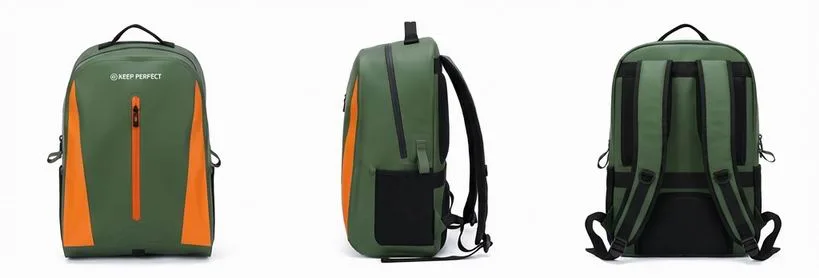
Colourway choice is a marketing decision with a production consequence: every colourway is its own minimum quantity, so a five-colourway drop at 500 pieces each is a 2,500-piece order. Consolidating to three colourways at 800 pieces each usually lowers the unit cost by 4% to 7% while giving the same shelf presence. Keeping one colour consistent across sizes is a separate problem, covered in the note on matching colour across a bag range.
Packaging, labels and the handover moment
A promotional bag is handed over once, and that moment decides whether it is received as a gift or as merchandise. A folded polybag with a 300 gsm hang tag costs about USD 0.35 per unit, a printed belly band on kraft board costs USD 0.55 to 0.75, and a rigid gift box costs USD 1.80 to 3.20 and only makes commercial sense above a USD 25 retail equivalent. Carton quantity matters too: 40 flat-packed 10L bags per carton is a two-person unpack, 12 backpacks is not.
Put the compliance story on the tag rather than on the shell. A hang tag can carry the material statement, the care instructions and the recycling mark without adding a print colour to the bag, and it can be reprinted within a week if regulations change while the bag artwork stays frozen for three seasons. Tag stock and print detail are set out in our hang tag guide, and the plastic-free options are compared in the packaging note.
Compliance paperwork by destination market
Three documents decide whether a shipment clears: a material composition file, a restricted-substance test report from an accredited third-party laboratory, and country-of-origin marking on the product or the packaging. Test reports are issued per material and colour rather than per bag, so a five-colourway program in two fabrics can need up to ten sets of paperwork unless the laboratory accepts a matrix approach on shared components.
Budget 7 to 12 working days and USD 180 to 450 per test, and start the testing during sampling rather than after bulk. The failures that actually show up are plasticisers in PVC film, nickel release from metal hardware, and azo dyes in a printed label or tape. Reading a report is its own skill: the REACH note and the Prop 65 primer explain what each line means and which lines a retail buyer will ask about.
Timeline: brief through to delivered cartons
| Stage | Duration | Who signs off | Where it slips |
|---|---|---|---|
| Brief and platform selection | 3-7 days | Brand or buyer | Size chosen without a packed test |
| Artwork and Pantone approval | 5-10 days | Brand | Two strike-off rounds needed |
| Sample bag | 6-10 working days | Buyer | Hardware or colour change |
| Sample courier and review | 4-8 days | Buyer | Public holiday at destination |
| Bulk production slot | 35-50 days | Production planner | Slot lost in week three |
| Inspection at AQL 2.5 | 2-4 days | Buyer or agent | No agreed inspection standard |
| Freight, sea or air | 28-38 / 5-8 days | Logistics | Import clearance held on paperwork |
Work backwards from the date the bags must be on site. A 35-day bulk run plus 30 days on the water plus a week of import clearance and inland delivery means artwork has to be approved roughly 85 days before the handover date, and the sample has to be signed off about 15 days before that. Air freight removes 22 to 30 days and adds USD 1.10 to 1.90 per unit on a 20L bag, which is usually the cheapest insurance available in week six.
Two gates cause almost every late delivery. The first is colour approval, because a strike-off round takes 5 to 7 days and programs routinely need two. The second is the bulk slot, which is booked against machine capacity and cannot always be recovered once peak season starts. Lock both before the artwork is finalised, not after, and treat the sample courier leg as a line item rather than an afterthought.
Distribution models and how the bag is handed over
| Model | Typical quantity | Best platform | Target cost per unit |
|---|---|---|---|
| Gift with purchase | 500-2,000 | Tote or 10L roll-top | USD 6-11 |
| Resort welcome kit | 300-1,500 | 10L roll-top | USD 7-13 |
| Event or festival handout | 2,000-10,000 | 5L or 10L roll-top | USD 4-8 |
| Regatta or race entry pack | 200-800 | 20L duffel | USD 9-16 |
| Crew and staff kit | 100-600 | Waterproof backpack | USD 14-22 |
The handover model sets the size, the decoration and the packaging all at once. A gift-with-purchase bag sits on a retail counter and needs a hang tag, a scannable barcode and a perceived value above the spend threshold. A resort welcome kit sits in a villa and has to be useful for a beach day, which argues for a 10L roll-top or a tote rather than anything with a harness.
Event handouts are the least forgiving format: 2,000 units can go out in three hours, so the bag has to arrive flat-packed in cartons of 40 and be unpackable by two people with a blade. Numbered crew kit is the opposite problem, because each bag needs a name or a number applied after the main run, which pushes you towards heat transfer. Format detail is set out in the resort programme note and the festival guide.
Measuring whether the program paid for itself
Three numbers tell you whether to repeat a program: uptake rate, retained-use rate after six months, and cost per thousand impressions. Free handouts at an event typically see 85% to 95% uptake, while a gift-with-purchase threshold converts at 25% to 45%. Retained use is the number that separates a good bag from a good idea, and anything above 55% at six months is a strong result for a waterproof category item.
Collect the data cheaply. A QR code on the hang tag pointing to a care page gives a scan count you can attribute, a short URL printed inside the bag gives a second signal months later, and a hashtag on the tag gives a third. A bag with 60% six-month retention at USD 9.80 per unit beats a USD 4.50 bag discarded in week two, because impressions are what the money actually bought.
Where programs go wrong
- Artwork arrives as a bitmap, so the logo has to be redrawn and the slot slips a week.
The operational failures repeat across nearly every first program. The bag is specified by volume without anyone packing a real load into it, so the 10L turns out to hold a phone and nothing else. The colour is approved on a screen. The compliance test is booked after bulk instead of during sampling. The packaging arrives three weeks after the bags. Each one of these is avoidable with a single page of brief.
The second category is a design failure, and it is more expensive because it is only discovered on the delivered goods. The logo sits where the roll-top fold covers it. The print runs across a weld line and lifts in the first month. The brand colour is applied to a camouflage base where it disappears at two metres. Placement is a technical question with a short answer, covered in our logo placement guide, and process selection is set out in the digital versus screen comparison.
The one-page brief to send
- Platform and size, with the packed load you expect it to hold.
- Quantity per colourway and the total, including a 5% buffer.
- Face fabric and film thickness, or the target unit weight in grams.
- Decoration method, print area in millimetres and Pantone references.
- Packaging spec: polybag, tag, belly band, carton quantity.
- Destination market and the compliance set that market requires.
- Inspection standard, usually AQL 2.5 on a defined defect list.
- The date the bags must be on site, not the date you want to order.
A usable brief has eight lines and fits on one page. Anything longer belongs in an appendix; anything shorter generates a week of email while a planner guesses at the gaps. Send it with vector artwork and a target date and you will get a costed reply against every line, including the ones you did not ask about, which is usually where the surprises are hiding.
Our own waterproof line has produced bags since 2014 in an SGS-verified 4,950 m2 facility with 137 staff across 7 production lines, working to a 500-piece minimum with sampling in 6 to 10 working days and bulk in 35 to 50 days, FOB Xiamen. The route from first sketch to packed pallets is documented and the platforms available for branding are listed under products. Once the first drop is on the water, the questions shift to numbering and size mix; the team and club guide answers those, and the gift set note covers bundling two sizes into one offer.
Frequently asked questions
Q1. What is a promotional dry bag program?
A promotional dry bag program is a bulk order of branded waterproof bags, usually 500 to 5,000 pieces, covering platform, decoration, packaging, testing and freight. Minimums start at 500 pieces per colourway, sampling takes 6 to 10 working days and bulk runs 35 to 50 days.
Q2. What is the minimum order for branded dry bags?
Plan on 500 pieces per colourway for a made-to-order waterproof bag. Below that you still pay for the line changeover, which takes three to four hours, so the unit price at 300 pieces is often 15% to 25% above the 500-piece price.
Q3. How much does a branded dry bag cost per unit?
A 10L PVC roll-top runs USD 4.10 to 6.90 depending on volume, and a 20L TPU roll-top runs USD 7.60 to 12.40. Decoration adds USD 0.28 to 1.40 per unit and packaging adds USD 0.35 to 0.75 before freight.
Q4. Which print method lasts longest on a waterproof bag?
A welded silicone or TPU patch lasts longest at roughly 75 wash cycles, followed by a woven label in the seam at about 60. Screen print with a flexible ink system reaches 35 to 40 cycles and a full-colour heat transfer about 25.
Q5. Can I print a full-colour logo on a TPU dry bag?
Yes, through a heat-applied transfer rather than screen print. Transfers handle gradients and photographs, need no screen set-up and start at about 300 pieces, but they soften sooner than a welded patch in heavy sun and salt use.
Q6. How long does a promotional dry bag program take?
Roughly 85 days from brief to bags on site by sea: 6 to 10 working days for a sample, 35 to 50 days for bulk, then 28 to 38 days on the water. Air freight cuts 22 to 30 days and adds USD 1.10 to 1.90 per unit.
Q7. Why is each colourway its own minimum quantity?
Because fabric is dyed and film is extruded in batches, and a colour change means a wash-down and a new set-up on the line. A five-colourway drop at 500 pieces each is really a 2,500-piece commitment, not five small orders.
Q8. What artwork files should I send?
Vector artwork with Pantone references: AI, EPS or PDF with fonts converted to outlines. Any raster element needs 300 dpi at final size, and every element should sit at least 3 mm inside the panel edge and 25 mm clear of a weld line.
Q9. How do I stop the bulk colour being different from the sample?
Approve a signed physical strike-off viewed under 5,000 K daylight and state a numerical tolerance, typically ΔE 2.0 for a brand colour and 3.0 for a secondary. Screen approvals are not enforceable because displays differ.
Q10. Do promotional dry bags need safety testing?
Yes for most regulated markets. Budget USD 180 to 450 and 7 to 12 working days per material and colour at an accredited laboratory, and start during sampling. Common failures are plasticisers in PVC film, nickel release from hardware and azo dyes in labels.
Q11. Should the logo go on the bag or on the hang tag?
Put the brand mark on the bag and the compliance story on the tag. A tag carries the material statement, care instructions and recycling mark without adding a print colour, and it can be reprinted in a week if rules change.
Q12. What packaging works best for a mass handout?
Flat-packed polybags in cartons of 40, so two people can unpack 2,000 units in under an hour. Assembled backpacks stack about 12 per carton and can triple freight cost per unit, which matters more than an extra litre of capacity.
Q13. How many spare bags should I order?
Add 5% to the first order. Programs lose 3% to 8% to transit damage, misprints and handover losses, and a 200-piece reprint after the run costs two to three times the original unit price because it reopens the line.
Q14. Is TPU or PVC better for a promotional bag?
TPU if the bag is meant to be kept: it stays flexible in the cold, has no plasticiser to migrate and survives about 300 hours of UV before noticeable stiffening. PVC is 25% to 40% cheaper per unit and suits a single-season event handout.
Q15. Can each bag be numbered or named?
Yes, and it is best done with a heat-applied transfer after the main run, because numbering on the line slows every station. Team, club and crew programs typically number 100 to 600 units this way at about USD 1.10 per unit.
Q16. How do I measure whether the program worked?
Track uptake, retained use at six months and cost per thousand impressions. Free handouts convert at 85% to 95%, gift-with-purchase at 25% to 45%, and retained use above 55% at six months is a strong result for waterproof gear.
People also ask
How do you plan a promotional dry bag order?
Fix the platform, then the quantity per colourway, then the decoration and packaging, in that order. Work backwards from the handover date: allow 6 to 10 working days for a sample, 35 to 50 days for bulk and 28 to 38 days by sea.
Are branded dry bags worth the cost?
They are when the bag is kept. A USD 9.80 bag with 60% retained use at six months delivers more impressions than a USD 4.50 bag discarded in week two, measured as cost per thousand impressions rather than cost per unit.
What is the cheapest dry bag for a mass giveaway?
A 5L or 10L PVC roll-top at USD 4.10 to 6.90 per unit in flat-packed cartons of 40. It ships flat, stacks densely and accepts a one-colour screen print at about USD 0.35 per unit.
How long does branding take on a waterproof bag?
Sampling takes 6 to 10 working days and bulk 35 to 50 days, with decoration adding 2 to 4 days depending on method. Air freight then removes 22 to 30 days compared with sea at a cost of USD 1.10 to 1.90 per unit.
Can you print on TPU fabric?
Yes. Screen print with a flexible ink system suits one to three spot colours, and a heat transfer handles full colour. Keep artwork 25 mm clear of any RF weld line, where the film flexes and prints lift first.
Do promotional bags need compliance certificates?
Most regulated markets require a restricted-substance test report per material and colour, plus country-of-origin marking. Budget USD 180 to 450 per test and book it during sampling rather than after bulk production has finished.
Need this in production volume?
QUANZHOU JUNYUAN BAGS has produced waterproof bags since 2014 in an SGS-verified 4,950 m2 facility in Fujian, China. Minimum order 500 pieces, sampling in 6–10 working days, bulk in 35–50 days, FOB Xiamen — write to service@junyuanbags.com with your spec and target market.