Home / Blog / Design & Branding
Hang Tags and Labels for Dry Bags
A hang tag on a welded dry bag has to survive roughly 20 to 40 wet-handed touches on a shop floor, then explain the product in the 30 seconds a shopper gives it. That means a 300 to 400 gsm board or a 105 gsm spunbond sheet, a longest edge under 130 mm so it cannot foul the roll-top closure, and attachment through a welded loop rather than a sharp pin through the film, because a single 1.5 mm hole destroys an IPX7 rating.
Below is the full decision chain: substrate, size relative to bag volume, print method with realistic run sizes, the six label lines most markets require, barcode geometry that still scans when the tag is damp, and the four attachment methods that keep the waterproof construction intact. The cost and lead-time figures come from live programme volumes rather than from a pricing page, and the closing section is a one-page brief you can send before you pay for any artwork.
- The journey a tag has to survive
- Choosing a substrate that tolerates humidity
- Matching tag size to bag volume
- Print method: where the break-even sits
- The lines every label has to carry
- Care symbols that mean something
- Barcodes that scan when the tag is damp
- Attaching without piercing the film
- Sewn-in labels versus heat-transfer labels
- Getting the print to agree with the bag colour
- Environmental claims that survive checking
- What a tag programme costs and how long it takes
- A one-page brief you can send tomorrow
The journey a tag has to survive
A tag leaves the packing bench, travels flat in a carton for two to six weeks at 60 to 80% relative humidity, is unpacked into a shop that may be 15 m from open water, and then gets handled every day until the bag sells. The failure modes are not dramatic: a curled corner at 70% humidity, a 3 mm tear at the string hole after the tenth touch, and ink rub on a dark background where the plate cost was saved. Every one of those is a visible quality signal on a bag that cost far more to make than the tag.
Because dry bags are sold against a waterproof promise, the tag carries an unusual load. It must state the capacity honestly, name the construction material, and survive the same salt-laden air as the product. When a shopper picks up a 20L roll-top bag and the tag falls off, they do not blame the printer; they file it as evidence that the whole product is cheap. Budget accordingly: a tag costing 0.04 to 0.09 USD is protecting a bag with a tenfold value.
Choosing a substrate that tolerates humidity
Four families cover almost every programme. Coated art board at 300 to 400 gsm is the retail default: it prints beautifully, holds a score fold, and costs the least per thousand. Tyvek-style spunbond at 105 to 150 gsm does not tear at the string hole and stays legible after salt spray, but takes fewer ink densities. rPET sheet made from post-consumer bottle flake supports a recycled-content claim and still folds cleanly. Clear polypropylene suits a bag where the product itself should stay visible.
The decision rule is mechanical. If the bag will sit on an open-air rack or near a pool, choose the spunbond; if it ships straight into a big-box retailer with barcode scanning at the till, choose coated board with a machine-readable finish. Our own guiding reference for this trade-off sits alongside the print comparison in digital versus screen printing for dry bags, where the same humidity question is answered for the bag panel rather than the tag.
| Substrate | Weight | Cost per 1,000 | Humidity behaviour | Best paired with |
|---|---|---|---|---|
| Coated art board | 300 gsm | 18-26 USD | Curls above 70% RH | Shelf retail, barcode scanning |
| Coated art board | 400 gsm | 26-38 USD | Slight curl, holds fold | Premium ranges, gift sets |
| Spunbond sheet | 105 gsm | 34-52 USD | Flat through 95% RH | Marine shops, poolside display |
| rPET sheet | 250 gsm | 30-44 USD | Flat, softens slightly | Recycled ranges |
| Clear PP film | 200 micron | 22-34 USD | Flat, static cling | Bag-in-bag presentation |
Matching tag size to bag volume
Tag area scales with the amount of copy the retailer demands, not with the bag. A 2L pouch needs three lines and a barcode, so a 45 x 90 mm card is enough. A 40L duffel with eight specification lines, a care symbol strip and two barcodes needs doubled space, and anything larger than a 120 x 180 mm card starts to look like a sign rather than a label.
String length matters as much as card size. On a roll-top bag the tag hangs from the buckle or the welded loop, so a 120 mm cord lets it lie flat against the panel for photography, while a 220 mm cord lets it swing free and catch on the next bag in the bin. The table below settles both dimensions by bag family, which keeps a whole range visually consistent across a shelf run.
| Bag family | Tag size | Cord length | Data lines | Suggested stock |
|---|---|---|---|---|
| 2L-5L pouch | 45 x 90 mm | 110 mm | 3 | 300 gsm board |
| 10L-20L roll-top | 55 x 100 mm | 120 mm | 5 | 350 gsm board |
| 25L-40L duffel | 75 x 130 mm | 150 mm | 7 | 400 gsm board |
| 50L-90L holdall | 100 x 160 mm | 180 mm | 8 | Spunbond 130 gsm |
| Retail gift set | 120 x 180 mm | 200 mm | 10 | 400 gsm board, matte |

Print method: where the break-even sits
Offset litho gives the sharpest type and the widest colour gamut but carries plate cost, so it only makes sense above roughly 3,000 pieces per design. Digital toner or inkjet has no plates and handles versioning, which is what you want for a colourway-limited drop or a market where three languages share one print run. Screen printing lays down the thickest ink film and the highest rub resistance, which matters for dark solid areas that will be handled.
Rub resistance is measurable rather than subjective: the abrasion of printed matter is covered by an ASTM method that runs a weighted disc over the surface for a set cycle count, and a good target is no visible transfer after 50 cycles on a dark ground. Type below 5 pt should be avoided on uncoated stock regardless of method, because the fine strokes close up after the first week of handling.
The lines every label has to carry
Retailers and border officers ask for the same core facts, and a missing line is the most common reason a shipment is held. Product identification, material composition by percentage, country of origin, responsible party address, care instructions and a traceable batch code cover nearly every market. Imprecise wording is the trap: writing 'waterproof fabric' tells nobody whether the shell is TPU laminate, PVC coating or a sprayed finish.
Capacity belongs on the tag in litres, measured the same way every time. Write it as a rounded whole number plus the method note, because a 20L bag measured to the roll line and one measured to the fill line differ by 2 to 4 litres in the shopper's hands. If you need a refresher on how to read those figures before you sign off artwork, the breakdown in our spec sheet guide shows the same numbers that belong on the card.
| Label line | Needed for | Typical wording | Failure if omitted |
|---|---|---|---|
| Product identity | All markets | 20L Roll-Top Dry Bag | Listing rejection |
| Material composition | EU, US | Shell 100% polyester with TPU film | Border hold, relabel cost |
| Country of origin | All markets | Made in China | Shipment delay |
| Responsible party | EU, US | Company name and postal address | Marketplace delisting |
| Care instructions | EU, US | Wipe clean, do not machine wash | Retail compliance score |
| Batch trace code | Internal QA | PO 2026-0417 / Line 3 | No recall traceability |
Care symbols that mean something
Textile care labelling follows a numbered symbol system defined by the ISO, and a coated bag is not exempt simply because nobody expects it to go in a washing machine. The minimum honest set for a welded dry bag is: wipe clean only, no machine wash, no tumble dry, no iron, and dry in shade. Those five symbols tell a buyer more than three paragraphs of prose and they cost nothing extra to print.
There is also a commercial argument for getting this right. A shopper who machine washes a TPU bag, sees the film haze, and leaves a one-star review is reacting to missing information, not to a product defect. Put the symbols on the sewn-in label as well as the hang tag so the instruction survives after the tag goes in the bin. Our cleaning guide uses the same five symbols in the field routine.
Barcodes that scan when the tag is damp
A barcode fails silently. It scans on the packing bench and fails at the till because humidity swelled the substrate by 1 to 2% and changed the bar widths. Keep the X-dimension at or above 0.33 mm, keep the quiet zone at 2.5 mm on each side, and print the human-readable digits below the bars so a clerk can key the number manually when a scan fails.
Place the code away from the string hole and away from any fold line, because a crease through the bars is the second most common failure after shrinkage. If you are printing in two markets with different code requirements, print one code rather than two side by side: adjacent symbologies confuse laser scanners and the operator ends up covering one with a thumb.
Attaching without piercing the film
The single biggest tag-related mistake on a welded bag is a plastic pin driven through the panel. The 1.5 mm hole it leaves is invisible in photos and fatal in a submersion test. Every serious programme therefore uses a load path that already exists: the webbing loop above the closure, a welded D-ring on the side, the handle grab loop, or a loop of cord around the roll itself.
Each method has a different labour cost at packing. A pre-tied string through a die-cut hole takes about four seconds per bag. A snap-lock tag through a webbing loop takes two seconds and survives rough handling better. An elastic loop around the rolled top takes three seconds but interferes with photography if it sits over printed artwork. Choose the method at the same time as you choose the bag fixture so they agree.
| Attachment | Bag feature needed | Packing time | Risk |
|---|---|---|---|
| Die-cut string through tag | Any loop or buckle | 4 s | Tear at the hole over many touches |
| Snap-lock tag to webbing | Welded loop or webbing | 2 s | None to the waterproof shell |
| Elastic loop over roll | Roll-top mouth | 3 s | Covers artwork in pack shots |
| Adhesive backing card | Flat panel, dry conditions | 1 s | Residue and poor adhesion below 10 degrees |
| Sleeve over carry handle | Grab handle | 3 s | Slides off 25 mm webbing |
Sewn-in labels versus heat-transfer labels
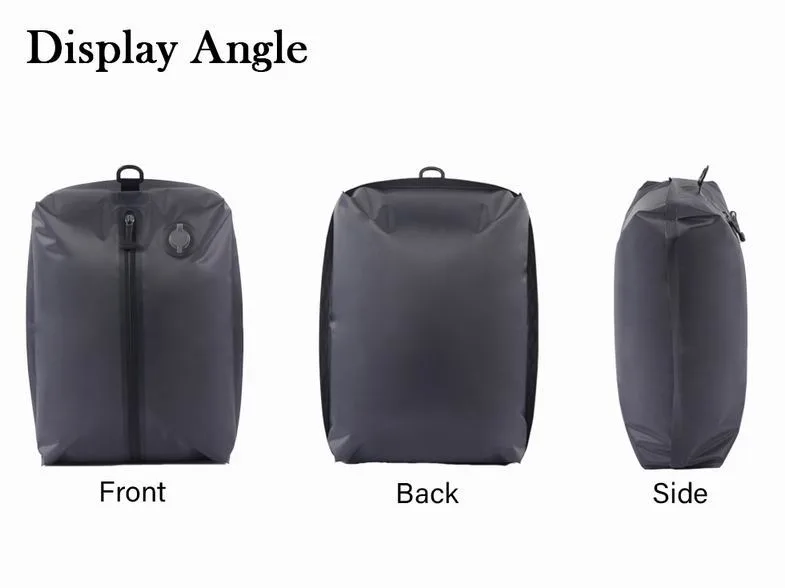
Hang tags are removable; labels are permanent. On a fabric-panel bag you can sew a woven satin label into a seam allowance where the needle holes sit inside a taped seam. On a fully welded TPU bag you cannot, so the options narrow to a heat-transfer label pressed onto the face fabric, an RF-welded patch carrying the mark, or a printed panel done in-line before assembly.
Heat-transfer labels last best on flat internal surfaces such as the interior back panel, where they face no abrasion. On an external panel, sand and salt lift the edges within one season. If you need a permanent external mark, plan it into the print stage and let us know before the cutting markers are made; retrofitting a label line onto a finished tool is expensive. The placement logic is set out further in our logo placement guide.
Getting the print to agree with the bag colour
Nothing undermines a range faster than a tag whose brand red is two shades away from the bag it is tied to. The fix is procedural: specify the brand colours as a physical reference, approve a printed proof on the actual production substrate, and set a tolerance rather than a judgement. A colour difference under a Delta E of 2 is invisible to most observers; above 4 it reads as a mistake even to untrained eyes.
Remember that the reference and the production run use different processes. Fabrics are dyed or pigment printed and often carry a subtle texture that scatters light; a tag is smooth and reflective. Ask for the proof of both together on one sheet under the same light source, around 800 lux neutral white, and you will see the mismatch before the run rather than after.
Environmental claims that survive checking
A hang tag is the most scrutinised 100 square centimetres in the industry. Every recycled-content number, every 'ocean bound' claim, every plastic-free badge needs a document behind it. Set concrete figures: 'recycled content 62% by weight, verified per batch' is defensible, while 'eco friendly material' is not. On the packaging side, some markets now require extended producer responsibility registration numbers printed directly on the marketing material.
Keep strength claims away from vague adjectives too. 'Injection-moulded buckle, UV-stabilised, tested to 500 hours' is a factual statement; 'industrial strength' is not. Where a chemical compliance statement is needed for the EU market, the supporting documentation sits with the topic covered in our REACH compliance article, and the rules for California Prop 65 warnings are handled separately from the tag artwork itself.
What a tag programme costs and how long it takes
Tag cost breaks into three parts: substrate and print, finishing (die-cut, hole punch, cord), and the packing labour to attach it. Below 1,000 pieces the unit price is dominated by setup; above 5,000 pieces the substrate choice decides more than the print method does. The figures below assume a two-colour layout with a single barcode and a standard die shape.
Timing interacts with the bag build rather than running beside it. Because tags are packed at the end, artwork has to be locked roughly 7 to 10 working days before the bulk packing date, and the printed lot should arrive with the cartons rather than after them. On our own lines, waterproof bag programmes run with sampling in 6 to 10 working days and bulk production in 35 to 50 days with a 500-piece minimum, and the tag window fits inside that schedule if the artwork is approved early.
| Component | 1,000 pieces | 5,000 pieces | Lead time | Note |
|---|---|---|---|---|
| Coated board, offset print | 31 USD | 24 USD | 8-12 days | Plate cost dominates below 3k |
| Spunbond, screen print | 52 USD | 41 USD | 10-14 days | No minimum background drying |
| Die-cut, hole, cord | 9 USD | 7 USD | Parallel | Standard shapes only |
| Attachment labour | 6 USD | 6 USD | Inline | Two seconds per bag |
| Artwork revision cycle | 60-140 USD | Same | 2-4 days | Budget two rounds |
A one-page brief you can send tomorrow
- State the bag family and capacity range the tag must cover, with litres measured to the roll line.
- Choose substrate by display environment: spunbond for humid or marine, board for barcode retail.
- Fix the tag size and cord length from the size table so every size in the range looks related.
- List the six compliance lines exactly as they must appear, including responsible-party address.
- Give brand colours as physical references with a stated Delta E tolerance, not as a screenshot.
- Specify the barcode symbology, X-dimension and quiet zone, and put it away from every fold.
- Name the attachment point on the bag and confirm no piercing of the welded shell.
- Confirm the recycled-content percentage and hold the supporting certificate before print.
- Lock artwork at least 10 working days before packing and request two proofing rounds.
Programmes that follow this sequence rarely need a second print run. The ones that do are almost always missing one of three things: a physical colour standard, a confirmed attachment point, or a compliance line list reviewed by someone who has actually shipped into the target market. Software version control helps too; name your artwork files with a date and revision number so nobody packs Wednesday's cards by mistake.
Minimums start at 500 pieces with FOB Xiamen terms, T/T 30/70, and AQL 2.5 inspection before the cartons close.
From here, two adjacent decisions shape how the card finally looks. The colour story across sizes belongs to our colour range guide, and the outer box that carries the through-line is handled in packaging ideas for dry bags. Both sit upstream of the artwork you send us, so read them before the first proof rather than after the second.
Frequently asked questions
Q1. What should a hang tag for a dry bag say?
A dry bag tag needs product name, capacity in litres, material composition with percentages, country of origin, responsible-party address, care symbols and a scannable barcode. Six lines plus symbols covers EU and US retail. Add a batch code for internal traceability, keeping the longest tag edge under 130 mm.
Q2. How big should a dry bag hang tag be?
Scale the tag to the amount of copy, not the bag. A 2L pouch works with 45 x 90 mm and three lines; a 40L duffel needs 75 x 130 mm for seven lines; anything past 120 x 180 mm on a 90L holdall starts to read as a sign rather than a label.
Q3. Can you put a hang tag through the bag film?
Never. A plastic pin leaves a 1.5 mm hole that voids an IPX7 rating the moment the bag is submerged. Attach through an existing load path instead: a welded webbing loop above the buckle, a D-ring, the grab handle, or a cord loop around the rolled top.
Q4. Which tag material survives humidity best?
Spunbond sheet at 105 to 150 gsm stays flat through 95% relative humidity and resists tearing at the string hole, which suits marine shops and poolside display. Coated art board is cheaper and prints sharper but begins to curl above 70% relative humidity.
Q5. What print method should I use for 500 tags?
Use digital. Offset plate cost is only recovered above roughly 3,000 pieces per design, and screen setup is recovered around 1,500. Digital toner or inkjet has no plates and handles versioning, so a colourway-limited drop of 500 to 1,000 tags is economical and can be corrected quickly.
Q6. Why does my barcode stop scanning in the shop?
Two causes dominate: humidity swell changing bar widths, and a crease running through the bars. Keep the X-dimension at or above 0.33 mm, hold a 2.5 mm quiet zone on both sides, place the code away from the string hole and every fold line, and print human-readable digits underneath.
Q7. Do dry bags need care symbols on the tag?
Yes. The ISO care-labelling system applies to any textile-based product, and the honest minimum set for a welded bag is wipe clean only, no machine wash, no tumble dry, no iron, and dry in shade. Put the same symbols on the permanent label so the instruction survives the bin.
Q8. How much does a hang tag add per bag?
For a two-colour layout with one barcode and standard finishing, budget 0.04 to 0.09 USD per bag including attachment labour at 5,000 pieces. Below 1,000 pieces setup pushes the unit cost toward 0.12 USD. Substrate choice matters more than print method above about 5,000 tags.
Q9. Should the tag be recycled paper?
Only if you can document it. An rPET sheet at 250 gsm supports a recycled-content claim and still folds cleanly, but the number printed on the card must match a certificate held on file. A vague eco badge with no percentage behind it is a compliance risk, not a marketing asset.
Q10. How long does a tag programme take?
Artwork lock to packed cartons is 10 to 14 days for standard die shapes, of which 2 to 4 days should be reserved for a second proofing round. Because tags are attached at the end of packing, plan the printed lot to arrive before bulk production closes rather than during it.
Q11. Can I use one tag for several bag sizes?
Yes, if they share a family. A single run-on tag with a blank capacity line and a check box works across 5L to 20L sizes and cuts artwork cost in half, but the size differences are then invisible on shelf, which hurts range navigation for larger families.
Q12. What is the best cord length for a tag?
110 mm for a small pouch, 120 mm on a 10L to 20L roll-top, 150 mm on a duffel, and 180 mm on a 50L to 90L holdall. Longer cords let the card swing into the next bag in a display bin and catch on neighbours; shorter cords trap the card under the webbing in pack shots.
Q13. Should the tag use matte or gloss lamination?
Matte reads warmer on outdoor gear and hides handling scuffs better, and it keeps a barcode readable under strong shop lighting. Gloss pops colour but shows fingerprints on dark grounds. If the bag is displayed near water and handled often, matte with a water-based varnish is the safer combination.
Q14. Who signs off the printed proof?
One named person per range, with a physical reference swatch and a stated Delta E tolerance in hand. Committee approvals cost more in delay than a second proof costs in money: budget two rounds and a reviewer with authority to accept a colour difference under Delta E 2.
Q15. What happens if the compliance line is wrong?
A missing responsible-party address or material composition can trigger a marketplace delisting or a border hold, and relabelling a container of bags costs 200 to 600 USD in labour plus storage. Always have someone who has shipped into the target market review the six lines before artwork lock.
Q16. Do I need a batch code on the tag?
It is not legally required, but it is the cheapest recall tool you will ever buy. A simple code such as PO line plus week number costs nothing extra to print and lets you isolate 500 suspect bags instead of recalling twenty thousand units after a hardware failure.
People also ask
How are hang tags attached to waterproof bags?
They are tied through an existing anchor rather than pinned through the film: a welded webbing loop above the buckle, a D-ring, the grab handle or a cord loop around the rolled top. A snap-lock tag to webbing takes about two seconds at packing and leaves the waterproof shell untouched.
What size is a standard product hang tag?
Common sizes run 45 x 90 mm for small accessories, 55 x 100 mm for mid-size items, and 75 x 130 mm for larger goods. The right size depends on copy length, not on the product, and anything over 120 x 180 mm starts to read as signage.
Why do barcodes fail at the checkout?
Usually because humidity swelled the substrate and changed bar widths, or because a fold runs through the bars. Keeping the X-dimension above 0.33 mm, the quiet zone at 2.5 mm, and the placement away from every crease prevents nearly all the failures.
Are Tyvek hang tags better than paper?
For wet or marine retail, yes: spunbond sheets stay flat through 95% relative humidity and resist tearing at the string hole. Paper is cheaper, prints sharper and suits barcode retail in climate-controlled shops, but it curls above 70% relative humidity.
What information must an imported bag carry?
Product identity, material composition with percentages, country of origin, responsible-party address, and care instructions. Most retailers also require a scannable barcode, and a batch code is strongly recommended for traceability if a component ever fails.
Can printed ink rub off a hang tag?
Dark solid areas on uncoated stock can. Rub resistance is measured with an abrasion test that runs a weighted disc over the surface; aim for no visible transfer after 50 cycles, and avoid type below 5 pt on any uncoated substrate regardless of the print method.
Need this in production volume?
QUANZHOU JUNYUAN BAGS has produced waterproof bags since 2014 in an SGS-verified 4,950 m2 facility in Fujian, China. Minimum order 500 pieces, sampling in 6–10 working days, bulk in 35–50 days, FOB Xiamen — write to service@junyuanbags.com with your spec and target market.