Home / Blog / Buying & Comparisons
Matching a Dry Bag to Your Boat
The boat sets the dry bag specification before the activity does. A sea kayak with a 200 mm round hatch will not take a 40L duffel no matter how useful it would be, a sit-on-top has no hatch at all so every bag lives on deck in full sun, and a raft frame needs flat-topped bags that stack rather than cylinders that roll. Match three variables and the choice is easy: the opening you must pass the bag through, the water the hull throws at it, and the points it can be lashed to. Get any one wrong and the bag is either unusable or lost.
This guide walks through nine hull types with the numbers that matter for each: aperture in millimetres, exposure in realistic terms, the format that fits, the size band that works and the lashing hardware each boat actually offers. It ends with a decision matrix and a five-minute fit test you can run in a garage with a tape measure and a bathroom scales. Sizing detail for specific paddling formats is linked throughout, including the sea kayak sizing guide for longer touring loads.
- Why the hull sets the specification before the activity does
- Aperture and stowage space: measure the opening first
- Exposure profiles: what each hull actually throws at a bag
- Sea kayaks and touring kayaks
- Sit-on-tops and recreational kayaks
- Canoes and open boats
- Rafts, inflatables and packrafts
- Dinghies, keelboats and small sailboats
- Stand-up paddleboards
- Powerboats, jet skis and centre consoles
- Format versus boat: a decision matrix
- Lashing points and what each hull offers
- A five-minute fit test before you buy
Why the hull sets the specification before the activity does
Most buying advice starts from the activity, which is the wrong variable. Two people paddling the same stretch of coast on the same afternoon need completely different bags if one is in a sea kayak and the other is on a stand-up paddleboard. The kayaker has a dry compartment behind a bulkhead and can use a cheap splash-resistant bag; the paddleboarder has a set of bungees on a deck that is underwater every time a ferry wake arrives, and needs a welded IPX7 bag lashed with two lines.
Three hull properties drive everything. The first is stowage: is there a compartment, how big is the opening, and is it dry. The second is exposure: does the bag sit in a dry compartment, on an open deck, or in the water. The third is attachment: are there deck lines, D-rings, a frame, a rail, or nothing but a flat surface. Those three answers eliminate most of the catalogue before you look at litre markings.
The practical consequence is that a boat owner should buy by measurement, not by capacity. Write down the hatch opening, the compartment length and the distance between lash points, then shop against those numbers. A 30L bag that fits a compartment beats a 40L bag that has to be forced, because a forced bag is a bag with a closure that was never properly rolled.
Aperture and stowage space: measure the opening first
A hatch aperture is a rigid limit and it is smaller than people expect. A round 200 mm hatch will pass a bag whose rolled diameter is 190 mm, which in practice means a 20L roll-top and not a 30L one. An oval 240 by 145 mm hatch takes a wider but flatter load, which suits a 30L duffel. Measure the opening at its narrowest axis, subtract 10 mm for tolerance, and compare that against the bag’s rolled diameter, not its flat width.
| Boat type | Typical opening | Max rolled bag diameter | Usable litres | Note |
|---|---|---|---|---|
| Sea kayak, round hatch | 200 mm | 190 mm | 20 L | Day hatch is smaller, usually 150 mm |
| Sea kayak, oval hatch | 240 x 145 mm | 230 x 135 mm | 30 L | Flat duffels work best here |
| Sit-on-top, no hatch | Deck only | No limit | Any lashed size | All exposure, no shelter |
| Open canoe | Open hull | No limit | 60 L and up | Thwart and seat lash points |
| Dinghy, forward locker | 300 x 220 mm | 290 x 210 mm | 45 L | Locker drains slowly |
| RIB or console boat | Anchor locker | No practical limit | 90 L | Dry storage is the constraint |
Compartment length matters as much as aperture. A kayak stern compartment that is 700 mm long will take a 20L bag lying across it but not two 20L bags end to end, and a canoe that is 4.9 m long has room for three 60L duffels if they are loaded from the centre outwards. Sketch the compartment on paper with its dimensions before buying, and allow 60 to 80 mm at the mouth for the roll-top closure itself.
Exposure profiles: what each hull actually throws at a bag
Exposure is not a single scale. A bag can face continuous light spray, occasional solid water, sustained immersion during a capsize, or a long soak in bilge water, and each of those kills a different construction. Spray tests the closure; solid water tests the seam; immersion tests both; a soak tests the seam material against hydrolysis rather than its initial strength.
Translate exposure into a rating using the standard, not the adjective. The ISO and IEC frameworks behind ingress codes exist precisely because terms such as water resistant and waterproof are unenforceable. Ask which code the bag was tested to and at what depth and duration, then compare that against what your boat does. A bag that has never been immersion tested is fine in a kayak day hatch and a liability on a paddleboard.
Sea kayaks and touring kayaks
A sea kayak is the easiest boat to pack and the fussiest about shape. Bulkheads create dry compartments, hatches restrict what goes in, and deck lines give excellent lash points for a small grab bag. The standard setup is one 20L roll-top per compartment plus a 5L deck bag on the front lines, which covers three to five days with resupply and keeps the weight low and central.
Favour cylindrical roll-tops over duffels here. A cylinder slides through a round hatch, deforms to fit the hull curve and comes out again when wet, whereas a loaded duffel binds in a round aperture and has to be pushed, which is how hatch rims crack. Use 0.5 mm film in the stern compartment where bags rub against each other for days, and 0.3 mm for the deck bag where weight matters more than abrasion life.
Sit-on-tops and recreational kayaks
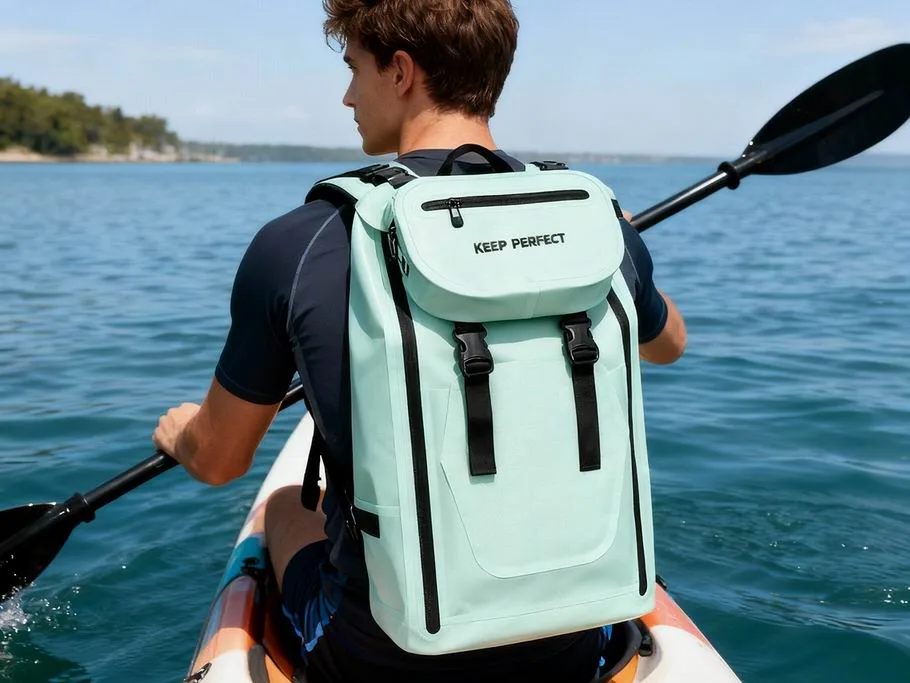
A sit-on-top is the hardest small craft to keep dry because there is no sheltered volume at all. Everything sits on the deck, in the sun, in full view of every wave. That changes three decisions at once: the rating must be IPX7 rather than IPX6, the attachment must be positive rather than a bungee tuck, and the colour should be light rather than black, because a black bag on a deck at 32 °C reaches 55 °C inside within an hour.
Use two bags, not one. A 10L to 15L bag lashed behind the seat with two straps to the existing well fittings carries layers and food, and a 2L to 5L bag on the front bungees holds the phone and keys. Both must be lashed with a line rather than tucked, because a sit-on-top deck is scoured by water in any kind of chop and a tucked bag is gone within two waves.
Canoes and open boats
An open canoe has enormous volume and no compartments, which points to large duffels rather than small roll-tops. Two 60L duffels and three 30L roll-tops cover a week for two paddlers, and the duffels double as seats and tables in camp. Trim matters more than in a kayak: a 16-foot hull wants the load centred and low, with heavy items between the thwarts and light bulky items toward the ends.
Lash to the thwarts and the seat pedestals, never to the gunwales alone. A gunwale lash pulls inward and deforms the hull when tightened, while a thwart lash pulls across the boat and holds its shape. Carry a spare 30L bag for the wet tarp and the bailer, because an open boat in rain collects 5 to 15 litres of water in the bilge over a day and that water has to be managed before it reaches the dry kit.
Rafts, inflatables and packrafts
Inflatable craft share two properties: they flex, and they are wet inside. Everything strapped to a frame moves independently of the tubes, so bags must be strapped tight and checked often, and anything inside the boat sits in water. Flat-topped duffels with a rectangular footprint win here because they stack two high on a frame and open from the side without being unstrapped.
Packrafts are the exception. Volume is measured in tens of litres rather than hundreds, the tubes are the storage system on some designs, and a bag dragged behind on a tether is a common solution. Use 10L to 20L roll-tops with a welded D-ring, keep the tether short enough that the bag cannot wrap an ankle, and expect the bag to be submerged for long stretches, which calls for welded seams and an IPX7 test.

Dinghies, keelboats and small sailboats
On a sailing dinghy the bag lives in a locker or under a thwart, gets soaked at least once per session, and is dragged across a shingle beach at the end of the day. Abrasion resistance and seam strength matter more than weight, so 0.5 mm film with a 500D face fabric is the sensible build, and a reinforced base is worth the extra 40 g. A capsize is routine rather than exceptional, so every bag that matters should be immersion rated and clipped in.
Small keelboats invert the problem: there is plenty of dry space below, but the companionway is narrow and the bags have to be carried down a ladder. Medium bags in the 20L to 30L range are easier to handle than a single 60L bag, and a waterproof backpack with welded seams makes the dock-to-cabin carry far less awkward. Keep one small roll-top permanently in the cockpit for the phone and the handheld radio, because that is where water actually arrives.
Stand-up paddleboards
A paddleboard is a kayak with the shelter removed and the stability reduced. Everything rides on the bungees in front of or behind the standing area, everything gets wet, and anything unlashed is in the water the moment the rider falls. The whole load therefore has to be small, light and positively attached; 10L to 20L is the working range and 30L is the practical maximum before the deck becomes crowded.
Buoyancy is a genuine design consideration here. A sealed 10L bag with air inside provides about 10 kg of lift, which will keep a paddleboard bag visible and recoverable if it goes in. Pack to about 70% volume so there is air left, and run the bungee over the top of the bag in a cross pattern rather than lengthwise, which is the arrangement that survives a fall.
Powerboats, jet skis and centre consoles
Powered craft generate two exposures paddlers rarely see: high-speed spray at 40 km/h or more, which is a pressure event rather than a splash, and long periods of direct sun on an open deck. Spray at speed is best handled by IPX6 or better with a closure that cannot work loose, and sun is handled by light colours and by keeping bags in a locker rather than on the deck. A black bag on a console deck in July will reach 60 °C internally.
Jet skis are the extreme case: a small storage bucket, constant immersion around the hull and a rider who is in and out of the water all day. Use a 5L to 10L welded roll-top, keep the registration and phone in a second small pouch inside it, and expect to rinse the whole thing in fresh water after every session. Salt left on a closure for a season will stiffen it enough to compromise the fold.
Centre consoles with under-seat storage can carry a 90L bag, but the opening is usually a side access hatch that suits a soft duffel. Dry storage volume, not water exposure, is the limiting factor on a console boat, so measure the locker before buying and accept that the deck bag and the locker bag will be two different formats.
Format versus boat: a decision matrix
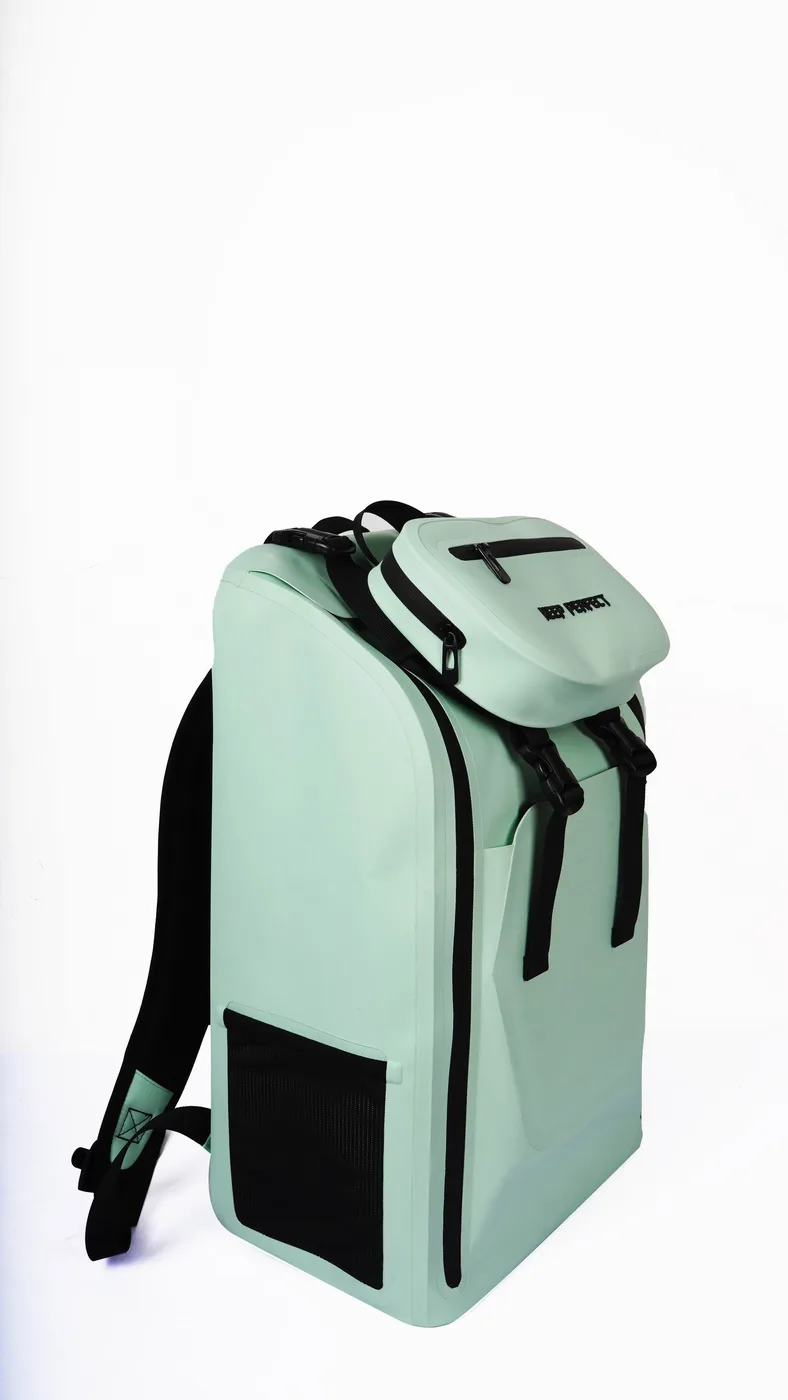
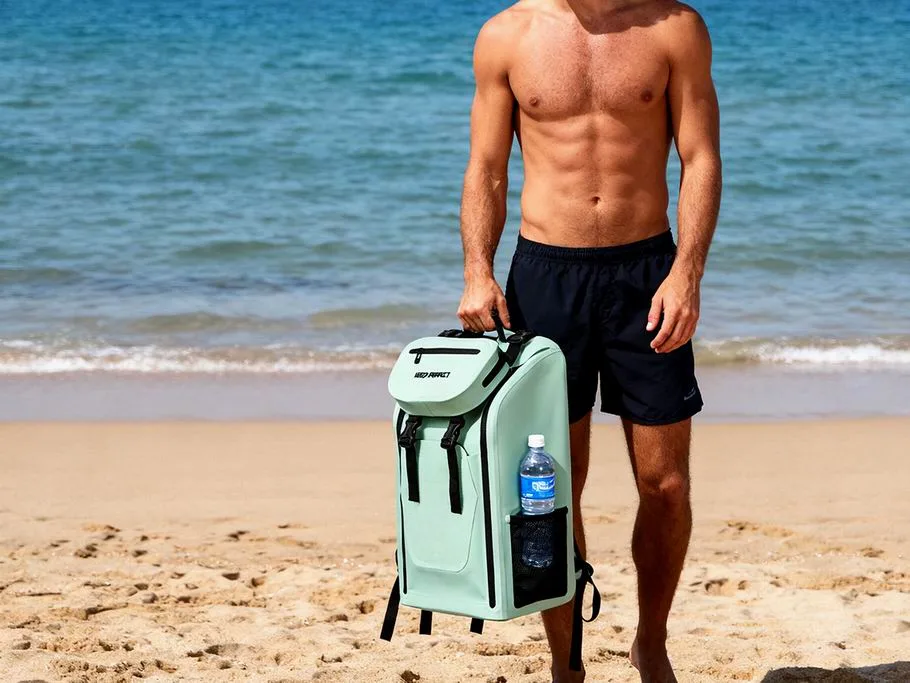
Once aperture, exposure and lash points are known, the format follows almost mechanically. Cylindrical roll-tops suit round hatches and tight compartments. Duffels suit open hulls and frames. Backpacks suit boats where the carry is long and the stowage is generous. Buckets suit decks where the bag has to stand open and be reached into constantly.
| Boat type | First choice | Second choice | Avoid | Why |
|---|---|---|---|---|
| Sea kayak | 20L roll-top cylinder | 30L soft duffel | Rigid box | Round hatch and hull curve |
| Sit-on-top | 15L roll-top, lashed | 10L roll-top plus 5L | Anything tucked under bungee | No shelter, full sun |
| Open canoe | 60L duffel | 30L roll-top set | Small bags only | Volume available, trim critical |
| Raft with frame | 60L flat duffel | 30L roll-top | Cylinders that roll | Stacking and side access |
| Dinghy | 20L roll-top, 0.5 mm | 30L roll-top | Light 0.3 mm film | Capsize and shingle wear |
| Paddleboard | 10-20L roll-top | Waterproof backpack | 30L and larger | Deck space and re-entry |
| Centre console | 60-90L duffel | 30L roll-top set | Backpacks below deck | Locker aperture limits |
The avoid column is the most useful part of the table. Most disappointing purchases are not the wrong size, they are the wrong format: a rigid box that will not pass a hatch, a cylinder that rolls off a frame, a lightweight film bag dragged across shingle. Check the avoid line for your boat before you look at litre numbers again.
Lashing points and what each hull offers
Lashing is the last variable and the one most often improvised. Deck lines, D-rings, thwarts, frame crossbars, rails and bungee webs each take a different attachment, and each has a different failure mode under load. A welded D-ring on the bag takes a 25 mm strap comfortably; a sewn webbing loop on a budget bag tears at 60 to 80 kg of shock load, which a breaking wave will exceed.
| Boat type | Lash points available | Attachment method | Practical load limit | Failure mode to watch |
|---|---|---|---|---|
| Sea kayak | Deck lines, 4 mm | Two lines, one full turn | 3 kg on deck | Line chafe at the fitting |
| Sit-on-top | Well fittings, bungees | Two straps per bag | 8 kg | Tucked bag washes off |
| Open canoe | Thwarts, seat pedestals | 25 mm strap around thwart | 20 kg | Gunwale lash deforms hull |
| Raft frame | Crossbars, 32 mm tube | Two cam straps, one over top | 35 kg per bag | Strap relaxation when wet |
| Paddleboard | Bungee web | Cross pattern over the bag | 5 kg | Bag lost on a fall |
| Console boat | Cleats, rail, locker | Strap to rail or stow loose | 25 kg | UV on exposed webbing |
Whatever the boat, the rule is two attachment points and a quick release. A single point lets the bag rotate and chafe; three points take too long to undo when you need the bag now. Use a screw-gate carabiner or a cam buckle rather than a knot, because knots tighten under load and a wet knot is slow to undo with cold hands.
A five-minute fit test before you buy
- Measure the narrowest axis of every opening the bag must pass through and subtract 10 mm.
- Measure the compartment length and write down how many bags fit side by side.
- Weigh the kit you actually carry on a normal day, not the kit you carry once a year.
- Decide the exposure: dry compartment, open deck, or in the water, then pick the rating.
- Check the lash points and confirm the bag has a welded D-ring that matches the strap width.
- Load the bag to 85%, roll three times, and confirm it still passes the aperture.
Run that sequence with a tape measure and a bathroom scales and most of the catalogue disappears. What remains is usually two or three bags, and the tie-breaker is film thickness: 0.3 mm where the bag is carried and handled gently, 0.5 mm where it is dragged, stacked or strapped against a frame for days.
Two external references help at the planning stage. Coastal conditions, tide and wind forecasts for open-water paddling come from NOAA Ocean Service, and the test standards behind any waterproof claim a seller makes are published by the ISO, which is worth reading before trusting a rating on a listing.
Per-boat packing detail sits in the activity guides: the day kayaking guide covers the small-boat case in full, the canoe packing list handles open-hull loading, the rafting guide covers strapping on a frame, and the paddleboard guide covers deck lashing. Powered craft have their own care routine in the jet ski care guide. Compare formats in the bag versus sack versus duffel comparison, check the full product line for the sizes that fit your measurements, and note that club and fleet orders usually standardise on one roll-top dry bag platform across all hulls.
Frequently asked questions
Q1. Which dry bag should I choose for my boat?
Match three variables: the hatch opening the bag must pass through, the water the hull throws at it, and the lash points available. A sea kayak wants a 20L cylinder, a canoe wants 60L duffels, a paddleboard wants a 10L to 20L welded roll-top lashed in a cross pattern.
Q2. Does boat type really change the bag I need?
Yes, more than the activity does. Two people on the same coast need different bags if one is in a kayak with a dry hatch and the other is on a paddleboard with no shelter at all.
Q3. How do I measure a kayak hatch for a dry bag?
Measure the narrowest axis of the opening and subtract 10 mm for tolerance. A round 200 mm hatch passes a bag with a rolled diameter of 190 mm, which means a 20L roll-top rather than a 30L one.
Q4. Are duffels or roll-tops better in a canoe?
Duffels. An open canoe has volume and no compartments, so two 60L duffels cover a week for two paddlers, and they double as seats and tables in camp. Lash to the thwarts, not the gunwales.
Q5. What rating does a sit-on-top kayak need?
IPX7, because there is no sheltered volume and every wave lands on the bag. Use a 10L to 15L bag lashed with two straps to the well fittings, plus a small 5L bag on the front bungees.
Q6. Why do duffels work better than cylinders on a raft frame?
They stack two high and open from the side without being unstrapped. A loaded cylinder rolls on a frame, and anything that has to be unstrapped to open defeats the point of a forward bay.
Q7. How big a bag can I take on a paddleboard?
10L to 20L is the working range and 30L is the practical maximum before the deck becomes crowded. Pack to about 70% so there is air left, and run the bungee over the bag in a cross pattern.
Q8. Do I need a different bag for a dinghy than for a kayak?
Yes. A dinghy capsizes routinely and is dragged across shingle, so the priority is abrasion and seam strength: 0.5 mm film with a 500D face and a reinforced base rather than a lightweight sprint bag.
Q9. What film thickness suits which boat?
0.3 mm where the bag is carried and handled gently, such as a kayak deck bag, and 0.5 mm where it is dragged, stacked or strapped against a frame for days, as on a raft, dinghy or canoe.
Q10. Can a black dry bag sit on a deck in summer?
It can, but a black bag on a console deck at 32 °C reaches about 55 °C inside within an hour, and up to 60 °C on an open powerboat deck in July. Choose a light colourway for exposed decks.
Q11. How should I lash a bag to a canoe?
Around a thwart or a seat pedestal with a 25 mm strap, never to the gunwales alone. A gunwale lash pulls inward and deforms the hull when tightened, while a thwart lash pulls across the boat and holds its shape.
Q12. What load can deck lines on a sea kayak take?
About 3 kg on deck is the sensible limit, with the bag held by two lines and one full turn. Beyond that the boat weathercocks in a crosswind and the deck lines start to chafe at the fittings.
Q13. Do I need two attachment points for every bag?
Yes. A single point lets the bag rotate and chafe, and three points take too long to release when you need the bag now. Use a cam buckle or a screw-gate carabiner rather than a knot.
Q14. What is the most common dry bag mistake by boat owners?
Buying by litre markings instead of by measurement. A 30L bag that fits the compartment beats a 40L bag that has to be forced, because a forced bag is a bag whose closure was never properly rolled.
Q15. How much lift does a sealed dry bag give?
Roughly one kilogram of lift per litre of trapped air, so a sealed 10L bag packed to 70% gives about 7 kg. That keeps a lost paddleboard bag visible and recoverable, but it is not a flotation aid.
Q16. Should every bag on a boat be the same format?
On a fleet, yes, because one closure geometry means one training session and one spare part. On a private boat, no: a kayak genuinely wants cylinders while a canoe wants duffels, and matching the format to the hull beats matching it to the others.
People also ask
How do you choose a dry bag for a kayak?
Measure the hatch opening, subtract 10 mm, and buy a cylinder that passes it. A round 200 mm hatch takes a 20L roll-top; load it to 85%, roll three times and check it still fits.
What size dry bag fits in a canoe?
Two 60L duffels plus three 30L roll-tops covers a week for two paddlers in a 16-foot open canoe, loaded heavy between the thwarts and light toward the ends to protect trim.
Are dry bags necessary on a paddleboard?
Yes, and they have to be welded and lashed. There is no sheltered storage, the bag gets wet every session, and anything tucked under a bungee is lost on the first fall.
Can you use the same dry bag in different boats?
Often, if the aperture and the exposure match. A 20L roll-top works in a sea kayak hatch and on a raft as a personal bag, but a 60L duffel that suits a canoe will not pass a kayak hatch.
What waterproof rating do I need on a small sailboat?
IPX7 for anything that matters, because a capsize is routine rather than exceptional. Use 0.5 mm film with a reinforced base, and clip every bag in rather than leaving it loose in a locker.
How do you stop a dry bag washing off a deck?
Two positive attachment points rather than one tuck, using cam buckles or screw-gate carabiners on welded D-rings. Bungees alone let a bag rotate and slide out in the second wave.
Need this in production volume?
QUANZHOU JUNYUAN BAGS has produced waterproof bags since 2014 in an SGS-verified 4,950 m2 facility in Fujian, China. Minimum order 500 pieces, sampling in 6–10 working days, bulk in 35–50 days, FOB Xiamen — write to service@junyuanbags.com with your spec and target market.