Roll-Top Dry Bags for Whitewater Rafting: Why They Win
A roll-top dry bag wins on a raft because it is the only closure that tolerates the three things a river delivers in quantity: sand, abrasion and cold. A waterproof zip whose track carries one grain of quartz stops sealing; a roll-top with the same grain in the fold loses one of three contact lines and still holds. On a six-day trip in 10 C water with 40 km/h canyon wind, each bag is opened four to six times a day, dragged over a frame twice, and submerged at least once, which is roughly 40 roll cycles and 12 abrasion events per bag per trip.
This guide covers why the closure survives that, what 0.5 mm film buys against frame chafe, how to size from a day trip to an eight-day descent, how to lash bags so they stay on the frame through a flip, what buoyancy a sealed bag actually gives you, and how to patch a tear on a riverbank in ten minutes. It also covers the two systems that should never share a bag: group kitchen kit and personal kit.
- Why a raft punishes every closure except a roll-top
- Sand and grit: the reason zips lose on the river
- Abrasion on a frame: what 0.5 mm of film buys
- Sizing a raft load: a day trip to eight days
- Strapping bags to a frame without losing them
- What a flip actually does to a sealed bag
- Buoyancy, colour and the recovery plan
- Working the closure with cold, wet hands
- Group kit and personal kit: two separate systems
- Field repair on a riverbank in ten minutes
- Between trips: rinse, dry, inspect
- What should never go inside a raft dry bag
- A raft packing checklist for the put-in
Why a raft punishes every closure except a roll-top
A raft is the harshest environment a soft bag meets. The frame is aluminium or steel tube that vibrates for six hours a day; the load is strapped down hard enough that the bag is compressed against a moving surface; the water carries suspended quartz at concentrations that turn a zip track into lapping compound; and the whole assembly is periodically inverted in 10 C water moving at 10 km/h. Nothing about that favours a precision mechanical closure.
The roll-top answers each of those with the same mechanism. Abrasion does not change its function because there are no moving parts. Compression does not matter because a tighter strap actually improves the seal. Submersion is what it is designed for. And when sand does contaminate the fold — it will, several times a day — the consequence is one degraded contact line out of three rather than total failure.
The failure profile is also visible, which matters when you are four days from a road. A zip that is about to fail looks fine until it does not. A roll-top that is wearing shows a permanent crease at the fold band, a clouded weld at the corners, or a stiffener that has lost its shape. You can inspect those with your hands in camp light, and you can rotate the fold to buy another two days.

Sand and grit: the reason zips lose on the river
Suspended sediment is the argument that settles the closure question, and the numbers are unflattering to zips. A moderate run-off day on a desert river carries 200 to 800 milligrams per litre of suspended sediment; a silty spring run-off can exceed 2,000 milligrams per litre. Every time a zip opens in that environment, the track collects particles, and every close then grinds them between the slider and the laminated tape.
Quartz is harder than the polyurethane tape. A season of that wear produces a weeping zip near the bottom stop, which is the classic raft-bag failure: everything dry for three days, then a damp sleeping bag on day four with no obvious cause. Rinsing the track helps, but you cannot rinse a zip that is being opened four times a day in a sandstorm of your own making at every camp.
| Closure | Sand tolerance | Field repair | Cycles per trip | Verdict on a raft |
|---|---|---|---|---|
| Roll-top, three folds | High: loses one of three lines | Rinse and re-roll | 40-60 | Default choice |
| Waterproof zip | Low: grit scores the tape | Whole zip replacement | 40-60 | Kitchen bag only |
| Roll-top with clip bar | High plus second compression | Rinse and re-roll | 40-60 | Best on exposed frames |
| Lid with a latch | High but heavy and bulky | Hinge or latch spares | 20-30 | Hard cases for cameras |
| Drawcord with a flap | Poor | Not repairable | Unlimited | Dry-bag liners only |
None of this means a zip has no place on a raft. A large kitchen bag with a full-length zip is genuinely easier to work at camp, and if it lives on the floor rather than the frame and is opened once a day rather than six times, it will survive. The rule is positional: roll-tops on the frame and at the bow, zips where access frequency is low and grit exposure is lower.
Abrasion on a frame: what 0.5 mm of film buys
Frame chafe is the second killer, and it is a thickness question. A 0.3 mm TPU laminate starts to show fibre breakthrough after a few thousand abrasion cycles against a wet, gritty surface; a 0.5 mm film roughly doubles that life for about 90 g of extra weight on a 20L bag. On a six-day trip where each bag is strapped and unstrapped twice daily and vibrated for six hours in between, that difference is the whole service life of the bag.
Placement beats specification, though. Pad the frame rails where a bag contacts them — a 3 mm neoprene sleeve or a length of split hose over the tube costs almost nothing and removes the vibration component entirely. Put a sacrificial layer, an old tarp or a closed-cell pad, between the bag and the frame. And rotate bags: the one that sat against the rail all day should not sit in the same place tomorrow.
Check the base corners every evening. On a duffel, the two lower corners take the load whenever the bag is dragged from raft to camp, and they are always the first place to go through. On a roll-top sack, watch the base circle where the cylinder is set down on wet grit. Both are repairable with a patch if you catch them before they perforate, and both become a wet sleeping bag if you do not.
Sizing a raft load: a day trip to eight days
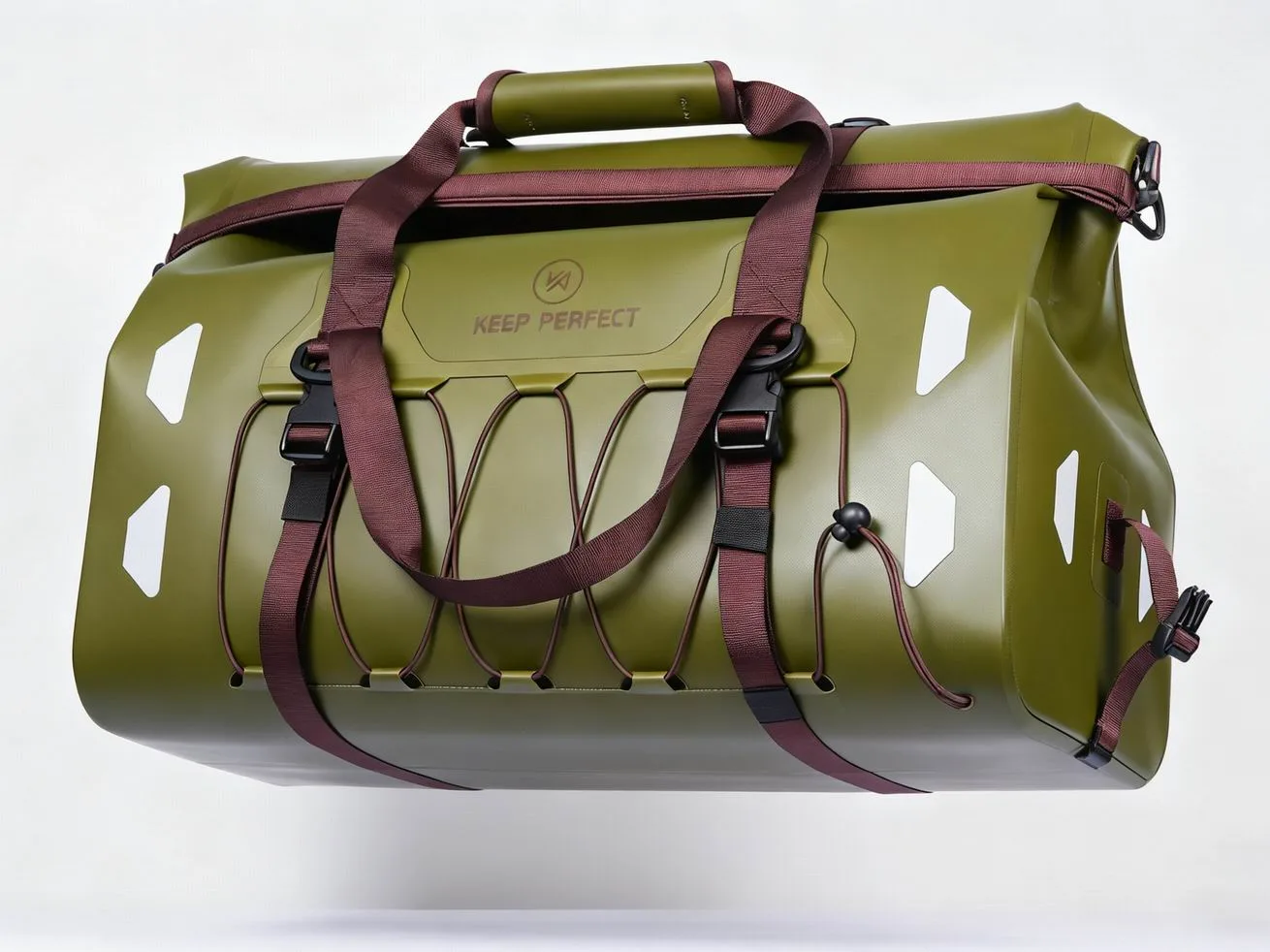
Raft volume scales with trip length and group size, and it splits cleanly into two categories. Personal kit runs 20 to 30 litres per person for a day trip and 35 to 50 litres per person for a multi-day descent, because a multi-day load adds a sleeping bag, a pad and more insulation. Group kit — kitchen, groover, fire pan, spare throw bag, group first aid — is a separate calculation and usually consumes one or two large bags regardless of group size.
The mistake is putting everything in one 110L bag. A loaded 110L bag weighs 25 to 35 kg, which is a two-person lift on a wet bank and a back injury on a portage. Split group kit across two 60L to 90L bags and personal kit across individual 20L to 40L bags, and the whole rig becomes manageable by one person at a time.
| Trip | Personal volume | Group volume | Bag split | Loaded bag weight |
|---|---|---|---|---|
| Day trip, 6 people | 20-30 L each | 40-60 L | 6 x 20 L + 1 x 60 L | 6-9 kg |
| Two-day weekend | 30-40 L each | 70-90 L | 6 x 30 L + 1 x 90 L | 9-14 kg |
| Four-day descent | 35-45 L each | 90-120 L | 6 x 40 L + 2 x 60 L | 12-18 kg |
| Eight-day expedition | 40-50 L each | 150-200 L | 6 x 40 L + 3 x 70 L | 14-20 kg |
| Support kayak or rescue boat | 10-15 L each | 20-30 L | 2 x 10 L + 1 x 30 L | 4-7 kg |
Weight per bag matters as much as volume. Keep any single bag under 20 kg so one person can move it on a wet rock, and put the heaviest group kit low and central on the frame. A rig loaded high and forward pitches in a hole and makes the rower work twice as hard; the same load distributed low over the frame rows like a different boat.
Strapping bags to a frame without losing them
Sand aside, the most common way to lose kit on a raft is a strap that stretched. Nylon cam straps elongate 3% to 5% when wet and vibrate loose over a day of continuous frame movement; a bag strapped tight at 7 am can be loose enough to shift by noon. Retension every two hours on the water and again after every rapid of consequence, and carry two spare straps in the repair bag.
Use two straps per bag, crossed, rather than one strap over the top. A single strap allows rotation, and a rotating bag walks out from under it within an hour. Crossed straps constrain rotation as well as vertical movement. On an exposed bow load, add a third strap forward to prevent the bag sliding toward the rower in a hole.
Lash points decide whether any of this works. Look for welded D-ring patches wider than 60 mm on 25 mm webbing rated above 200 kg, with at least four points on a large bag. A sewn loop on a strap point is the classic failure: it holds on the bank and tears at 60 to 80 kg of shock load when the boat drops into a hole. Full detail on lash geometry is in our D-ring and lash point guide.
What a flip actually does to a sealed bag
A flip is a violent, brief, pressurised event. The bag is submerged at 0.5 to 2 m, tumbled, and subjected to the full flow load of the current, which at 10 km/h adds dynamic pressure well above the static head. A bag with three clean folds, a welded body and a tensioned buckle survives this routinely; that is precisely what IPX7 describes. What does not survive is a bag whose closure was rolled over a strap at 6 am.
The bigger risk is not water but loss. An untethered bag in a flip is gone at the speed of the current, and a raft that loses its kitchen bag on day two of a six-day trip has a serious problem. Tether every bag to the frame with a 6 to 8 mm line and a locking carabiner, short enough that the bag cannot wrap a limb and strong enough to hold a 20 kg bag in moving water.
Colour and identification matter in the ten minutes after a flip. Bags in four different colours let a crew account for kit by eye from the bank, while six black bags of the same size require opening each one. If you swim, hypothermia is the clock you are working against, and the CDC cold-water guidance is worth reading before the trip rather than during it.
Buoyancy, colour and the recovery plan
A sealed bag floats because of the air trapped inside it, and on a raft that is a genuine safety feature rather than a curiosity. A 40L bag rolled with 25 to 30 litres of air displaces 40 litres of water and generates close to 40 kg of buoyant force minus its own weight, which is enough to keep itself and a light load on the surface and visible. Press the air out and the same bag floats low or sinks slowly.
That is why raft bags should not be vacuum-compressed. Compression straps remove volume, which is excellent inside a backpack and counterproductive on a river where a floating bag is a recoverable bag. Leave 25% to 40% air in personal bags, and accept the extra bulk. See our floating dry bag range for bags built around that behaviour.
Plan the recovery before you need it. Assign one person to count bags at the first eddy after any flip, agree a downstream rendezvous point for anything that comes loose, and keep a throw bag accessible on the frame rather than inside a strapped bag. A bag floating in the current is recoverable for the first few hundred metres; after that it becomes litter.

Working the closure with cold, wet hands
Dexterity is the hidden design constraint. On a spring trip with 8 C water and 12 C air, hands lose fine motor control within minutes of getting wet, and a closure that needs a pinch, a twist and a pull is a closure that gets rolled badly. Roll-tops suit this because the whole operation is one motion: fold, fold, fold, clip. There is no alignment, no slider to start, no teeth to check.
Two details make it easier still. Choose a side-release buckle that can be clipped with a palm rather than a pinch, and choose a bag with a stiffener wide enough that the first fold stays open while you make it. A 25 to 40 mm stiffener stays put against a cold hand; a soft mouth curls and costs you 30 seconds each time.
Pack for cold hands as well. Keep the bag you need during the day — rain shell, snack, water, sunscreen — in a 10L bag strapped where the rower can reach it, not inside a 40L bag that has to be unstrapped. The fewer times a large bag is opened on the water, the fewer chances there are to roll it badly in a hurry.
Group kit and personal kit: two separate systems
Mixing them is the organisational mistake that costs the most time. Group kit is opened once in the morning and once at camp, lives in one or two large bags on the floor, and is unpacked by whoever is cooking. Personal kit is opened at camp by its owner and never touched by anyone else. Two systems, two colours, two positions on the frame, no overlap.
Give the kitchen its own colour and its own lash position, and label the bag with a permanent marker at both ends. Give each person one personal bag in an assigned colour and one small 5L bag for the day. A crew of six then manages nine bags with no ambiguity, and the question “whose bag is this” never gets asked at dusk.
Hard items belong in hard containers regardless of system. Fuel bottles, a fire pan, a groover and any glass go in ammo cans or purpose-built boxes strapped to the frame, not inside a soft bag. A metal corner inside a dry bag on a vibrating frame is a puncture looking for an opportunity, and fuel or detergent leaking into a dry bag ruins everything it touches.
Field repair on a riverbank in ten minutes
Carry a kit and know how to use it. A roll-top bag can be repaired in the field because the film is weldable and patchable: a TPU patch with heat activation bonds to the body in about 30 seconds of applied heat at 120 to 150 C, and a peel-and-stick patch gives 24 to 48 hours of service while you finish the trip. Neither requires a workshop, but both require the surface to be clean and dry.
| Damage | Kit item | Method | Working time | Expected life |
|---|---|---|---|---|
| Puncture under 10 mm | Peel-and-stick TPU patch | Clean, dry, press 60 s | 2 min | 24-48 h |
| Tear 10-60 mm | Heat-activated patch | Clean, clamp, apply heat | 10 min | Rest of the trip |
| Weld opening at a corner | Liquid TPU seam sealer | Degrease, apply, 12 h cure | 15 min plus cure | One to two seasons |
| Buckle broken | Spare side-release buckle | Swap on the webbing | 5 min | Permanent |
| Strap cut through | Spare 25 mm cam strap | Replace and retension | 3 min | Permanent |
Dry the surface properly before patching. A patch applied over a damp, gritty film fails within the hour, and a patch applied over a film warmed by the sun and wiped with alcohol holds for the rest of the trip. If you can, do the repair in camp in the evening rather than in the rain at 5 pm; the extra hour of cure time is worth more than the convenience. Full kit contents are listed in the patch kit guide.
Know when a bag is finished. A tear over 100 mm in a load-bearing area, a weld that has separated along more than a third of a seam, or film that has gone brittle and chalky from UV all mean retirement, not repair. Carry one spare 20L bag per raft for exactly that outcome, rolled small and strapped under a seat.
Between trips: rinse, dry, inspect
Post-trip care is what decides whether a bag lasts three seasons or ten. Empty every bag completely, rinse the body and the closure with fresh water at ambient temperature, and pay particular attention to the fold band, where grit collects in the crease. Wipe the closure with a cloth, work the buckle through its travel while wet, then hang the bag open in shade until it is dry inside.
Do the inspection while it dries. Look at the fold band for permanent creasing, at the corner welds for clouding or lift, at the base for abrasion, and at the D-ring patches for any sign of peel. Write the trip on the bag with a marker so you can track cycles: a bag that has done 40 trips deserves closer inspection than one that has done four. UV and grit do more damage than water ever does.
Store loosely rolled with the buckle unclipped, out of direct sun, off concrete. A bag folded flat for six months develops a crease at the fold band that will not recover, and that crease is a leak path. A bag stored in a hot shed for a summer ages more than a season of use would age it.

What should never go inside a raft dry bag
Four categories of item do not belong in a soft dry bag on a raft. Fuel and solvents, which attack the film and contaminate everything else. Glass and hard metal with corners, which puncture from the inside under vibration. Wet items, which have nowhere to drain and turn the whole bag into a damp environment. And anything irreplaceable, which should be in a hard case strapped to the frame rather than in a bag.
Cameras are the contentious one. A body with a lens, wrapped in a padded insert and placed in the centre of a soft bag inside a 20L roll-top, survives most trips. The same kit loose in a kitchen bag does not. If the camera matters professionally, use a hard case with a latch; if it is a holiday camera, a padded roll-top inside the personal bag is proportionate.
Food is the one to plan carefully. Anything that smells — sausage, cheese, fish — should be double-bagged in a sealed inner bag, because a dry bag will hold the smell for the whole trip and a canyon campsite with a food smell is a bear and raccoon problem. Dry bag film is not odour-proof to an animal nose, only waterproof.
A raft packing checklist for the put-in
- Rinse and thumb-check every fold band before the bag leaves the truck.
- Roll three folds, buckle to firm resistance, and clip any secondary bar.
- Leave 25-40% air in personal bags so they float if the boat flips.
- Strap every bag with two crossed cam straps and tether it to the frame.
- Use four or more lash points on any bag above 40 L; welded D-rings only.
- Separate group kit and personal kit by colour and by frame position.
- Put fuel, glass and the fire pan in hard containers on the frame.
- Carry a patch kit, a spare buckle, two spare straps and one spare 20 L bag.
Run it at the put-in with the whole crew present, because the person who packed the bag is rarely the person who has to find something in it at dusk on day three. Ten minutes of shared organisation at the start saves an hour of searching per day on a long trip.
For outfitters, guide services and rental fleets, the same checklist becomes the specification: 0.5 mm film, welded seams with a named test standard, four or more welded lash points, a stiffener wide enough for cold hands, and a size ladder that lets one spare bag substitute for any other. Waterproof bags have been produced here since 2014 across an SGS-verified 4,950 m2 site running 7 lines and 149 machines, with a 500-piece minimum, sampling in 6 to 10 working days and bulk in 35 to 50 days FOB Xiamen, inspected to AQL 2.5.Compare the ladder against the roll-top range, cross-check volumes with the capacity guide, and set abrasion expectations using ASTM abrasion test methods rather than a marketing adjective.

Frequently asked questions
Q1. Why are roll-top dry bags better than zippered ones for rafting?
Because rivers carry suspended quartz that scores a waterproof zip tape and causes weeping after a few days. A roll-top with grit in the fold loses one of three contact lines and still seals, and it can be rinsed and re-rolled in camp.
Q2. What size dry bag do I need for a rafting day trip?
Plan 20 to 30 litres per person plus one 40-60 L group bag for six people. Keep any single loaded bag under 20 kg so one person can move it on a wet bank.
Q3. How much volume for a multi-day raft trip?
35 to 50 litres per person depending on trip length, plus 90 to 200 litres of group kit split across two or three bags. An eight-day trip with six people runs about 300 litres total.
Q4. Should I compress my dry bag on a raft?
No. Leave 25-40% air in personal bags so they float if the boat flips. A 40 L bag with 25-30 litres of air generates close to 40 kg of buoyant force and is recoverable downstream.
Q5. How do I stop bags coming off the frame?
Use two crossed 25 mm cam straps per bag, retension every two hours because wet nylon stretches 3-5%, and tether each bag to the frame with a short 6-8 mm line and a locking carabiner.
Q6. What film thickness should a rafting dry bag have?
0.5 mm minimum. It adds about 90 g to a 20 L bag over 0.3 mm and roughly doubles abrasion life against a vibrating, gritty frame, which is the whole service life of the bag.
Q7. Can I patch a dry bag on a riverbank?
Yes. A peel-and-stick TPU patch gives 24-48 hours of service in about two minutes; a heat-activated patch applied at 120-150 C lasts the rest of the trip. Both need a clean, dry surface to work.
Q8. Do dry bags survive a raft flip?
A welded bag with three clean folds and a tensioned buckle does, routinely. A flip is a brief submersion at 0.5-2 m with flow load, which is what IPX7 describes. Most wet bags after a flip were rolled over a strap.
Q9. Should I put fuel or a stove in a dry bag?
No. Fuel and solvents attack the film and contaminate everything else if they leak. Use a labelled hard container strapped to the frame, and keep the fire pan and any glass out of soft bags for the same reason.
Q10. How often should I retension raft straps?
Every two hours on the water and after any significant rapid. Wet nylon cam straps elongate 3-5% and vibrate loose over a day of continuous frame movement, so a bag tight at 7 am can shift by noon.
Q11. How long does a rafting dry bag last?
With rinsing after each trip and shaded storage, a 0.5 mm welded TPU bag gives five to ten years of weekend use and roughly three to five seasons of commercial guide use. UV and frame abrasion decide it, not immersion.
Q12. Why do my bags get damp on day four but not day one?
Almost always grit in the closure or a fold rolled over a strap. Zips weep progressively as the tape wears; roll-tops degrade when contaminated. Rinse the fold band daily and re-roll carefully at camp.
Q13. What colour dry bags should a raft fleet use?
At least four distinct colours so a crew can account for kit by eye after a flip, and one dedicated colour for group kitchen kit. Six identical black bags turn a ten-minute check into a full unpack.
Q14. Can I use a dry bag as a flotation aid on a river?
No. A sealed bag with air is buoyant, but it is not a life jacket and it will not stay with a person in moving water. Personal flotation devices only, and read cold-water immersion guidance before a spring trip.
Q15. What should be in a raft dry bag repair kit?
Peel-and-stick and heat-activated TPU patches, a small alcohol wipe pack, a spare side-release buckle, two spare 25 mm cam straps, and a lighter or heat source. Add one rolled spare 20 L bag per raft.
Q16. How do I store raft dry bags between seasons?
Rinse, dry completely in shade, then store loosely rolled with the buckle unclipped and out of direct sun. Never fold flat: a flat crease at the fold band becomes a permanent leak path.
People also ask
How do you pack a dry bag for whitewater rafting?
Fill to about 85%, leave 25-40% air so the bag floats, roll three folds over a clean mouth, clip the buckle firmly, then lash with two crossed cam straps and tether to the frame. Keep group and personal kit in separate bags.
Are dry bags necessary for rafting?
Yes for anything you need dry at camp: sleeping bags, clothing, food and first aid. A raft throws constant splash, and a flip submerges everything on the frame, so uncoated luggage is wet by lunchtime on day one.
What size dry bag fits a sleeping bag on a raft trip?
A 20 L bag for a compressible summer bag, 30 L for a three-season bag and 40 L for a bulky synthetic winter bag. Add 15% because three folds consume 2.5-4 litres on a 20 L bag.
Why do raft dry bags leak after a few days?
Grit in the closure, a fold rolled over a strap, or a slack buckle from a strap that stretched. Zip closures add tape wear from suspended sediment. Rinse the fold band daily and re-roll in camp.
Can a dry bag float down a river and be recovered?
A sealed bag with air floats and is recoverable in the first few hundred metres if tethered or spotted quickly. Untethered bags travel at current speed, around 10 km/h, and are lost quickly in a canyon.
How many dry bags does a raft trip need?
One personal bag per person in an assigned colour, one 5 L day bag per person, and one or two large group bags for kitchen and shared kit. Six people on a four-day trip run about nine bags in total.
Need this in production volume?
QUANZHOU JUNYUAN BAGS has produced waterproof bags since 2014 in an SGS-verified 4,950 m2 facility in Fujian, China. Minimum order 500 pieces, sampling in 6–10 working days, bulk in 35–50 days, FOB Xiamen — write to service@junyuanbags.com with your spec and target market.