Home / Blog / Buying & Comparisons
Matching a Dry Bag to Your Climate
Two dry bags with the same 20L capacity and the same IPX7 rating can behave completely differently after one season, and climate is nearly always the reason. A 0.5 mm TPU film that folds easily at 20 °C needs markedly more hand force at -5 °C and approaches its cold-crack range near -30 °C, while the same bag used year round in the tropics faces roughly 2,200 annual UV hours and 80% average humidity instead. Choose by temperature, UV dose, humidity and altitude before you choose by litres.
This comparison sets those four variables against the specification lines that actually respond to them: film thickness, face fabric, hardware metal, colourway and closure geometry. Each section ends with a decision you can apply at the point of purchase, and the quick reference at the end collapses the whole thing into a single table you can check against your own weather. Numbers are given for real conditions rather than laboratory ideals.
- Why climate beats capacity when you choose a dry bag
- Cold: flexibility loss and the cold-crack threshold
- Freeze-thaw: what happens to a bag stored outdoors
- Hot and dry: UV dose, abrasion and thermal load
- Humid tropics: mildew, condensation and salt air
- Wet temperate: rain, mud and constant damp
- Altitude and pressure differential
- Film thickness by climate
- Hardware corrosion by environment
- Colour and surface temperature
- Closure behaviour across the temperature range
- Climate-to-spec quick reference
- What to check before you buy in your climate
Why climate beats capacity when you choose a dry bag
Capacity answers how much you can carry; climate decides whether the bag still closes, still seals and still holds its weld after a season of the weather you actually use it in. Buying by litres alone is the most common way to end up with a bag that is technically correct and practically wrong, because a specification that is ideal for a Scottish sea loch is a poor one for an Arizona summer and vice versa.
Four variables do the work. Temperature sets how flexible the film is at the exact moment you roll the closure. UV dose sets how quickly the polymer loses tensile strength. Humidity sets the mildew and condensation risk inside a sealed shell. Altitude and air travel set the pressure differential working against the fold. Some destinations push all four at once: a high tropical plateau combines 2,000 m of elevation with 90% humidity and very intense UV, which is a harder brief than most bags are sold against.
Cold: flexibility loss and the cold-crack threshold
TPU does not have a single freezing point; it stiffens gradually. A film that folds under light hand pressure at 20 °C resists noticeably at -5 °C, feels board-like around -25 °C, and reaches the cold-crack range for most bag-grade material somewhere near -30 °C. The failure is rarely that the bag leaks through the film. It is that you cannot roll it properly with cold, gloved hands, and a closure that has not been rolled tightly is a closure that lets water in.
Mitigation is half a buying decision and half technique. Where abrasion allows, choose the thinner film for cold use, because 0.3 mm folds at temperatures where 0.5 mm fights you. Warm the fold line inside a jacket for 30 seconds before rolling, never crease a frozen bag flat, and pack the bag indoors rather than on the tailgate. The low-temperature behaviour of the film is set out in the cold crack guide.
| Temperature | Feel of a 0.5 mm film | Rolls achievable with gloves | Risk | Practical action |
|---|---|---|---|---|
| +20 °C | Soft, drapes easily | 3-4 | Over-rolling shortens volume | Standard three-fold close |
| +5 °C | Slightly firmer | 3 | None if hands are dry | Standard three-fold close |
| -5 °C | Resists folding | 2-3 | Under-rolled closure | Warm the fold before rolling |
| -15 °C | Stiff, springy | 2 | Fold will not seat flat | Warm 30-60 s, use 0.3 mm film |
| -25 °C | Board-like | 1-2 | Crease damage, cracked ink | Pack indoors, keep flat |
| -30 °C and below | At cold-crack range | 1 | Film cracking at the fold | Use a colder-rated film or a hard case |
Freeze-thaw: what happens to a bag stored outdoors
Repeated freeze-thaw is harder on a bag than sustained cold. Water trapped in a fold or at a weld corner expands by about 9% as it freezes, and a bag stored rolled and wet through a winter has that expansion working on the same corners every night. After 60 to 90 cycles the corners are where delamination first appears, long before the flat panels show anything at all.
This is a storage rule rather than a use rule, and it is cheap to follow. Dry the bag completely, store it loosely rolled or flat at a stable temperature, and keep it out of direct sun even in winter, because a dark bag on a clear frosty morning still swings close to 30 °C between night and midday. The same bag kept in a shed at 5 to 15 °C will outlast one left on a dock through two winters by several seasons.

Hot and dry: UV dose, abrasion and thermal load
Desert and high-summer environments attack the polymer and the surface at once. A location with 2,200 annual UV hours will chalk an unstabilised PVC face within two seasons, where a UV-stabilised TPU face with a hindered-amine package holds far more of its tensile strength over the same period. Abrasion compounds it, because sand is a hard, sharp contaminant that sits in the fold and grinds the film on every closure.
Ask for the accelerated weathering method behind any UV claim rather than the adjective. The xenon-arc and fluorescent UV exposure procedures published by the ASTM are the ones worth naming, because they state the irradiance and the cycle, and a bag maker who can quote hours-to-50%-strength has actually tested the fabric. A bag that survives 500 hours of accelerated exposure translates to roughly two to three full seasons of intense sun.

Humid tropics: mildew, condensation and salt air
In the tropics the problem is rarely water getting in; it is water that is already there. Air at 30 °C and 85% relative humidity holds about 26 g of moisture per cubic metre, and when a bag packed in that air cools overnight the excess condenses on the inside of the film. Clothing sealed even slightly damp will show mildew in 48 to 72 hours at that temperature, which is why tropical packing starts with everything genuinely dry.
Salt air adds a second mechanism that catches people out. Salt crystals left on a buckle or in a fold wick moisture from the air and stay damp long after the bag looks dry, and a damp fold line is a capillary path straight into the bag. Rinse with fresh water daily in coastal tropics, dry the closure before rolling, and store with the mouth propped open. Where a bag already smells, the safe fixes are in the odour guide.
Wet temperate: rain, mud and constant damp
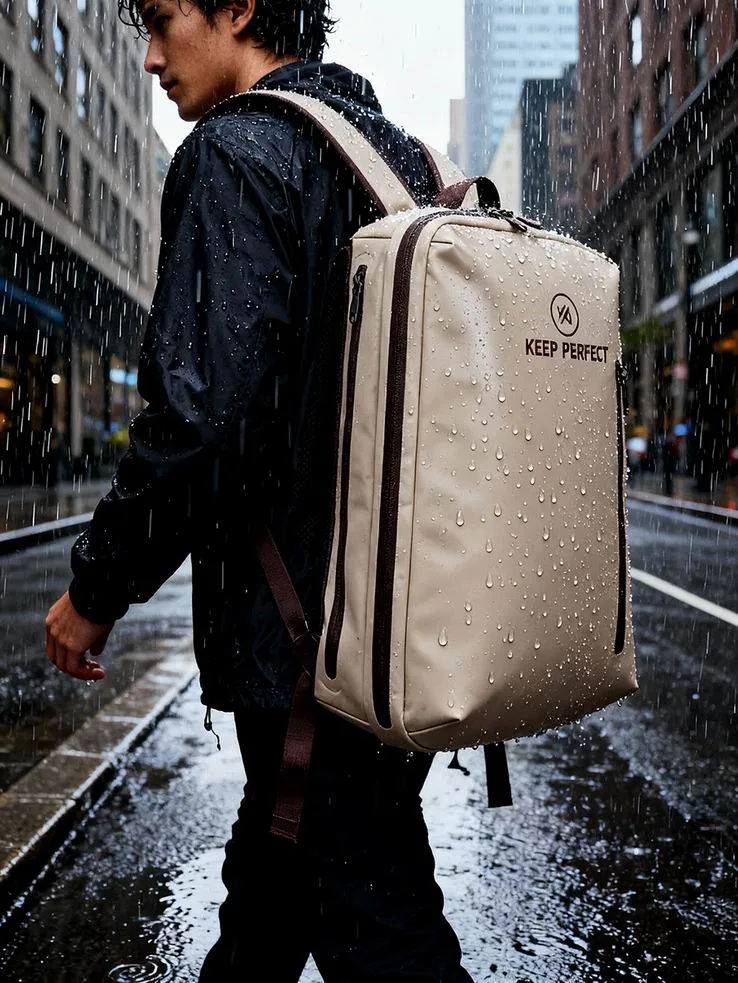
Maritime temperate climates, meaning the UK, Ireland, coastal Norway and the Pacific Northwest, deliver moderate UV, frequent rain and near-constant damp. Nothing here is extreme, which is precisely why bags fail slowly and unnoticed. A bag that never fully dries between trips develops a persistent musty smell and eventually mildew spotting on the inside of the film, even though it has never once been submerged.
The answer is airflow rather than chemistry. Dry bags open, upside down and propped, ideally on a rack with air moving on both faces; the same bag thrown closed into a shed will still be damp three days later in a maritime climate. Plan a longer drying window, and if you paddle or walk on consecutive weekends, own two bags so each gets 72 hours to dry. The rack setup that works in a damp garage is covered in the airflow guide.
Altitude and pressure differential
A bag closed at sea level and carried to 2,500 m gains roughly 25 kPa of internal pressure relative to the outside air, because ambient pressure falls by about 11 kPa per 1,000 m of ascent. Most roll-top closures vent rather than burst, which is the right behaviour, but a bag closed hard and packed tight can push its fold open if the buckle is clipped across the fold rather than around the body of the bag.
Flying produces the same effect in reverse on descent, with a larger step, because cabins are held near 2,400 m while the aircraft cruises higher. Close the bag loosely at altitude, or re-close it after landing, and never seal a pressurised canister or a warm lithium cell inside a welded bag. If a bag genuinely must stay sealed, fit a valve and equalise before opening rather than fighting the pressure at the buckle.
Film thickness by climate
Thickness is sold as a durability upgrade, but in the cold it works against you. A 0.3 mm film folds with roughly 40% less hand force at -10 °C than a 0.5 mm film of the same grade, which is the difference between a closure you can seat properly with gloves on and one you cannot. In hot, abrasive places the trade flips: 0.5 mm resists rock and sand contact far better, and the penalty is about 90 g on a 20L bag.
Decide on your coldest packing moment and your roughest contact surface, and take the thicker film only when the second one dominates. A sea kayaker who packs at 4 °C on a rocky beach needs 0.5 mm and should warm the fold before rolling. A winter hillwalker packing at -12 °C on snow is better served by 0.3 or 0.4 mm with a lighter load and fewer rolls.
| Climate | Dominant risk | Film thickness | Face fabric | Added weight on a 20L | Notes |
|---|---|---|---|---|---|
| Cold, snow, low abrasion | Stiff film, unseated fold | 0.3-0.4 mm | 420D TPU | Baseline | Folds with gloves on |
| Cold with rock or ice contact | Puncture plus stiffness | 0.4-0.5 mm | 500D TPU | +60 to 90 g | Warm the fold before rolling |
| Hot desert, high UV | UV and sand abrasion | 0.5 mm | 500D UV-stabilised TPU | +90 g | Rinse the fold daily |
| Humid tropics, coastal | Mildew and salt wicking | 0.4-0.5 mm | 500D TPU | +60 to 90 g | Dry open, mouth propped |
| Temperate maritime | Persistent damp | 0.4 mm | 420D or 500D TPU | Baseline to +60 g | Two bags for back-to-back trips |
| High altitude, mixed | Pressure plus UV | 0.4 mm | 500D UV-stabilised TPU | +60 g | Close loosely, vent on ascent |
Hardware corrosion by environment
Hardware fails long before film does in most wet places, and it fails at the contact between metal and salt. A steel spring in a cam buckle will show rust bloom within about 200 hours of salt spray if it is only nickel plated, where a 304 stainless spring lasts several times longer and a well-specified plastic acetal buckle never corrodes at all. The trade-off is that plastic creeps under sustained load and metal does not.
Choose by environment and inspect on a schedule. In a saltwater climate, rinse buckles in fresh water and work them through full travel while wet, then check for play every month of heavy use. In a dusty desert climate, the failure is grit in the cam teeth rather than corrosion, so blow the mechanism out rather than rinsing it. The table below sets the service interval that matches each environment.
| Environment | Corrosion mechanism | Buckle material to choose | First sign of failure | Service interval |
|---|---|---|---|---|
| Warm saltwater coast | Chloride pitting on steel springs | 304 stainless or acetal | Rust bloom, then slipping | Rinse every trip, check monthly |
| Cold freshwater | Freeze bonding of the cam | Acetal | Buckle will not release when frozen | Dry before storage |
| Hot desert, dusty | Grit packing the cam teeth | Acetal with an open cam | Slip under load | Blow out weekly |
| Humid tropics | Surface oxidation plus mould | 304 stainless | Discolouration, stiff travel | Rinse weekly, dry open |
| Temperate maritime | Slow general corrosion | 304 stainless or acetal | Dull finish, then play | Check every season |
Colour and surface temperature
Colour is a thermal decision as well as a branding one. Measured on the same 500D panel in 38 °C sun with no shade, a black face reaches roughly 60 °C at the surface while a mint or light grey face sits near 46 °C, a gap of 12 to 14 °C that shows up inside the bag within about 40 minutes. Chocolate, adhesives on phone screens, and lithium cells all behave differently across that range.
Dark colourways have one compensating advantage: they hide scuffing and salt residue far better than pale ones, and carbon black is itself a very effective UV stabiliser in the polymer. The balanced answer for hot climates is a mid tone such as olive, blue or grey, which runs cooler than black and shows less dirt than mint or white. Add a shade plan at camp rather than relying on the colour alone.
| Colourway | Surface temperature in 38 °C sun | Effect on contents after 40 minutes | Appearance note |
|---|---|---|---|
| Black | 58-62 °C | Chocolate softens, batteries warm | Hides scuffs and salt film |
| Olive | 50-54 °C | Warm but usable | Hides dirt, low glare |
| Blue | 49-53 °C | Warm but usable | Standard marine tone |
| Grey | 47-51 °C | Minor warming | Shows scuffs on weld lines |
| Mint | 44-48 °C | Little measurable change | Shows dirt and sunscreen marks |
| White or very pale | 42-46 °C | Coolest interior | Stains easily, needs frequent care |
Closure behaviour across the temperature range
The roll-top is a friction seal, and friction changes with temperature and with contamination. In the cold the film resists folding and the fold sits proud, so three rolls achieved with cold hands may be three loose rolls rather than three tight ones. In the heat the film is soft and seals beautifully, but it also creeps under a buckle that is overtightened, and a fold left tightly clipped in strong sun for weeks will take a permanent set.
Adjust the technique rather than the bag. Cold: warm the fold, roll twice tightly rather than three times loosely, and re-check after ten minutes. Heat: roll three times, clip with moderate tension, and release the buckle for storage. In both cases the check is the same, a squeeze of the closed bag while listening for a hiss, which takes 30 seconds and catches nearly every seal fault.
Climate-to-spec quick reference
Collapse the four variables into one short check before you buy. Work out your coldest realistic packing temperature, your annual UV dose, whether your trips are coastal or freshwater, and whether you will fly or climb with the bag closed. Match those four answers against the specification lines below and the shortlist narrows to one or two options.
- Coldest packing moment below -10 °C: 0.3 to 0.4 mm film, acetal hardware, and a fold you can seat with gloves on.
- Annual UV above 1,800 hours: UV-stabilised 500D face, mid tone colourway, and a stated weathering test method.
- Coastal or salt water: 0.5 mm film, 304 stainless or acetal hardware, fresh-water rinse after every trip.
- Above 2,000 m or flying with the bag closed: 0.4 mm film, a purge or equalising valve, and a loosely clipped fold.
- Humidity above 70% for weeks: pack bone dry, add a 10 g silica sachet, and store with the mouth propped open.
Two specification lines are worth insisting on regardless of climate: a named test standard behind the waterproof claim, and a named weathering or abrasion method behind any durability claim. Both are cheap for a serious bag maker to produce and both are impossible to fake after the fact. Where a listing offers neither, the price is usually the only thing that has been optimised.
What to check before you buy in your climate
Take the shortlist and test the two things you can test in a shop or on arrival: the fold and the hardware. Roll the closure three times at room temperature and squeeze; then chill the bag in a refrigerator for an hour and roll it again, because the difference in feel between those two attempts is exactly the difference your climate will apply every time you pack. Work every buckle through full travel and look for play.
Then match the climate to a service expectation. In a hot coastal climate expect five to eight years from a 0.5 mm UV-stabilised bag with a rinse habit, and three to five if it lives on a deck in full sun. Our own line has been produced since 2014 in an SGS-verified 4,950 m2 facility with 137 staff, 7 production lines and 200,000 pieces of monthly capacity, 500-piece minimum, sampling in 6 to 10 working days, bulk in 35 to 50 days, FOB Xiamen.Local climate normals are published by NOAA for US locations. See the freezing conditions guide and the fabric weight guide, then compare against the full product line.
Frequently asked questions
Q1. How do I match a dry bag to my climate?
Work from four numbers: your coldest packing temperature, annual UV hours, whether you use salt or fresh water, and whether you fly or climb with the bag closed. Those decide film thickness, face fabric, hardware metal and colourway in that order.
Q2. What film thickness suits a cold climate?
0.3 to 0.4 mm. A thinner film folds with about 40% less hand force at -10 °C, which is the difference between a closure you can seat with gloves and one that stays slightly open. Move to 0.5 mm only where ice or rock abrasion is real.
Q3. Do dry bags work below freezing?
Yes, but technique changes. TPU stiffens gradually and approaches its cold-crack range near -30 °C. Warm the fold for 30 seconds, roll twice tightly rather than three times loosely, and pack indoors where you can.
Q4. How much UV damages a dry bag?
Locations above 1,800 annual UV hours will chalk an unstabilised PVC face within two seasons. A UV-stabilised TPU face that survives 500 hours of accelerated xenon-arc exposure translates to roughly two to three full seasons of intense sun.
Q5. Is black a bad colour for a hot climate?
It runs hot: about 60 °C at the surface in 38 °C sun, against 46 °C for a pale face, a 12 to 14 °C gap. It also hides scuffs and carbon black stabilises the polymer, so a mid tone such as olive or blue is usually the balanced choice.
Q6. Why does my bag smell musty in a wet climate?
Because it never fully dries. Bags closed and stored in a maritime climate stay damp for days and grow mildew inside the film. Dry open, upside down on a rack with air on both faces, and own two bags for back-to-back trips.
Q7. Does altitude affect a sealed dry bag?
Yes. Ambient pressure falls about 11 kPa per 1,000 m, so a bag closed at sea level gains roughly 25 kPa of internal pressure at 2,500 m. Most closures vent safely, but close loosely and re-close after landing.
Q8. What hardware survives salt water best?
304 stainless springs or acetal plastic bodies. A lightly plated steel spring shows rust bloom within about 200 hours of salt spray; acetal never corrodes but creeps under sustained load, so match the material to the load.
Q9. Should I choose a lighter colour for the tropics?
It helps with heat but costs you on appearance. Mint runs 4 to 6 °C cooler than blue or olive but shows dirt and sunscreen marks quickly. Olive or grey is the practical compromise in humid heat.
Q10. How often should I inspect hardware by climate?
Rinse after every saltwater trip and check for play monthly in coastal use. In dusty deserts blow grit out of the cam weekly instead of rinsing, and in temperate maritime climates a check each season is enough.
Q11. Can I leave a dry bag outside all winter?
You should not. Water in a fold expands about 9% on freezing, and 60 to 90 freeze-thaw cycles start delamination at the weld corners. Store dry, loosely rolled, at a stable temperature out of direct sun.
Q12. Does humidity get inside a sealed dry bag?
Yes, as vapour in the trapped air. Air at 30 °C and 85% relative humidity holds about 26 g of moisture per cubic metre, and the excess condenses on the film when the bag cools overnight.
Q13. What is the best all-round specification for mixed climates?
0.4 mm UV-stabilised TPU on a 500D face, acetal or 304 stainless hardware, and a mid tone colourway. That combination folds acceptably at -10 °C, tolerates strong sun and survives both fresh and salt water with a rinse.
Q14. How long does a dry bag last in a hot coastal climate?
Five to eight years for a 0.5 mm UV-stabilised bag that is rinsed after every trip and stored in shade. Leave the same bag on a deck in full sun and expect three to five years before the film shows fatigue at the fold.
Q15. Do I need a valve in a hot or high climate?
It helps. A valve lets you equalise pressure after a climb or a flight and lets you squeeze air out after packing, so the bag sits flat and the fold is not fighting internal pressure at altitude.
Q16. Is a hard case better than a dry bag in extreme climates?
For camera and electronics at altitude or in intense heat, yes. A hard case holds its shape at -20 °C and shields against a 60 °C surface, where a soft bag depends on your technique being right every time.
People also ask
How does temperature affect a dry bag?
Cold stiffens the film, so the fold becomes hard to seat and a loose closure leaks; heat softens it, so it seals well but creeps under an overtightened buckle. Warm the fold in cold and release the buckle for storage in heat.
What dry bag is best for hot weather?
A 0.5 mm UV-stabilised TPU face on 500D, in a mid tone such as olive or blue, with acetal hardware that will not corrode. Rinse the fold before rolling and keep the bag in shade at camp.
Are dry bags OK in freezing temperatures?
Yes down to about -25 °C with a change in technique. Below that, films approach cold crack, so switch to a colder-rated material or a hard case for anything critical.
Why does my dry bag stiffen in winter?
Because the polymer loses flexibility as it cools rather than freezing at one point. A film that drapes at 20 °C resists at -5 °C and feels board-like near -25 °C, which is a handling problem rather than a leak.
Does sun damage a dry bag?
Yes. UV breaks polymer chains and chalks unstabilised faces within two seasons above 1,800 annual UV hours. Look for a named weathering test method rather than a vague UV-resistant claim.
Should I buy a different dry bag for the tropics?
Yes if you currently use a heavy 0.5 mm cold-weather bag. Prioritise a UV-stabilised face, corrosion-resistant hardware and a drying routine, because mildew and salt do more damage there than immersion.
Need this in production volume?
QUANZHOU JUNYUAN BAGS has produced waterproof bags since 2014 in an SGS-verified 4,950 m2 facility in Fujian, China. Minimum order 500 pieces, sampling in 6–10 working days, bulk in 35–50 days, FOB Xiamen — write to service@junyuanbags.com with your spec and target market.