Home / Blog / Design & Branding
Minimal Design for Outdoor Bags
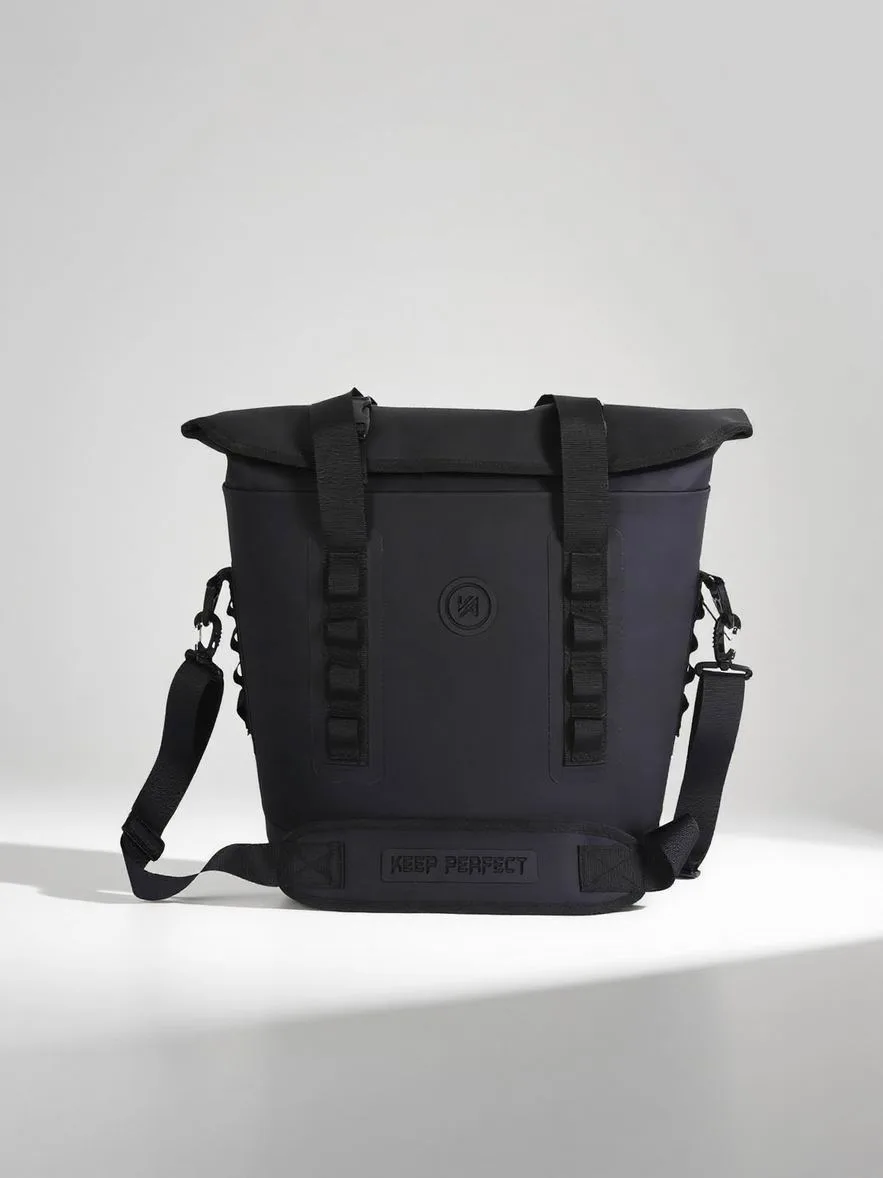
Minimal design on an outdoor bag is a build with four panels or fewer, one closure, no external pockets and a single mark no wider than 60 mm. Compared with a feature-loaded 20L roll-top, that specification removes about 2.8 m of welded seam and roughly 180 g of hardware, and it takes the leak-path count from eleven potential entry points down to four. On a waterproof product every seam end, every stitched loop and every zip is a place where water can start, so reduction is an engineering decision long before it becomes a styling one.
This guide walks through the arithmetic of panel and seam reduction, the hardware audit that shows what can be deleted safely, how small a logo can go before legibility fails, and the point at which restraint stops saving money. It is written for people specifying a range: a club order, a retail private label, or a brand refresh. Numbers come from real builds in the 5L to 40L range with 420D and 500D faces laminated to 0.4 mm and 0.5 mm TPU film.
- What minimal means when the bag has to stay dry
- Panel count, seam length and the defect arithmetic
- Where waterproof bags actually leak
- The hardware audit: what to keep and what to delete
- Closure geometry: one way in, one way out
- Colour: one body, one accent, no gradients
- How small can the mark go?
- Minimal does not mean thin
- Where a pocket still earns its place
- What minimal costs, and what it saves
- Testing a reduced design before it ships
- Does restraint sell on a shelf and online?
- A one-page minimal brief you can hand over
What minimal means when the bag has to stay dry
Minimal is not the same as stripped down. A stripped-down bag is a full-feature bag with parts removed to hit a price; a minimal bag is designed from the load outwards so the parts were never needed. The distinction shows up in the field: a bag designed around a 3 kg load, one closure and one carry mode works with wet hands and gloves. A bag with its pockets deleted still has the attachment points, the seam ends and the stiffening panels that the pockets required, so it saves nothing at the welding bench.
The practical test has three parts. First, the bag must pass a 30-minute immersion at one metre with the closure folded three times, which is the IPX7 protocol defined under IEC 60529 and referenced by most serious spec sheets. Second, it must read as a single object from five metres away, which rules out fussy panel breaks and multi-colour prints. Third, it must be repairable with one patch size, which rules out exotic geometry at the corners.
Two further definitions matter when you brief a production partner. Minimal refers to the visible architecture, not the material: a minimal bag still uses a heavier film than a budget bag, because it cannot hide a puncture behind a second layer. And minimal refers to the range, not just the sample: four sizes that share one closure geometry, one weld programme and one hardware set are worth more than one beautifully reduced sample that cannot be repeated at volume.
Panel count, seam length and the defect arithmetic
Weld length is the single best predictor of both cost and field failure. Every metre of seam is a metre of material that can be under-welded, over-welded or contaminated with dust, and every corner is a stress concentrator where the weld turns. Cutting a 20L roll-top from four panels instead of seven typically removes 2.8 m of weld and four corners, which at a realistic defect rate of one fault per 250 m of weld is worth roughly one avoided warranty return per 90 bags.
| Bag size | Panels, standard | Panels, minimal | Weld length saved | Corners removed | Mass saved |
|---|---|---|---|---|---|
| 5L | 5 | 3 | 0.9 m | 2 | 55 g |
| 10L | 6 | 4 | 1.6 m | 3 | 90 g |
| 20L | 7 | 4 | 2.8 m | 4 | 180 g |
| 30L | 8 | 5 | 3.4 m | 4 | 215 g |
| 40L duffel | 9 | 5 | 4.1 m | 6 | 260 g |
Those savings are not linear. Below about 10L the base fabric dominates the cost and the saving is real but small; above 30L the seam length dominates and removing panels is the cheapest thing you can do to a design. This is why large duffels respond best to minimal treatment, and why a 5L grab bag is usually better left with a second panel if that panel gives it a flat base that stands up on a deck.
Where waterproof bags actually leak
Field returns on welded bags cluster in four places, and only one of them is the middle of a seam. The largest share comes from seam ends and corners, where the weld terminates and the film can peel back under load. The second is hardware attachment: a D-ring or a strap anchor welded onto the body creates a local stiff spot that flexes differently from the surrounding film. The third is the closure, almost always because the bag was over-filled. The fourth is abrasion through the film, which is a material choice rather than a design one.
| Failure location | Share of returns | Typical cause | Design response |
|---|---|---|---|
| Seam ends and corners | 41% | Peel initiation at weld stop | Fewer corners, radiused ends |
| Hardware attachment | 23% | Stiff spot flexing against film | Welded webbing tails, wider footprint |
| Closure | 21% | Over-filled bag, grit in fold | Reinforced mouth, three fold lines |
| Film abrasion | 11% | Sand, rock, conveyor contact | 0.5 mm film, 500D face |
| Other | 4% | Handling, heat, chemicals | Clear care guidance |
Designing minimally attacks the first two rows directly. A four-panel build has four corners rather than eight, and a body with no external pockets has no pocket welds at all. The remaining risk is concentrated at the closure and the strap anchors, which is exactly where the engineering budget should go. Our own roll-top dry bag range puts a reinforced mouth band and welded webbing tails on every size for this reason, regardless of how plain the rest of the bag looks.
The hardware audit: what to keep and what to delete
Run the audit item by item with three questions: does it carry load, does it help the user find or access the contents, and does it survive 500 cycles of salt water and sun. Anything that fails all three is a candidate for deletion. In practice that removes side compression straps on bags under 20L, external mesh pockets, key clips, whistle buckles and any plastic loop that is not load-bearing.
| Component | Mass | Verdict on a minimal build | Reason |
|---|---|---|---|
| Side compression straps | 48 g | Delete below 20L | No load case in a soft bag |
| External mesh pocket | 62 g | Delete | Holds water, adds two welds |
| Sternum strap | 34 g | Delete below 30L | Only useful above 8 kg loads |
| Welded D-ring pair | 18 g | Keep | Lash point, rescue tether |
| Top carry handle | 22 g | Keep | Primary grab point on deck |
| Shoulder harness | 190 g | Keep on backpack format | Only way to carry 12 kg far |
| Clear window | 40 g | Optional | Adds one weld; useful in a hold |
Keep the deletions honest by testing the bag loaded, not empty. Compression straps look redundant on an empty bag and earn their place on a half-full 40L duffel that has to be strapped to a rack for 200 km of dirt road. The rule we use is simple: if a component has no load case at 85% fill, it comes off the drawing. If it has one at any fill level, it stays and gets a bigger weld footprint.
Closure geometry: one way in, one way out
A minimal bag has one opening. Two openings mean two seal systems, two inspection steps and two ways to mis-close the bag in the dark, and in our experience the second opening is the one that leaks because users treat it as a convenience pocket and roll it with one fold instead of three. A single roll-top mouth with three fold lines is the most robust arrangement yet devised for a soft waterproof bag, and it scales from 2L to 90L without changing the technique.
The mouth band deserves more attention than it usually gets. A reinforced band about 45 mm tall stabilises the fold, gives the user something to grip with cold hands, and stops the film from rolling unevenly. Below 35 mm the fold tends to walk; above 60 mm the band adds stiffness and mass for no gain. Pair it with a single centre-release buckle rated to at least 250 N rather than a ladderlock, which is the part most often reported as hard to release with wet fingers.
Colour: one body, one accent, no gradients
Restraint in colour is the cheapest way to make a range look considered. The working rule is one body colour, one accent colour, and no more than 8% of the visible surface in the accent. That is enough to identify a size at a distance, which is the functional job of colour on a boat or a campsite, without creating a second dye lot risk on every production run.
A two-tone panel build looks striking in a studio shot and is the hardest thing to repeat: two fabric lots have to match, the panel weld has to land on the colour break, and any misalignment is visible on every unit. If a range needs visual interest, put it in the hardware and the webbing rather than in a second body fabric. See the colour range guide for how lot tolerance behaves across a four-size family.
Put the accent where it is cheap to repeat. A black body with olive webbing at 6% coverage needs one fabric lot and one trim lot, and a reorder two years later can be matched from a reference swatch. The same design executed as a blue body with a grey side panel needs two fabric lots matched inside a tolerance that drifts with every dye lot, and it costs more to inspect, because misalignment has to be checked on every unit rather than on a sample.
How small can the mark go?
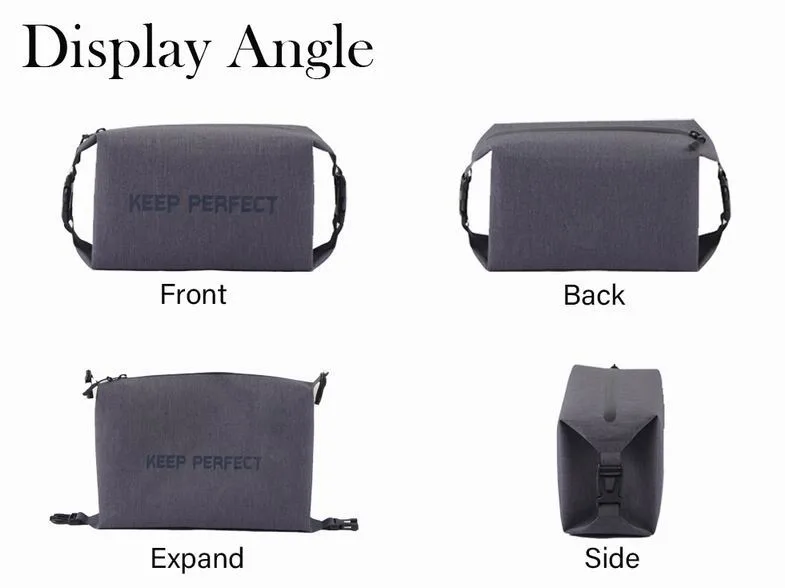
Logos on waterproof film behave differently from logos on cotton. There is no weave to hold ink, so the mark sits on the surface and its edge quality is everything. In our experience the floor for a welded or screen-applied mark is around 25 mm in height for a simple wordmark and 40 mm for anything with fine detail; below that the edges fill in and the mark reads as a smudge at arm's length.
| Mark height | Legible from | Method that holds up | Added cost per unit |
|---|---|---|---|
| 25 mm | 1.5 m | Heat transfer, one colour | Low |
| 40 mm | 3 m | Screen print, one colour | Low |
| 60 mm | 5 m | Screen print or welded patch | Medium |
| 100 mm | 9 m | Screen print, two colours | Medium |
| 180 mm | 15 m | Digital print | High |
Placement matters more than size. A mark on the lower third of the front panel survives abrasion because it is away from the closure and away from the ground contact zone, while the same mark at the top of the panel is folded and creased on every single use. Full placement geometry, including the no-print zones around weld lines, is set out in our logo placement guide.
Minimal does not mean thin
The most common failure of a minimal brief is that reduction in parts is read as permission to reduce the material. It is the opposite. A bag with no second layer, no liner and no external reinforcement has to take all of its abrasion on the face fabric, which is why a minimal build should move up a film class rather than down. In practice that means 0.5 mm TPU laminated to a 500D face for anything that touches sand, rock or a boat deck, and 0.4 mm on a 420D face for a bag that lives inside another bag.
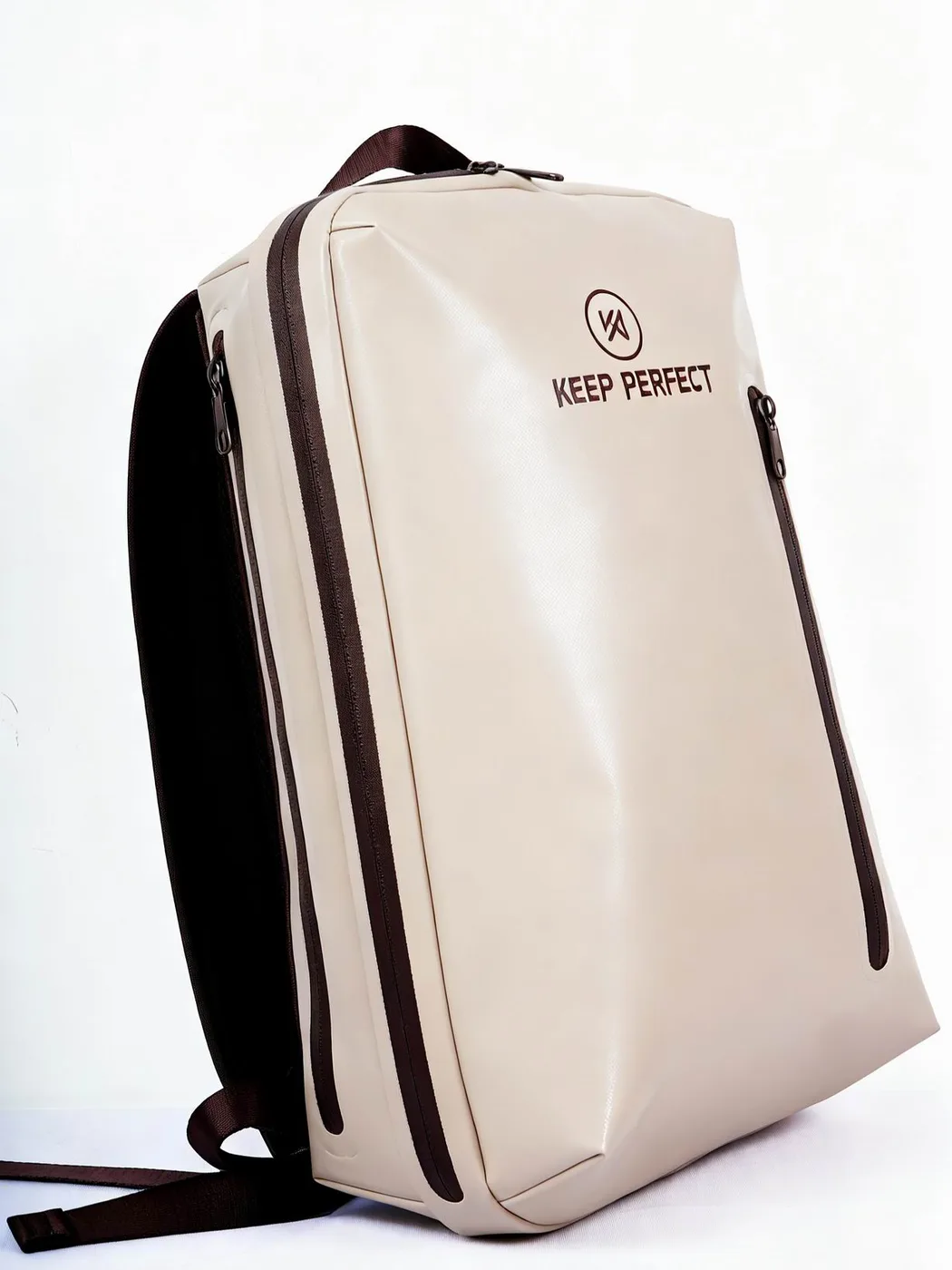
Material choice also drives how quiet the design looks. A stiff, heavy film with a matte finish reads as expensive with no branding at all; a thin glossy film reads as cheap no matter how clean the silhouette. That is a finishing decision, and it is one of the few places where spending more per metre genuinely reduces the amount of print needed to make a range look premium. Related thinking on surface finish sits in the hardware finish note.
Where a pocket still earns its place
Two exceptions survive the audit. The first is an internal slip pocket for a phone or a passport, which costs one short weld, adds about 12 g, and stops small hard objects from abrading the film from the inside. The second is a mesh or film divider in a bag used for wet and dry separation, where the alternative is a second bag. Both are internal, so neither adds an external seam or changes the silhouette.
Everything else is arguable. External bottle pockets hold water and catch on deck lines. External zip pockets on a waterproof bag need a water-resistant zip, which is the single most expensive component on the bill of materials and the most common cause of a failed immersion test. If a brief demands one, put it on the lid of a duffel where a leak drains away from the main cavity rather than on the side of a roll-top.
What minimal costs, and what it saves
Per unit, minimal saves money in three places: seam metres, hardware pieces and print passes. It costs money in one: the film and fabric usually step up a class, and the tooling for a clean single-piece body needs tighter tolerance than a panelled build that hides error behind a seam. Net effect on a 20L roll-top at a 500-piece run is a saving of roughly 8 to 12% of the unit cost, with most of it recovered from hardware and print rather than fabric.
| Cost line | Feature-rich 20L | Minimal 20L | Delta | Note |
|---|---|---|---|---|
| Fabric and film | 100% | 112% | +12% | Heavier film, better finish |
| Welding and assembly | 100% | 78% | -22% | 2.8 m less weld, 4 fewer steps |
| Hardware | 100% | 61% | -39% | Six components removed |
| Print and branding | 100% | 70% | -30% | One colour, one pass |
| Inspection and rework | 100% | 82% | -18% | Fewer welds to check |
| Total unit cost | 100% | 88% | -12% | At a 500-piece run |
The saving compounds after delivery. Fewer parts means fewer warranty claims, and a bag with one closure and no external pockets has one care instruction instead of five, which reduces the support burden on whoever sells it. That is the argument for restraint that survives a spreadsheet, and it is why minimal architectures dominate rental fleets where bags are used hard and returned often.
Testing a reduced design before it ships
- Weld peel test on five samples per weld programme: pull at 100 mm per minute and record force at failure.
- Immersion test at one metre for 30 minutes with the bag loaded to 85% and closed with three folds.
- Abrasion run: 2,000 cycles against a standard abrasive at 9 kPa, then re-immerse and check for weeping at the worn panel.
- Hardware pull: 250 N static on each load-bearing anchor for 60 seconds, then inspect the weld footprint for whitening.
- Cold fold: condition at minus 10 °C for four hours, fold three times, then inspect for cracking at the crease.
The cold fold step is the one most often skipped and the one that catches the most problems. Film that passes every room-temperature test can craze at the fold in winter, and on a minimal bag there is no liner behind it to hold water out. Test methods for coated and laminated fabrics are published by ASTM, and a documented test protocol is the difference between a claim and a specification.
Document the results as ranges, not pass-fail numbers. A weld programme that produces 180 to 220 N of peel force across five samples is healthy; one that produces 90 to 240 N is not, even though every sample passed, because the spread tells you the process is not under control. Quality discipline of that kind is what a written quality system such as those described by ISO is meant to enforce.
Does restraint sell on a shelf and online?
On a shelf, minimal loses the first glance and wins the second. A plain black roll-top next to a printed, pocketed, multi-colour bag is invisible for about three seconds, and then the shopper picks it up, feels the film, works the closure and checks the price. Conversion data from outdoor retail consistently favours the bag that survives that second look, because the buyer is solving a problem rather than buying a picture.
Online the mechanics are different and restraint helps more. A plain bag photographs consistently under any lighting, needs no colour correction between shots, and generates fewer returns for 'not what I expected'. Range pages also stay cleaner: four sizes that differ only in dimension can share one hero image and one specification table, which is the cheapest content a brand will ever produce.
A one-page minimal brief you can hand over
- State the load case: litres, packed mass in kilograms, and how far it is carried.
- Fix the panel count and the weld length target before any styling conversation starts.
- Name the film and the face fabric: 0.5 mm TPU on 500D for abrasion, 0.4 mm on 420D for liners.
- Choose one closure and describe the fold geometry, including the mouth band height.
- Audit hardware component by component against load, access and durability.
- Set the colour rule: one body, one accent, no more than 8% accent coverage.
- Fix the mark: height, method, and a no-print zone around every weld line.
- Attach the test protocol: peel, immersion, abrasion, hardware pull, cold fold.
A brief of that shape takes about an hour to write and removes most of the sampling loop. Our team has produced waterproof bags since 2014 in an SGS-verified 4,950 m² facility with 137 staff across seven lines, and the projects that move fastest are always the ones where the panel count and the film class were decided before the artwork. Sampling runs 6 to 10 working days, bulk 35 to 50 days, FOB Xiamen, with a 500-piece minimum and AQL 2.5 inspection.
Two closing checks keep a minimal range honest across a season. First, repeat the immersion test on a bag that has been in service for twelve months, not just on a new one, because film fatigue shows up at the fold before anywhere else. Second, keep one size in the range unchanged for the whole life of the programme: a stable reference point is what lets a retailer reorder with confidence four years later. Sizing consistency across a family is covered in the matching note, and the wider set of options lives on the product line page.
Frequently asked questions
Q1. What is minimal design for an outdoor bag?
It is a build with four panels or fewer, one closure, no external pockets and one small mark. On a 20L roll-top that removes about 2.8 m of welded seam and 180 g of hardware compared with a feature-loaded equivalent.
Q2. Does minimal design make a bag more waterproof?
Yes, indirectly. Fewer panels mean fewer seam ends and corners, and those are where roughly 41% of field leaks on welded bags start. Material thickness still does the rest of the work.
Q3. How many panels should a minimal dry bag have?
Three for a 5L, four for a 10L to 20L, and five for a 30L to 40L duffel. Below three panels the bag will not stand or pack cleanly; above five you are paying for weld length you do not need.
Q4. Is a minimal bag cheaper to produce?
Usually by 8 to 12% per unit at a 500-piece run. The saving comes from hardware and print, not fabric, because a minimal build normally steps up to a heavier film and a better face fabric.
Q5. What hardware should stay on a minimal waterproof bag?
A welded D-ring pair, a top carry handle, and a harness on backpack formats. Side compression straps, external mesh pockets and non-load-bearing loops can be deleted without losing a load case.
Q6. How small can a logo be on TPU film?
About 25 mm high for a simple one-colour wordmark and 40 mm for anything with fine detail. Below that the edges fill in and the mark reads as a smudge at arm's length.
Q7. Does minimal design always look premium?
No. A thin glossy film with a clean silhouette still reads as cheap. Surface finish and film weight carry more of the perceived quality than the absence of parts does.
Q8. Why are external pockets removed from minimal bags?
Each pocket adds two welds and a water trap. External pockets catch on deck lines, hold water after rain, and are the second most common source of leaks after seam ends.
Q9. Can a minimal bag still have an internal pocket?
Yes. An internal slip pocket costs one short weld and about 12 g, adds no external seam, and stops hard objects abrading the film from the inside.
Q10. What film thickness suits a minimal build?
0.5 mm TPU on a 500D face for anything touching sand, rock or a deck, and 0.4 mm on 420D for a bag that lives inside another bag. Minimal bags need more film, not less, because there is no liner.
Q11. How do you test a minimal design before production?
Peel test five samples per weld programme, immerse at one metre for 30 minutes at 85% fill, run 2,000 abrasion cycles then re-immerse, pull each anchor at 250 N, and cold fold at minus 10 °C.
Q12. Why does the cold fold test matter?
Film that passes every room-temperature test can craze at the crease in winter. On a minimal bag with no liner, a cracked fold is a direct leak path, so the test catches failures the immersion test misses.
Q13. Does a minimal range sell as well as a busy one?
It loses the first glance on a shelf and wins the second, when the buyer feels the film and works the closure. Online it performs better: consistent photography, fewer surprises, fewer returns.
Q14. How many colours should a minimal bag use?
One body colour and one accent, with the accent covering no more than 8% of the visible surface. Two-tone panel builds look strong in a studio shot and are the hardest to repeat across dye lots.
Q15. What is the biggest mistake in a minimal brief?
Treating fewer parts as permission to use thinner material. Reduction should move the film up a class, because the face fabric now takes all the abrasion with no second layer behind it.
Q16. How long does a minimal programme take from brief to bulk?
Sampling runs 6 to 10 working days and bulk 35 to 50 days at a 500-piece minimum, provided the panel count and the film class are fixed before artwork starts. Most delays come from re-deciding those two items late.
People also ask
What does minimal design mean in outdoor gear?
It means the product is designed from the load outwards so unnecessary parts were never added, rather than a full-feature bag with pieces removed to hit a price. The result has fewer welds, less hardware and one closure.
Are simple bags more durable than complex ones?
Generally yes, because durability fails at joins. A four-panel welded bag has four corners instead of eight and no pocket welds, which removes the two locations where most field leaks begin.
How do you make a plain bag look expensive?
Use a heavier film with a matte finish, keep the silhouette clean, put contrast in the hardware and webbing, and print one small mark placed away from the fold. Finish and material weight do more than decoration.
Why do outdoor brands use fewer colours now?
Fewer colours mean fewer dye lots to match, lower rework, and consistent product photography. A single body colour with one accent is easier to repeat across a four-size range over several seasons.
How do you brief a bag design to a production partner?
State the load case, fix the panel count and film class first, then specify the closure geometry, audit the hardware, set the colour rule and attach a test protocol. Decide structure before artwork.
Is a pocketless dry bag practical for everyday use?
Yes for water sports and travel, where an internal slip pocket holds a phone or passport and everything else goes in one cavity. It is less convenient if you need to reach small items without unloading the bag.
Need this in production volume?
QUANZHOU JUNYUAN BAGS has produced waterproof bags since 2014 in an SGS-verified 4,950 m2 facility in Fujian, China. Minimum order 500 pieces, sampling in 6–10 working days, bulk in 35–50 days, FOB Xiamen — write to service@junyuanbags.com with your spec and target market.