Home / Blog / Travel & Packing
A Waterproof Setup for the Rainy Commute
A 30-minute commute in rain falling at 20 to 50 millimetres per hour with 30 km/h of wind delivers more water to the front of a backpack than a 3-hour coastal paddle does, because the rider leans forward and every drop arrives horizontally at 40 km/h closing speed. Two layers are the honest answer: a welded waterproof backpack or roll-top that blocks the rain, plus a sealed 10L to 14L inner pouch for the laptop, papers and anything that costs more to replace than the bag. A 25L pack with 0.5 mm TPU film and RF-welded seams stays dry inside at IPX6 exposure, while a coated pack with a rain cover wets out at the shoulder straps within 12 minutes.
This guide builds the setup from the exposure inward: what the rain actually does at speed, which carrier survives it, how to split a working day’s kit into three waterproof layers, how to keep paper and electronics separated from wet shoes, and how to dry the whole system at the office in half an hour. Sizes, weights and times are given as figures you can check against your own route rather than as adjectives.
- What a rainy commute actually throws at a bag
- Rain rates, wind and the rating you actually need
- Backpack, liner or both: choosing the carrier
- The three-layer packing system for a working day
- Seams, zips and the wet-shoulder problem
- Laptop and tablet: the pouch that does the real work
- Paper, passports and the things that cannot be dried
- Shoes, gym kit and the wet-items problem
- Visibility: being seen in a November downpour
- Condensation: the damp that is not a leak
- Drying the whole system at the office in 30 minutes
- Winter, slush and freezing rain
- A commute checklist you can run the night before
What a rainy commute actually throws at a bag
Commuting rain is not the same as standing rain. On a bicycle leaning forward at 20 km/h into rain falling at 25 mm/h, the front panel sees an effective water load several times higher than the same rain on a stationary shoulder, and the lower back panel collects road spray thrown up by the rear wheel with no mudguard. On foot the pattern inverts: the shoulders and upper back take the rain, the base takes puddle splash, and the front panel stays comparatively dry.
Duration is the second variable, and it is the one commuters underestimate. A 30-minute ride at 25 mm/h is a sustained jet event on one panel, not a brief shower. Fabric with a hydrostatic head of 3,000 mm and a durable water-repellent finish will bead for the first 8 to 12 minutes, then wet out and start conducting water through the face fabric to whatever is touching it. Welded film does not wet out, which is the entire argument for a TPU pack over a coated one on a daily route.
Weight matters because the commute happens twice a day, five days a week. A 25L TPU backpack with welded shoulder straps weighs 900 to 1,100 g empty; the same volume in a coated pack with a separate rain cover weighs 1,200 to 1,400 g once the cover is packed. Over 200 commuting days the difference is carried as roughly 100 kg of cumulative load, which is a fair way to think about a 300 g decision.
Rain rates, wind and the rating you actually need
Rain intensity is measured in millimetres per hour, and the NOAA classification used in US forecasts puts moderate rain at 2.5 to 7.6 mm/h, heavy rain above 7.6 mm/h and tropical downpours above 50 mm/h. A commuter in a temperate city sees 5 to 25 mm/h for most of the year with a handful of 40 mm/h days; a monsoon-season commuter routinely sees 60 to 100 mm/h for 20 minutes at a time. Design the setup for your worst month, not your average week.
Translate that into a rating and the answer is IPX5 to IPX6 for a cycling commute and IPX4 to IPX5 for walking. IPX4 covers splashing from any direction, IPX5 covers a 6.3 mm nozzle jet at 12.5 litres per minute from 3 metres, and IPX6 doubles the flow to 100 litres per minute. A bag that passes IPX6 with welded seams will cope with any rain a commuter can ride through; the failure point then moves to the opening, not the fabric.
| Condition | Rain rate | Effective exposure | Rating that holds | Failure mode |
|---|---|---|---|---|
| Drizzle, walking | 1-2.5 mm/h | Light contact | IPX3-IPX4 | Coated fabric holds easily |
| Steady rain, walking 25 min | 5-8 mm/h | Sustained wetting | IPX4-IPX5 | DWR wets out at 10-15 min |
| Heavy rain, cycling 30 min | 20-30 mm/h | Horizontal jet on front panel | IPX6 | Shoulder strap seams leak |
| Tropical downpour | 60-100 mm/h | Deluge plus road spray | IPX6 | Roll-top mouth if under-rolled |
| Freezing rain and slush | 5-15 mm/h at 0 C | Ice film then meltwater | IPX5 | Stiff film will not roll cleanly |
Backpack, liner or both: choosing the carrier
Three configurations work, and each has a clear best case. A welded waterproof backpack with a roll-top mouth is the simplest: one closure, no cover, and the harness is part of the waterproof shell so there is no seam where a strap meets the body. A conventional backpack plus a dry bag liner inside is the cheapest upgrade to a bag you already own, but the outer pack still absorbs 300 to 600 g of water and stays wet all day at the office.
The third option, a waterproof backpack plus an inner pouch for the laptop, is what most daily commuters settle on after a winter. The outer shell deals with the rain; the inner pouch deals with the two failure modes that a shell cannot: a closure that was rolled in a hurry, and a bottle or wet jacket sharing the main compartment. That redundancy is the whole point of the setup.
| Configuration | Empty weight | Dry time at office | Protects laptop from a bad roll | Best for |
|---|---|---|---|---|
| Welded roll-top backpack only | 900-1,100 g | 10-15 min | No | Short rides, light loads |
| Ordinary pack plus dry bag liner | 1,300-1,600 g | 4-8 h for the pack | Yes | Reusing an existing bag |
| Waterproof pack plus inner pouch | 1,150-1,350 g | 10-15 min | Yes | Daily commute with a laptop |
| Waterproof tote with laptop sleeve | 700-900 g | 8-12 min | Partial | Walking, transit, office use |
| Dry duffel with backpack straps | 1,000-1,300 g | 12-18 min | Yes | Gym, swim, mixed kit |
The three-layer packing system for a working day
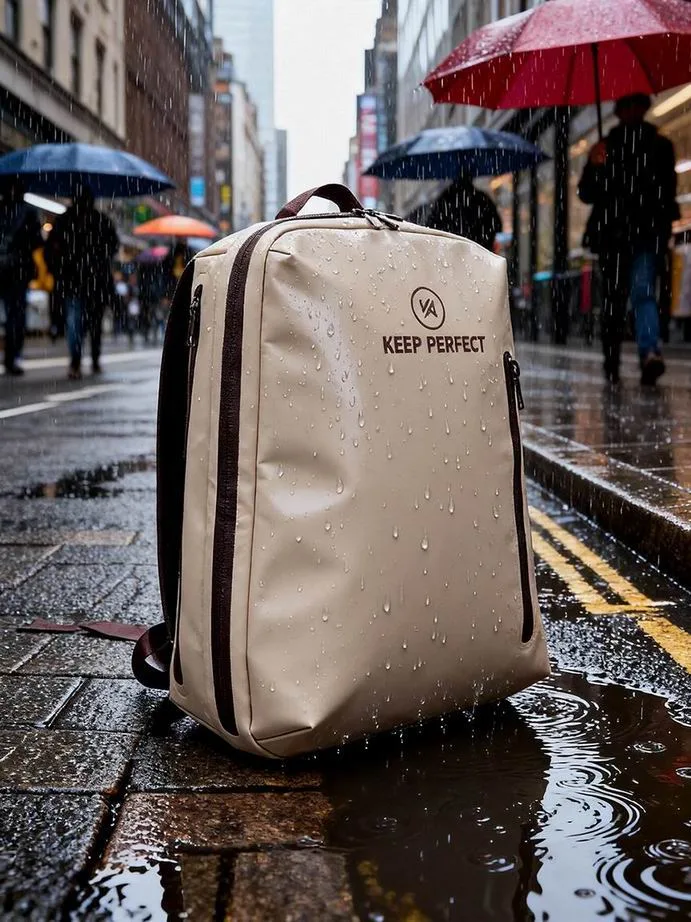
Sort the day’s kit by what happens if it gets wet. Layer one is the sealed core: laptop, tablet, charger, notebook, passport or ID. Layer two is the dry-but-tolerable zone: a change of shirt, a packed lunch, a wash bag. Layer three is the wet zone, which should be a separate bag entirely: shoes, gym kit, a folded rain jacket. Three layers means a leak in one place never reaches the laptop, and it means the wet zone can be emptied and dried without unpacking the rest.
Size the layers rather than guessing. A 13-inch laptop in a sleeve occupies about 2.0 litres and weighs 1.4 kg with its charger; a 14-inch machine with a 65 W brick reaches 2.4 litres and 1.7 kg. Add a slim notebook and a pen case and the sealed core is a 4L to 6L pouch. Layer two in a 10L roll-top covers the shirt, lunch and wash bag at roughly 6 litres packed. Layer three wants a 5L bag that can be wiped out in 30 seconds.
| Layer | Contents | Recommended size | Packed weight | Why separate |
|---|---|---|---|---|
| Sealed core | Laptop, charger, notebook, ID | 4-6 L pouch | 1.6-2.1 kg | Two independent closures |
| Dry zone | Shirt, lunch, wash bag, cables | 10 L roll-top | 1.2-1.8 kg | Food and clothing tolerate damp less than you think |
| Wet zone | Shoes, gym kit, wet shell | 5 L bag | 0.9-1.6 kg | Can be emptied without unpacking the rest |
| Pockets | Pass, keys, headphones | Zip pockets | 0.2-0.4 kg | Accessed without opening the roll |
Total carried weight for a typical office day lands between 3.9 and 5.9 kg including the pack. That is a reasonable load for a 30-minute ride, and it is worth weighing once with a luggage scale: commuters who report shoulder pain are frequently carrying 7 kg or more, usually because the wet zone and the dry zone have merged into one heavy bag with a second pair of shoes in it.
Seams, zips and the wet-shoulder problem
The shoulder straps are where ordinary packs fail, because a stitched strap attachment is thousands of needle holes in the exact place where water runs. A welded strap attachment on a TPU shell has no holes at all, and the load path is a continuous film patch typically 120 to 180 mm wide. If you are buying a pack for commuting, turn it inside out and look at the strap attachment before you look at anything else.
Zips are the second decision. A standard coil zip with a storm flap is water-resistant, not waterproof, and it will pass a fine spray before it passes a 30-minute ride. A waterproof zip with a polyurethane laminated tape and a moulded tooth line is genuinely sealed, but it needs a clean pull: grit in the teeth scores the tape and the zip starts weeping at the bottom stop after a season. Welded seams plus a roll-top mouth avoids the question altogether.

Laptop and tablet: the pouch that does the real work
The laptop is the one item that justifies redundancy. A 13-inch machine plus sleeve fills a 4L to 6L welded pouch comfortably, and the pouch should be padded on five faces with 4 to 6 mm of closed-cell foam rather than a single panel, because the impact that kills a laptop in a commute is a corner drop onto a kerb, not a soak. Look for a pouch with a welded seam and a roll-top or a sealed zip, not a sleeve with a sewn binding.
Pack the pouch flat against your back, not at the front of the bag. That position puts it closest to the spine, away from the impact zone if you set the bag down hard, and it keeps the stiff rectangle from pressing into a shoulder blade. Put the charger in the same pouch rather than loose: a 65 W brick with a hard edge abrading a laptop lid for 200 commutes leaves visible wear. Deeper detail on padding and sizing sits in our guide to protecting a laptop in a dry bag.
Condensation is the subtle risk with a sealed pouch. A cold machine carried into a warm office inside a closed pouch collects moisture on the lid within 10 minutes. Open the pouch as soon as you sit down, or use a pouch with a breathable panel on one face. This is the same mechanism that damps out a sealed dry bag in a hot car, and it is not a leak.
Paper, passports and the things that cannot be dried
Paper is more fragile than electronics in one specific way: a laptop survives a splash if it is powered down and dried for 48 hours, while a signed contract, a boarding pass or a passport page is ruined the instant it is touched. Keep paper in a flat welded document wallet of 1.5 to 2.5 litres, inside the sealed core pouch, and keep it flat rather than rolled so the corners do not crease in the bottom of a full bag.
Separate anything with a magnetic strip or an RFID chip from a laptop charger, because a 65 W brick sitting against a card for an hour is enough to cause intermittent read failures at a barrier. A two-pocket document wallet solves both problems for under 40 g. If your commute crosses a border or an airport, the packing order at the checkpoint matters too; that is covered in our documents and passport guide.
Shoes, gym kit and the wet-items problem
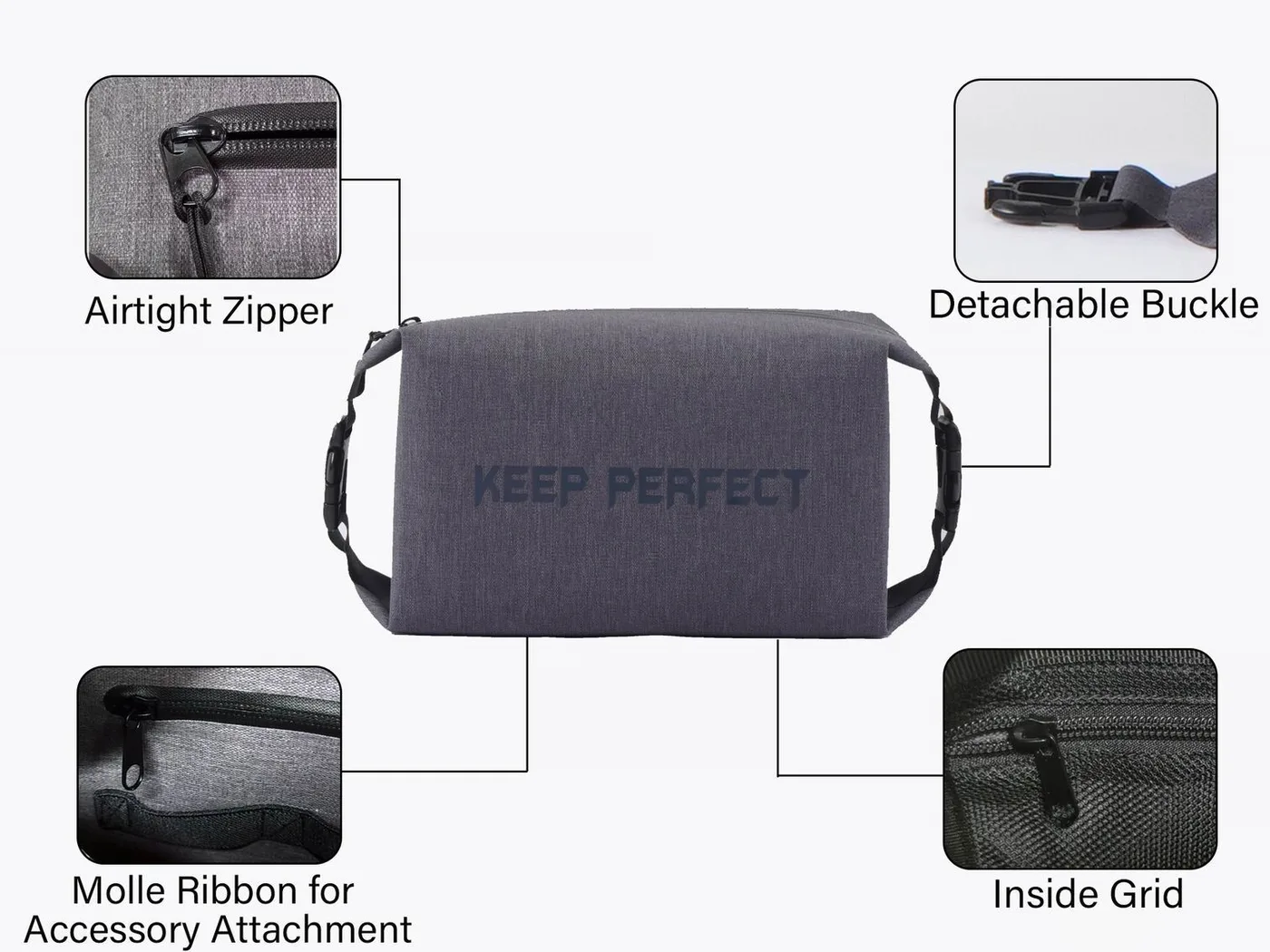
Wet shoes are the item most likely to defeat a good setup, because they carry 80 to 150 ml of water each and they smell within a day. Give them their own 5L welded bag, wipe the outsoles before packing, and open that bag the moment you arrive. Never put wet shoes in the same compartment as a shirt, even inside a dry bag: the water has to go somewhere and the only somewhere is the fabric around it.
Gym kit follows the same rule, and a commuting gym bag is worth reading separately because the wet zone dominates the volume. Our gym bag guide for rainy climates goes into the drying detail. For a swim commute, a 10L bag holds a wet towel and trunks at about 5 litres packed; wring the towel before it goes in and the bag stays serviceable for years rather than months.
Visibility: being seen in a November downpour
Rain at dusk is the worst visibility condition a commuter faces: drivers have wipers, mirrors misted and glass covered in a moving film of water, and a dark bag on a dark jacket is effectively invisible at 25 metres. Retroreflective material returns a headlamp beam at 400 to 500 candela per lux per square metre, which raises detection distance to roughly 120 to 150 metres on a straight road. That is the difference between a driver reacting and a driver braking.
Put reflective area on the moving parts. A band across the lower back panel is hidden by the rider; a band on the shoulder straps and on the sides of the bag moves with every pedal stroke and is what a driver actually notices. Aim for 150 to 250 square centimetres total, split across at least three separate patches so one folded strap does not hide all of it. Placement geometry is laid out in the reflective accents guide.
Condensation: the damp that is not a leak
Every winter, commuters decide their waterproof bag has failed because the inside is damp while the outside stayed dry. What happened is physics: warm humid air sealed inside a cold bag deposits water on the coldest surface, which is usually the film itself. A bag packed in a 22 C kitchen and carried into 4 C rain holds maybe 3 to 8 ml of condensed water after 30 minutes. That is enough to feel like a leak and not enough to wet anything.
Manage it rather than fighting it. Pack at the temperature of the outdoors where possible, expel air before you roll so there is less humid volume inside, and put a small silica sachet of 10 to 20 g in the sealed core pouch during winter. Open the bag for 10 minutes at the office and the film dries completely. If water is still pooling after that, you have a real leak and should look at the closure.
Drying the whole system at the office in 30 minutes
A welded bag dries fast because there is no fabric to hold water: the film sheds it in seconds and only the seams, webbing and harness need attention. Hang the pack upside down with the mouth open on a coat hook, shake the roll-top out once, and wipe the base with the hand towel you keep at your desk. Ten to fifteen minutes of room airflow at 20 C is enough for the shell.
The harness takes longer than the shell because closed-cell foam and webbing hold water between the layers. Squeeze the straps along their length twice, then leave the pack hanging with the straps spread rather than folded. In a heated office the whole system is dry inside 30 minutes; in an unheated hallway at 12 C, budget 60 to 90 minutes and expect the straps to still be damp at lunchtime.
| Item | Method | Time at 20 C | Time at 12 C | Do not |
|---|---|---|---|---|
| Welded shell | Hang open, mouth down | 10-15 min | 25-35 min | Dry on a radiator |
| Harness and straps | Squeeze, spread, air | 20-30 min | 60-90 min | Fold straps while wet |
| Laptop pouch | Open flat, wipe inside | 5-10 min | 15-20 min | Store closed while damp |
| Wet shoe bag | Empty, invert, wipe | 5 min | 10-15 min | Leave shoes in overnight |
| Documents | Open wallet, air flat | 5 min | 10 min | Stack wet paper |
Winter, slush and freezing rain
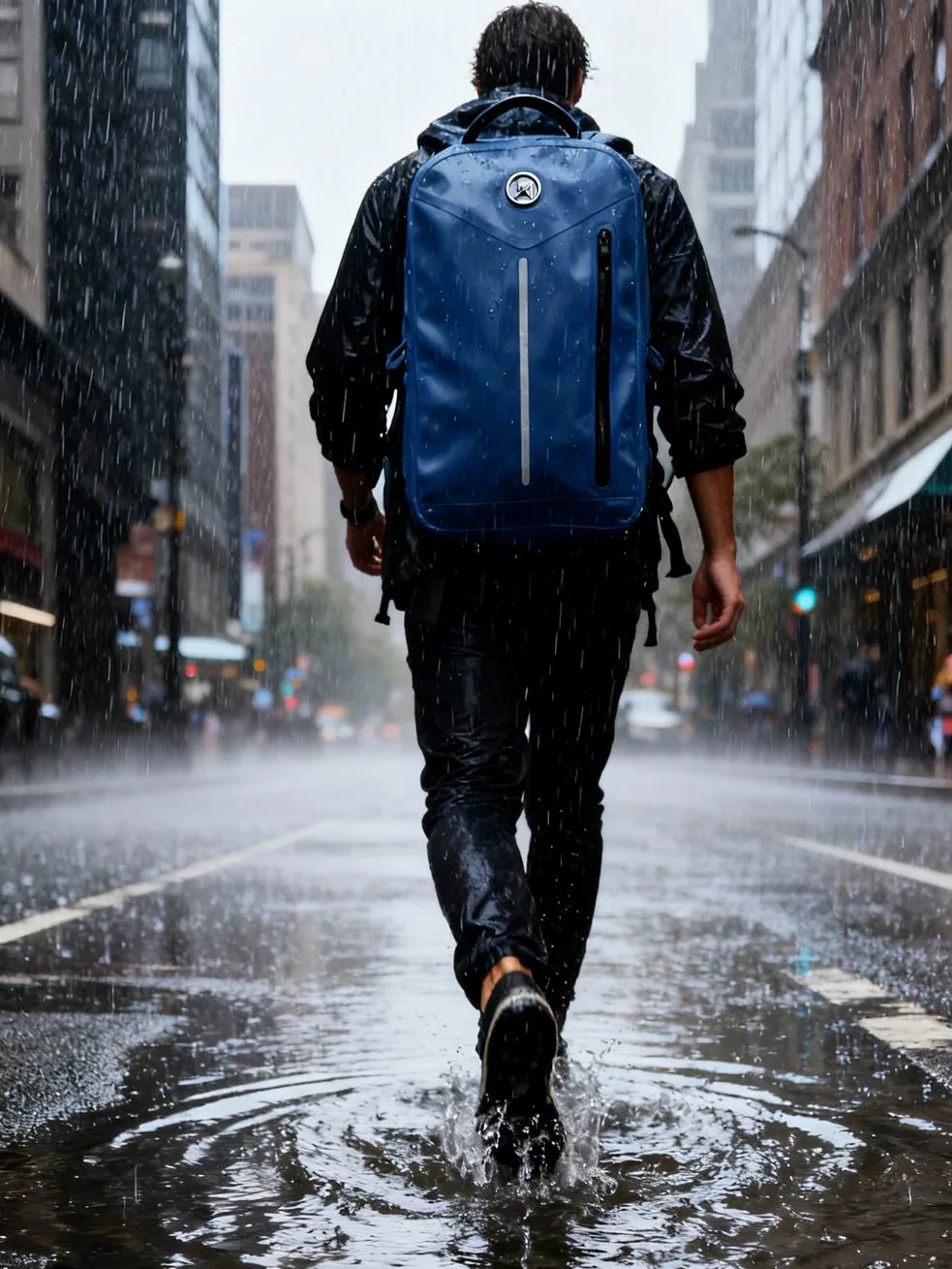
Cold changes the film before it changes the water. TPU stays flexible well below freezing, with a cold-crack threshold around -30 C for a quality grade, while PVC stiffens noticeably below 0 C and becomes unpleasant to roll at -5 C. A stiff roll-top that will not conform is a leak waiting to happen, which is why a winter commuter should check the film grade rather than the litre number. See how dry bags behave in freezing conditions for the full picture.
Slush is the harder problem because it is water plus grit. Road grit in a roll-top fold creates a capillary path that wicks water inward over a 30-minute ride, and it abrades the film at the fold line. Rinse the mouth of the bag with a wet hand before you roll in winter conditions, and once a week wipe the fold band with a damp cloth. Salt from gritted roads should be rinsed off the hardware monthly or buckles start to stiffen within one season.
A commute checklist you can run the night before
- Charge and pack the laptop in its welded pouch, charger included, and close it before bed.
- Pack paper flat in a document wallet inside the same sealed core.
- Roll the main compartment three times and clip the buckle on the top, not the side.
- Put shoes and gym kit in their own 5L bag, outsoles wiped.
- Check two reflective patches are visible from behind with the pack on.
- Weigh the loaded pack once a month; keep it under 6 kg for a bike commute.
- Keep a hand towel at the desk for the 10-minute dry-down.
- Empty the wet zone the moment you arrive, every day, without exception.
Run it at night rather than in the morning, because the two failures that soak a commuter are both morning failures: a roll done in a hurry with a jacket strap caught in the fold, and a laptop left loose in the main compartment instead of in its pouch. Both are solved by a habit that takes 90 seconds the previous evening.
If you are specifying these bags for a staff programme, a bike-share scheme or a retail range, the same checklist converts into a brief: welded shell, IPX6 with the test standard named, a strap attachment with no needle holes, reflective area over 150 square centimetres, and a pouch that fits a 14-inch machine. Our TPU waterproof backpack line is built to that specification, and the backpack versus liner comparison explains where each one wins. Compare against the wider product range before you standardise, and use ASTM test methods when you write the waterproof requirement into a specification. Waterproof bags have been produced here since 2014 in an SGS-verified 4,950 m2 site running 7 lines and 149 machines, with a 500-piece minimum, sampling in 6 to 10 working days and bulk in 35 to 50 days FOB Xiamen.
Frequently asked questions
Q1. What waterproof rating do I need for a rainy commute?
IPX5 to IPX6 for cycling and IPX4 to IPX5 for walking. A 30-minute ride in 20-30 mm/h rain is a sustained jet event on the front panel, which IPX6 covers and a coated pack with a rain cover does not.
Q2. Is a waterproof backpack better than a rain cover?
Yes for a daily commute. A cover protects the body of the pack but leaves the shoulder straps wet, and it wets out at the strap attachment within 10-15 minutes. A welded shell has no stitched strap holes to leak in the first place.
Q3. Do I need a dry bag inside a waterproof backpack?
For a laptop, yes. The inner pouch protects against the two failures a shell cannot prevent: a closure rolled in a hurry, and a water bottle or wet jacket sharing the main compartment.
Q4. What size inner pouch fits a 14-inch laptop?
A 4L to 6L welded pouch. A 14-inch machine with its 65 W charger occupies about 2.4 litres and weighs 1.7 kg, so 4 litres is the practical floor and 6 litres leaves room for a notebook.
Q5. Why is the inside of my waterproof bag damp when it never leaked?
Condensation. Warm humid air sealed in a cold bag deposits water on the film, typically 3 to 8 ml over a 30-minute winter ride. Expel air before rolling, add a 10-20 g silica sachet, and air the bag for 10 minutes indoors.
Q6. How do I stop wet shoes ruining my commute bag?
Give them a separate 5L welded bag, wipe the outsoles, and empty it on arrival. Two shoes hold 80-150 ml of water between them and will transfer it to anything in the same compartment.
Q7. Are waterproof zips reliable on a commuting backpack?
They seal properly, but grit in the teeth scores the tape and the zip starts weeping at the bottom stop after a season. A roll-top mouth has no teeth to score and is the lower-maintenance answer for daily use.
Q8. How much reflective area should a commuting bag have?
Aim for 150 to 250 square centimetres split across at least three patches, with some of it on moving parts such as the shoulder straps. Material rated at 400-500 candela per lux per square metre lifts detection distance to 120-150 metres.
Q9. Can I dry a waterproof backpack on a radiator?
No. Direct heat above about 40 C softens the film and can distort a weld line. Hang it upside down with the mouth open at room temperature; the shell dries in 10-15 minutes at 20 C.
Q10. Do dry bags work in freezing rain and slush?
TPU stays flexible to about -30 C and rolls cleanly; PVC stiffens below 0 C and resists conforming at the fold. Rinse grit out of the fold band regularly, because a single grain creates a capillary path.
Q11. What should I look for at the shoulder strap attachment?
A welded film patch 120-180 mm wide with no stitching. A stitched attachment puts thousands of needle holes in the one place where water runs off your shoulders and down the back panel.
Q12. How heavy should a commuting load be?
Keep the loaded pack under 6 kg for a bike commute. A typical office day with a laptop, shirt, lunch and gym kit runs 3.9 to 5.9 kg including the bag, before you add a second pair of shoes.
Q13. Will a waterproof tote work for a walk-and-transit commute?
Yes, and it is lighter at 700-900 g. It protects well against vertical rain and splash, but it offers less protection in a horizontal downpour than a backpack, because the opening faces up and the straps sit on the shoulder.
Q14. How often should I wash a commuting waterproof bag?
Wipe the shell weekly and do a full rinse monthly, or every two weeks if you ride on gritted winter roads. Salt and grit in the fold band are what shorten a bag’s life, not rain.
Q15. Can a waterproof bag replace a laptop bag entirely?
It can if the pouch is padded on five faces with 4-6 mm of closed-cell foam, because the commute risk is a corner drop onto a kerb. Choose a pouch with welded seams rather than a sewn binding.
Q16. What is the fastest way to dry a commuting bag at the office?
Hang it upside down with the mouth open, shake the roll-top out once, wipe the base, and squeeze the harness twice with the straps spread. Shell dry in 10-15 minutes, harness in 20-30 minutes at 20 C.
People also ask
How do you keep a laptop dry on a bike commute?
Put it in a welded 4-6 L padded pouch inside a waterproof backpack, pack the pouch flat against your back with the charger inside it, and roll the main compartment three times. The pouch is the second closure that saves you from a hurried roll.
Are waterproof backpacks worth it for commuting?
Yes if you commute more than twice a week. A welded shell weighs 200-300 g less than a coated pack plus a rain cover, dries in 15 minutes instead of several hours, and has no stitched strap holes to leak.
What is the difference between water-resistant and waterproof for a commute?
Water-resistant fabric beads water for 8-12 minutes and then wets out and conducts it inward. Waterproof welded film does not wet out at all, which is why a 30-minute ride needs welded construction rather than a coating.
Why does my backpack leak at the shoulders?
Because the strap attachment is stitched. Every needle hole is a path, and the shoulders are where water runs off a jacket and pools. Look for a welded strap patch with no stitching when you buy.
How do you stop condensation inside a dry bag?
Pack at outdoor temperature where you can, press the air out before rolling so there is less humid volume sealed inside, add a 10-20 g silica sachet in winter, and open the bag for 10 minutes once indoors.
Can you ride in heavy rain with a roll-top bag?
Yes, at IPX6 with three folds and the buckle clipped on top. A 20-30 mm/h rain at 20 km/h is a jet event, so the roll has to be clean: no jacket strap, no earphone cable and no grit in the fold.
Need this in production volume?
QUANZHOU JUNYUAN BAGS has produced waterproof bags since 2014 in an SGS-verified 4,950 m2 facility in Fujian, China. Minimum order 500 pieces, sampling in 6–10 working days, bulk in 35–50 days, FOB Xiamen — write to service@junyuanbags.com with your spec and target market.