Home / Blog / Sustainability & Compliance
rPET Fabric Dry Bags
rPET fabric dry bags use recycled polyethylene terephthalate yarn in the woven face, commonly at 300D to 600D, then add a separate waterproof layer such as TPU. A 20L body may contain roughly 350 to 550 g of rPET textile composite, but the recycled percentage must be calculated by component and verified with transaction records; one recycled face does not make buckles, webbing, print or coating recycled. The best programmes combine traceable feedstock, welded construction, repairable hardware and service testing beyond 500 closure cycles.
The environmental case rests on evidence and longevity, not a green colour or bottle icon. Recycled yarn can reduce demand for virgin polyester feedstock, yet lamination, dyeing, transport, waste and a short product life can erase part of that advantage. This guide shows how to read an rPET specification, connect yarn identity to finished lots, evaluate waterproof construction, calculate honest content claims and design a bag that remains useful long enough for material savings to matter.
- What rPET means inside a dry bag construction
- Recycled-content percentages without vague arithmetic
- Traceability from yarn lot to finished bag
- Strength and abrasion behaviour of rPET textiles
- Lamination turns the textile into waterproof material
- Waterproof performance belongs to the complete system
- Environmental benefit requires a defined comparison
- Microfibre release and keeping plastic out of water
- End-of-life limits of mixed-material dry bags
- Colour, print and finish choices that preserve the case
- Compliance and claim files for each sales market
- Testing rPET fabric dry bags for long service
- Building an honest rPET dry bag purchase brief
What rPET means inside a dry bag construction
rPET is recycled polyethylene terephthalate, the same polymer family used for conventional polyester fibre and many beverage containers. In a dry bag, recycled PET is usually spun into yarn and woven as the structural face. That textile gives tear strength, dimensional stability, colour and abrasion support. It is not inherently a watertight barrier, because water can travel between yarns. A film or coating must cover the weave, and welded seams plus a functioning closure complete the water-control system.
Name every layer when describing the product. A phrase such as 420D rPET polyester with TPU laminate is more useful than recycled waterproof fabric because it identifies the woven support and barrier separately. State whether the recycled claim applies to the face yarn, webbing, lining or entire textile assembly. The TPU versus PVC guide explains barrier choices, while this article focuses on what the recycled textile does and does not prove.
| Bag component | Possible material | Waterproof role | Recycled claim question |
|---|---|---|---|
| Outer woven face | 300D-600D rPET polyester | Supports barrier and abrasion | What percentage is recycled PET? |
| Inner barrier | TPU film | Blocks water and enables welding | Virgin, recycled or unspecified? |
| Webbing | Polyester or nylon | Carries strap load | Is recycled content documented? |
| Buckle | Acetal or nylon | Closes roll-top | Is resin content included in claim? |
| Print and ink | Water- or solvent-based system | No primary barrier role | Is it excluded from percentage? |
| Packaging | Paper, film or textile sack | Protects in transit | Is its claim separate from the bag? |
A mechanical route typically sorts PET feedstock, removes labels and contaminants, washes and dries the material, reduces it to flakes or pellets, melts it, filters it and extrudes filaments. Those filaments are drawn, textured and spun into yarn before weaving. Each stage has yield loss and quality controls. Feedstock can come from post-consumer bottles or post-industrial material, and those sources should not be treated as identical in a claim. Colour contamination and polymer degradation affect the yarn options available.
The conversion chain matters because a finished-bag invoice alone cannot establish origin. Traceability should connect feedstock, chip or flake, yarn, greige fabric, dyed fabric, lamination and bag lot. Lot codes and quantities help reconcile input and output without implying that every molecule can be followed visually. The US EPA provides general information on recycling and materials management; programme-specific recycled-content evidence still needs the applicable scheme and market rules.
Recycled-content percentages without vague arithmetic
A recycled percentage needs a denominator. If a 700 g finished bag contains 380 g of textile that is 100% rPET fibre, 140 g of TPU, 90 g of webbing, 55 g of buckles and 35 g of print plus trim, then recycled content is not automatically 100%. On a total-product mass basis, the documented rPET contributes about 54.3%. If only the textile face is being described, the claim may be 100% recycled polyester face, but that narrower boundary must be visible.
Ask whether the figure is based on mass, whether it excludes packaging, and how loss during cutting is handled. Cutting waste can be recorded for production efficiency, but it is not part of the shipped bag. Reconcile purchase quantities against output over a defined period and retain transaction evidence. Do not estimate bottle counts from marketing formulas unless bottle mass, conversion yield and claim rules are documented. A clear percentage with a clear boundary is stronger than a dramatic but untraceable equivalence.
| Example component | Mass per bag | Documented recycled share | Recycled mass |
|---|---|---|---|
| rPET woven face | 380 g | 100% | 380 g |
| TPU barrier | 140 g | 0% | 0 g |
| Polyester webbing | 90 g | 60% | 54 g |
| Buckles | 55 g | 0% | 0 g |
| Print and trim | 35 g | 0% | 0 g |
| Finished 20L bag | 700 g | 62% by total mass | 434 g |
Traceability from yarn lot to finished bag
Build a document chain before approving the label. The yarn record should identify material composition and lot; the weaving and dyeing records should link that lot to a fabric roll; the lamination record should add the barrier code; and the cutting record should connect roll numbers to finished production. Transaction certificates or equivalent programme documents may support certified claims when applicable, but the certificate holder, scope, dates, product description and quantity all need to align.
Physical segregation is the simplest concept: identified material remains separated and labelled through storage and cutting. Where an accepted chain-of-custody system permits another accounting model, explain that model accurately rather than suggesting direct physical identity. Incoming rolls should carry durable labels, and remnants should retain the same code until reconciled. The sustainability questions guide provides a useful checklist for evidence, waste and process boundaries.

Strength and abrasion behaviour of rPET textiles
Recycled polyester can meet demanding bag specifications, but equivalence should be demonstrated rather than assumed. Yarn tenacity, filament consistency, twist, weave, denier and finishing determine tensile and tear behaviour. Repeated thermal processing can shorten polymer chains if feedstock and extrusion are poorly controlled, while filtration and process control can produce stable yarn. Compare actual fabric lots at equal denier, weave density and finish, then test both dry and wet if the bag will see sustained spray.
Abrasion usually begins on the outer textile face, protecting the waterproof layer beneath. A tightly woven 420D rPET can outperform a loosely woven heavier fabric because yarn movement and surface snagging are reduced. Base panels, corner radius and load also matter. Use the 420D versus 500D guide to separate denier from construction. For a 12 kg duffel, reinforce predictable contact areas instead of assuming recycled yarn alone limits durability.
| Property | Suggested comparison | Why it matters | Result to retain |
|---|---|---|---|
| Mass per area | 5 cuts per roll | Controls weight and consistency | g/m2, min and max |
| Tensile strength | Warp and weft | Carries panel and strap loads | Peak force in N |
| Tear strength | Warp and weft | Shows notch growth resistance | Force in N |
| Abrasion | Face under agreed load | Protects barrier from wear | Cycles and failure mode |
| Bond strength | After dry and wet conditioning | Keeps film attached | N per 25 mm |
| Colour fastness | Water, rubbing and light | Controls transfer and fading | Grade by method |
Lamination turns the textile into waterproof material
A woven rPET face remains breathable between yarns until a continuous barrier is bonded to it. TPU is attractive for welded bags because compatible surfaces can join under radio-frequency or thermal processes, while other coatings may require different seam technology. The bond must survive bending, water, temperature and cleaning. An attractive recycled face with weak adhesion is not a durable environmental choice; once the layers separate, repair is difficult and the product may leave service early.
Specify film chemistry, nominal thickness, bonding system, total composite mass and minimum peel performance. Test after water conditioning because a dry bond can behave differently after 24 hours wet. The film and textile should also shrink compatibly under welding heat so panels remain flat. The laminated versus coated guide describes the structural distinction, and RF welding explained covers the joining window.
Waterproof performance belongs to the complete system
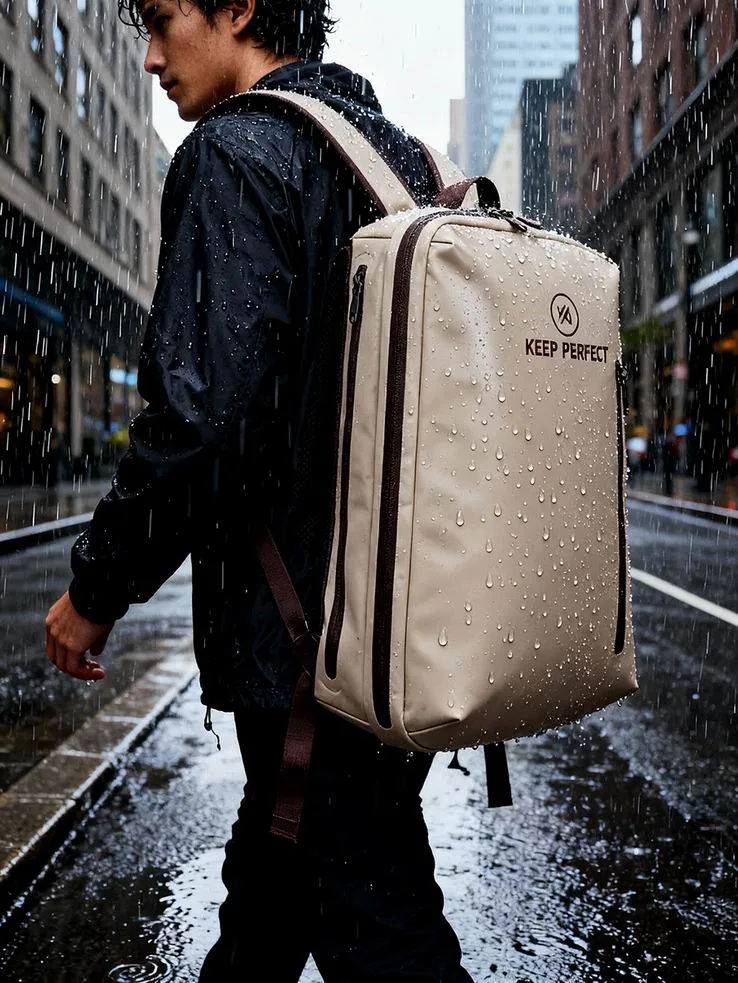
Neither recycled content nor polyester denier grants a waterproof rating. Water resistance begins with the barrier, then depends on weld continuity, roll-top geometry, valves, windows and attachments. Test a finished, closed bag under the exposure it will face. Rain commuting may need driven spray and puddle contact; paddle use can require jets and temporary immersion. A high hydrostatic result on the laminate cannot reveal a channel beside a webbing anchor.
If an ingress-protection claim is planned, use the relevant conditions from the IEC 60529 framework with competent test support. Keep the claim separate from the recycled-content statement. Post-conditioning checks are important: repeat exposure after 500 closure rolls, controlled abrasion and low-temperature flexing. A bag that remains watertight after use simulation supports a stronger sustainability case than one that begins with high recycled content but fails early.
Environmental benefit requires a defined comparison
A credible environmental comparison defines a functional unit, such as one 20L bag delivering five years of service, and uses equivalent performance boundaries. Comparing one kilogram of rPET textile with one kilogram of virgin textile is incomplete if one bag needs more mass or wears out sooner. Include feedstock preparation, yarn production, weaving, dyeing, lamination, cutting, assembly, transport, use and end of life where data are available. State exclusions and uncertainty instead of compressing the analysis into one unsupported percentage.
Energy source, transport distance, dye process and waste yield can materially alter results. Recycled feedstock may reduce virgin resource demand, but it is not impact-free. ISO publishes life-cycle assessment principles that help structure boundaries and interpretation. Use primary data for the actual programme where possible, keep generic database values labelled, and avoid claiming a carbon reduction unless the baseline, method, geography and date can be shown.
Microfibre release and keeping plastic out of water
rPET is still synthetic polyester and can shed fibres through abrasion, cutting and washing. A dry bag is washed less aggressively than clothing, which can limit release during use, but rough brushing and exposed frayed edges increase it. Bind or weld cut edges where construction permits, design the base to avoid dragging and instruct users to hand wash gently. Collect cutting dust and offcuts through housekeeping rather than allowing them into drains.
The product should also remain physically secured around water. A lost bag becomes litter regardless of its recycled percentage. Use dependable lash points, inspect tethers and avoid presenting floating behaviour as recovery assurance. NOAA Ocean Service explains the wider problem of marine debris. Durability, attachment and care are direct pollution-prevention measures, not separate topics from material selection in any watersports programme.
End-of-life limits of mixed-material dry bags
A laminated dry bag combines polyester textile, TPU or another barrier, webbing, buckles, thread, print and labels. That mixture is difficult for conventional recycling streams to separate, even when the face began as recycled PET. The honest statement is often that the bag contains recycled material, not that the finished bag is recyclable. Local acceptance varies, and a recycling symbol on one component should never be extended to the whole product without an available collection and processing route.
Design can still improve end-of-life options. Make straps and buckles removable without cutting the waterproof body, mark major polymer families, reduce unnecessary material combinations and provide repair parts. Extend use through replaceable hardware and patch guidance. The dry bag recyclability guide explores separation barriers, while repairing instead of replacing shows why service extension is often the most practical waste reduction step available today.
| Design choice | Use-phase benefit | End-of-life effect | Evidence to request |
|---|---|---|---|
| Removable shoulder strap | Easy cleaning and replacement | Separates webbing and hardware | Attachment drawing |
| Replaceable buckle | Extends life after impact | Removes rigid part cleanly | Spare-part procedure |
| Single face-fibre family | Simpler material control | Reduces textile mixture | Bill of materials |
| Welded repair patch area | Supports puncture repair | Delays disposal | Validated repair test |
| Material marking | Identifies major polymers | Improves sorting information | Marking artwork |
| Reduced decorative layers | Less weight and fewer peel points | Fewer bonded materials | Approved sample cross-section |
Colour, print and finish choices that preserve the case
Dark colour can tolerate feedstock variation and hide trail soil, potentially reducing reject rates and aggressive washing. Light and bright shades may need cleaner feedstock, more controlled dye recipes or additional pigment. That does not make one colour automatically better; it means yield and colour tolerance belong in the brief. Approve a realistic colour range under daylight and artificial light, then test rubbing, water and UV exposure on the final laminated fabric rather than an unlaminated swatch.
Printing adds chemistry and another durability interface. Select an ink system compatible with the surface, cure conditions and intended market, then check adhesion after fold, abrasion and water exposure. A peeling graphic shortens perceived life even when the bag remains watertight. The water-based printing guide discusses process trade-offs. Keep environmental wording separate from decorative language and document each material claim on the final artwork review.
Compliance and claim files for each sales market
Recycled-content evidence does not replace chemical compliance. The finished product may need restricted-substance review for polymers, pigments, inks, adhesives and hardware according to destination and use. Build a technical file with the bill of materials, declarations, relevant laboratory reports, traceability records, artwork approvals and claim calculations. Dates, material codes and legal entities should align. A report for one black fabric cannot silently cover a later fluorescent fabric with a different pigment package.
Avoid absolute phrases such as zero impact, completely sustainable or fully recyclable unless an unusually strong, market-specific evidence set supports them. Prefer bounded wording: the outer face contains a stated percentage of recycled polyester verified under a named programme, while other components are listed separately. The REACH considerations guide and PFAS-free fabric guide help separate chemical and material-origin questions. Legal review remains necessary for claims in each destination.
Testing rPET fabric dry bags for long service
Start with incoming identity, width, mass, denier and thickness. Compare tensile, tear, abrasion, colour fastness and laminate peel against the approved reference. Validate weld settings for each colour and lot because finish and thickness can influence the process window. On finished bags, inspect weld width and alignment, screen for leak channels and check strap loads. Then run rain, jet or immersion tests matching the stated use rather than relying on textile strength alone.
Condition samples before repeating the checks. A practical development set might use five material specimens per direction, three bags for exposure, 500 roll-top cycles, 5,000 controlled abrasion cycles on the base and 24 hours of water conditioning before peel. These numbers are programme examples, not universal standards; adjust them to risk and the named method. Record failures by location and mode so revisions target the actual weak point instead of simply increasing denier or film thickness.
- Verify yarn, fabric and laminate codes against traceability records.
- Measure mass, thickness and roll-to-roll variation before cutting.
- Test tensile, tear, abrasion, colour and laminate bond with named methods.
- Validate weld settings and inspect channels around attachments.
- Expose finished bags after closure cycling and base abrasion.
- Retain samples and reports under the finished production lot number.
Building an honest rPET dry bag purchase brief
Specify recycled claim boundary, minimum percentage, evidence scheme, yarn denier, weave, fabric mass, colour, barrier chemistry, total thickness and bond requirement. Add bag dimensions, usable volume, maximum load, weld width, closure rolls, attachment loads and waterproof exposure. Define packaging separately. Ask bidders to complete the same component table so recycled percentages and price are compared on equal boundaries. Approval should depend on documents and performance, not a recycled hang tag alone.
Production since 2014 in an SGS-verified 4,950 m2 facility, with 137 staff, 7 lines, 149 machines and capacity up to 200,000 pieces per month, supports traceable welded-bag programmes. Normal planning can begin at 500 pieces, with samples in 6-10 working days, bulk in 35-50 days and AQL 2.5 where agreed. Submit the component boundary, evidence requirement and performance tests through the contact page.
Choose rPET when the textile source can be traced, the laminate meets performance needs and the resulting bag is designed for a credible service life. Compare it with an equivalent virgin-polyester build at the same denier, weave, coating, weight and test level. Prefer the construction that meets the intended duty with less virgin input and no avoidable loss of durability. If evidence covers only the face yarn, say exactly that and improve other components over successive programmes.
The strongest rPET fabric dry bags make four things visible: what is recycled, how much, how it is verified and how long the product is expected to perform. They also acknowledge what is not solved, especially mixed-material recycling at end of life. That combination of traceability, bounded claims, post-conditioning waterproof tests and repairable details is more meaningful than a bottle count. Use the eco-friendly dry bag overview to compare wider material and packaging choices under the same evidence-first approach.
Frequently asked questions
Q1. What are rPET fabric dry bags?
They are dry bags whose woven textile face uses recycled polyethylene terephthalate yarn. The rPET provides structure and abrasion support; a separate barrier such as TPU, welded seams and a working closure provide waterproof performance.
Q2. Are rPET dry bags made from bottles?
Some rPET yarn uses post-consumer bottle feedstock, while other yarn may use different post-consumer or post-industrial PET. The origin should be stated and supported by traceability records rather than inferred from a bottle graphic.
Q3. Is an rPET dry bag 100% recycled?
Usually not. The textile face may be 100% recycled polyester while TPU, buckles, webbing, ink and labels use other materials. A total-product percentage must include every component in the mass calculation.
Q4. Is recycled polyester waterproof?
Woven recycled polyester is not inherently waterproof because water passes between yarns. It needs a continuous film or coating, compatible seam construction and a closure validated under the intended exposure.
Q5. Is rPET as strong as virgin polyester?
It can meet comparable requirements when yarn quality, denier, weave and finishing are controlled. Verify tensile, tear, abrasion and bond results on the actual material rather than assuming equivalence from fibre origin alone.
Q6. Does rPET reduce carbon emissions?
It may reduce virgin feedstock demand and impacts in some comparisons, but the result depends on energy, transport, processing, product mass and service life. Any reduction claim needs a defined baseline, boundary, method and current data.
Q7. Can rPET fabric be RF welded?
The rPET textile itself is not the active RF barrier. A compatible TPU layer can enable RF welding. Validate energy, pressure, dwell and cooling for the complete laminate and each relevant material lot.
Q8. How is recycled content verified?
Evidence should connect feedstock, yarn, fabric, lamination and finished lots through material codes, quantities and transaction records under the applicable chain-of-custody programme. Certificate scope and dates must match the product.
Q9. What does 100% rPET face mean?
It means the polyester yarn in the stated face fabric is entirely recycled within the defined claim system. It does not describe the TPU layer, webbing, buckles, ink, labels or whole-bag mass unless explicitly included.
Q10. Are rPET dry bags recyclable?
Most finished bags are difficult to recycle because textile, film, buckles, webbing and print are bonded or assembled together. Removable hardware and material marking help, but local collection and processing routes must exist.
Q11. Do rPET bags shed microfibres?
They can shed synthetic fibres through abrasion, cutting and aggressive washing. Durable weaving, protected edges, gentle hand cleaning and avoiding dragging can reduce release during production and use.
Q12. Which denier is suitable for an rPET dry bag?
Small protected pouches may use around 300D, while exposed roll-tops and backpacks often use 420D to 600D. Weave density, yarn quality, barrier, reinforcement and test results matter alongside denier.
Q13. How long should an rPET dry bag last?
No calendar life follows from recycled content. Set a duty cycle and test closure folds, abrasion, bond and water exposure. Care, load, UV, grit and repair access determine whether the bag serves for years or fails early.
Q14. What documents should a buyer request?
Request a bill of materials, recycled-content and chain-of-custody evidence, transaction records where applicable, fabric and laminate test reports, restricted-substance documents, finished-bag tests and the calculation behind any percentage claim.
Q15. Can rPET dry bags use bright colours?
Yes, but bright shades may need tighter feedstock and dye control. Approve colour on the final laminate and test water, rubbing and light fastness so appearance does not fail before waterproof performance.
Q16. What is the main sustainability risk with rPET bags?
Overclaiming is the central risk: treating one recycled textile layer as proof that the whole bag is recycled, low-carbon or recyclable. Bounded claims, traceability and long-service testing prevent that mistake.
People also ask
What does rPET mean in fabric?
rPET means recycled polyethylene terephthalate. It is processed into polyester yarn and woven into fabric, with source and recycled percentage established through defined evidence and traceability.
How are rPET dry bags made waterproof?
The woven rPET face is bonded to a continuous barrier such as TPU. Compatible panels are welded, attachments are sealed and the closure is tested under rain, jets or immersion appropriate to the claim.
Are recycled polyester bags good for the environment?
They can reduce virgin material demand, but performance depends on sourcing, processing, durability, transport and end of life. Compare equivalent products with a defined life-cycle boundary and avoid absolute claims.
Can rPET fabric be recycled again?
The textile may be recyclable in isolation, but lamination, print and attached hardware make a finished dry bag difficult for ordinary streams. Local collection and a process able to handle the composite are required.
Does rPET fabric last as long as normal polyester?
It can when yarn, weave, finish and lamination meet the same strength and ageing requirements. Test actual lots for tensile, tear, abrasion, bond and post-conditioning waterproof performance.
Why do rPET claims need traceability?
Appearance cannot reveal recycled origin or percentage. Traceability connects documented inputs through yarn, fabric, lamination and finished lots, allowing a claim to be checked against quantity and scope.
Need this in production volume?
QUANZHOU JUNYUAN BAGS has produced waterproof bags since 2014 in an SGS-verified 4,950 m2 facility in Fujian, China. Minimum order 500 pieces, sampling in 6–10 working days, bulk in 35–50 days, FOB Xiamen — write to service@junyuanbags.com with your spec and target market.