Home / Blog / Design & Branding
School and University Dry Bag Orders
Most school and university dry bag orders settle on one 15L to 20L roll-top with welded seams and a 0.4 to 0.5 mm TPU film, at a minimum of 500 pieces and a landed unit cost between 4.20 and 8.60 USD. Two numbers decide everything downstream: the academic calendar and the service life. A bag handed out in September has to survive 190 term days of locker scrapes, bus floors and playground rain, and a bag that splits in March costs far more in goodwill than the 1.70 USD saved by dropping to a thinner film.
What follows is the full order path. It starts by sizing the bag around a real student day rather than around a catalogue page, moves through film and denier, then covers how to put a crest on TPU so it does not peel, which chemical paperwork a district or university procurement office will ask for, and the schedule that lands cartons in a storeroom before term begins. Where a decision carries a price, the price is stated; where it carries a test, the standard is named.
- What a school dry bag order actually covers
- Sizing the bag around a real student day
- Film and face fabric that survive a school year
- Closures younger users can actually work
- House colours, contrast and staying legible
- Marking methods compared: print, patch and welded badge
- Chemical and product-safety paperwork for student kit
- Reflective detail and the walk home in the dark
- Volumes, timing and the academic calendar
- Where the money goes per unit
- Approval samples: what to check on the bench
- Hand-out day, spares and the reorder
- A specification brief you can send out
What a school dry bag order actually covers
A school order is rarely a single product. In practice it is a small family: one day size for the majority of students, one bigger size for clubs and trips, and often a staff or marshal version in a high-visibility colourway. Standardising on one closure geometry across the family matters more than it sounds, because a pupil who learns the three-fold roll in year 7 should not have to relearn it on a club bag in year 10. Our own roll-top dry bag range uses one closure across 5L to 90L for exactly this reason.
The second thing to settle before anything else is ownership. A bag bought by the school and handed out stays in school service and is normally expected to last three years, which pushes the spec up. A bag sold to families through a uniform shop is a one-year product judged on price and appearance, which pushes the spec down but raises expectations on print quality and colour matching. Those are two different products and quoting them from the same brief is the most common source of disappointment.
Third, decide what the bag replaces. If it replaces a drawstring PE bag, it is judged on whether it keeps a tablet dry in an 8-minute walk between buildings; if it replaces a rucksack, it is judged on strap comfort at 5 kg. That single sentence settles arguments about film thickness later.
Sizing the bag around a real student day
Volume should come from the load, not from a guess. A secondary student day bag typically carries an A4 folder, a 1.1 kg tablet or laptop, a 500 ml bottle, a packed lunch and a PE kit; that list packs to roughly 11 to 13 litres and weighs 3.2 to 4.1 kg. A bag sold as 15L will hold it with the three-fold roll intact. A 10L bag will hold the same list only if the PE kit travels separately, which is why 10L works for primary and 15L is the safe secondary default.
Club and crew bags are a different calculation because the load is wet. Wet kit is bulkier than dry kit and it should not share a bag with books, so give clubs their own size rather than asking them to borrow the day bag. A 25L club bag with welded D-rings will lash to a boat thwart, sit on a muddy minibus floor and be hosed out at the end of term, all of which are jobs a 15L school bag with a printed crest is not built for.
| User group | Recommended size | Typical load | Empty weight | Spec note |
|---|---|---|---|---|
| Primary years 5-6 | 10 L | PE kit, lunch, bottle | 260 g | Two-hand roll, wide mouth |
| Secondary day bag | 15 L | A4 folder, tablet, PE kit | 340 g | A4 fits flat, no diagonal load |
| Sixth-form commute | 20 L | Laptop in sleeve, books, lunch | 430 g | Padded harness or tote format |
| Rowing or outdoor-ed club | 25 L | Wet kit, towel, spare layers | 520 g | Welded D-rings for lashing |
| Shared field-trip kit | 40 L | Group first aid and waterproofs | 760 g | One bag per six students |
| Staff and marshal kit | 12 L | Radio, paperwork, torch | 310 g | High-visibility colourway |
Film and face fabric that survive a school year
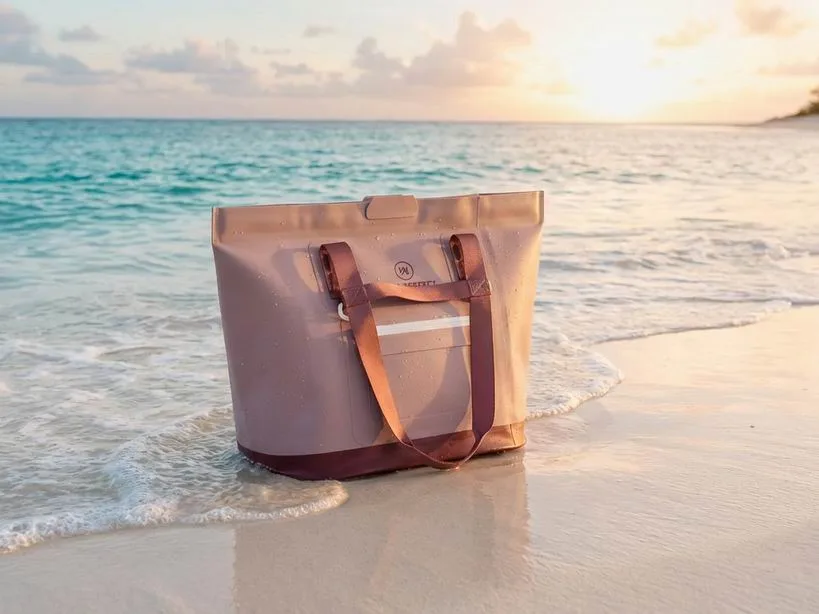
Two numbers govern durability and both should appear in the brief: film thickness in millimetres and face fabric in denier. Film thickness decides puncture and tear resistance at the corners; denier decides how long the outer face resists abrasion against locker edges and concrete. A 0.30 mm PVC film over 210D polyester is cheap and will abrade through in a single term of daily locker use. A 0.40 mm TPU film over 420D nylon is the realistic floor for a bag expected to last two years.
TPU is worth the extra in a school setting for one specific reason beyond durability: it contains no plasticiser that can migrate. A PVC bag stored in a warm classroom over a summer holiday can stiffen and, in some formulations, give off a noticeable odour by the September hand-out. TPU also stays flexible down to about -20 °C, which matters for a school with a winter field programme or a northern campus.
Abrasion is best specified by test rather than by adjective. Ask for a Martindale or Wyzenbeek result on the face fabric and a hydrostatic head figure on the laminate; both are objective and both are cheap to run before bulk. The ISO textile test series and the ASTM methods give you language that a procurement officer will recognise, rather than a marketing phrase that no one can verify.
| Spec tier | Film | Face fabric | Abrasion cycles | Service life | Unit cost band |
|---|---|---|---|---|---|
| Light duty | 0.30 mm PVC | 210D polyester | 5,000 | One term | 2.40-3.20 USD |
| Standard school | 0.40 mm TPU | 420D nylon | 12,000 | 2-3 years | 4.20-5.60 USD |
| Heavy duty | 0.50 mm TPU | 500D nylon | 20,000 | 4-6 years | 5.90-7.40 USD |
| Club and crew | 0.60 mm TPU | 500D ripstop | 30,000 | 6-8 years | 7.80-9.60 USD |
| Marine grade | 0.70 mm TPU | 840D nylon | 40,000 | 8+ years | 11.00-14.20 USD |
Closures younger users can actually work
A closure that a twelve-year-old cannot operate is a closure that gets left open. Grip strength in that age group sits in the 15 to 25 kg range, so specify a side-release buckle with a release force of 4 to 6 kg and a mouth stiffener that holds the fold line open while the bag is being packed. A limp mouth is the single most common reason a school dry bag is found half-rolled and half-full of water at the end of the day.
Three folds is still the rule, but for primary years consider a two-fold closure with a wider fold allowance. Two folds on a well-stiffened mouth hold a rainstorm and a bus-stop puddle, which is the realistic exposure, and they take four seconds less to teach to a class of thirty. The trade-off is genuine: two folds will not survive being dropped in a pond on a field trip. If your field programme includes water, keep three folds and teach the roll in a ten-minute form-room session.
House colours, contrast and staying legible
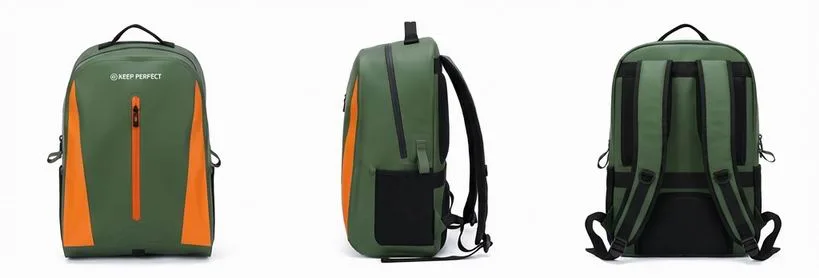
Colour is where school orders succeed or fail politically: procurement wants the house colour, pupils want something they will carry, and staff want to spot a bag across a field. Black and olive hide dirt but look anonymous, mint and blue read well at distance, and a pink or rose colourway is often the most requested option in a coeducational secondary order because bags stay identifiable in a pile.
Soil resistance should be part of the colour decision, not an afterthought. A mid-tone colourway hides scuffing better than either extreme: black shows every chalk mark and chalk dust, and a pale mint shows every bus-floor smear. If the crest is a light colour on a dark bag, check the print opacity after 20 washes rather than on day one, because low-opacity white inks go grey on a black TPU face within a term.
Marking methods compared: print, patch and welded badge
Putting a crest on a waterproof shell is not the same job as printing on cotton. TPU has a low surface energy, which means ordinary plastisol ink does not bond well without a pre-treatment, and any stitch through the shell perforates the waterproof layer. That leaves four practical routes, and each has a different minimum, a different set-up cost and a different end-of-life behaviour.
Screen print is the default for flat crest panels and holds up for about 30 wash cycles before edge lift. Digital transfer needs no screens, so it suits photographic artwork and small personalisation runs, but it is the least durable option at roughly 20 cycles. A heat-pressed patch lasts longest of the applied methods at about 50 cycles and can be applied after bulk, which is useful when a school wants the same bag with three different house crests. A radio-frequency welded badge costs the most to set up and has no holes at all, so it is the correct choice when the bag will be immersed rather than rained on.
| Marking method | Minimum run | Set-up cost | Durability | Lead time added | Best for |
|---|---|---|---|---|---|
| Screen print | 500 pcs | 55 USD per colour | 30 wash cycles | 4 days | Flat crest panels |
| Digital transfer | 100 pcs | 0 USD | 20 wash cycles | 2 days | Photographic artwork |
| Heat-pressed patch | 300 pcs | 80 USD | 50 wash cycles | 6 days | Crests with fine detail |
| Woven label, sewn | 500 pcs | 35 USD | 60 wash cycles | 5 days | Care and name labels |
| RF welded badge | 1,000 pcs | 260 USD | Bag life | 10 days | No holes in the shell |
Placement is a separate decision from method, and the two interact with the waterproof claim. Keep any print at least 40 mm below the fold line so the ink is not on the surface that presses against itself when the bag is closed. Put sewn labels on a hem or a webbing tab rather than through the main panel. Our logo placement guide covers the geometry in more detail, and the print method comparison goes through the cycle-testing numbers behind the table above.
Chemical and product-safety paperwork for student kit
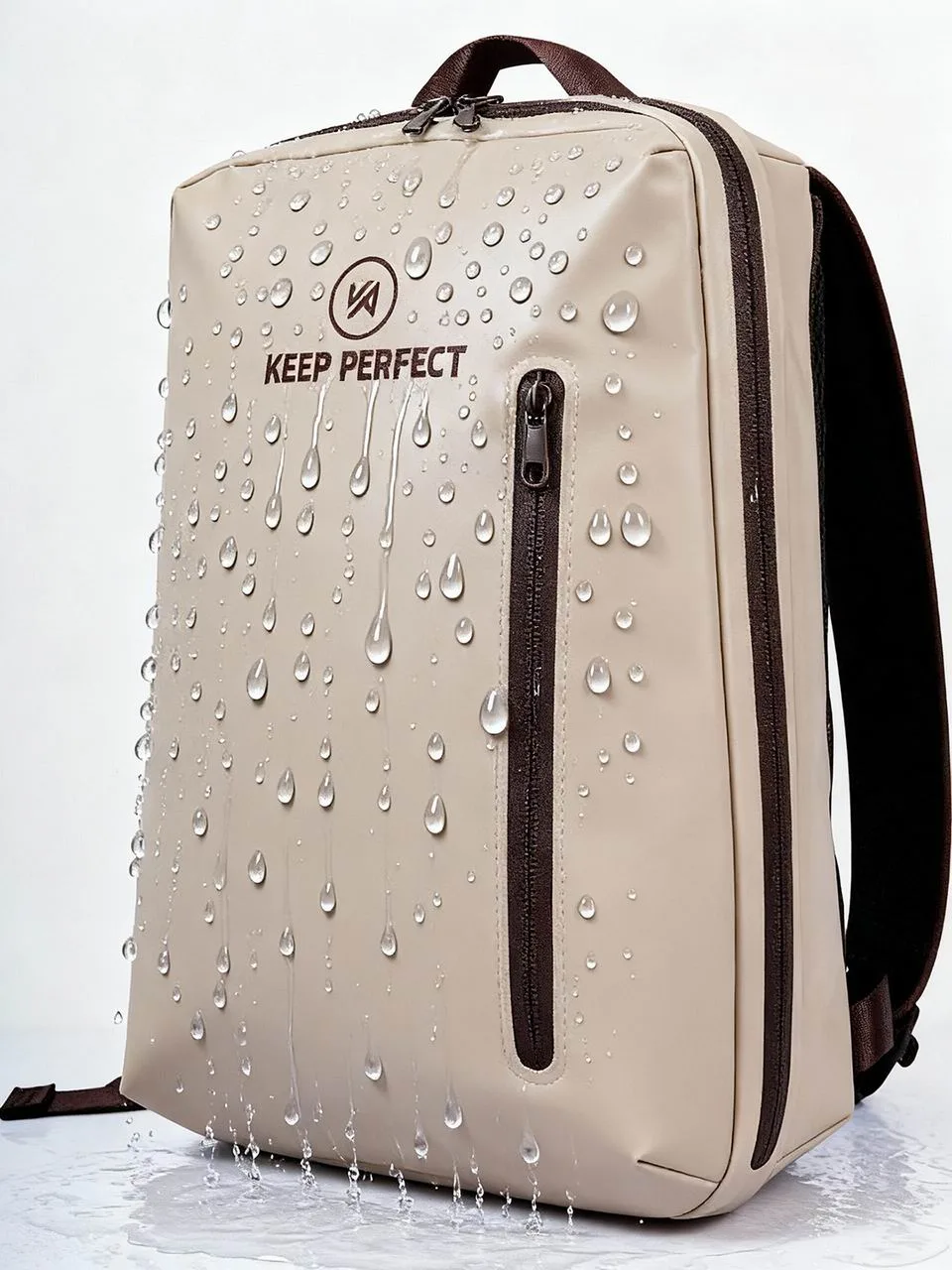
Procurement offices ask for documents, not assurances. The four names that recur are REACH for substances of very high concern, Prop 65 for the Californian market, OEKO-TEX or an equivalent textile-safety certificate, and EN 71-3 migration testing if any of the users are under fourteen. None of these is difficult to satisfy with a phthalate-free TPU film and a PFAS-free finish, but all of them need to be planned in, because a migration test takes ten to fifteen working days and the result arrives after the bag is already made.
Two substance families deserve specific attention. Short-chain chlorinated paraffins and certain phthalates appear in cheap PVC coatings, and per- and polyfluoroalkyl substances appear in durable water-repellent finishes. Ask for a declaration on both rather than a general compliance statement. Guidance on safer chemical choices in consumer products is published by the US EPA, and it is a reasonable reference to attach to a school brief. Our eco-friendly dry bag options are built on phthalate-free TPU for exactly this reason.
Hardware is part of the same paperwork. Buckles and D-rings are usually acetal or nylon, both of which are straightforward, but coatings and electroplated finishes on metal parts can be the item that fails a screening test. Specify untreated stainless or a documented coating, and ask for the test report at the same time as the fabric certificate so the two arrive together.
Reflective detail and the walk home in the dark
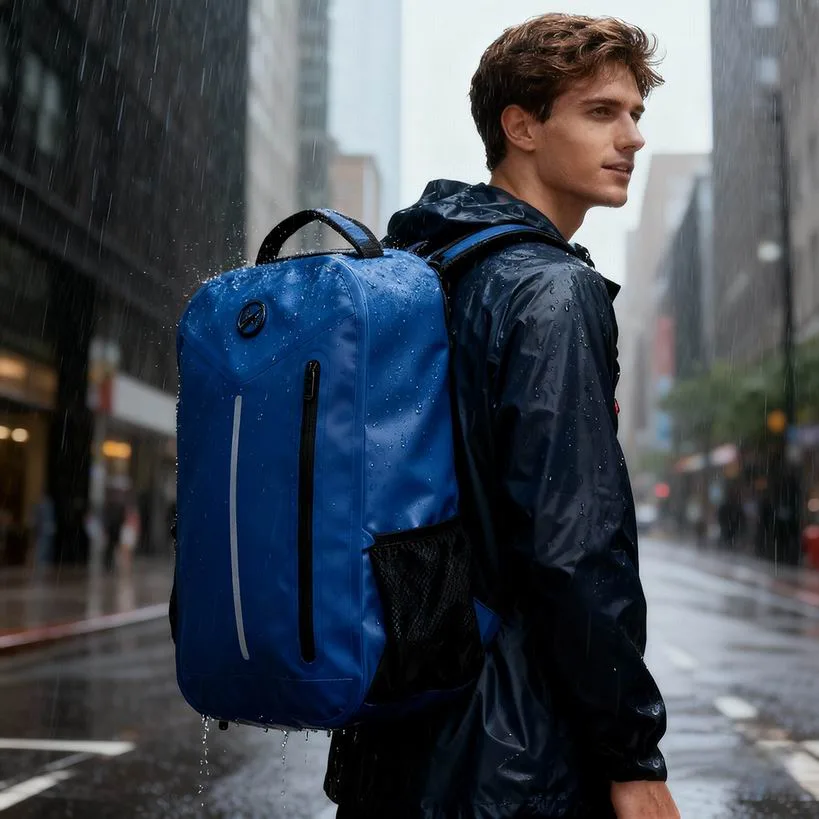
For a northern hemisphere winter term a large share of the school day happens in low light, and a wet black bag on a wet road is close to invisible. Retroreflective detail is cheap insurance: a 20 mm band across the front panel returns dipped headlight at roughly 120 m, the same width on a shoulder strap reads at about 80 m because it moves with the wearer, and a small patch on a side gusset returns at roughly 55 m. Place it where it is never covered by a hand or a coat.
Reflective piping on the seam line is the most robust option because it is welded in during construction rather than applied afterwards, and it does not peel in a wash. Applied reflective transfers are cheaper to add late in the schedule but lose roughly 30% of their return after 20 wash cycles. If the bag is for a primary school with a walking-bus arrangement, specify welded piping and put the band on both the front and the strap.
Volumes, timing and the academic calendar
The calendar is the hard constraint that never moves. Working back from a September hand-out, sea freight needs 25 to 35 days from Xiamen, bulk production needs 35 to 50 days, and sampling takes 6 to 10 working days. Add lab testing at 10 to 15 working days and artwork approval at 3 to 5, and the brief has to be signed off in April. Orders that start in June are air-freight orders, and air freight typically adds 1.20 to 1.90 USD per unit on a 15L bag.
Minimum order quantity is 500 pieces per colourway, not per style, which surprises people. A school wanting three colourways of the same 15L bag is placing a 1,500-piece order unless the film is the same and only the print differs. Sampling runs on the same production lines as bulk, so the 6 to 10 working day figure assumes the film and hardware are already in stock; a bespoke colourway adds roughly two weeks for film lead time.
| Milestone | Calendar slot | Duration | What is decided |
|---|---|---|---|
| Brief and quotation | April | 5-8 working days | Size, film, colourway, marking |
| Artwork proof | April to May | 3-5 working days | Crest size and placement |
| Approval sample | May | 6-10 working days | Physical sign-off |
| Laboratory testing | May to June | 10-15 working days | REACH, Prop 65, colour fastness |
| Bulk production | June to July | 35-50 days | Welding, assembly, AQL 2.5 inspection |
| Sea freight | July to August | 25-35 days | FOB Xiamen to destination port |
| Hand-out week | Early September | 5-7 days | Labelling and distribution |

Where the money goes per unit
Unit cost is worth breaking open because the headline figure hides the two items that actually control quality. Film and fabric is the largest single bucket and the one where a 1.50 USD saving costs two years of service life. Hardware is the second and the one that fails first in the field: a buckle that cracks at -5 °C in December will generate a wave of complaints regardless of how good the film is.
Freight per unit is the number schools overlook. A 15L bag packs roughly 40 pieces per export carton, so freight of 14 USD per carton is 0.35 USD per bag, and air freight multiplies that by four to six. Testing is a fixed cost amortised over the run, which is why 500 pieces carries a higher per-unit test cost than 2,000.
| Cost bucket | Standard bag | Heavy duty bag | What drives it |
|---|---|---|---|
| Film and face fabric | 1.85 USD | 2.90 USD | Film thickness and denier |
| Hardware | 0.62 USD | 0.95 USD | Buckle grade, D-rings, strap webbing |
| Marking | 0.45 USD | 0.55 USD | Method, colours, placement |
| Cut and weld labour | 0.90 USD | 1.05 USD | Panel count and weld length |
| Testing and compliance | 0.22 USD | 0.28 USD | Fixed cost amortised over the run |
| Freight per unit | 0.35 USD | 0.42 USD | Carton fill of roughly 40 bags |
| Landed total | 4.39 USD | 6.15 USD | Excludes duty and local delivery |
Approval samples: what to check on the bench
The approval sample is the last chance to change anything without cost, and it should be tested rather than admired. Fill the bag with 4 kg of books, close it with three folds, and leave it on a wet floor overnight. Open it in the morning and check two things: whether the fold line has taken a permanent crease, and whether the print has marked where it pressed against itself.
- Close the empty bag, submerge it for 30 minutes at one metre, and check the inside with a dry tissue.
- Load it to 4 kg and carry it for 20 minutes; check strap attachment points for creep or stretch.
- Wipe the crest with a solvent-free cleaner and look for ink transfer.
- Flex the film at -10 °C from a freezer for 30 minutes and check it does not crack at the fold.
- Open and close the buckle 200 times and re-test the seal with a squeeze test.
Two of those five checks catch most problems before bulk: the submersion test catches a weld that looks continuous but has a cold spot, and the buckle cycling catches a moulding that will wear loose. Our team and club brief uses the same five checks for crew orders, and the sample-to-bulk walkthrough shows the sequence in production.
Quality control at bulk is specified separately from the sample. AQL 2.5 with a defined major and minor defect list is normal for a school order, meaning roughly one carton in forty is opened. Ask for the inspection report to include photographs of the weld ends, where process drift shows first.
Hand-out day, spares and the reorder
Plan for breakage. Even on a heavy-duty specification, a school of 1,200 students will see 2 to 4% of bags come back damaged in the first year, mostly from buckle breakage and mostly in the first six weeks. Order 3% spares with the main run rather than reordering later; a reorder of 30 bags carries the same freight and set-up overhead as 300 and arrives six weeks later.
Names matter more than you would expect. A bag with no name label ends up in lost property within a fortnight, and lost property is where the perceived failure of a school bag programme happens. Put a writable panel or a name label inside the mouth where it is protected from rain, and consider a colour-coded year-group system so a bag found on a corridor can be returned without opening it.
A specification brief you can send out
- Name the user group and the load: secondary day bag, 12 to 13 litres, 3.2 to 4.1 kg packed.
- Set the film and fabric: 0.40 mm TPU minimum on 420D nylon, Martindale 12,000 cycles or better.
- Choose the closure: three folds, stiffened mouth, side-release buckle at 4 to 6 kg release force.
- Fix the colourway in a Pantone or physical swatch, and confirm ink opacity after 20 washes.
- State the marking method, the crest size and the 40 mm clearance from the fold line.
- List the compliance documents required: REACH, Prop 65, EN 71-3 if users are under 14.
- Give the hand-out date and work backwards; expect 35 to 50 days bulk plus 25 to 35 days sea freight.
- Order 3% spares with the main run and specify AQL 2.5 inspection with weld-end photographs.
That brief is eight lines and it removes almost every ambiguity that causes a school order to slip. Anything that is not written down will be decided by default, and the default is almost always the cheapest film in the range. The same eight lines work for a university faculty order, a rowing club, or a district-wide tender; only the volume and the compliance list change.
Our own line has produced waterproof bags since 2014 in an SGS-verified 4,950 m2 facility in Fujian, running seven production lines with a monthly output of 200,000 pieces, so a 500-piece school order is a small slot in a large schedule. Compare the finished specification against the full product line before you commit, and read the programme guide if the bags are part of a wider campaign.
If the bags will be used by younger children, check the sizing advice in our kids versus adult sizing guide, because a 20L bag on a year-4 pupil is a posture problem rather than a capacity solution. A named test standard also carries more weight in a tender than any description of the bag, so keep the academy reference material to hand at the procurement meeting.
Frequently asked questions
Q1. What size dry bag should a school order?
A 15L roll-top is the safe default for secondary students because it holds an A4 folder, a tablet, a bottle and a PE kit at about 12 to 13 litres packed. Primary year 5 and 6 work from a 10L, and clubs with wet kit need a separate 25L.
Q2. What is the minimum order for a school dry bag run?
500 pieces per colourway. A school wanting three colourways of the same bag is placing a 1,500-piece order unless the film is shared and only the marking differs, so decide colourway count before you ask for a price.
Q3. How much does a school dry bag cost per unit?
Landed cost is 4.20 to 5.60 USD for a standard 0.40 mm TPU bag and 5.90 to 7.40 USD for a heavy-duty 0.50 mm bag, excluding duty and local delivery. Film and fabric is the largest cost bucket at 1.85 to 2.90 USD.
Q4. Is TPU or PVC better for school bags?
TPU. It has no plasticiser that can migrate or stiffen over a summer in storage, it stays flexible down to about -20 °C for winter field programmes, and it welds cleanly. PVC is cheaper per square metre but abrades through faster on locker edges.
Q5. Can a school crest be printed on a waterproof bag?
Yes, and the method matters: screen print lasts about 30 wash cycles, a heat-pressed patch about 50, and an RF welded badge lasts the life of the bag because it adds no holes. Keep any print 40 mm below the fold line.
Q6. Which safety documents will procurement ask for?
REACH for substances of very high concern, Prop 65 for the Californian market, an OEKO-TEX or equivalent textile certificate, and EN 71-3 migration testing if any users are under fourteen. Plan 10 to 15 working days for the laboratory work.
Q7. How long does a school dry bag order take?
Roughly five months from signed brief to hand-out: 6 to 10 working days for sampling, 10 to 15 for testing, 35 to 50 days for bulk, and 25 to 35 days for sea freight. A brief signed in April lands cartons in August.
Q8. Can we get bags with different house colours in one order?
Yes, but each colourway carries the 500-piece minimum. Where the budget is tight, keep one film colour across the run and vary the marking instead, which keeps the order at a single 500-piece minimum.
Q9. Do school dry bags need reflective detail?
For any winter term in northern latitudes, yes. A 20 mm retroreflective band on the front panel returns dipped headlight at about 120 m, and welded piping lasts far longer than an applied transfer, which loses roughly 30% of return after 20 washes.
Q10. Should the school or the family buy the bag?
If the school buys, spec for three years of service and expect to hold 3% spares. If families buy through a uniform shop, the product is judged on price and appearance for one year, which changes the film and finish choice.
Q11. How do we stop bags ending up in lost property?
Put a writable name panel or a sewn name label inside the mouth where rain cannot reach it, and give each year group its own colourway. Colour coding lets a found bag be returned without anyone opening it.
Q12. Will a dry bag protect a school laptop?
A welded-seam roll-top rated IPX7 will survive a soaked walk between buildings, but the laptop also needs a padded sleeve because the bag has no internal structure. A 20L format with a dedicated sleeve is the right choice for sixth form.
Q13. How many rolls should students use?
Three folds for secondary and for any field programme near water. Two folds on a stiffened mouth are faster to teach and hold rain and puddles, which is the realistic primary-school exposure.
Q14. Can a wet PE kit go in the same bag as books?
No. A roll-top has no internal divider and no drain, so a damp kit wicks water through the whole load within minutes. Give clubs and PE kit their own 25L bag and keep the day bag dry.
Q15. What breaks first on a school dry bag?
Buckles, in roughly two thirds of first-year returns, followed by print edge lift. Specify a buckle with a 4 to 6 kg release force and cycle it 200 times on the approval sample rather than trusting the catalogue photograph.
Q16. How many spare bags should we order?
Three per cent of the run, ordered with the main shipment. A reorder of 30 bags carries the same freight and set-up overhead as 300 and arrives about six weeks later, usually after the bags are needed.
People also ask
How do you plan a school dry bag order?
Work back from the hand-out date: 6 to 10 working days for sampling, 10 to 15 for testing, 35 to 50 days for bulk and 25 to 35 for sea freight, so a September hand-out needs an April brief. Fix size, film, colourway and marking in writing before you ask for a price.
What size dry bag does a secondary student need?
A 15L roll-top. An A4 folder, a 1.1 kg tablet, a 500 ml bottle, a packed lunch and a PE kit pack to 12 to 13 litres, and a 15L closes with three folds over that load. A 10L only works if the PE kit travels separately.
Are branded dry bags worth it for schools?
Yes when the bag replaces a bag the school already buys and the specification is set for service life rather than unit price. A 0.40 mm TPU bag at 4.20 to 5.60 USD lasts two to three years, while a 0.30 mm PVC bag at 2.40 USD lasts a term.
How do you put a crest on a waterproof bag?
Screen print for flat panels at about 30 wash cycles, a heat-pressed patch for fine detail at about 50, or an RF welded badge where the bag is immersed. Keep marking 40 mm below the fold line and never stitch through the main panel.
What compliance documents do schools need for bags?
REACH, Prop 65 for California, an OEKO-TEX or equivalent textile certificate, and EN 71-3 if any user is under fourteen. Ask for declarations on phthalates and PFAS specifically, because a general compliance statement does not cover either.
Can university clubs use the same bag as the school?
They can share the platform but not the size. Clubs carry wet kit and need a 25L with welded D-rings for lashing, while a day bag needs 15L and a laptop sleeve. Standardising the closure across both keeps training to one session.
Need this in production volume?
QUANZHOU JUNYUAN BAGS has produced waterproof bags since 2014 in an SGS-verified 4,950 m2 facility in Fujian, China. Minimum order 500 pieces, sampling in 6–10 working days, bulk in 35–50 days, FOB Xiamen — write to service@junyuanbags.com with your spec and target market.