Home / Blog / Design & Branding
Team and Club Dry Bags
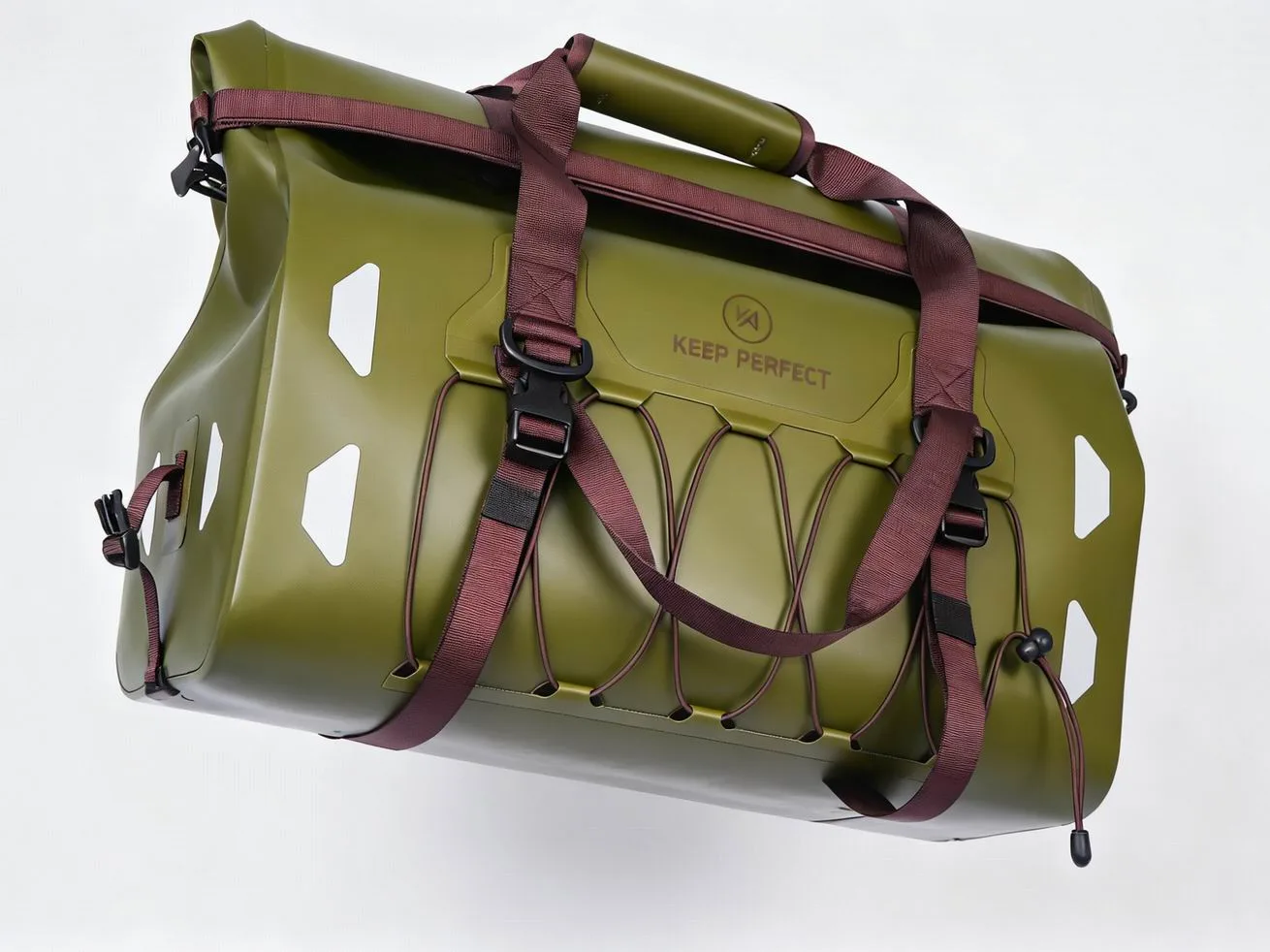
A club dry bag fleet works when it runs on one closure family, three sizes and two club colours. For a 60-member paddling or sailing club the practical split is 40 bags of 10L, 20 bags of 5L and a dozen 20L rescue and coach bags, ordered in one colour pair so replacements match later. Specify 0.5 mm TPU film with welded seams, an IPX7 immersion test rather than an adjective, and spare buckles at 5% of fleet size each year, and the fleet survives roughly six seasons of shared use.
Everything below comes from what actually breaks in a shared kit room rather than from a catalogue. Closures stored clipped shut, buckles packed with sand, mould along the fold lines and bags nobody can return to an owner are the four issues that decide whether a club reorders every two years or every six. Decorate too early and the unit cost climbs by 30% for a crest nobody sees once the lid is rolled shut; decorate too little and the fleet drifts off with members by August.
- What a shared kit room demands that an individual never does
- Sizing a shared fleet: three sizes beat eight
- How many colourways a club actually needs
- Where the crest belongs on a waterproof panel
- Numbers, names and ownership without ruining resale value
- Print method versus badge versus label
- Member-owned or club-owned: which model survives
- Hardware that can be replaced in March, not in September
- Writing a one-page club spec
- Order maths: volumes, minimums and storage
- Labels, tags and the lost-property problem
- Kit-room care rules posted on the wall
- How to run the reorder without colour drift
What a shared kit room demands that an individual never does
One owner knows where a bag has been and dries it in a spare bathroom. A club bag is used by eleven different people in a weekend, dragged across gravel, left damp in a container overnight, then handed to a newcomer who has never read a care card. In a 60-member coastal club each shared bag is opened, packed and emptied roughly 40 to 60 times a season, where a privately owned bag might see eight to twelve trips in the same period.
That usage rate changes the engineering priorities. Abrasion at the base, weld fatigue at the corners and buckle wear rank higher than packed volume does, because nobody carries everything at once. Design for serviceability first: one buckle type across the fleet, one film thickness wherever the risk is equal, and marking areas that survive being scrubbed rather than looking good for the first weekend.
A useful mental model is the rental season. Ask how the bag looks after 200 sessions rather than how it photographs on delivery day. Any finish that needs special handling, any closure that only seals when it is rolled carefully, and any label that lifts after mild heat will fail long before the fabric reaches the end of its life. Where two quotes look identical on paper, ask how the film performs in the rotary-platform abrasion method published by the ASTM, because that number separates laminates far better than any adjective in the catalogue does.
Sizing a shared fleet: three sizes beat eight
Clubs lose money buying to individual taste. Every extra size adds a setup, a colour-matching risk and a box of spares nobody wants. The narrow working set is 5L for grab kit, 10L for a day session, 20L for coaching and rescue loads, plus a single 40L to 60L duffel per team for regatta transport. Four formats cover nearly every club job, and standardising means any member can grab any bag and close it correctly the first time.
| Bag size | Primary club job | Bags per 40 members | Replacement cycle | Note |
|---|---|---|---|---|
| 5 L | Grab bag, phone and keys | 18 | 4-6 years | Issue one per boat, cheap to replace |
| 10 L | Day session bag | 40 | 5-7 years | Buy twice what you expect to need |
| 20 L | Coach kit, rescue kit, first aid | 12 | 6-8 years | 0.5 mm film minimum for this job |
| 40 L | Regatta day and club campouts | 8 | 8-10 years | Club-owned, log it in and out |
| 60 L | Whole-team kit transport | 4 | 8-10 years | Duffel format with welded handles |

Notice that the 10L count equals the member count. That ratio is deliberate: every member can be issued a numbered bag at the start of a season, with two or three spares covering losses without a second production run. The 5L inventory belongs to the boats rather than to people, which is exactly why it disappears fastest in clubs that hand them out with boats and keep no log.
How many colourways a club actually needs
Two, occasionally three. A dominant club colour carries identity and a neutral black or olive carries the bags that live hardest in the container. A third high-visibility option earns its place only for safety kit that must be spotted from a rescue boat in poor light. Every extra colourway splits the order, raises minimum quantity questions and makes matching replacements harder in year four.
| Colourway | Share of fleet | Used for | Matching risk |
|---|---|---|---|
| Club primary colour | 55% | 10L member bags | Low: reorder every two seasons |
| Neutral black or olive | 30% | 20L coach and rescue bags | Very low: always available |
| Contrast accent panel | 10% | Print zone on the 10L | Medium: needs a reference chip |
| High-visibility yellow | 5% | Emergency grab bags | Low: safety norms fix the shade |

Ask for a physical reference chip of each colour alongside the Pantone reference, because a woven pouch read six metres from the print head differs from a paper swatch. Keep two signed chips in the club file with the order date. Three years on, when one body colour is retired, that chip is the only reliable way to match replacements; a screen image drifts between monitors and always will.
Colour also has a test behind it. Textile colour fastness to rubbing, light and water is defined by the ISO 105 series, so a specification can demand a grey-scale rating rather than a promise. For bags that sit in summer sun on a slipway for eight hours a week, light fastness matters more than most committees assume when they first sign off artwork.
Where the crest belongs on a waterproof panel
Put the mark where it still reads when the lid is rolled and clipped, which means the front panel about one third down from the mouth, and keep it at least 15 mm clear of any weld. A crest across a weld either bridges the seam and lifts, or sits on a stiffened ridge and cracks after repeated folding. Printing into a flat zone between welds is the single rule that separates a logo lasting five years from one peeling in five weeks.
Size the mark for the smallest bag, not the largest. A crest that looks right on a 40L duffel becomes a blur once it is reduced to the 70 x 45 mm panel that fits a 5L grab bag. Keep a one-colour version for hard-wearing areas and let the full-colour version live on the welcome pack or the tote, where the abrasion risk is far lower and nobody cares if it scuffs.
Artwork geometry counts as much as placement. Fine lines under 1 mm, thin serifs and long gradients either fill in or wash out on a laminated face fabric. A simplified crest built from solid shapes with a 2 mm minimum stroke outlasts a detailed version by several seasons and still prints cleanly at the small end of the size run, where there is no space to spare.
Numbers, names and ownership without ruining resale value
Every shared bag needs a durable slot number. A 40 mm high digit heat-transferred into a dedicated welded panel survives hundreds of salt sessions, unlike a marker pen that rubs off within a week. Give each bag a two-digit number and record it on the sheet beside the sign-out clipboard; that one habit recovers more lost kit than any lockable cabinet a committee could buy.
Member names are a separate question. Permanent names reduce the hand-on value of a bag when someone leaves, so most clubs number the bag and keep names on a removable tag or a writable strip inside the closure fold. If you do want individual marking, use a separate welded label strip rather than printing onto a load-bearing panel, because anything that perforates the film is where water eventually gets in.
Print method versus badge versus label
| Method | Typical minimum | Salt and scrub life | Colour count | Best for |
|---|---|---|---|---|
| Screen print | 300 pieces per colour | 3-5 seasons | 1-4 spot colours | 10L member bags |
| Digital transfer | 100 pieces | 2-4 seasons | Full colour | Welcome packs and trials |
| Silicone badge | 500 pieces | 5-8 seasons | 1-3 colours | Crest panels on 20L bags |
| Woven insert label | 1,000 pieces | 4-6 seasons | 1-2 colours | Membership number strip |
| Direct-to-film transfer | 200 pieces | 2-3 seasons | Full colour | Trial run before committing |
Silicone badges welded into a panel last longest because the decoration sits under a second layer of film instead of on the surface, but they carry the highest unit cost and need the longest planning window. Screen printing is the sensible default for a 10L run where one or two spot colours carry the crest, and its cost advantage over digital appears from roughly 400 pieces upward.
Whichever route you take, ask how the decoration behaves after flexing. A printed panel from the same batch can be folded 500 times at one point and then inspected for cracking, a ten-minute bench test that removes most surprises. Rub the same panel with a wet cloth 50 times and look for colour transfer onto the cloth; if it marks, the crest will not survive a salt season in a container.
Member-owned or club-owned: which model survives
Club-owned fleets are easier to keep tidy and harder to fund. They work when membership churn is high, when juniors need kit before they buy their own, and when safety bags must be checked before every session. The cost sits with the club, and the annual replacement budget is roughly one fifth of the fleet, since around 20% of shared bags go missing or become unserviceable in a busy twelve months.
Member-owned fleets move the cost to individuals and keep club funds for coaching, but they need discipline: one spec issued centrally, one ordering window per year and a rule that says nobody buys their own version mid-season. Clubs that run this model well re-open ordering every spring with exactly the same four sizes and two colours, so a bag bought in March 2027 matches one bought in March 2026.
The hybrid that most clubs settle on is club-owned safety and coach bags plus member-owned day bags. It keeps replacement budgets predictable at maybe 12% of total fleet value per year, keeps every member responsible for the bag they use every week, and still guarantees that the emergency kit on each boat is identical and has been inspected to the same schedule.
Hardware that can be replaced in March, not in September
Standardise the closure hardware before style decisions, not after. One buckle width and one ladderlock format across the whole fleet lets a treasurer order 20 spares and know they will fit anything in the container. Mixed hardware forces a spare-box archaeology project in the middle of a regatta weekend, which is precisely when nobody has time for it.
Budget for spares at 5% of fleet size per season, biased towards buckles, which fail at least four times more often than films do. Keep them in a labelled bin with the date received, store them dry, and make replacing a stiff buckle a five-minute job anyone can do at the kit-room bench. A bag with a working spare is a bag that stays in service; a bag waiting for a part is effectively gone for the season.
Writing a one-page club spec
- Name the sizes and counts first, then the colours; never start with artwork.
- Fix film thickness at 0.5 mm TPU for every bag above 10L and seam type as welded.
- Require an IPX7 immersion result with the method named, not the word waterproof on its own.
- Give exact crest coordinates: panel, distance from weld, finished size in millimetres.
- Standardise hardware to one buckle family and one D-ring pattern fleet-wide.
- State the spare-parts ratio, packaging format and the delivery window you can actually receive in.
- Include the storage conditions the bags really face: damp container, direct slipway sun, salt air.
A single page written like this travels well. It can be quoted to three production partners in the same week, compared line by line, and re-used two years later by a treasurer who has never met the person who wrote it. Compare the quotations line by line against the full product line before committing, and reject any quote that cannot name the test method behind its waterproof claim.
Order maths: volumes, minimums and storage
| Order size | Unit cost index | Sampling window | Bulk window | Typical freight |
|---|---|---|---|---|
| 200 pieces | 112 | 6-10 working days | 35-40 days | Air courier, club pays |
| 500 pieces | 100 | 6-10 working days | 35-50 days | Sea, FOB Xiamen |
| 1,000 pieces | 92 | 6-10 working days | 40-50 days | Sea, FOB Xiamen |
| 3,000 pieces | 86 | 6-10 working days | 45-50 days | Sea, consolidated pallets |
The 500-piece line is the practical floor for a bespoke club colourway, which is why neighbouring clubs often combine into one order and split a container. Below that, the same money buys a stock colour with a print, which is a perfectly good answer for a first season. Above it, unit costs fall gently but not dramatically, so ordering three years of inventory at once usually costs more in storage and faded stock than it saves in unit price.
Storage is the hidden cost in club orders. A hundred 20L bags occupy roughly 1.6 m3 loosely stacked, and TPU stored flat under a hot container roof for two summers ages faster than TPU that is in use and being rinsed. If you cannot store the surplus somewhere cool, dry and dark, buy less and reorder later rather than buying once and hoping.
Our line has built waterproof bags since 2014 in an SGS-verified 4,950 m2 facility, with sampling in 6 to 10 working days, bulk production in 35 to 50 days, AQL 2.5 inspection and T/T 30/70 terms, and the same questions about numbering and spares come up in nearly every club project. We document the full production walkthrough from sampling to bulk for every programme, and the club crews that plan around those windows are the ones whose kit arrives before the season rather than halfway through it.
Labels, tags and the lost-property problem
Every bag should carry its slot number on the outside and its owner or rack position on a writable strip inside the fold. A hang tag with the club name, the care rules and a mobile number survives longer than most members admit, particularly if it is printed on synthetic paper rather than card, because it goes into a damp pocket at least once. Card tags turn to pulp after the first wet session and then the bag is anonymous.
Synthetic tags cost little and solve the return problem at events. At a regatta where three clubs share a slipway, a numbered bag with a writable internal strip goes back to the right rack even if nobody recognises it. Clubs that adopt this habit report noticeably fewer losses at open events, where most kit disappears simply because nothing identifies it beyond a colour shared by three neighbouring teams.
Kit-room care rules posted on the wall
- Empty every bag the same day it is used; nothing stays packed overnight in a container.
- Rinse with fresh water at ambient temperature, never a hot hose on a TPU laminate.
- Store unclipped and loosely rolled, not folded flat and never in direct sun.
- Brush closures before rolling; one grain of grit breaches a fold within an hour.
- Replace stiff or cracked buckles immediately from the labelled spares bin.
- Report any weld or seam damage the day it is spotted, before the next session uses the bag.
Posting six lines on the kit-room wall works better than a full manual nobody opens, because members read what is at eye height while waiting to sign out a boat. Pair it with a ten-second check at the start of a session: look at the closure, look at the buckle, look at the base. Bags that get that check are the bags still in service six years later in every club we have supplied.
How to run the reorder without colour drift
Reordering well is mostly record keeping. Keep three things from the first run: the signed colour chips, one retained sample bag per size, and the artwork file with its colour separations. Quote from those rather than from memory, and ask for a pre-production sample from the same fabric lot before accepting a full repeat. Lots vary slightly in gloss and hand even when everything else is identical.
Plan the reorder around lead time, not around the first sunny weekend. Sampling takes 6 to 10 working days and bulk production another 35 to 50 days before loading, so an April start-of-season delivery is decided in the previous December. Clubs that miss that window end up paying for air freight or waiting until June, both of which cost more than the planning did.
Finally, keep flexibility in the brief. If the same bag must serve the adult fleet and the junior programme, choose the neutral colour for shared stock and let the club colour live on the owned bags. The full range of sizes sits in our roll-top dry bag range, other branding detail is in the guide to logo placement, and the colour logic behind a shared fleet is set out in building a colour range and colour matching across a range.
Frequently asked questions
Q1. What are team and club dry bags?
Shared fleet bags bought to one specification: usually three sizes, two colourways, welded seams and a numbered ownership system. They are specified for heavy rotation in a kit room rather than for one careful owner, so serviceability outranks packed volume in every decision.
Q2. How many dry bags does a 40-member club need?
About 70 bags: roughly 40 at 10L issued to members, 18 at 5L kept with boats, and a dozen at 20L for coaching and rescue work. Add one 40L to 60L duffel per team for regatta transport and expect to replace around a fifth annually.
Q3. Should each member own their own bag?
The hybrid works best: club-owned safety and coach bags that can be inspected, plus member-owned day bags bought through one annual order. That keeps club replacement budgets predictable while making each member responsible for what they use weekly.
Q4. What size should a club day bag be?
Ten litres. It holds a spare layer, a shell, lunch and a small first-aid pouch in about eight litres of packed volume with room left to roll three times. Anything larger becomes a heavy lump that members leave in the car rather than on the boat.
Q5. Why do club bags fail faster than personal bags?
Usage rate and storage. A shared bag is opened 40 to 60 times a season by different people, often stored damp in a container and left clipped shut, which creases the film at the fold and grits the buckle. None of those conditions exist in a well-aired spare bathroom.
Q6. How many rolls should members use on a shared bag?
Three, always, and never fewer. Three folds create three contact lines for water to cross side-on, which covers a brief immersion. Training every member on exactly the same number removes the most common cause of damp kit in a club fleet.
Q7. What is the minimum order for club colours?
Five hundred pieces is the practical floor for a bespoke colourway, though smaller runs are possible in stock colours with a print. Clubs below that line often combine with neighbouring clubs into a single order and split the freight.
Q8. Which print method lasts longest on a damp PVC-free bag?
A silicone badge welded into a second layer of film lasts five to eight seasons because it is not exposed on the surface. Screen printing runs three to five seasons and digital transfers two to four, so match the method to how hard the panel is worked.
Q9. Where exactly should the club crest go?
On a flat front panel about one third down from the mouth, at least 15 mm clear of any weld line, finished at roughly 70 x 45 mm on the smallest bag. Artwork across a weld bridges the seam, then lifts or cracks after repeated folding.
Q10. How do we stop club bags going missing?
Give every bag a durable welded number strip outside and a writable internal strip for rack position, then log it out next to the sign-out sheet. Synthetic hang tags with a contact number also return kit at shared events where several clubs use one slipway.
Q11. Can we machine wash a fleet bag?
No. Agitation abrades the laminate face and twists welded seams. Rinse by hand with fresh water at ambient temperature, wipe the closure line, dry in shade and store loosely rolled with the buckle unclipped.
Q12. How many spare buckles should a club hold?
Budget spare parts at 5% of fleet size each season, weighted towards buckles, which fail around four times more often than film does. Standardising on one buckle family means twenty spares fit every bag in the container.
Q13. Is one colourway enough for a club?
Two is safer: a club colour for identity and a neutral for hard-use bags. The neutral Body colour stays available for years, which makes replacements easy when the committee changes and nobody remembers the original Pantone reference.
Q14. How long do we need to plan ahead for a new season?
Decide roughly six months out. Sampling runs 6 to 10 working days and bulk another 35 to 50 days before loading, so an April delivery is locked in the previous December. Missing that window means air freight or a June arrival.
Q15. Does a club need high-visibility bags?
Only for safety kit that must be spotted from a rescue boat: typically one 5L grab bag per boat, about 5% of the fleet. Keep the high-visibility shade out of the everyday issue so the colour still signals emergency when it is seen.
Q16. What film thickness suits club use?
Half a millimetre for anything above ten litres, and never less than 0.3 mm even on a 5L grab bag. Thicker film adds around 90 g to a 20L bag and buys several extra seasons of abrasive contact with slipway gravel and boat decks.
People also ask
How do you organise dry bags for a team?
Issue one size per job, number every bag outside and record it against a rack position inside, then standardise the closure so any member can use any bag. Keep safety and coach bags club-owned and inspected, with member day bags bought through one annual order.
Are branded club bags worth the extra cost?
Yes for fleets above about forty bags, because numbering and crest panels recover far more lost kit than they cost and allow cheaper repeat runs later. Below that, a stock colour with a simple print delivers most of the benefit.
What size dry bag should each rower or paddler carry?
Ten litres per person for a training session, plus 20L shared bags for coaching and rescue kit and a 5L grab bag per boat. That mix keeps individual loads light and makes the heavy duffel sort easily at the trailer.
Can you put names on shared dry bags?
You can, but numbering the bag and keeping names on a removable tag protects hand-on value when members leave. Permanent names also make fleet audits harder, since knit tends to travel with people rather than with the club rack.
How do you match club colours across a reorder?
Keep signed physical colour chips and one retained sample per size from the first run, then demand a pre-production sample from the same fabric lot. Pantone numbers alone drift, and computer screens shift between committees and seasons.
Do club dry bags need a tested rating?
Yes. Ask for IPX7 immersion evidence naming the method rather than a marketing adjective, since club bags face brief submersion during rescues as well as spray. A tested result also gives the committee something concrete to compare between quotes.
Need this in production volume?
QUANZHOU JUNYUAN BAGS has produced waterproof bags since 2014 in an SGS-verified 4,950 m2 facility in Fujian, China. Minimum order 500 pieces, sampling in 6–10 working days, bulk in 35–50 days, FOB Xiamen — write to service@junyuanbags.com with your spec and target market.