Home / Blog / Travel & Packing
Paddleboard Day Trip Kit
A paddleboard day trip kit runs to 10 to 25 litres and 3 to 6 kg depending on trip length, and almost none of that should ride above deck height. On an all-round inflatable, carrying more than roughly 15% of your own body weight in gear changes how fast the board recovers from a wobble, which is why the load belongs low, central and clipped to the bungee rather than strapped to your back.
Paddleboarding differs from kayaking in one decisive way: you are standing, so your centre of gravity is already high and every litre you add works against you. This guide lays out the volume maths for three trip lengths, what goes in each container, how much water to carry at air temperatures above 28 degrees, and the packing routine that keeps a swim from becoming a lost-kit incident.
- Start with the board, not the bag
- The deck bungee sets your hard limit
- Volume by trip length
- What belongs in which container
- Water loading for hot paddles
- Sun protection that survives immersion
- Stability maths for standing paddlers
- Keys, cards and the car that waits
- Downwind runs and one-way logistics
- What happens when you fall in
- Rinse, dry and repack the same week
- Beach start without soaking everything
- The launch checklist
Start with the board, not the bag
Every board has a stated payload: all-round inflatables commonly quote 90 to 140 kg, touring boards 120 to 180 kg, and a race hull sometimes less. Subtract your own mass and then the mass of anything else that floats with you. What is left is your kit budget, and it is usually smaller than people expect. A 70 kg paddler on a board rated to 120 kg with a 12 kg dog has 38 kg to spare, which sounds generous until you consider water.
Water is dense and unavoidable: 2 litres weighs 2 kg and takes up 2 litres of volume. Once you add a pump repair kit, a leash, sun protection, a shell and a phone pouch, the remaining allowance for luxuries such as a camera or a full picnic is thin. Plan the mandatory list first and let it set whether you need a 10L, a 20L or both.
The deck bungee sets your hard limit
Bungee webbing on a touring or all-round board is arranged in a diamond or two-row pattern, usually four to six attachment points rated for light loads. It will comfortably hold 5 to 8 kg spread across its length, but it concentrates force at each anchor, so a single heavy bag at one point can distort the deck pad or pop an anchor under a wave slap.
The practical rule is to spread load across at least two contact points and to keep the heaviest item within 30 cm of the board centre line. If your board has only front-mounted points, consider a strap adapter or a cargo net that distributes to the rear. Anything you expect to keep dry through a fall should also be clipped, not merely tucked under the cord.
| Board length | Typical payload | Comfortable gear load | Bag sizes that suit | Notes |
|---|---|---|---|---|
| 9 ft all-round | 90 - 110 kg | 3 - 5 kg | 1 x 10L | Weight forward hurts nose rocker |
| 10 ft 6 all-round | 110 - 140 kg | 5 - 8 kg | 1 x 10L + 1 x 5L | Most common day-trip platform |
| 12 ft 6 touring | 130 - 170 kg | 8 - 14 kg | 1 x 20L + 1 x 10L | Load can sit further aft |
| 14 ft race/touring | 110 - 150 kg | 4 - 8 kg | 1 x 10L low profile | Keep everything below knee height |
| Inflatable tandem | 180 - 240 kg | 15 - 20 kg | 2 x 20L | Two paddlers, two independent kits |
Volume by trip length
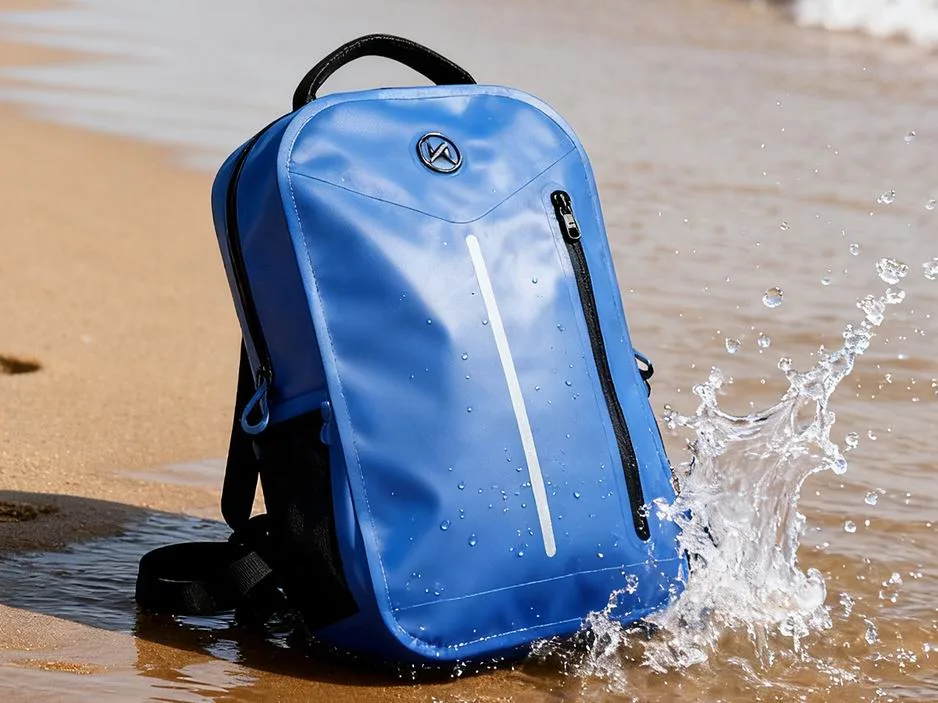
For a ninety-minute coastal paddle in warm air, you need water, sun protection, a phone pouch, a leash-safe set of keys and one warm layer if the wind turns. That packs to between 6 and 9 litres. Add lunch and you reach 12 litres. Add snorkel kit or a compact camera and you are into the 18 to 22 litre bracket, which is the point where a second bag becomes cheaper in stability terms than one large one.
The reason is weight placement rather than volume itself. Two 10L bags either side of the centre line balance each other; one 20L bag on the nose shifts trim forward, slows the board and makes downwind runs tiring. Splitting the load also gives redundancy: if one closure is mis-rolled, you lose a lunch rather than your car key and your phone.
| Trip profile | Time afloat | Waterproof volume | Packed weight | Suggested split |
|---|---|---|---|---|
| Harbour lap, warm air | 1 - 1.5 h | 6 - 9 L | 2.0 - 2.8 kg | 1 x 10L |
| Coastal morning paddle | 2 - 3 h | 10 - 14 L | 3.0 - 4.2 kg | 1 x 10L + 1 x 5L |
| Full day with lunch | 4 - 6 h | 18 - 24 L | 5.0 - 6.5 kg | 2 x 10L or 1 x 20L + 1 x 5L |
| Downwind one-way, 12 km | 3 - 4 h | 14 - 20 L | 4.5 - 6.0 kg | 1 x 20L low profile |
| Two boards, shared kit | 3 - 5 h | 25 - 32 L | 7.0 - 9.0 kg | 2 x 20L split across boards |
What belongs in which container
Assign jobs and never mix them. The board bag, strapped to the bungee, holds water, food and the repair kit. The grab bag, clipped within arm’s reach at the front of the diamond, holds sunscreen, lip balm, snacks and sunglasses. The personal pouch, ideally on your body or leashed to your PFD rather than the board, holds keys, cards and the phone.
That division reflects three different risks. Board-bag contents can get soaked if you flip, and that is acceptable for a spare tee and a pump. Grab-bag contents must survive spray and need to be reachable while kneeling. Personal items must not go in the water at all, and the safest place for them is the same place your flotation device sits: on you.
Electronics deserve a second layer. A floating dry bag gives buoyancy if the clip fails, and a small inner 2L roll-top inside a 10L adds a second independent seal. Gear loss is rarely dramatic; it is usually one tired clip at the end of a beach landing, and a two-second cost-of-failure calculation is worth doing each time you repack.
Water loading for hot paddles
Hydration dominates the weight budget. Paddling moderately in 28 degrees with direct reflection from the water drives fluid loss of roughly 500 to 900 ml per hour, so a three-hour trip without shade needs 1.5 to 2.5 litres per person, plus electrolytes if you are sweating heavily. Carrying less than that is the most common single failure in summer day trips.
Cold water changes the problem rather than removing it. In 12-degree air you will drink less but still lose fluid through respiration, and the consequence of getting wet shifts from dehydration towards cold stress. Pack the same volume, add a hot drink in an insulated bottle, and put a dry mid-layer in the board bag where you can reach it without unrolling anything else.
| Air temperature | Water per hour | Three-hour total | Electrolytes | Extra kit required |
|---|---|---|---|---|
| 18 - 22 deg C | 350 - 500 ml | 1.2 - 1.5 L | Optional | Wind shell |
| 23 - 27 deg C | 500 - 700 ml | 1.5 - 2.0 L | Recommended | Sun hat, reef-safe sunscreen |
| 28 - 33 deg C | 700 - 900 ml | 2.2 - 2.7 L | Yes, one per 1 L | Shade breaks every 45 min |
| Above 33 deg C | 900 - 1100 ml | 2.7 - 3.3 L | Yes | Paddle before 10:00 or after 16:00 |
Sun protection that survives immersion
Sun on water arrives twice: directly, and reflected off the surface, which is why paddlers burn on the underside of the chin and the backs of the knees. A broad-spectrum SPF 50 applied 20 minutes before launch and reapplied every two hours is standard, and the tube itself belongs in the grab bag rather than the board bag so reapplication actually happens.
Sunscreen and TPU do not always get along. Oils and some organic filters can leave films that attract grit at the closure line, so wipe the roll area after handling either. The CDC publishes straightforward sun and heat guidance that is worth reading before a long midday crossing, especially if anyone in the group is on medication that affects heat tolerance.
Stability maths for standing paddlers
Height hurts more than weight on a board. Moving 3 kg from deck level to knee level barely changes total mass but meaningfully lowers the combined centre of gravity, and small reductions in that height translate into noticeably faster recovery from a wobble. This is why a low-profile roll-top dry bag outperforms a tall bucket shape on a board, even when both hold identical litres.
Watch two numbers on the water: how quickly the board stops rocking after a brace, and whether the nose lifts in crosswind. If recovery feels slow, reduce deck height first, then rebalance fore and aft. A load that sits 10 cm too high can cost you more confidence than carrying an extra 2 kg low and central ever would.
Keys, cards and the car that waits
Every summer, car keys are lost exactly the way you would predict: they travel in a board bag, the paddler flips, and the bag stays clipped while the keys slide out of an open mouth. Put keys in a sealed pouch and then that pouch in a zipped PFD pocket or a waist belt, because anything on the board must be assumed recoverable only if it floats.
A second tactic costs nothing and saves everything: leave the car key with a non-paddling companion or in a magnetic case under the vehicle. If neither is possible, photograph your parking row, note the launch name on your phone lock screen, and duplicate a spare into a second bag so that one failure does not end your day at a locked gate.
Downwind runs and one-way logistics
A downwind one-way is the most efficient way to see coastline and the easiest way to strand yourself. It works when you have a shuttle, a confirmed pick-up time, and a forecast checked twice. Check local predictions through NOAA if you paddle in US waters, and pay attention to whether the wind is forecast to build or ease through your window.
One-way trips reward flat packing. Your final 2 km often turns into a walk, a bus or a ferry, so everything must convert from board mode to carry mode in under a minute. That is the argument for a convertible roll-top with straps over a plain sack, and it is also why the smallest viable dry bag usually wins: what you cannot comfortably carry for 800 m you will abandon.

What happens when you fall in
Assume you will fall. In wind above 20 km/h or in confused swell, even experienced paddlers swim several times a season, and each swim is a test of your clipping rather than your padding. Anything not attached to the board or to your body leaves immediately, and it leaves downwards or downwind depending on how much air it holds.
Bags with trapped air float high and drift fast. That makes them easy to spot but impossible to swim after if the wind is pushing them. Two mitigations: keep the bag clipped with a short leash of 60 to 90 cm, and purge enough air before rolling closure so the bag rides low. Read our notes on float characteristics before you decide how to load yours.
Rinse, dry and repack the same week
- Open every bag at the car park and tip out sand while it is still loose.
- Rinse closures and buckles with fresh water; a 2 litre bottle is enough for two bags.
- Hang bags upside down with the mouth open in moving shade for 2 - 4 hours.
- Check the bungee contact points for scuffing before the next salt session.
- Repack the grab bag on the day you get home, not the night before the next trip.
Salt crystals are the hidden failure. They settle into buckle springs and the fold line, then abrade film from inside during storage. A two-minute rinse after each paddle costs less time than one repair, and long-term sun and storage habits are covered in our coastal storage guide.

Beach start without soaking everything
The transition from shore to board is where most kit gets wet, not the paddle itself. Stage your load above the swash line, load the board in knee-deep water with the nose pointing out, and keep personal items on your body rather than balanced on the tail. If surf is present, wait for a lull and launch with the board sideways to the waves.
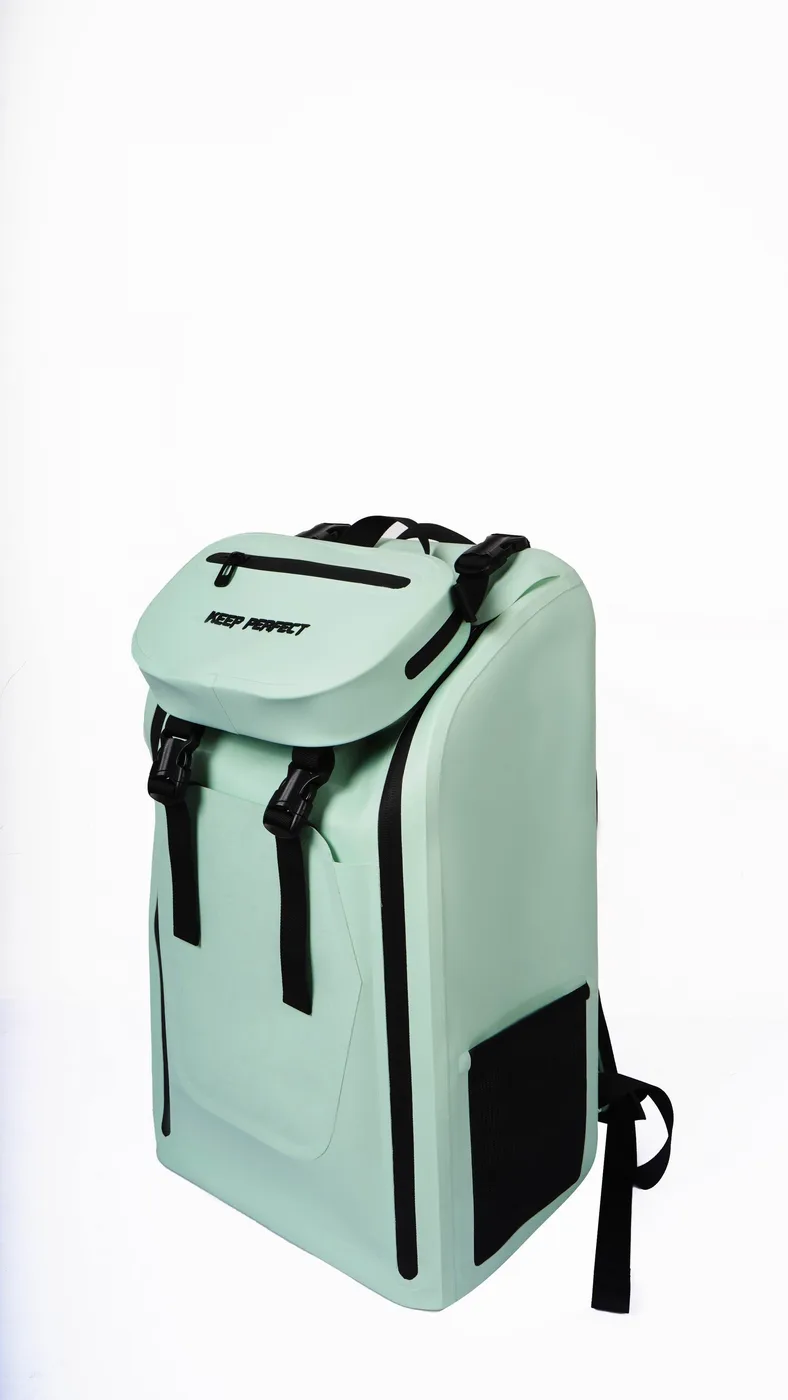
A dedicated wet/dry split helps here too. Anything designated wet-tolerant, such as the pump, the repair kit and spare cord, goes closest to the waterline. The things that must stay dry ride higher on the board or on your shoulders. Many paddlers find that a compact dry backpack solves this better than any board-mounted arrangement, and the format is compared in our format comparison.
The launch checklist
- Water loaded at 1.5 litres per person minimum, more above 28 degrees.
- Sun protection applied 20 minutes before launch, tube kept in the grab bag.
- Board bag clipped at two contact points, heaviest item within 30 cm of centre line.
- Personal pouch on your body: keys, cards, phone, one form of ID.
- Leash inspected at the cuff and rail attachment, replaced if the cord shows flat spots.
- Pump and patch kit aboard even for short paddles on an inflatable.
- One dry layer sealed separately, not buried under lunch.
- Float plan texted to someone ashore with a return time.
Two habits separate tidy paddlers from rummaging ones. First, pack in the same order every time so your hand finds sunscreen without thought. Second, keep the repair kit, the pump and the water in the same bag forever; these three are what you actually reach for, and reaching for them through other people’s lunch is how closures get left open.
Groups and clubs repeat the same pattern at scale. Standardising on one bag size, one closure geometry and one colour coding makes a fleet teachable in an afternoon, and it also makes replacement simple when a board or a bag is lost. Our own production has run waterproof bags since 2014 in an SGS-verified 4,950 m2 facility, and fleet operators usually order three sizes across all boards so spares interchange; the process is outlined and the current size families are listed under products alongside the beach day planning guide.
Frequently asked questions
Q1. What should I pack for a paddleboard day trip?
For two to three hours afloat, carry 1.5 to 2 litres of water per person, SPF 50 sunscreen, a light wind shell, snacks, a pump and patch kit, and a sealed pouch for keys and phone. That is roughly 10 to 14 litres split across a 10L board bag and a 5L grab bag.
Q2. How much weight can I put on a paddleboard?
Stay under about 15% of your body mass in gear, around 11 kg for a 75 kg paddler, and check the board payload rating first. Spread it across two bungee contact points and keep it low and near the centre line.
Q3. Do I need a dry bag for paddleboarding?
Yes for anything that must stay dry. Board splash, paddle drip and the occasional swim will soak an unprotected bag within an hour. One 10L roll-top covers most paddles, plus a small grab bag clipped within arm’s reach.
Q4. Should I wear a backpack while paddleboarding?
Generally no. A backpack raises your centre of gravity and spoils your trim while standing. Use it to carry kit to the launch, then strap the bag to the deck and paddle with the load below knee height.
Q5. Where do I put my car keys?
On your body. A sealed pouch in a zipped PFD pocket or waist belt is best, because the board can flip and anything clipped to it can still be lost. If possible, leave a spare at home or with someone ashore.
Q6. How much water do I need for a three-hour paddle?
Between 1.5 and 2.5 litres in warm conditions. Expect to lose 500 to 900 ml per hour paddling in 28 degrees with reflected sun, and add electrolytes once intake passes roughly 1.5 litres.
Q7. What size dry bag fits behind the seat area of a board?
A 10L roll-top is the usual answer for all-round boards up to 11 ft. Touring boards from 12 ft 6 will take a 20L sitting further aft, and anything longer should use two mid-size bags rather than one tall one.
Q8. Will my bag float if I fall in?
A bag with trapped air floats, sometimes too well, and it will drift downwind faster than you can swim after a loaded board. Leash it with a short cord and purge some air before closing so it rides lower.
Q9. What should be in my grab bag?
Sunscreen, lip balm, sunglasses, a snack, a small towel or sponge, and anything you might need while kneeling. Keep it under 5 litres and clipped to the front of the bungee diamond where reaching it costs no balance.
Q10. Can I take a camera on a paddleboard?
Yes, in a dedicated 10L to 15L bag with a padded insert, strapped low and central. Mount anything heavy to your body instead, since a camera on a strap around your neck is a snag hazard in a fall.
Q11. Do I need a dry bag for clothes I am not wearing?
You should still pack one dry layer and a wind shell even in summer. Wind chill on wet skin drops core temperature quickly once you stop paddling, and the layer only works if it stayed dry.
Q12. How do I stop my bag sliding on the board?
Use two contact points rather than one, face the closure toward the rear so waves push it shut, and pull the bungee down over the bag rather than under it. A cargo net helps on boards with just four anchor points.
Q13. Is there a difference between boarding bags and kayak dry bags?
The bag is the same; the limits are different. Kayaks tolerate greater total weight and offer dry hatches, whereas a board rewards low height and low mass, so choose squat profiles and split loads rather than buying a separate category.
Q14. How do I keep water cool on a hot paddle?
Freeze one bottle overnight and top it up with chilled water at the launch; two-thirds full bottles freeze without bursting. Insulated bottles hold temperature for three to four hours at 28 degrees ambient.
Q15. What is the minimum kit for a one-hour paddle?
Water, sun protection, keys in a sealed pouch on your body, and a leash in good condition. That fits in a 5L bag. Add a phone pouch in case you need to call for help.
Q16. How do I pack for a downwind one-way trip?
Keep it flat and convertible, because you will probably walk or ride at the far end. One 20L low-profile bag with straps beats several small items, and confirm pick-up logistics and a return time before you launch.
People also ask
What do you take on a paddleboarding day trip?
Water at roughly 1.5 litres per person, SPF 50 sunscreen, snacks, a wind shell, a pump and patch kit for inflatables, and a sealed pouch for keys, cards and phone. Most paddles need 10 to 14 litres of waterproof space split across two bags.
How do you carry stuff on a paddleboard?
Strap one mid-size roll-top low and central across the bungee diamond using two contact points, keep personal items on your body, and use a small grab bag clipped at the front for anything you need while kneeling.
Can you wear a backpack on a paddleboard?
You can, but it is usually a mistake while standing. A backpack raises your centre of gravity and slows recovery from a wobble. Carry it to the launch, then strap the bag to the deck instead.
Do dry bags work for stand-up paddleboarding?
Yes, provided the profile is low. A squat 10L roll-top clipped near the centre line handles spray, paddle drip and a swim better than a tall bucket bag, which shifts your centre of gravity upward when full.
How much weight can you put on the front of a paddleboard?
As a working limit, keep forward deck load under about 1.5 kg and anything heavier within 30 cm of the centre line. Weight ahead of the handle buries the nose and makes the board sluggish to turn.
What happens to your stuff when you fall off a paddleboard?
Unclipped items leave immediately and often drift faster than you can swim. Leash each bag with a short cord, keep valuables on your body, and accept that anything tucked loosely under the bungee will end up in the water.
Need this in production volume?
QUANZHOU JUNYUAN BAGS has produced waterproof bags since 2014 in an SGS-verified 4,950 m2 facility in Fujian, China. Minimum order 500 pieces, sampling in 6–10 working days, bulk in 35–50 days, FOB Xiamen — write to service@junyuanbags.com with your spec and target market.