Wet-Weather Kit for Van Life
A wet-weather kit for van life starts with the moisture you create, not the rain outside. Two people breathing produce about 0.7 litres of water vapour overnight, cooking on gas adds roughly 160 grams of water per 100 grams of fuel burned, and a wet wetsuit or hiking kit carries another 0.6 litres into the cabin. In a 3.5 m3 living space that is 1.5 litres a day against a dew point that a single-glazed window will cross every night. The answer is four bags plus airflow: a 40L dry store, a 20L wet bag in the garage, a 10L boot bag by the door and a 5L pouch for electronics.
This guide covers the moisture budget, the ventilation rate that actually clears it, the door-side wet zone that stops water at the threshold, and a drying routine that works without a tumble dryer. It also covers the health side: sustained relative humidity above 70 per cent is where mould starts, and mould in a vehicle is a genuine problem rather than a cosmetic one. Every figure below is tied to a real object, from a 100 m3/h roof fan to a 2 kW diesel heater, so you can size the kit to your own van.
- Why a van is the wettest place you will ever live
- The moisture budget: where the litres come from
- Dew point: why the windows go first
- Ventilation maths: air changes per hour
- The door-side wet zone
- Staging wet kit: three bag sizes, three positions
- Drying without a tumble dryer
- Rain gear, sports kit and the garage
- Bedding and the sleep system
- Cold weather and frozen kit
- Mould, health and when it stops being cosmetic
- The daily and weekly routine
- Kit list and the sizing checklist
Why a van is the wettest place you will ever live
A van is a metal box with a large glazing area, thin insulation by house standards, and an occupancy density that no building would permit. Two people in 3.5 m3 of air is roughly 0.57 people per cubic metre; a typical bedroom runs at about 0.05. Every surface is either glass or a thermal bridge to the outside, and both are the coldest surfaces in the space, which is exactly where water vapour goes to condense.
Then there is the doorway. In a house you walk through a hall, kick off your shoes and hang your coat. In a van you step from rain directly into the living space, usually onto the same floor you sleep above. The first 30 seconds after opening the side door on a wet day decide how much water ends up in the bed, and almost nobody plans for them.
The result is that van dwellers who have never had a leak wake up to wet windows, damp bedding and a smell in the soft furnishings by the second week of autumn. None of that is a bag failure or a seal failure. It is condensation, and it is solved with airflow and separation, which is what the kit below is built to do.
The moisture budget: where the litres come from
Write the water down before you buy anything. Two adults exhale roughly 0.35 litres each over eight hours of sleep. Cooking on LPG is a bigger source than most people expect: burning 100 grams of propane produces about 164 grams of water as a combustion product, so a week of cooking two hot meals a day contributes close to 2.3 litres. Add showering if the van has one, add drying kit, and the daily total lands between 1.5 and 3 litres.
| Source | Water per event | Frequency | Daily total | Where it goes | Control that works |
|---|---|---|---|---|---|
| Breathing, two people | 0.35 L each | Every night | 0.7 L | Windows and ceiling | Roof vent on trickle |
| Cooking on LPG | 164 g per 100 g fuel | Twice a day | 0.5 L | Ceiling and lockers | Lid on the pan, vent open |
| Boiling a kettle | 20 g per litre boiled | Four times a day | 0.1 L | Window above the hob | Extract while boiling |
| Wet jacket and boots | 0.4-0.8 L | Most days | 0.6 L | Door mat and floor | Wet bag by the door |
| Wetsuit or swim kit | 0.6 L | Two or three times | 0.4 L | Garage or rear door | Hang over the rear door |
| Shower, if fitted | 0.3 L residual | Daily | 0.3 L | Every cold surface | Extract for 20 minutes |
Add the column and it is obvious why a 500 g desiccant tub is a rounding error. That tub absorbs perhaps 150 grams before it is saturated, against a daily load of 1.5 litres, so it buys you a few hours and a false sense of progress. Airflow is the only control that scales, and it is the one worth spending money on.
Dew point: why the windows go first
Condensation happens on the coldest surface once it falls below the dew point of the air. At 20 °C and 60 per cent relative humidity the dew point is about 12.2 °C; at 70 per cent it rises to 14.4 °C. A single-glazed side window with 2 °C air outside and no internal insulation will sit at 6 to 9 °C on its inner face, so it is below the dew point for most of a cold night and it runs with water.
The fix has two halves: raise the surface temperature and lower the humidity. Insulated internal window covers do the first, lifting the inner face by 5 to 8 °C and often enough to stop the run entirely. Ventilation does the second, and it is the half people resist because it feels like letting heat out. It does let heat out, at a cost of roughly 30 to 60 watts for a modest continuous extract, which is less than a 2 kW heater spends in ninety seconds.
| Inside air | Relative humidity | Dew point | Bare glass at 2 °C outside | With internal cover | Result |
|---|---|---|---|---|---|
| 20 °C | 50% | 9.3 °C | Runs | Dry | Cover is enough |
| 20 °C | 60% | 12.2 °C | Runs heavily | Dry | Cover plus trickle vent |
| 20 °C | 70% | 14.4 °C | Runs heavily | Light film | Needs extract |
| 16 °C | 65% | 9.6 °C | Runs | Dry | Cover plus low heat |
| 22 °C | 55% | 12.6 °C | Runs | Dry | Cover plus trickle vent |
Ventilation maths: air changes per hour
Size the fan by air changes rather than by catalogue description. A 3.5 m3 cabin needs about 8 to 12 air changes per hour while cooking or drying kit, and 2 to 4 as a continuous baseline. That is 30 to 60 m3/h running and about 10 m3/h baseline, which is well inside what a single 12 V roof fan rated at 100 m3/h can deliver on medium against a small amount of back pressure.
The detail that matters is make-up air. An extract fan cannot move air out of a sealed box, so there must be a low-level inlet of comparable area, usually a floor vent or a cracked window on the leeward side. Without it, a 100 m3/h fan delivers perhaps 35 m3/h in practice and the humidity barely moves.
A diesel heater changes the numbers in your favour without adding moisture, because it is a sealed combustion unit. Raising the cabin from 14 °C to 20 °C at constant water content drops relative humidity from about 75 per cent to 52 per cent, which is the difference between a wet window and a dry one. Run heat and extract together for 20 minutes after cooking and the cabin dries faster than with either alone.
The door-side wet zone
The most valuable square metre in a wet-weather van is the 600 mm inside the sliding door. Everything that happens there decides whether water travels further into the vehicle. The rule is the 30-second rule: within half a minute of closing the door, wet outer layers are off, boots are in a bag, and the floor is wiped. After 30 seconds, water has already spread.
- Brush or stamp water off boots on the step before stepping in.
- Outer shell straight into the 10 L boot bag, never onto the floor.
- Boots into a 10 L bag with the mouth open, standing on a ribbed mat.
- Wipe the floor mat with a small squeegee or a microfibre cloth.
- Hang the jacket on the rear door hook with at least 100 mm of air gap.
- Close the door and run the roof vent on boost for ten minutes.
The mat matters more than people expect. A ribbed rubber mat with a raised lip holds about 0.5 litres in its channels and stops it spreading to the ply floor, where it will find a seam and start a rot problem you will not see for a year. A flat carpet mat holds nothing and dries slowly, which is worse than no mat at all.
Staging wet kit: three bag sizes, three positions
Wet kit needs three separate destinations, because a wetsuit, a pair of boots and a damp jacket have completely different drying times and odour profiles. Mixing them in one bag guarantees that the fastest-drying item is re-wetted by the slowest, and that the whole bag smells by day three.
| Item | Water carried | Bag | Position | Dry time at 15 °C | Open or closed |
|---|---|---|---|---|---|
| Boots | 0.2 L | 10 L | Door mat, upright | 8 h | Open, mouth rolled down |
| Waterproof jacket | 0.25 L | 10 L | Rear door hook | 4 h | Open, hung |
| Wetsuit | 0.6 L | 20 L | Garage or rear door | 12 h | Open, turned inside out |
| Swimwear and towel | 0.4 L | 5 L | Shower area | 3 h | Open, spread |
| Wet dog towel | 0.35 L | 5 L | Door step, outside | 5 h | Closed, outside the van |
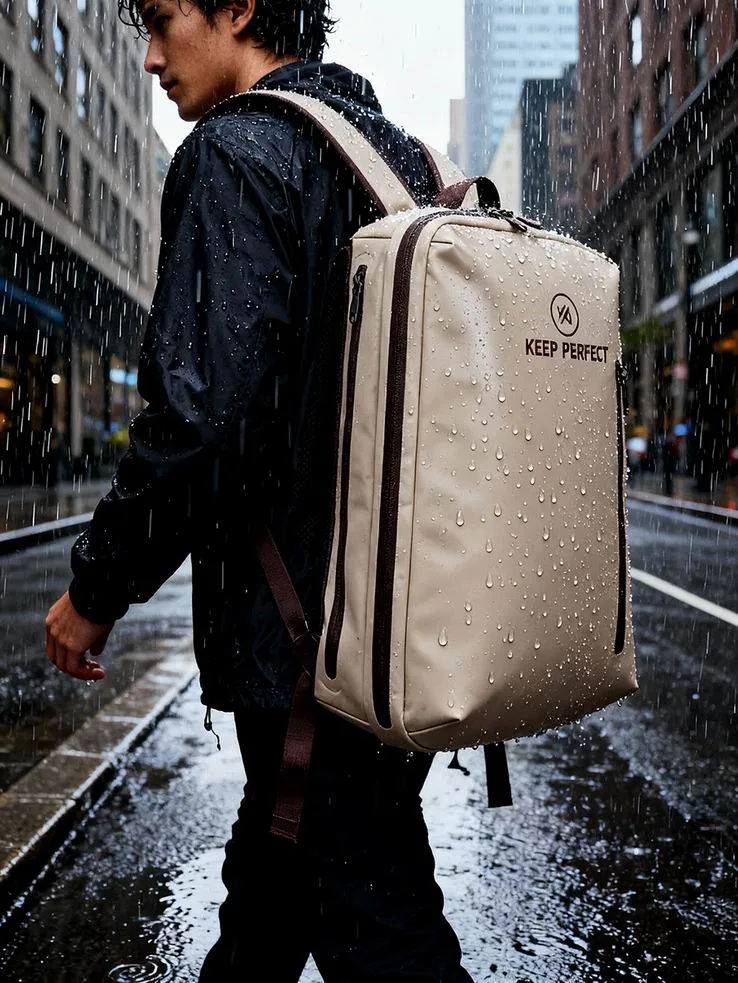
Position is as important as bag size. Anything that is drying needs airflow on both faces, and a bag sitting flat on a floor delivers airflow to one face only. Hang it, prop the mouth open with a rolled towel, or stand it upright against a vent. A 20 L bag with a wetsuit in it will dry in about 12 hours hung and will still be damp after 36 hours lying flat.
Drying without a tumble dryer
Nobody has a tumble dryer in a van, so drying is a function of airflow, surface area and temperature. A 12 V fan moving 100 m3/h across a hung jacket removes roughly 200 grams of water per hour at 15 °C and 60 per cent humidity; the same jacket lying on a bed manages perhaps 60 grams. Surface area and moving air beat heat, which is why a cold van with good airflow dries faster than a warm one with none.
The practical setup is a line over the cab or across the rear doors, with each item hanging freely and at least 100 mm between neighbours, plus a fan aimed along the line rather than at it. Add a 2 kW heater on low for 30 minutes after the wettest items go up, not to dry them directly but to lower the relative humidity so the air can hold more water.
One caution about hanging near a heater outlet. Diesel heater air leaves the outlet at 80 to 110 °C, and a TPU bag 100 mm away from that outlet will exceed its comfortable service range within the hour. Keep bags at least 400 mm from any heater outlet and never drape anything over the unit, which is a fire risk as well as a fabric one.
Rain gear, sports kit and the garage
The garage, the space under a fixed bed, is the natural home for wet outdoor kit because it is usually the coldest and best-ventilated part of the vehicle and it is separated from the sleeping area by a bulkhead. That separation is the whole point: a wetsuit stored under the bed does not humidify the bedding. Keep the garage kit in a 40L bag with welded seams so that nothing seeps into the ply.
Sports kit brings specific problems. A surfboard bag carries salt and sand, a bike kit carries chain oil, and both should never meet the dry clothing store. Give each its own bag, rinse salt off with 1 litre of fresh water before storage, and accept that this corner of the van will always be the damp one. That is fine, as long as it is the only damp one.
If the van doubles as a base for winter sports, the load changes again. Ski boots carry 0.3 litres of melt water each and the liners take 24 hours to dry at 15 °C. A 20 L bag per pair, opened in the garage with the liners pulled out, is the only arrangement that works, and a small 12 V boot dryer running at 25 watts overnight is worth more than any bag.

Bedding and the sleep system
The bed is the thing you are protecting. A duvet that picks up 200 grams of water over a week feels damp, weighs more and loses loft, and it is the hardest item in a van to dry because it is bulky and usually lies flat. Two habits protect it: open the bed to air for an hour each morning before making it up, and keep a 40L bag for spare bedding that is never opened except to swap.
Memory foam and closed-cell mattresses are unaffected by humidity, but the ply beneath them is not. Condensation forms under a mattress that sits directly on a cold panel, and the classic result is a black patch of mould under the bed after one winter. Fix it with a slatted or ventilated base with a 20 mm air gap, and lift the mattress once a week to check.
Cold weather and frozen kit
Below freezing the problem inverts: instead of too much water in the air, you get water freezing where you do not want it. A water container in the garage drops below zero overnight, a wet bag left outside the rear door becomes a solid block, and a roll-top closure stiffens enough that three folds become hard work at minus 8 °C.
TPU handles this better than PVC, staying workable to about minus 30 °C, but the closure still needs care. Roll the bag loosely, do not force a stiff fold, and keep closures inside the heated envelope overnight. Water containers go in the cabin, not the garage, and anything with liquid in it moves inside below minus 3 °C.
Cold also changes how you ventilate. Cold air holds almost no moisture, so extracting it and warming it is the single most effective drying action available in winter: air at 2 °C and 80 per cent humidity warmed to 20 °C arrives at about 21 per cent relative humidity. That is why a winter van with a good fan and a heater is often drier than a summer one with the windows shut.
Mould, health and when it stops being cosmetic
Sustained relative humidity above 70 per cent on a cold organic surface is where mould germinates, and in a van the organic surfaces are ply, fabric trim, carpet and any paper or clothing stored against a panel. Damp and mould in buildings is treated as a health issue rather than a maintenance one, and the EPA guidance on moisture and mould indoors is the standard reference for why that is.
The health effects are real enough to plan around. Respiratory symptoms, irritation and allergic responses are all associated with indoor dampness, and the CDC publishes guidance on mould exposure and cleanup that applies just as well to a vehicle interior as to a house. If you find more than about 0.1 m2 of growth, treat it as a remediation job, not a wipe-down.
Practically, that means a weekly inspection. Lift the mattress, pull the garage bags out, feel the ply under the bed and look at the window rubbers. Ten minutes a week finds every problem while it is still a cloth-and-vinegar job rather than a rebuild.
The daily and weekly routine
- Morning: extract on boost for ten minutes, windows wiped with a squeegee.
- Bed opened and aired for one hour before it is made up.
- Cooking with a lid on the pan and the vent above the hob open.
- Door-side routine applied within 30 seconds of every entry in rain.
- Wet kit hung with 100 mm gaps and a fan aimed along the line.
- Evening: heater plus extract for 20 minutes, then vent on trickle overnight.
- Weekly: mattress lifted, garage emptied, ply inspected, bags rinsed and dried.
The overnight setting is the one that takes longest to get right, because it changes with the weather. On a mild damp night, trickle ventilation at about 10 m3/h plus insulated window covers is enough. On a freezing clear night, more airflow and slightly more heat works better. Watch the windows rather than the thermometer: dry glass in the morning means the setting was right.
Kit list and the sizing checklist
| Item | Volume | Weight | Position | Job | Priority |
|---|---|---|---|---|---|
| Dry clothing store | 40 L | 6.5 kg | Under bench, forward | Never-humidified clothing | High |
| Garage wet bag | 20 L | 1.2 kg | Garage, rear | Wetsuit, sports kit | High |
| Boot bag | 10 L | 0.9 kg | Door mat | Boots, wet shoes | High |
| Electronics pouch | 5 L | 0.4 kg | Cab, shaded | Phone, camera, laptop | Medium |
| Swim and towel pouch | 5 L | 0.5 kg | Shower area | Damp towels | Medium |
| Spare bedding bag | 40 L | 4.0 kg | Under bench, aft | Rotation stock | Low |
- Buy one 40L, one 20L and one 10L before buying anything else; those three cover every job.
- Confirm welded seams, because a garage bag sits in water by design.
- Choose TPU over PVC if the van sees winter, and check the cold-crack figure.
- Keep every drying bag at least 400 mm from a diesel heater outlet.
- Colour code the bags so wet and dry are never confused in the dark.
- Match bag size to the garage, not to the shop: measure the aperture first.
Operators building rental fleets or conversion packages run into the same five decisions at scale: volume, film thickness, closure type, colour and hard points. Our production partner has produced waterproof bags since 2014 in an SGS-verified 4,950 m2 facility, with a 500-piece minimum and sampling in 6 to 10 working days, and van packages now make up a steady share of that work.
Finish by matching the kit to the climate you actually live in, because a setup tuned for a wet Scottish winter will over-ventilate in a dry Spanish one. Our climate matching guide covers that choice, and the condensation guide explains what is happening when a sealed bag still ends up wet inside. For the drying side, the racks and airflow notes go further on airflow geometry, and the slush protection guide covers the shoulder season when melt water is worse than rain. Our TPU waterproof backpack range covers the day bag, and the full blog index carries the rest of the series.
Frequently asked questions
Q1. What wet-weather kit do I need for van life?
Four bags and airflow: a 40L dry clothing store, a 20L garage bag for wetsuits and sports kit, a 10L boot bag by the door, a 5L electronics pouch, plus a roof fan delivering 30 to 60 m3/h and insulated window covers.
Q2. How much water do two people produce in a van overnight?
About 0.7 litres from breathing alone. Add cooking on LPG at roughly 164 grams of water per 100 grams of fuel, plus wet kit, and the realistic daily total is 1.5 to 3 litres in a 3.5 m3 cabin.
Q3. Why do my van windows run with water every morning?
The glass is below the dew point. At 20 °C and 60 per cent humidity the dew point is 12.2 °C, while a single-glazed window with 2 °C air outside sits at 6 to 9 °C on its inner face.
Q4. What ventilation rate clears condensation in a van?
About 30 to 60 m3/h while cooking or drying, and 10 m3/h as a continuous baseline in a 3.5 m3 cabin. That is 8 to 12 air changes per hour running and 2 to 4 baseline, well within a 100 m3/h roof fan on medium.
Q5. Does a diesel heater dry out a van?
Indirectly and effectively. Raising the cabin from 14 °C to 20 °C at constant water content drops relative humidity from about 75 per cent to 52 per cent, and the heater adds no moisture because the combustion circuit is sealed.
Q6. Where should wet boots go in a van?
Into a 10 L bag standing upright on a ribbed mat just inside the door, with the mouth rolled down and open. Never onto the floor, and never into the same bag as a wetsuit, which takes three times as long to dry.
Q7. How long does a wetsuit take to dry in a van?
About 12 hours hung with airflow on both faces at 15 °C, and more than 36 hours lying flat. Surface area and moving air matter far more than temperature, so hang it rather than laying it out.
Q8. Is TPU or PVC better for winter van use?
TPU. It stays workable to about minus 30 °C while PVC stiffens well above that, and a stiff closure at minus 8 °C is hard to roll three times. Keep closures inside the heated envelope overnight either way.
Q9. Can I put wet kit near a diesel heater outlet?
No. Heater outlet air is 80 to 110 °C and a TPU bag 100 mm away will exceed its service range within the hour. Keep at least 400 mm of clearance and never drape anything over the unit.
Q10. How do I stop mould under the van mattress?
Give the mattress a slatted or ventilated base with a 20 mm air gap, and lift it once a week to check the ply. Condensation forms under any mattress sitting directly on a cold panel, and the result is usually found a year later.
Q11. Is a desiccant tub worth using?
Only as a supplement. A 500 g tub absorbs roughly 150 grams before it is saturated, against a daily load of 1.5 litres, so it buys hours rather than solving anything. Airflow is the only control that scales.
Q12. Should the garage bag be open or closed?
Open while drying, closed while driving. A 20 L bag with a wetsuit in it dries when it is hung with the mouth propped open, and it should be sealed before the vehicle moves so nothing seeps into the ply.
Q13. What is the 30-second rule?
Within 30 seconds of closing the door in rain, outer layers are off, boots are in a bag and the floor is wiped. After that, water has spread into the living space and reached the bed.
Q14. How do I dry kit in winter without a heater running all day?
Ventilate. Cold outside air at 2 °C and 80 per cent humidity becomes about 21 per cent relative humidity once warmed to 20 °C, so extracting and warming cold air is the most effective drying action available in winter.
Q15. What should never be stored in the garage?
Bedding, clothing, electronics and anything paper. The garage is the coldest and dampest zone in the vehicle, which is exactly why it suits wetsuits and sports kit and nothing else.
Q16. How often should I inspect for damp?
Weekly. Lift the mattress, pull the garage bags out, feel the ply and check the window rubbers. Ten minutes a week finds every problem while it is still a cloth-and-vinegar job rather than a rebuild.
People also ask
How do you stop condensation in a van?
Ventilate continuously and insulate the glass. Run 10 m3/h baseline extract with insulated window covers that lift the inner glass face by 5 to 8 °C, and boost to 30 to 60 m3/h while cooking or drying kit.
What causes damp in a campervan with no leaks?
The occupants. Two people produce 0.7 litres of vapour overnight, cooking on gas adds about 0.5 litres a day, and that water condenses on the coldest surface, which is usually single-glazed glass or an uninsulated panel.
How much ventilation does a campervan need?
About 30 to 60 cubic metres per hour while cooking or drying, and roughly 10 as a continuous baseline for a 3.5 cubic metre cabin. There must also be a matching low-level inlet, or the fan will not deliver its rating.
Where do you put wet boots in a campervan?
In a 10 litre bag standing upright on a ribbed mat just inside the door, mouth open and rolled down. Boots carry about 0.2 litres and dry in roughly 8 hours upright, against much longer if they are left flat.
Is it safe to dry clothes near a diesel heater?
Not close. Outlet air is 80 to 110 °C, so keep bags and clothing at least 400 mm away and never drape anything over the unit. Use the heater to lower humidity and let airflow do the drying.
How do you dry a wetsuit in a van?
Hang it inside out with airflow on both faces and the bag mouth propped open. That takes about 12 hours at 15 °C; the same suit lying flat on a bed will still be damp after 36 hours.
Need this in production volume?
QUANZHOU JUNYUAN BAGS has produced waterproof bags since 2014 in an SGS-verified 4,950 m2 facility in Fujian, China. Minimum order 500 pieces, sampling in 6–10 working days, bulk in 35–50 days, FOB Xiamen — write to service@junyuanbags.com with your spec and target market.