Home / Blog / Buying & Comparisons
What to Skip When Buying Dry Bags
Most dry bag money is wasted on three things: capacity you never fill, closures that cannot be sealed with cold hands, and coatings that fail while the base fabric is still sound. A weekend paddler who buys a 40L bag for a 12-litre load pays about 40% more in material and carries 900 g of dead weight, while a 20L bag with welded seams and a proper three-fold closure does the job for a decade. The features that matter are few and measurable.
This is a skip list rather than a shopping list. Each of the twelve sections below names one specification or feature that sounds valuable at the point of sale and rarely pays for itself in the field, together with the number that tells you when the feature is genuinely worth having. It ends with the short list of things that are worth paying for: welded seams, a three-fold closure, film thickness matched to abrasion, and a test standard behind the rating.
- Start from the failure, not from the feature
- Skip the largest litre count you can afford
- Skip a zip on the main closure
- Skip water resistant when the bag will be immersed
- Skip heavy PVC unless you need chemical resistance
- Skip pockets, windows and internal organisers
- Skip the purge valve unless you compress the load
- Skip the padded harness on a bag that lives in a boat
- Skip the highest denier number on the label
- Skip unverified ratings and unbranded test claims
- Skip one bag for five activities
- Skip colourways that will not be restocked
- What is actually worth paying for
Start from the failure, not from the feature
A dry bag has exactly one job and it either does it or it does not. Everything else, the pocket count, the colour, the harness, the reflective piping, is secondary to whether the bag keeps water out after a season of being folded, squeezed, dropped on gravel and left in the sun. When buyers are asked what went wrong with the last bag they owned, the answers are remarkably consistent: the closure stopped sealing, a seam opened, or the coating went stiff and cracked.
That is why the skip list is structured around the failure modes rather than around price bands. A feature earns its place if it delays one of those three failures or if it makes the bag materially easier to use on the water. A feature is worth skipping if it adds cost, weight or a new way to fail without doing either. Judged on that basis, a striking number of mid-market specifications disappear immediately.
Skip the largest litre count you can afford
Capacity is the single most over-specified number on a dry bag. A roll-top used properly is filled to about 85% of its nominal volume because the remaining space is taken up by the three folds of the closure, so a 40L bag carries 32 to 34 litres at best. Buyers who need 12 litres therefore buy a 20L, see 40L on the shelf for only a few pounds more, and end up with a bag that is too big to lash down and too bulky to sit in a hatch.
The cost of oversizing is not just money. A large bag invites a heavy load: an extra 28 litres of clothing and food is easily 5 kg, which on a kayak deck shifts the trim and on a backpack shifts your balance on wet rock. It also degrades the closure, because a half-empty big bag has to be rolled further down to close, putting four or five folds into the fabric instead of three and accelerating crease fatigue at the fold line.

Skip a zip on the main closure
A waterproof zip on the main opening is the most expensive way to make a bag harder to seal. The slider has to be driven fully home against a stiff gasket every single time, and it fails silently: a zip left 15 mm short looks closed and lets water in within a minute of immersion. A roll-top needs no precision, tolerates grit better, and can be sealed by feel with numb hands, which is exactly the condition in which you will be sealing it.
Zips do have a place, and it is access, not waterproofing. A zip on an outer pocket, a lid pocket or an internal organiser panel is fine, because those compartments are not the watertight chamber. The rule is straightforward: the chamber that must stay dry closes with folds, and the chamber that must be convenient closes with a zip. If a bag puts a zip on the main chamber, ask what the roll-top is for, because the answer is usually photography rather than function.
| Closure type | Seal reliability | Seals with cold hands | Tolerates sand | Replacement cost | Verdict |
|---|---|---|---|---|---|
| Roll-top, three folds | High | Yes | Rinse, then reseals | None | Buy this on the main chamber |
| Roll-top, two folds | Moderate | Yes | Yes | None | Acceptable for splash only |
| Waterproof zip, TPU coated | Moderate | Poor | Poor, grit jams the slider | High | Pockets and lids only |
| Standard zip under a flap | Low | Moderate | Poor | Low | Skip for any wet use |
| Magnetic or roll-and-clip | Variable | Yes | Moderate | Medium | Skip until field proven |
Skip water resistant when the bag will be immersed
Two words do a lot of damage on packaging. Water resistant means the fabric sheds a shower and the seams are stitched with a coating over the top; waterproof means the closure and the seams survive immersion. A bag can be sold as water resistant while letting in water through the needle holes of every seam the moment it is squeezed under 30 cm of water, and there is no legal threshold that stops that description.
The number to look for is an ingress code. IPX4 covers splashing, IPX6 covers powerful jets such as bow spray at 40 km/h, IPX7 covers 30 minutes at one metre and IPX8 is a depth agreed in the test protocol by whoever ran it. The definitions sit in IEC 60529, published by the IEC. If a listing will not name a code, treat the bag as splash-only and price it accordingly.
| Stated claim | What it actually survives | Realistic use | Code to ask for |
|---|---|---|---|
| Showerproof | Light rain for a few minutes | Urban commute | IPX3 |
| Water resistant | Splash, no immersion | Deck bag in calm water | IPX4 |
| Splashproof | Directed jets, no immersion | Bow spray, surf wash | IPX6 |
| Waterproof | Immersion at depth for a period | Capsize, full submersion | IPX7 |
| Submersible | Sustained depth by agreement | Commercial or dive support | IPX8 with a stated depth |
Skip heavy PVC unless you need chemical resistance
PVC-coated fabric is cheap per square metre and genuinely tough against abrasion, which is why it still dominates river bags and rafting equipment. It is also 20 to 35% heavier than an equivalent TPU laminate, it hardens below about 5 °C, and it depends on plasticisers that migrate out over three to five years, leaving a stiff, cracked film. On a bag that gets folded every trip, that stiffening shows first at the fold line, which is precisely where the seal is made.
TPU costs more per metre and is worth it whenever the bag will be folded in the cold, carried on the back, or expected to last beyond five years. It welds cleanly with radio-frequency energy, which is what makes a continuous seam possible, and it has no plasticiser to lose. If your use case is a warm-water raft that lives strapped to a frame and never gets folded, PVC is a rational buy; if it is a kayak or a commute bag, it is not. The trade-off is set out in full in our TPU versus PVC comparison.
Skip pockets, windows and internal organisers
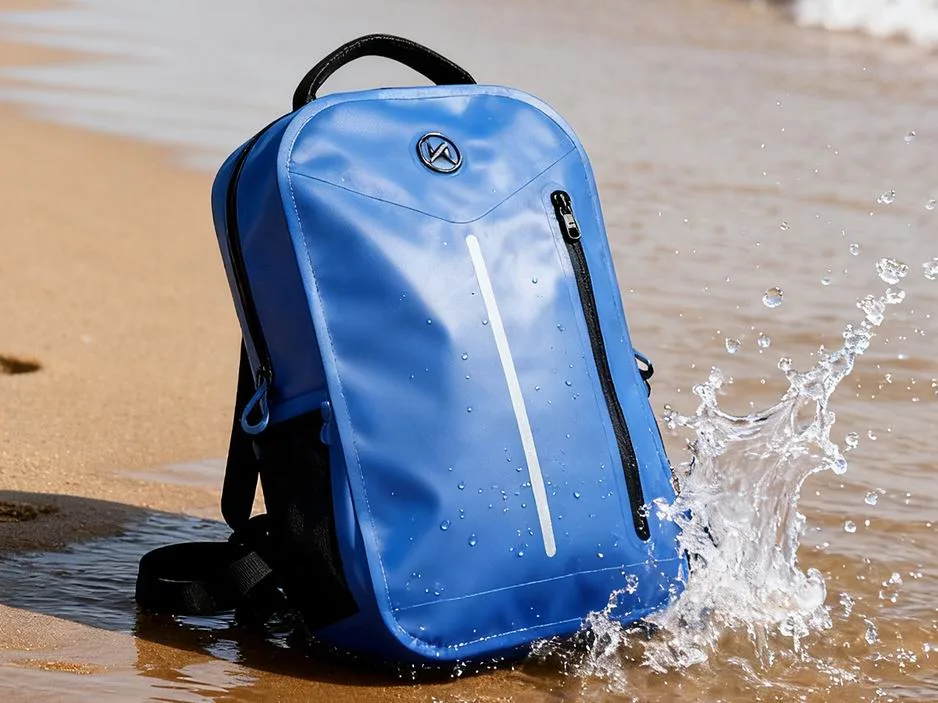
Every pocket on a waterproof bag is an additional seam, and every seam is a candidate leak path. A clear window is a welded panel of a different material with a different melting point, which is why windowed bags are over-represented in leak reports relative to their market share. External mesh pockets hold water after every immersion and keep the bag wet for hours after the bag itself has dried.
Organisation is a real need, and the better answer is internal. Colour-coded small dry bags inside one large welded chamber give you separation without adding a single seam to the waterproof shell, and they let you re-pack by category rather than by pocket. A 2L roll-top inside a 20L chamber holding phone, keys and wallet is the standard solution on expedition boats, and it has the side benefit of giving critical items two independent seals.
Skip the purge valve unless you compress the load
A purge valve lets you squeeze air out of a closed bag so it sits flat in a hatch. It is genuinely useful on a kayak where compartment space is tight, and close to useless on a beach bag, a duffel or a backpack. Each valve is an extra penetration in the shell with its own seal and its own failure mode, and a valve that has been knocked against a rock is a valve that will weep.
The test is simple. If you routinely push bags through a hatch rim smaller than the packed bag, buy the valve. If you fill the bag on a beach and throw it in a car or a boat, take the simpler shell and spend the money on film thickness instead. Riders of inflatable packrafts and paddlers with 20 cm round hatches are the main beneficiaries; almost everyone else should skip it.
Skip the padded harness on a bag that lives in a boat
A padded harness with a sternum strap and a hip belt adds 250 to 400 g and 20 to 30% to the price. On a bag carried two kilometres to a launch that is money well spent. On a bag that spends its life lashed to a deck or pushed into a hatch it is padding that never touches a shoulder and webbing that snags on everything within reach.
Match the harness to the distance walked, not to the size of the bag. Under 400 m of carrying, a single webbing strap or two grab handles are sufficient and are far easier to lash. Between 400 m and 2 km, a simple unpadded webbing harness works. Beyond 2 km, or with loads above 8 kg, a padded harness earns its weight. The same logic applies to duffels: a backpack versus duffel decision is mostly a walking-distance decision.
Skip the highest denier number on the label
Denier is the linear mass of the yarn in the face fabric and says nothing about waterproofing, which is the job of the film laminated behind it. A 1000D face on a thin 0.25 mm film will abrade for years and then puncture on a sharp shell, while a 420D face on a 0.5 mm film resists puncture far better. Marketing leans on denier because it is a big number that is cheap to increase.
Ask for two figures instead: the film or coating thickness in millimetres and the fabric mass in grams per square metre. A dry bag for mixed use sits around 0.4 to 0.5 mm of TPU on a 420D to 500D face, which lands near 480 to 620 g/m². Below 0.3 mm the bag is a liner, not a bag. Above 0.7 mm it is a rafting bag and will feel like one on your back.
| Specification | Too light | Right for mixed use | Over-built | What it predicts |
|---|---|---|---|---|
| Film thickness | Under 0.30 mm | 0.40-0.50 mm | Over 0.70 mm | Puncture and abrasion life |
| Face fabric | 210D | 420-500D | 1000D and above | Scuff and tear resistance |
| Total mass | Under 350 g/m² | 480-620 g/m² | Over 850 g/m² | Weight you carry |
| Weld width | Under 8 mm | 12-20 mm | Over 25 mm | Peel strength of the seam |
| Roll folds to seal | Two | Three | Five or more | Closure margin and crease life |
Skip unverified ratings and unbranded test claims
A bag that says waterproof without saying how it was tested has told you nothing. The three documents that convert a claim into a specification are an ingress test report naming the code and duration, a seam peel or weld strength figure, and a sampling standard for production. A brand that holds those three will usually publish them without being asked twice.
Standardised test methods exist for all of this. Coated fabric strength and hydrostatic resistance methods are published by ASTM International, and the equivalent international series is maintained by ISO. When you compare two bags at similar prices, the one that can name the method is very often the one built to a consistent tolerance, and that consistency is worth more than any single headline figure. Our warranty testing guide lists what to ask for line by line.
| Claim on the page | Question to ask | Good answer | Bad answer |
|---|---|---|---|
| Waterproof | Which ingress code and how long? | IPX7, 30 minutes at 1 m | Very waterproof |
| Welded seams | What is the weld width and peel strength? | 15 mm, tested per batch | Strong welds |
| Heavy duty fabric | Film thickness and grams per square metre? | 0.5 mm, 560 g/m² | 1000D tough |
| Tested | Who tested it and to which standard? | Named laboratory and method | In-house checked |
| Lifetime guarantee | What does the term cover and exclude? | Seams and closure, stated years | Everything, no term |

Skip one bag for five activities
The universal bag does not exist because the constraints genuinely conflict. A kayak bag has to fit a hatch rim, which favours a squat shape and a soft body. A backpacking bag has to carry 8 kg comfortably, which favours a tall shape and a structured harness. A beach bag has to be rinsed and dried in an hour, which favours a wide mouth and light colours that do not cook in the sun.
Two bags chosen well beat one compromise bag in every case we see. The usual pairing is a 10L to 20L squat bag for the boat or the commuting pack, plus a 40L to 60L duffel for camp and travel. They share a closure system and a colour coding, so spares and habits transfer between them, and neither is asked to do a job it is shaped badly for.
| Activity | Shape that works | Wrong shape | Closure priority | Size range |
|---|---|---|---|---|
| Kayak or canoe | Squat, soft, compressible | Tall rigid backpack | Three folds, no zip | 10-30 L |
| Backpacking | Tall, harnessed | Wide duffel | Three folds plus lid access | 30-60 L |
| Beach and pool | Wide mouth, light colour | Dark slim sack | Two folds, roll and clip | 5-20 L |
| Urban commute | Flat back panel | Round sack | Roll-top or welded zip | 15-30 L |
| Rafting | Heavy, strapped, no harness | Anything with padding | Four folds, burly weld | 40-90 L |
Skip colourways that will not be restocked
This one only matters if you are buying more than one bag or expect to replace one later. A print or a seasonal shade looks distinctive at purchase and is impossible to match two years on, which leaves a fleet or a family with mismatched kit and no shared spares. Core solid colours are restocked because demand is steady; fashion shades are not, because the tooling and the fabric lot are gone.
The practical rule is to buy function in a core colour and personality in one accent piece. A black or olive 20L bag will be available for years, so it can be replaced, colour-coded and repaired with matching parts. A limited print run should be the bag you would not mind retiring. For anyone specifying bags for a club or a rental fleet, availability over five years is a more valuable property than any single feature on this list.
What is actually worth paying for
- A continuous welded seam rather than a stitched and taped one.
- A closure with at least three fold lines and a reinforced, stiffened mouth.
- Film thickness of 0.4 to 0.5 mm on a 420D to 500D face for mixed use.
- A named ingress code with a duration, ideally IPX6 or IPX7.
- Welded attachment points rather than sewn loops at any load-bearing spot.
- A size that matches your real load at 85% fill, not your aspirational one.
- A core colourway that will still be available when you need a second bag.
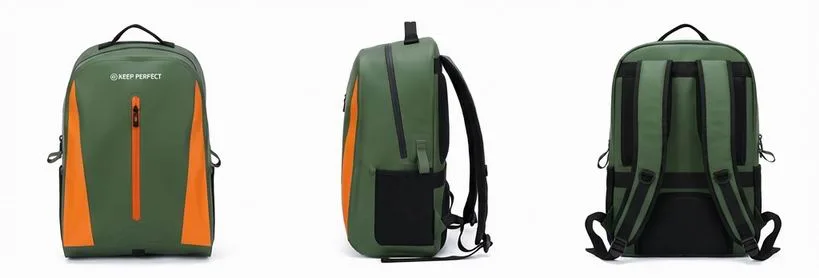
Those seven lines add up to a bag that costs slightly more than the shelf average and lasts three times as long. The pattern across the whole skip list is that money moves from features to fundamentals: fewer seams, thicker film, a simpler closure and a documented test. Every item that was skipped above either adds a seam, adds a number that does not predict service life, or adds weight to a bag that will spend its life in a boat.
Price bands do track this, but weakly. Testing across a range of mid-market bags shows the spread within a single price band is wider than the spread between bands, which means the specification sheet is a better guide than the ticket. If you want a number to anchor on, our dry bag cost guide breaks down where the money goes at each price point, and the value of a tested rating puts a figure on the testing itself.
Finally, buy the second bag before you need it. The most common regret is not a wrong feature but a wrong size, and the fix is a second bag in a different size rather than a replacement of the first. Two bags in the 10L to 20L range cover most of what people actually do with a dry bag. Compare the current range across the full product line, and use the buying checklist at the point of sale.
For anyone buying in volume rather than singly, the same skip list becomes a specification. Remove the zip from the main chamber, drop the window, fix the film thickness, name the ingress code and the weld width, and the unit cost usually falls while the return rate falls further. Start with the waterproof academy if you want the underlying test methods explained first.
Frequently asked questions
Q1. What should I not pay for on a dry bag?
Skip the oversized litre count, a zip on the main chamber, clear windows, external mesh pockets and a padded harness on a bag that lives in a boat. Pay instead for welded seams, a three-fold closure and 0.4 to 0.5 mm film.
Q2. Is a bigger dry bag always better?
No. A roll-top carries about 85% of its nominal volume once rolled three times, so a 40L bag holds 32 to 34 litres. Oversizing adds weight, worsens trim and forces extra folds that shorten crease life.
Q3. Are zips bad on dry bags?
On the main chamber, yes. A waterproof zip left 15 mm short looks closed and leaks within a minute of immersion. Zips are fine on pockets and lids, where the compartment is not the watertight chamber.
Q4. What is the difference between water resistant and waterproof?
Water resistant means the fabric sheds splash while the seams stay stitched. Waterproof means the closure and seams survive immersion. Ask for an ingress code: IPX4 for splash, IPX6 for jets, IPX7 for 30 minutes at one metre.
Q5. Is TPU worth the extra cost over PVC?
Yes if the bag is folded in the cold, carried on the back or expected to last past five years. TPU has no plasticiser to migrate and welds cleanly. PVC is heavier, stiffens below about 5 °C and cracks at the fold.
Q6. Does a higher denier mean a better bag?
Not on its own. Denier describes the face yarn, not waterproofing. Film thickness and grams per square metre predict service life far better; look for 0.4 to 0.5 mm on a 420D to 500D face.
Q7. Do I need a purge valve?
Only if you push bags through a hatch rim smaller than the packed bag. Otherwise it is an extra penetration with its own seal and its own failure mode, and the money is better spent on film thickness.
Q8. Should I buy a dry bag with a padded harness?
Match it to walking distance. Under 400 m, grab handles suffice; 400 m to 2 km, a webbing harness; beyond 2 km or above 8 kg, padding earns its 250 to 400 g.
Q9. How do I know if a waterproof claim is real?
Ask which ingress code, which duration and which test method. A brand that holds the data will name it. Waterproof with no code behind it should be priced as splash-only protection.
Q10. Are clear windows on dry bags a good idea?
Usually not. A window is a welded panel of a different material with a different melting point, and windowed bags are over-represented in leak reports. Colour-coded inner bags give the same identification without an extra seam.
Q11. Can one dry bag cover kayaking, hiking and the beach?
Not well. A kayak bag needs a squat soft body for a hatch rim, a hiking bag needs a tall harnessed shape, and a beach bag needs a wide mouth. Two bags chosen for purpose beat one compromise.
Q12. What size dry bag do most people actually need?
Ten to twenty litres covers most day use. A 10L handles layers and food for three hours; a 20L handles a camera, lunch and a towel. Buy the second bag before you need it rather than upsizing the first.
Q13. Is a lifetime guarantee worth anything?
Only with a stated term and stated exclusions. Ask what is covered: seams and closure for a defined number of years is a real commitment, while a promise with no term and no scope is marketing.
Q14. How much should a good dry bag cost?
Less than the spread within a price band suggests. Specification predicts service life better than ticket price, so compare film thickness, weld width and test documentation rather than shopping by band alone.
Q15. Do seasonal colours matter when buying?
Yes, for replacement. Core solid shades are restocked for years; fashion prints are not. Buy function in a core colour and personality in one accent piece you would not mind retiring.
Q16. What is the single most important specification?
The seam. A continuous welded seam of 12 to 20 mm with tested peel strength outlasts any fabric upgrade, because the seam is where every dry bag eventually fails.
People also ask
What makes a dry bag worth buying?
A continuous welded seam, a three-fold closure with a stiffened mouth, 0.4 to 0.5 mm film on a 420D to 500D face, and a named ingress code with a duration. Everything else is secondary to those four.
Are expensive dry bags worth it?
Only when the premium buys fundamentals rather than features. Within any price band the spread in seam quality and film thickness is wider than the difference between bands, so read the spec sheet instead of the ticket.
Do you really need a dry bag?
If the kit must stay dry through immersion or a capsize, yes. A splash-proof pack survives a shower and fails the moment it is squeezed under 30 cm of water, because pressure pushes water through stitched seams.
Why does my dry bag leak at the top?
Usually because it was rolled while overfilled, or a grain of sand sits in the fold. Rinse the closure before rolling, press the air out first, and use three folds rather than two.
Is 500D better than 420D for a dry bag?
Marginally, and less than film thickness matters. Denier describes the face yarn; the laminate behind it does the waterproofing. A 420D face on 0.5 mm film outperforms a 500D face on 0.3 mm film.
Can you repair a dry bag seam?
Yes, with a solvent or heat weld patch on TPU, and it holds well if the surrounding film is sound. PVC needs a compatible cement. A stitched seam cannot be made waterproof again by stitching.
Need this in production volume?
QUANZHOU JUNYUAN BAGS has produced waterproof bags since 2014 in an SGS-verified 4,950 m2 facility in Fujian, China. Minimum order 500 pieces, sampling in 6–10 working days, bulk in 35–50 days, FOB Xiamen — write to service@junyuanbags.com with your spec and target market.