Can You Check a Dry Bag on a Plane?
A dry bag can be checked on a plane, and it is one of the better checked-bag choices for wet destinations, provided it meets three conditions: it fits the 158 cm linear and 23 kg allowance, its straps and buckles are secured so they cannot catch in a conveyor, and it is not sealed airtight at sea level. Cabin altitude sits at 1,800 to 2,400 m where ambient pressure falls to about 75 kPa, so a bag closed tight on the ground can expand by roughly 35% in the hold.
The rest of the decision is about what goes inside. Lithium cells, stove fuel, flares and spare gas cartridges never go in a checked dry bag; medicines, documents and camera bodies travel in the cabin. This guide covers the allowance arithmetic, the pressure problem, the prohibited list, conveyor damage, TSA-accepted locks and a packing sequence that gets a dry bag through a baggage system intact and dry on the other side.
- The three conditions that decide whether it flies
- Allowance arithmetic: linear dimensions and weight
- What cabin pressure does to a sealed bag
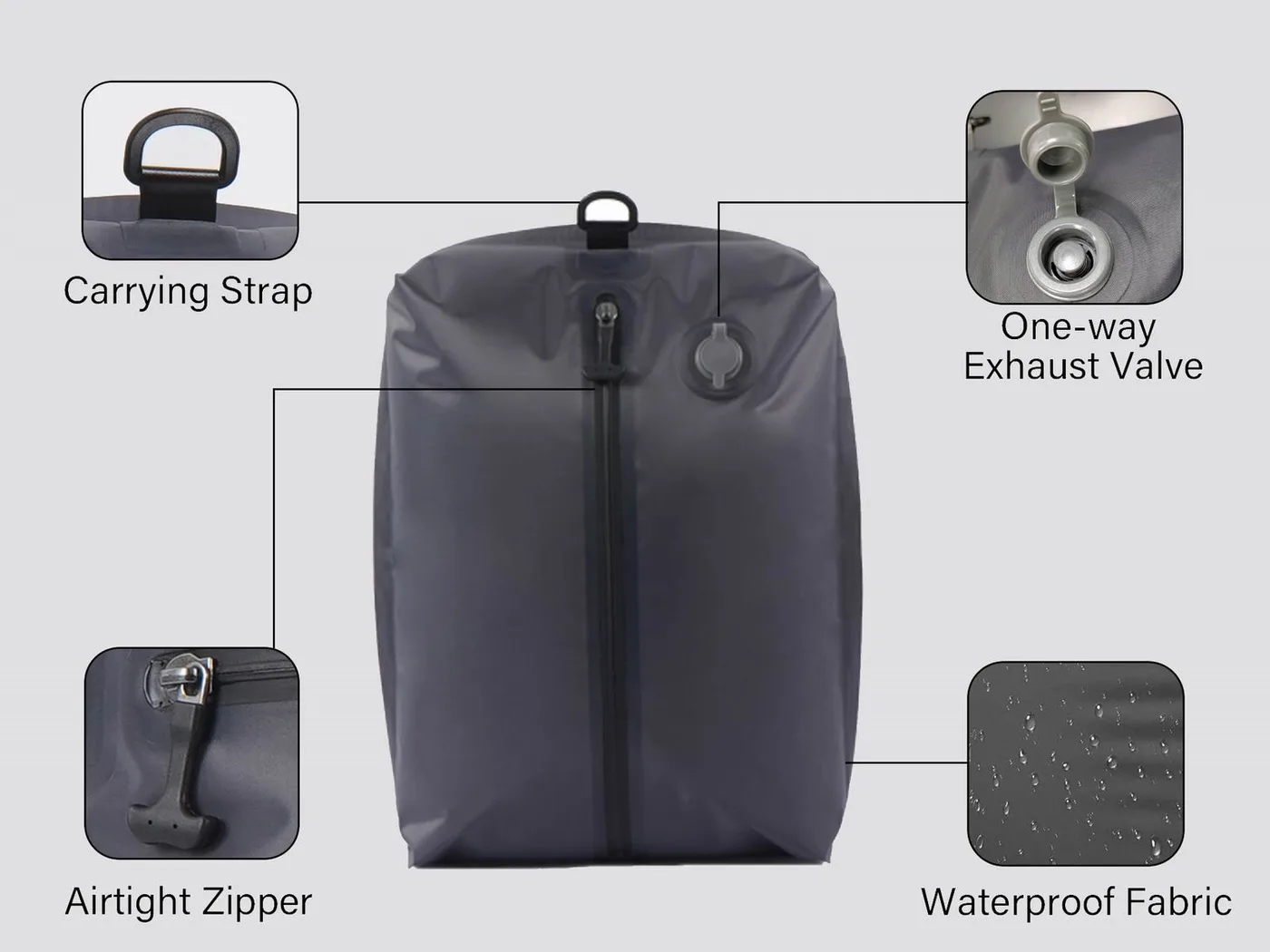
- Valves, folds and how to close for a flight
- What must never go inside a checked dry bag
- Straps, buckles and conveyor survival
- Locking a dry bag: what a lock actually protects
- Roll-top, duffel or backpack as checked luggage
- Weather on the tarmac: the real advantage
- Labelling and identifying a soft black bag
- A packing sequence for a checked dry bag
- If the bag is damaged or delayed
- When a dry bag belongs in the cabin instead
The three conditions that decide whether it flies
Airlines treat a dry bag as a bag, not as a category of equipment. What matters is its measured size, its weight and whether it can survive an automated belt without shedding parts. A soft 60L dry duffel at 2.4 kg empty and 70 cm long passes every mainstream allowance; the same bag with a rigid frame, an external mesh pocket and 40 cm of dangling webbing is a snag risk that a handler will deal with by taping it or by refusing it.
The second condition is the closure, and it is the one that catches people out. A roll-top pressed flat and clipped at sea level traps air at about 101 kPa. In a hold at 75 kPa that air expands by a factor of roughly 1.35, which stresses the weld line at the corners and can pop a closure open mid-flight. Vent the bag, or pack it so the air volume is small, and the problem disappears entirely.
The third condition is contents, which is the part with legal weight behind it. Lithium cells, flammable liquids, gas cartridges and flares are prohibited or restricted in checked baggage on virtually every carrier, and a dry bag offers no exemption because it is waterproof. Waterproofing is a property of the shell, not a permission slip for what goes inside it.
Allowance arithmetic: linear dimensions and weight
Most carriers outside the ultra-low-cost segment use a piece allowance with a weight cap of 23 kg and a linear cap of 158 cm, meaning length plus width plus height. Some allow 32 kg per piece at a higher fee, and most cap a single item at 32 kg for handler safety regardless of what you pay. Weight beyond that has to be split into a second piece, which is where a second smaller dry bag earns its keep.
Measure the bag loaded and closed, not empty. A 60L roll-top that is 62 cm long and 34 cm wide when empty becomes 70 by 40 once it is filled and the top is folded down, and a soft bag will bulge wherever the contents push. Convert to the linear figure before you get to the airport: 70 + 40 + 34 = 144 cm, safely inside 158 cm, while an 80 cm expedition duffel at 45 by 40 comes to 165 cm and will be charged as oversize.
| Allowance class | Weight cap | Linear cap | Typical fee band | Dry bag that fits |
|---|---|---|---|---|
| Economy, one piece | 23 kg | 158 cm | Included or 30-60 USD | 60 L duffel, 70 x 40 x 34 cm |
| Economy, two pieces | 23 kg each | 158 cm each | Included on long haul | 40 L plus 20 L pairing |
| Premium or sports allowance | 32 kg | 158-200 cm | Included or reduced | 90 L expedition duffel |
| Low-cost carrier, purchased | 15-20 kg | 140-158 cm | 25-70 USD | 40 L duffel packed to 30 L |
| Oversize, per piece | 32 kg hard cap | 159-300 cm | 80-200 USD | 110 L plus raft bag |

What cabin pressure does to a sealed bag
Aircraft cabins are pressurised to an equivalent altitude of 1,800 to 2,400 m rather than to sea level, and cargo holds are held at a similar or slightly lower pressure. Ambient pressure at 2,400 m is about 75 kPa against 101 kPa at sea level. Boyle’s law then does the arithmetic: a fixed mass of gas at constant temperature occupies 101/75, or about 1.35 times, the volume it had on the ground.
In practice that means a 20L dry bag packed with 12 litres of clothing and 8 litres of air at sea level arrives with that air occupying roughly 10.8 litres, pushing total demand to 22.8 litres in a 20-litre shell. A roll-top will usually vent past the fold before anything tears, which is the safe outcome, but a bag with a screw valve, a welded zip or a clip-and-roll closure can hold long enough to load the corner welds. The fix is one motion: open the valve, or press the air out and re-roll at the gate.
Valves, folds and how to close for a flight
Three closure behaviours matter in the air. A roll-top with three folds is self-venting under moderate pressure: it burps past the last fold rather than failing, which is why it is the safest closure to check. A screw purge valve left closed behaves like a rigid container until something gives; left open it vents continuously and is completely safe. A welded waterproof zip is the riskiest, because the slider holds until the pressure differential is significant and then releases abruptly.
The practical routine is to pack to 85% of volume, press the air out with a knee, close with three folds, and leave the buckle clipped but not tensioned to the last notch. If the bag has a valve, open it for the flight and close it on arrival. Never use a dry bag as a vacuum compression sack for a flight; the compression is exactly what creates the differential you are trying to avoid, and the seam damage from over-packing is permanent.
| Closure and state | Behaviour at 2,400 m cabin altitude | Risk | Action before check-in |
|---|---|---|---|
| Roll-top, three folds, air pressed out | Vents gently past the last fold | Low | None beyond pressing the air out |
| Roll-top, four folds, bag inflated | Loads corner welds, may pop open | Moderate | Re-roll with two folds at the desk |
| Screw purge valve, closed | Holds pressure, then releases sharply | Moderate | Open the valve for the flight |
| Screw purge valve, open | Vents continuously | Very low | Correct state, close on arrival |
| Welded waterproof zip, fully closed | Holds, then releases abruptly | Higher | Leave the slider 20 mm short |
| Compression sack, fully evacuated | Maximum differential on the welds | High | Do not check an evacuated bag |
What must never go inside a checked dry bag
The prohibited list is short, absolute, and applies to a dry bag exactly as it applies to a hardshell suitcase. Lithium ion cells above 100 Wh, spare lithium batteries of any size, flammable liquids including stove fuel and lighter fluid, gas cartridges, flares, strike-anywhere matches, and pressurised containers are all restricted or banned. A dry bag that is genuinely waterproof makes the risk worse rather than better, because a leaking cell inside a sealed shell cannot vent.
Lithium cells are the one people get wrong most often. Cells installed in a device may be checked on many carriers, but spare cells must be in the cabin, in a terminal-protected state, with a capacity declaration. The construction and testing of those cells is covered by the IEC 62133 series published by the IEC. Fuel, flares and solvents fall under dangerous goods rules for transport, and disposal guidance is published by the US EPA; buy fuel on arrival rather than carrying it.
| Item | Checked bag | Cabin bag | Practical handling |
|---|---|---|---|
| Lithium cells in a device | Usually allowed | Allowed | Carry devices in the cabin to be safe |
| Spare lithium cells | Prohibited | Allowed with limits | Terminals taped, capacity labelled |
| Stove fuel, liquid | Prohibited | Prohibited | Buy at the destination |
| Gas cartridges | Prohibited | Prohibited | Buy at the destination |
| Flares and pyrotechnics | Prohibited | Prohibited | Rent or buy locally |
| Medicines and prescriptions | Allowed but risky | Allowed | Keep in the cabin with the label |
| Passport and documents | Never | Always | See our documents guide |
| Aerosol over 500 ml | Restricted | Restricted | Leave it or buy locally |
Straps, buckles and conveyor survival
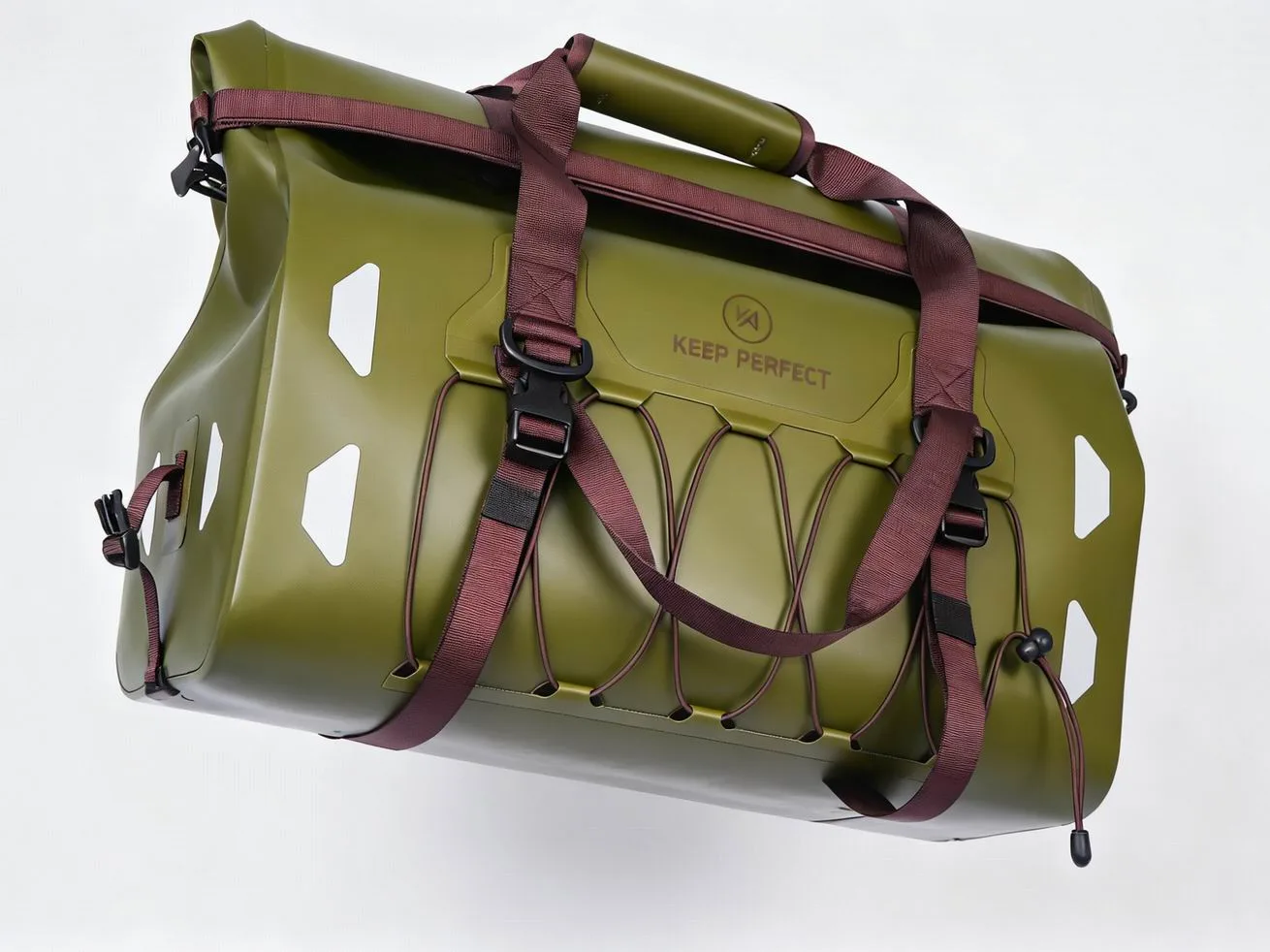
Baggage systems are built around boxes. Anything that dangles, loops or protrudes is a snag, and a dry duffel with detachable backpack straps and two grab handles offers plenty of it. A strap caught in a belt transfers the full drive force into the attachment point, which on a welded TPU bag means a torn D-ring or a peeled weld rather than a cheap repair.
The standard fix costs nothing. Remove detachable straps and put them inside the bag. Wrap fixed straps flat against the body and tape them down with two bands of cloth tape, leaving no loop bigger than a finger. Tuck buckles into a fold of webbing so no hook profile stands proud. If the bag has a compression strap system, cinch it fully so the whole package behaves like one soft block rather than a bag with appendages.
Locking a dry bag: what a lock actually protects
A lock on a soft bag is a mild deterrent, not a security measure. A welded TPU shell can be cut with a pocket knife in under five seconds, so no lock changes the risk profile materially. What a lock does achieve is keeping a roll-top closure from working loose in transit and signalling that the bag was tampered with, which matters for an insurance claim far more than for theft prevention.
If you lock, use a lock that screening staff can open without cutting, since a cut lock is a cut strap or a cut zip pull on a soft bag. Thread the shackle through the two D-rings at the closure rather than through a webbing loop, and lock the bag closed rather than locking it shut under tension. Note that screening authorities in most countries may open any checked bag, so a lock is never a guarantee of privacy.
Roll-top, duffel or backpack as checked luggage
For checking, a duffel profile wins almost every time. A 40L to 60L dry duffel packs as a soft block, has no protruding harness to snag, and opens along its length so a screening officer can inspect it and reclose it in seconds. A roll-top sack is nearly as good and lighter, but its single opening makes inspection slower and it sits awkwardly on a belt because it will not lie flat.
A waterproof backpack is the weakest checked choice and the strongest carry-on choice. Its harness, sternum strap and hip fins are exactly the protrusions that cause belt snags, and a stiff back panel does not compress into an irregular space. Carry it onboard and check a duffel instead; if you must check it, invert the bag inside a second soft sack or use an airline bag wrap, which costs about 10 to 15 USD and is worth it on a long itinerary.
Weather on the tarmac: the real advantage
Here a dry bag earns its place. Checked bags sit on open carts and conveyor bridges in rain, and a conventional fabric suitcase absorbs water for the ten to twenty minutes it is exposed, then transfers that moisture to everything inside. A welded dry bag sheds it completely, which matters most on tropical routes where a 20-minute downpour at 28 °C is routine and where the bag may then sit in a humid arrivals hall for an hour.
The second advantage is containment. Toiletries leak, wet swimwear from the last hotel soak everything, and a bag that has been opened for inspection is rarely reclosed as carefully as the owner closed it. A dry bag with a continuous welded seam gives you a watertight chamber, so a burst shampoo bottle stays in one place instead of ruining a jacket. Pack liquids in a 2L inner roll-top and the containment is doubled for about 60 g.
Labelling and identifying a soft black bag
A black dry duffel is indistinguishable from several thousand others on a carousel. Put two external identifiers on it: a rigid tag with a surname and a mobile number, and a second number written inside the bag on a card, because external tags are the first thing to be torn off. Photograph the bag before check-in with any distinguishing mark visible; that photograph is what resolves a delayed-baggage claim.
Add one visual marker that survives handling. A 5 cm band of coloured tape on the grab handle, a webbing loop in a bright shade, or a luggage strap in a colour nobody else uses will let you spot the bag from twenty metres. Avoid relying on a print or a logo, since a soft bag is usually lying on its side with the marked panel facing away from you.
A packing sequence for a checked dry bag
- Weigh the empty bag and note it; a 60L dry duffel is typically 1.8 to 2.6 kg.
- Pack to about 85% of nominal volume, leaving room for the closure folds.
- Put liquids and anything damp in a 2L inner roll-top inside the main chamber.
- Remove detachable straps and place them inside the bag with a note to reattach them.
- Press the air out with a knee, close with three folds, and open any purge valve.
- Tape fixed straps flat, leaving no loop larger than a finger.
- Weigh the loaded bag; redistribute anything over 23 kg into a second piece.
- Measure length, width and height and confirm the total is under 158 cm.
- Fit an external tag with a mobile number and add an identical card inside.
- Photograph the closed bag, then check the airline app for the bag tag number.
Two minutes spent on steps six to eight prevents most of the problems in this article. Straps that are taped do not snag, a bag under the linear cap is not charged as oversize, and a bag under 23 kg is not repacked on the floor of a terminal. If you are travelling with several pieces, put the heaviest single item in the bag with the fewest protrusions, because that is the one a handler will move the furthest.
If the bag is damaged or delayed
Report damage before you leave the baggage hall. Most carriers require notification within seven days in writing and many require a report at the airport for obvious damage, so a photograph taken at the carousel is worth more than a description written a week later. Keep the bag and the boarding pass; disposing of the bag before the claim is assessed can void it.
Most dry bag damage from handling is repairable. A torn D-ring can be replaced with a welded patch, a scuffed panel can be cleaned, and a punctured chamber can be welded if the surrounding film is sound; a full walkthrough is in our luggage handling repair guide. Delayed bags are a different problem, which is why a small dry bag with one day of essentials should always travel in the cabin rather than in the hold.
When a dry bag belongs in the cabin instead
Anything that must not be lost goes onboard: medicines, documents, camera bodies, laptop, spare cells and one day of clothing. A 20L roll-top works well as a personal item because it compresses under a seat and its soft body accepts an irregular space that a rigid case cannot. Pair it with a checked 60L duffel and the combination covers a three-week trip with no single point of failure.
Screening is straightforward with a dry bag if you plan for it. Liquids still follow the 100 ml rule, electronics still come out, and a roll-top opens and recloses faster than a zip for an officer who wants to look inside. Our airport security guide covers the tray routine, and cabin size and weight tips gives the sizer dimensions that matter for a soft bag.
For longer itineraries the cabin and hold split is what keeps a trip running. Multi-city packing explains how to keep one bag permanently cabin-ready and the other permanently checked, and carry-on-only travel takes the same logic to the limit when you want to skip the hold entirely. Documents are covered in the passport and documents guide; the health side of flying with medicines is summarised by the CDC.
One last practical point for anyone travelling with a full kit rather than a suitcase. Checked dry bags are soft, which means they compress into an irregular hold space but also that they absorb the weight of whatever is stacked on them. Put dense items low and near the centre, keep sharp objects away from the film, and accept that a soft bag will be squeezed; that is what the fabric and the welded seam are rated for.
The 40L to 60L duffel sizes remain the sweet spot for air travel across the range: large enough for a ten-day trip, small enough for every mainstream allowance, and light enough at 1.8 to 2.6 kg empty that the weight budget goes to what you are carrying rather than to the bag. Browse the current travel sizes across the full product line and pack the cabin bag first.
Frequently asked questions
Q1. Can you check a dry bag on a plane?
Yes. It must fit the 158 cm linear and 23 kg allowance, have straps taped so nothing dangles into a conveyor, and not be sealed airtight at sea level because cabin pressure at 2,400 m lets trapped air expand by about 35%.
Q2. Will a sealed dry bag burst in the cargo hold?
Rarely, but it can pop its closure or load the corner welds. A roll-top usually vents past the last fold, which is safe; a screw valve left closed or a fully closed waterproof zip holds pressure longer and releases abruptly. Vent before check-in.
Q3. Should I open the purge valve on a flight?
Yes. Leave it open for the flight and close it on arrival. An open valve vents continuously and removes the pressure differential entirely, which is the safest state for any welded chamber in a hold.
Q4. What size dry bag can I check for free?
Anything up to 158 cm linear and 23 kg on a standard economy piece allowance. A 60L duffel at roughly 70 x 40 x 34 cm totals 144 cm and clears it; an 80 cm expedition duffel often exceeds 158 cm once loaded.
Q5. Are lithium batteries allowed in a checked dry bag?
Spare lithium cells are prohibited in checked baggage on virtually every carrier and must travel in the cabin with terminals protected. Cells installed in a device are usually permitted, but safest practice is to carry the device with you.
Q6. Can I check stove fuel or gas cartridges?
No. Flammable liquids, gas cartridges, flares and strike-anywhere matches are prohibited in both checked and cabin bags. Buy fuel and gas at your destination and leave the empties behind rather than flying them home.
Q7. How do I stop straps catching in the baggage system?
Remove detachable straps and put them inside the bag, tape fixed straps flat against the body with cloth tape, and leave no loop larger than a finger. A caught strap transfers belt force straight into a welded D-ring.
Q8. Is a dry bag better than a suitcase for checking?
For wet destinations, yes. It sheds twenty minutes of tarmac rain instead of absorbing it, and a welded chamber contains a burst toiletries bottle. It compresses into irregular hold space but offers no impact protection for fragile items.
Q9. Should I lock a checked dry bag?
A lock is a tamper indicator and a closure retainer rather than a real security measure, since a soft shell can be cut quickly. Use a lock screening staff can open without cutting, through the two D-rings rather than a webbing loop.
Q10. Can I use a dry bag as carry-on?
Yes, and a 20L roll-top is an excellent personal item because it compresses under a seat. Liquids still follow the 100 ml rule and electronics still come out at screening, but the soft body accepts irregular space better than a rigid case.
Q11. What happens to a dry bag at low hold temperature?
TPU stays flexible well below hold temperatures, typically to minus 30 °C or lower, so the film is not the concern. The concern is the pressure differential and any sharp object pressing against the film under stack load.
Q12. How do I identify a black dry bag at the carousel?
Use two identifiers: an external tag with a mobile number and a card with the same number inside the bag, plus one visual marker such as a coloured tape band on the handle. Photograph the bag before check-in for any claim.
Q13. Will screening open my checked dry bag?
Possibly. Screening authorities may open any checked bag, and a roll-top reopens and recloses quickly, so leave the closure easy to undo. Do not rely on a lock to prevent inspection.
Q14. What should never go in a checked dry bag?
Spare lithium cells, stove fuel, gas cartridges, flares, pressurised containers, passports, documents and medicines. Keep medicines and documents in the cabin where a delay does not strand you without them.
Q15. How much does an empty dry duffel weigh?
A 40L dry duffel is typically 1.2 to 1.8 kg and a 60L around 1.8 to 2.6 kg, against 3.5 to 4.5 kg for a comparable wheeled suitcase. That difference is weight budget you can spend on what you carry.
Q16. What if the airline damages my dry bag?
Report it before leaving the baggage hall, photograph the damage at the carousel, and keep the bag until the claim is assessed. Most handling damage is repairable: a torn D-ring takes a welded patch and a puncture takes a weld if the surrounding film is sound.
People also ask
Can you take a dry bag as hand luggage?
Yes. A 20L roll-top compresses under a seat and works well as a personal item. Keep liquids within the 100 ml rule and be ready to open it, because a roll-top is quick to reopen at screening.
Why do sealed bags expand on a plane?
Cabins and holds are pressurised to an equivalent altitude of 1,800 to 2,400 m, where ambient pressure is about 75 kPa against 101 kPa at sea level. Gas at a fixed mass therefore occupies roughly 1.35 times the volume.
Do dry bags protect against rain on the tarmac?
Yes, better than any woven suitcase. A welded shell sheds twenty minutes of exposure on an open cart instead of absorbing it, which matters most on tropical routes with 28 °C downpours.
Should I tape the straps on a checked bag?
Yes. Tape fixed straps flat against the body with cloth tape and pack detachable straps inside. A dangling strap is the most common cause of torn D-rings and peeled welds in automated baggage systems.
Are dry bags allowed in checked luggage with batteries?
Spare lithium cells are not; they must travel in the cabin with terminals protected and capacity labelled. Cells installed inside a device are generally permitted in the hold, but carrying the device is safer.
What is the weight limit for a checked dry bag?
23 kg per piece on a standard economy allowance, with a hard cap of 32 kg for handler safety on most carriers. Split anything heavier into a second bag rather than paying an overweight fee.
Need this in production volume?
QUANZHOU JUNYUAN BAGS has produced waterproof bags since 2014 in an SGS-verified 4,950 m2 facility in Fujian, China. Minimum order 500 pieces, sampling in 6–10 working days, bulk in 35–50 days, FOB Xiamen — write to service@junyuanbags.com with your spec and target market.