Dry Bag Setup for Deep Sea Fishing
A deep sea fishing setup needs 30 to 60 litres of welded, salt-proof storage split across three bags: a 20L for clothing and layers, a 10L for electronics and documents, and a 30L to 40L for catch, ice or wet gear. Offshore, the exposure is continuous rather than occasional: spray at 25 to 40 km/h of boat speed, a deck wash every few minutes, and eight hours of direct UV. That is an IPX6 event at minimum, with IPX7 for anything that can go overboard.
The other difference offshore is what shares the deck with your bag. Hooks, knives, gaffs, fish slime and lead sinkers are all present in the same square metre, and each of them damages a dry bag in a specific way. This guide covers capacity by trip length, where each bag belongs on a working deck, how to keep electronics alive in salt air, and the rinse routine that decides whether a bag lasts three seasons or ten.
- What offshore conditions actually do to a bag
- Capacity planning by trip length
- Ratings: spray, deck wash and going overboard
- Where each bag belongs on a working deck
- Hooks, knives and gaffs: the puncture problem
- Electronics: the item that fails first offshore
- Clothing, layers and the change of clothes rule
- Fish, bait and slime: what contaminates a bag
- Sun, salt and UV over a long season
- The end-of-trip rinse that doubles bag life
- Safety gear that must stay dry
- Pre-trip checklist for a day offshore
- Setting up a charter or club fleet
What offshore conditions actually do to a bag
Three forces act on a bag offshore and none of them is gentle. Salt spray arrives continuously while the boat is moving and dries into crystals that work into the closure and the buckle. Deck wash from a hose or a boarding wave arrives in bursts and is the most likely thing to defeat a marginal seal. And UV at sea, with reflection off the water, is roughly a third stronger than the same sun on land, which is why bags left on a deck fade and stiffen far faster than bags used on a lake.
Then there is the mechanical side. A sportfishing boat rolls, and anything not lashed down slides until it hits a gunwale, a rod holder or a fish box. That movement is slow and repeated, so the failure mode is abrasion at one contact point rather than a single impact. A bag that survives being dropped will still wear through in a season if it is free to move for eight hours in a swell.
The practical conclusion is that offshore bags need three properties in this order: a welded body, hard wearing at the base, and a lashing point that actually gets used. Waterproofing is the easy part; most welded bags manage IPX6 without effort. It is the second and third properties that separate a bag that works from one that is replaced every season.
Capacity planning by trip length
Plan for the clothing and safety load first, because that is what must stay dry, then add volume for catch and ice. A half-day inshore trip needs very little: a shell, a fleece, sunscreen, phone and wallet, which is 8 to 12 litres. A full day offshore adds food, water, a camera, a change of clothes and a first-aid kit, and typically lands at 25 to 35 litres. An overnight or multi-day trip adds a sleeping bag and a dry change, which pushes past 60 litres.
| Trip | Dry storage | Catch and ice | Bag split | Total mass |
|---|---|---|---|---|
| Half-day inshore | 8-12 L | 20 L cooler | 1 x 10L | 2 kg |
| Full day offshore | 25-35 L | 40-60 L | 1 x 20L plus 1 x 10L | 5 kg |
| Overnight tuna run | 40-55 L | 80 L hold | 1 x 30L plus 2 x 10L | 9 kg |
| Two-day offshore | 60-80 L | Hold | 1 x 40L plus 2 x 20L | 14 kg |
| Charter, six anglers | 90-120 L | Hold plus ice | 6 x 20L, colour coded | 24 kg |
The charter row is worth noting because it changes the logic. On a boat with six anglers, individual bags beat shared bags: everyone keeps their own phone, wallet and medication, nobody opens someone else's bag, and the loss of one bag costs one person a change of clothes rather than the whole party. Colour coding each bag makes identification instant, and it is the single cheapest organisational improvement available on a shared deck.

Ratings: spray, deck wash and going overboard
Offshore, a bag meets two of the IPX grades regularly and the third occasionally. Spray from a bow at 30 km/h is a directed jet, which is IPX6. A bucket of deck wash or a green wave over the rail is a larger volume of moving water, also IPX6 in practice but applied to the whole bag rather than one face. A bag that goes overboard is immersed, which is IPX7, and the same bag may be in the water for ten minutes before anyone notices.
| Event | Frequency offshore | Rating needed | Construction | Notes |
|---|---|---|---|---|
| Bow spray at 30 km/h | Continuous | IPX6 | Welded, roll-top | Dries to salt crystals |
| Deck wash from a hose | Hourly | IPX6 | Welded, roll-top | Hits the closure directly |
| Green wave over the rail | A few times a trip | IPX6-IPX7 | Welded, 0.5 mm film | Whole-bag loading |
| Bag overboard | Rare | IPX7 | Welded, three folds | Must also float |
| Fish box meltwater | Continuous | IPX4 | Welded base | Standing water, not pressure |
Note the last row: standing water is a different problem from moving water. A bag sitting in 20 mm of meltwater in a fish box is only exposed to a few millibars of pressure and any welded bag copes, but the same bag left there all day will wick water through a closure that was rolled with salt crystals in the fold. Rinse the fold before you roll it, and the standing water case disappears. Salt behaviour in closures is covered in our saltwater rinsing guide.
Where each bag belongs on a working deck
A fishing boat has three zones and each one suits a different bag. The cabin or console area is dry and sheltered, and this is where electronics, documents and medication belong, in a 10L bag stored on a shelf rather than on the deck. The cockpit is wet and busy, and holds the 20L clothing bag lashed under a gunwale or behind the helm seat. The open deck near the transom is the working area and should hold nothing you cannot afford to lose or soak.
Height matters as much as zone. Anything below knee height on an open deck will be standing in wash, fish slime and meltwater for the whole trip, so bags should be either lashed above the scupper line or stored in a locker. A bag on a shelf 300 mm above the deck stays dry and out of the way of a fighting chair, a gaff and a landing net, all of which swing wide when a fish comes alongside.
Lash everything. Two straps through welded D-rings, anchored to a cleat or a rod holder base, take about ninety seconds and stop the slow sliding that destroys bags. A bag wedged into a corner is not secured: the first big roll will move it, and the second will put it against something sharp. Our floating dry bag range adds buoyancy for anything that could go over the side, which offshore means everything.
Hooks, knives and gaffs: the puncture problem
The single most common cause of a ruined fishing dry bag is not water, it is a hook. A 6/0 circle hook pressed against 0.4 mm film by a foot or a fish box will find its way through, and the resulting hole is small enough that it may not be noticed until the contents are wet. Knives are the second cause, usually because a bag lands on a fillet blade left on a bait board, and gaff points are the third.
Three rules reduce this to near zero. Never place a bag on or under a bait board, a cutting surface or a tackle tray. Keep all hooks in a closed tackle box with the lid latched, never loose in a pocket or a bag. And put a sacrificial layer between the bag and any hard surface: an old towel or a foam pad under a bag that lives on a deck costs nothing and absorbs both abrasion and the occasional point load.
If a puncture does happen offshore, patch it properly rather than ignoring it. A TPU patch applied with a heat source or a suitable adhesive holds indefinitely on TPU film, and a temporary tape patch will get you through the day. Carry a small repair kit with two patches, a scrap of film and a tube of adhesive in the 10L electronics bag; it weighs about 60 g and it has saved more trips than any other single item. The method is set out in our patch kit guide.
Electronics: the item that fails first offshore
Salt air kills electronics slowly and water kills them instantly, and both happen on a fishing boat. A phone in a pocket will be exposed to spray during a deck wash and to corrosion over a season, and a VHF radio or a chart plotter remote that gets soaked is a safety problem, not an inconvenience. Everything electronic should be inside a welded bag with two barriers: an inner pouch and an outer roll-top.
| Item | Risk offshore | Protection | Where it lives |
|---|---|---|---|
| Phone | Spray, pockets, drops | Inner pouch plus 10L roll-top | Console shelf or cabin |
| VHF handheld | Deck wash, immersion | Welded pouch, lanyard | Chart table, clipped |
| Camera | Spray, fish slime | Roll-top with a soft wrap | Cabin, brought out only when used |
| Spare batteries | Corrosion of contacts | Sealed pouch with a desiccant | Inside the 10L bag |
| Fish finder display | Fixed, spray at the console | Cover plus a shade | Console, covered when unused |
Add a desiccant sachet to the electronics bag and replace it every few trips. A sealed welded bag in a humid environment will hold whatever moisture was trapped inside at packing time, and a 10 g sachet costs almost nothing while keeping contacts clean. Open the bag at the end of every trip and let it air out completely before it goes back in the truck; sealed damp bags grow mildew quickly in a hot cabin.
Clothing, layers and the change of clothes rule
The most underrated item offshore is a complete dry change of clothes, including socks, sealed in a 20L bag. Getting soaked in spray at the start of a cold morning run and then standing in it for six hours is how a pleasant trip becomes a miserable one, and in cold water it is how mild hypothermia starts. The bag should contain a base layer, a mid layer, a shell, socks and a hat, packed at the top so it can be reached without unpacking everything else.
Separate the wet change from the dry change. A second bag for wet clothing stops a soaked fleece from sharing space with the dry one, and it keeps fish slime and bait residue out of the bag you will wear home. A 10L bag with a smooth welded interior rinses out in a minute at the end of the day, whereas a fabric bag holds smell and takes a full wash cycle. The wet bag is also the one to put used gloves and a fillet apron in.
Fish, bait and slime: what contaminates a bag
Fish slime, blood and bait residue are protein, and protein left in a sealed bag for a week in the sun becomes an odour problem that no amount of rinsing will fix quickly. The rule is never to put anything with residue into the bag you use for clothing or food. Use a dedicated bag for catch bags, bait gloves and fillet aprons, and rinse that bag with fresh water the same day rather than at the weekend.
Bait is worse than fish in one respect: oily bait such as squid or pilchard leaves a film that also attacks some films and coatings over time. If a bag has been used for bait, wash it with mild dish soap rather than water alone, rinse thoroughly, and dry it open in shade. Do not use bleach or a solvent-based degreaser on TPU; both shorten the life of the film considerably and neither is necessary for protein residue.
Sun, salt and UV over a long season
UV is the slow killer offshore. Reflected off water, the dose on an open deck is meaningfully higher than on land, and a bag strapped to a rail for a full season shows it: colour fades, film stiffens, and the fold line becomes the first place to craze. Dark colours absorb the most and run the hottest at the surface; mid-tones such as grey, blue and olive age noticeably better in continuous sun.
| Exposure | Surface temperature | Effect on film | Mitigation |
|---|---|---|---|
| Shaded cabin storage | 30-40 °C | Negligible | Best option |
| Deck, mid-tone bag | 45-55 °C | Slow fading over years | Rinse and shade when possible |
| Rail, black bag, full sun | 60-75 °C | Stiffening, fold crazing | Avoid, or cover |
| Inside a closed truck | 55-70 °C | Accelerated ageing | Ventilate, do not store wet |
| Winter sun, low angle | 25-35 °C | Minimal | No action needed |
Salt works with UV rather than separately. Crystals left in a fold line abrade the film every time the bag is opened, and the abraded surface then takes more UV damage. Rinsing at the end of the day, which takes three minutes, removes the abrasive and resets both problems at once. Service life figures for welded bags in continuous salt use are set out in our saltwater lifespan guide.
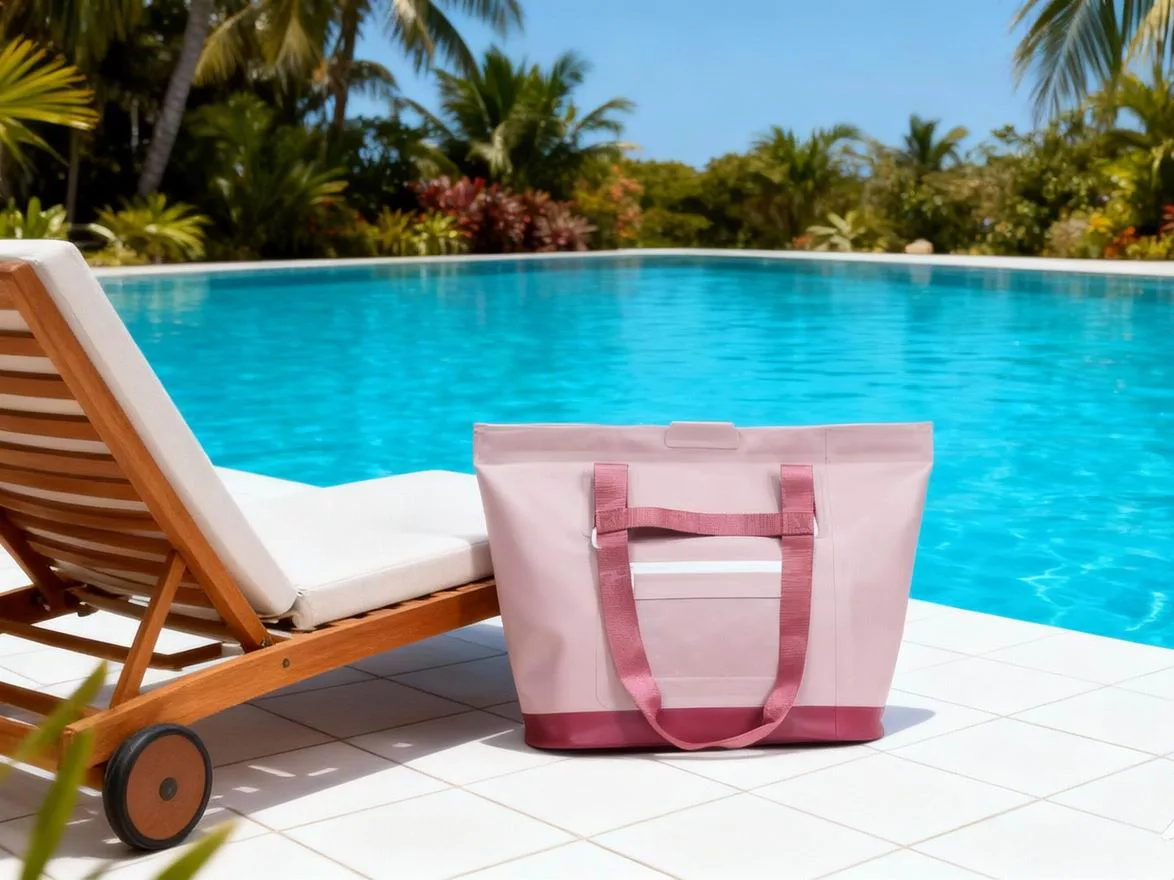
A welded roll-top makes a serviceable cooler for drinks and for icing a catch, provided you understand what it is: insulation from trapped air and the film itself, not from a foam core. Expect ice to last roughly half as long as in a moulded cooler of the same volume: about 6 to 8 hours for a 20L bag in 28 °C air with a 2 kg ice load, against 14 to 18 hours for a rotomoulded box. That is enough for a day trip and not for a two-day run.
Two details make it work. Pre-chill the contents before they go in, because ice spent cooling warm drinks is ice wasted; and keep the bag out of the sun and off a hot deck, since a black bag on a steel deck in full sun will lose ice twice as fast as the same bag in the shade. Meltwater is contained, which is a genuine advantage: a welded bag does not leak brine into the boat the way a holed cooler bag does. For catch, use a dedicated 30L to 40L bag lined with a catch bag or a plastic liner, and rinse it the same day: fish blood and slime in a clothing bag is the mistake that ends that bag's usable life.
The end-of-trip rinse that doubles bag life
- Empty everything on the dock, including the catch bag and any wet clothing.
- Rinse the outside with fresh water at ambient temperature, working the crystals out of the fold.
- Open the mouth, rinse the inside, and pour the water out through the closure rather than over the rim.
- Wash any bag used for bait or fish with mild dish soap, then rinse twice.
- Work each buckle through its full travel while wet, then rinse it again.
- Dry in shade with the mouth open and the buckle unclipped, then store loosely rolled.
The fourth step is the one people skip and the one that matters most for odour. Protein residue needs a surfactant, not just water, and a bag that smells faintly of bait will smell strongly after two weeks in a hot garage. Use a mild dish soap at a low concentration, avoid anything with bleach or solvent, and rinse until the water runs clear. Odour chemistry and the safe methods are covered in our deodorising guide.
Hardware deserves its own minute. A cam buckle that has been left salty for a season will slip under load, and a centre-release that has dried with crystals inside will not release at all. Work every buckle while it is wet, rinse again, and check that the spring returns fully. Replacing a buckle is a two-minute job with a standard part; discovering at sea that one will not open is not.
Safety gear that must stay dry
Some items have no tolerance for water: a handheld VHF, flares, a first-aid kit, an EPIRB or personal locator beacon, and any medication. Each belongs in its own welded pouch or small roll-top, colour coded, stored in the same place on every trip so it can be found in the dark and in a hurry. A 5L roll-top per critical item is far better than one shared bag, because a single failed seal then costs one item rather than all of them.
Check the safety pouches on a schedule rather than when you remember. Once a month, open each one, confirm the contents are dry and the device powers on, re-roll with three folds, and note the date. Batteries in a sealed bag corrode slowly even when dry, so inspect the contacts as well. This is the same discipline a sailing crew applies to a grab bag, and it is described for multi-day passages in our sailing dry bag plan.
Weather is the other half of offshore safety and it changes what you carry. A forecast of a 25 km/h sea breeze and 1 m swell is a light-clothing day; the same trip with a 40 km/h wind and a 2.5 m swell means full waterproofs, more layers, and every bag lashed down before you leave the dock. Marine forecasts and sea-state predictions for US waters are published by NOAA, with tide and coastal detail from NOAA Ocean Service; read both the night before and again on the morning of the trip.
Four specification lines change when a bag goes offshore. Film thickness goes to 0.5 mm, because hooks and sinkers are point loads. Hardware should be corrosion-resistant and standard, so a buckle can be replaced dockside. Colour should be a mid-tone that hides salt staining and reflects some sun. And every bag should have welded D-rings rather than sewn loops, because a lashing point that tears out in a swell loses the bag and everything in it.
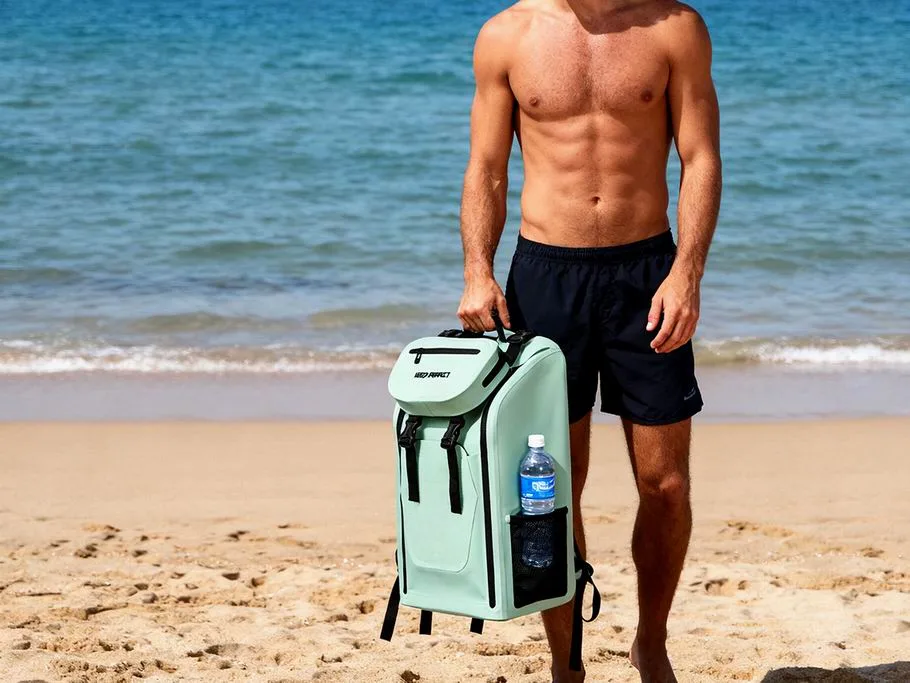
The format question is easier. A backpack harness is useful for the walk from the truck to the boat and useless on deck, where the bag should be lashed rather than worn. A duffel with a flat base stores better in a cabin locker and under a gunwale. Most offshore anglers end up with one backpack-format bag for the walk and two or three plain roll-tops for everything that stays on the boat. Format trade-offs by boat type are set out in our boat matching guide.
Pre-trip checklist for a day offshore
- One 20L bag with a complete dry change of clothes, packed at the top.
- One 10L bag for phone, VHF, documents and medication, with a desiccant sachet.
- One 10L bag dedicated to wet clothing, gloves and the fillet apron.
- One 30L to 40L bag for ice, drinks or catch, lined and rinsed the same day.
- Colour coding per angler so bags can be identified without opening them.
- Every bag lashed through welded D-rings, never wedged into a corner.
- Fold lines rinsed and checked for salt crystals before the final roll.
Run the list the evening before rather than at the dock, because the items that get forgotten are the ones that are stored wet from the previous trip. The wet clothing bag and the catch bag are almost always still damp on a Friday night; drying them properly then means they are usable on Saturday morning instead of becoming the source of the smell in the cabin.

Setting up a charter or club fleet
For a charter operation or a fishing club, standardise on two sizes and one colour rule: a 20L personal bag per angler in a distinct colour, and a 40L shared bag for ice and catch in a single dark tone. Standardisation means a lost or damaged bag can be replaced without breaking the system, crew can tell at a glance whether the right number of bags is aboard, and rinsing at the end of the day takes one pass rather than six.
Specify three things in writing when ordering: film thickness at 0.5 mm, welded D-rings at every lashing point, and a closure geometry that is identical across sizes so a crew member trained on one bag can close any of them. Those three lines do more for fleet durability than anything else on a specification sheet, and they are the ones most often omitted because they do not appear in a product photograph. Our team has produced waterproof bags to this kind of specification since 2014 in an SGS-verified 4,950 m² facility, with a 500-piece minimum, sampling in 6 to 10 working days and bulk in 35 to 50 days.
Two closing habits separate a good setup from a lucky one. Rinse the same day, every time, because salt and protein both set overnight and no amount of effort on Sunday undoes a bag left in a hot truck since Friday. And keep a spare 10L bag aboard permanently: it covers the failure of any other bag, it doubles as a wet-gear bag when someone gets soaked, and it costs less than the fuel used to reach the fishing grounds. The wider range of formats is on the product line page, and comparable freshwater loads are covered in our bass fishing guide.
Frequently asked questions
Q1. What size dry bag do I need for deep sea fishing?
Plan on 30 to 60 litres total: a 20L for clothing and layers, a 10L for electronics and documents, and a 30L to 40L for ice, catch or wet gear. A half-day inshore trip needs only 8 to 12 litres.
Q2. What waterproof rating do I need offshore?
IPX6 minimum, because bow spray and deck wash are directed jets of water. Choose IPX7 for anything that could go over the side, since that covers 30 minutes of immersion at one metre.
Q3. How do I stop hooks puncturing my dry bag?
Keep all hooks in a latched tackle box, never place a bag on or under a bait board, and put a sacrificial towel or foam pad under any bag that lives on deck. Use 0.5 mm film, which resists point loads far better than 0.3 mm.
Q4. Can I use a dry bag as a cooler offshore?
Yes for a day. Expect 6 to 8 hours from 2 kg of ice in a 20L bag at 28 °C, against 14 to 18 hours in a moulded cooler. Pre-chill the contents and keep the bag shaded and off a hot steel deck.
Q5. How do I keep my phone dry on a fishing boat?
Use two barriers: an inner sealed pouch and an outer 10L welded roll-top, stored on a console shelf rather than in a pocket. Add a desiccant sachet and air the bag out after every trip.
Q6. How often should I rinse saltwater off my bags?
Every single trip, the same day. Salt crystals abrade the fold line each time the bag is opened, and combined with UV that is what ends a bag's life years early.
Q7. What is the best colour for an offshore dry bag?
A mid-tone such as grey, blue or olive. Black film on a rail in full sun can reach 60 to 75 °C and stiffens fastest, while pale colours show salt staining and scuffs immediately.
Q8. Should I lash dry bags down on a fishing boat?
Always. Two straps through welded D-rings to a cleat or rod holder base take ninety seconds. A bag wedged into a corner will move on the first big roll and end up against something sharp.
Q9. How do I get fish smell out of a dry bag?
Wash with mild dish soap, rinse twice, and dry open in shade. Protein residue needs a surfactant, not water alone. Never use bleach or solvent degreasers on TPU film.
Q10. Can I repair a punctured bag at sea?
Yes temporarily. Carry two TPU patches, a scrap of film and adhesive in the 10L electronics bag; a tape patch will get you through the day and a proper patch applied ashore lasts indefinitely.
Q11. Do I need a separate bag for wet clothing?
Yes. A soaked fleece or a fillet apron carries slime and residue, and sharing a bag means the dry change of clothes ends up damp and smelling. A smooth welded 10L rinses out in a minute.
Q12. Why does my buckle stick after a fishing trip?
Salt crystals dried inside the mechanism. Work every buckle through its full travel while wet, rinse again, and check the spring returns. A buckle that will not release is a real problem offshore.
Q13. What should go in a fishing first-aid dry bag?
A 5L welded roll-top with dressings, a pressure bandage, antihistamines, any personal medication and a pair of gloves. Keep it colour coded and in the same place on every trip.
Q14. Is a backpack or a duffel better on a fishing boat?
A backpack for the walk from the truck to the boat and a duffel or plain roll-top for anything that stays aboard. On deck a bag should be lashed rather than worn, and a flat base stores better under a gunwale.
Q15. How long does ice last in a dry bag?
About 6 to 8 hours for 2 kg of ice in a 20L bag at 28 °C in shade, roughly half the life of a moulded cooler. Pre-chilling the contents and keeping the bag out of the sun matter more than the bag itself.
Q16. How many bags should a charter boat carry for six anglers?
Six 20L personal bags, one per angler in a distinct colour, plus one or two 40L shared bags for ice and catch. Colour coding makes the head count instant and keeps medication and valuables separated.
People also ask
How do you keep gear dry on a fishing boat?
Split the load into three welded bags: clothing in a 20L, electronics and documents in a 10L stored in the cabin, and wet gear or catch in a dedicated 30L. Lash everything through welded D-rings and rinse the fold lines before rolling.
Are dry bags good for saltwater fishing?
Yes, provided the seams are welded and the film is 0.5 mm. Salt spray and deck wash are IPX6 events, and hooks and sinkers are point loads that thin film will not survive.
What size dry bag for a day of offshore fishing?
Around 30 to 40 litres in total for one angler: a 20L for layers and a dry change, plus a 10L for electronics. Add a separate 30L to 40L bag if you are carrying ice or catch.
How do you stop a dry bag smelling of fish?
Keep fish and bait residue out of clothing bags entirely, wash the dedicated bag with mild dish soap the same day, rinse twice and dry open in shade. Protein needs a surfactant, not water.
Can you use a dry bag as a cooler on a boat?
Yes for a single day. Ice lasts about half as long as in a moulded cooler, so pre-chill contents, keep the bag shaded and expect 6 to 8 hours from 2 kg of ice at 28 °C.
Why do dry bags wear out faster at sea?
Because spray dries to abrasive salt crystals in the fold, UV reflected off water is stronger, and a rolling deck wears one contact patch continuously. Rinsing after every trip addresses the first two and lashing addresses the third.
Need this in production volume?
QUANZHOU JUNYUAN BAGS has produced waterproof bags since 2014 in an SGS-verified 4,950 m2 facility in Fujian, China. Minimum order 500 pieces, sampling in 6–10 working days, bulk in 35–50 days, FOB Xiamen — write to service@junyuanbags.com with your spec and target market.