Home / Blog / Buying & Comparisons
Waterproof Backpack vs Dry Bag Liner
A 30L welded waterproof backpack weighs 940 to 1,150 g empty and costs USD 32 to 68, while a 20L roll-top dry bag used as a liner inside an ordinary pack weighs 190 to 260 g and costs USD 9 to 18. The backpack wins on access speed and on carrying comfort once you are walking more than about 3 km with 8 kg or more; the liner wins on weight and on cost per litre by a factor of roughly three. The combination that survives a full submersion and still carries well is a liner inside a waterproof backpack, which sounds redundant until you have watched one closure fail.
This comparison is written for people choosing one system for a season rather than for a single trip. It walks through what each option actually protects against, the grams you carry all day, how long it takes to reach one item at the bottom, what fails first in each design, and what a season of use really costs once repairs are counted. The short version: pick the backpack if you walk to the water, pick the liner if you drive to it, and buy both if the load includes a laptop or a camera body.
- Two systems, three different jobs
- What each system actually keeps out
- Weight and bulk carried all day
- Access speed: reaching the one thing you need
- Waterproof ratings, read properly
- Seam architecture and where each system leaks
- Carrying comfort and centre of gravity
- Cost per litre and cost per season
- Failure modes, side by side
- Hybrid setups that actually work
- Matching the system to the activity
- Care, drying and repair differences
- Five questions that settle it
Two systems, three different jobs
The confusion starts because the words overlap. A waterproof backpack is a carrying system that happens to be sealed: welded shell, sealed or protected opening, and a harness that transfers 8 to 14 kg to your hips. A dry bag liner is a sealing system that happens to be carried: a welded tube with a roll-top closure that goes inside somebody else’s pack. They solve different problems, and the question is which of the three jobs you actually need done: keeping water out, carrying weight comfortably, and reaching your kit quickly.
Only one of the two systems does all three, and it does not do all three equally well. A welded backpack keeps rain and splash out, carries 12 kg over 12 km without complaint, and lets you reach the top third of the load in about ten seconds. A liner keeps a full immersion out, which the backpack may not, but it turns every retrieval into a dig through whatever you packed last. Naming the job you care about most is most of the decision.
What each system actually keeps out
| Exposure | Waterproof backpack, welded | Dry bag liner in a normal pack | What you should expect |
|---|---|---|---|
| Forty minutes of steady rain | Dry inside | Pack shell wets through, liner dry | Both work, pack gets heavy |
| Paddle spray at 20 km/h | Dry inside | Liner dry | Both work |
| Bag dropped in a river, 30 s | Usually dry, check the rating | Dry | Liner is the safer answer |
| Bag dragged under for 2 min | Depends on the closure rating | Dry | Liner, inside a second bag |
| Standing in 10 cm of bilge water | Dry if the base is welded | Dry | Both, if the base has no seam |
| Jet wash at a marina | May leak at the zip or mouth | Dry | Liner, or keep the bag away |
The pattern in that table is consistent: the liner wins every immersion case and the backpack wins nothing that the liner cannot match, provided the liner is closed properly. The backpack wins on the exposure the table does not measure, which is continuous rain while you are walking. A liner inside a normal pack means the pack itself absorbs one to two kilograms of water over a wet day, and that weight is on your shoulders for the whole walk.
That absorbed water is the hidden cost people forget. A 1,400 g fabric pack can take up 900 to 1,300 g of water in an hour of heavy rain, and unlike a welded shell it does not shed it when the rain stops. Carrying an extra kilogram for six kilometres is roughly 6% more energy per kilometre, which on a long day is the difference between arriving fresh and arriving sore.
Weight and bulk carried all day
Weight is the easiest axis to measure and the one most buyers ignore. A 20L liner at 210 g plus a normal 35L pack at 1,250 g is 1,460 g before you load anything. A 30L welded waterproof backpack at 1,050 g is 410 g lighter for slightly less usable volume, and every gram saved on the shell is a gram you can spend on food, water or a warmer layer. Over a 12 km day that is a rounding error; over a five-day trip it is noticeable.
Bulk matters in the other direction. A liner is floppy, so it takes the shape of whatever you stuff into it and wastes less space in an odd-shaped pack compartment. A welded backpack with a structured back panel holds its shape, which is better for your back and slightly worse for packing awkward loads like a wetsuit or a coiled rope. If your load is soft and compressible, a sleeping bag and clothing for example, the liner uses space better; if it is dense and heavy, the harness wins immediately.
Access speed: reaching the one thing you need
| Action | Waterproof backpack | Liner inside a normal pack | Difference |
|---|---|---|---|
| Reach a top-layer snack | 8-12 s | 45-70 s | Backpack is 5x faster |
| Reach an item at the bottom | 35-55 s | 90-150 s | Backpack is 3x faster |
| Open in heavy rain | 12-18 s, contents exposed | 25-40 s, contents exposed | Backpack, marginally |
| Repack after a search | 45-70 s | 90-140 s | Backpack is 2x faster |
| Find one bag inside a hatch | One handed, by colour | Two handed, by feel | Backpack |
Access time is where the liner loses, and it loses badly. Reaching a rain shell at the bottom of a liner means unrolling the mouth, pulling out three items, digging, and then repacking in the rain with everything exposed. On a kayak deck or a wet pontoon that is not a nuisance, it is the moment the kit gets wet. The waterproof backpack is not fast either, but a roll-top mouth at your shoulder level is far easier to work one-handed than a liner buried in a pack.
Colour coding and a two-bag split fix most of the liner penalty. Three liners of 5L, 10L and 15L, each a different colour and each with a written contents tag, cut the average retrieval from about 100 seconds to about 35, because you are never digging to the bottom of one big bag. That is the system expedition paddlers use, and it costs about USD 30 for three bags rather than USD 50 for one backpack.
Waterproof ratings, read properly
Ratings are the most abused number in the category. The ingress protection grades in IEC 60529, published by the IEC, describe a laboratory test: IPX6 is powerful water jets, IPX7 is 30 minutes at one metre, IPX8 is a depth and duration agreed between the brand and the laboratory. A backpack with a roll-top mouth and a welded shell can honestly claim IPX7. A backpack with a coated zip generally lands at IPX5 or IPX6, which is rain and jets, not immersion.
A liner is simpler: a welded tube with three folds is either sealed or it is not, and most roll-top dry bags pass an IPX7 immersion check because the closure is the whole design. The practical consequence is that a USD 12 liner can be more waterproof than a USD 90 backpack, and the rating printed on the backpack is usually limited by its opening rather than its fabric. Full detail is in the IPX rating guide, and the rain-versus-dunking distinction is set out in rain protection versus submersion.

Seam architecture and where each system leaks
Seams decide service life. A radio-frequency weld on TPU laminate fuses the two films into one continuous piece, and a well-tuned weld is stronger than the fabric around it: pull tests on 0.5 mm TPU typically break the film at 380 to 460 N per 50 mm rather than peeling the seam. A taped and stitched seam relies on an adhesive layer that softens with heat and hydrolysis, and it is the first thing to go on a pack that lives in a hot car or a damp garage.
Stitched-and-taped construction is not automatically bad. On a pack that only ever sees rain, a good tape lasts five to eight years, and the stitching lets the shell take complex three-dimensional shapes that a flat weld cannot. Where it fails is immersion and abrasion: water under pressure finds the needle holes at the tape edge, and a tape edge that lifts 2 mm will lift 20 mm within a season. See welded versus stitched seams for the failure sequence.
Abrasion resistance is the other half of the story, and it is measurable. On standard abrasive-wheel testing maintained by ASTM, a 0.5 mm TPU film on a 500D face typically runs two to three times the cycles to breakthrough of a 0.3 mm PVC coating on a 420D face. That is why a liner that lives inside a pack, protected from everything, outlasts a backpack shell that gets dragged across a concreted slipway every weekend.
Carrying comfort and centre of gravity
Comfort is not a waterproofing question but it decides what you actually use. A harness with a padded hip belt transfers roughly 70% to 80% of the load to the hips on a well-fitted pack, which is why 12 kg in a backpack is tolerable and 12 kg slung from one shoulder is not. A liner has no harness of its own, so it inherits whatever the host pack offers, and a liner stuffed with 10 kg of dive kit into a school-style daypack is miserable within twenty minutes.
Centre of gravity matters on water as much as on land. A soft liner sits low and conforms to the hull or the deck, which is better for boat trim than a structured backpack that stands up and raises the centre of mass. On a kayak, a SUP or a small sailing dinghy, that difference is worth more than any harness feature. On a 10 km walk to a put-in, the opposite is true, and the harness wins by a wide margin.
Cost per litre and cost per season
| Option | Buy-in cost | Usable volume | Cost per litre | Realistic service life |
|---|---|---|---|---|
| 20L roll-top liner | USD 12 | 17 L after rolling | USD 0.71 | 5-8 years, light use |
| Three-bag liner set, 5/10/15L | USD 31 | 25 L total | USD 1.24 | 6-9 years |
| 30L welded waterproof backpack | USD 48 | 26 L after rolling | USD 1.85 | 4-7 years, harness limits it |
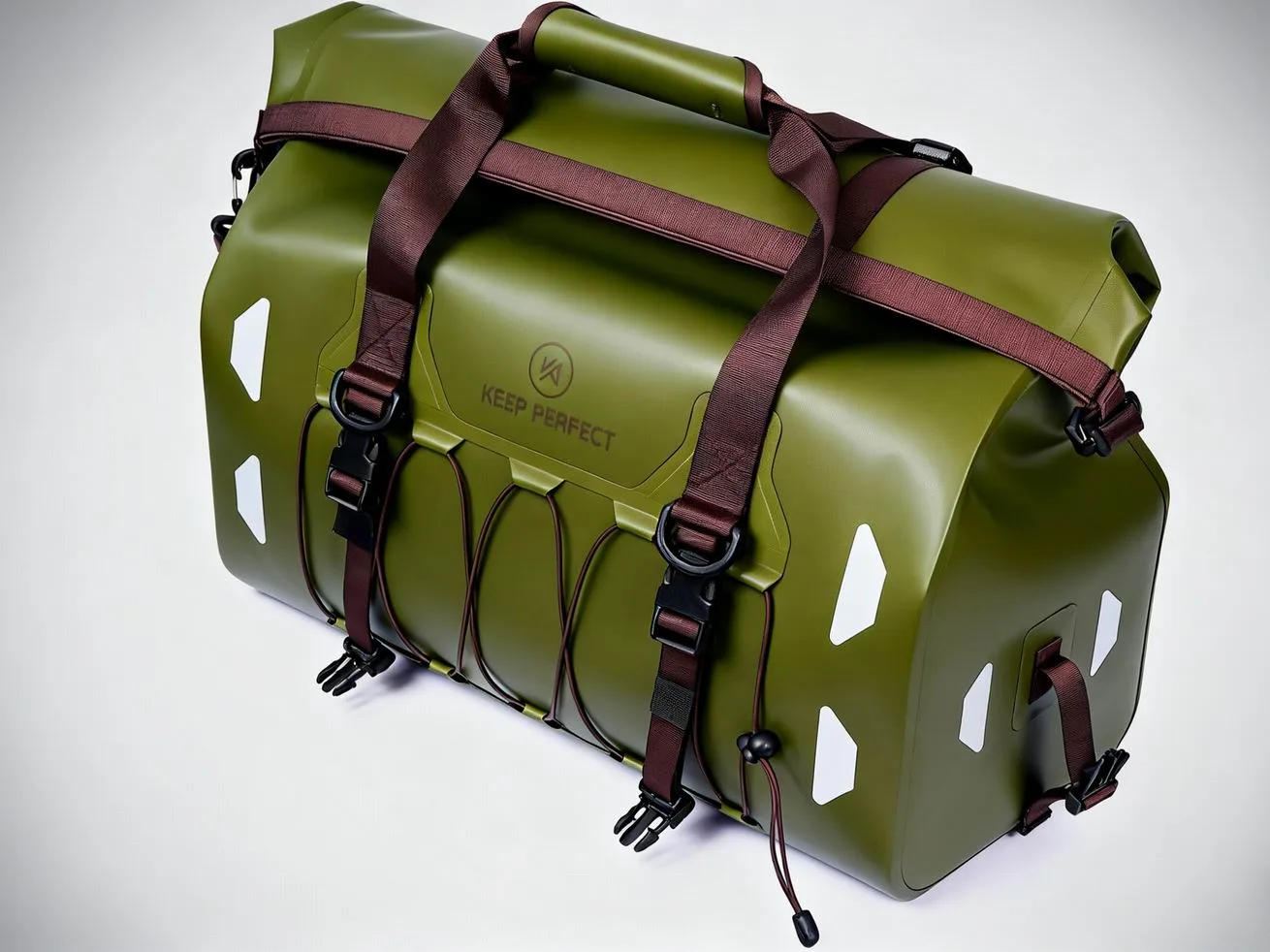
| 40L waterproof duffel with straps | USD 62 | 35 L | USD 1.77 | 5-8 years |
| Liner plus a used 35L pack | USD 12 plus existing | 17 L sealed | USD 0.71 | Liner outlives the pack |
Cost per litre favours the liner by a factor of roughly two and a half, and the gap widens if you already own a pack. What the table hides is the cost of the failure each option insures against. A liner protects the contents but not the pack, so a soaked pack still needs drying and may mildew; a waterproof backpack protects both, and a laptop that survives a dunking is worth more than the USD 36 difference.
Service life is asymmetric. The liner usually outlives the pack it sits in, because it does almost no work: no abrasion, no UV on the weld, no load on the seams. The backpack fails at the points that do the work, which are the harness foam, the shoulder strap welds and the closure. Plan on a liner lasting two packs, and on a backpack needing strap or buckle work in year four; both are cheaper than replacing the system.
Failure modes, side by side
| Failure | Waterproof backpack | Dry bag liner | Field fix |
|---|---|---|---|
| Closure left partly open | Slow leak at the mouth | Slow leak at the fold | Re-roll, three folds, buckle tight |
| Puncture from a sharp tool | One hole, contents at risk | One hole, contents at risk | Tape inside, patch outside, 5 min |
| Seam peels at a corner | Leak under load | Rare, no load on the seam | Patch with TPU tape and heat |
| Harness or strap weld tears | Bag still seals, cannot be carried | Not applicable | Sew a webbing loop, or carry it |
| Zip jams on grit | Cannot close at all | Not applicable | Rinse, dry, re-lubricate |
| UV stiffening after 500 h | Shell cracks at folds | Protected inside the pack | Retire the bag |
Reading that table as a buyer: the liner has fewer failure modes because it has fewer parts. No zip, no harness, no structured panel, no foam to rot. The backpack has more ways to fail but fails more gracefully, because a torn strap weld leaves you with a dry bag you can carry by hand, while a liner with a punctured wall leaves you with a wet pack and no second barrier.
That points at the real answer for expensive kit. Two independent barriers, a liner inside a welded backpack, cost about USD 60 together and reduce the chance of both failing on the same day to almost nothing. A camera body in a 10L liner inside a 30L waterproof backpack survives a capsize, a downpour and a conveyor belt, and each layer can be inspected and patched separately. See single versus double layer construction for the same argument at fabric level.
Hybrid setups that actually work
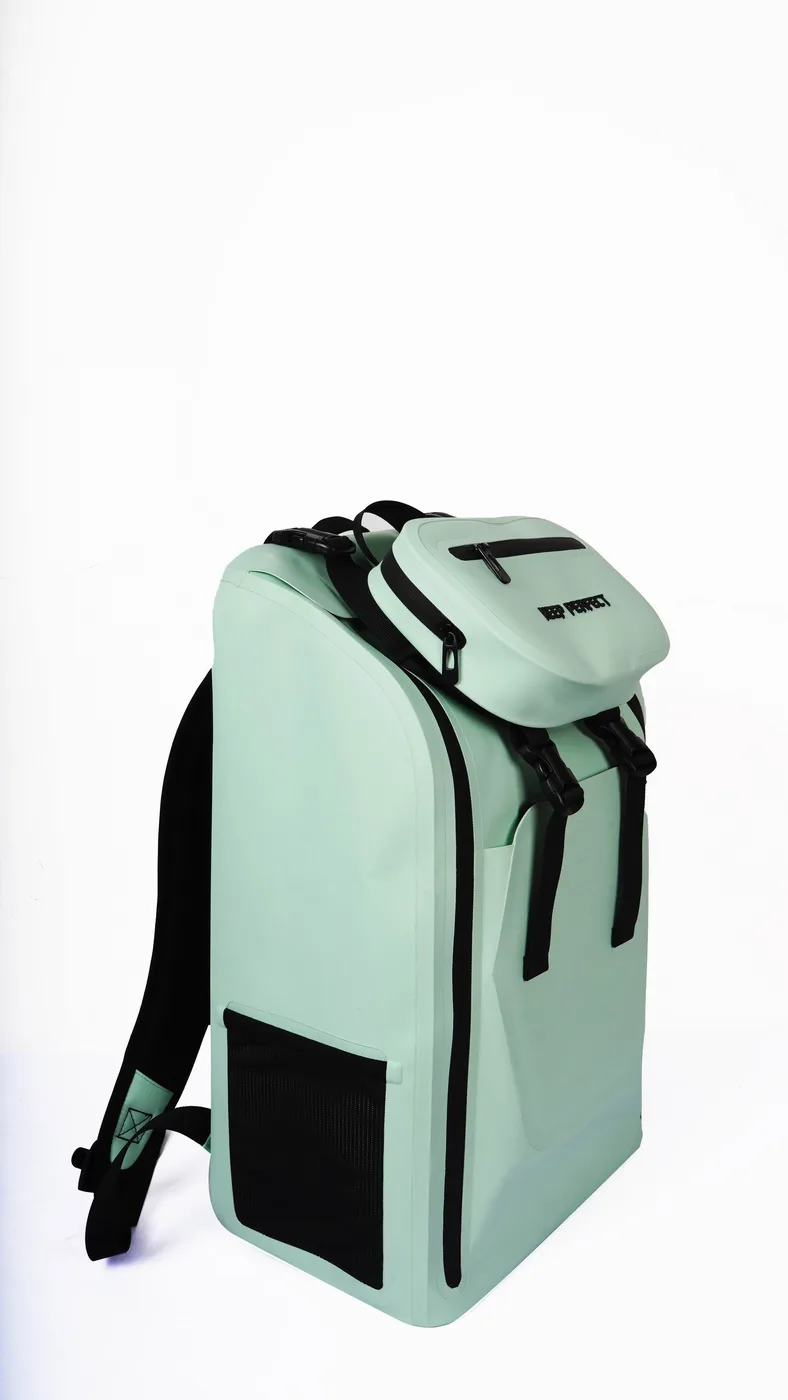
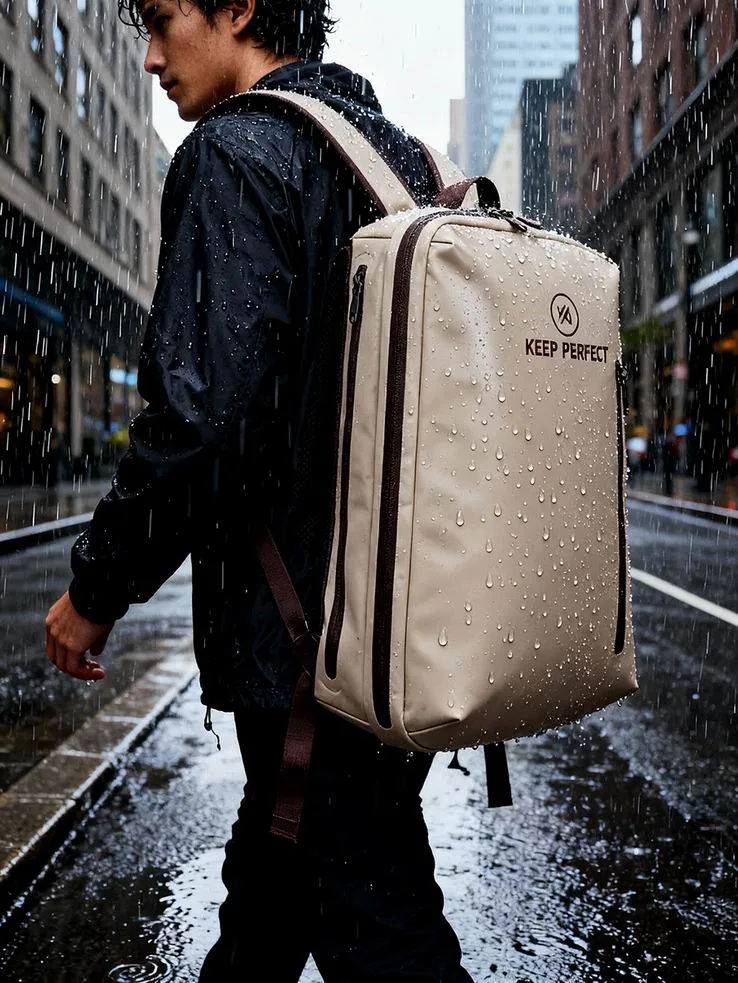
Three hybrids cover nearly every real use. The first is a liner set inside an ordinary pack, colour coded by contents, which is the cheapest way to make an existing pack immersion-proof and costs about USD 31 for three bags. The second is a roll-top dry bag worn as a backpack, which is one welded system with a harness and the best balance of access and sealing for most paddlers and commuters.
The third is the two-barrier stack: a small liner inside a waterproof backpack, used when the load includes electronics or documents. It adds 210 g and USD 12, and it turns a single point of failure into two independent ones. The mistake to avoid is the reverse stack, a backpack inside a dry bag, which is fast to pack and impossible to open on a wet deck without exposing everything.
A fourth option deserves a mention and is usually a trap: a rain cover over an ordinary pack. Covers cost USD 8 to 18, weigh 90 to 160 g, and keep rain off the shell for about a season before the coating fails at the folds. They do nothing for immersion, nothing for spray from below, and they blow off in a 40 km/h coastal wind. Buy a liner for the same money.
Matching the system to the activity
- Kayak or canoe day trip: three colour-coded liners, 5L, 10L and 15L, no harness needed on the water.
- Coastal walk to a launch: 30L welded waterproof backpack, because the harness earns its keep on the walk.
- SUP and surf: 10L liner lashed to the deck plus a dry bag at camp; a backpack on a board is a hazard.
- Dive or snorkel boat: one 20L liner per dive bag, because boat decks are permanently wet.
- Daily commute in a wet city: 25L waterproof backpack, because access speed matters more than immersion.
- Multi-day expedition: liner set inside a haul pack, plus one welded backpack for the portage day.
Notice that the walk length is the deciding variable in four of those six cases. Where the walk is short or nonexistent, the liner wins on weight and cost; where you carry the load on your back for more than two or three kilometres, the harness wins regardless of what the water is doing. Boat type matters too: a sit-on-top kayak or a paddleboard has no dry compartment, so everything rides on deck and needs its own sealed shell.
Formal comparisons by format are worth reading once before you buy. The backpack versus duffel comparison covers the volume and access trade-offs, and dry bag volume versus backpack volume explains why a 30L dry bag does not hold what a 30L pack holds. Our TPU waterproof backpack line uses the same welded shell as the roll-top range, so the two systems can be mixed in one order.
Care, drying and repair differences
Both systems want the same three things: fresh water rinse after salt exposure, shade drying with the mouth open, and loose rolled storage rather than a hard fold. The difference is what needs attention. A liner has one thing to check, the fold line and the weld corners, and a thirty-second air squeeze tells you everything. A backpack adds a harness to rinse, foam to dry, and a zip or buckle to work through its travel.
Drying time is where the backpack is genuinely worse. A liner turned inside out over a rail dries in two to four hours; a backpack with a padded back panel and closed-cell foam takes eight to twenty-four, and drying it against a radiator to speed that up is the fastest way to delaminate the foam. Store both open and upside down so the mouth is the lowest point and any trapped water can leave.
Repair is easier on the liner. A 60 mm TPU patch and a little heat fixes a puncture in about five minutes and restores most of the strength, because the repair is a flat film-to-film bond. Repairs on a backpack are often on a strap root or a seam corner where the geometry is three-dimensional, and those need a sewing awl or a professional. Keep a 60 mm patch, a tube of sealant and a spare buckle in the kit either way.
Five questions that settle it
- How far do you walk with the load? Over 3 km points to a harness and a backpack.
- Will the bag be submerged, or only rained on? Submersion points to a liner with three folds.
- Is there a laptop, camera or passport in the load? If yes, use two barriers, not one.
- Does the load exceed 8 kg? Above that, a liner in a daypack is uncomfortable within twenty minutes.
- Do you already own a pack you like? A USD 12 liner makes it waterproof for one season.
Answer those five honestly and the decision is usually obvious within a minute. Most people who buy a waterproof backpack and then regret it were really buying for a single trip where the bag got dunked; most people who buy a liner and regret it were really carrying 10 kg up a hill. Neither mistake is expensive, and both are fixable for about USD 12 in the right direction.
One closing point on buying both: order them in the same colour family and the same closure geometry, so liners and shells are interchangeable across a household or a club fleet. Our roll-top platforms share one closure from 5L to 90L, and the welded backpack shells use the same 0.5 mm TPU laminate, which is what makes a mixed system practical. The current formats are listed under products, production standards are documented and the light versus heavy-duty guide helps if you are still weighing film thickness against weight.
Frequently asked questions
Q1. Should I buy a waterproof backpack or a dry bag liner?
Buy the backpack if you walk more than about 3 km with the load or carry over 8 kg; buy the liner if the bag will be submerged and the walk is short. A liner costs roughly a third as much and is more waterproof, while a harness carries better.
Q2. Is a dry bag liner more waterproof than a waterproof backpack?
Usually yes for immersion. A welded roll-top tube with three folds passes an IPX7 check, while a backpack is limited by its opening, and a coated zip typically drops it to IPX5 or IPX6. The backpack wins on continuous rain while walking.
Q3. How much weight does a liner add compared with a backpack?
A 20L liner adds 190 to 260 g inside the pack you already own, against 940 to 1,150 g for a 30L welded backpack. The liner plus a 1,250 g fabric pack is about 410 g heavier overall, but the pack shell absorbs up to 1.3 kg of water in heavy rain.
Q4. Can I use a dry bag as a backpack?
Yes, if it has a harness. A roll-top dry bag with welded straps carries 6 to 8 kg acceptably for short distances, but without a padded hip belt it puts the whole load on the shoulders, which is uncomfortable above about 30 minutes.
Q5. Do I need both a liner and a waterproof backpack?
Only when the load is expensive or irreplaceable. A 10L liner inside a 30L welded backpack costs about USD 60 together, adds 210 g, and gives two independent barriers, which is the standard approach for cameras, laptops and documents.
Q6. Why does my backpack leak but my dry bag does not?
Almost always the opening, not the fabric. A coated zip, a storm flap or a lid seam lets water in under pressure, while a three-fold roll-top has no hardware in the seal path. Check the rating the brand quotes and what part of the bag was tested.
Q7. How long does a dry bag liner last?
Five to eight years of regular use, and often longer than the pack it sits in, because it does no work: no abrasion, no UV on the welds and no load on the seams. The fold line and the corner welds are the only parts that need inspection.
Q8. What size liner do I need for a 35L pack?
A 25L liner for clothing and a 10L liner for electronics, rather than one 35L bag. Splitting the load means a dig at the bottom takes about 35 seconds instead of 100, and one failed seal does not soak everything you own.
Q9. Are rain covers a substitute for a liner?
No. A cover keeps rain off the shell for roughly a season before the coating cracks at the folds, does nothing for spray from below or immersion, and blows off in a 40 km/h coastal wind. A liner costs the same and actually seals.
Q10. Which is better for kayaking?
Three colour-coded liners, typically 5L, 10L and 15L. A kayak hatch is a confined space, a soft liner conforms to it and sits low, and a structured backpack raises the centre of gravity and wastes space in a round hatch.
Q11. Which is better for a rainy commute?
A 25L waterproof backpack, because access speed and carrying comfort matter more than immersion. Reaching a top-layer item takes 8 to 12 seconds in a backpack against 45 to 70 seconds through a liner inside a pack.
Q12. How do I repair a punctured liner?
Dry the area, round the tear with scissors if it is a slit, apply a 60 mm TPU patch with heat and pressure for about 30 seconds, then air test. Repairs on a flat film bond restore most of the original strength; repairs at a strap root on a backpack usually need sewing.
Q13. Does a liner protect against condensation?
It protects against liquid water but not against moisture already in the load. A damp towel sealed inside a liner stays damp. Dry everything before packing, and leave the mouth open overnight at camp so the bag can breathe.
Q14. Can a liner be used as a pillow or a float?
A partly inflated liner makes an acceptable camp pillow, and a sealed liner with air in it floats, but it is not a buoyancy aid and should never be relied on as one. Keep a PFD on the person, not in the bag.
Q15. What is the cheapest way to make my pack waterproof?
A 20L roll-top liner at about USD 12, plus a second 10L liner for electronics at about USD 9. That is under a quarter of the price of an entry-level welded backpack and covers everything except continuous rain on the pack shell itself.
Q16. Do welded backpacks get heavy when wet?
No, and that is their main advantage in rain. A welded shell sheds water instead of absorbing it, so a 30L backpack gains perhaps 40 g of surface water, while a fabric pack with a liner inside can gain 900 to 1,300 g in an hour of heavy rain.
People also ask
Is a dry bag better than a waterproof backpack?
For immersion, yes: a welded roll-top liner passes IPX7 for about USD 12 and carries no hardware in the seal path. For walking and access, the backpack wins, because a harness moves 70% to 80% of the load to the hips and reaches items five times faster.
Can you put a dry bag inside a backpack?
Yes, and it is the standard expedition method. Use several colour-coded liners rather than one large bag, so a dig at the bottom takes about 35 seconds instead of 100, and a single failed seal does not soak the whole load.
What is the difference between waterproof and water-resistant packs?
A waterproof pack has welded seams and a sealing closure and can be immersion tested; a water-resistant pack has a coating and taped seams that shed rain for a while and leak under pressure. The rating usually reflects the opening, not the fabric.
How do you choose between a dry bag and a dry backpack?
Ask how far you walk and whether the bag will be submerged. Over 3 km or over 8 kg points to a backpack with a harness; regular submersion points to a liner. Electronics in the load points to using both together.
Are waterproof backpacks worth the money?
They are if you walk in the rain regularly, because the shell does not absorb one to two kilograms of water the way a fabric pack does. If you drive to the water and the bag lives in a boat, a USD 12 liner does the same sealing job.
Do dry bags work as backpack liners in heavy rain?
Yes for the contents, but the pack shell around them still soaks through and gains up to 1.3 kg. The liner keeps everything inside dry; the pack itself then needs drying at camp and may mildew if it is stored wet.
Need this in production volume?
QUANZHOU JUNYUAN BAGS has produced waterproof bags since 2014 in an SGS-verified 4,950 m2 facility in Fujian, China. Minimum order 500 pieces, sampling in 6–10 working days, bulk in 35–50 days, FOB Xiamen — write to service@junyuanbags.com with your spec and target market.