Home / Blog / Design & Branding
Seasonal Colour Trends for Outdoor Bags
Outdoor bag colour moves on a 12 to 18 month cycle, not the 10 week cycle of fast fashion. A palette that shows up in apparel in one spring reaches volume bag retail roughly 14 months later and then stays sellable for about three seasons, with neutrals running for six years or more. In the 2026 outdoor channel the split is stable: core neutrals carry 45 to 55% of unit volume, earth and mineral tones take 20 to 25%, water blues and aquas sit near 15%, and everything else, including pattern and high-visibility, divides the remainder.
That lag is the reason colour planning is a calendar problem before it is a taste problem. With three lab-dip rounds at 6 to 10 working days each and bulk at 35 to 50 days, a colour decided in March cannot reach a shelf before the following spring, so you commit to a trend before it is proven. This guide sets out what is moving in each colour family, how long each family lasts, where a trend colour cannot be executed on a waterproof substrate, which families fade fastest, and how to build a two-year roadmap that keeps the core stable while the accents rotate.
- How long a colour trend actually lasts in outdoor bags
- The core neutrals that anchor every range
- Earth and mineral tones: why clay, ochre and slate keep gaining
- Water blues, aquas and the resort channel
- High-visibility colour: the safety-led segment
- Mint, sage and the soft green shift
- Camouflage and pattern as a seasonal lever
- Pink and coral: from niche to mainstream
- Matching a trend colour to a waterproof substrate
- Which trend colours fade fastest
- Regional differences: what sells where
- Planning the seasonal drop calendar
- A two-year colour roadmap checklist
How long a colour trend actually lasts in outdoor bags
The useful number is not how popular a colour is but how many seasons it stays profitable. Across outdoor bag programmes, a fashion accent typically peaks in its second season and then loses 30 to 40% of its sell-through rate in the third, while a core neutral holds within 5% for five or six years. That asymmetry is why a balanced range is mostly boring: the accent colours create the story, the neutrals create the volume and pay for the tooling.
The lag between a colour appearing and a colour shipping is longer than most calendars allow for. Apparel adopts first, accessories follow six to nine months later, and hardgoods with welded seams and lab-dip approvals follow another six months behind that. Add three dip rounds at 6 to 10 working days each and a 35 to 50 day bulk window, and a decision made in March realistically lands in a warehouse the following February, which means the trend you are buying into is the one you can already see, not the one you expect.
Read the signal where the risk is lowest. Resort and marina shop reorders move about four months ahead of general outdoor retail because their season starts earlier, and rental fleets replace stock on a fixed cycle that reveals which colours survive abrasion and sun. Tracking reorder colour mix across a 500-piece fleet over two seasons is a more reliable predictor than a mood board, because it measures what people bought twice.
The core neutrals that anchor every range
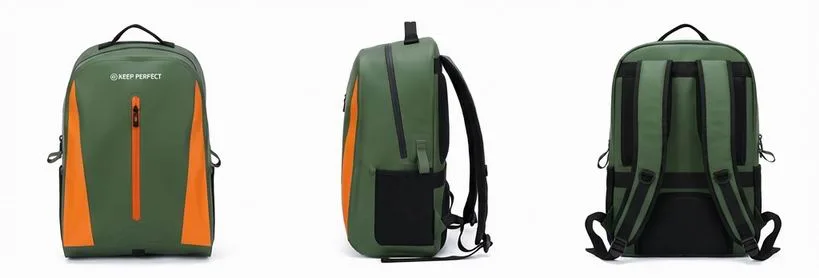
Black, olive, grey and navy are the working core of an outdoor bag range, and they behave differently from each other in the field. Black carries 30 to 35% of unit volume in watersports channels but gains 15 to 20 °C of surface temperature over ambient on a sunny deck, which matters when the bag sits beside a cooler or against a wetsuit. Olive hides abrasion and dust better than any other neutral, which is why rental and expedition programmes default to it.
Grey is the quiet problem. It sells well at 8 to 12% of units because it photographs well and matches apparel, but it shows sunscreen, boat grease and clay dust, and return rates on light grey run about 1.5 times those on olive in comparable programmes. Navy sits between the two: better soiling behaviour than grey, less heat gain than black, and the highest reorder stability of the four because it reads as neither fashion nor utility.
| Neutral | Share of unit volume | Surface heat gain in sun | Soiling visibility | Typical reorder life |
|---|---|---|---|---|
| Black | 30-35% | +15 to 20 °C | Low | 6+ years |
| Olive | 12-18% | +10 to 14 °C | Very low | 6+ years |
| Grey | 8-12% | +12 to 16 °C | High | 4-5 years |
| Navy | 8-12% | +13 to 18 °C | Low | 6+ years |
| Sand and bone | 4-7% | +8 to 12 °C | Very high | 3-4 years |
| Charcoal | 3-6% | +14 to 19 °C | Low | 5-6 years |

Earth and mineral tones: why clay, ochre and slate keep gaining
Earth and mineral tones have grown steadily for four seasons and now sit at 20 to 25% of outdoor bag units in most European and North American accounts. The driver is not outdoor activity at all: these colours migrated from hiking apparel and from interior design palettes, and they read as technical without reading as safety equipment. Clay and ochre sell in autumn programmes, slate and basalt sell all year, and sand sells in resort channels.
From a use standpoint earth tones are forgiving. They hide trail dust, sunscreen and dried salt spray far better than any pale neutral, and iron oxide based pigments give light fastness grades of 6 to 7, which is two grades better than most fashion brights. The trade-off is visibility: a clay bag on a brown riverbank is genuinely hard to spot, so pair earth tones with a reflective accent of at least 25 mm on one face if the bag will be used near water at dusk.
Execution on laminated fabric is easier here than anywhere else in the palette. Low-chroma mineral tones tolerate the gloss shift of a TPU film without separating across light sources, and they mask the faint yellow cast that welding can leave within 3 mm of a seam. If you are launching a first seasonal accent with a tight calendar, an earth tone is the lowest-risk choice available.
Water blues, aquas and the resort channel
Blues and aquas behave as two separate businesses. In general outdoor retail they take 12 to 15% of units, mostly as navy and a single mid-blue. In resort, pool and marina channels the same family reaches 25 to 35%, driven by turquoise, aqua and pale sky tones that match water and read well in photography. The same colourway list should not be shipped to both channels, because the resort palette looks out of place in a hiking account.
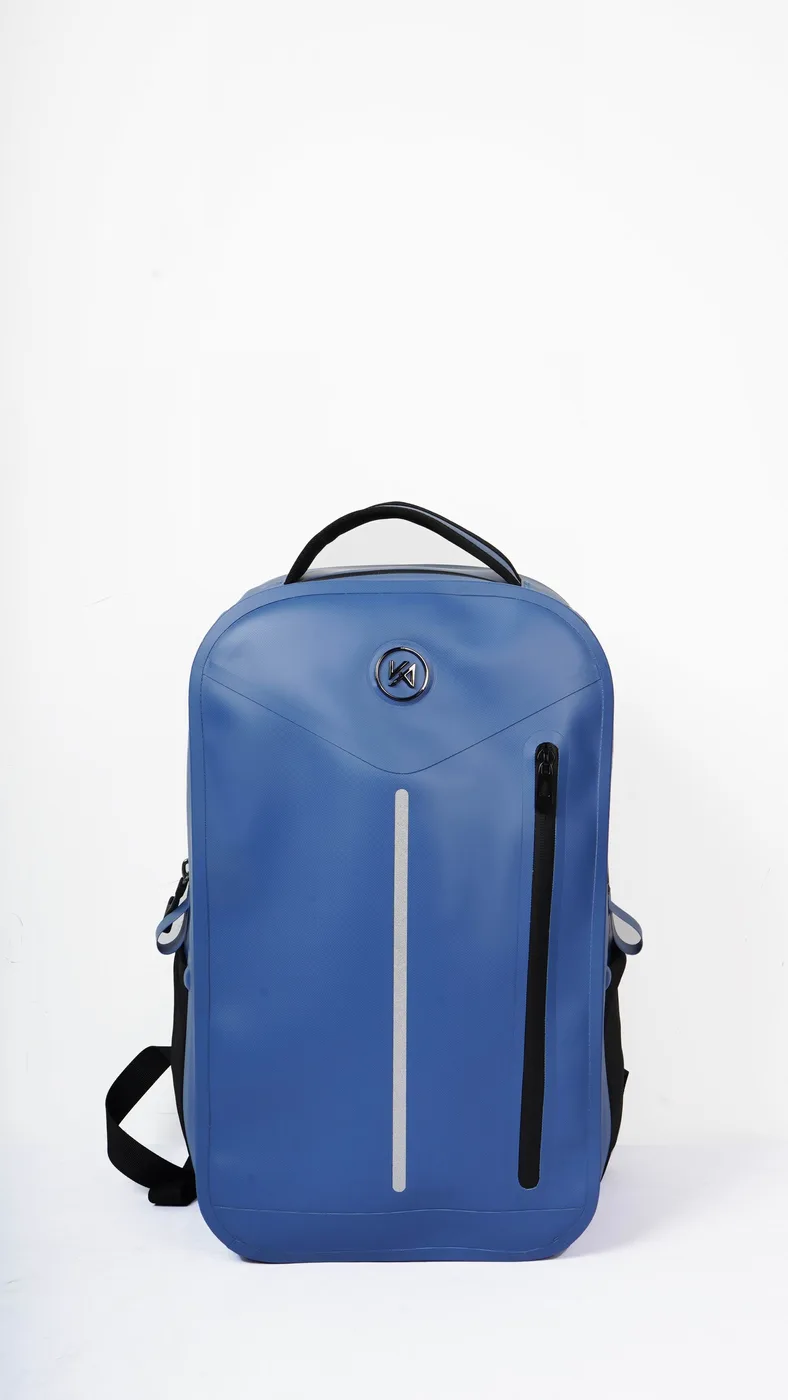
Pale blues carry two technical risks worth budgeting for. Chlorinated water shifts some blue pigments toward pink, and phthalocyanine-based turquoise can drop a full fastness grade against salt water even when it passes light exposure. Navy, by contrast, is one of the most stable colours in the whole range at grades 5 to 6 across light, salt and chlorine, which is why navy is the safe core blue and aqua is the accent.
High-visibility colour: the safety-led segment
Fluorescent yellow, blaze orange and signal green take only 5 to 10% of units but earn their place through attachment and through programmes where visibility is a specification rather than a preference. The physics is stark: a fluorescent yellow-green surface has a luminance factor around 0.70 while black sits near 0.05, so a hi-vis panel is roughly fourteen times brighter to the eye and to a headlamp beam at 50 m.
The limitation is durability. Fluorescent pigments are intrinsically less light-stable, typically grade 3 rather than grade 5, and lose around half of their chroma after 200 hours of xenon arc exposure, which on a boat deck is roughly one season of strong summer use. The practical answer is to use fluorescent as a panel, a binding or a welded accent of 10 to 20% of the visible area, and keep the body in a stable non-fluorescent colour.
Mint, sage and the soft green shift
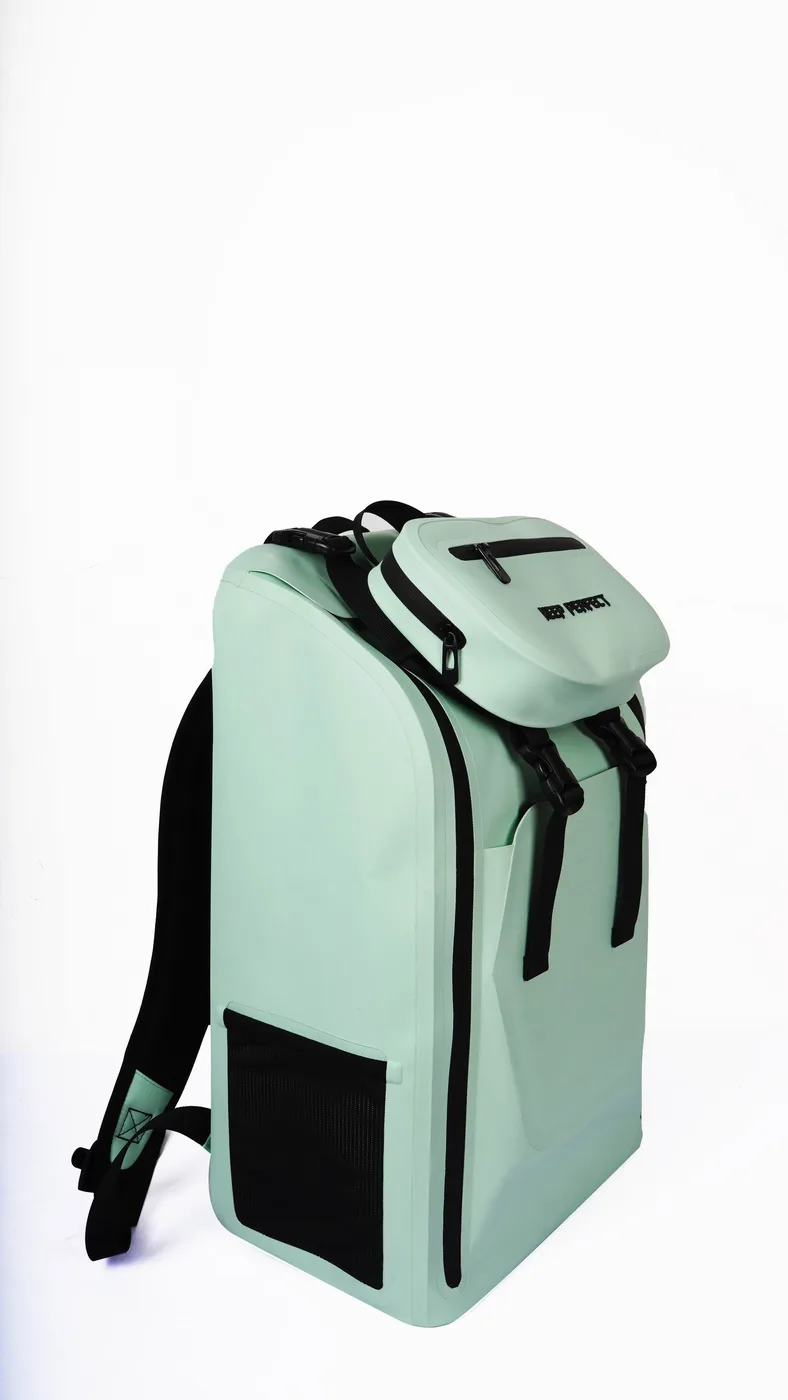
Mint and sage have moved from a niche lifestyle colour into a mainstream outdoor accent over three seasons, now appearing in roughly one in five new waterproof ranges. They work because they bridge channels: soft enough for a city commute, green enough for a trail account, and they photograph well against both sand and foliage. The strongest-selling execution is a low-chroma sage with a black or charcoal hardware package rather than a matching green.
Technically, soft greens behave like pale neutrals. Because the chroma is low, metamerism risk is lower than on any bright colour, but the lightness puts them in the same band as white for weld yellowing, so cap the weld temperature near 170 °C and check a welded sample after 48 hours. They also show soiling more than olive, so a sage bag destined for a rental or expedition programme needs a soil-resistant top finish.
Camouflage and pattern as a seasonal lever
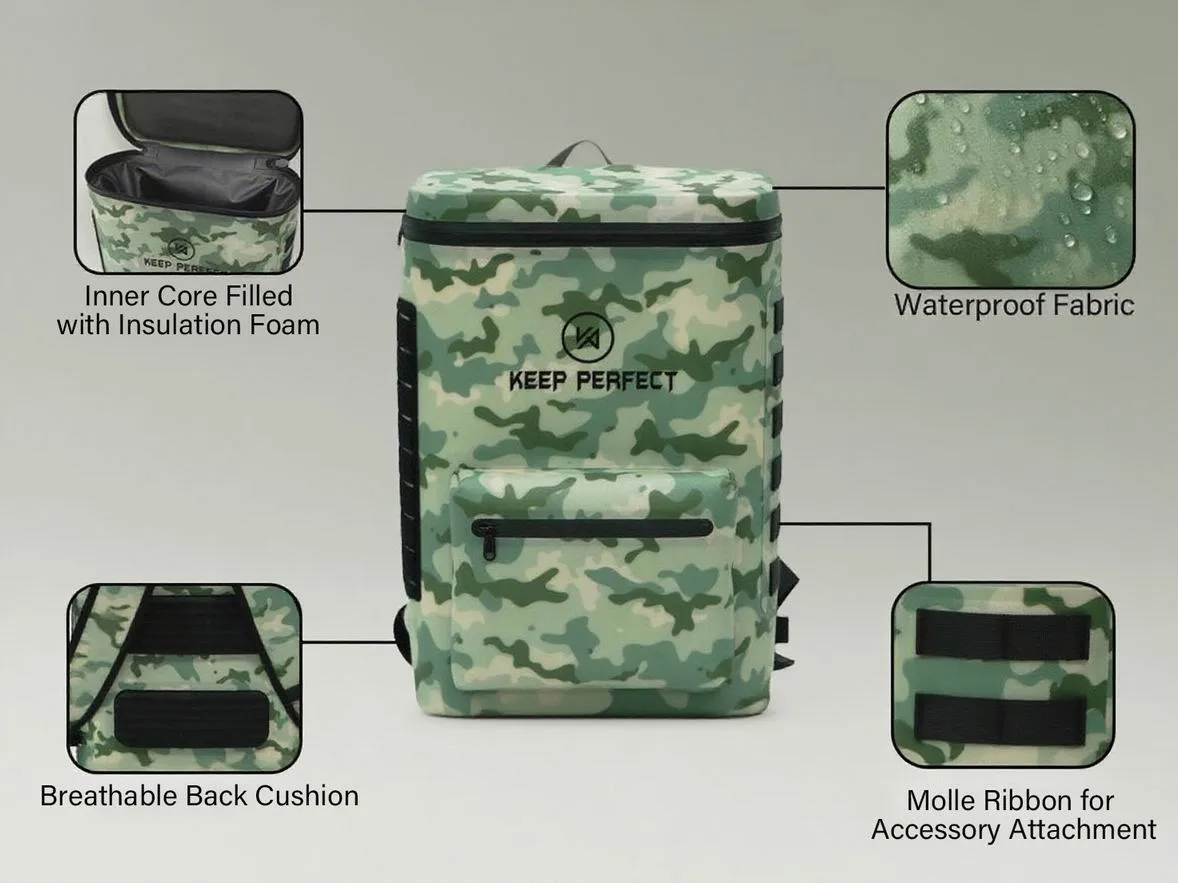
Pattern rotates more slowly than colour: a successful camouflage or geometric design runs three to five years against the two to three seasons of a fashion accent. In hunting, angling and paddle-sport accounts pattern takes 15 to 25% of units, and it is one of the few levers that raises average selling price without changing the base material cost by more than a few percent.
The cost sits in artwork and setup rather than in cloth. A new pattern needs scale variants for each size, because artwork drawn for a 90L duffel reads sparse on a 5L bag and usually has to be scaled to about 60% for the small sizes. Registration is the second tolerance: the vertical weld on a roll-top body should land in a low-contrast part of the pattern. Both decisions belong at the artwork stage, and our camouflage design notes and print method comparison cover where digital beats screen for multi-colour work.
Pink and coral: from niche to mainstream
Pink has completed the move from a childrens colour to an adult lifestyle colour in the outdoor channel, reaching 5 to 12% of units depending on region. The split inside the family matters more than the family itself: dusty rose and blush sell in Northern Europe and Japan at two to three times the rate of hot pink, while the Gulf Coast and Australian resort channels invert that ratio almost exactly.
Pink is also the clearest example of pigment choice deciding product life. Conventional red pigments sit at light fastness grade 3 to 4 and can bleed under salt exposure, while quinacridone and diketopyrrolopyrrole pigments reach grade 5 to 6 at a pigment cost premium of 8 to 15%. On a bag that will sit on a beach or a boat deck for a full summer, that premium is the difference between a one-season accent and a three-season colourway.
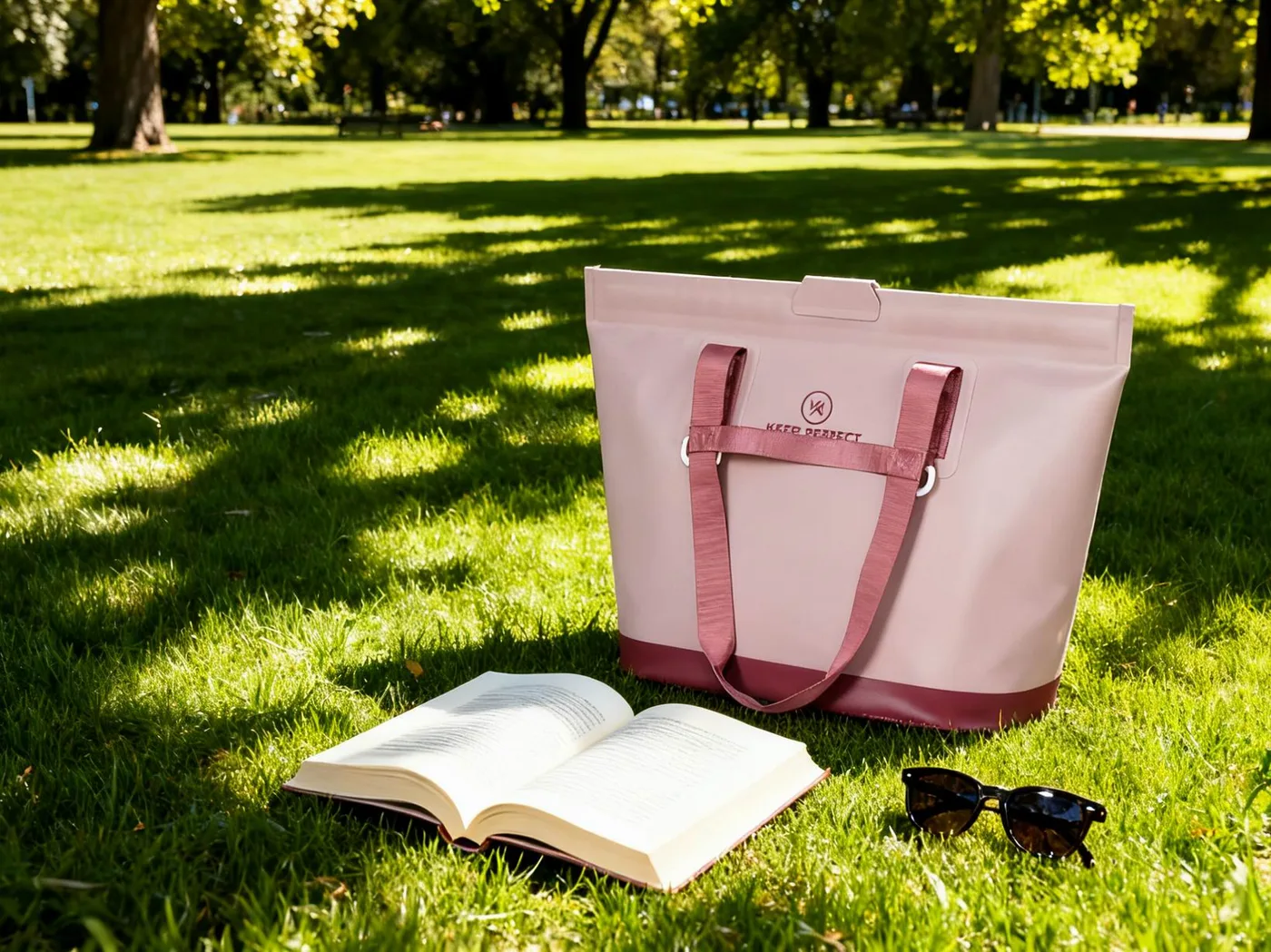
Matching a trend colour to a waterproof substrate
Every colour decision is filtered through the substrate, and the substrate sets a ceiling on what is achievable. A laminated TPU film is partly specular, so saturation reads lower on a curved panel than on a flat swatch, and the film itself carries a slight haze that grows with thickness. Recycled face fabrics add a grey cast that varies by batch, and clear window film sits outside the normal colour system entirely because the eye reads the print behind it rather than the film.
Write the substrate into the colour brief rather than discovering it at sampling. Naming the face fabric, the film thickness and the finish alongside the reference code removes one full approval round, which at 6 to 10 working days is the cheapest week you will ever save on a programme. Where a range spans formats, our colour matching guide sets out the per-component tolerances that keep a set coherent.
| Substrate | Achievable chroma | Light fastness ceiling | Main colour risk | Spec note |
|---|---|---|---|---|
| 420D nylon, 0.3 mm TPU | High | Grade 5-6 | Gloss shift on curves | Specify gloss units with the code |
| 500D polyester, 0.5 mm TPU | High | Grade 5-6 | Weld yellowing on pale tones | Cap weld at 170 °C |
| rPET face fabric | Medium | Grade 4-5 | Batch grey cast | Approve from production yarn |
| Clear window film | n/a | Grade 4-5 | Haze over printed panels | Match the print, not the film |
| Coated PVC tarpaulin | Medium-high | Grade 4-5 | Plasticiser bloom dulling | Agree gloss retained at 30 days |
| Coated ripstop nylon | Medium | Grade 4-5 | Grid showing through pale tones | Avoid very light colourways |
Which trend colours fade fastest
Fading is the failure most buyers discover too late, because it only appears after a season of real sun and salt. The ranking is consistent: fluorescent brights fade fastest, then hot pinks and corals, then turquoise and aqua, then the earth tones, then navy and black at the stable end. Measured as chroma loss after 200 hours of xenon arc exposure, the spread runs from about 50% at the top to under 5% at the bottom.
Test methods matter as much as the result. The ISO 105 series defines the exposure and contact methods used for textiles, and the ASTM light-fastness method is the usual reference in North American outdoor programmes. Ask for the method number and the grade, not a pass statement, because grade 3 and grade 5 are both passes on a poorly written report and three seasons apart in the field.
| Colour family | Light fastness grade | Chroma loss after 200 h | Salt water grade | Practical risk |
|---|---|---|---|---|
| Fluorescent yellow | 3 | 45-55% | 3-4 | Dulls within one season |
| Hot pink | 3-4 | 30-40% | 3-4 | Bleeds and blanches |
| Turquoise and aqua | 4 | 20-30% | 3 | Pink shift in chlorine |
| Coral and orange | 4 | 18-25% | 4 | Warms unevenly on curves |
| Olive and clay | 6-7 | Under 8% | 5 | Very stable |
| Navy | 5-6 | Under 8% | 5 | Very stable |
| Black | 6-7 | Under 5% | 5 | Chalking under extreme UV |
Regional differences: what sells where
A single global palette underperforms in every market it touches. Northern Europe leans muted and dark, with olive, charcoal and slate taking the majority of units and bright accents selling poorly outside the safety channel. The US Gulf and Southeast coasts invert toward saturated coastal colour, with coral, aqua and white dominant. Japan and Korea favour soft pastels and low-chroma greens, and Australia and New Zealand over-index on high-visibility and on UV-stable mineral tones.
Compliance narrows the palette as well. Restricted substance lists and regional chemical rules constrain which pigments and which finishes are available in each market, and a formulation that passes in one region may need reformulation in another. Set the compliance boundary at the same time as the colour brief by reading our notes on REACH compliance and Prop 65 considerations, because reformulating for chemistry and colour at once is far cheaper than doing it twice.
| Market | Leading families | Indicative share | Planning note |
|---|---|---|---|
| Northern Europe | Olive, charcoal, slate | 55-65% | Bright accents sell only in safety |
| US Gulf and Southeast | Coral, aqua, white | 40-50% | Chlorine fastness is critical |
| Japan and Korea | Pastels, sage, greige | 45-55% | Low chroma, tight matching |
| Australia and New Zealand | Hi-vis, mineral, navy | 50-60% | Highest UV load of any market |
| Resort and marina | Turquoise, sand, white | 55-70% | Salt and chlorine both apply |
Planning the seasonal drop calendar
Seasonal colour is a scheduling exercise with two hard gates: the reference freeze and the bulk start. Between them sit three lab-dip rounds at 6 to 10 working days each, a welded confirmation sample, and a pre-production sample in the real format, which is realistically 9 to 12 weeks from freeze to cutting. Bulk then runs 35 to 50 days with a 500-piece minimum and inspection at AQL 2.5 against the signed colour standard.
Allocate volume on the 70/30 rule unless you have data that says otherwise: 70% of units into core colourways that will be reordered, 30% across accents that can be retired. That split keeps the expensive part of the range small and gives you somewhere to be wrong.
| Timing | Action | Output | Decision gate |
|---|---|---|---|
| T-9 months | Freeze references and substrate | Named codes, gloss, light source | Trend signal confirmed |
| T-8 months | Lab dip round one | Three swatches around target | Direction of correction |
| T-7 months | Lab dip round two | Candidate standard | Metamerism check passed |
| T-6 months | Welded confirmation | Production fabric with seam | No yellowing after 48 h |
| T-5 months | Pre-production sample | Real format, final hardware | Colour and gloss signed |
| T-4 months | Bulk start | 35-50 day production window | AQL 2.5 against the standard |
A two-year colour roadmap checklist
- Fix the core first: two to four neutrals that will be reordered for five years or more.
- Commit to at most two new accents per season, each with a planned retirement date.
- Name the substrate, gloss and light source with every reference code you send out.
- Check fluorescent and hot pink formulations against 200 hours of xenon exposure.
- Cap weld temperature at 170 °C on any colourway lighter than mid-grey.
- Decide pattern scale per size at the artwork stage, before print profiles are built.
- Split the palette by channel: resort colour and trail colour are different lists.
- Keep a signed fabric standard and a formulation reference for every reorder.
- Compare the plan against the full product range before freezing volumes.
A roadmap only works if the core is genuinely frozen. The most common failure is a core colourway that gets quietly reformulated every year to hit a cost target, which leaves a retailer with three visibly different blacks on one wall. Freeze the formulation, keep the physical standard under controlled light, and re-verify it against fresh production every twelve months; that single discipline is what makes a second season look like the first.
The second discipline is knowing when to retire. An accent that has lost 30 to 40% of its sell-through should be dropped before it becomes clearance stock, and the slot should go to a colour that has already been proven in a neighbouring channel. Our colour range guide covers the commercial structure behind that decision, and limited-edition drops are the low-risk way to test a candidate before it enters the permanent range.
Two closing checks finish the plan. Confirm that the seasonal accents can actually be produced on the substrate you have chosen, using the saltwater fastness notes as the screen, and confirm that the core colourways are available across every size you merchandise as a set. Our roll-top dry bag line carries the same colour standards from 2L to 90L, and the TPU waterproof backpack range is matched to it, so a mixed wall reads as one programme.
Frequently asked questions
Q1. What colour trends are strongest for outdoor bags in 2026?
Core neutrals still take 45 to 55% of unit volume, earth and mineral tones 20 to 25%, and water blues and aquas about 15%. The fastest-growing accents are sage and mint greens, clay and ochre, and dusty rose, with fluorescent colour holding steady at 5 to 10% in safety-led channels.
Q2. How long does a trend colour stay sellable?
About three seasons for a fashion accent, which peaks in season two and loses 30 to 40% of sell-through in season three. Core neutrals run five or six years, and a successful camouflage pattern can run three to five years before it needs replacing.
Q3. Why does bag colour lag behind apparel colour?
Because of approval and production time. Three lab-dip rounds at 6 to 10 working days each, a welded confirmation sample and a 35 to 50 day bulk window mean a colour decided in March typically ships the following February, roughly 12 to 18 months after it appeared in apparel.
Q4. Which colours fade fastest on a waterproof bag?
Fluorescent yellow loses around half of its chroma after 200 hours of xenon exposure, hot pink 30 to 40%, and turquoise 20 to 30%. Olive, clay, navy and black all sit under 8%, which is why they anchor a range while the brights rotate.
Q5. Can fluorescent colour be used on the whole bag?
It can, but it will look dull within a season. Fluorescent pigments are typically light fastness grade 3 and unstable in strong UV, so use them across 10 to 20% of the visible area as panels, binding or welded accents and keep the body in a stable colour.
Q6. Do pale colours have a production risk?
Yes, weld yellowing. Radio-frequency welding runs the film to 160 to 190 °C, and on white, bone, sand and pale green that can leave a visible yellow cast within 3 mm of the seam. Capping weld temperature near 170 °C controls it on most pale colourways.
Q7. How should I split volume between core and seasonal colour?
On the 70/30 rule: 70% of units into two to four neutrals that will be reordered, 30% across one or two accents with a planned retirement date. That keeps the expensive part of the range small and gives you somewhere to be wrong.
Q8. Does the same palette work in every market?
No. Northern Europe leans dark and muted at 55 to 65% of units in olive and charcoal, the US Gulf Coast leans saturated coastal colour at 40 to 50%, Japan and Korea favour pastels and greige, and Australia over-indexes on high-visibility because of the UV load.
Q9. Is recycled fabric harder to colour match?
Slightly. Recycled polyester carries a grey cast that varies by batch, so achievable tolerance widens from Delta E 0.8 to 1.5 to roughly 1.2 to 2.0, and approvals should be made from production yarn rather than lab yarn.
Q10. What is the minimum colour spec I should send with an order?
The reference code with its TCX or TPG suffix, the substrate including face fabric and film thickness, the gloss level, the light source for evaluation, and the fastness grades you require to light, salt water and chlorine.
Q11. How much does a new colourway add to a programme?
About one week of sampling per colourway and one more dye lot to control in every reorder. A new pattern costs more, because it needs scale variants per size and registration decisions before print profiles are built.
Q12. Do resort channels need different colour fastness?
Yes. Resort and marina bags face both salt water and chlorinated water, so ask for grade 4 or better to chlorine under ISO 105-E03 as well as to salt. Turquoise is the classic failure, shifting pink in pool water even when it passes light exposure.
Q13. How far ahead should a seasonal colour be frozen?
Roughly nine months before the goods need to be on a shelf. That allows three lab-dip rounds, a welded confirmation and a pre-production sample, which is 9 to 12 weeks, plus a 35 to 50 day bulk window and shipping.
Q14. Should small sizes use the same dye lot as large sizes?
Yes, if they will be merchandised together. Dye is not perfectly uniform across a roll width, so a 2L cut from offcuts will not match a 20L cut from the centre unless both are scheduled inside one production window.
Q15. How do I stop a reorder drifting from the original colour?
Keep three artefacts per colourway: a signed fabric swatch, a welded sample showing the seam, and the lab formulation reference. Re-verify the standard against fresh production every twelve months and store it away from light.
Q16. What is the safest first seasonal accent for a new range?
An earth or mineral tone such as clay, ochre or slate. Low chroma tolerates the gloss shift of a laminated film, masks weld yellowing, and gives light fastness grades of 6 to 7, which is two grades better than most brights.
People also ask
How do you choose colours for an outdoor product range?
Fix two to four neutral anchors first, add one or two seasonal accents with a retirement date, then check each accent against the substrate and the fastness grades you need. Allocate roughly 70% of units to the core and 30% to accents.
What colours sell best for waterproof bags?
Black at 30 to 35% of units, olive at 12 to 18%, and grey and navy at 8 to 12% each. Among accents, sage and clay are growing fastest, while turquoise and aqua lead the resort and marina channels.
Why do bright colours fade faster than dark ones?
Fluorescent and high-chroma pigments absorb more energy per unit area and break down faster under UV. Measured after 200 hours of xenon exposure, fluorescent yellow loses about half its chroma while black loses under 5%.
Are pastel colours practical for outdoor bags?
They are popular but demanding. Pale colourways show soiling, risk yellowing at the weld and need a higher grade of pigment to stay stable, so treat them as accents for lifestyle channels rather than as expedition colourways.
How far in advance do bag colours get decided?
About nine months before the goods reach a shelf. That covers three lab-dip rounds at 6 to 10 working days each, a welded confirmation, a pre-production sample and a 35 to 50 day bulk window.
Does colour affect how hot a bag gets in the sun?
Yes, by a wide margin. Black gains 15 to 20 °C over ambient on a sunny deck while sand and bone gain only 8 to 12 °C, which matters when the bag sits next to a cooler or against heat-sensitive gear.
Need this in production volume?
QUANZHOU JUNYUAN BAGS has produced waterproof bags since 2014 in an SGS-verified 4,950 m2 facility in Fujian, China. Minimum order 500 pieces, sampling in 6–10 working days, bulk in 35–50 days, FOB Xiamen — write to service@junyuanbags.com with your spec and target market.