Home / Blog / Design & Branding
Spec Sheets That Sell Dry Bags
Most dry bag spec sheets fail for a boring reason: they list 28 fields and prove none of them. A sheet that sells carries about twelve verifiable lines with a tolerance on each one: nominal volume, rolled height, film thickness in millimetres, face fabric in denier and grams per square metre, seam type, closure folds, hardware grade, test evidence with a named standard, colour reference, carton data and a version block. A buyer spends roughly eight seconds on the first read, and in that window they hunt for three numbers that can be compared across brands without a phone call: usable litres, fabric weight and the standard behind the waterproof claim.
This guide walks through the fields in the order a buyer actually reads them, pairs weak and strong wording side by side, and sets out the evidence that turns an adjective into a result. It also covers the lines most sheets leave out: what a roll-top closure costs in usable volume, how to write a colour reference that still matches on a re-order eighteen months later, and how revision control stops a bulk run being built to a drawing nobody signed. Every table below doubles as a template you can lift into your own document.
- What a buyer reads in the first eight seconds
- The twelve fields that earn a place on a dry bag spec sheet
- Stated litres versus packed litres: the roll-top tax
- Film, face fabric and grams per square metre
- Seams and closures written so they can be checked
- Test evidence: the difference between a claim and a result
- Hardware schedule: buckles, D-rings and strap ratings
- Colour, print and branding fields
- Photography and line drawings that agree with the numbers
- Compliance fields buyers ask for before price
- Packing, carton and freight data
- Revision control: the version block nobody thanks you for
- Mistakes that make a sheet unreadable
What a buyer reads in the first eight seconds
A spec sheet is not read top to bottom; it is scanned for anchors. In buying conversations the first three anchors are almost always volume, fabric weight and waterproof evidence, because those are the three numbers that can be compared across brands without a phone call. Strap width, thread count, zip garages and lining colour are read only after the three anchors have passed a sanity check, and often not at all.
The practical consequence is ordering. Put the comparable numbers in the top third of the sheet, keep them in fixed units, and never bury them beneath a marketing paragraph. A buyer who has to convert inches to millimetres, or guess whether 500D refers to the face fabric or the base cloth, has already spent attention they will not spend twice. Tables beat prose for this part of the document every time.
A second, quieter test runs underneath the scan: internal consistency. If a 20L bag is 340 mm tall with a 190 mm diameter, simple arithmetic gives about 9.6 litres before any roll, not 20. Buyers run that calculation far more often than brands expect, and a sheet that fails it loses credibility on every other line, including the ones that are perfectly accurate.
The twelve fields that earn a place on a dry bag spec sheet
Twelve fields carry the decision. Anything else belongs in an appendix or in the sample photographs. The point of limiting the number is not brevity for its own sake: every extra unverifiable field dilutes the ones a buyer can act on, and a sheet with 28 lines reads like a sheet with no priorities.
| Field | Question it answers | Weak wording | Strong wording | Tolerance to state |
|---|---|---|---|---|
| Nominal volume | How much fits before rolling | 20L | 20 L nominal, 16.5 L usable after three folds | +/- 3% |
| Rolled height | How tall once closed | Rolls down | 78 mm lost to three folds | +/- 5 mm |
| Film thickness | Puncture and abrasion life | Heavy-duty TPU | 0.50 mm TPU film, blue tint | +/- 0.03 mm |
| Face fabric | Tear strength and hand feel | Nylon | 420D nylon, 78 gsm before lamination | +/- 5 gsm |
| Seam type | Whether the bag can leak | Sealed seams | RF welded, 20 mm weld, 100% of seams | None |
| Closure folds | Immersion performance | Roll top | Three fold lines, reinforced mouth, side buckle | 3 minimum |
| Hardware | Load path strength | Strong buckle | 25 mm acetal cam buckle, 90 kg static | +/- 5 kg |
| Test evidence | What the rating really means | Waterproof | IPX7 per IEC 60529, 30 min at 1 m, report dated | Report date |
Notice that the strong column is longer but not vaguer. Each line adds a number, a method or a date, and that extra text is what makes the field checkable on arrival. A tolerance is the part most sheets omit, yet it is the part that settles a dispute: without +/- 3% on volume, a delivery measuring 19.2 L against a stated 20 L becomes an argument instead of a measurement.
The four remaining fields are colour reference, branding method, carton data and the version block. They matter less to the first eight seconds and more to the second order, which is where margins are actually made. They are covered in the sections below, in the order a buyer asks about them once the product itself has passed.
Stated litres versus packed litres: the roll-top tax
Every roll-top closure eats volume. Folding the mouth three times removes 70 to 110 mm of height depending on size, and the fabric consumed by the folds does not come back. A 20L bag typically delivers 16 to 17 litres of usable space; a 10L delivers about 8. Publishing both numbers is the single cheapest credibility win available on a dry bag sheet, because it shows the reader you measured rather than copied a catalogue.
| Nominal size | Height lost to three folds | Usable volume | Typical packed load | Who buys this size |
|---|---|---|---|---|
| 5 L | 55 mm | 3.8 L | 0.8 kg | Grab bag, phone and keys |
| 10 L | 70 mm | 8.1 L | 1.6 kg | Day paddle, day hike |
| 15 L | 75 mm | 12.6 L | 2.4 kg | Overnight, small camera kit |
| 20 L | 80 mm | 16.5 L | 3.2 kg | Camera kit, two-day trip |
| 30 L | 95 mm | 25.4 L | 5.0 kg | Expedition, group kit |
| 40 L | 110 mm | 34.0 L | 7.5 kg | Raft rigs, base camp |

Write the usable figure next to the nominal one, not in a footnote. A buyer planning a kit list needs the smaller number; the buyer comparing value for money needs both, because cost per usable litre is a very different ranking from cost per nominal litre. Our roll-top range states both figures on every size for exactly this reason.
Film, face fabric and grams per square metre
Three numbers describe a waterproof laminate and they are not interchangeable. Denier describes the yarn thickness in the woven face, grams per square metre describes the mass of the finished laminate, and film thickness describes the waterproof layer itself. A 420D face with a 0.5 mm film and a 210D face with a 0.5 mm film have identical puncture resistance and quite different tear strength, which is why quoting only the denier is misleading.
| Build | Film | Total gsm | Weight of a 20L bag | Field life |
|---|---|---|---|---|
| Packable light | 0.25 mm TPU + 210D | 265 gsm | 210 g | 3-4 seasons |
| General purpose | 0.40 mm TPU + 420D | 430 gsm | 380 g | 6-8 seasons |
| Heavy duty | 0.55 mm TPU + 500D | 620 gsm | 540 g | 10+ seasons |
| Coated economy | 0.35 mm PVC + 500D | 700 gsm | 610 g | 5-7 seasons |
Grams per square metre is the honest comparative metric because it captures everything: face cloth, adhesive and film. Measure it by die-cutting a 100 mm by 100 mm square and weighing it on a 0.01 g scale, then take the average of five samples from different panels. Two bags with the same stated denier can differ by 90 gsm, which on a 20L bag is a 65 g weight difference the buyer will notice on a shelf.
Low-temperature behaviour belongs on the sheet as well, especially for any programme sold into alpine or northern markets. TPU film typically stays flexible to about -30 °C while PVC coatings stiffen well above that point, and a bag that cracks when folded at -10 °C will be returned regardless of how well it performed in the laboratory. The detail is covered further in the film thickness comparison.
Seams and closures written so they can be checked
Seam lines should state the joining method, the weld width and the coverage. "RF welded, 20 mm weld, 100% of seams" tells a buyer the whole bag is sealed by one process; "sealed seams" tells them nothing, because taped, glued and welded construction all hide behind that phrase and perform very differently under pressure. Stitch holes remain the most common leak path in bags that pass a shower test and fail an immersion test.
The closure field should describe geometry rather than intent. State the number of fold lines, whether the mouth is reinforced, which side the buckle sits on, and whether there is a purge valve. A buyer packing a kayak hatch in the dark cares about handedness and fold count far more than about adjectives, and a sheet that names these details shortens the sample round by a full iteration.

Test evidence: the difference between a claim and a result
The word waterproof is not a specification. What converts an adjective into evidence is a named standard, a method, a duration and a date. The IEC publishes the ingress protection grading used across the industry in IEC 60529, and naming it lets a buyer compare two sheets on identical terms. A test report without a date is worth little, because materials and tooling drift over an eighteen-month production run.
| Claim on the sheet | Evidence that supports it | Standard | Typical pass result |
|---|---|---|---|
| Splash proof | Oscillating spray, 10 minutes | IEC 60529 IPX4 | No ingress |
| Jet resistant | 12.5 mm nozzle, 100 L/min, 3 minutes | IEC 60529 IPX6 | No ingress |
| Immersion proof | 30 minutes at 1 m, bag packed | IEC 60529 IPX7 | Interior dry |
| Fabric resistance | Hydrostatic head 5,000 mm | ISO 811 | No penetration by third drop |
| Abrasion life | Martindale 20,000 cycles | ASTM D4966 | No film loss, grade 4 |
The second authority line matters here too: abrasion claims should cite a method, and the ASTM Martindale and Taber methods are the ones buyers recognise. Stating "20,000 cycles" with no method is untestable, because the abrading head, the load and the endpoint all change the answer by a factor of three.
What does not count as evidence: a photograph of a bag under a tap, an in-house test with no written method, or the phrase "waterproof fabric". Fabric can resist a water column and a finished bag can still leak at a corner weld, so the sheet should always report the test on the assembled product. More on the commercial value of this is in the tested rating guide.
Hardware schedule: buckles, D-rings and strap ratings
Hardware is where a cheap bag fails first and where a well-specified bag is easiest to defend. Every load-bearing part needs a material, a size and a rating. Acetal resin holds up to salt and UV better than nylon in thin sections, stainless steel survives salt but adds weight, and zinc alloy looks good on a sample and pits within a season in coastal use.
- Cam buckle: 25 mm acetal body with a stainless pin, rated 90 kg static, matte black; the failure mode if unspecified is a strap that slips under load.
- Ladderlock: 25 mm acetal with a double bar, rated 45 kg static; a single-bar version lets webbing creep loose within an hour of walking.
- D-ring: TPU welded patch, 20 mm tape, tested to 120 kg pull; a patch that is too small tears away from the panel rather than the tape failing.
- Webbing: 25 mm polyester at 1.2 mm, 600 kg break, solution dyed for colour fastness in saltwater.
- Shoulder pad: 8 mm foam under a 420D cover, comfort rated to an 8 kg load; omitting it produces a hot spot on any carry beyond 40 minutes.
Add a corrosion line. A 48-hour neutral salt spray test at 35 °C is cheap and settles most arguments about hardware quality before they start. If the bag will be sold into a rental fleet or a beach club, ask for 96 hours instead: rental kit is rinsed less often than private kit, and the difference shows up in the second season rather than the first.
Colour, print and branding fields
Colour references need a system and a tolerance. Give the Pantone or RAL reference, name the substrate it was matched on, and state an acceptable delta E, typically 1.5 or better for a matched range. A TPU film and a woven face take dye differently, so a colour matched on the fabric can sit visibly warmer on the welded panel; naming the substrate tells the buyer where the reference was taken.
- Screen print on the flat front panel: 1.5 mm minimum stroke, two working days added, wash fastness grade 4 to 5.
- Digital transfer on curved panels: 0.8 mm minimum stroke, one working day added, wash fastness grade 4.
- Woven label on a side seam or strap: 8 mm minimum text height, three working days added, wash fastness grade 5.
- Welded badge at centre front: 20 mm minimum diameter, five working days added, wash fastness grade 5.
- Reflective transfer on straps and front: 10 mm minimum band, three working days added, wash fastness grade 4.
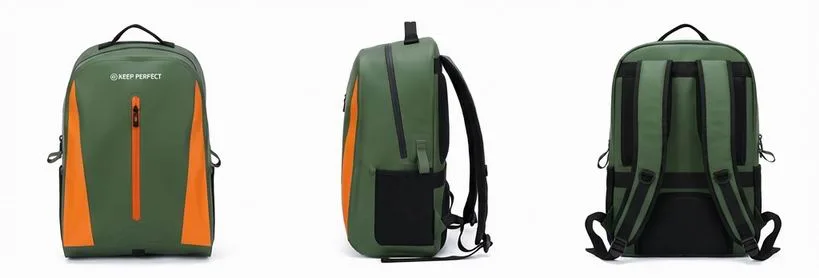
Print area on a welded bag is smaller than on a sewn one because the panel is curved and the weld line takes 20 mm at each edge. Ask the artwork team for a 3 mm bleed and keep critical detail 25 mm clear of any weld. Logos placed across a fold line crack within a season, a point covered in more depth in the logo placement guide.
For programmes with more than one colourway, specify the range as a list on the sheet rather than as attached artwork. A named list with references survives an eighteen-month gap between orders; an email attachment with a JPEG does not. The mechanics of keeping a set consistent are set out in the colour matching guide.
Photography and line drawings that agree with the numbers
Images are part of the specification, because a buyer will measure the photograph against the table. Provide a hero shot with a scale reference, a second shot of the mouth open so the closure is visible, and a third of the bag packed to its stated usable volume. Any image that contradicts the numbers creates doubt about all of them.
The line drawing should carry dimension callouts that match the table to the millimetre, state whether the bag is shown empty or filled, and include the rolled height as a separate dimension. A drawing at 1:10 with six callouts resolves more questions in a single email than three paragraphs of description, and it gives the buyer something to circle when they request a change.
Compliance fields buyers ask for before price
Compliance questions arrive earlier every season. A REACH statement covering the SVHC candidate list, a Prop 65 position for California, and a food-contact declaration where a bag will carry food are now standard requests on European and North American programmes. Stating the position on the sheet prevents the question becoming a week-long delay at approval stage.
Documentation should name the laboratory, the report number and the date. A buyer can verify a dated report from a named laboratory in minutes; an undated in-house certificate costs both sides a week. Where a programme is aimed at children, add the relevant toy-safety or textile declaration to the same block rather than answering it later by email.
Two related guides cover the detail if a buyer pushes on either point: REACH compliance for dry bags and Prop 65 considerations. Linking to them from your own documentation, or simply mirroring their structure in a compliance appendix, keeps the conversation on evidence rather than opinion.
Packing, carton and freight data
Carton data decides landed cost, and it is the block most often left to the last minute. Pieces per carton, carton dimensions, gross weight and container loading are four numbers a buyer plugs straight into a margin calculation. Getting them right at sample stage avoids the awkward discovery that a 5% fabric change has pushed a container load from 8,800 pieces to 8,200.
| Carton field | Worked example | Why the buyer needs it |
|---|---|---|
| Pieces per carton | 40 pieces | Order quantities and warehouse picking |
| Carton size | 600 x 400 x 350 mm | Pallet configuration and racking |
| Gross weight | 12.4 kg | Manual handling limits, often 15 kg |
| Volumetric weight | 14.0 kg at 167 kg/m3 | Air freight billing, usually the higher figure |
| 20 ft container | 8,800 pieces | Landed cost per unit |
| Unit packing | Recycled paper wrap, no polybag | Retail sustainability commitments |
Volumetric weight is the trap. A carton of soft bags is mostly air, so a 12.4 kg carton can bill as 14 kg on air freight, and that 12% difference is often the margin on a first order. State both figures and let the buyer plan. If the programme ships by sea, give the container quantity for 20 ft and 40 ft high cube and say whether the bags are flat packed or nested.

Revision control: the version block nobody thanks you for
Every sheet needs a version number, a date and a column recording what changed since the previous issue. This is unglamorous and it is the single field that prevents the most expensive error in the whole process: a bulk run built to a drawing that was never approved. When a sample is signed off, the version number on the sheet becomes the reference on the golden sample tag.
Changes propagate further than people expect. Moving from 0.45 mm to 0.50 mm film adds about 40 g to a 20L bag, which adds 1.6 kg to a 40-piece carton and shifts the container quantity down. Recording the change in a version block means the carton data, the weight claim and the packing list all get updated in the same pass instead of drifting apart across three documents.
Mistakes that make a sheet unreadable
- Listing 28 fields with no tolerance on any of them.
- Quoting denier without grams per square metre, or film thickness with no unit.
- Using the word waterproof with no standard, method, duration or date.
- Publishing nominal volume but never stating usable volume after rolling.
- Photographs that show a bag packed well beyond its stated capacity.
- Colour references with no substrate and no tolerance.
- Carton data missing, so landed cost cannot be calculated.
- No version block, so nobody can tell which drawing was approved.
- Hardware listed by appearance rather than material and rating.
Putting this together is a documentation job as much as a product job, and the programmes that move fastest are the ones where the brief, the sample report and the sheet all use the same twelve field names. Our own team has produced waterproof bags since 2014 in an SGS-verified 4,950 m2 facility, working to a 500-piece minimum with sampling in 6 to 10 working days and bulk in 35 to 50 days.
If you are rebuilding an existing sheet, start with the fields in the second table, then work outward to colour, carton and version control. The guide to reading a spec sheet approaches the same twelve fields from the buyer side, which is a useful cross-check before you send anything out; quality signals in a sample and red flags in listings cover what happens when the sheet and the product disagree. The full specification set for every size sits in the product line, and background terminology is in the academy.
Frequently asked questions
Q1. What should a dry bag spec sheet include?
Twelve verifiable lines: nominal and usable volume, rolled height, film thickness, face fabric in denier and gsm, seam type and weld width, closure folds, hardware rating, test standard with date, colour reference, carton data and a version block. Each line needs a tolerance.
Q2. Why does usable volume matter more than nominal volume?
A roll-top closure consumes 70 to 110 mm of height, so a 20L bag delivers roughly 16.5 litres. Buyers plan kit lists against usable volume and compare value against usable volume, which makes the smaller number the one that decides the sale.
Q3. What is the difference between denier and grams per square metre?
Denier describes the thickness of the yarn in the woven face fabric; grams per square metre is the mass of the finished laminate including film and adhesive. Two bags with the same denier can differ by 90 gsm, so gsm is the honest comparison.
Q4. How should a waterproof claim be written?
Name the standard, the method, the duration and the date. "IPX7 per IEC 60529, 30 minutes at 1 m, report dated March 2026" is checkable; "waterproof" is an adjective and settles nothing if a delivery is disputed.
Q5. Should the sheet state the seam joining method?
Yes. Taped, glued and welded seams all hide behind the phrase sealed seams and perform differently under pressure. State the method, the weld width and the percentage of seams covered by it, typically 20 mm and 100%.
Q6. What tolerance is reasonable on volume?
About +/- 3% is normal for a welded roll-top bag. Stating a tolerance turns a borderline delivery into a measurement rather than an argument, and it protects both sides when a fabric change alters the finished dimensions slightly.
Q7. Do I need carton data on a product spec sheet?
Yes, because it decides landed cost. Pieces per carton, carton dimensions, gross weight, volumetric weight and container loading are the four or five numbers a buyer uses to calculate margin before replying to a quotation.
Q8. What colour information belongs on the sheet?
The Pantone or RAL reference, the substrate the reference was matched on, and an acceptable delta E, usually 1.5 or better. Film and woven face take colour differently, so the substrate note prevents a visible mismatch on welded panels.
Q9. How much print area does a welded bag really have?
Less than a sewn bag. Welds claim about 20 mm at each panel edge and the panel is curved, so keep critical detail 25 mm clear of any weld, allow a 3 mm bleed and avoid placing artwork across a fold line.
Q10. Why is a version block worth the space?
Because it prevents a bulk run being built to a drawing nobody approved. A version number, a date and a changed-fields column give the golden sample a traceable reference and keep weight, carton and packing data in sync.
Q11. Should hardware ratings appear on the sheet?
Yes, for every load-bearing part. State material, size and static rating: a 25 mm acetal cam buckle at 90 kg static, a welded D-ring patch tested to 120 kg pull. Hardware is the most common first failure point on an otherwise sound bag.
Q12. What test standard covers immersion ratings?
IEC 60529 defines the IPX grades used across the industry. IPX7 covers 30 minutes at one metre, IPX6 covers powerful jets from a 12.5 mm nozzle, and IPX4 covers splashing. Naming the standard lets a buyer compare two sheets on identical terms.
Q13. How do I specify abrasion resistance?
Cite a method, not just a number. Martindale to ASTM D4966 at 20,000 cycles with an endpoint of no film loss and grade 4 appearance is a full specification; "20,000 cycles" alone is untestable because head, load and endpoint all change the result.
Q14. What compliance statements do buyers ask for?
A REACH position on the SVHC candidate list, a Prop 65 position for California, and a food-contact declaration where a bag will carry food. Name the laboratory, report number and date so the buyer can verify it quickly.
Q15. Should photographs be part of the specification?
Yes. Provide a hero shot with a scale reference, a shot of the open mouth so the closure is visible, and a shot packed to the stated usable volume. Images that contradict the numbers undermine every other field on the sheet.
Q16. How many fields should a spec sheet have?
About twelve on page one, with anything else in an appendix. A sheet with 28 lines reads like a sheet with no priorities, and the extra unverifiable fields dilute the ones a buyer can act on during an eight-second scan.
People also ask
How do you write a dry bag specification?
List twelve fields with a tolerance on each: nominal and usable volume, rolled height, film thickness, face fabric in denier and gsm, seam type and weld width, closure folds, hardware rating, test standard with date, colour reference, carton data and a version block.
What makes a spec sheet credible?
Numbers that can be checked on arrival. Named standards instead of adjectives, tolerances instead of single figures, dated third-party reports instead of in-house certificates, and photographs that agree with the dimension table.
Why do buyers reject dry bag spec sheets?
Usually for missing evidence or internal inconsistency: a waterproof claim with no standard, a stated volume the dimensions cannot produce, or carton data absent so landed cost stays unknown.
Is grams per square metre better than denier?
For comparison, yes. Denier only describes the face yarn, while gsm captures the whole laminate including film and adhesive, so it is the figure that correlates with puncture resistance, weight and durability.
How much volume does a roll-top closure cost?
Three folds remove 70 to 110 mm of height depending on size, so a 5L bag delivers about 3.8 litres, a 10L about 8.1 and a 20L about 16.5. Always publish both nominal and usable figures.
What should a golden sample reference contain?
The version number of the approved spec sheet, the date of approval, and the signed sample itself. Together they let an inspector settle any bulk question by comparing the delivery against a physical reference rather than an email.
Need this in production volume?
QUANZHOU JUNYUAN BAGS has produced waterproof bags since 2014 in an SGS-verified 4,950 m2 facility in Fujian, China. Minimum order 500 pieces, sampling in 6–10 working days, bulk in 35–50 days, FOB Xiamen — write to service@junyuanbags.com with your spec and target market.